Recognition: 2 theorem links
· Lean TheoremAltermagnons at the metal-insulator transition
Pith reviewed 2026-05-13 00:57 UTC · model grok-4.3
The pith
Altermagnetic magnons cross over from chirality-selective dissipation to coherent but deformed branches at the metal-insulator transition.
A machine-rendered reading of the paper's core claim, the machinery that carries it, and where it could break.
Core claim
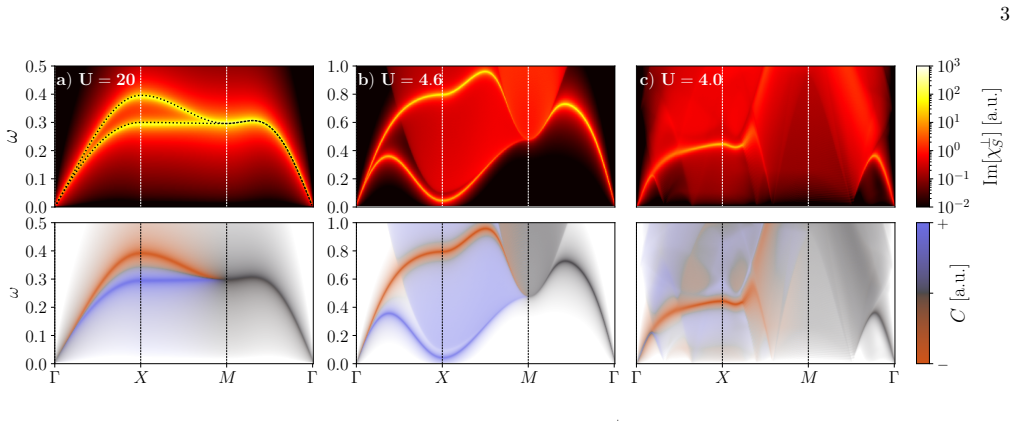
By means of slave-boson theory for the Hubbard model on the checkerboard lattice, we calculate dynamical altermagnetic spin susceptibilities from the metallic to the Mott-insulating regime. We track magnon dispersion and lifetime renormalization, allowing us to uncover a crossover from a chirality-selective dissipation of magnon modes to coherent yet strongly deformed chiral magnon branches across the metal insulator transition. Our formalism lends itself to a quantitative description of collective spin dynamics in correlated altermagnets.
What carries the argument
Dynamical altermagnetic spin susceptibilities obtained from slave-boson theory on the checkerboard Hubbard model, with explicit tracking of magnon dispersion and lifetime renormalization.
If this is right
- Magnon lifetimes become independent of chirality once the system enters the Mott insulator.
- Chiral magnon branches remain coherent but strongly renormalized in dispersion across the transition.
- The same formalism yields quantitative predictions for spin dynamics in other correlated altermagnets.
- Doping or pressure tuning near the transition can switch the dominant magnon damping mechanism.
Where Pith is reading between the lines
- Altermagnetic order can survive the metal-insulator transition while its excitations undergo a qualitative change in coherence.
- Similar crossovers may appear in other lattices or models once altermagnetism is combined with strong correlations.
- The deformed coherent branches could be detected as broadened or shifted peaks in momentum-resolved spin probes.
- The approach opens a path to engineering magnon transport or lifetime in devices that exploit altermagnetic order.
Load-bearing premise
The slave-boson approximation remains quantitatively reliable for dynamical spin susceptibilities throughout the metallic, critical, and Mott-insulating regimes of the checkerboard Hubbard model.
What would settle it
A neutron-scattering or resonant inelastic X-ray measurement of magnon dispersion and damping in a material described by the checkerboard Hubbard model near its metal-insulator transition that shows no change from chirality-selective lifetimes to uniformly coherent yet deformed branches.
Figures


read the original abstract
By means of slave-boson theory for the Hubbard model on the checkerboard lattice, we calculate dynamical altermagnetic spin susceptibilities from the metallic to the Mott-insulating regime. We track magnon dispersion and lifetime renormalization, allowing us to uncover a crossover from a chirality-selective dissipation of magnon modes to coherent yet strongly deformed chiral magnon branches across the metal insulator transition. Our formalism lends itself to a quantitative description of collective spin dynamics in correlated altermagnets.
Editorial analysis
A structured set of objections, weighed in public.
Referee Report
Summary. Using slave-boson theory for the Hubbard model on the checkerboard lattice, the authors calculate dynamical altermagnetic spin susceptibilities from the metallic to the Mott-insulating regime. They track magnon dispersion and lifetime renormalization to uncover a crossover from chirality-selective dissipation of magnon modes to coherent yet strongly deformed chiral magnon branches across the metal-insulator transition. The formalism is presented as suitable for quantitative description of collective spin dynamics in correlated altermagnets.
Significance. If the calculations prove robust, the work would provide a useful extension of altermagnon theory into the strongly correlated regime, offering a framework to connect itinerant and localized spin dynamics near the Mott transition and potentially aiding interpretation of experiments on correlated altermagnets.
Simulated Author's Rebuttal
We thank the referee for their summary of our manuscript. We appreciate the recognition that the work could offer a useful extension of altermagnon theory into the strongly correlated regime and a framework connecting itinerant and localized spin dynamics near the Mott transition. No specific major comments were listed in the report, and the recommendation is given as uncertain without elaboration on the sources of uncertainty. We address this overall assessment below.
read point-by-point responses
-
Referee: No specific major comments provided; recommendation uncertain
Authors: We maintain that the slave-boson calculations on the checkerboard Hubbard model provide a controlled description of the crossover from chirality-selective dissipation of altermagnon modes in the metallic regime to coherent yet strongly deformed chiral branches in the Mott insulator. This follows directly from computing the dynamical spin susceptibility and tracking the renormalization of magnon dispersion and lifetime across the transition. The formalism is an established extension of prior slave-boson treatments of the Hubbard model and is presented as suitable for quantitative studies of collective modes in correlated altermagnets. If the referee has particular concerns about robustness (for example, limitations of the slave-boson approximation or the choice of lattice), we are prepared to supply additional technical details or perform further checks in a revision. revision: no
Circularity Check
No significant circularity identified
full rationale
The available abstract describes application of the established slave-boson formalism to the standard checkerboard Hubbard model for computing dynamical altermagnetic spin susceptibilities and tracking magnon dispersion/lifetime renormalization across the metal-insulator transition. No equations, parameter fits, self-citations, or derivation steps are provided that would allow any reduction of the reported crossover to a fitted input or definitional tautology. The central claim therefore remains independent of the paper's own inputs and is self-contained against external benchmarks.
Axiom & Free-Parameter Ledger
axioms (1)
- domain assumption Slave-boson theory provides a quantitatively useful approximation to the dynamical spin susceptibility of the Hubbard model on the checkerboard lattice from metallic to Mott-insulating regimes.
Lean theorems connected to this paper
-
IndisputableMonolith/Cost/FunctionalEquation.leanwashburn_uniqueness_aczel unclearBy means of slave-boson theory for the Hubbard model on the checkerboard lattice, we calculate dynamical altermagnetic spin susceptibilities... crossover from a chirality-selective dissipation of magnon modes to coherent yet strongly deformed chiral magnon branches
-
IndisputableMonolith/Foundation/ArrowOfTime.leanforward_accumulates unclearThe resulting fluctuation propagator encodes the dynamical response, such that static and dynamical susceptibilities are computed from the corresponding slave-boson fluctuation correlators
Reference graph
Works this paper leans on
-
[1]
I. ˇZuti´ c, J. Fabian, and S. Das Sarma, Spintronics: Fun- damentals and applications, Rev. Mod. Phys.76, 323 (2004)
work page 2004
- [2]
-
[3]
B. Lenk, H. Ulrichs, F. Garbs, and M. M¨ unzenberg, The building blocks of magnonics, Physics Reports507, 107 (2011)
work page 2011
-
[4]
H. Yu, O. d’ Allivy Kelly, V. Cros, R. Bernard, P. Bortolotti, A. Anane, F. Brandl, F. Heimbach, and D. Grundler, Approaching soft X-ray wavelengths in nanomagnet-based microwave technology, Nature Com- munications7, 11255 (2016)
work page 2016
-
[5]
B. Flebus, D. Grundler, B. Rana, Y. Otani, I. Bar- sukov, A. Barman, G. Gubbiotti, P. Landeros, J. Aker- man, U. Ebels, P. Pirro, V. E. Demidov, K. Schultheiss, G. Csaba, Q. Wang, F. Ciubotaru, D. E. Nikonov, P. Che, R. Hertel, T. Ono, D. Afanasiev, J. Mentink, T. Rasing, B. Hillebrands, S. V. Kusminskiy, W. Zhang, C. R. Du, A. Finco, T. van der Sar, Y. K...
work page 2024
-
[6]
Y. Xie, D. Wang, C. Li, X. Shen, and J. Zhang, A general theory of chiral splitting of magnons in two-dimensional magnets (2026)
work page 2026
- [7]
-
[8]
A. Chumak, A. Serga, M. Jungfleisch, R. Neb, D. Bozhko, V. Tiberkevich, and B. Hillebrands, Di- rect detection of magnon spin transport by the in- verse spin hall effect, Applied Physics Letters100, https://doi.org/10.1063/1.3689787 (2012)
-
[9]
L. ˇSmejkal, J. Sinova, and T. Jungwirth, Emerging re- search landscape of altermagnetism, Phys. Rev. X12, 6 040501 (2022)
work page 2022
-
[10]
L. ˇSmejkal, A. Marmodoro, K.-H. Ahn, R. Gonz´ alez- Hern´ andez, I. Turek, S. Mankovsky, H. Ebert, S. W. D’Souza, O. c. v. ˇSipr, J. Sinova, and T. c. v. Jungwirth, Chiral magnons in altermagnetic ruo 2, Phys. Rev. Lett. 131, 256703 (2023)
work page 2023
-
[11]
Z. Liu, M. Ozeki, S. Asai, S. Itoh, and T. Masuda, Chiral split magnon in altermagnetic mnte, Phys. Rev. Lett. 133, 156702 (2024)
work page 2024
-
[12]
W. F. Brinkman and R. J. Elliott, Theory of spin-space groups, Proceedings of the Royal Society of London. Se- ries A. Mathematical and Physical Sciences294, 343 (1966)
work page 1966
-
[13]
D. B. Litvin and W. Opechowski, Magnetic space groups, Physica76, 538 (1974)
work page 1974
-
[14]
M. Roig, A. Kreisel, Y. Yu, B. M. Andersen, and D. F. Agterberg, Minimal models for altermagnetism, Phys. Rev. B110, 144412 (2024)
work page 2024
-
[15]
Y. Guo, H. Liu, O. Janson, I. C. Fulga, J. van den Brink, and J. I. Facio, Spin-split collinear antiferromagnets: A large-scale ab-initio study, Materials Today Physics32, 100991 (2023)
work page 2023
-
[16]
Z. Feng, X. Zhou, L. ˇSmejkal, L. Wu, Z. Zhu, H. Guo, R. Gonz´ alez-Hern´ andez, X. Wang, H. Yan, P. Qin, X. Zhang, H. Wu, H. Chen, Z. Meng, L. Liu, Z. Xia, J. Sinova, T. Jungwirth, and Z. Liu, An anomalous hall effect in altermagnetic ruthenium dioxide, Nature Elec- tronics5, 735 (2022)
work page 2022
-
[17]
R. D. Gonzalez Betancourt, J. Zub´ aˇ c, R. Gonzalez- Hernandez, K. Geishendorf, Z. ˇSob´ aˇ n, G. Springholz, K. Olejn´ ık, L.ˇSmejkal, J. Sinova, T. Jungwirth, S. T. B. Goennenwein, A. Thomas, H. Reichlov´ a, J.ˇZelezn´ y, and D. Kriegner, Spontaneous Anomalous Hall Effect Arising from an Unconventional Compensated Magnetic Phase in a Semiconductor, Phy...
work page 2023
-
[18]
S. Reimers, L. Odenbreit, L. ˇSmejkal, V. N. Strocov, P. Constantinou, A. B. Hellenes, R. Jaeschke Ubiergo, W. H. Campos, V. K. Bharadwaj, A. Chakraborty, T. Denneulin, W. Shi, R. E. Dunin-Borkowski, S. Das, M. Kl¨ aui, J. Sinova, and M. Jourdan, Direct observation of altermagnetic band splitting in CrSb thin films, Nature Communications15, 2116 (2024)
work page 2024
-
[19]
J. Krempask´ y, L. ˇSmejkal, S. W. D’Souza, M. Ha- jlaoui, G. Springholz, K. Uhl´ ıˇ rov´ a, F. Alarab, P. C. Constantinou, V. Strocov, D. Usanov, W. R. Pudelko, R. Gonz´ alez-Hern´ andez, A. Birk Hellenes, Z. Jansa, H. Reichlov´ a, Z. ˇSob´ aˇ n, R. D. Gonzalez Betancourt, P. Wadley, J. Sinova, D. Kriegner, J. Min´ ar, J. H. Dil, and T. Jungwirth, Alterm...
work page 2024
-
[20]
A. Bose, N. J. Schreiber, R. Jain, D.-F. Shao, H. P. Nair, J. Sun, X. S. Zhang, D. A. Muller, E. Y. Tsymbal, D. G. Schlom, and D. C. Ralph, Tilted spin current generated by the collinear antiferromagnet ruthenium dioxide, Na- ture Electronics5, 267 (2022)
work page 2022
-
[21]
X. Zhou, W. Feng, R.-W. Zhang, L. ˇSmejkal, J. Sinova, Y. Mokrousov, and Y. Yao, Crystal thermal transport in altermagnetic ruo2, Phys. Rev. Lett.132, 056701 (2024)
work page 2024
-
[22]
T. Tschirner, P. Keßler, R. D. Gonzalez Betancourt, T. Kotte, D. Kriegner, B. B¨ uchner, J. Dufouleur, M. Kamp, V. Jovic, L. ˇSmejkal, J. Sinova, R. Claessen, T. Jungwirth, S. Moser, H. Reichlova, and L. Veyrat, Saturation of the anomalous hall effect at high magnetic fields in altermagnetic ruo 2, APL Materials11, 101103 (2023)
work page 2023
-
[23]
O. Fedchenko, J. Min´ ar, A. Akashdeep, S. W. D’Souza, D. Vasilyev, O. Tkach, L. Odenbreit, Q. Nguyen, D. Kut- nyakhov, N. Wind, L. Wenthaus, M. Scholz, K. Ross- nagel, M. Hoesch, M. Aeschlimann, B. Stadtm¨ uller, M. Kl¨ aui, G. Sch¨ onhense, T. Jungwirth, A. B. Hellenes, G. Jakob, L. ˇSmejkal, J. Sinova, and H.-J. Elmers, Ob- servation of time-reversal s...
work page 2024
-
[24]
J. Liu, J. Zhan, T. Li, J. Liu, S. Cheng, Y. Shi, L. Deng, M. Zhang, C. Li, J. Ding, Q. Jiang, M. Ye, Z. Liu, Z. Jiang, S. Wang, Q. Li, Y. Xie, Y. Wang, S. Qiao, J. Wen, Y. Sun, and D. Shen, Absence of altermagnetic spin splitting character in rutile oxide ruo 2, Phys. Rev. Lett.133, 176401 (2024)
work page 2024
-
[25]
D. T. Plouff, L. Scheuer, S. Shrestha, W. Wu, N. J. Parvez, S. Bhatt, X. Wang, L. Gundlach, M. B. Jungfleisch, and J. Q. Xiao, Revisiting altermagnetism in ruo2: a study of laser-pulse induced charge dynamics by time-domain terahertz spectroscopy, npj Spintronics 3, 17 (2025)
work page 2025
-
[26]
M. Hiraishi, H. Okabe, A. Koda, R. Kadono, T. Muroi, D. Hirai, and Z. Hiroi, Nonmagnetic ground state in ruo2 revealed by muon spin rotation, Phys. Rev. Lett.132, 166702 (2024)
work page 2024
-
[27]
P. Keßler, L. Garcia-Gassull, A. Suter, T. Prokscha, Z. Salman, D. Khalyavin, P. Manuel, F. Orlandi, I. I. Mazin, R. Valentı, and S. Moser, Absence of magnetic or- der in ruo 2: insights fromµsr spectroscopy and neutron diffraction (2024), arXiv:2405.10820 [cond-mat.mtrl-sci]
- [28]
-
[29]
B. Bradlyn, L. Elcoro, J. Cano, M. G. Vergniory, Z. Wang, C. Felser, M. I. Aroyo, and B. A. Bernevig, Topological quantum chemistry, Nature547, 298 (2017)
work page 2017
-
[30]
D. Di Sante, A. Hausoel, P. Barone, J. M. Tomczak, G. Sangiovanni, and R. Thomale, Realizing double dirac particles in the presence of electronic interactions, Phys. Rev. B96, 121106(R) (2017)
work page 2017
- [31]
- [32]
-
[33]
P. Das, V. Leeb, J. Knolle, and M. Knap, Realizing al- termagnetism in fermi-hubbard models with ultracold atoms, Physical Review Letters132, 263402 (2024)
work page 2024
-
[34]
Del Re, Dirac points and topological phases in corre- lated altermagnets, Phys
L. Del Re, Dirac points and topological phases in corre- lated altermagnets, Phys. Rev. Res.7, 033234 (2025)
work page 2025
-
[35]
V. Leeb, A. Mook, L. ˇSmejkal, and J. Knolle, Sponta- neous formation of altermagnetism from orbital ordering, Phys. Rev. Lett.132, 236701 (2024)
work page 2024
- [36]
-
[37]
M. D¨ urrnagel, H. Hohmann, A. Maity, J. Seufert, M. Klett, L. Klebl, and R. Thomale, Altermagnetic phase transition in a lieb metal, Phys. Rev. Lett.135, 036502 7 (2025)
work page 2025
- [38]
-
[39]
M. D¨ urrnagel, L. Klebl, T. M¨ uller, R. Thomale, and M. Klett, Extended s-wave altermagnets (2026), arXiv:2508.20163 [cond-mat.str-el]
work page internal anchor Pith review arXiv 2026
-
[40]
T. Li, P. W¨ olfle, and P. J. Hirschfeld, Spin-rotation- invariant slave-boson approach to the Hubbard model, Physical Review B40, 6817 (1989)
work page 1989
-
[41]
D. Riegler, M. Klett, T. Neupert, R. Thomale, and P. W¨ olfle, Slave-boson analysis of the two-dimensional Hubbard model, Physical Review B101, 235137 (2020)
work page 2020
-
[42]
D. Riegler, J. Seufert, E. H. da Silva Neto, P. W¨ olfle, R. Thomale, and M. Klett, Interplay of spin and charge order in the electron-doped cuprates, Phys. Rev. B108, 195141 (2023)
work page 2023
- [43]
-
[44]
F. Ferrari and R. Valent´ ı, Altermagnetism on the shastry- sutherland lattice, Phys. Rev. B110, 205140 (2024)
work page 2024
-
[45]
A. Georges, G. Kotliar, W. Krauth, and M. J. Rozen- berg, Dynamical mean-field theory of strongly correlated fermion systems and the limit of infinite dimensions, Re- views of Modern Physics68, 13 (1996)
work page 1996
-
[46]
M. Wallerberger, A. Hausoel, P. Gunacker, A. Kowal- ski, N. Parragh, F. Goth, K. Held, and G. Sangiovanni, w2dynamics: Local one- and two-particle quantities from dynamical mean field theory, Computer Physics Commu- nications235, 388 (2019)
work page 2019
-
[47]
F. Garcia-Gaitan, A. Kefayati, J. Q. Xiao, and B. K. Nikoli´ c, Magnon spectrum of altermagnets beyond linear spin wave theory: Magnon-magnon interactions via time- dependent matrix product states versus atomistic spin dynamics, Phys. Rev. B111, L020407 (2025)
work page 2025
- [48]
- [49]
-
[50]
X. Wang, R. Moessner, and D. Chowdhury, Interaction- mitigated landau damping, Physical Review B109, L121102 (2024)
work page 2024
-
[51]
B. Gaveau and L. Schulman, Limited quantum decay, Journal of Physics A: Mathematical and General28, 7359 (1995)
work page 1995
-
[52]
R. Eto, M. Gohlke, J. Sinova, M. Mochizuki, A. L. Chernyshev, and A. Mook, Spontaneous magnon decays from nonrelativistic time-reversal symmetry breaking in altermagnets, Phys. Rev. B112, 094442 (2025)
work page 2025
-
[53]
R. Verresen, R. Moessner, and F. Pollmann, Avoided quasiparticle decay from strong quantum interactions, Nature Physics15, 750 (2019)
work page 2019
-
[54]
K. W. Plumb, K. Hwang, Y. Qiu, L. W. Harriger, G. Granroth, A. I. Kolesnikov, G. Shu, F. Chou, C. R¨ uegg, Y. B. Kim,et al., Quasiparticle-continuum level repulsion in a quantum magnet, Nature Physics12, 224 (2016)
work page 2016
- [55]
-
[56]
Y. Wang, D. Zhu, Y. Yang, K. Lee, R. Mishra, G. Go, S.- H. Oh, D.-H. Kim, K. Cai, E. Liu, S. D. Pollard, S. Shi, J. Lee, K. L. Teo, Y. Wu, K.-J. Lee, and H. Yang, Mag- netization switching by magnon-mediated spin torque through an antiferromagnetic insulator, Science366, 1125 (2019)
work page 2019
-
[57]
W.-Y. Choi, J.-H. Ha, M.-S. Jung, S. B. Kim, H. C. Koo, O. Lee, B.-C. Min, H. Jang, A. Shahee, J.-W. Kim, et al., Magnetization switching driven by magnonic spin dissipation, Nature Communications16, 5859 (2025)
work page 2025
-
[58]
G. Kotliar and A. E. Ruckenstein, New functional inte- gral approach to strongly correlated fermi systems: The gutzwiller approximation as a saddle point, Phys. Rev. Lett.57, 1362 (1986)
work page 1986
-
[59]
R. Fr´ esard and P. W¨ olfle, Unified slave boson represen- tation of spin and charge degrees of freedom for strongly correlated fermi systems, International Journal of Mod- ern Physics B06, 685 (1992)
work page 1992
-
[60]
J. Seufert, D. Riegler, M. Klett, R. Thomale, and P. W¨ olfle, Breakdown of charge homogeneity in the two- dimensional hubbard model: Slave-boson study of mag- netic order, Phys. Rev. B103, 165117 (2021)
work page 2021
-
[61]
S. K. O’Leary and S. M. Malik, A simplified joint den- sity of states analysis of hydrogenated amorphous silicon, Journal of applied physics92, 4276 (2002)
work page 2002
-
[62]
F. Orapunt and S. K. O’Leary, Optical transitions and the mobility edge in amorphous semiconductors: A joint density of states analysis, Journal of Applied Physics 104, 073513 (2008)
work page 2008
-
[63]
M. D¨ urrnagel, J. Beyer, R. Thomale, and T. Schwemmer, Unconventional superconductivity from weak coupling, The European Physical Journal B95, 112 (2022)
work page 2022
-
[64]
A. Smolyanyuk, I. I. Mazin, L. Garcia-Gassull, and R. Valent´ ı, Fragility of the magnetic order in the pro- totypical altermagnet ruo 2, Phys. Rev. B109, 134424 (2024). Supplemental Material: Altermagnons at the metal-insulator transition Jonas Issing,1,∗ Matteo D¨ urrnagel,1 Sarbajit Mazumdar, 1 Alena Lorenz,1 Niklas Witt,1 Giorgio Sangiovanni,1 Michael...
work page 2024
-
[65]
NNN contribution. S7 B. Magnon Spectrum S7 S4. Random phase approximation S8 S1. SPIN-ROTATIONALLY INVARIANT KOTLIAR-RUCKENSTEIN SLAVE-BOSONS A. Formalism To incorporate local correlation effects beyond Hartree–Fock, we employ the spin-rotation-invariant Kotliar– Ruckenstein slave-boson formalism [58, 59]. Therefore, we introduce six slave bosonsb † ∈ {e,...
-
[66]
NN contribution. From (S3.5), summing the number terms over all NN bonds, X ⟨ij⟩ a† i ai = X i∈A X j∈NN(i) 1 a† i ai =z 1 X i∈A a† i ai, z 1 = 4,(S3.8) and analogouslyP ⟨ij⟩ b† jbj = 4P j∈B b† jbj. Hence J1S X ⟨ij⟩ (a† i ai +b † jbj) = 4SJ1 X i∈A a† i ai + 4SJ1 X j∈B b† jbj = 4SJ1 X k (a† kak +b † kbk).(S3.9) We can write NN sites asj=i+δwithδ∈ {(±1,0),(0...
-
[67]
NNN contribution. From (S3.6), the diagonal onsite contribution on sublatticeAis −S X ⟨ ⟨ij⟩ ⟩⊂A Jij(a† i ai +a † jaj) =−S X i∈A a† i ai X j∈diag(i) Jij .(S3.14) For the checkerboard plaquette modulation we take: onAsites the two±(1,1) diagonals carryJ + and the two ±(1,−1) diagonals carryJ −, soP j∈diag(i) Jij = 2J+ + 2J−. Hence −S X ⟨ ⟨ij⟩ ⟩⊂A Jij(a† i ...
discussion (0)
Sign in with ORCID, Apple, or X to comment. Anyone can read and Pith papers without signing in.