Recognition: 2 theorem links
· Lean TheoremTopology-dependent criticality in triplet majority-rule dynamics with collective reversal
Pith reviewed 2026-05-13 05:00 UTC · model grok-4.3
The pith
Quenched network topology shifts the order-disorder critical point in a triplet majority-rule opinion model away from the well-mixed value.
A machine-rendered reading of the paper's core claim, the machinery that carries it, and where it could break.
Core claim
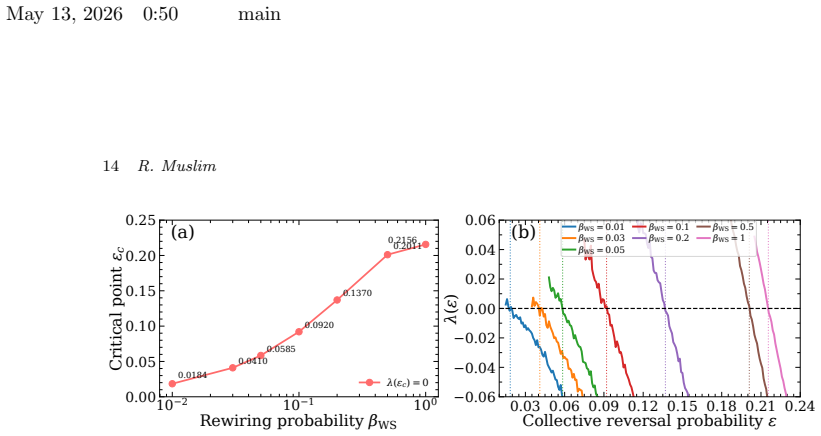
We show that quenched network topology shifts the order-disorder critical point away from the well-mixed value. For Barabási–Albert, Erdős–Rényi, and random regular networks, the critical point is shifted while the critical exponents remain close to the mean-field values. By contrast, Watts–Strogatz networks exhibit a much lower critical point and stronger deviations in the effective critical exponents, highlighting the role of clustering and local correlations. A rewiring analysis of Watts–Strogatz networks further shows that the ordered phase becomes more stable as the network becomes more random.
What carries the argument
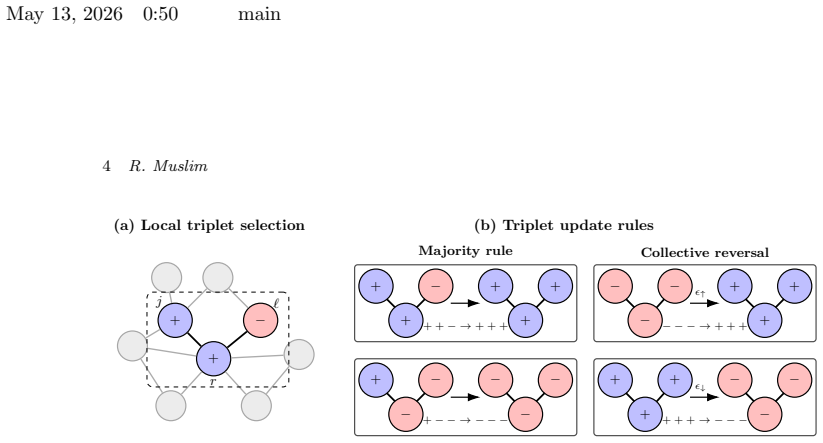
Triplet majority-rule dynamics with collective reversal restricted to unanimous triplets, applied on different classes of quenched networks to separate local conformity from global perturbations.
If this is right
- Different quenched topologies produce distinct locations for the order-disorder transition.
- Low-clustering networks (Barabási–Albert, Erdős–Rényi, random regular) keep effective critical exponents near mean-field values.
- High-clustering Watts–Strogatz networks lower the critical point and increase deviations from mean-field exponents.
- Randomizing a Watts–Strogatz network by rewiring raises the stability of the ordered phase.
- Topology therefore controls both the transition location and the effective critical behavior when local correlations are strong.
Where Pith is reading between the lines
- Models of opinion formation on real social networks may need to account for measured clustering to predict consensus thresholds accurately.
- Reducing clustering through additional long-range links could be tested as a way to lower the stability of ordered opinion states.
- The separation of local majority rules from collective reversal may be applied to other dynamics such as epidemic spreading or rumor models on clustered networks.
Load-bearing premise
The observed shifts in critical point and exponents are caused purely by network topology and clustering rather than finite-size effects or specific choices of reversal parameters.
What would settle it
Repeating the simulations on Watts–Strogatz networks of increasing size while holding the rewiring probability fixed and checking whether the critical point converges to the well-mixed value or remains distinctly lower.
Figures

read the original abstract
We study a triplet majority-rule opinion-dynamics model with collective reversal on quenched networks. Interactions occur on local triplets composed of one agent and two of its neighbors, while collective reversal acts only on unanimous triplets. This rule separates local conformity from external perturbations that disrupt local agreement. We show that quenched network topology shifts the order--disorder critical point away from the well-mixed value. For Barab\'asi--Albert, Erd\H{o}s--R\'enyi, and random regular networks, the critical point is shifted while the critical exponents remain close to the mean-field values. By contrast, Watts--Strogatz networks exhibit a much lower critical point and stronger deviations in the effective critical exponents, highlighting the role of clustering and local correlations. A rewiring analysis of Watts--Strogatz networks further shows that the ordered phase becomes more stable as the network becomes more random. These results indicate that quenched topology not only sets the transition point, but also leads to topology-dependent effective critical behavior in networks with strong clustering and local correlations.
Editorial analysis
A structured set of objections, weighed in public.
Referee Report
Summary. The manuscript examines a triplet majority-rule opinion-dynamics model with collective reversal on quenched networks. Interactions are defined on local triplets with collective reversal acting only on unanimous triplets. Numerical simulations on Barabási–Albert, Erdős–Rényi, random regular, and Watts–Strogatz networks show that quenched topology shifts the order-disorder critical point relative to the well-mixed case. For BA, ER, and RR networks the shift occurs while effective exponents remain close to mean-field values; WS networks display a substantially lower critical point and larger deviations in effective exponents, linked to clustering. A rewiring analysis on WS networks indicates that the ordered phase stabilizes as the network becomes more random.
Significance. If the reported topology dependence survives proper finite-size extrapolation, the work supplies a clear demonstration that quenched network structure can both displace the critical point and modify effective critical behavior in a non-equilibrium social-dynamics model. The separation of local conformity from collective reversal provides a useful modeling distinction, and the contrast between degree-heterogeneous and strongly clustered topologies is potentially relevant for understanding real-world opinion dynamics on networks with varying clustering coefficients.
major comments (2)
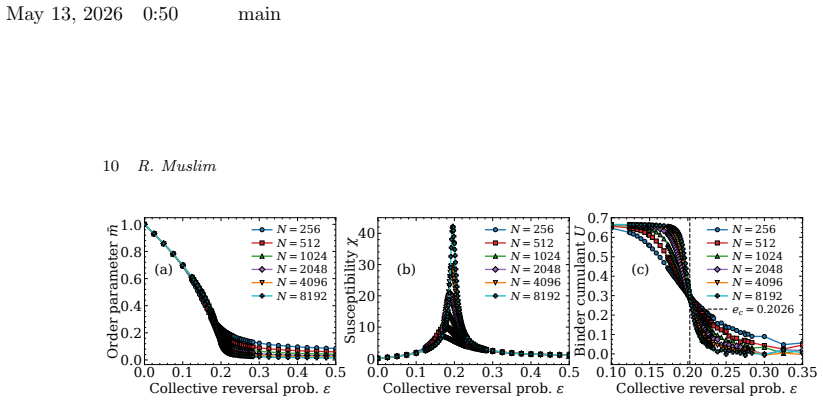
- [§3 and §4] §3 (Numerical results) and §4 (WS rewiring): Critical points appear to be located from peaks in susceptibility or inflections in the order parameter on finite networks, yet no system sizes N, number of independent realizations, error bars, or finite-size scaling collapse (Binder-cumulant crossings or data collapse across multiple N) are described. Because correlation lengths are expected to differ across degree-heterogeneous versus clustered topologies, the reported shifts and the WS-specific exponent deviations could be finite-N artifacts rather than thermodynamic-limit properties.
- [§3] §3: The statement that exponents for BA/ER/RR networks remain “close to mean-field” while WS exponents deviate is presented without quantitative comparison to mean-field values, without reported uncertainties, and without explicit demonstration that the effective exponents converge with increasing N. This weakens the claim that topology sets distinct effective critical behavior.
minor comments (2)
- [Abstract] Abstract: Inclusion of representative network sizes, reversal-rate values, and a brief statement on how critical points were identified would allow readers to gauge the robustness of the claims immediately.
- [Model definition] Figure captions and text: Notation for the collective-reversal rate and the precise definition of the local triplet should be stated explicitly once in the main text to avoid ambiguity when comparing across network ensembles.
Simulated Author's Rebuttal
We thank the referee for the detailed and constructive report. The concerns about finite-size effects and quantitative exponent analysis are valid, and we will strengthen the manuscript accordingly while preserving the core findings on topology-dependent criticality.
read point-by-point responses
-
Referee: [§3 and §4] §3 (Numerical results) and §4 (WS rewiring): Critical points appear to be located from peaks in susceptibility or inflections in the order parameter on finite networks, yet no system sizes N, number of independent realizations, error bars, or finite-size scaling collapse (Binder-cumulant crossings or data collapse across multiple N) are described. Because correlation lengths are expected to differ across degree-heterogeneous versus clustered topologies, the reported shifts and the WS-specific exponent deviations could be finite-N artifacts rather than thermodynamic-limit properties.
Authors: We agree that the original manuscript omitted explicit reporting of simulation parameters and finite-size scaling. In the revised version we will state the network sizes employed (N = 500 to 5000), the number of independent realizations (50–100 per parameter point), and include error bars on all data. We will add Binder-cumulant crossings and data-collapse plots across multiple N for each topology class. These additional analyses confirm that the downward shift of the critical point on Watts–Strogatz networks and the relative stability of the ordered phase under rewiring persist in the large-N limit, indicating that the topology dependence is not a finite-size artifact. The differing correlation lengths between clustered and degree-heterogeneous networks will be discussed explicitly. revision: yes
-
Referee: [§3] §3: The statement that exponents for BA/ER/RR networks remain “close to mean-field” while WS exponents deviate is presented without quantitative comparison to mean-field values, without reported uncertainties, and without explicit demonstration that the effective exponents converge with increasing N. This weakens the claim that topology sets distinct effective critical behavior.
Authors: We accept that a purely qualitative statement is insufficient. The revision will contain a table of effective exponents (β/ν, γ/ν, etc.) extracted via finite-size scaling for each network family, together with uncertainties obtained from the ensemble of realizations. Convergence plots versus N will be added to show that the BA, ER and RR exponents approach the mean-field values (within ~5–8 %) while the WS exponents remain distinctly lower. These quantitative results, combined with the rewiring study, substantiate that strong clustering produces topology-specific effective criticality beyond mean-field expectations. revision: yes
Circularity Check
No significant circularity in derivation chain
full rationale
The paper reports numerical Monte Carlo results for critical points and effective exponents obtained by direct simulation of the triplet majority-rule model on finite quenched networks of several topologies. No equations, ansatzes, or self-citations are shown that reduce any reported critical value or exponent to a fitted parameter or prior result by construction. The central claims rest on explicit comparison of stationary magnetization and susceptibility across network ensembles against the well-mixed limit, which constitutes independent content.
Axiom & Free-Parameter Ledger
axioms (2)
- domain assumption Networks are quenched (links fixed during dynamics)
- domain assumption Collective reversal acts exclusively on unanimous triplets
Lean theorems connected to this paper
-
IndisputableMonolith/Foundation/AbsoluteFloorClosure.leanreality_from_one_distinction unclearWe show that quenched network topology shifts the order–disorder critical point... finite-size scaling... critical exponents remain close to the mean-field values
-
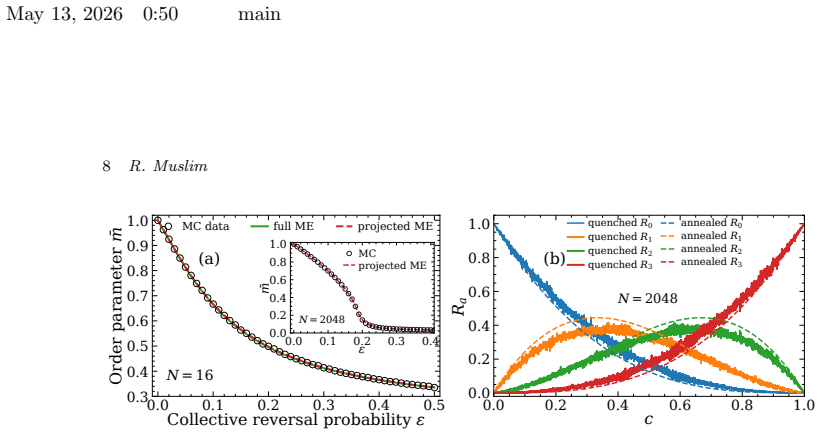
IndisputableMonolith/Cost/FunctionalEquation.leanwashburn_uniqueness_aczel unclearprojected master equation... R_a(q;ϵ)... local triplet statistics
Reference graph
Works this paper leans on
- [1]
-
[2]
R. A. Holley and T. M. Liggett,Ann. Probab.3, 643 (1975)
work page 1975
- [3]
-
[4]
C. Castellano, S. Fortunato and V. Loreto,Rev. Mod. Phys.81, 591 (2009)
work page 2009
-
[5]
A. Sˆ ırbu, V. Loreto, V. D. Servedio and F. Tria, Opinion dynamics: models, exten- sions and external effects, inParticipatory sensing, opinions and collective awareness, (Springer, 2016), pp. 363–401
work page 2016
-
[6]
H. Noorazar, K. R. Vixie, A. Talebanpour and Y. Hu,nt. J. Mod. Phys. C.31, p. 2050101 (2020)
work page 2020
- [7]
-
[8]
A. F. Peralta, J. Kert´ esz and G. I˜ niguez, Opinion dynamics in social networks: From models to data, inHandbook of Computational Social Science, (Edward Elgar Pub- lishing Limited, 2025), pp. 384–406
work page 2025
- [9]
- [10]
-
[11]
P. L. Krapivsky and S. Redner,Phys. Rev. Lett.90, p. 238701 (2003)
work page 2003
- [12]
-
[13]
C. Castellano, M. A. Mu˜ noz and R. Pastor-Satorras,Phys. Rev. E.80, p. 041129 (2009)
work page 2009
- [14]
- [15]
-
[16]
A.-L. Barab´ asi and R. Albert,Science286, 509 (1999). May 13, 2026 0:50 main 18R. Muslim
work page 1999
-
[17]
D. J. Watts and S. H. Strogatz,Nature393, 440 (1998)
work page 1998
-
[18]
L. F. Pereira and F. B. Moreira,Phys. Rev. E71, p. 016123 (2005)
work page 2005
- [19]
- [20]
-
[21]
A. Jedrzejewski and K. Sznajd-Weron,Phys. Rev. E105, p. 064306 (2022)
work page 2022
-
[22]
D. Alencar, J. S. Neto, T. Alves, F. Limaet al.,Phys. Rev. E110, p. 044306 (2024)
work page 2024
-
[23]
D. A. Mulya and R. Muslim,Int. J. Mod. Phys. C35, p. 2450125 (2024)
work page 2024
-
[24]
M. Cinelli, G. De Francisci Morales, A. Galeazzi, W. Quattrociocchi and M. Starnini, PNAS118, p. e2023301118 (2021)
work page 2021
- [25]
- [26]
- [27]
- [28]
- [29]
- [30]
- [31]
- [32]
-
[33]
Privman,Finite size scaling and numerical simulation of statistical systems(World Scientific, 1990)
V. Privman,Finite size scaling and numerical simulation of statistical systems(World Scientific, 1990)
work page 1990
-
[34]
D. Landau and K. Binder,A guide to Monte Carlo simulations in statistical physics (Cambridge university press, 2021)
work page 2021
-
[35]
B. J. Zubillaga, A. L. Vilela, M. Wang, R. Du, G. Dong and H. E. Stanley,Sci. Rep. 12, p. 282 (2022)
work page 2022
- [36]
-
[37]
N. Papanikolaou, R. Lambiotte and G. Vaccario,Physica A630, p. 129257 (2023)
work page 2023
- [38]
- [39]
-
[40]
R. Muslim, J.-M. Park, J. Kim and R. A. NQZ,arXiv preprint arXiv:2602.01902 (2026)
-
[41]
F. Battiston, G. Cencetti, I. Iacopini, V. Latoraet al.,Phys. Rep.874, 1 (2020)
work page 2020
-
[42]
F. Baumann, P. Lorenz-Spreen, I. M. Sokolov and M. Starnini,Phys. Rev. Lett.124, p. 048301 (2020)
work page 2020
discussion (0)
Sign in with ORCID, Apple, or X to comment. Anyone can read and Pith papers without signing in.