Recognition: 1 theorem link
· Lean TheoremStarspot activity and surface differential rotation on UX Arietis
Pith reviewed 2026-05-13 05:37 UTC · model grok-4.3
The pith
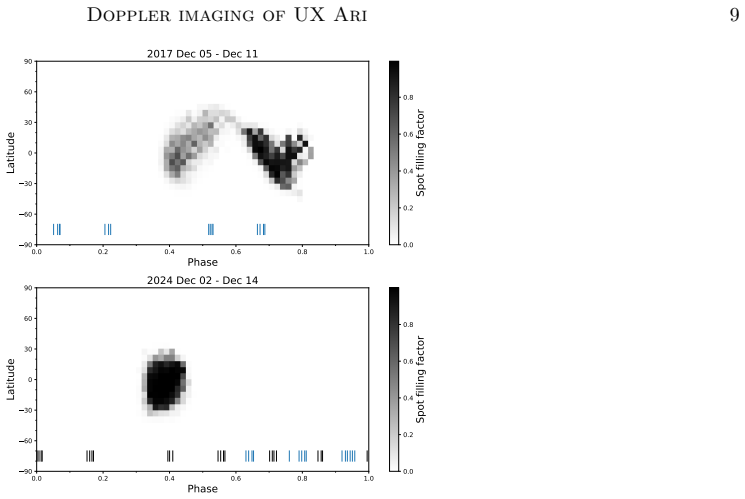
Doppler images of UX Arietis show dominant mid-to-high latitude starspots that shift by half a rotation period over seven years, together with weak anti-solar differential rotation whose equator is tidally locked to the binary orbit.
A machine-rendered reading of the paper's core claim, the machinery that carries it, and where it could break.
Core claim
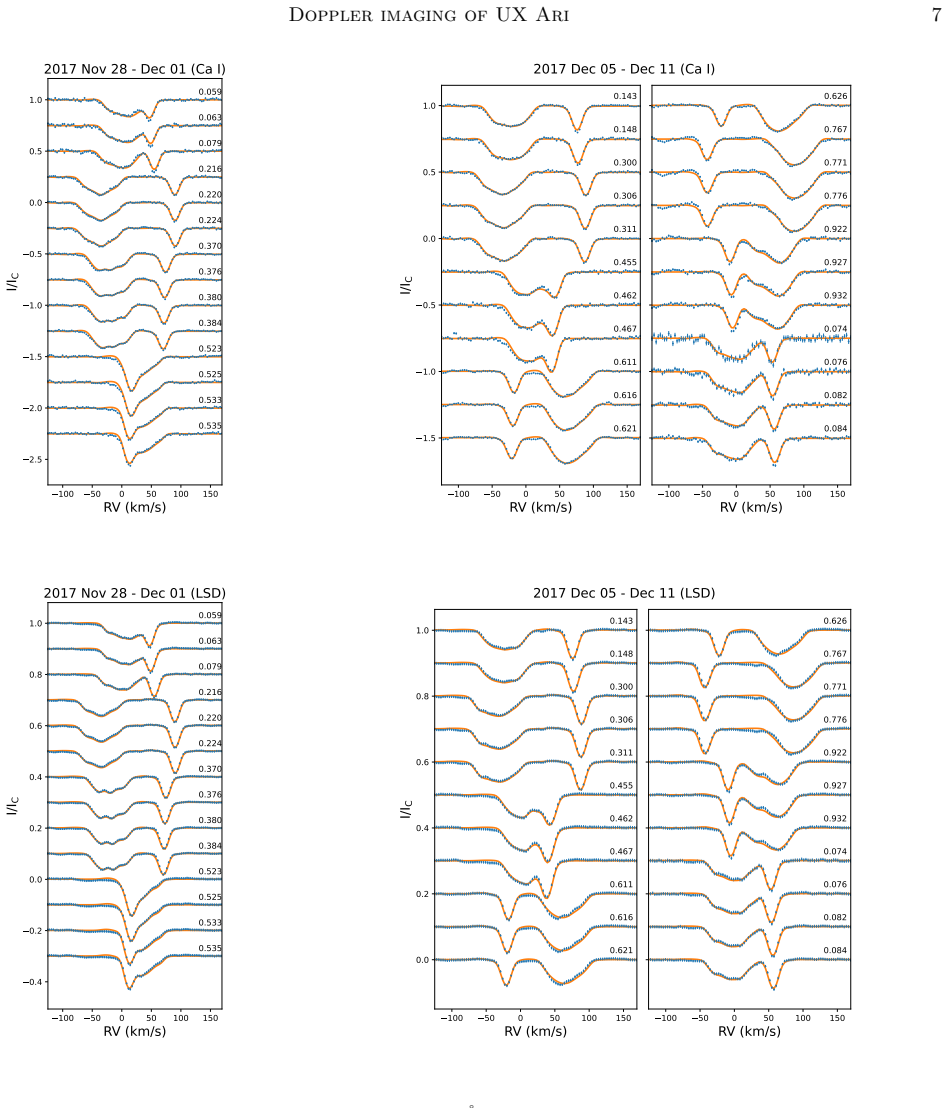
Using least-squares deconvolution profiles referenced to the stable Ca I 6439 Å line, the authors generate Doppler images that reveal persistent starspot activity concentrated at mid and high latitudes on the primary star. Cross-correlation of the 2017 and 2024 maps yields a small negative differential rotation coefficient, indicating weak anti-solar shear, while the equatorial zone rotates at the orbital period.
What carries the argument
Doppler imaging from LSD profiles calibrated to the Ca I 6439 Å reference line, followed by cross-correlation tracking of surface features to measure shear.
If this is right
- Starspot groups on the primary shift in rotational phase by about 0.5 between the 2017 and 2024 epochs.
- A prominent mid-latitude spot complex observed in late 2017 is spatially close to the location of a large flare detected half a month afterward.
- The equatorial belt rotates synchronously with the binary orbit even though higher latitudes exhibit anti-solar shear.
- Dominant activity remains at mid-to-high latitudes with appendages extending equatorward in both epochs.
Where Pith is reading between the lines
- The tidal locking of the equator may be a general signature of strong tidal interaction in short-period RS CVn systems that suppresses the usual solar-like differential rotation.
- Repeated Doppler imaging of similar binaries could test whether anti-solar shear becomes more pronounced as orbital period decreases.
- The unexplained rapid variations seen in some spectral lines but not in Ca I 6439 Å suggest additional atmospheric dynamics worth targeted follow-up.
Load-bearing premise
The Ca I 6439 Å line is unaffected by starspot activity and can serve as a clean reference for generating the LSD profiles.
What would settle it
Additional spectra or photometry that show the equatorial rotation period differing from the orbital period, or that demonstrate rapid line-profile changes in Ca I 6439 Å itself.
Figures





read the original abstract
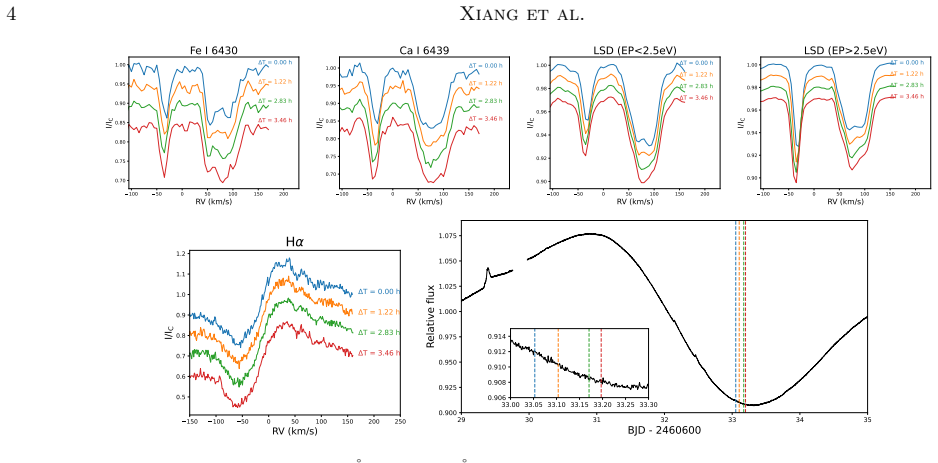
We present new Doppler images of the K0 subgiant primary component of the RS CVn-type binary UX Arietis (UX Ari), derived from time-series spectra obtained in November--December of 2017 and 2024. Observations demonstrate that some spectral lines of the K0 IV component exhibit rapid changes on timescales of 1-2 hours, which seem not to be resulting from spot activity, meanwhile other spectral lines show no such fast variations. Through an investigation, we find that the Ca I 6439 $\unicode{x212B}$ profile shows variation that follows the rotational modulation of spots. Using this line as a reference, we derive the least-squares deconvolution (LSD) profile from the selected lines of each spectrum so as to generate a more reliable Doppler image, which is consistent with the shape of the corresponding Ca I 6439 $\unicode{x212B}$ line. The Doppler images are separately reconstructed from the Ca I 6439 $\unicode{x212B}$ and the LSD profiles for each dataset, and the surface maps are in good agreement with each other. All of the surface maps show dominant starspot structure at mid-to-high latitudes with appendages extending to the equator, while their locations differ by about 0.5 in the rotational phase between 2017 and 2024. In 2017 November-December, the main starspot group appears to be spatially associated with a large flare event just half a month later. Through the cross-correlation method, we have derived a weak anti-solar differential rotation for the primary component of UX Ari, while its equator belt is well tidally locked.
Editorial analysis
A structured set of objections, weighed in public.
Referee Report
Summary. The manuscript presents new Doppler images of the K0 IV primary in the RS CVn binary UX Arietis from time-series spectra in 2017 and 2024. It notes rapid 1-2 hour variations in some K0 IV lines that appear unrelated to spots, uses the Ca I 6439 Å line (which follows rotational modulation) as reference to select lines for LSD profiles, reconstructs consistent surface maps from both Ca I and LSD data showing dominant mid-to-high latitude starspots with equatorial appendages, reports a ~0.5 rotational phase shift in spot locations between epochs, links a 2017 spot group to a subsequent flare, and derives a weak anti-solar differential rotation law (with tidally locked equator) via cross-correlation.
Significance. If the line-selection assumption and resulting maps hold, the work provides useful multi-epoch constraints on starspot distribution, evolution, and differential rotation in an active binary, including potential flare-spot associations. The reported consistency between Ca I and LSD maps is a methodological strength that supports the imaging results.
major comments (2)
- [Abstract] Abstract: The claim that rapid 1-2 hour variations in certain K0 IV lines 'seem not to be resulting from spot activity' is load-bearing for the line selection used to construct LSD profiles, the Doppler images, and the subsequent cross-correlation differential rotation measurement. No quantitative tests (e.g., phase-folding the variations against rotational phase, comparison to expected spot-crossing timescales, or chi-squared model comparisons with/without the fast-varying lines) are described to support this distinction or to rule out small-scale/dynamic spot contributions.
- [Abstract] Abstract: The differential rotation result (weak anti-solar law with tidally locked equator) is derived via cross-correlation, but the manuscript provides no details on the fitting procedure, error analysis, or validation (e.g., against synthetic data or alternative methods), which is required to assess whether the reported coefficients are robust or sensitive to the input maps.
minor comments (1)
- [Abstract] The abstract would benefit from specifying the number of spectra, spectral resolution, and wavelength coverage to allow readers to evaluate the data quality underlying the maps.
Simulated Author's Rebuttal
We thank the referee for their careful reading of the manuscript and for the constructive major comments. We address each point below and have revised the manuscript to incorporate the suggested additions and clarifications.
read point-by-point responses
-
Referee: [Abstract] Abstract: The claim that rapid 1-2 hour variations in certain K0 IV lines 'seem not to be resulting from spot activity' is load-bearing for the line selection used to construct LSD profiles, the Doppler images, and the subsequent cross-correlation differential rotation measurement. No quantitative tests (e.g., phase-folding the variations against rotational phase, comparison to expected spot-crossing timescales, or chi-squared model comparisons with/without the fast-varying lines) are described to support this distinction or to rule out small-scale/dynamic spot contributions.
Authors: We acknowledge that the distinction between rapid line variations and spot activity is critical to the line-selection procedure and downstream results. The manuscript describes an investigation in which certain K0 IV lines show 1-2 hour changes while the Ca I 6439 Å line follows the expected rotational modulation and was therefore used as reference for LSD line selection. To strengthen this claim, the revised manuscript will include quantitative tests: phase-folding the rapid variations against rotational phase, comparison of observed timescales to expected spot-crossing durations, and chi-squared comparisons of models with and without the fast-varying lines. These additions will provide a more rigorous basis for the selection and help rule out small-scale spot contributions. revision: yes
-
Referee: [Abstract] Abstract: The differential rotation result (weak anti-solar law with tidally locked equator) is derived via cross-correlation, but the manuscript provides no details on the fitting procedure, error analysis, or validation (e.g., against synthetic data or alternative methods), which is required to assess whether the reported coefficients are robust or sensitive to the input maps.
Authors: We agree that additional methodological detail is required to allow readers to evaluate the robustness of the differential-rotation coefficients. Although the cross-correlation approach is stated in the manuscript, the revised version will expand the relevant section to describe the fitting procedure, include a full error analysis, and report validation tests performed on synthetic data as well as comparisons with alternative methods. These additions will demonstrate that the derived weak anti-solar law with a tidally locked equator is stable with respect to the input maps. revision: yes
Circularity Check
No circularity: standard observational Doppler imaging and cross-correlation DR measurement
full rationale
The derivation chain consists of acquiring time-series spectra, selecting lines via reference to Ca I 6439 Å rotational modulation, constructing LSD profiles, reconstructing Doppler images, and applying cross-correlation to extract the differential rotation law. None of these steps reduce the reported mid-to-high latitude spots, 0.5-phase shift, or weak anti-solar DR (with tidally locked equator) to the inputs by definition or by self-citation. The cross-correlation method is an independent measurement from the reconstructed maps; the line-variation assumption is a data-quality choice, not a self-referential fit. The analysis is self-contained against external benchmarks and contains no load-bearing self-citation chains or ansatz smuggling.
Axiom & Free-Parameter Ledger
free parameters (1)
- differential rotation coefficients
axioms (2)
- domain assumption Rapid spectral line variations are not caused by spot activity
- domain assumption Standard assumptions of Doppler imaging hold (no other velocity fields dominate)
Lean theorems connected to this paper
-
IndisputableMonolith/Foundation/RealityFromDistinction.leanreality_from_one_distinction unclear?
unclearRelation between the paper passage and the cited Recognition theorem.
We present new Doppler images of the K0 subgiant primary component of the RS CVn-type binary UX Arietis (UX Ari), derived from time-series spectra obtained in November–December of 2017 and 2024.
What do these tags mean?
- matches
- The paper's claim is directly supported by a theorem in the formal canon.
- supports
- The theorem supports part of the paper's argument, but the paper may add assumptions or extra steps.
- extends
- The paper goes beyond the formal theorem; the theorem is a base layer rather than the whole result.
- uses
- The paper appears to rely on the theorem as machinery.
- contradicts
- The paper's claim conflicts with a theorem or certificate in the canon.
- unclear
- Pith found a possible connection, but the passage is too broad, indirect, or ambiguous to say the theorem truly supports the claim.
Reference graph
Works this paper leans on
-
[1]
Aarum , V., Berdyugina , S. V., & Ilyin , I. V. 1999, title Doppler imaging of UX Ari (poster) , in Astrophysics with the NOT, ed. H. Karttunen & V. Piirola , 222
work page 1999
-
[15]
Donati , J. F., Semel , M., & Rees , D. E. 1992, title Circularly polarized spectroscopic observations of RS CVn systems. , , 265, 669
work page 1992
-
[21]
1994, title H survey of late-type active binaries
Frasca , A., & Catalano , S. 1994, title H survey of late-type active binaries. , , 284, 883
work page 1994
-
[24]
2004, title Surface Map of the RS CVn-type Star UX Arietis , in IAU Symposium, Vol
Gu , S., Tan , H., Wang , X., & Shan , H. 2004, title Surface Map of the RS CVn-type Star UX Arietis , in IAU Symposium, Vol. 219, Stars as Suns : Activity, Evolution and Planets, ed. A. K. Dupree & A. O. Benz , 873
work page 2004
-
[27]
Hatzes , A. P. 1998, title SPOT activity and the differential rotation on HD 106225 derived from Doppler tomography , , 330, 541
work page 1998
-
[35]
Kupka, F., Piskunov, N., Ryabchikova, T. A., Stempels, H. C., & Weiss, W. W. 1999, title VALD-2: Progress of the Vienna Atomic Line Data Base, A&AS, 138, 119. <Go to ISI>://000081742600011
work page 1999
-
[43]
Strassmeier , K. G. 1994, title Rotational-modulation mapping of the active atmosphere of the RS Canum Venaticorum binary HD 106225. , , 281, 395
work page 1994
-
[47]
, year = 2015, month = may, volume =
A major upgrade of the VALD database. , year = 2015, month = may, volume =. doi:10.1088/0031-8949/90/5/054005 , adsurl =
-
[48]
Kupka, F. and Piskunov, N. and Ryabchikova, T. A. and Stempels, H. C. and Weiss, W. W. , title =. A&AS , volume =. 1999 , type =
work page 1999
-
[49]
Doppler images of the RS CVn binary HR 1099 (V711 Tau) from the MUSICOS 1998 campaign. , keywords =. doi:10.1051/0004-6361:20030288 , archivePrefix =. astro-ph/0303154 , primaryClass =
-
[50]
Research in Astronomy and Astrophysics , year = 2015, month = jun, volume =
Rapid instrument exchanging system for the Cassegrain focus of the Lijiang 2.4-m Telescope. Research in Astronomy and Astrophysics , year = 2015, month = jun, volume =. doi:10.1088/1674-4527/15/6/014 , adsurl =
-
[51]
The Xinglong 2.16-m Telescope: Current Instruments and Scientific Projects. , keywords =. doi:10.1088/1538-3873/128/969/115005 , archivePrefix =. 1605.09166 , primaryClass =
-
[52]
From solar-like to antisolar differential rotation in cool stars. , keywords =. doi:10.1093/mnrasl/slt162 , archivePrefix =. 1311.3047 , primaryClass =
-
[53]
Astronomische Nachrichten , keywords =
Anti-solar differential rotation. Astronomische Nachrichten , keywords =. doi:10.1002/asna.200410297 , archivePrefix =. astro-ph/0504173 , primaryClass =
-
[54]
Long-term magnetic activity in close binary systems. I. Patterns of color variations. , keywords =. doi:10.1051/0004-6361:20078932 , archivePrefix =. 0712.2117 , primaryClass =
-
[55]
Rotational and Radial Velocities for a Sample of 761 HIPPARCOS Giants and the Role of Binarity. , keywords =. doi:10.1088/0004-6256/135/1/209 , adsurl =
-
[56]
Astrophysics with the NOT , year = 1999, editor =
Doppler imaging of UX Ari (poster). Astrophysics with the NOT , year = 1999, editor =
work page 1999
-
[57]
Bluer colour of UX Arietis at fainter visual magnitudes. , keywords =. doi:10.1051/0004-6361:20078429 , adsurl =
-
[58]
A Survey of IUE Spectra of the Active Binary System UX Arietis. , keywords =. doi:10.1071/AS09011 , archivePrefix =. 1006.0197 , primaryClass =
- [59]
-
[60]
Doppler Images of Rotating Stars Using Maximum Entropy Image Reconstruction. , keywords =. doi:10.1086/165647 , adsurl =
-
[61]
Doppler images of the RS CVn binary II Pegasi during the years 1994-2002. , keywords =. doi:10.1051/0004-6361/201015203 , adsurl =
-
[62]
Spot activity of the RS Canum Venaticorum star Geminorum. , keywords =. doi:10.1051/0004-6361/201321291 , archivePrefix =. 1311.1116 , primaryClass =
-
[63]
Dynamics of magnetic flux tubes in close binary stars. II. Nonlinear evolution and surface distributions. , keywords =. doi:10.1051/0004-6361:20030584 , archivePrefix =. astro-ph/0304498 , primaryClass =
-
[64]
Possible joint origin of differential rotation and Li enrichment
Lithium enrichment on the single active K1-giant DI Piscium. Possible joint origin of differential rotation and Li enrichment. , keywords =. doi:10.1051/0004-6361/201424263 , archivePrefix =. 1408.6106 , primaryClass =
-
[65]
Doppler imaging of stellar surface structure. XXIV. The lithium-rich single K-giants DP Canum Venaticorum and DI Piscium. , keywords =. doi:10.1051/0004-6361/201220227 , archivePrefix =. 1301.0445 , primaryClass =
-
[66]
Radio Astrometry of the Triple Systems Algol and UX Arietis. , keywords =. doi:10.1088/0004-637X/737/2/104 , archivePrefix =. 1104.5005 , primaryClass =
-
[67]
Magnetic activity in V815 Her, a compact 2+2 hierarchical system
A star under multiple influences. Magnetic activity in V815 Her, a compact 2+2 hierarchical system. , keywords =. doi:10.1051/0004-6361/202348324 , archivePrefix =. 2312.08416 , primaryClass =
-
[68]
Surprisingly different star-spot distributions on the near equal-mass equal-rotation-rate stars in the M dwarf binary GJ 65 AB. , keywords =. doi:10.1093/mnras/stx1482 , archivePrefix =. 1706.03979 , primaryClass =
-
[69]
Differential rotation of cool active stars: the case of intermediate rotators. , keywords =. doi:10.1046/j.1365-8711.2002.05529.x , adsurl =
-
[70]
SPOT activity and the differential rotation on HD 106225 derived from Doppler tomography. , keywords =
-
[71]
Rotational-modulation mapping of the active atmosphere of the RS Canum Venaticorum binary HD 106225. , keywords =
-
[72]
Correlations between the Flaring Radio Emission and Starspot Distribution of UX ARIETIS. , keywords =. doi:10.1086/175235 , adsurl =
-
[73]
Temporal Variation of Flare Occurrence Rates via the Spot Evolution on the Sun and Solar-type Stars. , keywords =. doi:10.3847/1538-4357/adce7c , archivePrefix =. 2504.12761 , primaryClass =
-
[74]
The connection between starspots and superflares: a case study of two stars. , keywords =. doi:10.1093/mnrasl/slad034 , archivePrefix =. 2303.16051 , primaryClass =
-
[75]
Anti-solar differential rotation on the active sub-giant HU Virginis. , keywords =. doi:10.1051/0004-6361/201628642 , archivePrefix =. 1606.05497 , primaryClass =
-
[76]
Spectropolarimetric observations of active stars. , keywords =. doi:10.1093/mnras/291.4.658 , adsurl =
-
[77]
Differential rotation and magnetic polarity patterns on AB Doradus. , keywords =. doi:10.1093/mnras/291.1.1 , adsurl =
-
[78]
A triple system with a binary on the same line of sight
The radial velocities of the RS CVn star UX Ari. A triple system with a binary on the same line of sight. , keywords =. doi:10.1051/0004-6361:20010275 , archivePrefix =. astro-ph/0102405 , primaryClass =
-
[79]
LO Peg in 1998: star-spot patterns and differential rotation. , keywords =. doi:10.1111/j.1365-2966.2004.08588.x , archivePrefix =. astro-ph/0410596 , primaryClass =
-
[80]
Circularly polarized spectroscopic observations of RS CVn systems. , keywords =
-
[81]
Separation of high resolution spectra of the multiple star system <ASTROBJ>UX Ari</ASTROBJ>. , keywords =. doi:10.1051/0004-6361:20030024 , adsurl =
-
[82]
BV photometry of <ASTROBJ>UX Ari</ASTROBJ> in the period 1987-2002. , keywords =. doi:10.1051/0004-6361:20030304 , adsurl =
-
[83]
IAU Colloquium 130: The Sun and Cool Stars
The Differential Rotation and Evolution of Spots on UX-Arietis from a Sequence of Doppler Images. IAU Colloquium 130: The Sun and Cool Stars. Activity, Magnetism, Dynamos , publisher =. doi:10.1007/3-540-53955-7_14610.1007/3-540-53955-7 , adsurl =
work page doi:10.1007/3-540-53955-7_14610.1007/3-540-53955-7
-
[84]
Stars as Suns : Activity, Evolution and Planets , year = 2004, editor =
Surface Map of the RS CVn-type Star UX Arietis. Stars as Suns : Activity, Evolution and Planets , year = 2004, editor =
work page 2004
-
[85]
Chromospheric activity on the RS CVn-type binary UX Arietis. , keywords =. doi:10.1051/0004-6361:20020561 , adsurl =
-
[86]
A filament eruption on the RS CVn-type star UX Ari. , keywords =. doi:10.1051/0004-6361/202452857 , adsurl =
-
[87]
Research in Astronomy and Astrophysics , year = 2017, month = may, volume =
Optical flare events on the RS Canum Venaticorum star UX Arietis. Research in Astronomy and Astrophysics , year = 2017, month = may, volume =. doi:10.1088/1674-4527/17/6/55 , adsurl =
-
[88]
New limb-darkening coefficients for PHOENIX/1D model atmospheres. I. Calculations for 1500 K T _ eff 4800 K Kepler, CoRot, Spitzer, uvby, UBVRIJHK, Sloan, and 2MASS photometric systems. , keywords =. doi:10.1051/0004-6361/201219849 , adsurl =
-
[89]
Orbital Elements and Stellar Parameters of the Active Binary UX Arietis. , keywords =. doi:10.3847/1538-4357/aa7b87 , adsurl =
-
[90]
Eclipse mapping of starspots on XY UMa in 1992 and 1995. , keywords =. doi:10.1093/mnras/287.3.567 , adsurl =
-
[91]
, year = 1994, month = aug, volume =
Doppler images of AB Doradus in 1992 January. , year = 1994, month = aug, volume =. doi:10.1093/mnras/269.3.814 , adsurl =
-
[92]
, year = 1971, month = aug, volume =
HD 21242, A Spectroscopic Binary with H and K Emission. , year = 1971, month = aug, volume =. doi:10.1086/129165 , adsurl =
discussion (0)
Sign in with ORCID, Apple, or X to comment. Anyone can read and Pith papers without signing in.