Recognition: 2 theorem links
· Lean TheoremSpectral Sensitivity of Directed Weighted Networks: Why Weakening Edges May Trigger Synchronization
Pith reviewed 2026-05-13 05:23 UTC · model grok-4.3
The pith
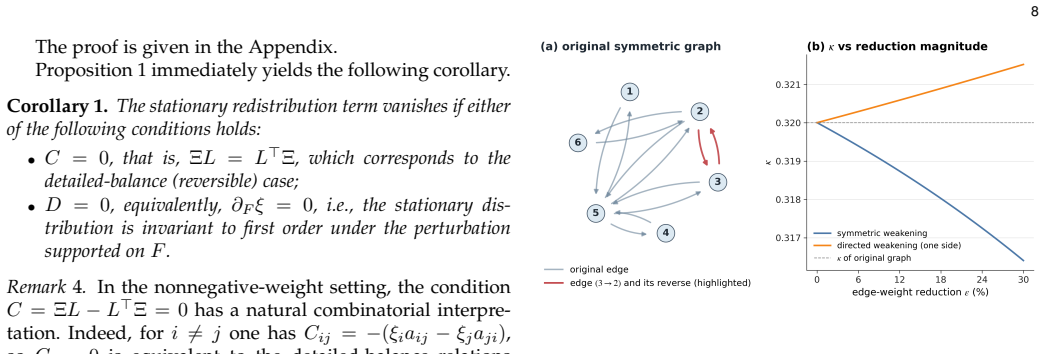
Weakening selected edges can increase generalized algebraic connectivity and trigger synchronization in directed networks.
A machine-rendered reading of the paper's core claim, the machinery that carries it, and where it could break.
Core claim
The central claim is that the generalized algebraic connectivity kappa of a directed weighted network responds to edge-weight perturbations according to an explicit first-order formula that decomposes into a directed cut-energy term and a stationary redistribution term; consequently, weakening certain edges can raise kappa and, for suitable nonlinear dynamics, convert nonsynchronization into synchronization.
What carries the argument
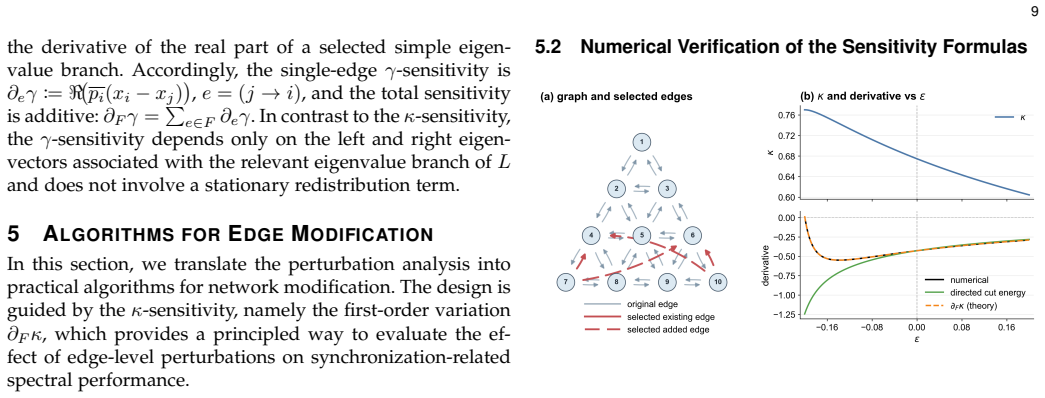
The first-order perturbation formula for the sensitivity of kappa, which decomposes the change into a directed cut-energy term and a stationary redistribution term.
If this is right
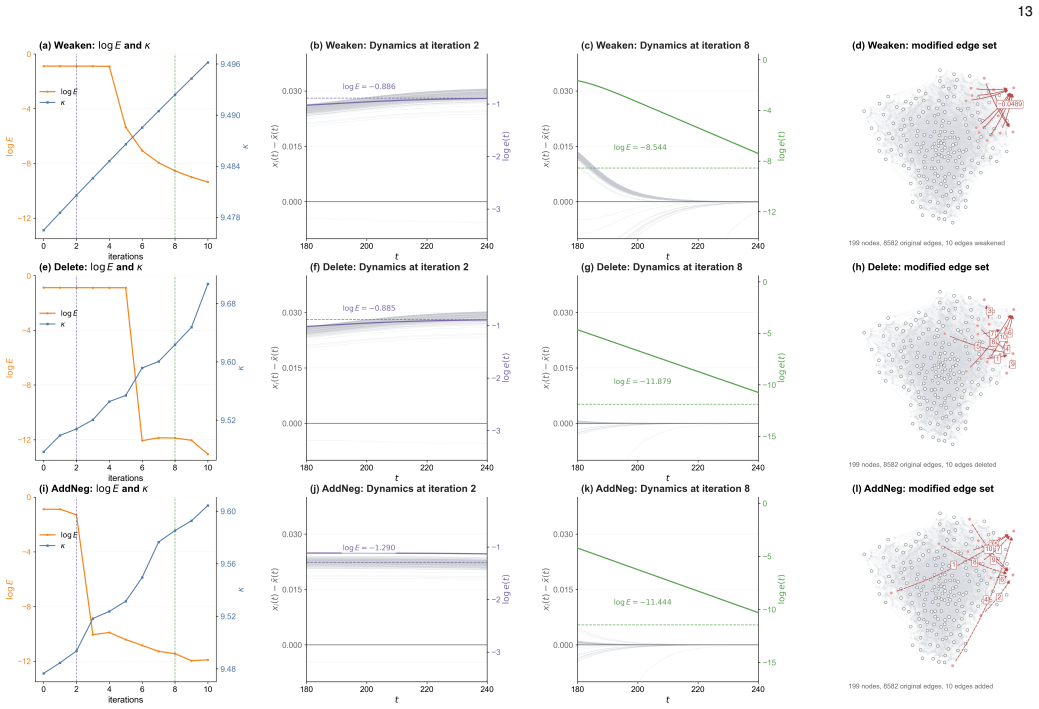
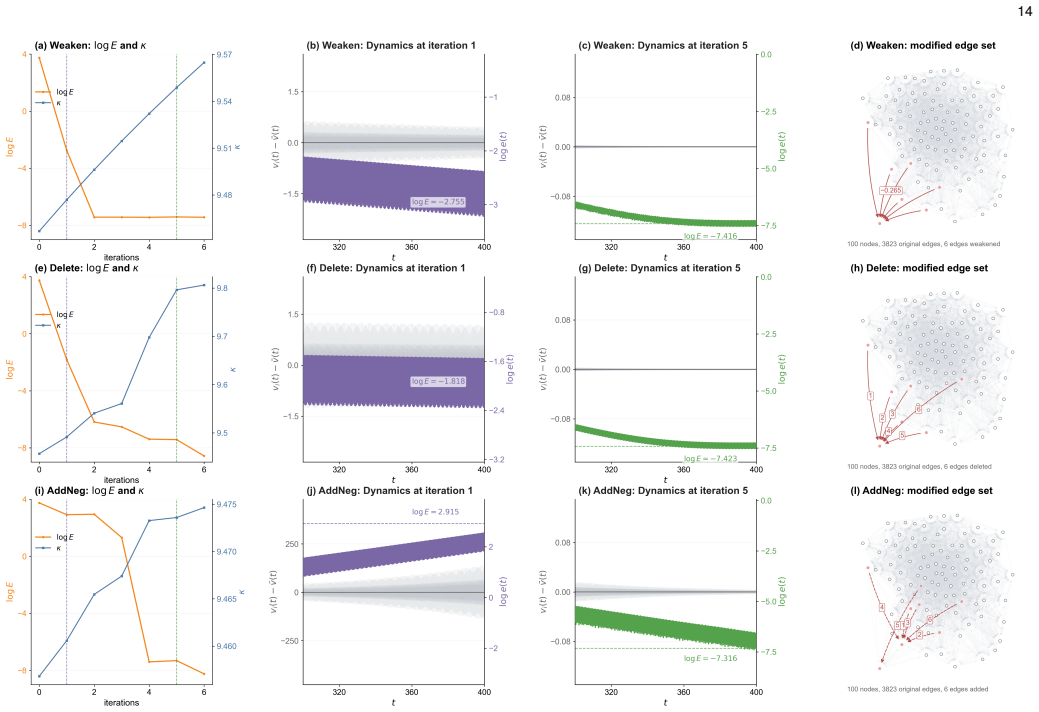
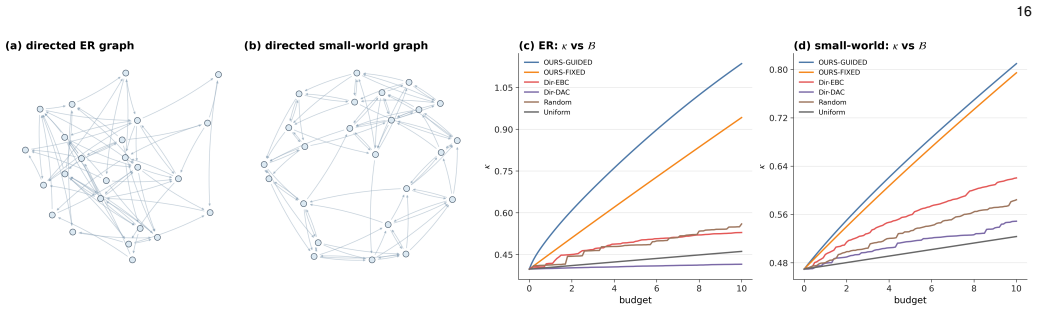
- Sensitivity-guided weakening, deletion, or negative insertion of edges produces measurable gains in kappa on both synthetic and real directed networks.
- The same modifications yield faster convergence rates in first- and second-order nonlinear consensus dynamics.
- In selected cases the spectral improvement is accompanied by an explicit transition from nonsynchronization to synchronization.
- The decomposition identifies which edges are locally most harmful or most helpful to synchronization performance.
Where Pith is reading between the lines
- The same local sensitivity analysis could be applied to other spectral quantities, such as the algebraic connectivity of the symmetrized Laplacian or the convergence rate of linear consensus.
- Network designers might deliberately insert negative weights or remove links rather than only adding positive ones when optimizing for synchronization.
- Empirical tests on time-varying or stochastic networks would reveal whether the stationary-distribution assumption still holds under realistic fluctuations.
Load-bearing premise
The first-order perturbation formula stays accurate enough for the finite edge modifications that are actually performed, and the network admits a well-defined stationary distribution so that the redistribution term is meaningful.
What would settle it
A directed weighted network in which the sensitivity ranking predicts that weakening a particular edge will raise kappa, yet direct recomputation after the change shows kappa has decreased.
Figures


read the original abstract
Synchronization in dynamical systems on directed weighted networks is often associated with stronger coupling and denser interactions. This paper shows that the opposite can also occur: weakening selected edges may increase the generalized algebraic connectivity, denoted by $\kappa$, and in some nonlinear systems this spectral improvement is accompanied by a transition from nonsynchronization to synchronization. To explain this effect, we develop a perturbation-based spectral sensitivity framework for directed weighted networks. We derive an explicit first-order formula for the response of $\kappa$ to edge-weight perturbations and show that it decomposes into a directed cut-energy term and a stationary redistribution term. This decomposition clarifies how asymmetric flow structure and invariant-mass redistribution jointly determine the synchronization role of each edge. Based on this theory, we design sensitivity-guided algorithms for edge weakening, edge deletion, negative-edge insertion, and edge strengthening. Experiments on synthetic and real networks show that these methods identify critical edges whose modification yields substantial gains in $\kappa$. Simulations of first- and second-order nonlinear consensus dynamics further show markedly faster convergence and, in some cases, a transition from incoherence to synchronization. The results provide a local spectral mechanism by which reducing or reallocating coupling can enhance synchronization-related performance.
Editorial analysis
A structured set of objections, weighed in public.
Referee Report
Summary. The paper claims that selectively weakening edges in directed weighted networks can increase the generalized algebraic connectivity κ, contrary to the usual expectation that stronger coupling aids synchronization. It derives an explicit first-order perturbation formula for the sensitivity of κ to edge-weight changes, decomposing the response into a directed cut-energy term and a stationary redistribution term. This decomposition is used to design algorithms for edge weakening, deletion, negative-edge insertion, and strengthening. Experiments on synthetic and real networks demonstrate that these sensitivity-guided modifications yield substantial gains in κ, with simulations of first- and second-order nonlinear consensus dynamics showing faster convergence and, in some cases, transitions from incoherence to synchronization.
Significance. If the first-order formula remains accurate for the finite modifications tested and the simulations are robust, the work provides a local spectral mechanism explaining how asymmetric flow and invariant-mass redistribution determine an edge's role in synchronization. The explicit decomposition offers insight beyond generic connectivity measures and could inform network control strategies in consensus, opinion dynamics, or infrastructure networks. The combination of analytic derivation with numerical validation on both synthetic and empirical graphs is a positive feature.
major comments (2)
- [§3 and §4] §3 (perturbation derivation) and §4 (algorithms): the central claim that the first-order sensitivity formula reliably identifies edges whose finite weakening increases κ rests on the unverified accuracy of the linear approximation at the modification sizes used in the experiments. No section compares the predicted Δκ from the formula against the exactly recomputed eigenvalue after each finite change, leaving open the possibility that observed gains arise from higher-order effects or unrelated structural alterations.
- [§2 and §5] §2 (definition of κ) and §5 (nonlinear simulations): the redistribution term in the sensitivity formula presupposes a unique stationary distribution, which requires the Laplacian to have a simple eigenvalue with well-defined left and right eigenvectors. The manuscript does not report explicit checks (e.g., eigenvalue gaps or numerical conditioning) for the directed networks tested, yet this assumption is load-bearing for the decomposition and for interpreting why certain weakenings improve κ.
minor comments (2)
- Notation for the left and right eigenvectors and the stationary distribution should be introduced once with consistent symbols across the derivation and the algorithm pseudocode.
- Figure captions for the synchronization time-series plots should state the precise initial conditions, integration method, and threshold used to declare synchronization.
Simulated Author's Rebuttal
We thank the referee for the constructive and insightful comments, which have identified opportunities to strengthen the validation of our perturbation framework. We address each major comment point by point below and will incorporate revisions to provide the requested verifications.
read point-by-point responses
-
Referee: [§3 and §4] §3 (perturbation derivation) and §4 (algorithms): the central claim that the first-order sensitivity formula reliably identifies edges whose finite weakening increases κ rests on the unverified accuracy of the linear approximation at the modification sizes used in the experiments. No section compares the predicted Δκ from the formula against the exactly recomputed eigenvalue after each finite change, leaving open the possibility that observed gains arise from higher-order effects or unrelated structural alterations.
Authors: We agree that explicit validation of the first-order approximation for the finite modifications is necessary to support the central claim. In the revised manuscript we will add a dedicated subsection (or appendix) that directly compares the predicted Δκ from the sensitivity formula against the exactly recomputed algebraic connectivity after each finite edge-weight change performed in §4. This comparison will be presented for both the synthetic and real-world networks, including quantitative measures such as relative error and correlation between predicted and observed Δκ. Where the approximation holds well, we will note the range of modification sizes for which it remains reliable; where discrepancies appear, we will discuss the contribution of higher-order terms. revision: yes
-
Referee: [§2 and §5] §2 (definition of κ) and §5 (nonlinear simulations): the redistribution term in the sensitivity formula presupposes a unique stationary distribution, which requires the Laplacian to have a simple eigenvalue with well-defined left and right eigenvectors. The manuscript does not report explicit checks (e.g., eigenvalue gaps or numerical conditioning) for the directed networks tested, yet this assumption is load-bearing for the decomposition and for interpreting why certain weakenings improve κ.
Authors: We acknowledge that the uniqueness of the stationary distribution and the well-conditioning of the left and right eigenvectors are foundational for the redistribution term. In the revised version we will include explicit numerical checks in §5 (with a brief reference in §2) for every directed network examined. These checks will report (i) the gap between the zero eigenvalue and the eigenvalue with the next-smallest real part, and (ii) the condition numbers of the computed left and right eigenvectors. For any network where the gap is modest, we will add a short discussion of the implications for the sensitivity formula and, if needed, apply a small regularization to ensure numerical stability. revision: yes
Circularity Check
No significant circularity in the perturbation-based derivation of spectral sensitivity
full rationale
The paper derives an explicit first-order formula for the response of generalized algebraic connectivity κ to edge-weight perturbations via standard perturbation theory applied to the directed Laplacian, decomposing it into a directed cut-energy term and a stationary redistribution term. This derivation does not reduce κ or its sensitivity to a fitted parameter, self-definition, or tautological renaming of inputs by construction. No load-bearing self-citation chain is invoked to establish uniqueness or the ansatz; the formula is presented as following directly from the eigenvalue perturbation expansion under the assumption of a simple eigenvalue with well-defined eigenvectors. Experiments apply the derived formula to guide modifications and observe outcomes in simulations, but the central claim remains independently falsifiable against exact eigenvalue recomputation and does not collapse to its own inputs.
Axiom & Free-Parameter Ledger
axioms (2)
- domain assumption The directed weighted network admits a unique stationary probability distribution for the Markov chain defined by its normalized adjacency matrix.
- standard math First-order perturbation theory applies to the generalized algebraic connectivity eigenvalue under small edge-weight changes.
Lean theorems connected to this paper
-
IndisputableMonolith/Cost/FunctionalEquation.leanwashburn_uniqueness_aczel unclearWe derive an explicit first-order formula for the response of κ to edge-weight perturbations and show that it decomposes into a directed cut-energy term and a stationary redistribution term.
-
IndisputableMonolith/Foundation/RealityFromDistinction.leanreality_from_one_distinction unclearκ := λ₂(M) where M = Ξ^{-1/2} (ΞL + LᵀΞ)/2 Ξ^{-1/2}
Reference graph
Works this paper leans on
-
[1]
Mathematical frameworks for oscillatory network dynamics in neuroscience,
P . Ashwin, S. Coombes, and R. Nicks, “Mathematical frameworks for oscillatory network dynamics in neuroscience,”The Journal of Mathematical Neuroscience, vol. 6, no. 1, p. 2, 2016
work page 2016
-
[2]
A tutorial on modeling and analysis of dynamic social networks. Part II,
A. V . Proskurnikov and R. Tempo, “A tutorial on modeling and analysis of dynamic social networks. Part II,”Annual Reviews in Control, vol. 45, pp. 166–190, 2018
work page 2018
- [3]
-
[4]
M. Newman,Networks, 2nd ed. Oxford: Oxford University Press, 2018
work page 2018
-
[5]
D. Meng, M. Du, and Y. Wu,Disagreement Behavior Analysis of Signed Networks. Singapore: Springer, 2022
work page 2022
-
[6]
Algebraic connectivity of graphs,
M. Fiedler, “Algebraic connectivity of graphs,”Czechoslovak Math- ematical Journal, vol. 23, no. 2, pp. 298–305, 1973
work page 1973
-
[7]
C. Godsil and G. F. Royle,Algebraic Graph Theory, ser. Graduate Texts in Mathematics. New York: Springer, 2001, vol. 207
work page 2001
-
[8]
Consensus and cooperation in networked multi-agent systems,
R. Olfati-Saber, J. A. Fax, and R. M. Murray, “Consensus and cooperation in networked multi-agent systems,”Proceedings of the IEEE, vol. 95, no. 1, pp. 215–233, 2007
work page 2007
-
[9]
T. Nishikawa and A. E. Motter, “Network synchronization land- scape reveals compensatory structures, quantization, and the pos- itive effect of negative interactions,”Proceedings of the National Academy of Sciences, vol. 107, no. 23, pp. 10 342–10 347, 2010
work page 2010
-
[10]
Manipulating directed networks for better synchronization,
A. Zeng, L. L ¨u, and T. Zhou, “Manipulating directed networks for better synchronization,”New Journal of Physics, vol. 14, no. 8, p. 083006, 2012
work page 2012
-
[11]
Effect of adding edges to con- sensus networks with directed acyclic graphs,
H.-T. Zhang, Z. Chen, and X. Mo, “Effect of adding edges to con- sensus networks with directed acyclic graphs,”IEEE Transactions on Automatic Control, vol. 62, no. 9, pp. 4891–4897, 2017
work page 2017
-
[12]
Perturbation analysis and comparison of network synchronization methods,
Z. He, C. Yao, J. Yu, and M. Zhan, “Perturbation analysis and comparison of network synchronization methods,”Physical Review E, vol. 99, no. 5, p. 052207, 2019
work page 2019
-
[13]
Effects of adding arcs on the consensus convergence rate of leader-follower multi-agent systems,
S. Gao, S. Zhang, X. Chen, and X. Song, “Effects of adding arcs on the consensus convergence rate of leader-follower multi-agent systems,”Applied Mathematics and Computation, vol. 453, p. 128086, 2023
work page 2023
-
[14]
Cycle-star motifs: Network response to link modifications,
S. Bakrani, N. Kiran, D. Eroglu, and T. Pereira, “Cycle-star motifs: Network response to link modifications,”Journal of Nonlinear Science, vol. 34, no. 4, p. 60, 2024
work page 2024
-
[15]
S. Gao, S. Zhang, and X. Chen, “Effects of changing the weights of arcs on the consensus convergence rate of a leader–follower multi-agent system,”Chaos, Solitons & Fractals, vol. 172, p. 113590, 2023
work page 2023
-
[16]
X. Liu and T. Chen, “Synchronization analysis for nonlinearly- coupled complex networks with an asymmetrical coupling ma- trix,”Physica A: Statistical Mechanics and its Applications, vol. 387, no. 16-17, pp. 4429–4439, 2008
work page 2008
-
[17]
Synchronisation in complex networks of coupled systems with directed topologies,
W. Lu and T. Chen, “Synchronisation in complex networks of coupled systems with directed topologies,”International Journal of Systems Science, vol. 40, no. 9, pp. 909–921, 2009
work page 2009
-
[18]
Second-order consensus for multiagent systems with directed topologies and nonlinear dynamics,
W. Yu, G. Chen, M. Cao, and J. Kurths, “Second-order consensus for multiagent systems with directed topologies and nonlinear dynamics,”IEEE Transactions on Systems, Man, and Cybernetics, Part B (Cybernetics), vol. 40, no. 3, pp. 881–891, 2010
work page 2010
-
[19]
W. Yu, G. Chen, and M. Cao, “Some necessary and sufficient conditions for second-order consensus in multi-agent dynamical systems,”Automatica, vol. 46, no. 6, pp. 1089–1095, 2010
work page 2010
-
[20]
Growing well-connected graphs,
A. Ghosh and S. Boyd, “Growing well-connected graphs,” in Proceedings of the 45th IEEE Conference on Decision and Control. IEEE, 2006, pp. 6605–6611
work page 2006
-
[21]
Optimizing algebraic connectivity by edge rewiring,
A. Sydney, C. Scoglio, and D. Gruenbacher, “Optimizing algebraic connectivity by edge rewiring,”Applied Mathematics and Computa- tion, vol. 219, no. 10, pp. 5465–5479, 2013
work page 2013
-
[22]
Laplacians and the Cheeger inequality for directed graphs,
F. Chung, “Laplacians and the Cheeger inequality for directed graphs,”Annals of Combinatorics, vol. 9, no. 1, pp. 1–19, 2005
work page 2005
-
[23]
Consensus problems on networks with antagonistic interactions,
C. Altafini, “Consensus problems on networks with antagonistic interactions,”IEEE Transactions on Automatic Control, vol. 58, no. 4, pp. 935–946, 2013
work page 2013
-
[24]
Community structure in social and biological networks,
M. Girvan and M. E. Newman, “Community structure in social and biological networks,”Proceedings of the National Academy of Sciences, vol. 99, no. 12, pp. 7821–7826, 2002
work page 2002
-
[25]
Assortative mixing in networks,
M. E. Newman, “Assortative mixing in networks,”Physical Review Letters, vol. 89, no. 20, p. 208701, 2002
work page 2002
-
[26]
D. F. Gleich, “PageRank beyond the web,”SIAM Review, vol. 57, no. 3, pp. 321–363, 2015
work page 2015
-
[27]
Spectra of Laplacian matrices of weighted graphs: structural genericity properties,
C. Poignard, T. Pereira, and J. P . Pade, “Spectra of Laplacian matrices of weighted graphs: structural genericity properties,” SIAM J. Appl. Math., vol. 78, no. 1, pp. 372–394, 2018
work page 2018
-
[28]
F. P . Kelly,Reversibility and Stochastic Networks. Chichester: John Wiley & Sons, 1979
work page 1979
-
[29]
Graph evolution: Den- sification and shrinking diameters,
J. Leskovec, J. Kleinberg, and C. Faloutsos, “Graph evolution: Den- sification and shrinking diameters,”ACM Transactions on Knowl- edge Discovery from Data, vol. 1, no. 1, pp. 2–es, 2007
work page 2007
-
[30]
Local higher- order graph clustering,
H. Yin, A. R. Benson, J. Leskovec, and D. F. Gleich, “Local higher- order graph clustering,” inProceedings of the 23rd ACM SIGKDD International Conference on Knowledge Discovery and Data Mining, 2017, pp. 555–564
work page 2017
-
[31]
A. L. Andrew and R. C. Tan, “Computation of derivatives of repeated eigenvalues and the corresponding eigenvectors of sym- metric matrix pencils,”SIAM Journal on Matrix Analysis and Appli- cations, vol. 20, no. 1, pp. 78–100, 1998
work page 1998
discussion (0)
Sign in with ORCID, Apple, or X to comment. Anyone can read and Pith papers without signing in.