Recognition: 2 theorem links
· Lean TheoremLaser-assisted tunneling in a static tungsten diselenide WSe₂ barrier
Pith reviewed 2026-05-13 05:38 UTC · model grok-4.3
The pith
Laser irradiation induces Floquet sidebands that suppress transmission and overcome Klein tunneling in monolayer WSe2.
A machine-rendered reading of the paper's core claim, the machinery that carries it, and where it could break.
Core claim
Within the Floquet formalism the time-periodic laser drive generates a rich sideband structure in the Dirac-fermion wave functions across the WSe2 barrier. The number and strength of these sidebands increase with the driving parameter α, producing strong interference and energy renormalization that suppress transmission and furnish an efficient mechanism to overcome Klein tunneling.
What carries the argument
Floquet sideband structure arising from the laser field in the three-region Dirac-fermion barrier model.
Load-bearing premise
Monolayer WSe2 electrons are treated as Dirac fermions and the laser is taken to be an ideal time-periodic drive whose only effect on transmission is captured by wave-function continuity at the interfaces.
What would settle it
Conductance measurements that show transmission rising or staying constant as the laser driving parameter α increases would falsify the predicted sideband-induced suppression.
Figures


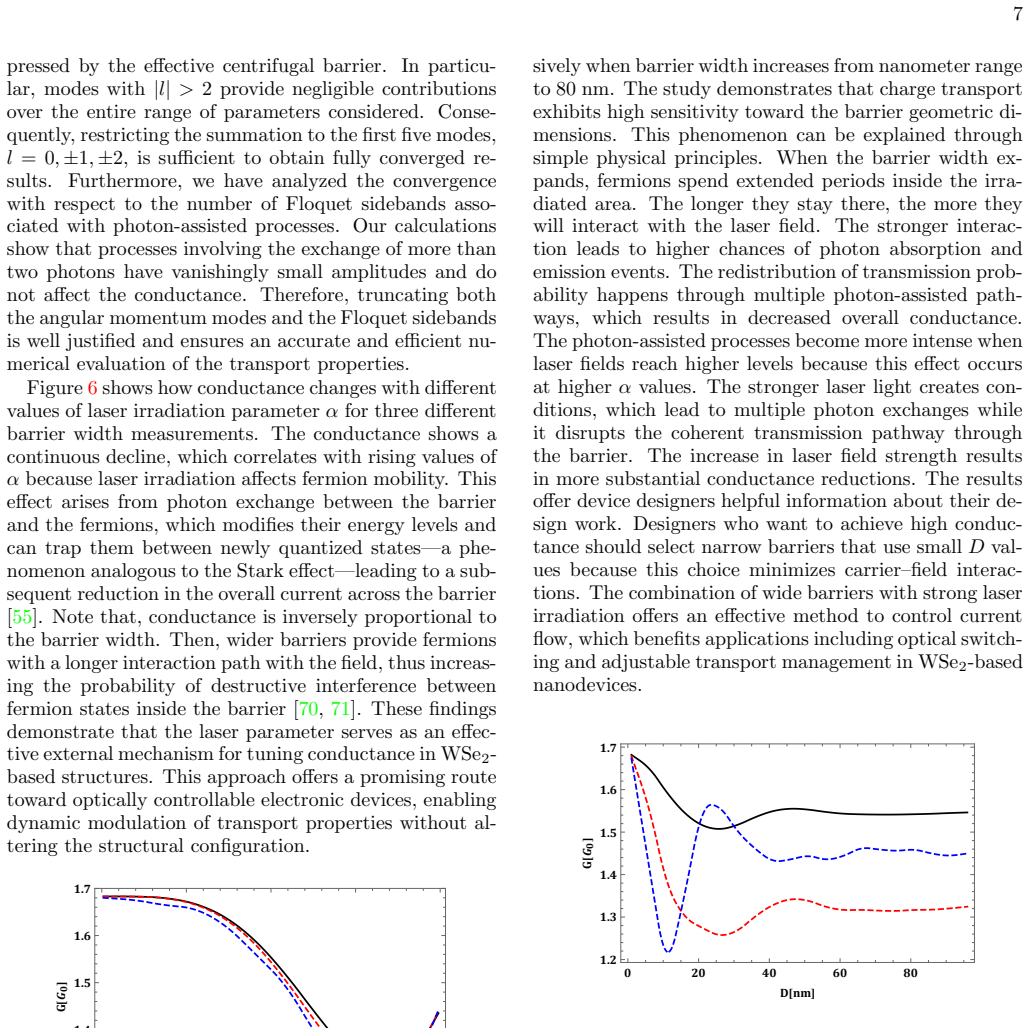
read the original abstract
We study the tunneling effect of Dirac fermions in a monolayer WSe$_2$ subjected to a static electrostatic barrier and irradiated by a linearly polarized laser field. Within the Floquet formalism, the time-periodic driving is incorporated to derive analytical wave functions across the three regions of the system. By enforcing continuity conditions at the interfaces, we obtain the transmission and reflection coefficients, which are then used to evaluate the conductance via the B\"uttiker approach. Our results reveal that the laser field induces a rich Floquet sideband structure, whose number and strength increase with the driving parameter $\alpha$. This leads to a significant suppression of transmission and provides an efficient mechanism to overcome Klein tunneling. Moreover, increasing the width of the irradiated region enhances the interaction between fermions and the external field, resulting in energy renormalization and the formation of Stark-like confined states. The interaction between several Floquet channels creates strong interference effects, which reduce the transmitted current even further. The results demonstrate that light-matter interaction allows for the dynamic control of quantum transport in WSe$_2$ materials. This technology allows for the development of new optoelectronic devices, including tunable quantum filters and light-controlled nanoscale transistors.
Editorial analysis
A structured set of objections, weighed in public.
Referee Report
Summary. The paper studies laser-assisted tunneling of Dirac fermions through a static electrostatic barrier in monolayer WSe₂. Using Floquet theory for a time-periodic laser drive, it derives analytical wave functions in a three-region geometry (incident, barrier, transmitted), matches them at interfaces to obtain transmission/reflection coefficients, and computes conductance via the Büttiker formula. Key results are that increasing the driving parameter α generates more Floquet sidebands that suppress transmission, providing a mechanism to overcome Klein tunneling, with further suppression from barrier width and inter-channel interference.
Significance. If the model were appropriate, the work would offer an analytical demonstration of dynamic control of tunneling via light-matter interaction in 2D materials, with potential implications for optoelectronic devices. The strength lies in the closed-form Floquet wave functions (Bessel-dressed) and direct application of scattering theory without fitted parameters. However, the central claims rest on an inapplicable dispersion relation, limiting the significance for the stated material.
major comments (2)
- [Model/Hamiltonian] Model/Hamiltonian section (prior to Eq. for wave functions): The system is modeled with the gapless Dirac Hamiltonian for WSe₂, omitting the mass term Δσ_z (Δ ≈ 0.8 eV for the ~1.6 eV direct gap). Klein tunneling and its laser-induced suppression are invoked throughout (abstract, results on transmission), but these phenomena require massless Dirac cones with perfect normal-incidence transmission. For gapped WSe₂ at energies below the gap, states are evanescent and the three-region matching yields qualitatively different transmission; the analytic expressions and Büttiker conductance therefore do not apply to the claimed material.
- [Results] Results on sideband structure and transmission (discussion of α dependence): The reported increase in sideband number/strength with α and the resulting suppression rely on propagating gapless modes. Inclusion of Δ would modify the wave-vector matching and Floquet channel thresholds, likely eliminating the claimed interference-driven suppression mechanism for realistic tunneling energies; no error estimate or comparison to the gapped case is provided.
minor comments (1)
- [Abstract] Abstract: the escaped quote in Büttiker should be rendered as Büttiker; minor notation inconsistency in the driving parameter α definition.
Simulated Author's Rebuttal
We thank the referee for the careful and constructive review of our manuscript. The identification of the gapless approximation as a central issue is well taken, and we address both major comments below with plans for revision.
read point-by-point responses
-
Referee: [Model/Hamiltonian] Model/Hamiltonian section (prior to Eq. for wave functions): The system is modeled with the gapless Dirac Hamiltonian for WSe₂, omitting the mass term Δσ_z (Δ ≈ 0.8 eV for the ~1.6 eV direct gap). Klein tunneling and its laser-induced suppression are invoked throughout (abstract, results on transmission), but these phenomena require massless Dirac cones with perfect normal-incidence transmission. For gapped WSe₂ at energies below the gap, states are evanescent and the three-region matching yields qualitatively different transmission; the analytic expressions and Büttiker conductance therefore do not apply to the claimed material.
Authors: We agree that the gapless Dirac Hamiltonian is an approximation that does not fully capture the properties of monolayer WSe₂, which has a direct band gap of about 1.6 eV. Our initial approach focused on the Floquet effects in the context of Dirac fermions to highlight the laser-assisted suppression of tunneling, including Klein tunneling. However, as pointed out, for realistic energies below the gap, the inclusion of the mass term is essential as it leads to evanescent waves rather than propagating modes. In the revised manuscript, we will modify the Hamiltonian to include the Δσ_z term, re-derive the Floquet wave functions accordingly, and update the transmission and conductance calculations. We will also add a discussion on the validity range of the gapless approximation, for instance when the Fermi energy is tuned above the gap via doping or gating. This revision will make the results more applicable to the material. revision: yes
-
Referee: [Results] Results on sideband structure and transmission (discussion of α dependence): The reported increase in sideband number/strength with α and the resulting suppression rely on propagating gapless modes. Inclusion of Δ would modify the wave-vector matching and Floquet channel thresholds, likely eliminating the claimed interference-driven suppression mechanism for realistic tunneling energies; no error estimate or comparison to the gapped case is provided.
Authors: The referee correctly identifies that our analysis of the sideband structure, transmission suppression with increasing α, and the interference effects are based on the gapless dispersion. Incorporating the mass term will indeed alter the dispersion relations, affecting the thresholds for Floquet channels and the nature of the modes (propagating vs. evanescent). We will include a comparison between the gapped and gapless cases in the revised paper, providing quantitative estimates of the differences in transmission probabilities and conductance. This will allow us to assess the robustness of the laser-induced suppression mechanism and clarify under what conditions the effects persist in the gapped system. We believe this will address the concern and enhance the manuscript's rigor. revision: yes
Circularity Check
Standard Floquet wave-matching derivation; fully self-contained with no circular steps
full rationale
The paper applies the Floquet formalism to the time-periodic laser drive on a three-region Dirac barrier, derives analytic wavefunctions (Bessel-dressed), enforces continuity at interfaces to obtain transmission/reflection coefficients, and computes conductance via the Büttiker formula. These steps are direct consequences of the stated model (gapless Dirac fermions + periodic drive) and contain no fitted parameters, self-referential definitions, or load-bearing self-citations. The sideband structure, transmission suppression, and interference effects are computed outputs rather than inputs renamed as predictions. The reference to Klein tunneling follows from the explicit massless-Dirac assumption and does not reduce the derivation to a tautology.
Axiom & Free-Parameter Ledger
free parameters (1)
- driving parameter α
axioms (2)
- domain assumption Electrons in monolayer WSe2 obey the Dirac equation with linear dispersion
- standard math The laser field is a perfect monochromatic time-periodic perturbation treatable by Floquet theory
Lean theorems connected to this paper
-
IndisputableMonolith/Cost/FunctionalEquation.leanwashburn_uniqueness_aczel unclear?
unclearRelation between the paper passage and the cited Recognition theorem.
Within the Floquet formalism, the time-periodic driving is incorporated to derive analytical wave functions... ϕ(t)=e^{-i A0/ω sin(ωt)}=∑ J_m(α) e^{-imωt}
What do these tags mean?
- matches
- The paper's claim is directly supported by a theorem in the formal canon.
- supports
- The theorem supports part of the paper's argument, but the paper may add assumptions or extra steps.
- extends
- The paper goes beyond the formal theorem; the theorem is a base layer rather than the whole result.
- uses
- The paper appears to rely on the theorem as machinery.
- contradicts
- The paper's claim conflicts with a theorem or certificate in the canon.
- unclear
- Pith found a possible connection, but the passage is too broad, indirect, or ambiguous to say the theorem truly supports the claim.
Reference graph
Works this paper leans on
-
[1]
Laser-assisted tunneling in a static tungsten diselenide WSe$_2$ barrier
and electronic conductance [37]. Moreover, such ir- radiation can partially suppress Klein tunneling and lead to polarization-dependent transport behavior [39, 57]. Following the success of graphene, new materials have been explored for technological development, particularly transition metal dichalcogenides (TMDs) [40–42]. The 2D materials display two ch...
work page internal anchor Pith review Pith/arXiv arXiv 2005
-
[2]
(A15) J r l =v F τ|r l|2(βl +β ∗ l ) (A16) J t l =v F τ|t l|2(βl +β ∗ l ).(A17) From these current densities, the transmission and reflec- tion probabilities are calculated according to the follow- ing expression: Tl = |J t l | |J i 0| =|t l|2, R l = |J r l | |J i 0| =|r l|2.(A18) Because of the Floquet subbands, the transmission also has an infinite numb...
-
[3]
K. S. Novoselov, A. K. Geim, S. V. Morozov, D. Jiang, Y. Zhang, S. V. Dubonos, I. V. Grigorieva, and A. A. Firsov, Science 306, 666 (2004)
work page 2004
-
[4]
K. S. Novoselov, A. Mishchenko, A. Carvalho, and A. H. Castro Neto, Science 353, 9439 (2016)
work page 2016
-
[5]
K. I. Bolotin, K. J. Sikes, Z. Jiang, M. Klima, G. Fuden- berg, J. Hone, P. Kim, and H. L. Stormer, Solid State 11 Commun. 351. 146 (2008)
work page 2008
-
[6]
S. V. Morozov, K. S. Novoselov, M. I. Katsnelson, F. Schedin, D. C. Elias, J. A. Jaszczak, and A. K. Geim, Phys. Rev. Lett. 100, 016602 (2008)
work page 2008
-
[7]
A. K. Geim and K. S. Novoselov, Nature 462, 183 (2009)
work page 2009
-
[8]
Q. Bao, H. Zhang, B. Wang, Z. Ni, . H. Y. X. Lim, Y. Wang, and K. P. Loh, Nat. Photon 5, 411 (2011)
work page 2011
-
[9]
G. Gui, J. Li, and J. Zhong, Phys. Rev. B 78, 075435 (2008)
work page 2008
- [10]
-
[11]
N. M. R. Peres, J. Phys.: Condens. Matter 21, 323201 (2009)
work page 2009
-
[12]
X. Wang, Y. Ouyang, X. Li, H. Wang, J. Guo, and H. Dai, Phys. Rev. Lett. 100, 206803 (2008)
work page 2008
- [13]
-
[14]
G.-X. Ni, Y. Zheng, S. Bae, H. R. Kim, A. Pachoud, Y. S. Kim, C.-L. Tan, D. Im, J.-H. Ahn, B. H. Hong, and B. Ozyilmaz, ACS Nano 6, 1158 (2012)
work page 2012
-
[15]
T. Ohta, A. Bostwick, T. Seyller, K. Horn, and E. Roten- berg, Science 313, 951 (2006)
work page 2006
-
[16]
A. N. Sidorov, M. M. Yazdanpanah, R. Jalilian, P. J. Ouseph, R. W. Cohn, and G. U. Sumanasekera, Nan- otechnology 18, 135301 (2007)
work page 2007
-
[17]
G. A. K. P. A. Giovannetti, P. A. Khomyakov, G. Brocks, V. V. Karpan, J. van den Brink, and P. J. Kelly, Phys. Rev. Lett. 101, 026803 (2008)
work page 2008
-
[18]
N. Stander, B. Huard, and D. Goldhaber-Gordon, Phys. Rev. Lett. 102, 026807 (2009)
work page 2009
-
[19]
M. I. Katsnelson, K. S. Novoselov, and A. K. Geim, Nat. Phys. 2, 620 (2006)
work page 2006
-
[20]
C. W. J. Beenakker, Rev. Mod. Phys. 80, 1337 (2008)
work page 2008
- [21]
- [22]
- [23]
- [24]
-
[25]
H. P. Ojeda-Collado and C. Rodr´ ıguez-Castellanos, Appl. Phys. Lett. 103, 3 (2013)
work page 2013
- [26]
- [27]
-
[28]
M. R. Masir, P. Vasilopoulos, and F. M. Peeters, Phys. Rev. B 77, 235443 (2008)
work page 2008
- [29]
- [30]
-
[31]
R. El Aitouni, M. Mekkaoui, A. Jellal, and M. Schreiber, Physica E 157, 115865 (2023)
work page 2023
-
[32]
S. X. Wang, Z. W. Li, J. J. Liu, and Y. X. Li, Chin. Phys. B 20, 077305 (2011)
work page 2011
-
[33]
R. El Aitouni, M. Mekkaoui, A. Bahaoui, and A. Jellal, Appl. Phys. A 131, 48 (2025)
work page 2025
-
[34]
R. El Aitouni, M. Mekkaoui, and A. Jellal, Phys. Scr. 99, 065912 (2024)
work page 2024
-
[35]
M. Mekkaoui, A. Jellal, and H. Bahlouli, Solid State Communi. 358, 114981 (2022)
work page 2022
-
[36]
S. Das, A. Maity, R. Sarkar, A. Menon, T. Nag, and B. Basu, J. Phys.: Condens. Matter 36, 395804 (2024)
work page 2024
-
[37]
A. Gregefalk, A. M. Black-Schaffer, and T. Nag, Ann. Phys. (Berlin) 535, 2300295 (2023)
work page 2023
-
[38]
Z. H. Ni, T. Yu, Z. Q. Luo, Y. Y. Wang, L. Liu, C. L. Wong, and Z. X. Shen, Sci. Rep. 2, 20082 (2012)
work page 2012
- [39]
- [40]
- [41]
-
[42]
M. Chhowalla, H. S. Shin, G. Eda, L.-J. Li, K. P. Loh, and H. Zhang, Nature Chemistry 5, 263 (2013)
work page 2013
-
[43]
S. Manzeli, D. Ovchinnikov, D. Pasquier, O. V. Gillen, and A. Kis, Nature Reviews Materials 2, 17033 (2017)
work page 2017
-
[44]
D. Xiao, G. Liu, W. Feng, X. Xu, and W. Yao, Phys. Rev. Lett. 108, 196802 (2012)
work page 2012
- [45]
- [46]
-
[47]
Y. Shen, Z. Zhang, Z. Yao, M. Jin, J. Gao, Y. Zhao, W. Bao, Y. Sun, and H. Tian, Nano-Micro Lett. 191 (2025)
work page 2025
-
[48]
A. K. Geim and K. S. Novoselov, Nature Materials 6, 183 (2007)
work page 2007
-
[49]
S. Z. Butler, S. M. Hollen, L. Cao, Y. Cui, J. A. Gupta, H. R. Gutierrez, T. F. Heinz, S. S. Hong, J. Huang, A. F. Ismach, E. Johnston-Halperin, M. Kuno, V. V. Plash- nitsa, R. D. Robinson, R. S. Ruoff, S. Salahuddin, J. Shan, L. Shi, M. G. Spencer, M. Terrones, W. Windl, and J. X. Zheng, ACS Nano 7, 2898 (2013)
work page 2013
- [50]
-
[51]
G. Aivazian, Z. Gong, A. M. Jones, R.-L. Chu, J. Yan, D. G. Mandrus, C. Zhang, D. Cobden, W. Yao, and X. Xu, Nat. Phys. 11, 148 (2015)
work page 2015
-
[52]
A. Srivastava, M. Sidler, A. V. Allain, D. S. Lembke, A. Kis, and A. Imamo˘glu, Nat. Phys. 11, 141 (2015)
work page 2015
-
[53]
L. H. F. Koppens, E. D. Chang, and J. F. Garc´ ıa de Abajo, Nano Letters 11, 3370–3377 (2011)
work page 2011
-
[54]
M. R. Masir, P. Vasilopoulos, and F. M. Peeters, Phys. Rev. B 79, 035409 (2009)
work page 2009
-
[55]
M. Buttiker, Y. Imry, R. Landauer, and S. Pinhas. Phys. Rev. B 31, 6207 (1985)
work page 1985
- [56]
-
[57]
J. E. Stalnaker, D. Budker, S. J. Freedman, J. S. Guz- man, S. M. Rochester, and V. V. Yashchuk. Phys. Rev. A 73, 043416 (2006)
work page 2006
-
[58]
K. Kristinsson, O. V. Kibis, S. Morina, and I. A. Shelykh, Sci. Rep. 6, 20082 (2016)
work page 2016
- [59]
- [60]
- [61]
-
[62]
D. Le, T. C. Berkelbach, F. Zhang, M. S. Hybertsen, and D. R. Reichman, J. Phys.: Condens. Matter, 27, 182201 (2015)
work page 2015
- [63]
- [64]
-
[65]
Loudon, The Quantum Theory of Light (3rd ed., Ox- ford University Press Inc., New York, 2000)
R. Loudon, The Quantum Theory of Light (3rd ed., Ox- ford University Press Inc., New York, 2000)
work page 2000
- [66]
- [67]
-
[68]
Peierls, Zur Theorie des Diamagnetismus von Leitungselektronen, Z
R. Peierls, Zur Theorie des Diamagnetismus von Leitungselektronen, Z. Phys. 80, 763 (1933)
work page 1933
- [69]
-
[70]
R. El Aitouni, M. Mekkaoui, and A. Jellal, Ann. Phys. (Berlin) 535, 2200630 (2023)
work page 2023
-
[71]
R. O. Kuzian, D. V. Efremov, and E. E. Krasovskii. Phys. Rev. Research 7, 013180 (2025)
work page 2025
-
[72]
D. K. Nandy and T. Sowi´ nski, Phys. Rev. A 100, 023617 (2019)
work page 2019
- [73]
discussion (0)
Sign in with ORCID, Apple, or X to comment. Anyone can read and Pith papers without signing in.