Recognition: no theorem link
Theory of Supercritical Coupling And Generalized Bound States in the Continuum
Pith reviewed 2026-05-13 05:17 UTC · model grok-4.3
The pith
Finite leakage in quasi-bound states in the continuum creates reactive coupling that enables generalized bound states where total quality factor diverges.
A machine-rendered reading of the paper's core claim, the machinery that carries it, and where it could break.
Core claim
Friedrich-Wintgen interference emerges from a bright-dark supermode decomposition of resonances coupled through a shared radiation channel. Any finite leakage of a quasi-BIC induces a causality-driven reactive coupling enabling non-Hermitian pumping of the dark sector. The optimal condition for this process corresponds to the supercritical coupling regime while recovering universal quasi-BIC asymmetry scaling. Extending the theory to Dirac-like dispersions identifies an open-Dirac singularity where the Dirac gap matches the supercritical regime. A four-wave Hamiltonian quantitatively reproduces rigorous coupled-wave analysis, revealing the breakdown of conventional critical coupling. Near 4,
What carries the argument
Bright-dark supermode decomposition of resonances sharing a radiation channel, which produces causality-driven reactive coupling from any finite quasi-BIC leakage and drives the system into the supercritical regime.
If this is right
- Supercritical coupling is the optimal condition for non-Hermitian pumping of the dark sector in quasi-BICs.
- Universal quasi-BIC asymmetry scaling follows directly from the bright-dark model.
- An open-Dirac singularity appears in photonic crystal slabs when the Dirac gap equals the supercritical coupling value.
- Conventional critical coupling breaks down near the supercritical regime.
- Absorptive cross-coupling enables coherent absorption interference that suppresses effective dissipative losses beyond conventional material limits.
- Total quality factor diverges at the generalized bound state in the continuum limit where radiative and effective gain compensate.
Where Pith is reading between the lines
- The same bright-dark mechanism could be tested in acoustic or quantum open systems that possess a shared leakage channel.
- Targeting the open-Dirac singularity may allow device designs to reach higher quality factors than material losses would otherwise permit.
- Coherent absorption interference near supercritical coupling offers a route to loss engineering in sensors and absorbers.
Load-bearing premise
Finite leakage of a quasi-BIC always induces a causality-driven reactive coupling through the shared radiation channel in the bright-dark supermode decomposition.
What would settle it
Experimental observation that the total quality factor diverges when the Dirac gap in a photonic crystal slab is tuned to match the supercritical coupling condition.
Figures





read the original abstract
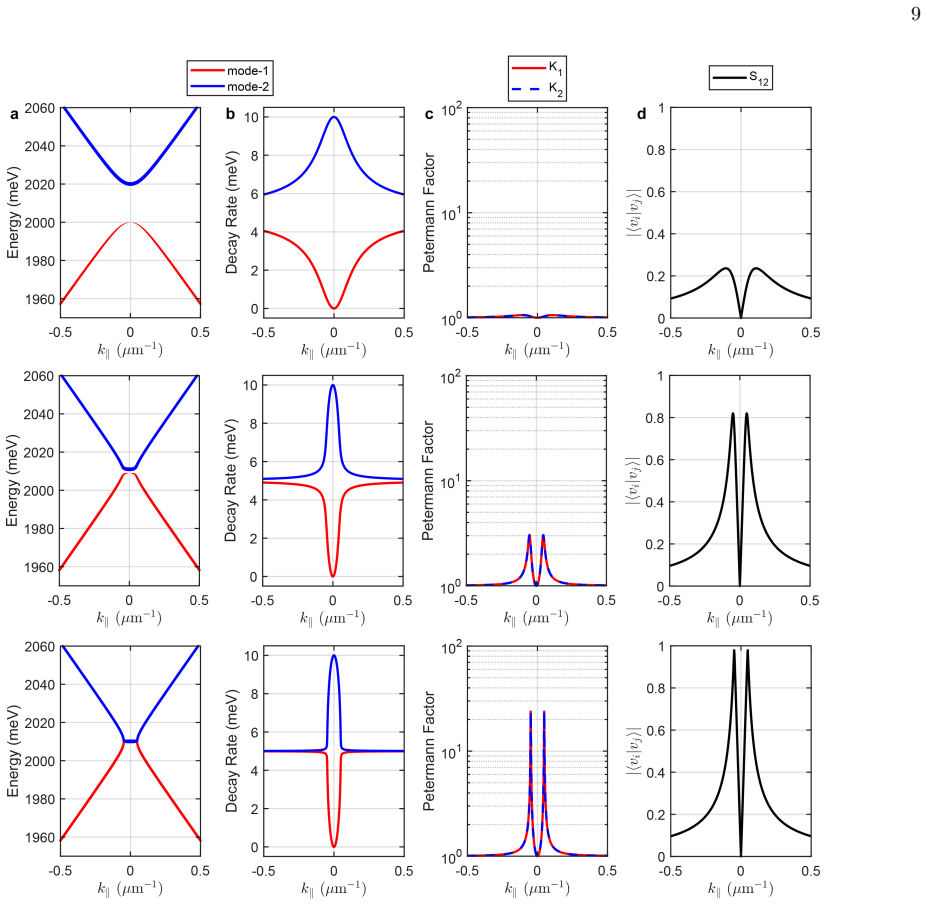
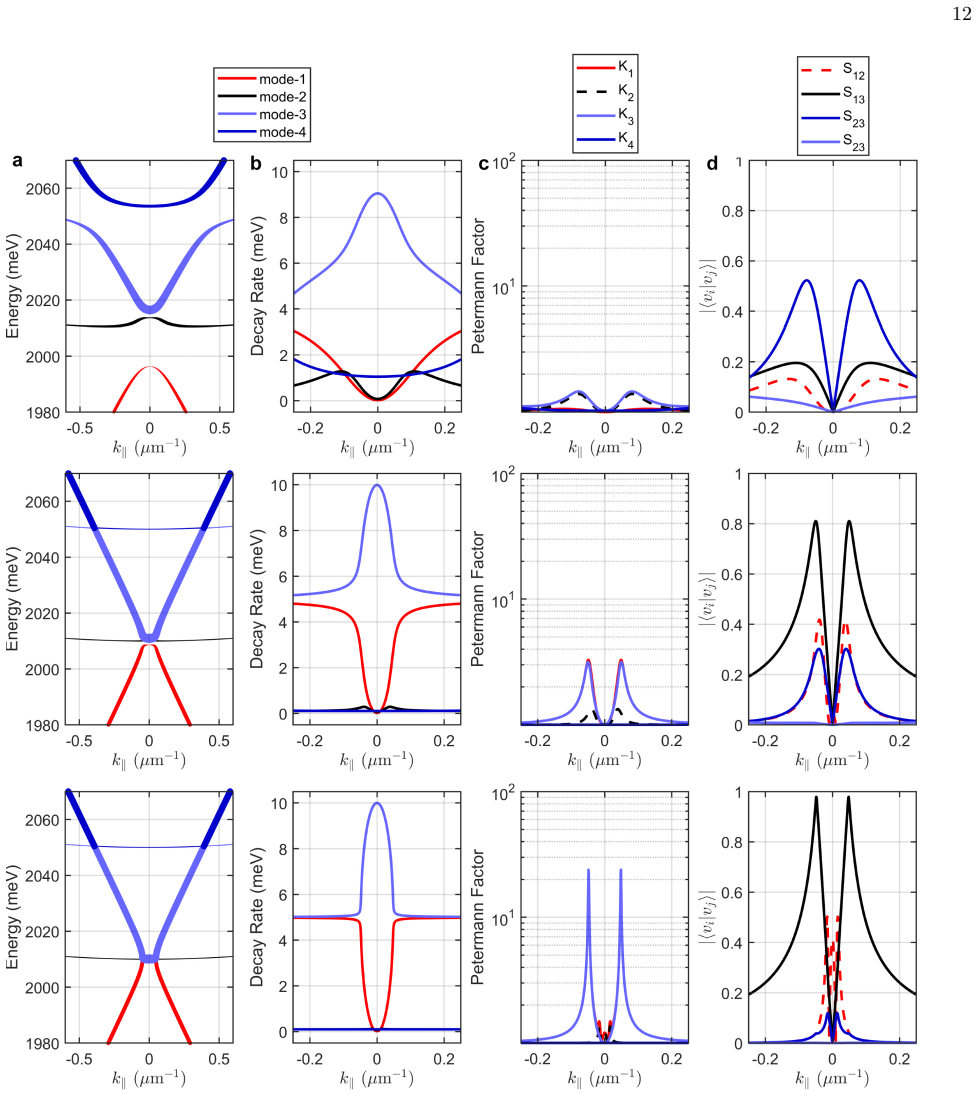
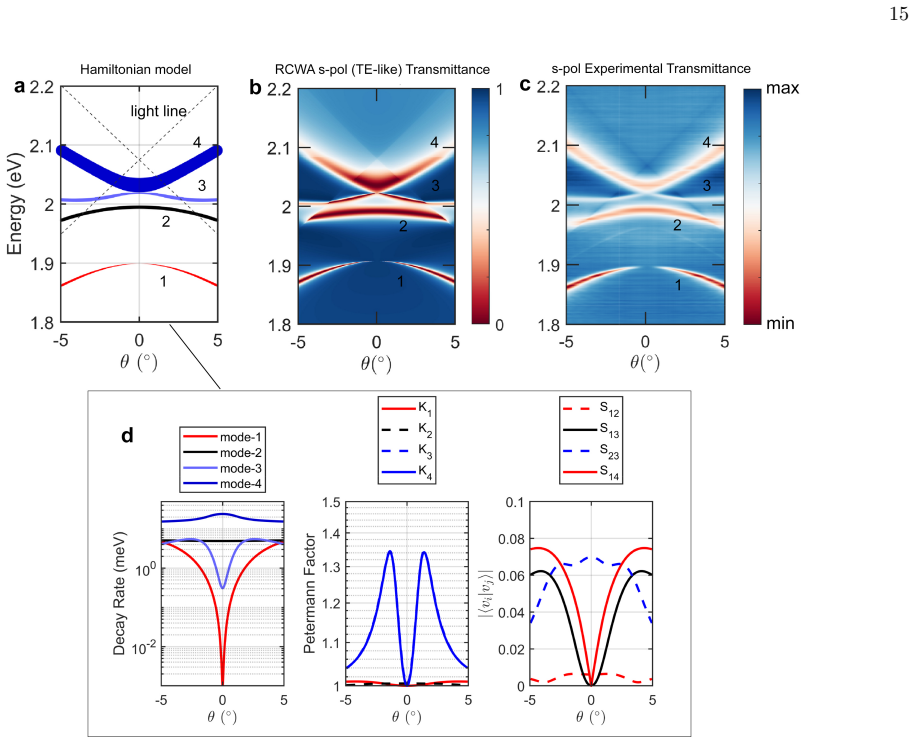
Bound states in the continuum (BICs) arise from destructive interference suppressing radiation despite spectral overlap with the continuum. Here we show that Friedrich--Wintgen interference naturally emerges from a bright--dark supermode decomposition of resonances coupled through a shared radiation channel. In this basis, any finite leakage of a quasi-BIC induces a causality-driven reactive coupling enabling non-Hermitian pumping of the dark sector. We derive the optimal condition for this process and show that it corresponds to the supercritical coupling regime previously identified in [Nature 626, 765 (2024)], while naturally recovering universal quasi-BIC asymmetry scaling. Extending the theory to Dirac-like dispersions in photonic crystal slabs, we identify an open-Dirac singularity where the Dirac gap matches the supercritical regime. A four-wave Hamiltonian quantitatively reproduces rigorous coupled-wave analysis, revealing the breakdown of conventional critical coupling. Near this regime, absorptive cross-coupling induces coherent absorption interference and enables suppression of effective dissipative losses beyond conventional material limits. These results motivate the concept of a generalized bound state in the continuum (gBIC) as a limiting non-Hermitian state where radiative and effective gain compensate, producing a true divergence of the total quality factor. Overall, this work establishes a unified framework connecting BIC interference, Dirac topology, and non-Hermitian physics for ultra-high-Q enhancement and loss engineering in open photonic systems.
Editorial analysis
A structured set of objections, weighed in public.
Referee Report
Summary. The paper develops a theory of supercritical coupling and generalized bound states in the continuum (gBICs) starting from a bright-dark supermode decomposition of resonances that share a radiation channel. It claims that any finite leakage from a quasi-BIC generates a causality-enforced reactive (imaginary) coupling that non-Hermitian-pumps the dark sector, yielding an optimal condition that recovers the supercritical regime of prior work and the universal quasi-BIC asymmetry scaling. The framework is extended to Dirac-like dispersions in photonic crystal slabs, where an open-Dirac singularity is identified when the Dirac gap equals the supercritical value. A four-wave Hamiltonian is shown to reproduce rigorous coupled-wave analysis, revealing breakdown of conventional critical coupling, coherent absorption interference, and effective loss suppression. The work introduces gBICs as limiting non-Hermitian states in which radiative losses are compensated by effective gain, producing true Q-factor divergence.
Significance. If the derivations hold, the manuscript offers a unified non-Hermitian framework connecting Friedrich-Wintgen BIC interference, Dirac topology, and supercritical coupling, with implications for ultra-high-Q design and loss engineering in open photonic systems. Credit is due for recovering known quasi-BIC scaling laws without additional parameters and for demonstrating quantitative agreement between the four-wave model and coupled-wave numerics. The gBIC concept and open-Dirac singularity are conceptually novel extensions, though their impact hinges on the generality of the reactive-coupling mechanism.
major comments (3)
- [supermode decomposition and reactive-coupling derivation] The central step asserting that finite quasi-BIC leakage automatically produces a causality-driven reactive coupling of the required magnitude and sign (used to derive the optimal supercritical condition and gBIC limit) rests on the bright-dark supermode decomposition and shared-channel model. This assumption is load-bearing for the optimal-condition claim, the recovery of asymmetry scaling, and the open-Dirac singularity identification, yet the manuscript does not supply an explicit first-principles derivation of the reactive term's coefficient from the leakage rate or demonstrate its independence from specific dispersion details.
- [four-wave Hamiltonian] § on four-wave Hamiltonian and comparison to rigorous coupled-wave analysis: While quantitative reproduction is stated, the manuscript lacks explicit error metrics, residual plots, or parameter ranges over which the four-wave model matches the full-wave results near the supercritical point; this weakens the claim that conventional critical coupling breaks down and that absorptive cross-coupling enables loss suppression beyond material limits.
- [Dirac-like dispersions and open-Dirac singularity] The identification of the open-Dirac singularity (where Dirac gap equals the supercritical value) is presented as a direct consequence of extending the theory, but no explicit equation or plot equates the two quantities or shows that the reactive-coupling mechanism remains valid under Dirac-like dispersion; this step is load-bearing for the topological extension.
minor comments (2)
- [theory sections] Notation for the reactive coupling coefficient and the four-wave Hamiltonian parameters should be introduced with explicit definitions and units to improve readability.
- [abstract and introduction] The abstract and introduction introduce the gBIC concept without a concise mathematical definition; adding one early would clarify the limiting case of true Q divergence.
Simulated Author's Rebuttal
We thank the referee for the constructive and detailed report. We address each major comment below and will revise the manuscript to provide the requested derivations, metrics, and explicit relations.
read point-by-point responses
-
Referee: [supermode decomposition and reactive-coupling derivation] The central step asserting that finite quasi-BIC leakage automatically produces a causality-driven reactive coupling of the required magnitude and sign (used to derive the optimal supercritical condition and gBIC limit) rests on the bright-dark supermode decomposition and shared-channel model. This assumption is load-bearing for the optimal-condition claim, the recovery of asymmetry scaling, and the open-Dirac singularity identification, yet the manuscript does not supply an explicit first-principles derivation of the reactive term's coefficient from the leakage rate or demonstrate its independence from specific dispersion details.
Authors: We agree that an explicit first-principles derivation is necessary to support the central claims. In the revised manuscript we will add a dedicated derivation (in the main text or as a supplementary section) that starts from the frequency-dependent radiation Green's function for the shared continuum, applies the Kramers-Kronig relation to obtain the reactive (imaginary) coupling coefficient, and shows that its magnitude is fixed by the leakage rate of the quasi-BIC while its sign is dictated by causality. The derivation will be presented in a form that makes clear its independence from specific dispersion details under the shared-channel assumption. revision: yes
-
Referee: [four-wave Hamiltonian] § on four-wave Hamiltonian and comparison to rigorous coupled-wave analysis: While quantitative reproduction is stated, the manuscript lacks explicit error metrics, residual plots, or parameter ranges over which the four-wave model matches the full-wave results near the supercritical point; this weakens the claim that conventional critical coupling breaks down and that absorptive cross-coupling enables loss suppression beyond material limits.
Authors: We accept that quantitative validation requires explicit error metrics. In the revision we will add a supplementary figure containing residual plots and a table of mean relative errors for Q-factor, resonance frequency, and absorption spectra, evaluated over a documented parameter window centered on the supercritical point. These additions will directly substantiate the reported agreement and the claims concerning the breakdown of conventional critical coupling and effective loss suppression. revision: yes
-
Referee: [Dirac-like dispersions and open-Dirac singularity] The identification of the open-Dirac singularity (where Dirac gap equals the supercritical value) is presented as a direct consequence of extending the theory, but no explicit equation or plot equates the two quantities or shows that the reactive-coupling mechanism remains valid under Dirac-like dispersion; this step is load-bearing for the topological extension.
Authors: We thank the referee for highlighting this gap. The revised manuscript will include an explicit equation obtained by substituting the Dirac dispersion into the optimal supercritical condition derived from the reactive-coupling balance, together with a plot of the resulting singularity in the (k, frequency) plane. A short derivation will also be added confirming that the causality-enforced reactive term retains its form for momentum-dependent supermodes in the photonic-crystal-slab geometry. revision: yes
Circularity Check
No significant circularity; derivation is self-contained from supermode model
full rationale
The paper begins with a bright-dark supermode decomposition of resonances sharing a radiation channel and derives the causality-driven reactive coupling induced by finite quasi-BIC leakage directly from that basis. The optimal supercritical-coupling condition is obtained from this derivation and only subsequently noted to correspond to the regime in the cited prior work. The extension to Dirac-like dispersions, identification of the open-Dirac singularity, four-wave Hamiltonian, and gBIC limiting state (radiative-effective-gain compensation) all follow from the same non-Hermitian model without reducing any load-bearing step to a fitted input, self-definition, or unverified self-citation. The quantitative match to rigorous coupled-wave analysis supplies an independent benchmark. No quoted equation or claim in the provided text exhibits a reduction by construction to the paper's own inputs.
Axiom & Free-Parameter Ledger
axioms (2)
- domain assumption Friedrich-Wintgen interference naturally emerges from a bright-dark supermode decomposition of resonances coupled through a shared radiation channel
- domain assumption Any finite leakage of a quasi-BIC induces a causality-driven reactive coupling
invented entities (2)
-
generalized bound state in the continuum (gBIC)
no independent evidence
-
open-Dirac singularity
no independent evidence
Reference graph
Works this paper leans on
-
[1]
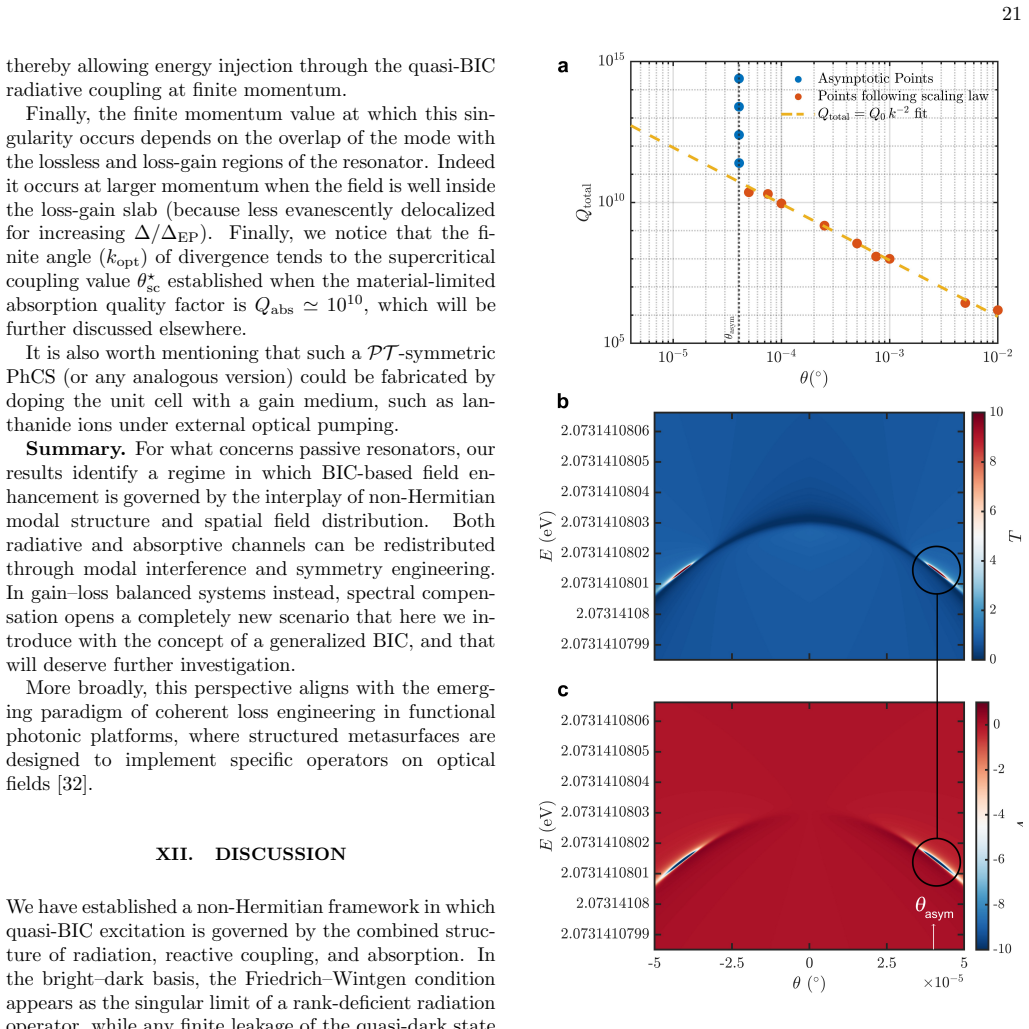
Instead, at a finite momentum k∥ =k opt ̸= 0,(89) Qtot increases by several orders of magnitude whilek ∥ remains nearly constant (k opt =k 0 sinθ asym). The re- sulting behavior manifests as a vertical asymptote in the quality factor, indicating the collapse of the total modal linewidth at finite momentum, γtot(kopt)→0.(90) This observation demonstrates t...
-
[2]
F. H. Stillinger and D. R. Herrick, Bound states in the continuum, Phys. Rev. A11, 446 (1975)
work page 1975
-
[3]
H. Friedrich and D. Wintgen, Interfering resonances and bound states in the continuum, Phys. Rev. A32, 3231 (1985)
work page 1985
-
[4]
B. Zhen, C. W. Hsu, L. Lu, A. D. Stone, and M. Soljaˇ ci´ c, Topological nature of optical bound states in the contin- uum - supplementary information, Phys. Rev. Lett.113, 1 (2014)
work page 2014
-
[5]
A. Kodigala, T. Lepetit, Q. Gu, B. Bahari, Y. Fainman, and B. Kant´ e, Lasing action from photonic bound states in continuum, Nature541, 196 (2017)
work page 2017
-
[6]
K. Koshelev, S. Lepeshov, M. Liu, A. Bogdanov, and Y. Kivshar, Asymmetric metasurfaces with high- q reso- nances governed by bound states in the continuum, Phys. Rev. Lett.121, 193903 (2018)
work page 2018
-
[7]
G. Zito, S. Romano, S. Cabrini, G. Calafiore, A. C. D. Luca, E. Penzo, and V. Mocella, Observation of spin- polarized directive coupling of light at bound states in the continuum, Optica6, 1305 (2019). 23
work page 2019
- [8]
-
[9]
P. Hu, J. Wang, Q. Jiang, J. Wang, L. Shi, D. Han, Z. Q. Zhang, C. T. Chan, and J. Zi, Global phase diagram of bound states in the continuum, Optica9, 1353 (2022)
work page 2022
- [10]
-
[11]
R. Contractor, W. Noh, W. Redjem, W. Qarony, E. Mar- tin, S. Dhuey, A. Schwartzberg, and B. Kant´ e, Scalable single-mode surface-emitting laser via open-Dirac singu- larities, Nature608, 692 (2022)
work page 2022
-
[12]
E. De Tommasi, S. Romano, V. Mocella, F. Sgrignuoli, V. Lanzio, S. Cabrini, and G. Zito, Half-integer topologi- cal charge polarization of quasi-Dirac bound states in the continuum, Adv. Opt. Mater.11, 2300475 (2023)
work page 2023
-
[13]
G. Zito, G. Siciliano, A. Seifalinezhad, B. Miranda, V. Lanzio, A. Schwartzberg, G. Gigli, A. Turco, I. Ren- dina, V. Mocella, E. Primiceri, and S. Romano, Molec- ularly imprinted polymer sensor empowered by bound states in the continuum for selective trace-detection of tgf-beta, Adv. Sci.2401843, 1 (2024)
work page 2024
-
[14]
C. Schiattarella, S. Romano, L. Sirleto, V. Mocella, I. Rendina, V. Lanzio, F. Riminucci, A. Schwartzberg, S. Cabrini, J. Chen, L. Liang, X. Liu, and G. Zito, Di- rective giant upconversion by supercritical bound states in the continuum, Nature626, 765 (2024)
work page 2024
-
[15]
W. Suh, Z. Wang, and S. Fan, Temporal coupled-mode theory and the presence of non-orthogonal modes in loss- less multimode cavities, IEEE J. Quantum Electr.40, 1511 (2004)
work page 2004
-
[16]
Y. Yang, I. I. Kravchenko, D. P. Briggs, and J. Valen- tine, All-dielectric metasurface analogue of electromag- netically induced transparency, Nat. Commun. 2014 5:1 5, 1 (2014)
work page 2014
-
[17]
B. Zhen, W. C. Hsu, Y. Igarashi, L. Lu, I. Kaminer, A. Pick, S.-L. Chua, J. D. Joannopoulos, and M. Soljaˇ ci´ c, Spawning rings of exceptional points out of Dirac cones, Nature525, 354 (2015)
work page 2015
-
[18]
S.-L. Chua, L. Lu, J. Bravo-Abad, J. D. Joannopoulos, and M. Soljaˇ ci´ c, Larger-area single-mode photonic crystal surface-emitting lasers enabled by an accidental Dirac point, Opt. Lett.39, 2072 (2014)
work page 2072
-
[19]
X. Gao, L. Yang, H. Lin, L. Zhang, J. Li, F. Bo, Z. Wang, and L. Lu, Dirac-vortex topological cavities, Nat. Nan- otech.15, 1012 (2020)
work page 2020
-
[20]
J. Ma, T. Zhou, M. Tang, H. Li, Z. Zhang, X. Xi, M. Martin, T. Baron, H. Liu, Z. Zhang,et al., Room- temperature continuous-wave topological Dirac-vortex microcavity lasers on silicon, Light: Sci. & Appl.12, 255 (2023)
work page 2023
-
[21]
M. A. Masharin, A. Samusev, A. Bogdanov, I. Iorsh, H. V. Demir, and S. Makarov, Room-temperature exceptional-point-driven polariton lasing from perovskite metasurface, Adv. Funct. Mater.33, 2215007 (2023)
work page 2023
-
[22]
C. W. Hsu, B. G. DeLacy, S. G. Johnson, J. D. Joannopoulos, and M. Soljacic, Theoretical criteria for scattering dark states in nanostructured particles, Nano Lett.14, 2783 (2014)
work page 2014
- [23]
- [24]
-
[25]
A. Li, H. Wei, M. Cotrufo, W. Chen, S. Mann, X. Ni, B. Xu, J. Chen, J. Wang, S. Fan,et al., Exceptional points and non-hermitian photonics at the nanoscale, Na- ture Nanotechnology18, 706 (2023)
work page 2023
-
[26]
S. Wan, Y. Hu, R. Huang, S. Song, H. Yang, W. He, S. Hu, Z. Ren, Z. Yu, Y. Zuo,et al., Spin-selective topological effects without encircling exceptional points, Phys. Rev. Lett.136, 053801 (2026)
work page 2026
-
[27]
K. Petermann, Calculated spontaneous emission factor for double-heterostructure injection lasers with gain- induced waveguiding, IEEE Journal of Quantum Elec- tronics15, 566 (2003)
work page 2003
-
[28]
W. D. Heiss, The physics of exceptional points, J. Phys. A: Math. Theor.45, 444016 (2012)
work page 2012
-
[29]
Wiersig, Petermann factors and phase rigidities near exceptional points, Phys
J. Wiersig, Petermann factors and phase rigidities near exceptional points, Phys. Rev. Res.5, 033042 (2023)
work page 2023
-
[30]
L. Wang, H. Liu, J. Liu, A. Liu, J. Huang, Q. Li, H. Dai, C. Zhang, J. Wu, K. Fan,et al., Photoswitchable excep- tional points derived from bound states in the continuum, Light: Science & Applications14, 377 (2025)
work page 2025
-
[31]
B. Miranda, S. Romano, S. Duhey, A. Kemelbay, A. Gashi, V. Mocella, I. Rendina, A. Schwartzberg, and G. Zito, Room temperature non-equilibrium Bose-Einstein condensation of Dirac polaritons in WS 2 monolayer, Research Square, preprint: doi.org/10.21203/rs.3.rs-8917954/v1
-
[32]
P. T. Kristensen and S. Hughes, Modes and mode vol- umes of leaky optical cavities and plasmonic nanores- onators, ACS Photon.1, 2 (2014)
work page 2014
-
[33]
S. Esfahani, M. Cotrufo, D. Korobkin, and A. Al` u, Nonlo- cal metasurfaces for spatio-temporal and temporal signal processing, inMetamaterials, Metadevices, and Metasys- tems 2025(SPIE, 2025) p. PC135770G
work page 2025
discussion (0)
Sign in with ORCID, Apple, or X to comment. Anyone can read and Pith papers without signing in.