Recognition: no theorem link
SMEFT everywhere: a NLO study of boldsymbol{pp to tbar{t}H} with decaying tops
Pith reviewed 2026-05-13 05:54 UTC · model grok-4.3
The pith
SMEFT operators in top decays must be included at NLO to capture the shapes of observables in ttH production at the LHC.
A machine-rendered reading of the paper's core claim, the machinery that carries it, and where it could break.
Core claim
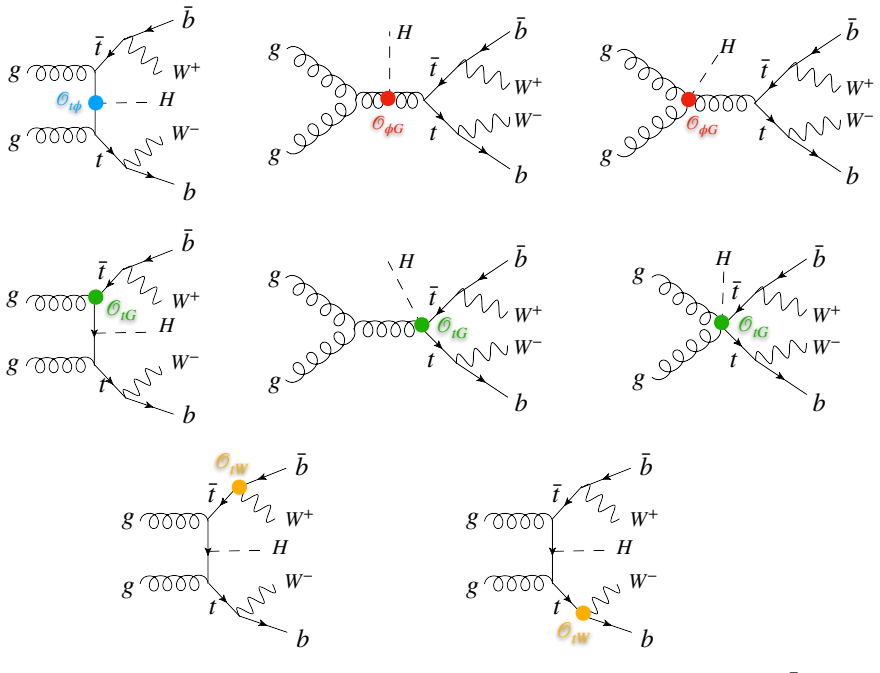
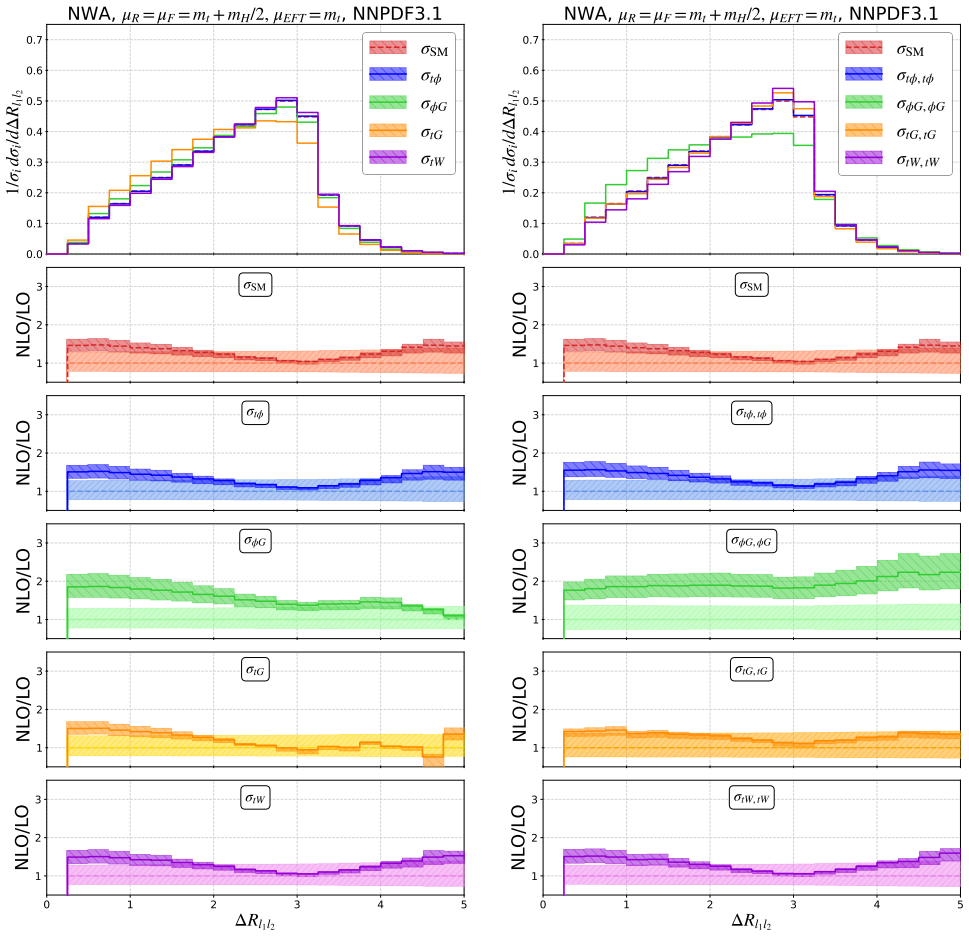
We present the computation of the next-to-leading order QCD corrections to the pp→t¯tH+X process in the di-lepton channel at the LHC, including relevant dimension-6 operators (O_tφ, O_φG, O_tG, O_tW) from the Standard Model Effective Field Theory. In our studies, higher-order corrections and effective operators are consistently included in the production part of the process as well as in the top-quark decays. We show that kinematic cuts, as well as higher-order effects and SMEFT operators in top-quark decays, are important and should be consistently considered together, because they have a significant impact on the shape of the standard observables measured for the pp→t¯tH+X process at the 0
What carries the argument
Consistent inclusion of the four dimension-6 SMEFT operators (O_tφ, O_φG, O_tG, O_tW) in both production and top-quark decays at NLO QCD.
If this is right
- Linear, cross, and quadratic contributions from the operators affect cross sections and shapes differently.
- Renormalization group effects of the operators must be accounted for in predictions.
- Predictions with stable tops differ from those with reconstructed decays from leptons.
- At 13.6 TeV these effects impact measurements in LHC Run III data.
Where Pith is reading between the lines
- Global SMEFT fits to ttH data may need to include decay operators to avoid biased constraints on the operators.
- Similar consistent treatments could be important for other top-associated processes like ttZ or single top production.
- Future work adding electroweak corrections might modify the uncertainties reported in this NLO QCD study.
Load-bearing premise
The four listed dimension-6 operators capture the dominant new-physics effects and that neglecting higher-dimensional operators or electroweak corrections does not alter the reported shapes and uncertainties at the level claimed.
What would settle it
A measurement at the LHC showing that the shapes of differential distributions in ttH events remain unchanged when SMEFT operators are included in top decays beyond the stated uncertainties, or that adding other operators changes them substantially.
Figures





read the original abstract
We present the computation of the next-to-leading order QCD corrections to the $pp\to t\bar{t} H+X$ process in the di-lepton channel at the LHC, including relevant dimension-6 operators $({\cal O}_{t\phi}, \, {\cal O}_{\phi G},\, {\cal O}_{tG}, \, {\cal O}_{tW})$ from the Standard Model Effective Field Theory. In our studies, higher-order corrections and effective operators are consistently included in the production part of the process as well as in the top-quark decays. We perform a detailed study of linear, cross, and quadratic contributions and their uncertainties, including renormalisation group effects. Our findings are presented at the integrated and differential cross-section level for the LHC Run III center-of-mass energy of $\sqrt{s}=13.6$ TeV. Finally, we provide predictions for $pp\to t\bar{t} H+X$ with stable top quarks and compare them with the results in which top quarks are reconstructed from their decay products. We show that kinematic cuts, as well as higher-order effects and SMEFT operators in top-quark decays, are important and should be consistently considered together, because they have a significant impact on the shape of the standard observables measured for the $pp\to t\bar{t}H+X$ process at the LHC.
Editorial analysis
A structured set of objections, weighed in public.
Referee Report
Summary. The paper computes next-to-leading-order QCD corrections to pp → t t-bar H + X in the dilepton channel at the LHC, incorporating four dimension-6 SMEFT operators (O_tφ, O_φG, O_tG, O_tW) consistently in both production and top-quark decays. It examines linear, cross, and quadratic contributions with uncertainties and renormalization-group evolution, presenting integrated and differential cross sections at √s = 13.6 TeV. Predictions assuming stable top quarks are compared to those with tops reconstructed from decay products, with the conclusion that kinematic cuts, higher-order effects, and SMEFT operators in decays significantly impact the shapes of standard observables.
Significance. If the numerical results hold, the work establishes that consistent inclusion of SMEFT effects in top decays at NLO is required to avoid distorting differential distributions in ttH production, with direct relevance to LHC precision measurements and new-physics searches. The technical advance lies in the simultaneous treatment of production and decay at NLO together with RG running, and the stable-versus-decaying comparison quantifies reconstruction biases.
major comments (1)
- [Introduction and operator-selection discussion] The central claim that the reported shape modifications from linear+quadratic SMEFT contributions are robust under truncation relies on the four operators capturing dominant effects. No explicit comparison to an enlarged basis (e.g., adding O_tB or relevant four-fermion operators) or estimate of dimension-8 insertions is provided in the same differential bins where kinematic cuts are shown to amplify deviations. This omission is load-bearing because the paper itself demonstrates that cuts enhance sensitivity in specific phase-space regions.
minor comments (2)
- Figure captions and legends should explicitly label the separate linear, interference, and quadratic SMEFT contributions as well as the SM baseline to improve readability of the differential distributions.
- A brief statement on the size of neglected electroweak corrections relative to the quoted QCD uncertainties would clarify the truncation assumptions in the results section.
Simulated Author's Rebuttal
We thank the referee for the careful reading of our manuscript and the constructive feedback. We address the single major comment below and have revised the paper accordingly to strengthen the discussion of operator selection.
read point-by-point responses
-
Referee: The central claim that the reported shape modifications from linear+quadratic SMEFT contributions are robust under truncation relies on the four operators capturing dominant effects. No explicit comparison to an enlarged basis (e.g., adding O_tB or relevant four-fermion operators) or estimate of dimension-8 insertions is provided in the same differential bins where kinematic cuts are shown to amplify deviations. This omission is load-bearing because the paper itself demonstrates that cuts enhance sensitivity in specific phase-space regions.
Authors: We agree that an explicit justification for the truncation is important, especially given the demonstrated sensitivity to kinematic cuts. The operators O_tφ, O_φG, O_tG and O_tW were chosen as they directly enter the top-Yukawa, Higgs-gluon, top-gluon and top-W vertices that dominate both production and dilepton decays in ttH. Operators such as O_tB primarily affect electroweak vertices with smaller QCD impact at 13.6 TeV, while four-fermion operators are typically bounded to be small by other LHC and precision data and would require separate matching. Dimension-8 terms are parametrically suppressed by additional 1/Λ² factors. In the revised manuscript we have expanded the introduction with a dedicated paragraph that (i) cites global SMEFT fits supporting the dominance of these four operators for ttH observables, (ii) provides a qualitative estimate of the possible size of neglected contributions based on current Wilson-coefficient bounds, and (iii) explicitly states that a full numerical comparison over an enlarged basis in the identical differential bins lies beyond the present computational scope but is planned for future work. We believe this addition addresses the robustness concern without altering the central numerical results. revision: partial
Circularity Check
No significant circularity in direct perturbative SMEFT NLO computation
full rationale
The paper performs a standard next-to-leading-order QCD calculation in the SMEFT for the pp→ttH process, incorporating four dimension-6 operators consistently in production and decays. The reported shapes and impacts are direct outputs of the perturbative expansion, including linear, quadratic, and interference terms, without any parameter fitting or self-referential definitions that would make predictions equivalent to inputs by construction. Comparisons to stable top predictions are explicit reconstructions. No self-citation load-bearing or ansatz smuggling is evident in the derivation chain. This is a self-contained computational study within established frameworks.
Axiom & Free-Parameter Ledger
axioms (1)
- domain assumption Validity of SMEFT at LHC energies with only dimension-6 operators
Reference graph
Works this paper leans on
-
[1]
S. Frixione, V. Hirschi, D. Pagani, H.S. Shao and M. Zaro,Electroweak and QCD corrections to top-pair hadroproduction in association with heavy bosons,JHEP06(2015) 184 [1504.03446]
-
[2]
A. Denner, J.-N. Lang, M. Pellen and S. Uccirati,Higgs production in association with off-shell top-antitop pairs at NLO EW and QCD at the LHC,JHEP02(2017) 053 [1612.07138]
-
[3]
D. Stremmer and M. Worek,Production and decay of the Higgs boson in association with top quarks, JHEP02(2022) 196 [2111.01427]
-
[4]
J. Hermann, D. Stremmer and M. Worek,CPstructure of the top-quark Yukawa interaction: NLO QCD corrections and off-shell effects,JHEP09(2022) 138 [2205.09983]
- [5]
-
[6]
G. Bevilacqua, M. Czakon, A. van Hameren, C.G. Papadopoulos and M. Worek,Complete off-shell effects in top quark pair hadroproduction with leptonic decay at next-to-leading order,JHEP02(2011) 083 [1012.4230]
- [7]
-
[8]
A. Denner and R. Feger,NLO QCD corrections to off-shell top-antitop production with leptonic decays in association with a Higgs boson at the LHC,JHEP11(2015) 209 [1506.07448]
-
[9]
O. Bessidskaia Bylund, F. Maltoni, I. Tsinikos, E. Vryonidou and C. Zhang,Probing top quark neutral couplings in the Standard Model Effective Field Theory at NLO in QCD,JHEP05(2016) 052 [1601.08193]
-
[10]
C. Zhang,Single Top Production at Next-to-Leading Order in the Standard Model Effective Field Theory, Phys. Rev. Lett.116(2016) 162002 [1601.06163]
-
[11]
F. Maltoni, E. Vryonidou and C. Zhang,Higgs production in association with a top-antitop pair in the Standard Model Effective Field Theory at NLO in QCD,JHEP10(2016) 123 [1607.05330]
-
[12]
M. de Beurs, E. Laenen, M. Vreeswijk and E. Vryonidou,Effective operators int-channel single top production and decay,Eur. Phys. J. C78(2018) 919 [1807.03576]
-
[13]
Off-shell single-top-quark production in the Standard Model Effective Field Theory
T. Neumann and Z.E. Sullivan,Off-Shell Single-Top-Quark Production in the Standard Model Effective Field Theory,JHEP06(2019) 022 [1903.11023]. – 43 –
work page Pith review arXiv 2019
-
[14]
N.P. Hartland, F. Maltoni, E.R. Nocera, J. Rojo, E. Slade, E. Vryonidou et al.,A Monte Carlo global analysis of the Standard Model Effective Field Theory: the top quark sector,JHEP04(2019) 100 [1901.05965]
- [15]
- [16]
-
[17]
C. Degrande, R. Rosenfeld and A. Vasquez,Collider sensitivity to SMEFT heavy-quark operators at one-loop in top-quark processes,JHEP07(2024) 114 [2402.06528]
-
[18]
J. Alwall, R. Frederix, S. Frixione, V. Hirschi, F. Maltoni, O. Mattelaer et al.,The automated computation of tree-level and next-to-leading order differential cross sections, and their matching to parton shower simulations,JHEP07(2014) 079 [1405.0301]
work page internal anchor Pith review Pith/arXiv arXiv 2014
-
[19]
UFO - The Universal FeynRules Output
C. Degrande, C. Duhr, B. Fuks, D. Grellscheid, O. Mattelaer and T. Reiter,UFO - The Universal FeynRules Output,Comput. Phys. Commun.183(2012) 1201 [1108.2040]
work page Pith review arXiv 2012
-
[20]
Darmé et al.,UFO 2.0: the ‘Universal Feynman Output’ format,Eur
L. Darmé et al.,UFO 2.0: the ‘Universal Feynman Output’ format,Eur. Phys. J. C83(2023) 631 [2304.09883]
- [21]
-
[22]
Brivio,SMEFTsim 3.0 — a practical guide,JHEP04(2021) 073 [2012.11343]
I. Brivio,SMEFTsim 3.0 — a practical guide,JHEP04(2021) 073 [2012.11343]
-
[23]
C. Degrande, G. Durieux, F. Maltoni, K. Mimasu, E. Vryonidou and C. Zhang,Automated one-loop computations in the standard model effective field theory,Phys. Rev. D103(2021) 096024 [2008.11743]
- [24]
- [25]
-
[26]
E.E. Jenkins, A.V. Manohar and M. Trott,Renormalization Group Evolution of the Standard Model Dimension Six Operators I: Formalism and lambda Dependence,JHEP10(2013) 087 [1308.2627]
-
[27]
E.E. Jenkins, A.V. Manohar and M. Trott,Renormalization Group Evolution of the Standard Model Dimension Six Operators II: Yukawa Dependence,JHEP01(2014) 035 [1310.4838]
-
[28]
R. Alonso, E.E. Jenkins, A.V. Manohar and M. Trott,Renormalization Group Evolution of the Standard Model Dimension Six Operators III: Gauge Coupling Dependence and Phenomenology,JHEP04(2014) 159 [1312.2014]
- [29]
-
[30]
S. Di Noi and R. Gröber,Renormalisation group running effects inpp→t¯thin the Standard Model Effective Field Theory,Eur. Phys. J. C84(2024) 403 [2312.11327]
-
[31]
R. Bartocci, A. Biekötter and T. Hurth,Renormalisation group evolution effects on global SMEFT analyses,JHEP05(2025) 203 [2412.09674]
- [32]
-
[33]
S. Di Noi and R. Gröber,Two loops, four tops and twoγ5 schemes: A renormalization story,Phys. Lett. B869(2025) 139878 [2507.10295]
-
[34]
S. Di Noi, B.A. Erdelyi and R. Gröber,Complete two-loop Yukawa-induced running of the Higgs-gluon coupling in SMEFT,2510.14680. – 44 –
- [35]
- [36]
-
[37]
J. Aebischer, J. Kumar and D.M. Straub,Wilson: a Python package for the running and matching of Wilson coefficients above and below the electroweak scale,Eur. Phys. J. C78(2018) 1026 [1804.05033]
-
[38]
J. Fuentes-Martin, P. Ruiz-Femenia, A. Vicente and J. Virto,DsixTools 2.0: The Effective Field Theory Toolkit,Eur. Phys. J. C81(2021) 167 [2010.16341]
-
[39]
S. Di Noi and L. Silvestrini,RGESolver: a C++ library to perform renormalization group evolution in the Standard Model Effective Theory,Eur. Phys. J. C83(2023) 200 [2210.06838]
-
[40]
R. Boughezal, C.-Y. Chen, F. Petriello and D. Wiegand,Top quark decay at next-to-leading order in the Standard Model Effective Field Theory,Phys. Rev. D100(2019) 056023 [1907.00997]
-
[41]
D. Barducci et al.,Interpreting top-quark LHC measurements in the standard-model effective field theory, 1802.07237
-
[42]
Dimension-Six Terms in the Standard Model Lagrangian
B. Grzadkowski, M. Iskrzynski, M. Misiak and J. Rosiek,Dimension-Six Terms in the Standard Model Lagrangian,JHEP10(2010) 085 [1008.4884]
work page internal anchor Pith review arXiv 2010
-
[43]
F. Maltoni, G. Ventura and E. Vryonidou,Impact of SMEFT renormalisation group running on Higgs production at the LHC,JHEP12(2024) 183 [2406.06670]
- [44]
-
[45]
V. Hirschi, F. Maltoni, I. Tsinikos and E. Vryonidou,Constraining anomalous gluon self-interactions at the LHC: a reappraisal,JHEP07(2018) 093 [1806.04696]
-
[46]
M.P. Rosello and M. Vos,Constraints on four-fermion interactions from thet¯tcharge asymmetry at hadron colliders,Eur. Phys. J. C76(2016) 200 [1512.07542]
-
[47]
A. Buckley, C. Englert, J. Ferrando, D.J. Miller, L. Moore, M. Russell et al.,Global fit of top quark effective theory to data,Phys. Rev. D92(2015) 091501 [1506.08845]
-
[48]
A. Buckley, C. Englert, J. Ferrando, D.J. Miller, L. Moore, M. Russell et al.,Constraining top quark effective theory in the LHC Run II era,JHEP04(2016) 015 [1512.03360]
-
[49]
G. Bevilacqua, M. Czakon, M.V. Garzelli, A. van Hameren, A. Kardos, C.G. Papadopoulos et al., HELAC-NLO,Comput. Phys. Commun.184(2013) 986 [1110.1499]
-
[50]
A. van Hameren, C.G. Papadopoulos and R. Pittau,Automated one-loop calculations: A Proof of concept,JHEP09(2009) 106 [0903.4665]
-
[51]
M. Czakon, C.G. Papadopoulos and M. Worek,Polarizing the Dipoles,JHEP08(2009) 085 [0905.0883]
-
[52]
G. Bevilacqua, M. Czakon, M. Kubocz and M. Worek,Complete Nagy-Soper subtraction for next-to-leading order calculations in QCD,JHEP10(2013) 204 [1308.5605]
-
[53]
G. Ossola, C.G. Papadopoulos and R. Pittau,CutTools: A Program implementing the OPP reduction method to compute one-loop amplitudes,JHEP03(2008) 042 [0711.3596]
-
[54]
van Hameren,OneLOop: For the evaluation of one-loop scalar functions,Comput
A. van Hameren,OneLOop: For the evaluation of one-loop scalar functions,Comput. Phys. Commun. 182(2011) 2427 [1007.4716]
-
[55]
van Hameren,Kaleu: A General-Purpose Parton-Level Phase Space Generator,1003.4953
A. van Hameren,Kaleu: A General-Purpose Parton-Level Phase Space Generator,1003.4953
-
[56]
J. Hermann,Signal and background modeling in BSM studies in the top-quark sector at the LHC, phd dissertation, RWTH Aachen University, Aachen, (2023). 10.18154/RWTH-2023-11870
-
[57]
G. Bevilacqua, H.B. Hartanto, M. Kraus, T. Weber and M. Worek,Off-shell vs on-shell modelling of top – 45 – quarks in photon associated production,JHEP03(2020) 154 [1912.09999]
-
[58]
A standard format for Les Houches Event Files
J. Alwall et al.,A Standard format for Les Houches event files,Comput. Phys. Commun.176(2007) 300 [hep-ph/0609017]
work page Pith review arXiv 2007
-
[59]
I. Antcheva et al.,ROOT: A C++ framework for petabyte data storage, statistical analysis and visualization,Comput. Phys. Commun.180(2009) 2499 [1508.07749]
- [60]
-
[61]
A. Kanaki and C.G. Papadopoulos,HELAC: A Package to compute electroweak helicity amplitudes, Comput. Phys. Commun.132(2000) 306 [hep-ph/0002082]
-
[62]
A. Cafarella, C.G. Papadopoulos and M. Worek,Helac-Phegas: A Generator for all parton level processes,Comput. Phys. Commun.180(2009) 1941 [0710.2427]
-
[63]
’t Hooft,A Planar Diagram Theory for Strong Interactions,Nucl
G. ’t Hooft,A Planar Diagram Theory for Strong Interactions,Nucl. Phys. B72(1974) 461
work page 1974
-
[64]
C.G. Papadopoulos and M. Worek,Multi-parton cross sections at hadron colliders,Eur. Phys. J. C50 (2007) 843 [hep-ph/0512150]
- [65]
-
[66]
LHAPDF6: parton density access in the LHC precision era
A. Buckley, J. Ferrando, S. Lloyd, K. Nordström, B. Page, M. Rüfenacht et al.,LHAPDF6: parton density access in the LHC precision era,Eur. Phys. J. C75(2015) 132 [1412.7420]
work page Pith review arXiv 2015
-
[67]
M. Jezabek and J.H. Kuhn,QCD Corrections to Semileptonic Decays of Heavy Quarks,Nucl. Phys. B 314(1989) 1
work page 1989
-
[68]
Zhang,Effective field theory approach to top-quark decay at next-to-leading order in QCD,Phys
C. Zhang,Effective field theory approach to top-quark decay at next-to-leading order in QCD,Phys. Rev. D90(2014) 014008 [1404.1264]. [72]CMScollaboration,Measurement of the RatioB(t→W b)/B(t→W q)in pp Collisions at √s= 8 TeV, Phys. Lett. B736(2014) 33 [1404.2292]. [73]ATLAScollaboration,Direct top-quark decay width measurement in thet ¯tlepton+jets channe...
- [69]
-
[70]
The anti-k_t jet clustering algorithm
M. Cacciari, G.P. Salam and G. Soyez,The anti-kt jet clustering algorithm,JHEP04(2008) 063 [0802.1189]
work page internal anchor Pith review Pith/arXiv arXiv 2008
-
[71]
R. Contino, A. Falkowski, F. Goertz, C. Grojean and F. Riva,On the Validity of the Effective Field Theory Approach to SM Precision Tests,JHEP07(2016) 144 [1604.06444]
- [72]
discussion (0)
Sign in with ORCID, Apple, or X to comment. Anyone can read and Pith papers without signing in.