Recognition: 2 theorem links
· Lean TheoremCERTIFY-ED: A Multi-Layer Verification Framework for Exact Diagonalization of Quantum Many-Body Systems
Pith reviewed 2026-05-13 05:19 UTC · model grok-4.3
The pith
CERTIFY-ED supplies machine-checkable certificates for the numerical correctness of exact diagonalization results in quantum many-body physics.
A machine-rendered reading of the paper's core claim, the machinery that carries it, and where it could break.
Core claim
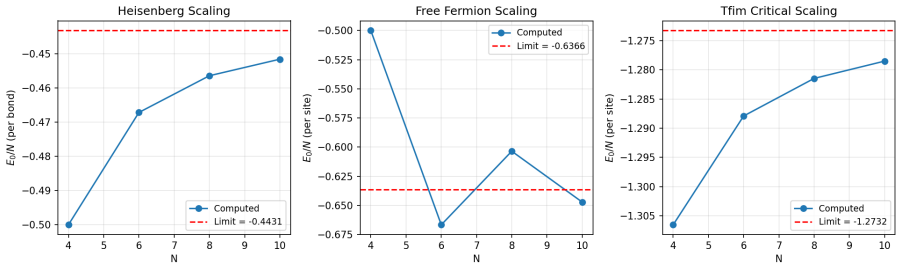
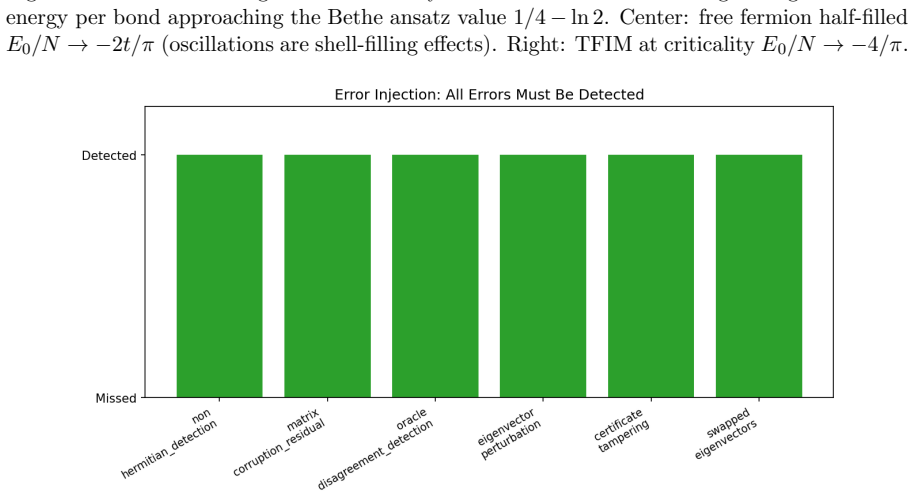
CERTIFY-ED is a multi-layer verification framework for exact diagonalization that consists of a multi-oracle eigensolver executing three independent LAPACK paths and reporting pairwise disagreement, thirteen logically independent validation layers covering algebraic invariants, analytic limits, alternative algorithms, arbitrary-precision reference computation, conservation laws, dynamical consistency, and finite-size scaling, plus tamper-evident SHA-256 hashed certificates. An error-injection layer confirms detection of six injected error classes. When executed on sixteen physics models, the framework passes 53 of 53 unit tests and 81 of 81 individual validation tests in under thirty seconds
What carries the argument
The multi-oracle eigensolver that compares three independent LAPACK paths together with the thirteen logically independent validation layers that cross-check algebraic invariants, physical conservation laws, and arbitrary-precision references.
If this is right
- Published exact diagonalization results can be accompanied by machine-verifiable certificates that any reader can check independently.
- The framework integrates as a companion to existing packages such as QuSpin, XDiag, and ALPS rather than replacing them.
- Error-injection tests establish that the pipeline catches six distinct classes of implementation or numerical faults.
- Agreement to 10 to the minus 15 with arbitrary-precision references holds across one- and two-dimensional models including spin chains and Kitaev clusters.
Where Pith is reading between the lines
- Similar layered verification could be applied to other numerical techniques such as density-matrix renormalization group or quantum Monte Carlo to raise the standard of evidence for theoretical claims.
- Widespread adoption would allow automated meta-analyses to filter or weight results according to the presence of certificates.
- The tamper-evident certificates could support reproducibility requirements in journal policies for numerical work in condensed-matter theory.
Load-bearing premise
That the thirteen chosen validation layers together with the three LAPACK paths are sufficient to detect all relevant classes of numerical or implementation errors that could affect downstream theoretical claims.
What would settle it
A single model and observable where the framework passes all thirteen layers and three LAPACK comparisons yet the reported eigenvalue differs from an independent 100-digit mpmath computation by more than 10 to the minus 12.
Figures


read the original abstract
Exact diagonalization (ED) is a workhorse technique in computational quantum many-body physics, but published ED results are rarely accompanied by machine-checkable evidence of their numerical correctness. The community typically relies on the implicit trust chain LAPACK $\to$ user code $\to$ result, with at most informal agreement against another package treated as confirmation. We argue that this practice is inadequate for a method whose output frequently underpins theoretical claims, and we present \textsc{certify-ed}, a verification framework designed to be used \emph{alongside} existing ED packages (QuSpin, XDiag, ALPS) rather than as a replacement for them. The framework consists of (i) a multi-oracle eigensolver that runs three independent LAPACK paths and reports their pairwise disagreement, (ii) thirteen logically independent validation layers covering algebraic invariants, analytic limits, alternative algorithms, arbitrary-precision reference computation, conservation laws, dynamical consistency, and finite-size scaling, and (iii) tamper-evident SHA-256 hashed certificates that downstream consumers can verify. The framework also ships an error-injection layer that confirms the entire pipeline detects six injected error classes. Running on sixteen physics models from one-dimensional spin chains to two-dimensional Kitaev honeycomb clusters, our reference implementation passes 53 of 53 unit tests and 81 of 81 individual validation tests in under thirty seconds, with maximum disagreement against QuSpin of $1.6\times 10^{-14}$ across 320 eigenvalue comparisons, and agreement with 50-digit \texttt{mpmath} reference values to $1.6\times 10^{-15}$. The package is released under the MIT license on Zenodo and Github
Editorial analysis
A structured set of objections, weighed in public.
Referee Report
Summary. The manuscript introduces CERTIFY-ED, a multi-layer verification framework intended to be used alongside existing exact diagonalization (ED) packages such as QuSpin, XDiag, and ALPS. The framework comprises a multi-oracle eigensolver that executes three independent LAPACK paths and reports pairwise disagreements, thirteen logically independent validation layers addressing algebraic invariants, analytic limits, conservation laws, dynamical consistency, finite-size scaling, and arbitrary-precision references, tamper-evident SHA-256 certificates, and an error-injection module that tests detection of six error classes. On sixteen models spanning one-dimensional spin chains to two-dimensional Kitaev honeycomb clusters, the reference implementation passes all 53 unit tests and 81 validation tests in under thirty seconds, with maximum disagreement against QuSpin of 1.6×10^{-14} across 320 eigenvalue comparisons and agreement with 50-digit mpmath references to 1.6×10^{-15}.
Significance. If the reported numerical agreements and test passage hold, the work supplies a practical, machine-checkable verification pipeline that materially strengthens the trust chain for ED results frequently used to support theoretical claims in quantum many-body physics. The explicit coverage of multiple error classes via independent layers and external oracles (QuSpin, mpmath, standard LAPACK) plus the open MIT-licensed release on Zenodo and GitHub represent concrete advances over the current informal LAPACK-to-result practice.
minor comments (2)
- The description of the thirteen validation layers in §3 would be clearer if accompanied by an explicit table mapping each layer to the error classes it targets and the models on which it was exercised.
- The timing claim of 'under thirty seconds' for the full test suite on sixteen models is stated in the abstract and §4 but lacks a breakdown by model size or layer, which would help readers assess scalability.
Simulated Author's Rebuttal
We thank the referee for their positive assessment of the manuscript, recognition of its practical value for strengthening the trust chain in exact diagonalization results, and recommendation to accept. We are pleased that the multi-layer verification approach, error-injection testing, and open-source release are viewed as concrete advances.
Circularity Check
No significant circularity
full rationale
The paper introduces a software verification framework for exact diagonalization rather than deriving any physical prediction or first-principles result. Its central claims rest on empirical passage of unit and validation tests against external references (QuSpin, mpmath 50-digit arithmetic, and multiple independent LAPACK paths), with explicit error-injection checks. No equations, fitted parameters, or uniqueness theorems are defined in terms of their own outputs, and no self-citation chain is invoked to justify load-bearing steps. The reported numerical agreements (e.g., 1.6e-14 vs QuSpin, 1.6e-15 vs mpmath) are direct comparisons to independent oracles, not reductions by construction.
Axiom & Free-Parameter Ledger
axioms (2)
- domain assumption LAPACK implementations return eigensolutions accurate to machine precision when no errors are present
- ad hoc to paper The thirteen validation layers collectively cover the dominant error classes that arise in ED computations
Lean theorems connected to this paper
-
IndisputableMonolith/Cost/FunctionalEquation.leanwashburn_uniqueness_aczel unclear?
unclearRelation between the paper passage and the cited Recognition theorem.
multi-oracle eigensolver that runs three independent LAPACK paths... thirteen logically independent validation layers covering algebraic invariants, analytic limits, arbitrary-precision reference computation...
-
IndisputableMonolith/Foundation/RealityFromDistinction.leanreality_from_one_distinction unclear?
unclearRelation between the paper passage and the cited Recognition theorem.
maximum disagreement against QuSpin of 1.6×10^{-14}... agreement with 50-digit mpmath reference values to 1.6×10^{-15}
What do these tags mean?
- matches
- The paper's claim is directly supported by a theorem in the formal canon.
- supports
- The theorem supports part of the paper's argument, but the paper may add assumptions or extra steps.
- extends
- The paper goes beyond the formal theorem; the theorem is a base layer rather than the whole result.
- uses
- The paper appears to rely on the theorem as machinery.
- contradicts
- The paper's claim conflicts with a theorem or certificate in the canon.
- unclear
- Pith found a possible connection, but the passage is too broad, indirect, or ambiguous to say the theorem truly supports the claim.
Reference graph
Works this paper leans on
-
[1]
P. Weinberg and M. Bukov,QuSpin: a Python Package for Dynamics and Exact Diag- onalisation of Quantum Many Body Systems part I: spin chains, SciPost Phys.2, 003 (2017)
work page 2017
-
[2]
P. Weinberg and M. Bukov,QuSpin: a Python Package for Dynamics and Exact Diago- nalisation of Quantum Many Body Systems. Part II: bosons, fermions and higher spins, SciPost Phys.7, 020 (2019)
work page 2019
-
[3]
XDiag: Exact Diagonalization for Quantum Many-Body Systems
A. Wieteket al.,XDiag: Exact Diagonalization for Quantum Many-Body Systems, arXiv:2505.02901 (2025), submitted to SciPost Physics Codebases
work page internal anchor Pith review arXiv 2025
-
[4]
Baueret al.,The ALPS project release 2.0: open source software for strongly correlated systems, J
B. Baueret al.,The ALPS project release 2.0: open source software for strongly correlated systems, J. Stat. Mech. (2011) P05001
work page 2011
-
[5]
S. M. Rump,Computational error bounds for multiple or nearly multiple eigenvalues, Linear Algebra Appl.324, 209 (2001)
work page 2001
-
[6]
S. M. Rump,INTLAB: INTerval LABoratory, in T. Csendes (ed.), Developments in Reli- able Computing, Kluwer Academic Publishers, 77 (1999)
work page 1999
-
[7]
Miyajima,Fast enclosure for all eigenvalues in generalized eigenvalue problems, J
S. Miyajima,Fast enclosure for all eigenvalues in generalized eigenvalue problems, J. Com- put. Appl. Math.233, 2994 (2010)
work page 2010
-
[8]
J. van der Hoeven,Efficient Certification of Numeric Solutions to Eigenproblems, in MACIS 2017, LNCS10693, 81 (2017). 11
work page 2017
-
[9]
K. Hashimoto, K. Morikuni, T. Sogabe and S.-L. Zhang,Verified eigenvalue and eigenvec- tor computations using complex moments and the Rayleigh-Ritz procedure for generalized Hermitian eigenvalue problems, arXiv:2110.01822 (2022)
-
[10]
S. P. Huberet al.,AiiDA 1.0, a scalable computational infrastructure for automated repro- ducible workflows and data provenance, Sci. Data7, 300 (2020)
work page 2020
-
[11]
Pfeuty,The one-dimensional Ising model with a transverse field, Ann
P. Pfeuty,The one-dimensional Ising model with a transverse field, Ann. Phys. (N.Y.)57, 79 (1970)
work page 1970
-
[12]
H. Bethe,Zur Theorie der Metalle. I. Eigenwerte und Eigenfunktionen der linearen Atom- kette, Z. Phys.71, 205 (1931)
work page 1931
-
[13]
E. Lieb, T. Schultz and D. Mattis,Two soluble models of an antiferromagnetic chain, Ann. Phys. (N.Y.)16, 407 (1961)
work page 1961
-
[14]
I. Affleck, T. Kennedy, E. H. Lieb and H. Tasaki,Rigorous results on valence-bond ground states in antiferromagnets, Phys. Rev. Lett.59, 799 (1987)
work page 1987
-
[15]
A. Y. Kitaev,Unpaired Majorana fermions in quantum wires, Phys. Usp.44, 131 (2001)
work page 2001
-
[16]
P. W. Anderson,The resonating valence bond state inLa 2CuO4 and superconductivity, Science235, 1196 (1987)
work page 1987
-
[17]
M. Suzuki,Relationship between d-Dimensional Quantal Spin Systems and (d+1)- Dimensional Ising Systems: Equivalence, Critical Exponents and Systematic Approximants of the Partition Function and Spin Correlations, Prog. Theor. Phys.56, 1454 (1976)
work page 1976
-
[18]
S. Vehale and R. Goel,sarang-kernel/CERTIFY-ED: v1.0.0, Zenodo (2026), DOI: 10.5281/ZENODO.20066565,https://zenodo.org/doi/10.5281/zenodo.20066565. 12
discussion (0)
Sign in with ORCID, Apple, or X to comment. Anyone can read and Pith papers without signing in.