Recognition: no theorem link
Why Users Go There: World Knowledge-Augmented Generative Next POI Recommendation
Pith reviewed 2026-05-13 06:14 UTC · model grok-4.3
The pith
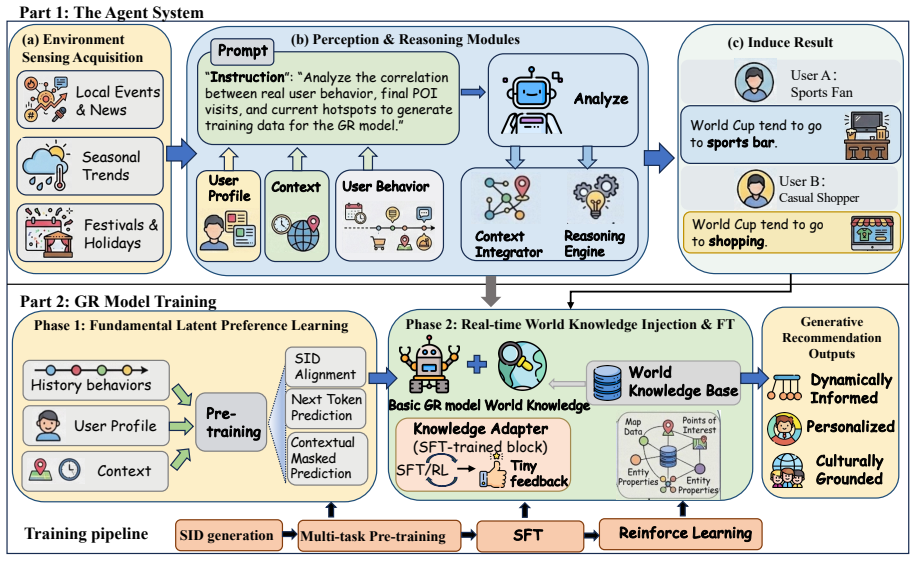
AWARE augments generative next POI models with an LLM agent that produces personalized world-knowledge narratives.
A machine-rendered reading of the paper's core claim, the machinery that carries it, and where it could break.
Core claim
AWARE employs an LLM agent to create contextual narratives that combine world knowledge with each user's spatial-temporal behavior; when these grounded narratives are fed into a generative next-POI model, prediction performance rises measurably over baselines that lack such augmentation.
What carries the argument
The LLM agent that generates location- and time-aware contextual narratives anchored in the user's behavioral context.
If this is right
- Generative POI models can now respond to dynamic external factors such as local events without retraining the underlying LLM.
- Personalized grounding of external knowledge reduces the risk of noisy or generic additions to user sequences.
- The same agent-based augmentation pattern could apply to other generative recommendation tasks that involve temporal or spatial context.
- User mobility modeling improves when external trends are filtered through observed individual patterns rather than applied uniformly.
Where Pith is reading between the lines
- If the grounding step works reliably, similar agent layers could help other LLM-based systems avoid hallucinated context in recommendation or planning domains.
- The approach suggests a general template for injecting evolving external information into sequence models without full retraining.
- Testing on datasets with rapidly changing events, such as during major festivals or disruptions, would reveal how well the method captures short-term shifts.
Load-bearing premise
The narratives produced by the LLM agent remain accurate and relevant rather than introducing hallucinations or unrelated information.
What would settle it
An ablation that replaces AWARE's generated narratives with either empty context or unanchored generic world facts should erase the reported accuracy gains on the same three datasets.
Figures



read the original abstract
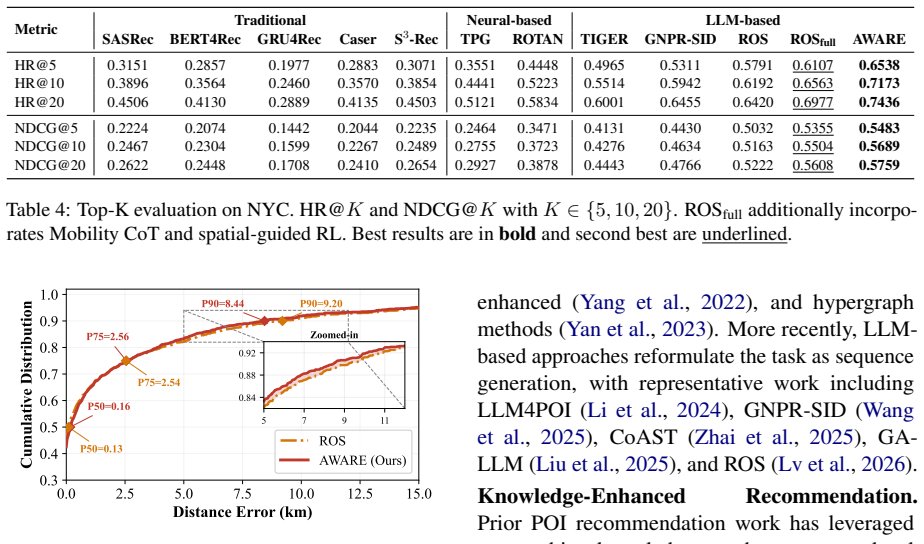
Generative point-of-interest (POI) recommendation models based on large language models (LLMs) have shown promising results by formulating next POI prediction as a sequence generation task. However, the knowledge encoded in these models remains fixed after training, making them unable to perceive evolving real-world conditions that shape user mobility decisions, such as local events and cultural trends. To bridge this gap, we propose AWARE (Agent-based World knowledge Augmented REcommendation), which employs an LLM agent to generate location- and time-aware contextual narratives that capture regional cultural characteristics, seasonal trends, and ongoing events relevant to each user. Rather than introducing generic or noisy information, AWARE further anchors these narratives in each user's behavioral context, grounding external world knowledge in personalized spatial-temporal patterns. Extensive experiments on three real-world datasets demonstrate that AWARE consistently outperforms competitive baselines, achieving up to 12.4% relative improvement.
Editorial analysis
A structured set of objections, weighed in public.
Referee Report
Summary. The paper introduces AWARE, an LLM-agent framework for generative next-POI recommendation. An agent produces location- and time-aware contextual narratives that encode regional culture, seasonal trends, and ongoing events; these narratives are anchored in each user's observed spatial-temporal behavior to avoid generic or noisy content. Experiments on three real-world datasets report consistent outperformance over competitive baselines, with a peak relative gain of 12.4%.
Significance. If the performance gains can be rigorously attributed to the world-knowledge component rather than to the underlying generative backbone or prompt engineering, the work would provide a concrete mechanism for injecting dynamic external context into LLM-based recommenders, addressing the static-knowledge limitation that currently constrains mobility modeling.
major comments (2)
- [Abstract and §4] Abstract and §4 (Experiments): the central claim of up to 12.4% relative improvement is presented without any description of the experimental protocol, baseline implementations, statistical significance tests, or ablation studies that isolate the contribution of the generated narratives. This information is load-bearing for the empirical result.
- [§3] §3 (Method): the anchoring of LLM-generated narratives in user behavioral context is described at a high level, yet no concrete prompt templates, retrieval steps, or verification procedures are supplied to guarantee that the narratives remain factually grounded and non-hallucinated rather than introducing irrelevant location-specific events.
minor comments (1)
- [Throughout] Ensure the acronym AWARE is expanded on first use and that all figure captions explicitly state the datasets and metrics shown.
Simulated Author's Rebuttal
We thank the referee for the constructive feedback. We agree that greater transparency in the experimental protocol and methodological details is essential to substantiate our claims. We will revise the manuscript accordingly.
read point-by-point responses
-
Referee: [Abstract and §4] Abstract and §4 (Experiments): the central claim of up to 12.4% relative improvement is presented without any description of the experimental protocol, baseline implementations, statistical significance tests, or ablation studies that isolate the contribution of the generated narratives. This information is load-bearing for the empirical result.
Authors: We agree that the current presentation of results lacks sufficient detail on the experimental setup. In the revised manuscript we will expand §4 with a complete description of the experimental protocol (data splits, preprocessing, evaluation metrics, and hyperparameter tuning), explicit implementation details for all baselines, statistical significance testing (e.g., paired t-tests or Wilcoxon signed-rank tests with p-values), and ablation studies that systematically remove the world-knowledge narrative component to isolate its contribution. These additions will directly address the attribution of the reported gains. revision: yes
-
Referee: [§3] §3 (Method): the anchoring of LLM-generated narratives in user behavioral context is described at a high level, yet no concrete prompt templates, retrieval steps, or verification procedures are supplied to guarantee that the narratives remain factually grounded and non-hallucinated rather than introducing irrelevant location-specific events.
Authors: We acknowledge that §3 currently provides only a high-level description. We will revise the section to include the exact prompt templates used by the LLM agent, the concrete retrieval steps that anchor narratives to each user’s observed check-in history (spatial-temporal filtering and relevance scoring), and verification procedures such as automated fact-checking against external event databases plus a human evaluation protocol on a sampled subset of generated narratives. These details will be placed in the main text or an appendix to ensure reproducibility and factual grounding. revision: yes
Circularity Check
No circularity: empirical system proposal with externally measured gains
full rationale
The paper proposes the AWARE system, which uses an LLM agent to generate location- and time-aware narratives anchored in user behavioral context, then evaluates it empirically on three real-world datasets against baselines, reporting up to 12.4% relative improvement. No equations, parameter-fitting steps presented as predictions, self-definitional constructs, or load-bearing self-citation chains appear in the derivation. The central claim is a falsifiable performance comparison rather than a reduction of outputs to inputs by construction, making the result self-contained against external benchmarks.
Axiom & Free-Parameter Ledger
Reference graph
Works this paper leans on
-
[1]
The Computational Geometry Algorithms Library , author =
-
[2]
Menelaos Karavelas , subtitle =
-
[3]
The Computational Geometry Algorithms Library , subtitle =
Menelaos Karavelas , editor =. The Computational Geometry Algorithms Library , subtitle =
-
[4]
The Parmap library , author =
-
[5]
Christopher Anderson and Sophia Drossopoulou , title =
-
[6]
Yu, Yuanqing and Gao, Chongming and Chen, Jiawei and Tang, Heng and Sun, Yuefeng and Chen, Qian and Ma, Weizhi and Zhang, Min , title =. Proceedings of the 47th International ACM SIGIR Conference on Research and Development in Information Retrieval , pages =. 2024 , isbn =. doi:10.1145/3626772.3657868 , abstract =
-
[7]
Communications of the ACM , volume =
Using collaborative filtering to weave an information tapestry , author =. Communications of the ACM , volume =. 1992 , publisher =
work page 1992
-
[8]
Proceedings of the 10th International Conference on World Wide Web (WWW) , pages =
Item-based collaborative filtering recommendation algorithms , author =. Proceedings of the 10th International Conference on World Wide Web (WWW) , pages =
-
[9]
Content-based recommendation systems , author =. The Adaptive Web , pages =. 2007 , publisher =
work page 2007
-
[10]
User Modeling and User-Adapted Interaction , volume =
Hybrid recommender systems: Survey and experiments , author =. User Modeling and User-Adapted Interaction , volume =. 2002 , publisher =
work page 2002
-
[11]
Proceedings of the 13th ACM Conference on Recommender Systems (RecSys) , pages =
Sampling-bias-corrected neural modeling for large corpus item recommendations , author =. Proceedings of the 13th ACM Conference on Recommender Systems (RecSys) , pages =
-
[12]
arXiv preprint arXiv:2206.05668 , year =
Revisiting Two-Tower Models for Unbiased Learning to Rank , author =. arXiv preprint arXiv:2206.05668 , year =
-
[13]
Sun, Zhiqiang and Zhang, Junliang and Liu, Xiao and others , booktitle =
- [14]
-
[15]
2018 IEEE international conference on data mining (ICDM) , pages=
Self-attentive sequential recommendation , author=. 2018 IEEE international conference on data mining (ICDM) , pages=. 2018 , organization=
work page 2018
-
[16]
BERT4Rec: Sequential recommendation with bidirectional encoder representations from transformer , author=. Proceedings of the 28th ACM international conference on information and knowledge management , pages=
-
[17]
Session-based Recommendations with Recurrent Neural Networks
Session-based recommendations with recurrent neural networks , author=. arXiv preprint arXiv:1511.06939 , year=
work page internal anchor Pith review Pith/arXiv arXiv
-
[18]
Proceedings of the eleventh ACM international conference on web search and data mining , pages=
Personalized top-n sequential recommendation via convolutional sequence embedding , author=. Proceedings of the eleventh ACM international conference on web search and data mining , pages=
-
[19]
Proceedings of the 29th ACM international conference on information & knowledge management , pages=
S3-rec: Self-supervised learning for sequential recommendation with mutual information maximization , author=. Proceedings of the 29th ACM international conference on information & knowledge management , pages=
-
[20]
Knowledge and Information Systems , volume=
Efficient itinerary recommendation via personalized POI selection and pruning , author=. Knowledge and Information Systems , volume=. 2022 , publisher=
work page 2022
-
[21]
ISPRS International Journal of Geo-Information , volume=
Point-of-Interest (POI) data validation methods: An urban case study , author=. ISPRS International Journal of Geo-Information , volume=. 2021 , publisher=
work page 2021
-
[22]
ACM Transactions on Intelligent Systems and Technology (TIST) , volume=
Trajectory data mining: an overview , author=. ACM Transactions on Intelligent Systems and Technology (TIST) , volume=. 2015 , publisher=
work page 2015
-
[23]
1.08 - Geocoding and Reverse Geocoding , editor =
Dapeng Li , keywords =. 1.08 - Geocoding and Reverse Geocoding , editor =. Comprehensive Geographic Information Systems , publisher =. 2018 , isbn =. doi:https://doi.org/10.1016/B978-0-12-409548-9.09593-2 , url =
-
[24]
Virtues of the Haversine , author=. Sky and telescope , volume=
-
[25]
Proceedings of the IEEE/CVF conference on computer vision and pattern recognition , pages=
Autoregressive image generation using residual quantization , author=. Proceedings of the IEEE/CVF conference on computer vision and pattern recognition , pages=
-
[26]
Understanding individual human mobility patterns , author=. nature , volume=. 2008 , publisher=
work page 2008
-
[27]
Comapoi: A collaborative multi-agent framework for next poi prediction bridging the gap between trajectory and language , author=. Proceedings of the 48th International ACM SIGIR Conference on Research and Development in Information Retrieval , pages=
-
[28]
Knowledge-Based Systems , volume=
Self-supervised representation learning for trip recommendation , author=. Knowledge-Based Systems , volume=. 2022 , publisher=
work page 2022
-
[29]
Advances in neural information processing systems , volume=
Chain-of-thought prompting elicits reasoning in large language models , author=. Advances in neural information processing systems , volume=
-
[30]
Plan-and- solve prompting: Improving zero-shot chain-of-thought reasoning by large language models
Plan-and-solve prompting: Improving zero-shot chain-of-thought reasoning by large language models , author=. arXiv preprint arXiv:2305.04091 , year=
-
[31]
Proceedings of the AAAI Conference on Artificial Intelligence , volume=
CoT4Rec: Revealing User Preferences Through Chain of Thought for Recommender Systems , author=. Proceedings of the AAAI Conference on Artificial Intelligence , volume=
-
[32]
Findings of the Association for Computational Linguistics: ACL 2024 , pages=
Leveraging llm reasoning enhances personalized recommender systems , author=. Findings of the Association for Computational Linguistics: ACL 2024 , pages=
work page 2024
-
[33]
OneRec: Unifying Retrieve and Rank with Generative Recommender and Iterative Preference Alignment
Onerec: Unifying retrieve and rank with generative recommender and iterative preference alignment , author=. arXiv preprint arXiv:2502.18965 , year=
work page internal anchor Pith review Pith/arXiv arXiv
-
[34]
Sunkyung Lee and Minjin Choi and Eunseong Choi and Hye-young Kim and Jongwuk Lee , booktitle =. 2025 , url =
work page 2025
-
[35]
Mtgr: Industrial-scale generative recommendation framework in meituan , author=. Proceedings of the 34th ACM International Conference on Information and Knowledge Management , pages=
-
[36]
Proceedings of the ACM Web Conference 2024 , pages=
Generative news recommendation , author=. Proceedings of the ACM Web Conference 2024 , pages=
work page 2024
-
[37]
Generative explore-exploit: Training-free optimization of generative recommender systems using LLM optimizers , author=. Proceedings of the 62nd Annual Meeting of the Association for Computational Linguistics (Volume 1: Long Papers) , pages=
-
[38]
IEEE Transactions on Knowledge and Data Engineering , year=
Tokenrec: Learning to tokenize id for llm-based generative recommendations , author=. IEEE Transactions on Knowledge and Data Engineering , year=
-
[39]
arXiv preprint arXiv:2505.13526 , year=
Geography-Aware Large Language Models for Next POI Recommendation , author=. arXiv preprint arXiv:2505.13526 , year=
-
[40]
2024 ieee conference on artificial intelligence (cai) , pages=
Where to move next: Zero-shot generalization of llms for next poi recommendation , author=. 2024 ieee conference on artificial intelligence (cai) , pages=. 2024 , organization=
work page 2024
-
[41]
arXiv preprint arXiv:2511.14221 , year=
LLM-Aligned Geographic Item Tokenization for Local-Life Recommendation , author=. arXiv preprint arXiv:2511.14221 , year=
-
[42]
IEEE Transactions on Knowledge and Data Engineering , year=
A survey on point-of-interest recommendation: Models, architectures, and security , author=. IEEE Transactions on Knowledge and Data Engineering , year=
-
[43]
Qwen3 technical report , author=. arXiv preprint arXiv:2505.09388 , year=
work page internal anchor Pith review Pith/arXiv arXiv
-
[44]
DeepSeekMath: Pushing the Limits of Mathematical Reasoning in Open Language Models
Deepseekmath: Pushing the limits of mathematical reasoning in open language models , author=. arXiv preprint arXiv:2402.03300 , year=
work page internal anchor Pith review Pith/arXiv arXiv
-
[45]
Proceedings of the 41st International Conference on Machine Learning , articleno =
Zhai, Jiaqi and Liao, Lucy and Liu, Xing and Wang, Yueming and Li, Rui and Cao, Xuan and Gao, Leon and Gong, Zhaojie and Gu, Fangda and He, Jiayuan and Lu, Yinghai and Shi, Yu , title =. Proceedings of the 41st International Conference on Machine Learning , articleno =. 2024 , publisher =
work page 2024
-
[46]
Proceedings of the 31st ACM SIGKDD Conference on Knowledge Discovery and Data Mining V
Generative Next POI Recommendation with Semantic ID , author=. Proceedings of the 31st ACM SIGKDD Conference on Knowledge Discovery and Data Mining V. 2 , pages=
-
[47]
arXiv preprint arXiv:2508.14646 , year=
Oneloc: Geo-aware generative recommender systems for local life service , author=. arXiv preprint arXiv:2508.14646 , year=
-
[48]
arXiv preprint arXiv:2510.14702 , year=
Cognitive-Aligned Spatio-Temporal Large Language Models For Next Point-of-Interest Prediction , author=. arXiv preprint arXiv:2510.14702 , year=
-
[49]
arXiv preprint arXiv:2409.12740 , year=
Hllm: Enhancing sequential recommendations via hierarchical large language models for item and user modeling , author=. arXiv preprint arXiv:2409.12740 , year=
- [50]
-
[51]
Proceedings of the 30th ACM SIGKDD conference on knowledge discovery and data mining , pages=
Rotan: A rotation-based temporal attention network for time-specific next poi recommendation , author=. Proceedings of the 30th ACM SIGKDD conference on knowledge discovery and data mining , pages=
-
[52]
Spatio-temporal hypergraph learning for next POI recommendation , author=. Proceedings of the 46th international ACM SIGIR conference on research and development in information retrieval , pages=
-
[53]
Large language models for next point-of-interest recommendation , author=. Proceedings of the 47th International ACM SIGIR Conference on Research and Development in Information Retrieval , pages=
-
[54]
Long short-term memory , author=. Neural computation , volume=. 1997 , publisher=
work page 1997
-
[55]
IEEE Transactions on Knowledge and Data Engineering , volume=
Personalized long-and short-term preference learning for next POI recommendation , author=. IEEE Transactions on Knowledge and Data Engineering , volume=. 2020 , publisher=
work page 2020
-
[56]
Proceedings of the web conference 2021 , pages=
Stan: Spatio-temporal attention network for next location recommendation , author=. Proceedings of the web conference 2021 , pages=
work page 2021
-
[57]
GETNext: Trajectory flow map enhanced transformer for next POI recommendation , author=. Proceedings of the 45th International ACM SIGIR Conference on research and development in information retrieval , pages=
-
[58]
Timestamps as prompts for geography-aware location recommendation , author=. Proceedings of the 32nd ACM International Conference on Information and Knowledge Management , pages=
-
[59]
KDD deep learning day , pages=
MTNet: a neural approach for cross-domain recommendation with unstructured text , author=. KDD deep learning day , pages=
-
[60]
Spacetime-GR: A Spacetime-Aware Generative Model for Large Scale Online POI Recommendation , author=. 2025 , eprint=
work page 2025
- [61]
-
[62]
Yang, Dingqi and Zhang, Daqing and Zheng, Vincent W. and Yu, Zhiyong , journal=. Modeling User Activity Preference by Leveraging User Spatial Temporal Characteristics in LBSNs , year=
-
[63]
Cho, Eunjoon and Myers, Seth A. and Leskovec, Jure , title =. Proceedings of the 17th ACM SIGKDD International Conference on Knowledge Discovery and Data Mining , pages =. 2011 , isbn =. doi:10.1145/2020408.2020579 , abstract =
-
[64]
LoRA: Low-Rank Adaptation of Large Language Models
Lora: Low-rank adaptation of large language models , author=. arXiv preprint arXiv:2106.09685 , year=
work page internal anchor Pith review Pith/arXiv arXiv
-
[65]
Reasoning Over Space: Enabling Geographic Reasoning for LLM-Based Generative Next POI Recommendation , author=. 2026 , eprint=
work page 2026
-
[66]
Findings of the Association for Computational Linguistics: NAACL 2024 , pages=
Recmind: Large language model powered agent for recommendation , author=. Findings of the Association for Computational Linguistics: NAACL 2024 , pages=
work page 2024
-
[67]
International Conference on Learning Representations (ICLR) , year=
ReAct: Synergizing Reasoning and Acting in Language Models , author=. International Conference on Learning Representations (ICLR) , year=
-
[68]
Proceedings of the AAAI Conference on Artificial Intelligence , volume=
Inductive generative recommendation via retrieval-based speculation , author=. Proceedings of the AAAI Conference on Artificial Intelligence , volume=
-
[69]
Advances in Neural Information Processing Systems , volume=
Recommender systems with generative retrieval , author=. Advances in Neural Information Processing Systems , volume=
-
[70]
arXiv preprint arXiv:2509.03236 , year=
Onesearch: A preliminary exploration of the unified end-to-end generative framework for e-commerce search , author=. arXiv preprint arXiv:2509.03236 , year=
-
[71]
Proceedings of the AAAI Conference on Artificial Intelligence , volume=
Llm-aligned geographic item tokenization for local-life recommendation , author=. Proceedings of the AAAI Conference on Artificial Intelligence , volume=
-
[72]
arXiv preprint arXiv:2508.20900 , year=
Onerec-v2 technical report , author=. arXiv preprint arXiv:2508.20900 , year=
discussion (0)
Sign in with ORCID, Apple, or X to comment. Anyone can read and Pith papers without signing in.