Recognition: 2 theorem links
· Lean TheoremAn algebraic-combinatorial framework for finding the average hitting times in graphs with high regularity
Pith reviewed 2026-05-13 05:17 UTC · model grok-4.3
The pith
A connection between maximal-entropy random walks and weight-equitable partitions provides an algebraic-combinatorial method to compute average hitting times in highly regular graphs.
A machine-rendered reading of the paper's core claim, the machinery that carries it, and where it could break.
Core claim
The authors claim that by connecting maximal-entropy random walks to weight-equitable partitions, they obtain a new algebraic-combinatorial framework for determining average hitting times between vertices in finite graphs with high regularity. This framework strengthens and extends several existing results, notably Rao's method for hitting times from a vertex to a neighbor when the starting vertex has certain symmetries.
What carries the argument
The central mechanism is the novel connection between maximal-entropy random walks and weight-equitable partitions, which enables the algebraic-combinatorial computation of hitting times.
If this is right
- The method allows computation of average hitting times for multiple classes of graphs exhibiting high regularity.
- It generalizes Rao's method to handle hitting times under broader symmetries of the starting vertex.
- The unifying framework incorporates and improves upon several previously known results on random walk hitting times.
- Exact values can be derived using algebraic properties rather than numerical simulation for suitable graphs.
Where Pith is reading between the lines
- If the connection holds in a given graph, it may simplify analysis of other random walk properties like mixing times in the same regular structures.
- The framework could be tested on additional highly symmetric graphs such as strongly regular graphs to find new closed-form expressions.
- Neighbouring problems in spectral graph theory might benefit from incorporating weight-equitable partitions for stochastic processes.
Load-bearing premise
The graphs must have enough regularity for weight-equitable partitions to exist and to interact effectively with maximal-entropy random walks within the algebraic-combinatorial framework.
What would settle it
A highly regular graph for which the hitting times calculated via this partition-based method differ from those obtained by solving the standard system of equations for expected hitting times using the transition matrix.
Figures
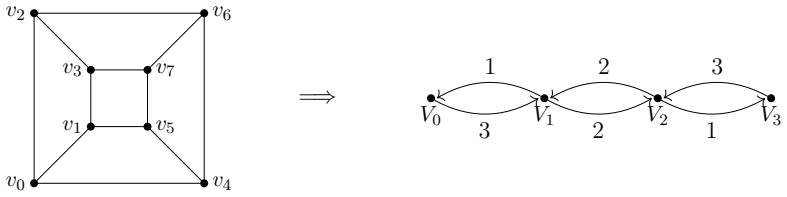
read the original abstract
For any given vertices $u$ and $v$ in a graph, the hitting time of a random walk on a finite graph is the number of steps it takes for a random walk to reach vertex $v$ starting at vertex $u$. The expected value of the hitting time is the average hitting time. In this paper, we present an algebraic-combinatorial method for calculating the average hitting time between vertices of finite graphs exhibiting high regularity, along with its applications to multiple graph classes. Our approach exploits a novel connection between maximal-entropy random walks and weight-equitable partitions, providing a unifying framework that strengthens and extends several known results, including Rao's method [Statistics \& Probability Letters, 2013] for computing the hitting time from a vertex to a neighbor under certain symmetries of the starting vertex.
Editorial analysis
A structured set of objections, weighed in public.
Referee Report
Summary. The manuscript presents an algebraic-combinatorial framework for computing the average hitting times of random walks between vertices in finite graphs exhibiting high regularity. It establishes a novel connection between maximal-entropy random walks and weight-equitable partitions to derive closed-form expressions, providing a unifying approach that extends prior results including Rao's method for hitting times under vertex symmetries.
Significance. If the derivations hold without gaps, the work offers a systematic, algebraic method for hitting times in regular graphs that strengthens existing techniques and may apply to classes such as strongly regular or distance-regular graphs. The explicit link to maximal-entropy walks and equitable partitions is a constructive strength that could influence spectral graph theory and random-walk analysis more broadly.
minor comments (2)
- [Abstract] Abstract: the citation to Rao's 2013 paper is given only by journal and year; include the full bibliographic entry and a precise pointer to the relevant theorem in the main text for traceability.
- [Introduction] The manuscript would benefit from an explicit list (perhaps as a table or proposition) of the minimal regularity conditions on the graph that guarantee the existence of the required weight-equitable partitions.
Simulated Author's Rebuttal
We thank the referee for their encouraging summary, recognition of the framework's unifying approach via maximal-entropy random walks and weight-equitable partitions, and recommendation of minor revision. We are pleased that the connection to Rao's method and potential applications to strongly regular and distance-regular graphs were noted as strengths.
Circularity Check
No significant circularity detected in derivation chain
full rationale
The paper derives average hitting times via a claimed novel algebraic-combinatorial link between maximal-entropy random walks and weight-equitable partitions in highly regular graphs. This connection is used to extend (not presuppose) prior results such as Rao's 2013 method. No equations reduce by construction to fitted parameters or self-referential definitions; no load-bearing self-citations appear; the central framework rests on independent graph-regularity properties and entropy maximization rather than tautological inputs. The derivation is therefore self-contained against external benchmarks.
Axiom & Free-Parameter Ledger
axioms (2)
- standard math Hitting time is the expected number of steps for a random walk to reach a target vertex.
- domain assumption Weight-equitable partitions respect the symmetry and transition probabilities of the graph.
Lean theorems connected to this paper
-
IndisputableMonolith/Foundation/AbsoluteFloorClosure.leanreality_from_one_distinction unclearweight-equitable partition … b∗ij(u) … weight-regular quotient matrix B∗ … Hm(G;(o,v))=H(GB∗;(V0,Vi)) (Theorem 3.1)
-
IndisputableMonolith/Cost/FunctionalEquation.leanwashburn_uniqueness_aczel unclearmaximal entropy random walk … T(DνA) … Perron eigenvector ν
Reference graph
Works this paper leans on
-
[1]
A. Abiad. A characterization and an application of weight-regular partitions of graphs.Linear Algebra and its Applications569(2019), 162–174
work page 2019
- [2]
- [3]
- [4]
- [5]
-
[6]
R. B. Bapat. On the first passage time of a simple random walk on a tree.Statistics & Probability Letters81(2011), 1552–1558
work page 2011
- [7]
-
[8]
N. L. Biggs. Potential theory on distance-regular graphs.Combinatorics, Probability and Computing2(1993), 243–255
work page 1993
- [9]
-
[10]
Á. Carmona, A. Encinas, and M. J. Jiménez. Mean first passage time for distance- biregular graphs.Conference of the International Linear Algebra Society, Book of Abstracts (2022), 202–206
work page 2022
-
[11]
J.-C. Delvenne and A.-S. Libert. Centrality measures and thermodynamic formalism for complex networks.Physical Review E83(2011), 046117
work page 2011
-
[12]
L. Devroye and A. Sbihi. Random walks on highly symmetric graphs.Journal of Theoretical Probability3(1990), 497–514
work page 1990
-
[13]
J. Duda. From maximal entropy random walk to quantum thermodynamics.Journal of Physics: Conference Series361(2012), 012039
work page 2012
-
[14]
M. A. Fiol. Eigenvalue interlacing and weight parameters of graphs.Linear Algebra and its Applications290(1999), 275–301
work page 1999
-
[15]
M. A. Fiol. On pseudo-distance-regularity.Linear Algebra and its Applications323 (2001), 145–165
work page 2001
-
[16]
M. A. Fiol. Pseudo-distance-regularized graphs are distance-regular or distance- biregular.Linear Algebra and its Applications437(2012), 2973–2977
work page 2012
-
[17]
M. A. Fiol, E. Garriga. On the algebraic theory of pseudo-distance-regularity around a set.Linear Algebra and its Applications298(1999), 115–141. 25
work page 1999
-
[18]
C. D. Godsil and W. J. Martin. Quotient of association schemes.Journal of Combinatorial Theory, Series A69(1995), 185–199
work page 1995
-
[19]
C. D. Godsil and J. Shawe-Taylor. Distance-regularised graphs are distance-regular or distance-biregular.Journal of Combinatorial Theory, Series B43(1987), 14–24
work page 1987
-
[20]
W. H. Haemers. Interlacing eigenvalues and graphs.Linear Algebra and its Appli- cations226(1995), 593–616
work page 1995
-
[21]
M. A. Jafarizadeh, R. Sufiani, S. F. Taghavi, and E. Barati. Optimal transfer of a d-level quantum state over pseudo-distance-regular networks.Journal of Physics A: Mathematical and Theoretical41(2008), 475302
work page 2008
-
[22]
S. Jafarizadeh, R. Sufiani, and M. A. Jafarizadeh. Evaluation of effective resistances in pseudo-distance-regular resistor networks.Journal of Statistical Physics139 (2010), 177–199
work page 2010
- [23]
-
[24]
L. Lovász. Random walks on graphs: a survey. In: Miklós, D., Sós, V. T., Szõnyi, T. (eds.), Combinatorics, Paul Erdõs is Eighty, volume 2, János Bolyai Mathematical Society, Budapest, pp. 353–398, 1993
work page 1993
- [25]
-
[26]
Y.-W. Niu, H. Liu, G.-H. Wang, and G.-Y. Yan. Maximal entropy random walk on heterogenous network for mirna-disease association prediction.Mathematical Biosciences306(2018), 1–9
work page 2018
-
[27]
J. K. Ochab and Z. Burda. Maximal entropy random walk in community detection. The European Physical Journal Special Topics216(2013), 73–81
work page 2013
-
[28]
S. K. Rao. Finding hitting times in various graphs.Statistics & Probability Letters, 83(2013), 2067–2072
work page 2013
-
[29]
R. Sinatra, J. Gómez-Gardeñes, R. Lambiotte, V. Nicosia, and V. Latora. Maximal- entropy random walks in complex networks with limited information.Physiscal Review E83(2011), 030103
work page 2011
-
[30]
A. R. D. Van Slijpe. Random walks on regular polyhedra and other distance-regular graphs.Statistica Neerlandica38(1984), 273–292
work page 1984
-
[31]
Y. Tanaka. On the average hitting times ofCay(Zn,+1,+2 ).Discrete Applied Mathematics,343(2024), 269–276. 26
work page 2024
- [32]
-
[33]
Y. Yang. Expected hitting times for simple random walks on wheel graphs. In2011 International Conference on Multimedia Technology, pages 5841–5843, 2011. 27
work page 2011
discussion (0)
Sign in with ORCID, Apple, or X to comment. Anyone can read and Pith papers without signing in.