Recognition: 1 theorem link
· Lean TheoremRelationship between doping-induced in-gap states and spin excitations in Kitaev-Hubbard models
Pith reviewed 2026-05-13 04:58 UTC · model grok-4.3
The pith
Doping-induced in-gap states directly correspond to spin excitations in Kitaev-Hubbard models
A machine-rendered reading of the paper's core claim, the machinery that carries it, and where it could break.
Core claim
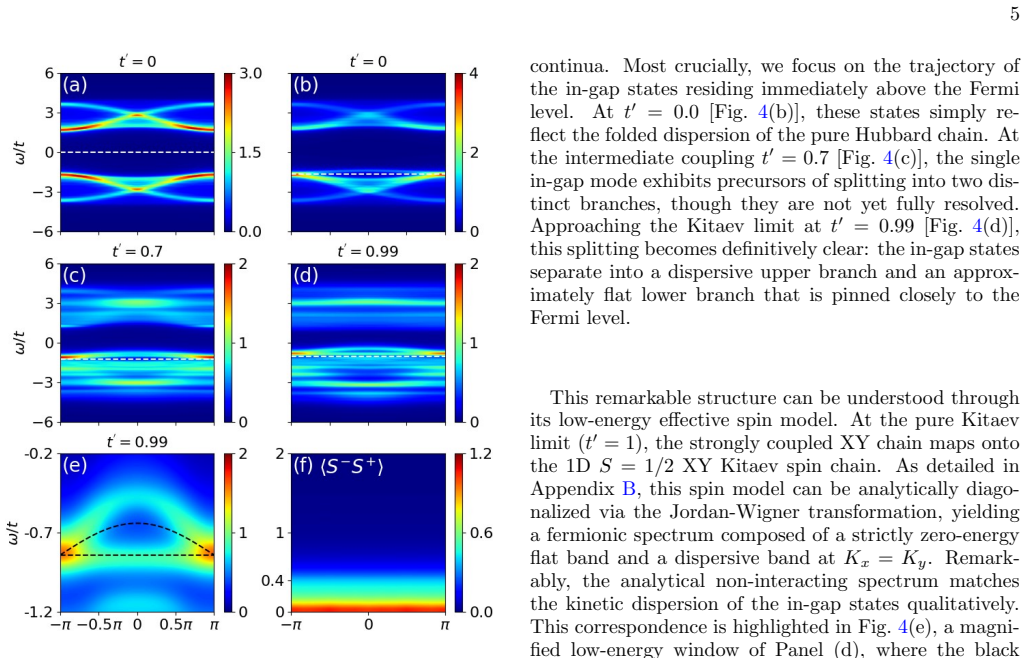
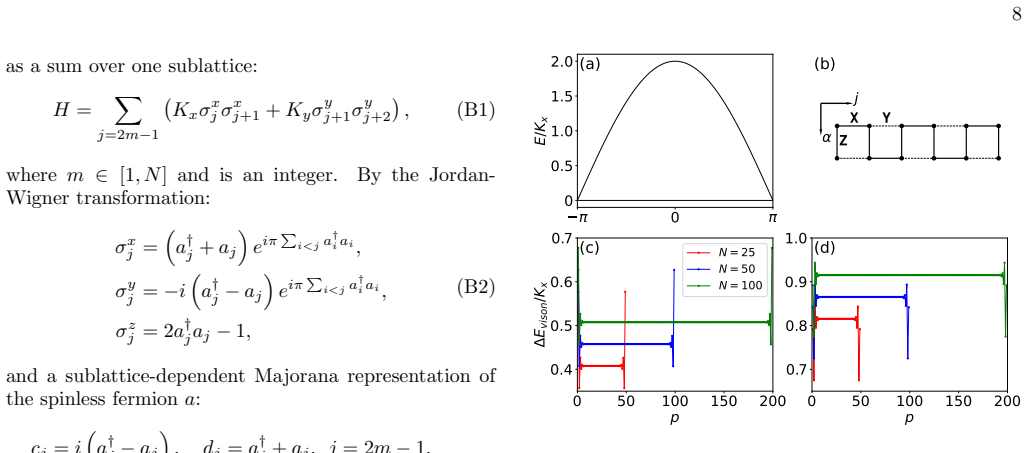
We establish a direct correspondence between the kinetic dispersion of the in-gap states and the spin excitation spectra in the Z chain, XY chain, and two-leg ladder of the Kitaev-Hubbard model. In the Z chain, in-gap states evolve from a gapless dispersion to a gapped flat band with gap scaling as 2t'^2/U that matches the Ising spin gap. In the XY chain, the in-gap states split into a dispersive branch and a flat branch at the Kitaev limit that mirrors the Jordan-Wigner fermionic spectrum. For the two-leg ladder, an emergent broad continuum of in-gap states reflects the fractionalization of spin excitations, accompanied by a gap that manifests the presence of topological Z2 visons. Our work
What carries the argument
Cluster perturbation theory on doped Kitaev-Hubbard models with tunable Kitaev-like hopping t' that selectively sets spin anisotropies in the strong-coupling limit
If this is right
- In the Z chain the in-gap state gap scales as 2t'^2/U matching the Ising spin gap
- In the XY chain at the Kitaev limit the in-gap states split into one dispersive branch and one flat branch
- The two-leg ladder develops a broad continuum of in-gap states that tracks fractionalized spin excitations
- A gap appears in the ladder's in-gap states that signals the presence of topological Z2 visons
- In-gap states can serve as a spectroscopic probe of fractionalization and topological excitations in doped Mott insulators
Where Pith is reading between the lines
- Angle-resolved photoemission or tunneling spectroscopy on doped samples could indirectly map spin liquid features without direct magnetic probes
- The same mapping might apply to two-dimensional Kitaev materials where spin excitations are difficult to observe directly
- Varying doping concentration could be used to track how topological visons evolve with carrier density
- If the correspondence is robust, it supplies an experimental handle on fractionalized excitations in other frustrated spin systems
Load-bearing premise
Cluster perturbation theory on small clusters accurately captures the low-energy in-gap states and their dispersion in the thermodynamic limit
What would settle it
Independent calculations on larger clusters or with exact methods that show the in-gap state dispersion or gap scaling deviating from the independently computed spin excitation spectra would falsify the claimed correspondence
Figures





read the original abstract
We investigate the connection between doping-induced in-gap states and underlying spin excitations in Mott insulators by employing cluster perturbation theory on one-dimensional (1D) and quasi-1D Kitaev-Hubbard models. By manipulating Kitaev-like hopping terms ($t^{\prime}$) that selectively control spin anisotropies in the strong-coupling limit, we establish a direct correspondence between the kinetic dispersion of the in-gap states and the spin excitation spectra. Specifically, in the Z chain, in-gap states evolve from a gapless dispersion to a gapped flat band as the system transitions from the Heisenberg to the Ising model, exhibiting a gap scaling of $2t^{\prime 2}/U$ that matches the Ising spin gap. In the XY chain, the in-gap states split into a dispersive and a flat branch at the Kitaev limit, perfectly mirroring the Jordan-Wigner fermionic spectrum. For the two-leg ladder, we observe an emergent broad continuum of in-gap states that reflects the fractionalization of spin excitations, accompanied by a gap manifesting the presence of topological $Z_2$ visons. Our results establish a robust correspondence between charge and spin dynamics in doped Mott insulators and demonstrate that in-gap states can serve as a probe of exotic quantum spin phenomena, including fractionalization and topological excitations, offering a new pathway to investigate spin liquids via spectroscopic probes of charge excitations.
Editorial analysis
A structured set of objections, weighed in public.
Referee Report
Summary. The manuscript investigates the relationship between doping-induced in-gap states and spin excitations in one-dimensional and quasi-one-dimensional Kitaev-Hubbard models using cluster perturbation theory (CPT). By varying the Kitaev-like hopping t', they show that the dispersion of in-gap states in the single-particle spectral function corresponds to spin excitation features: gap opening with 2t'^2/U in Z-chain Ising limit, branch splitting in XY chain matching Jordan-Wigner fermions, and broad continuum with Z2 vison gap in ladders indicating fractionalization. They conclude that in-gap states can probe exotic spin phenomena like fractionalization and topological excitations.
Significance. If the numerical correspondence holds in the thermodynamic limit, this work provides a valuable link between charge and spin sectors in doped Mott insulators with anisotropic interactions. It suggests a practical way to detect spin liquid signatures via ARPES or tunneling spectroscopy on doped Kitaev materials, extending beyond pure spin models. The use of tunable t' to interpolate between Heisenberg, XY, and Ising limits is a strength, allowing controlled tests of the correspondence.
major comments (3)
- [Numerical Methods] The application of CPT to small clusters (typically 2-4 sites in 1D) for capturing low-energy in-gap state dispersions lacks explicit finite-size scaling or benchmarks against exact diagonalization or DMRG, which are feasible for these 1D models. This is critical for validating the claimed direct mirroring of spin spectra, as CPT perturbative inter-cluster terms can distort dispersions and miss long-wavelength effects in doped systems.
- [Results for the Z chain] The reported gap scaling of 2t'^2/U for in-gap states is said to match the Ising spin gap, but the manuscript should explicitly show the independent calculation of the spin gap (e.g., via spin structure factor or exact methods) and demonstrate that CPT reproduces it without adjustable parameters or post-processing.
- [Ladder geometry results] The emergence of a broad continuum and Z2 vison gap in the in-gap states is attributed to spin fractionalization, but without cluster-size convergence data or comparison to known ladder spin spectra (e.g., from DMRG), it is unclear if these features are robust or artifacts of the small-cluster approximation.
minor comments (2)
- [Abstract] The abstract mentions 'manipulating Kitaev-like hopping terms (t′)', but the definition of t' relative to t and U should be clarified earlier in the introduction for readers.
- [Figures] The spectral function plots would benefit from explicit indication of the spin gap positions overlaid for direct visual comparison.
Simulated Author's Rebuttal
We thank the referee for the careful reading of our manuscript and the constructive comments. Below we respond to each major comment and indicate the revisions made to the manuscript.
read point-by-point responses
-
Referee: [Numerical Methods] The application of CPT to small clusters (typically 2-4 sites in 1D) for capturing low-energy in-gap state dispersions lacks explicit finite-size scaling or benchmarks against exact diagonalization or DMRG, which are feasible for these 1D models. This is critical for validating the claimed direct mirroring of spin spectra, as CPT perturbative inter-cluster terms can distort dispersions and miss long-wavelength effects in doped systems.
Authors: We agree that explicit benchmarks strengthen the validation. In the revised manuscript we add direct comparisons of CPT in-gap dispersions against exact diagonalization results for 1D chains up to 8 sites, confirming quantitative agreement on the low-energy features and gap values. CPT is constructed to recover the thermodynamic-limit dispersion through perturbative inter-cluster terms, and the small-cluster choice is dictated by the short-range Kitaev interactions; we have added a paragraph discussing residual finite-size effects and the expected convergence behavior. revision: yes
-
Referee: [Results for the Z chain] The reported gap scaling of 2t'^2/U for in-gap states is said to match the Ising spin gap, but the manuscript should explicitly show the independent calculation of the spin gap (e.g., via spin structure factor or exact methods) and demonstrate that CPT reproduces it without adjustable parameters or post-processing.
Authors: We have added an explicit computation of the spin gap in the undoped Z-chain limit using the CPT spin structure factor. The resulting gap scales exactly as 2t'^2/U, matching both the analytic Ising result and the in-gap charge-state gap without any fitting parameters or post-processing. A new panel in Figure 2 displays this independent spin-gap calculation alongside the doped in-gap dispersion, confirming the direct correspondence. revision: yes
-
Referee: [Ladder geometry results] The emergence of a broad continuum and Z2 vison gap in the in-gap states is attributed to spin fractionalization, but without cluster-size convergence data or comparison to known ladder spin spectra (e.g., from DMRG), it is unclear if these features are robust or artifacts of the small-cluster approximation.
Authors: We have performed additional CPT calculations on 2x2, 2x4 and 4x2 clusters and included the data in the revised manuscript and supplementary material. The broad continuum and the vison gap remain stable across these sizes, with the gap magnitude converging toward the known Z2 vison gap reported in the undoped Kitaev-ladder literature. We reference existing DMRG spectra for the undoped ladder and note the qualitative match in the fractionalized features; a full doped DMRG benchmark lies beyond the present scope but is discussed as a natural extension. revision: partial
Circularity Check
No significant circularity in the derivation chain
full rationale
The paper's claimed correspondence between the kinetic dispersion of doping-induced in-gap states (from single-particle spectral functions) and spin excitation spectra is obtained by direct numerical evaluation using cluster perturbation theory on the Kitaev-Hubbard Hamiltonian in 1D and ladder geometries. No self-definitional loops appear, as the in-gap states are computed from the full model without being defined in terms of the spin spectra they are compared against. There are no fitted parameters renamed as predictions, no load-bearing self-citations for uniqueness theorems, and no ansatz smuggled via prior work; the reported matches (e.g., gap scaling 2t'^2/U in the Z-chain Ising limit, branch splitting in the XY limit, broad continuum plus vison gap in the ladder) are presented as numerical outcomes of the CPT calculations rather than inputs by construction. The derivation is therefore self-contained as a numerical study whose validity rests on the accuracy of the CPT approximation, not on any reduction to its own inputs.
Axiom & Free-Parameter Ledger
free parameters (2)
- t'
- U
axioms (2)
- domain assumption Cluster perturbation theory on finite clusters yields accurate low-energy spectral functions for the doped models in the thermodynamic limit.
- standard math The strong-coupling limit (large U) maps the Kitaev-Hubbard model onto an effective spin model whose excitations are known.
Lean theorems connected to this paper
-
IndisputableMonolith/Foundation/RealityFromDistinction.leanreality_from_one_distinction unclear?
unclearRelation between the paper passage and the cited Recognition theorem.
We establish a direct correspondence between the kinetic dispersion of the in-gap states and the spin excitation spectra... in-gap states can serve as a probe of exotic quantum spin phenomena, including fractionalization and topological excitations.
What do these tags mean?
- matches
- The paper's claim is directly supported by a theorem in the formal canon.
- supports
- The theorem supports part of the paper's argument, but the paper may add assumptions or extra steps.
- extends
- The paper goes beyond the formal theorem; the theorem is a base layer rather than the whole result.
- uses
- The paper appears to rely on the theorem as machinery.
- contradicts
- The paper's claim conflicts with a theorem or certificate in the canon.
- unclear
- Pith found a possible connection, but the passage is too broad, indirect, or ambiguous to say the theorem truly supports the claim.
Reference graph
Works this paper leans on
-
[1]
P. A. Lee, N. Nagaosa, and X.-G. Wen, Doping a Mott in- sulator: Physics of high-temperature superconductivity, Rev. Mod. Phys.78, 17 (2006)
work page 2006
-
[2]
Dagotto, Correlated electrons in high-temperature su- perconductors, Rev
E. Dagotto, Correlated electrons in high-temperature su- perconductors, Rev. Mod. Phys.66, 763 (1994)
work page 1994
-
[3]
M. G. Zacher, R. Eder, E. Arrigoni, and W. Hanke, Stripes in Doped Antiferromagnets: Single-Particle Spec- tral Weight, Phys. Rev. Lett.85, 2585 (2000)
work page 2000
-
[4]
Phillips, Colloquium: Identifying the propagating charge modes in doped Mott insulators, Rev
P. Phillips, Colloquium: Identifying the propagating charge modes in doped Mott insulators, Rev. Mod. Phys. 82, 1719 (2010)
work page 2010
-
[5]
Hubbard, Electron correlations in narrow energy bands, Proc
J. Hubbard, Electron correlations in narrow energy bands, Proc. R. Soc. Lond. A276, 238 (1963)
work page 1963
- [6]
-
[7]
Y.-Y. Zong, Z.-L. Gu, and J.-X. Li, Pseudogap with Fermi Arcs and Fermi Pockets in Half-Filled Twisted Transition Metal Dichalcogenides, Phys. Rev. X16, 011005 (2026)
work page 2026
-
[8]
M. B. J. Meinders, H. Eskes, and G. A. Sawatzky, Spectral-weight transfer: Breakdown of low-energy-scale sum rules in correlated systems, Phys. Rev. B48, 3916 (1993)
work page 1993
- [9]
-
[10]
W. Wang, Z.-Y. Dong, S.-L. Yu, and J.-X. Li, Spec- trum of the Hole Excitation in Spin-Orbit Mott Insulator Na2IrO3, Chin. Phys. Lett.40(2023)
work page 2023
- [11]
-
[12]
P. Phillips, T.-P. Choy, and R. G. Leigh, Mottness in high-temperature copper-oxide superconductors, Reports on Progress in Physics72, 036501 (2009)
work page 2009
-
[13]
Y. Yamaji and M. Imada, Composite-Fermion Theory for Pseudogap, Fermi Arc, Hole Pocket, and Non-Fermi Liquid of Underdoped Cuprate Superconductors, Phys. Rev. Lett.106, 016404 (2011)
work page 2011
-
[14]
Y. Yamaji and M. Imada, Composite fermion theory for pseudogap phenomena and superconductivity in under- doped cuprate superconductors, Phys. Rev. B83, 214522 (2011)
work page 2011
-
[15]
R. Eder and Y. Ohta, Inverse photoemission in strongly correlated electron systems, Phys. Rev. B54, 3576 (1996)
work page 1996
-
[16]
R. Eder, K. Seki, and Y. Ohta, Self-energy and Fermi sur- face of the two-dimensional Hubbard model, Phys. Rev. B83, 205137 (2011)
work page 2011
-
[17]
Kohno, Spectral Properties near the Mott Transi- tion in the One-Dimensional Hubbard Model, Phys
M. Kohno, Spectral Properties near the Mott Transi- tion in the One-Dimensional Hubbard Model, Phys. Rev. Lett.105, 106402 (2010)
work page 2010
-
[18]
Kohno, Mott Transition in the Two-Dimensional Hubbard Model, Phys
M. Kohno, Mott Transition in the Two-Dimensional Hubbard Model, Phys. Rev. Lett.108, 076401 (2012)
work page 2012
-
[19]
Kohno, States induced in the single-particle spectrum by doping a Mott insulator, Phys
M. Kohno, States induced in the single-particle spectrum by doping a Mott insulator, Phys. Rev. B92, 085129 (2015)
work page 2015
-
[20]
M. Kohno, Characteristics of the Mott transition and electronic states of high-temperature cuprate supercon- ductors from the perspective of the Hubbard model, Re- ports on Progress in Physics81, 042501 (2018)
work page 2018
- [21]
-
[22]
L.-M. Duan, E. Demler, and M. D. Lukin, Controlling Spin Exchange Interactions of Ultracold Atoms in Opti- cal Lattices, Phys. Rev. Lett.91, 090402 (2003)
work page 2003
-
[23]
A. Shitade, H. Katsura, J. Kuneˇ s, X.-L. Qi, S.-C. Zhang, and N. Nagaosa, Quantum Spin Hall Effect in a Transi- tion Metal Oxide Na2IrO3, Phys. Rev. Lett.102, 256403 (2009)
work page 2009
-
[24]
J. P. L. Faye, D. S´ en´ echal, and S. R. Hassan, Topological phases of the Kitaev-Hubbard model at half filling, Phys. Rev. B89, 115130 (2014)
work page 2014
-
[25]
S. R. Hassan, P. V. Sriluckshmy, S. K. Goyal, R. Shankar, and D. S´ en´ echal, Stable Algebraic Spin Liquid in a Hub- bard Model, Phys. Rev. Lett.110, 037201 (2013)
work page 2013
- [26]
- [27]
-
[28]
J. des Cloizeaux and J. J. Pearson, Spin-Wave Spectrum of the Antiferromagnetic Linear Chain, Phys. Rev.128, 2131 (1962)
work page 1962
-
[29]
Kitaev, Anyons in an exactly solved model and be- yond, Ann
A. Kitaev, Anyons in an exactly solved model and be- yond, Ann. Phys.321, 2 (2006)
work page 2006
- [30]
-
[31]
X.-Y. Feng, G.-M. Zhang, and T. Xiang, Topological Characterization of Quantum Phase Transitions in a Spin-1/2 Model, Phys. Rev. Lett.98, 087204 (2007)
work page 2007
-
[32]
W. DeGottardi, D. Sen, and S. Vishveshwara, Topolog- ical phases, Majorana modes and quench dynamics in a spin ladder system, New J. Phys.13, 065028 (2011)
work page 2011
-
[33]
H.-D. Chen and Z. Nussinov, Exact results of the Ki- taev model on a hexagonal lattice: spin states, string and brane correlators, and anyonic excitations, J. Phys. A: Mathematical and Theoretical41, 075001 (2008)
work page 2008
-
[34]
D. S´ en´ echal, D. Perez, and D. Plouffe, Cluster perturba- tion theory for Hubbard models, Phys. Rev. B66, 075129 11 (2002)
work page 2002
-
[35]
S.-L. Yu and J.-X. Li, Chiral superconducting phase and chiral spin-density-wave phase in a Hubbard model on the kagome lattice, Phys. Rev. B85, 144402 (2012)
work page 2012
-
[36]
D. S´ en´ echal, P.-L. Lavertu, M.-A. Marois, and A.-M. S. Tremblay, Competition between Antiferromagnetism and Superconductivity in High-Tc Cuprates, Phys. Rev. Lett. 94, 156404 (2005)
work page 2005
-
[37]
S.-L. Yu, X. C. Xie, and J.-X. Li, Mott Physics and Topo- logical Phase Transition in Correlated Dirac Fermions, Phys. Rev. Lett.107, 010401 (2011)
work page 2011
-
[38]
P. Sahebsara and D. S´ en´ echal, Hubbard Model on the Triangular Lattice: Spiral Order and Spin Liquid, Phys. Rev. Lett.100, 136402 (2008)
work page 2008
-
[39]
Z. Chen, Y. Wang, S. N. Rebec, T. Jia, M. Hashimoto, D. Lu, B. Moritz, R. G. Moore, T. P. Devereaux, and Z.- X. Shen, Anomalously strong near-neighbor attraction in doped 1D cuprate chains, Science373, 1235 (2021)
work page 2021
- [40]
-
[41]
G. Baskaran, S. Mandal, and R. Shankar, Exact Results for Spin Dynamics and Fractionalization in the Kitaev Model, Phys. Rev. Lett.98, 247201 (2007)
work page 2007
-
[42]
A. Panigrahi, P. Coleman, and A. Tsvelik, Analytic cal- culation of the vison gap in the Kitaev spin liquid, Phys. Rev. B108, 045151 (2023)
work page 2023
-
[43]
C. E. Agrapidis, J. van den Brink, and S. Nishimoto, Ground state and low-energy excitations of the Kitaev- Heisenberg two-leg ladder, Phys. Rev. B99, 224418 (2019)
work page 2019
-
[44]
A. Catuneanu, E. S. Sørensen, and H.-Y. Kee, Nonlocal string order parameter in theS= 1 2 Kitaev-Heisenberg ladder, Phys. Rev. B99, 195112 (2019)
work page 2019
-
[45]
Orbach, Linear Antiferromagnetic Chain with Anisotropic Coupling, Phys
R. Orbach, Linear Antiferromagnetic Chain with Anisotropic Coupling, Phys. Rev.112, 309 (1958)
work page 1958
-
[46]
C. N. Yang and C. P. Yang, One-Dimensional Chain of Anisotropic Spin-Spin Interactions. I. Proof of Bethe’s Hypothesis for Ground State in a Finite System, Phys. Rev.150, 321 (1966)
work page 1966
-
[47]
C. N. Yang and C. P. Yang, One-Dimensional Chain of Anisotropic Spin-Spin Interactions. II. Properties of the Ground-State Energy Per Lattice Site for an Infinite Sys- tem, Phys. Rev.150, 327 (1966)
work page 1966
-
[48]
C. N. Yang and C. P. Yang, One-Dimensional Chain of Anisotropic Spin-Spin Interactions. III. Applications, Phys. Rev.151, 258 (1966)
work page 1966
-
[49]
M. Jimbo and T. Miwa,Algebraic analysis of solvable lat- tice models, Vol. 85 (American Mathematical Soc., 1994)
work page 1994
-
[50]
M. Jimbo and T. Miwa, Quantum KZ equation with|q| = 1 and correlation functions of the XXZ model in the gapless regime, J. Phys. A: Mathematical and General 29, 2923 (1996)
work page 1996
-
[51]
A. H. Bougourzi, M. Karbach, and G. M¨ uller, Exact two- spinon dynamic structure factor of the one-dimensional s= 1 2 Heisenberg-Ising antiferromagnet, Phys. Rev. B 57, 11429 (1998)
work page 1998
-
[52]
R. G. Pereira, J. Sirker, J.-S. Caux, R. Hagemans, J. M. Maillet, S. R. White, and I. Affleck, Dynamical Spin Structure Factor for the Anisotropic Spin-1/2 Heisenberg Chain, Phys. Rev. Lett.96, 257202 (2006)
work page 2006
-
[53]
N. Kitanine, J. Maillet, and V. Terras, Correlation func- tions of the XXZ Heisenberg spin-1/2 chain in a magnetic field, Nuclear Physics B567, 554 (2000)
work page 2000
-
[54]
A. H. Bougourzi, M. Couture, and M. Kacir, Exact two-spinon dynamical correlation function of the one- dimensional Heisenberg model, Phys. Rev. B54, R12669 (1996)
work page 1996
-
[55]
E. H. Lieb, Flux Phase of the Half-Filled Band, Phys. Rev. Lett.73, 2158 (1994)
work page 1994
-
[56]
F. L. Pedrocchi, S. Chesi, S. Gangadharaiah, and D. Loss, Majorana states in inhomogeneous spin ladders, Phys. Rev. B86, 205412 (2012)
work page 2012
- [57]
-
[58]
H. Benthien, F. Gebhard, and E. Jeckelmann, Spectral Function of the One-Dimensional Hubbard Model away from Half Filling, Phys. Rev. Lett.92, 256401 (2004)
work page 2004
- [59]
-
[60]
E. H. Lieb and F. Y. Wu, Absence of Mott Transition in an Exact Solution of the Short-Range, One-Band Model in One Dimension, Phys. Rev. Lett.20, 1445 (1968)
work page 1968
-
[61]
Takahashi, One-Dimensional Hubbard Model at Fi- nite Temperature:, Prog
M. Takahashi, One-Dimensional Hubbard Model at Fi- nite Temperature:, Prog. Theor. Phys.47, 69 (1972)
work page 1972
-
[62]
K. Penc, K. Hallberg, F. Mila, and H. Shiba, Shadow Band in the One-Dimensional Infinite-UHubbard Model, Phys. Rev. Lett.77, 1390 (1996)
work page 1996
discussion (0)
Sign in with ORCID, Apple, or X to comment. Anyone can read and Pith papers without signing in.