Recognition: no theorem link
Probabilistic Calibration Is a Trainable Capability in Language Models
Pith reviewed 2026-05-13 05:52 UTC · model grok-4.3
The pith
Fine-tuning language models on synthetic distribution prompts improves their ability to match user-specified randomness targets
A machine-rendered reading of the paper's core claim, the machinery that carries it, and where it could break.
Core claim
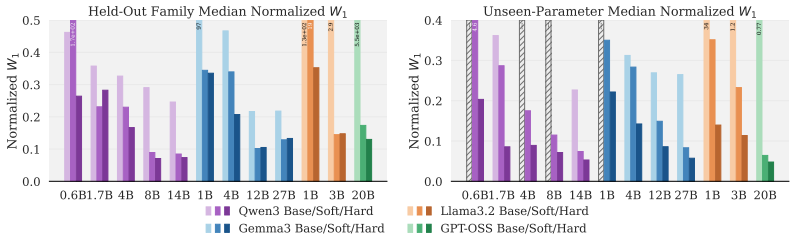
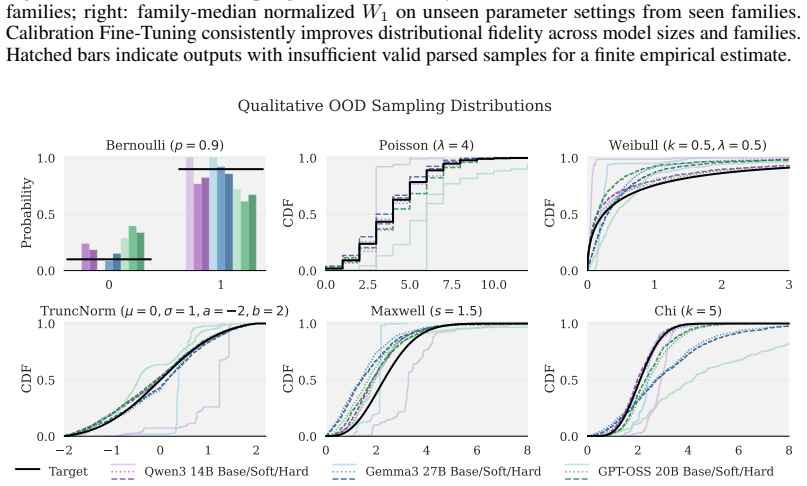
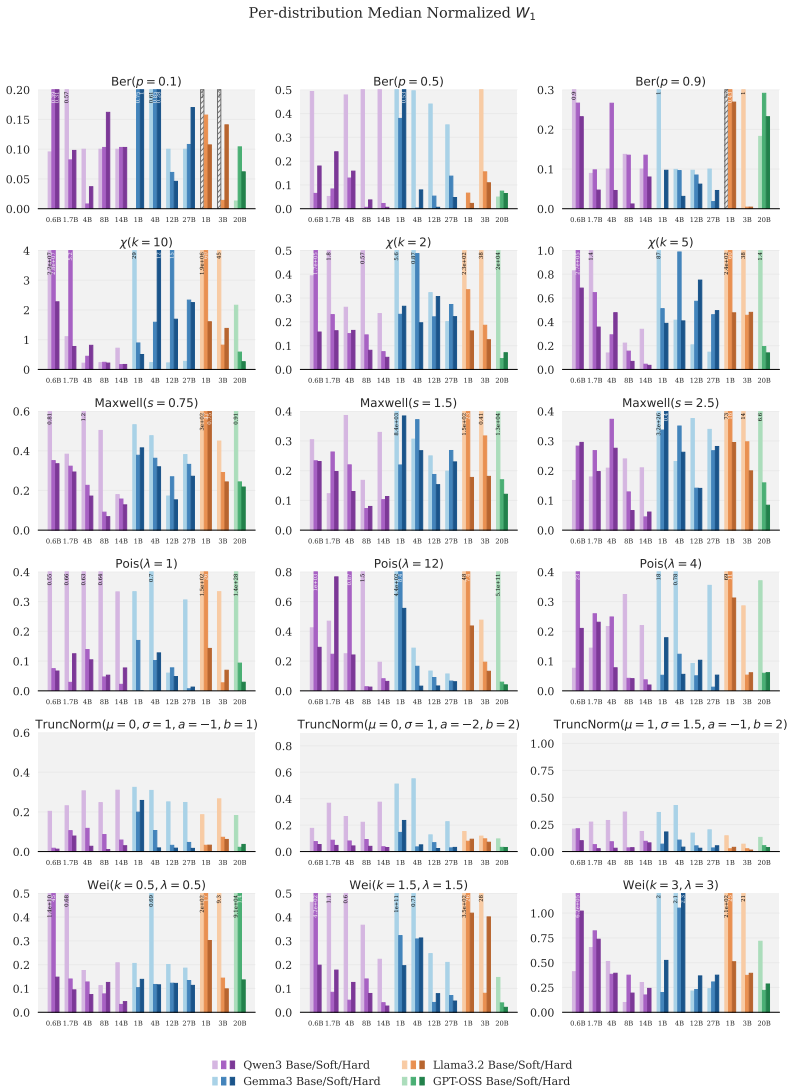
Probabilistic calibration is a trainable capability in language models. Fine-tuning on synthetic prompts that require sampling from mathematical distributions raises structured-sampling fidelity on held-out distribution families and unseen parameter settings. Hard-target fine-tuning tends to perform best on numeric sampling tasks while soft-target fine-tuning transfers more strongly to broader stochastic benchmarks including open-ended random generation and answer-position balancing, though both can reduce performance on arithmetic reasoning.
What carries the argument
Calibration Fine-Tuning: fine-tuning language models on synthetic prompts that demand sampling from mathematical distributions, implemented either via soft-target trie-derived next-token probabilities or hard-target sampled completions from the target distribution.
If this is right
- Both fine-tuning methods raise structured-sampling fidelity on held-out distribution families and unseen parameter settings.
- Hard-target fine-tuning delivers stronger results on structured numeric sampling tasks.
- Soft-target fine-tuning shows better transfer to open-ended random generation and multiple-choice answer-position balancing.
- Calibration gains can reduce performance on downstream arithmetic reasoning tasks, with the size of the cost varying by model.
Where Pith is reading between the lines
- The same synthetic-prompt approach could be adapted to train control over other generation properties such as response length or stylistic variation.
- Multi-objective fine-tuning that interleaves calibration examples with reasoning data might reduce the observed trade-offs with arithmetic performance.
- Production systems could apply targeted calibration updates to improve reliability on user requests that explicitly call for controlled randomness.
Load-bearing premise
That gains measured on synthetic mathematical distribution prompts will transfer to real user prompts specifying randomness without unacceptable losses in other model capabilities.
What would settle it
Measure whether the fine-tuned models produce outputs whose empirical distributions match user-specified targets more closely than base models on a suite of natural-language prompts such as 'draw 100 samples from a normal distribution with mean 5 and standard deviation 2' or 'shuffle this list randomly', while also checking accuracy on separate arithmetic and reasoning benchmarks.
Figures



read the original abstract
Language models are increasingly used in settings where outputs must satisfy user-specified randomness constraints, yet their generation probabilities are often poorly calibrated to those targets. We study whether this capability can be improved directly through fine-tuning. Concretely, we fine-tune language models on synthetic prompts that require sampling from mathematical distributions, and compare two Calibration Fine-Tuning variants: a soft-target method that converts the desired output distribution into trie-derived next-token targets, and a hard-target method that trains on sampled completions from the same target distribution. Across 12 models spanning four families, both methods substantially improve structured-sampling fidelity on held-out distribution families and unseen parameter settings, showing that probabilistic calibration is a trainable capability. Under our selected training configurations, the two methods exhibit different empirical profiles: hard-target fine-tuning is often strongest on structured numeric sampling, while soft-target fine-tuning performs better on broader stochastic generation benchmarks, including open-ended random generation, multiple-choice answer-position balancing, and NoveltyBench. The gains sometimes reduce downstream capability, especially arithmetic reasoning, with costs varying by model. Overall, our results show that probabilistic calibration can be improved through fine-tuning, with our hard-target configuration favoring exact numeric fidelity and our soft-target configuration favoring broader stochastic transfer. Code is available at https://github.com/chandar-lab/calibration-finetuning.
Editorial analysis
A structured set of objections, weighed in public.
Referee Report
Summary. The paper claims that probabilistic calibration to user-specified randomness constraints is a trainable capability in language models. The authors fine-tune 12 models across four families on synthetic prompts requiring sampling from mathematical distributions, using two variants: soft-target fine-tuning (converting targets to trie-derived next-token probabilities) and hard-target fine-tuning (training on sampled completions from the target distribution). Both methods yield substantial gains in structured sampling fidelity on held-out distribution families, unseen parameters, and broader stochastic benchmarks (open-ended random generation, answer-position balancing, NoveltyBench), with differentiated profiles (hard-target stronger on numeric fidelity, soft-target on transfer) and some variable costs to downstream tasks like arithmetic reasoning.
Significance. If the empirical results hold, the work establishes that calibration is not fixed but can be directly improved via fine-tuning, with the public code release at https://github.com/chandar-lab/calibration-finetuning providing a reproducible basis for follow-up. The multi-model, multi-family evaluation and differentiation between methods add value for understanding trade-offs in stochastic generation. Significance is limited by the narrow evaluation scope, as gains may not extend to typical user prompts with implicit randomness constraints.
major comments (2)
- [Abstract and Evaluation] The central claim that fine-tuning installs a general 'probabilistic calibration capability' (Abstract) rests on the assumption that improvements transfer beyond the training distribution. However, all reported gains are measured on synthetic mathematical distribution prompts, held-out families, and closely related benchmarks; no experiments evaluate prompts in which randomness constraints are embedded in complex, open-ended natural-language instructions (e.g., conditional or attribute-based randomness without explicit syntax or scaffolds). This leaves open whether gains reflect better parsing of distribution syntax rather than internal probability calibration.
- [Results] Results section: while the abstract states 'consistent gains' and 'substantially improve' across 12 models, the manuscript does not report statistical significance tests, confidence intervals, or exact effect sizes for the fidelity improvements. Without these, it is difficult to assess whether the differentiated profiles between soft- and hard-target methods are robust or whether the observed costs to arithmetic reasoning are systematic.
minor comments (1)
- [Abstract] The abstract and introduction could more explicitly define the metrics used for 'structured-sampling fidelity' and 'broader stochastic generation benchmarks' to aid readers in interpreting the differentiated method profiles.
Simulated Author's Rebuttal
We thank the referee for the constructive comments, which help clarify the scope and presentation of our results. We respond to each major comment below and indicate the revisions we will make.
read point-by-point responses
-
Referee: [Abstract and Evaluation] The central claim that fine-tuning installs a general 'probabilistic calibration capability' (Abstract) rests on the assumption that improvements transfer beyond the training distribution. However, all reported gains are measured on synthetic mathematical distribution prompts, held-out families, and closely related benchmarks; no experiments evaluate prompts in which randomness constraints are embedded in complex, open-ended natural-language instructions (e.g., conditional or attribute-based randomness without explicit syntax or scaffolds). This leaves open whether gains reflect better parsing of distribution syntax rather than internal probability calibration.
Authors: We appreciate the referee's emphasis on distinguishing syntactic parsing from genuine calibration. Our experimental design uses controlled synthetic distributions precisely to isolate the calibration objective and measure exact fidelity on held-out families and unseen parameters. The observed transfer to broader stochastic benchmarks—including open-ended random generation, answer-position balancing, and NoveltyBench—indicates that improvements generalize beyond the specific training syntax. Nevertheless, we agree that prompts embedding implicit randomness constraints within complex natural-language instructions lie outside our current evaluation. We will add a dedicated paragraph in the Discussion section acknowledging this limitation and framing our results as evidence for a trainable capability within the tested regimes, while noting the need for future work on more naturalistic prompts. revision: partial
-
Referee: [Results] Results section: while the abstract states 'consistent gains' and 'substantially improve' across 12 models, the manuscript does not report statistical significance tests, confidence intervals, or exact effect sizes for the fidelity improvements. Without these, it is difficult to assess whether the differentiated profiles between soft- and hard-target methods are robust or whether the observed costs to arithmetic reasoning are systematic.
Authors: The referee correctly notes the absence of formal statistical reporting. In the revised manuscript we will include paired statistical tests (e.g., Wilcoxon signed-rank across models), 95% confidence intervals, and effect sizes (Cohen's d) for the primary fidelity metrics, the soft- versus hard-target differences, and the downstream arithmetic costs. These additions will be placed in the Results section and summarized in a new table to allow readers to evaluate robustness directly. revision: yes
Circularity Check
Purely empirical study with no derivation chain or self-referential reductions
full rationale
The paper presents an empirical investigation of fine-tuning language models on synthetic mathematical distribution prompts, measuring improvements in sampling fidelity on held-out distribution families, unseen parameters, and stochastic benchmarks. No equations, derivations, or first-principles results are claimed; the central claim that probabilistic calibration is trainable rests entirely on experimental outcomes rather than any reduction of predictions to fitted inputs by construction. No self-citation load-bearing steps, uniqueness theorems, or ansatz smuggling appear in the load-bearing arguments. The study is self-contained against its own benchmarks and does not invoke external mathematical facts that collapse back to the authors' prior work.
Axiom & Free-Parameter Ledger
free parameters (1)
- fine-tuning hyperparameters (learning rate, epochs, batch size, etc.)
axioms (1)
- domain assumption Synthetic prompts requiring sampling from mathematical distributions are representative of general user-specified randomness constraints.
Reference graph
Works this paper leans on
-
[1]
URLhttps://arxiv.org/abs/2503.19786. Pauli Virtanen, Ralf Gommers, Travis E. Oliphant, Matt Haberland, Tyler Reddy, David Cournapeau, Evgeni Burovski, Pearu Peterson, Warren Weckesser, Jonathan Bright, Stéfan J. van der Walt, Matthew Brett, Joshua Wilson, K. Jarrod Millman, Nikolay Mayorov, Andrew R. J. Nelson, Eric Jones, Robert Kern, Eric Larson, C J Ca...
work page internal anchor Pith review Pith/arXiv arXiv doi:10.1038/s41592-019-0686-2 2020
-
[2]
doi: 10.48550/arXiv.2601.05414. URLhttps://arxiv.org/abs/2601.05414. 14 Appendix A Calibration Fine-Tuning Algorithms Algorithm 1 formalizes the soft-target Calibration Fine-Tuning pipeline described in Section 3. The first phase constructs a prefix trie from the discretized target distribution and derives per-prefix next-token targets. The second phase s...
work page internal anchor Pith review Pith/arXiv arXiv doi:10.48550/arxiv.2601.05414 1988
-
[3]
Leatherman.com D: 10, U: 8.00
-
[4]
Herschel D: 6, U: 5.43
-
[5]
Levi’s 2. Tumi 2. M. Gemi
-
[6]
Levi’s. 3. Ssense 3. Wynterleeleather.com
- [7]
-
[8]
LeatherMan.com 5. M. Gemi 5. Tumi 30 Table 12: Representative NoveltyBench cases where soft-target Calibration Fine-Tuning clearly improves reward-weighted utility. Model: Gemma-3-27B-it (Subjective Rankings & Opinions). Prompt: What is the coolest Pokémon from the second generation? Just give me one. Base Soft Hard D: 1, U: 1.57
-
[9]
Typhlosion. It’s a really solid pick! A powerful Fire-type with a cool, mature design - a big, powerful tiger wreathed in flames. It feels like a ... D: 10, U: 8.78
-
[10]
It’s just a sleek, mysterious, and powerful Dark-type with glowing markings
Umbreon. It’s just a sleek, mysterious, and powerful Dark-type with glowing markings. Everything about it is awesome. D: 2, U: 2.82
-
[11]
It’s just massive, imposing, and has a really cool design that feels genuinely threatening
Tyranitar. It’s just massive, imposing, and has a really cool design that feels genuinely threatening. It’s a pseudo-legendary that’s still
-
[12]
Typhlosion. It’s a fire-type with a really awesome, somewhat melancholic design - a big, powerful tiger wreathed in flames. Plus, its backstory (a
-
[13]
Typhlosion. 2. Typhlosion. Its design is sleek and power- ful, it’s a Fire-type starter with a lot of nostal- gia, and it just looks cool breathing those blue flames
-
[14]
Typhlosion. It’s a powerful Fire-type with a really cool, mature design - a big, strong tiger with flames constantly swirling. It feels like a truly
-
[15]
Houndoom. 3. Typhlosion. Its design is sleek and powerful, and it has a cool, fiery aesthetic without being too over-the-top. Plus, it’s a powerful Fire- type with
-
[16]
It’s a fiery, powerful, and sur- prisingly graceful final evolution with a really cool design
Typhlosion. It’s a fiery, powerful, and sur- prisingly graceful final evolution with a really cool design. Plus, that fiery mane is just awe- some! It
-
[17]
It’s a massive, imposing pseudo-legendary with a fantastic design and a powerful
Tyranitar is the coolest Pokmon from the second generation. It’s a massive, imposing pseudo-legendary with a fantastic design and a powerful
-
[18]
Typhlosion. Its design is sleek and powerful, it’s a Fire-type starter that doesn’t just look like a bigger version of itself (looking at you,
-
[19]
It’s a fully evolved Fire-type with a really cool, almost melancholy design
Typhlosion. It’s a fully evolved Fire-type with a really cool, almost melancholy design. The idea of a Pokmon constantly emitting flames from its
-
[20]
Typhlosion 5. Tyranitar. It’s a massive, intimidating pseudo-legendary with a fantastic design and a powerful presence. It just feels cool. Table 13: Representative NoveltyBench cases where soft-target Calibration Fine-Tuning clearly improves reward-weighted utility. Model: GPT-OSS-20B (Creativity). Prompt: Write a haiku about a whale and a walnut tree. B...
-
[21]
Whale roars the sea- a walnut tree echoes back, roots and waves entwine. D: 5, U: 5.94
-
[22]
Ripples whisper soft, Distance spun by the whale’s steps- Nuts scent, wind hears it. D: 6, U: 5.07
-
[23]
Sea wind whispers- whales and walnut branches sway in sync- blossoms scent the tide
-
[24]
Silent whale glides- Its song weaves through the orchard, Walnut leaves blush, hush
-
[25]
The wind whips low leaves Below, a whale sings in waves Sunlight paints their stories
-
[26]
Waves hush softly- whale’s breath stirs the brook below, nuts wait for spring’s kiss
-
[27]
Silent whale rises, Wind whispers through walnut bark- Sea and earth converse
-
[28]
Beneath waves gleams an eye, Tree bones grow, rain becomes rust, Silent bond of earth
-
[29]
Beneath waves gleam, Whale bones drape like sea silk,- Walnut traces fall
-
[30]
Waves hush the shore- a whale drifts be- neath the sky, nuts sway in the wind
-
[31]
Waves hush softly Below, roots, palm branches tremble- Sky, sea, nutmaiden
-
[32]
The sea song swells low Below, a whale bends near. Cedar tree sighs deep
-
[33]
Silent whale glides, under the walnut’s green shadow- seas and woods converse
-
[34]
Rippling moonlight Finds the walnut’s tall shade- Whale stirs the stream
-
[35]
Rippling moonlight Finds the shell, a distant glow Swayed by tree, it listens. Table 14: Representative cases where the hard-target variant is competitive or best on prompt-level NoveltyBench utility. Model: Qwen3-14B (Factual Knowledge). Prompt: List a capital city in Africa. Base Soft Hard D: 4, U: 4.23
-
[36]
A capital city in Africa is Abuja, which is the capital of Nigeria. D: 4, U: 4.24
-
[37]
Cairo is a capital city in Africa. 2. Cairo 2. Cairo is the capital city of Egypt, which is located in Africa
-
[38]
Abuja is the capital city of Nigeria. 3. Lome is a capital city in Africa. 3. An example of a capital city in Africa is Cairo, the capital of Egypt
-
[40]
Lagos is the capital city of Nigeria. 4. Abuja is the capital city of Nigeria, an African country
-
[41]
A capital city in Africa is Cairo, the capital of Egypt
-
[42]
The capital of Nigeria is Abuja. 5. Nairobi is a capital city in Africa. It is the capital of Kenya and serves as a major cultural and economic hub on the continent. 31 Table 15: Representative cases where the hard-target variant is competitive or best on prompt-level NoveltyBench utility. Model: Gemma-3-27B-it (Creativity). Prompt: One thing you might fi...
-
[43]
A whispering tree! It wouldn’t just look ancient and magical, but its leaves would rustle and murmur secrets on the breeze - stories of the forest, ... D: 4, U: 4.58
-
[44]
Definitely a talking animal. It could be a wise old owl offering cryptic advice, a mis- chievous squirrel trading riddles for nuts, or a regal stag ... D: 6, U: 7.40
-
[45]
They chime softly in the breeze, and catching the light creates a daz- zling, otherworldly
A tree with leaves made of shimmering amethyst crystals. They chime softly in the breeze, and catching the light creates a daz- zling, otherworldly
-
[46]
A talking animal! Perhaps a wise old owl offering cryptic advice, a mischievous squirrel bartering for shiny objects, or a regal stag who is actually
-
[47]
Glowing mushrooms. They come in all sizes and colours - sapphire blue, emerald green, ruby red - and illuminate the forest floor with a soft,
-
[48]
A mushroom ring that, when stepped into, momentarily swaps your senses - you hear colors, see sounds, smell textures, etc. It’s disorienting, but
-
[49]
It’s classic magical forest, a little mysterious, and opens up
A mushroom ring that, when stepped into, briefly shows you a possible future. It’s classic magical forest, a little mysterious, and opens up
-
[50]
Or maybe...a stream that flows
A mushroom ring that, if you step inside, temporarily grants you the ability to under- stand the language of animals. Or maybe...a stream that flows
-
[51]
Maybe if you step inside, you’ll
A glowing mushroom circle, pulsing with soft, ethereal light and rumored to be a door- way to the realm of the fae. Maybe if you step inside, you’ll
-
[52]
A glowing mushroom ring! It’s a classic magical forest element - a circle of fungi emit- ting a soft, ethereal light, perhaps marking a portal to
-
[53]
A mushroom ring that, when stepped into, momentarily swaps your memories with those of the oldest tree in the forest
-
[54]
Each leaf holds a snippet of a tale - a lost love, a heroic
A whispering tree whose leaves murmur forgotten stories to those who listen closely. Each leaf holds a snippet of a tale - a lost love, a heroic
-
[55]
Maybe fairies dance within it,
A glowing mushroom circle! It’s a classic magical forest trope - a ring of mushrooms emitting a soft, ethereal light. Maybe fairies dance within it,
-
[56]
But be warned - lingering too long steals your
A mushroom ring that, when stepped within, briefly shows you a vision of your greatest desire. But be warned - lingering too long steals your
-
[57]
The secrets aren’t always useful - sometimes it’s just the recipe for a forgotten
A tree whose leaves whisper secrets to those who listen closely. The secrets aren’t always useful - sometimes it’s just the recipe for a forgotten ... Table 16: Representative cases where the hard-target variant is competitive or best on prompt-level NoveltyBench utility. Model: GPT-OSS-20B (Factual Knowledge). Prompt: Name one person who won the Fields M...
- [58]
-
[59]
Sir Michael Atiyah D: 10, U: 6.61
-
[60]
One person who has won the Fields Medal is John G. Thompson (awarded in 1974)
work page 1974
- [61]
-
[62]
One Fields Medal laureate is Grigori Perel- man (1998)
work page 1998
- [63]
-
[64]
One notable Fields Medalist is Grigori Perelman, who received the award in 2006 for his proof of the Poincar conjecture
work page 2006
- [65]
-
[66]
Ada Levine (2024) 5. John Milnor 5. Laurent Lafforgue Table 17: Representative failure cases where Calibration Fine-Tuning hurts prompt-level utility. Model: GPT-OSS-20B (Product & Purchase Recommendations). Prompt: Suggest a birthday gift for a friend’s 25th birthday. Just one Base Soft Hard D: 8, U: 8.40
work page 2024
-
[67]
It’s stylish, practical for future trav- els, and
A personalized leather passport holder- engraved with their initials and a short birthday message. It’s stylish, practical for future trav- els, and ... D: 10, U: 5.34
-
[68]
Luxury leather wallet D: 10, U: 3.95
-
[69]
A personalized leather journal with a cus- tom engraved name or monogram
-
[70]
It’s a timeless, practical gift that encourages creativ- ity,
A handcrafted leather journal with a per- sonalized engraved initial on the cover. It’s a timeless, practical gift that encourages creativ- ity,
-
[71]
A personalized leather journal with a cus- tom monogram and a luxurious fountain pen set
Bluetooth speaker with WiFi connectivity 2. A personalized leather journal with a cus- tom monogram and a luxurious fountain pen set
-
[72]
A highquality leather messenger bag. It’s practical, stylish, and gets better with age- perfect for a 25yearold looking to upgrade their everyday
-
[73]
Custom portrait in the style of a retro comic book
-
[74]
Portable Bluetooth speaker with a sleek, waterproof design for music on-the-go
-
[75]
How about a highquality, personalized leather wallet? It’s classy, practical, and the added personal touch makes it special for a 25th birthday
-
[76]
Personalized leather guitar strap with high- quality engraving
-
[77]
A premium yoga retreat vacation voucher
-
[78]
A personalized leather passport holder with their initials and a small map of their favorite travel destinations
-
[79]
A personalized wood cutting board with a lifetime woodworm seal
Roku Streaming Stick+ 5. A personalized wood cutting board with a lifetime woodworm seal. It’s both functional and stylish for a cooking enthusiast. 32 Table 18: Representative failure cases where Calibration Fine-Tuning hurts prompt-level utility. Model: Qwen3-14B (Character & Entity Naming). Prompt: Suggest a name for a dappled-gray filly living in the ...
-
[80]
A dappled-gray filly living in the mountains could have a name that reflects both her color and her wild, elegant nature. D: 6, U: 6.02
-
[81]
Shadowmist A dappled-gray filly living in the mountains would be cloaked in an ever- changing play of light and shadow. Shad- owmist evokes the ... D: 3, U: 4.46
discussion (0)
Sign in with ORCID, Apple, or X to comment. Anyone can read and Pith papers without signing in.