Recognition: no theorem link
Cocycles with Quasi-Conformality II: Ergodic measures with positive entropy
Pith reviewed 2026-05-13 05:07 UTC · model grok-4.3
The pith
Any continuous SL(d,R) cocycle over a positive-entropy subshift of finite type either admits a dominated splitting or can be C^0-approximated by one that C^α-stably supports positive-entropy ergodic measures with uniformly bounded orbits.
A machine-rendered reading of the paper's core claim, the machinery that carries it, and where it could break.
Core claim
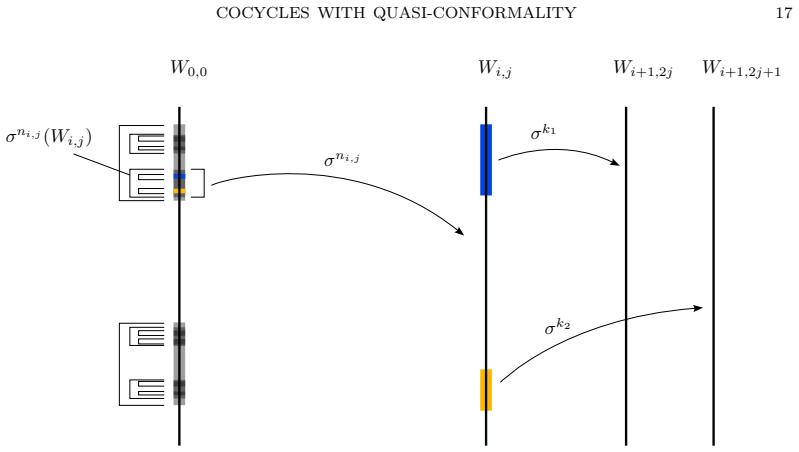
The central claim is that a multiple covering principle robustly produces positive-entropy ergodic measures on fiberwise uniformly bounded orbits. This principle implies that every continuous SL(d,R) cocycle over a positive-entropy subshift of finite type either admits a dominated splitting or can be C^0-approximated by a cocycle that C^α-stably supports such measures for some α>0. When the cocycle is non-isometric, the topological entropy of the bounded-orbit measures is strictly less than the entropy of the base subshift.
What carries the argument
The multiple covering principle, which constructs positive-entropy ergodic measures supported on orbits that stay uniformly bounded in every fiber.
If this is right
- Cocycles lacking a dominated splitting become approximable by ones that support stable positive-entropy bounded measures.
- The supported measures for non-isometric cocycles have strictly lower entropy than the base subshift.
- The property of supporting such measures persists under sufficiently small C^α perturbations after the initial C^0 approximation.
- The dichotomy separates cocycles according to the existence of a dominated splitting versus the existence of approximable bounded positive-entropy measures.
Where Pith is reading between the lines
- The covering principle may connect the absence of dominated splittings to the possibility of controlling conformal distortion along orbits.
- Similar constructions could be tested on cocycles over other expansive bases to see whether the entropy gap persists.
- The result suggests that the space of cocycles without splittings is approximable by ones whose Lyapunov exponents are constrained by the bounded-orbit condition.
Load-bearing premise
The base system must be a positive-entropy subshift of finite type and the cocycle must be continuous so that the multiple covering principle can be applied to produce the stated measures.
What would settle it
A continuous SL(d,R) cocycle over a positive-entropy subshift of finite type that has no dominated splitting and for which no C^0-small perturbation yields a cocycle whose positive-entropy measures with bounded orbits remain stable under C^α perturbations.
Figures

read the original abstract
As the second part of a series on linear cocycles over chaotic systems, this paper establishes a "multiple covering principle" that robustly yields positive-entropy ergodic measures supported on fiberwise uniformly bounded orbits. Using this mechanism, we prove that any continuous $\mathrm{SL}(d,\mathbb{R})$ cocycle over a positive-entropy subshift of finite type either admits a dominated splitting or can be $C^0$-approximated by one that $C^\alpha$-stably supports such measures ($\alpha>0$). Additionally, for non-isometric cocycles, we show that the topological entropy of these bounded orbits is strictly less than that of the base subshift.
Editorial analysis
A structured set of objections, weighed in public.
Referee Report
Summary. This paper, the second in a series, introduces a 'multiple covering principle' that produces positive-entropy ergodic measures supported on fiberwise uniformly bounded orbits for continuous SL(d,R) cocycles over positive-entropy subshifts of finite type. It then establishes that any such cocycle either admits a dominated splitting or can be C^0-approximated by one that C^α-stably supports such measures for some α>0. For non-isometric cocycles, the topological entropy of the bounded orbits is shown to be strictly less than the entropy of the base subshift.
Significance. If the multiple covering principle is established rigorously and applies robustly under the stated hypotheses, the result would constitute a meaningful advance in the ergodic theory of linear cocycles over hyperbolic bases. The dichotomy and C^0-approximation statements, together with the strict entropy inequality for non-isometric cases, provide both a structural classification and a quantitative distinction that could serve as tools for subsequent work on quasi-conformal cocycles and dominated splittings.
minor comments (3)
- [Introduction] The precise definition and hypotheses of the multiple covering principle (introduced in §3) should be stated in a self-contained manner in the introduction, including any dependence on the continuity of the cocycle and the positive-entropy assumption on the SFT, to allow readers to assess its independence from the main theorem.
- [Theorem 1.2] In the statement of the main approximation result (Theorem 1.2), the value or range of α>0 is not quantified; an explicit lower bound or dependence on the cocycle and base would strengthen the claim.
- [Theorem 1.3] The entropy comparison for non-isometric cocycles (Theorem 1.3) relies on a comparison between the topological entropy of the bounded-orbit measures and h_top of the base; a brief remark on whether equality can hold in the isometric case would clarify the sharpness.
Simulated Author's Rebuttal
We thank the referee for the positive assessment of our manuscript, the recognition of the multiple covering principle as a potential advance, and the recommendation for minor revision. No specific major comments were listed in the report, so we have no point-by-point rebuttals to provide at this stage. We stand ready to incorporate any minor suggestions once detailed feedback is received.
Circularity Check
No circularity; new principle introduced independently
full rationale
The paper defines and establishes a multiple covering principle within its own arguments to produce the positive-entropy ergodic measures with uniformly bounded fiber orbits. This principle is then applied to obtain the stated dichotomy or C^0-approximation result for continuous SL(d,R) cocycles over positive-entropy SFTs, along with the strict entropy inequality for non-isometric cases. No load-bearing step reduces by definition, by fitted-parameter renaming, or by a self-citation chain whose content is unverified outside the present work; the derivation remains self-contained against the base dynamical assumptions.
Axiom & Free-Parameter Ledger
Reference graph
Works this paper leans on
- [1]
- [2]
-
[3]
A. Avila and M. Viana, Extremal Lyapunov exponents: an invariance principle and applications , Invent. Math. 181 (2010), no. 1, 115--178
work page 2010
- [4]
- [5]
-
[6]
C. Bonatti, L. J. D \' az, and D. Kwietniak, Robust existence of nonhyperbolic ergodic measures with positive entropy and full support, Annali della Scuola Normale Superiore di Pisa, Classe di Scienze 22 (2021), no. 4, 1643--1672
work page 2021
-
[7]
C. Bonatti, L. J. D\' az, and E. R. Pujals, A C^1 -generic dichotomy for diffeomorphisms: weak forms of hyperbolicity or infinitely many sinks or sources , Ann. of Math. (2) 158 (2003), no. 2, 355--418
work page 2003
-
[8]
C. Bonatti, L. J. D\' az, and M. Viana, Dynamics beyond uniform hyperbolicity, Encyclopaedia of Mathematical Sciences, vol. 102, Springer-Verlag, Berlin, 2005, A global geometric and probabilistic perspective, Mathematical Physics, III
work page 2005
-
[9]
J. Bochi and N. Gourmelon, Some characterizations of domination, Math. Z. 263 (2009), no. 1, 221--231
work page 2009
-
[10]
J. Bochi and A. Navas, Almost reduction and perturbation of matrix cocycles, Ann. Inst. H. Poincar\' e C Anal. Non Lin\' e aire 31 (2014), no. 6, 1101--1107
work page 2014
-
[11]
Bochi, Genericity of zero L yapunov exponents , Ergodic Theory Dynam
J. Bochi, Genericity of zero L yapunov exponents , Ergodic Theory Dynam. Systems 22 (2002), no. 6, 1667--1696
work page 2002
-
[12]
, Removing quasiconformal orbits, Studia Mathematica (2026)
work page 2026
- [13]
-
[14]
Y. Benoist and J-F. Quint, Random walks on reductive groups, Ergebnisse der Mathematik und ihrer Grenzgebiete. 3. Folge. A Series of Modern Surveys in Mathematics, vol. 62, Springer, Cham, 2016
work page 2016
-
[15]
J. Bochi and M. Rams, The entropy of L yapunov-optimizing measures of some matrix cocycles , J. Mod. Dyn. 10 (2016), 255--286
work page 2016
-
[16]
J. Bochi and M. Viana, The L yapunov exponents of generic volume-preserving and symplectic maps , Ann. of Math. (2) 161 (2005), no. 3, 1423--1485
work page 2005
-
[17]
D. Coronel, A. Navas, and M. Ponce, On bounded cocycles of isometries over minimal dynamics, Journal of Modern Dynamics 7 (2013), no. 1, 45–74
work page 2013
-
[18]
L. J. D \' az, K. Gelfert, and M. Rams, Entropy spectrum of lyapunov exponents for nonhyperbolic step skew-products and elliptic cocycles, Communications in Mathematical Physics 367 (2019), no. 2, 351--416
work page 2019
-
[19]
, Variational principle for nonhyperbolic ergodic measures: skew products and elliptic cocycles, Communications in Mathematical Physics 394 (2022), no. 1, 73--141
work page 2022
-
[20]
A. Fakhari, M. Nassiri, and H. Rajabzadeh, Stable local dynamics: Expansion, quasi-conformality and ergodicity, Advances in Mathematics 462 (2025), 110088
work page 2025
-
[21]
Furstenberg, Noncommuting random products, Trans
H. Furstenberg, Noncommuting random products, Trans. Am. Math. Soc. 108 (1963), 377--428
work page 1963
-
[22]
Kalinin, Livšic theorem for matrix cocycles, Annals of Mathematics 173 (2011), no
B. Kalinin, Livšic theorem for matrix cocycles, Annals of Mathematics 173 (2011), no. 2, 1025–1042
work page 2011
-
[23]
B. Kalinin and V. Sadovskaya, Linear cocycles over hyperbolic systems and criteria of conformality, J. Mod. Dyn. 4 (2010), no. 3, 419--441
work page 2010
-
[24]
B. Kalinin and V. Sadovskaya, Boundedness, compactness, and invariant norms for banach cocycles over hyperbolic systems, Proceedings of the American Mathematical Society 146 (2018), no. 9, 3801--3813
work page 2018
-
[25]
Lacka, Non-hyperbolic ergodic measures with the full support and positive entropy, Monatsh
M. Lacka, Non-hyperbolic ergodic measures with the full support and positive entropy, Monatsh. Math. 200 (2023), no. 1, 163--178
work page 2023
-
[26]
F. Ledrappier, Positivity of the exponent for stationary sequences of matrices, Lyapunov Exponents (Berlin, Heidelberg) (Ludwig Arnold and Volker Wihstutz, eds.), Springer Berlin Heidelberg, 1986, pp. 56--73
work page 1986
-
[27]
Lind, Perturbations of shifts of finite type, SIAM Journal on Discrete Mathematics 2 (1989), no
D. Lind, Perturbations of shifts of finite type, SIAM Journal on Discrete Mathematics 2 (1989), no. 3, 350--365
work page 1989
-
[28]
D. Lind and B. Marcus, An introduction to symbolic dynamics and coding, 2nd updated edition ed., Camb. Math. Libr., Cambridge: Cambridge University Press, 2021
work page 2021
-
[29]
F. Ledrappier and L.-S. Young, The metric entropy of diffeomorphisms: Part II : Relations between entropy, exponents and dimension , Annals of Mathematics 122 (1985), no. 3, 540--574
work page 1985
-
[30]
Ma \ n \'e , An ergodic closing lemma, Annals of Mathematics 116 (1982), no
R. Ma \ n \'e , An ergodic closing lemma, Annals of Mathematics 116 (1982), no. 3, 503--540
work page 1982
-
[31]
M. Nassiri and M. Zareh Bidaki, Cantor sets in higher dimension I : Criterion for stable intersections , arXiv: 2502.02906 (2025)
-
[32]
M. Nassiri, H. Rajabzadeh, and Z. Reshadat, Cocycles with quasi-conformality I : Stability and abundance , Journal of the Institute of Mathematics of Jussieu (2026), 1–43
work page 2026
-
[33]
Y. Pesin and V. Climenhaga, Lectures on fractal geometry and dynamical systems, Student Mathematical Library, vol. 52, American Mathematical Society, Providence, RI, 2009
work page 2009
-
[34]
Y. Pesin, Dimension theory in dynamical systems: contemporary views and applications, Chicago: The University of Chicago Press, 1998
work page 1998
-
[35]
E. R. Pujals and M. Sambarino, Homoclinic bifurcations, dominated splitting, and robust transitivity, Handbook of dynamical systems. Volume 1B, Amsterdam: Elsevier, 2006, pp. 327--378
work page 2006
-
[36]
A. N. Quas, Rigidity of continuous coboundaries, Bull. London Math. Soc. 29 (1997), no. 5, 595--600
work page 1997
-
[37]
Reshadat, Quasi-conformal behaviour in linear cocycles, Ph.D
Z. Reshadat, Quasi-conformal behaviour in linear cocycles, Ph.D. thesis, IPM, 2025
work page 2025
-
[38]
M. Sambarino, A (short) survey on dominated splittings, Mathematical Congress of the Americas, Contemporary Mathematics, vol. 656, American Mathematical Society, Providence, RI, 2016, pp. 149--183
work page 2016
-
[39]
Viana, Almost all cocycles over any hyperbolic system have nonvanishing Lyapunov exponents , Ann
M. Viana, Almost all cocycles over any hyperbolic system have nonvanishing Lyapunov exponents , Ann. Math. (2) 167 (2008), no. 2, 643--680
work page 2008
-
[40]
J-C. Yoccoz, Some questions and remarks about \(SL(2, R)\) cocycles , Modern dynamical systems and applications. Dedicated to Anatole Katok on his 60th birthday, Cambridge: Cambridge University Press, 2004, pp. 447--458
work page 2004
discussion (0)
Sign in with ORCID, Apple, or X to comment. Anyone can read and Pith papers without signing in.