Recognition: no theorem link
High-energy Multi-messenger Emission from Galaxy Clusters in the Local Universe
Pith reviewed 2026-05-13 04:57 UTC · model grok-4.3
The pith
Numerical models show that gamma-ray and neutrino emission from local galaxy clusters falls below current telescope upper limits.
A machine-rendered reading of the paper's core claim, the machinery that carries it, and where it could break.
Core claim
Using MHD simulations that supply the distributions of gas, temperature, and magnetic field together with Monte Carlo tracking of cosmic-ray propagation, and taking cosmic-ray injection to scale with gas density, the predicted gamma-ray flux from the individual Virgo, Perseus, and Coma clusters lies well below present LHAASO upper limits; MAGIC data on the central source NGC 1275 exceed the model; the cumulative gamma-ray flux from clusters with masses above 5 times 10^13 solar masses within 500 megaparsecs is significantly lower than the Fermi-LAT diffuse measurement; and the neutrino predictions remain consistent with IceCube upper limits on unresolved flux from clusters above 10^14 solar
What carries the argument
MHD simulations of intracluster gas, temperature, and magnetic fields coupled to Monte Carlo cosmic-ray propagation and secondary production, with cosmic-ray injection scaled to local gas density.
If this is right
- Individual cluster gamma-ray fluxes remain below LHAASO sensitivity.
- Cumulative neutrino emission from clusters up to redshift 2 stays within IceCube unresolved limits.
- Galaxy clusters cannot account for the full Fermi-LAT diffuse gamma-ray background.
- High-density turbulent and shocked regions inside clusters act as the main sites of cosmic-ray acceleration.
Where Pith is reading between the lines
- Other populations such as starburst galaxies or active galactic nuclei must supply most of the diffuse high-energy backgrounds.
- Next-generation gamma-ray instruments could detect the faint cluster emission and thereby test the gas-density scaling assumption.
- The same numerical approach can be extended to higher-redshift or lower-mass systems to estimate the total cluster contribution to the cosmic neutrino background.
Load-bearing premise
Cosmic ray injection scales directly with the gas density inside the clusters.
What would settle it
A gamma-ray detection from Virgo, Perseus, or Coma at a flux level several times higher than the model prediction would falsify the central result.
Figures


read the original abstract
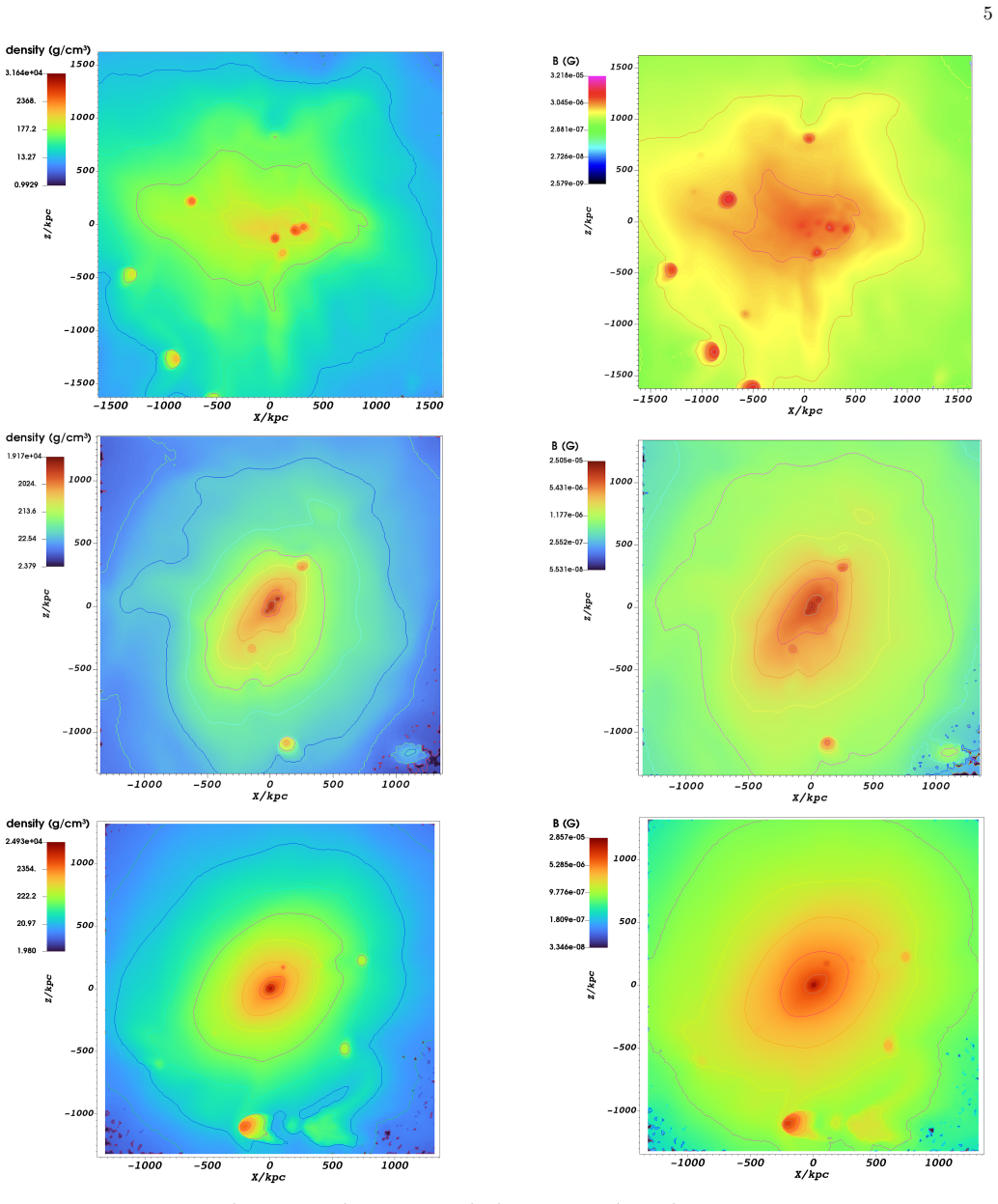
The origin of diffuse neutrinos and $\gamma$-rays is unknown, and galaxy clusters hosting AGN and starburst galaxies are the most probable sources of these cosmic messengers. In this work, we investigate the diffuse $\gamma$-ray and neutrino emission from the Virgo, Perseus, and Coma clusters using a detailed numerical method, combining MHD simulations with Monte Carlo methods. The MHD simulation provides the distributions of temperature, gas, and magnetic field in clusters. The Monte Carlo simulations are used to investigate the cosmic-ray (CR) propagation in ICM and subsequently the secondaries stemming from CRs. Our primary assumption is that CR injection scales with the gas density of clusters, providing a physically motivated approximation. High-density regions in clusters are associated with strong turbulence and prominent shock structures, making them natural sites for efficient CR acceleration. Our predicted $\gamma$-ray flux from the individual clusters lies well below the present LHAASO upper limits. The MAGIC observations of the central source NGC $1275$ of the Perseus cluster are significantly higher than our results. Further, we estimated the cumulative $\gamma$-ray and neutrino fluxes from clusters with masses $\gtrsim 5\times 10^{13}, M_{\odot}$ in the local Universe (within $500$ Mpc). The diffuse $\gamma$-ray flux reported by the Fermi-LAT collaboration is significantly higher than our results. Our predictions are consistent with IceCube's existing upper limits on the unresolved neutrino flux from galaxy clusters ($M > 10^{14}, M_{\odot}$) up to $z = 2$.
Editorial analysis
A structured set of objections, weighed in public.
Referee Report
Summary. The paper uses MHD simulations of the intracluster medium (temperature, gas density, magnetic fields) in Virgo, Perseus, and Coma combined with Monte Carlo cosmic-ray propagation to predict secondary gamma-ray and neutrino fluxes. It adopts the assumption that CR injection scales linearly with gas density, motivated by associations with turbulence and shocks. The central results are that predicted gamma-ray fluxes from the three clusters lie well below LHAASO upper limits (with MAGIC data for NGC 1275 noted as higher), the cumulative gamma-ray flux from clusters with M ≳ 5×10^13 M_⊙ within 500 Mpc is below the Fermi-LAT diffuse measurement, and the neutrino predictions are consistent with IceCube upper limits on unresolved flux from M > 10^14 M_⊙ clusters to z=2.
Significance. If the modeling holds, the work supplies concrete forward predictions for the contribution of local galaxy clusters to the diffuse high-energy neutrino and gamma-ray backgrounds. The combination of MHD fields with Monte Carlo CR transport is a methodological strength that avoids direct fitting to the messenger data being compared, allowing falsifiable tests against current and future limits. This can help prioritize multi-messenger follow-up of clusters and refine source population models.
major comments (2)
- [§2] §2 (Numerical Methods, Monte Carlo CR propagation): The absolute normalization of the CR density—and therefore the secondary gamma-ray and neutrino fluxes—is set by the assumption that injection scales linearly with gas density. No sensitivity analysis to alternative scalings (e.g., with magnetic-field strength, turbulence amplitude, or shock Mach number) or independent calibration against radio synchrotron data is presented. Because an order-of-magnitude shift in normalization would directly affect whether the fluxes remain “well below” LHAASO limits and “consistent with” IceCube limits, this assumption is load-bearing for the central claims.
- [Results section] Results for individual clusters (Virgo/Perseus/Coma) and cumulative flux section: The comparisons to LHAASO, MAGIC, Fermi-LAT, and IceCube limits are presented as direct statements without propagated uncertainties arising from the CR injection scaling or from variations in the MHD density fields. Adding even a simple range of scaling factors would show whether the “well below” and “consistent with” conclusions are robust or marginal.
minor comments (2)
- [§2] The description of the Monte Carlo step would benefit from an explicit equation for the CR injection rate (currently described only in prose) to make the normalization choice transparent.
- [Figures] Figure captions for the flux spectra should state the exact energy range and integration aperture used for the LHAASO and IceCube comparisons.
Simulated Author's Rebuttal
We thank the referee for the constructive and detailed comments on our manuscript. We address each major point below and outline the revisions we will make to strengthen the presentation of our results and the robustness of our conclusions.
read point-by-point responses
-
Referee: §2 (Numerical Methods, Monte Carlo CR propagation): The absolute normalization of the CR density—and therefore the secondary gamma-ray and neutrino fluxes—is set by the assumption that injection scales linearly with gas density. No sensitivity analysis to alternative scalings (e.g., with magnetic-field strength, turbulence amplitude, or shock Mach number) or independent calibration against radio synchrotron data is presented. Because an order-of-magnitude shift in normalization would directly affect whether the fluxes remain “well below” LHAASO limits and “consistent with” IceCube limits, this assumption is load-bearing for the central claims.
Authors: We appreciate the referee’s emphasis on the normalization choice. Our adoption of linear scaling with gas density is explicitly motivated in the manuscript by the physical association of high-density regions with strong turbulence and shocks, which are expected to be efficient CR acceleration sites. While a comprehensive sensitivity study across alternative scalings (e.g., with B-field strength or Mach number) would indeed be valuable, it would require additional Monte Carlo runs that exceed the scope and resources of the present work. In the revised manuscript we will add a dedicated paragraph in §2 and the results section that quantifies the effect of rescaling the injection normalization by factors of 0.1–10. This will demonstrate that the predicted fluxes remain below the LHAASO and IceCube limits for variations up to an order of magnitude, thereby addressing the robustness concern without new simulations. We will also include a short discussion noting that our model is not calibrated to radio synchrotron data and is intended as a forward prediction; any future joint radio–gamma-ray analysis would be a natural extension. revision: partial
-
Referee: Results for individual clusters (Virgo/Perseus/Coma) and cumulative flux section: The comparisons to LHAASO, MAGIC, Fermi-LAT, and IceCube limits are presented as direct statements without propagated uncertainties arising from the CR injection scaling or from variations in the MHD density fields. Adding even a simple range of scaling factors would show whether the “well below” and “consistent with” conclusions are robust or marginal.
Authors: We agree that explicit uncertainty ranges would improve clarity. In the revised results section we will propagate a representative range of CR injection scaling factors (0.1–10) into the gamma-ray and neutrino flux predictions for both the individual clusters and the cumulative flux. These ranges will be shown as shaded bands or tabulated limits in the comparisons with LHAASO, MAGIC, Fermi-LAT, and IceCube data. For the MHD density fields, we will add a brief statement that the adopted distributions already reflect the specific simulation outputs and that any residual variations are sub-dominant compared with the injection normalization uncertainty. This addition will make the robustness of our “well below” and “consistent with” statements quantitatively evident. revision: yes
Circularity Check
No significant circularity; forward predictions from simulations and stated assumption
full rationale
The derivation relies on MHD simulations supplying gas density, temperature, and B-field maps, followed by Monte Carlo CR propagation to compute secondaries. The key normalization choice (CR injection scaling linearly with gas density) is explicitly labeled a primary assumption and physically motivated by turbulence/shock associations, not obtained by fitting to the LHAASO, Fermi-LAT, MAGIC, or IceCube data against which predictions are compared. No equations reduce the reported fluxes to quantities fitted from those observational limits, no self-citation chain supplies a uniqueness theorem or ansatz, and no renaming of known results occurs. The outputs remain independent forward-model predictions whose absolute scale is set by the external assumption rather than by construction from the target measurements.
Axiom & Free-Parameter Ledger
free parameters (1)
- CR injection normalization / scaling factor with gas density
axioms (1)
- domain assumption CR injection scales with the gas density of clusters
Reference graph
Works this paper leans on
-
[1]
The Astrophysical Journal , volume=
The spectrum of isotropic diffuse gamma-ray emission between 100 MeV and 820 GeV , author=. The Astrophysical Journal , volume=. 2015 , publisher=
work page 2015
-
[2]
arXiv preprint arXiv:2510.15634 , year=
Simulating the LOcal Web (SLOW)-VI: gamma -ray Emission in the Local Universe , author=. arXiv preprint arXiv:2510.15634 , year=
-
[3]
Properties of local galaxy clusters , author=
Simulating the LOcal Web (SLOW)-II. Properties of local galaxy clusters , author=. Astronomy & Astrophysics , volume=. 2024 , publisher=
work page 2024
-
[4]
Synchrotron emission from the local cosmic web , author=
Simulating the LOcal Web (SLOW)-III. Synchrotron emission from the local cosmic web , author=. Astronomy & Astrophysics , volume=. 2024 , publisher=
work page 2024
-
[5]
Astronomy & astrophysics , volume=
Deep observation of the NGC 1275 region with MAGIC: search of diffuse -ray emission from cosmic rays in the Perseus cluster , author=. Astronomy & astrophysics , volume=. 2016 , publisher=
work page 2016
-
[6]
Detection of gamma-ray emission from the Coma cluster with Fermi Large Area Telescope and tentative evidence for an extended spatial structure , author=. Physical Review D , volume=. 2018 , publisher=
work page 2018
-
[7]
The Astrophysical Journal Letters , volume=
Constraining the Cosmic-Ray Energy Based on Observations of Nearby Galaxy Clusters by LHAASO , author=. The Astrophysical Journal Letters , volume=. 2025 , publisher=
work page 2025
-
[8]
The Astrophysical Journal Letters , volume=
The cosmic-ray energy spectrum observed with the surface detector of the telescope array experiment , author=. The Astrophysical Journal Letters , volume=. 2013 , publisher=
work page 2013
-
[9]
Journal of Cosmology and Astroparticle Physics , volume=
Combined fit of spectrum and composition data as measured by the Pierre Auger Observatory , author=. Journal of Cosmology and Astroparticle Physics , volume=. 2017 , publisher=
work page 2017
-
[10]
arXiv preprint astro-ph/0701167 , year=
Ultrahigh energy cosmic rays as heavy nuclei from cluster accretion shocks , author=. arXiv preprint astro-ph/0701167 , year=
-
[11]
Monthly Notices of the Royal Astronomical Society , volume=
Constraints on cosmic-ray transport in galaxy clusters from radio and -ray observations , author=. Monthly Notices of the Royal Astronomical Society , volume=. 2019 , publisher=
work page 2019
-
[12]
Astronomy & Astrophysics , volume=
-ray detection toward the Coma cluster with Fermi-LAT: Implications for the cosmic ray content in the hadronic scenario , author=. Astronomy & Astrophysics , volume=. 2021 , publisher=
work page 2021
-
[13]
Excess of diffuse gamma-ray emission detected from the galaxy cluster Abell 119 from 14-year F ermi-LAT data , author=. Physical Review D , volume=. 2025 , publisher=
work page 2025
-
[14]
The Astrophysical Journal , volume=
Search for gamma-ray emission from the Coma Cluster with six years of Fermi-LAT data , author=. The Astrophysical Journal , volume=. 2016 , publisher=
work page 2016
-
[15]
Cosmology from Sunyaev-Zeldovich cluster counts , author=
Planck 2015 results-XXIV. Cosmology from Sunyaev-Zeldovich cluster counts , author=. Astronomy & Astrophysics , volume=. 2016 , publisher=
work page 2015
-
[16]
Planelles, S and Borgani, Stefano and Fabjan, D and Killedar, M and Murante, G and Granato, GL and Ragone-Figueroa, C and Dolag, K , journal=. On the role of. 2014 , publisher=
work page 2014
-
[17]
The Astrophysical Journal , volume=
The large-scale bias of dark matter halos: numerical calibration and model tests , author=. The Astrophysical Journal , volume=. 2010 , publisher=
work page 2010
-
[18]
The Astrophysical Journal , volume=
Constraining Cluster Virialization Mechanism and Cosmology Using Thermal-SZ-selected Clusters from Future CMB Surveys , author=. The Astrophysical Journal , volume=. 2022 , publisher=
work page 2022
-
[19]
Annual Review of Astronomy and Astrophysics , volume=
Cosmology with the Sunyaev-Zel’dovich effect , author=. Annual Review of Astronomy and Astrophysics , volume=. 2002 , publisher=
work page 2002
-
[20]
Journal of Cosmology and Astroparticle Physics , volume=
Cosmogenic photon and neutrino fluxes in the Auger era , author=. Journal of Cosmology and Astroparticle Physics , volume=. 2019 , publisher=
work page 2019
-
[21]
34th International Cosmic Ray Conference , number=
Contributions to the 34th International Cosmic Ray Conference , author=. 34th International Cosmic Ray Conference , number=. 2015 , publisher=
work page 2015
-
[22]
Emission from the galaxy NGC 1275 at high and very high energies and its origin , author=. Astronomy Letters , volume=. 2014 , publisher=
work page 2014
-
[23]
The spectrum of isotropic diffuse gamma-ray emission between 100 MeV and 820 GeV
Ackermann, Markus and Ajello, M and Albert, A and Atwood, WB and Baldini, Luca and Ballet, J and Barbiellini, G and Bastieri, D and Bechtol, K and Bellazzini, R and others , journal=. The spectrum of isotropic diffuse gamma-ray emission between 100 MeV and 820 GeV. 2015 , publisher=
work page 2015
-
[24]
The Astrophysical Journal , volume=
Search for cosmic-ray-induced gamma-ray emission in galaxy clusters , author=. The Astrophysical Journal , volume=. 2014 , publisher=
work page 2014
-
[25]
High-Energy Neutrino Production in Clusters of Galaxies
Hussain, Saqib and Alves Batista, Rafael and Pino, Elisabete M and Dolag, Klaus , journal=. High-Energy Neutrino Production in Clusters of Galaxies
-
[26]
Journal of Cosmology and Astroparticle Physics , volume=
CRPropa 3—a public astrophysical simulation framework for propagating extraterrestrial ultra-high energy particles , author=. Journal of Cosmology and Astroparticle Physics , volume=. 2016 , publisher=
work page 2016
-
[27]
Space Science Reviews , volume=
Enrichment of the hot intracluster medium: numerical simulations , author=. Space Science Reviews , volume=. 2018 , publisher=
work page 2018
-
[28]
Ultrahigh-energy tau neutrino cross sections with GRAND and POEMMA , author=. Physical Review D , volume=. 2020 , publisher=
work page 2020
-
[29]
Frontiers in Astronomy and Space Sciences , volume=
Cluster physics with merging galaxy clusters , author=. Frontiers in Astronomy and Space Sciences , volume=. 2016 , publisher=
work page 2016
-
[30]
Astronomy & Astrophysics , volume=
Cosmological simulations of the generation of cluster-scale radio emission from turbulent re-acceleration , author=. Astronomy & Astrophysics , volume=. 2024 , publisher=
work page 2024
-
[31]
Astronomy & Astrophysics , volume=
Cosmic rays and thermal instability in self-regulating cooling flows of massive galaxy clusters , author=. Astronomy & Astrophysics , volume=. 2022 , publisher=
work page 2022
-
[32]
The Astrophysical Journal , volume=
Low injection rate of cosmic-ray protons in the turbulent reacceleration model of radio halos in galaxy clusters , author=. The Astrophysical Journal , volume=. 2024 , publisher=
work page 2024
-
[33]
The Astrophysical Journal Supplement Series , volume=
Galaxy clusters discovered via the Sunyaev--Zel'dovich effect in the 2500-square-degree SPT-SZ survey , author=. The Astrophysical Journal Supplement Series , volume=. 2015 , publisher=
work page 2015
-
[34]
Journal of Cosmology and Astroparticle Physics , volume=
Search for GeV gamma-ray emission from SPT-SZ selected galaxy clusters with 15 years of Fermi-LAT data , author=. Journal of Cosmology and Astroparticle Physics , volume=. 2024 , publisher=
work page 2024
-
[35]
Space Science Reviews , volume=
Diffuse radio emission from galaxy clusters , author=. Space Science Reviews , volume=. 2019 , publisher=
work page 2019
-
[36]
Monthly Notices of the Royal Astronomical Society , volume=
What are protoclusters?--Defining high-redshift galaxy clusters and protoclusters , author=. Monthly Notices of the Royal Astronomical Society , volume=. 2015 , publisher=
work page 2015
-
[37]
The Astrophysical Journal , volume=
Revealing the Production Mechanism of High-energy Neutrinos from NGC 1068 , author=. The Astrophysical Journal , volume=. 2024 , publisher=
work page 2024
-
[38]
Astroparticle Physics , volume=
Differential Sensitivity of the KM3NeT/ARCA detector to a diffuse neutrino flux and to point-like source emission: Exploring the case of the Starburst Galaxies , author=. Astroparticle Physics , volume=. 2024 , publisher=
work page 2024
-
[39]
Evidence for shock acceleration and intergalactic magnetic fields in a large-scale filament of galaxies ZwCl 2341.1+ 0000 , author=. New Astronomy , volume=. 2002 , publisher=
work page 2002
-
[40]
Physical Review D—Particles, Fields, Gravitation, and Cosmology , volume=
Inhomogeneous extragalactic magnetic fields and the second knee in the cosmic ray spectrum , author=. Physical Review D—Particles, Fields, Gravitation, and Cosmology , volume=. 2008 , publisher=
work page 2008
-
[41]
Astronomy & Astrophysics , volume=
Forecasts for the detection of the magnetised cosmic web from cosmological simulations , author=. Astronomy & Astrophysics , volume=. 2015 , publisher=
work page 2015
-
[42]
Monthly Notices of the Royal Astronomical Society , volume=
Radio haloes and relics from extended cosmic-ray ion distributions with strong diffusion in galaxy clusters , author=. Monthly Notices of the Royal Astronomical Society , volume=. 2024 , publisher=
work page 2024
-
[43]
Astronomy & Astrophysics , volume=
Galaxy cluster virial-shock sources in eROSITA catalogs , author=. Astronomy & Astrophysics , volume=. 2024 , publisher=
work page 2024
-
[44]
New Astronomy Reviews , volume=
Radio galaxies and feedback from AGN jets , author=. New Astronomy Reviews , volume=. 2020 , publisher=
work page 2020
-
[45]
Direct evidence of a major merger in the Perseus cluster , author=. Nature Astronomy , pages=. 2025 , publisher=
work page 2025
-
[46]
The Astrophysical Journal , volume=
Neutrinos and Gamma Rays from Galaxy Clusters Constrained by the Upper Limits of IceCube , author=. The Astrophysical Journal , volume=. 2024 , publisher=
work page 2024
-
[47]
The Astrophysical Journal , volume=
High-energy Neutrino Constraints on Cosmic-Ray Reacceleration in Radio Halos of Massive Galaxy Clusters , author=. The Astrophysical Journal , volume=. 2023 , publisher=
work page 2023
-
[48]
The Astrophysical Journal , volume=
Cosmic rays above the second knee from clusters of galaxies and associated high-energy neutrino emission , author=. The Astrophysical Journal , volume=. 2008 , publisher=
work page 2008
-
[49]
The Astrophysical Journal , volume=
Cumulative neutrino and gamma-ray backgrounds from halo and galaxy mergers , author=. The Astrophysical Journal , volume=. 2018 , publisher=
work page 2018
-
[50]
Constraining high-energy cosmic neutrino sources: implications and prospects , author=. Physical Review D , volume=. 2016 , publisher=
work page 2016
-
[51]
Physical review letters , volume=
Evidence for astrophysical muon neutrinos from the northern sky with IceCube , author=. Physical review letters , volume=. 2015 , publisher=
work page 2015
-
[52]
Monthly notices of the royal astronomical society , volume=
The cosmological simulation code GADGET-2 , author=. Monthly notices of the royal astronomical society , volume=. 2005 , publisher=
work page 2005
-
[53]
The Astrophysical Journal , volume=
Particle acceleration by relativistic magnetic reconnection driven by kink instability turbulence in poynting flux--dominated jets , author=. The Astrophysical Journal , volume=. 2021 , publisher=
work page 2021
-
[54]
Frontiers in Astronomy and Space Sciences , volume=
Open questions in cosmic-ray research at ultrahigh energies , author=. Frontiers in Astronomy and Space Sciences , volume=. 2019 , publisher=
work page 2019
-
[55]
Monthly Notices of the Royal Astronomical Society , volume=
Simulating the -ray emission from galaxy clusters: a universal cosmic ray spectrum and spatial distribution , author=. Monthly Notices of the Royal Astronomical Society , volume=. 2010 , publisher=
work page 2010
-
[56]
arXiv preprint arXiv:2404.13111 , year=
Coma cluster -ray and radio emission is consistent with a secondary electron origin for the radio halo , author=. arXiv preprint arXiv:2404.13111 , year=
-
[57]
Planck early results. XI. Calibration of the local galaxy cluster Sunyaev-Zeldovich scaling relations , author=. Astronomy & Astrophysics , volume=. 2011 , publisher=
work page 2011
-
[58]
Monthly Notices of the Royal Astronomical Society , volume=
Relativistic protons in the Coma galaxy cluster: first gamma-ray constraints ever on turbulent reacceleration , author=. Monthly Notices of the Royal Astronomical Society , volume=. 2017 , publisher=
work page 2017
-
[59]
Journal of Cosmology and Astroparticle Physics , volume=
CRPropa 3.2—an advanced framework for high-energy particle propagation in extragalactic and galactic spaces , author=. Journal of Cosmology and Astroparticle Physics , volume=. 2022 , publisher=
work page 2022
-
[60]
Classical and Quantum Gravity , volume=
Simulations of extragalactic magnetic fields and of their observables , author=. Classical and Quantum Gravity , volume=. 2017 , publisher=
work page 2017
-
[61]
arXiv preprint arXiv:1608.03348 , year=
Parametrization of the nucleus-nucleus gamma-ray production cross sections below 100 GeV/nucleon: Subthreshold pions and hard photons , author=. arXiv preprint arXiv:1608.03348 , year=
-
[62]
Physical Review D—Particles, Fields, Gravitation, and Cosmology , volume=
Energy spectra of gamma rays, electrons, and neutrinos produced at proton-proton interactions in the very high energy regime , author=. Physical Review D—Particles, Fields, Gravitation, and Cosmology , volume=. 2006 , publisher=
work page 2006
-
[63]
Monthly Notices of the Royal Astronomical Society , volume=
SZE observables, pressure profiles and centre offsets in Magneticum simulation galaxy clusters , author=. Monthly Notices of the Royal Astronomical Society , volume=. 2017 , publisher=
work page 2017
-
[64]
Monthly Notices of the Royal Astronomical Society , volume=
Cosmology dependence of galaxy cluster scaling relations , author=. Monthly Notices of the Royal Astronomical Society , volume=. 2020 , publisher=
work page 2020
-
[65]
Astroparticle physics , volume=
Searches for small-scale anisotropies from neutrino point sources with three years of IceCube data , author=. Astroparticle physics , volume=. 2015 , publisher=
work page 2015
-
[66]
International Journal of Modern Physics D , volume=
Cosmic rays in galaxy clusters and their nonthermal emission , author=. International Journal of Modern Physics D , volume=. 2014 , publisher=
work page 2014
-
[67]
Physical Review Letters , volume=
Second-order Fermi reacceleration mechanisms and large-scale synchrotron radio emission in intracluster bridges , author=. Physical Review Letters , volume=. 2020 , publisher=
work page 2020
-
[68]
Linking high-energy cosmic particles by black-hole jets embedded in large-scale structures , author=. Nature Physics , volume=. 2018 , publisher=
work page 2018
-
[69]
Filaments of galaxies as a clue to the origin of ultrahigh-energy cosmic rays , author=. Science advances , volume=. 2019 , publisher=
work page 2019
-
[70]
The 34th International Cosmic Ray Conference , volume=
Summary of results from the Telescope Array experiment , author=. The 34th International Cosmic Ray Conference , volume=. 2016 , organization=
work page 2016
-
[71]
Journal of Cosmology and Astroparticle Physics , volume=
CRPropa 3.1—a low energy extension based on stochastic differential equations , author=. Journal of Cosmology and Astroparticle Physics , volume=. 2017 , publisher=
work page 2017
-
[72]
A Handbook for the Natural and Social Sciences , year=
Stochastic Methods, Springer Series in Synergetics , author=. A Handbook for the Natural and Social Sciences , year=
-
[73]
The gamma-ray window to intergalactic magnetism , author=. Universe , volume=. 2021 , publisher=
work page 2021
-
[74]
Evidence for neutrino emission from the nearby active galaxy NGC 1068 , author=. Science , volume=. 2022 , publisher=
work page 2022
-
[75]
arXiv preprint arXiv:2508.15138 , year=
Electron-Ion Equilibration in the Merging Galaxy Cluster Abell 665 , author=. arXiv preprint arXiv:2508.15138 , year=
-
[76]
Monthly Notices of the Royal Astronomical Society , volume=
Kinetic AGN feedback effects on cluster cool cores simulated using SPH , author=. Monthly Notices of the Royal Astronomical Society , volume=. 2016 , publisher=
work page 2016
-
[77]
The Astrophysical Journal Letters , volume=
Detection of very high-energy gamma-ray emission from the radio galaxy M87 with LHAASO , author=. The Astrophysical Journal Letters , volume=. 2024 , publisher=
work page 2024
-
[78]
Monthly Notices of the Royal Astronomical Society , volume=
Extragalactic background light inferred from AEGIS galaxy-SED-type fractions , author=. Monthly Notices of the Royal Astronomical Society , volume=. 2011 , publisher=
work page 2011
-
[79]
Monthly Notices of the Royal Astronomical Society , volume=
Semi-analytic modelling of the extragalactic background light and consequences for extragalactic gamma-ray spectra , author=. Monthly Notices of the Royal Astronomical Society , volume=. 2012 , publisher=
work page 2012
-
[80]
The Astrophysical Journal , volume=
A survey of active galaxies at TeV photon energies with the HAWC gamma-ray observatory , author=. The Astrophysical Journal , volume=. 2021 , publisher=
work page 2021
discussion (0)
Sign in with ORCID, Apple, or X to comment. Anyone can read and Pith papers without signing in.