Recognition: no theorem link
Observation of sine-Gordon-like solitons in a spinor Bose-Einstein condensate
Pith reviewed 2026-05-13 04:54 UTC · model grok-4.3
The pith
Spinor Bose-Einstein condensates host tunable sine-Gordon-like solitons whose collisions match numerical predictions
A machine-rendered reading of the paper's core claim, the machinery that carries it, and where it could break.
Core claim
Sine-Gordon-like solitons are generated in a spin-1 spinor BEC through a reproducible local phase-imprinting scheme. Their speed is tuned by the effective quadratic Zeeman shift, enabling controlled pairwise collisions that display the elastic scattering and characteristic spatial phase shift of the integrable sine-Gordon model. The measured displacement between incoming and outgoing solitons matches quantitative predictions from spin-1 numerical simulations within experimental uncertainties.
What carries the argument
Local phase-imprinting scheme that sets the initial soliton conditions, combined with quadratic Zeeman shift for velocity control, whose evolution is described by the spin-1 Gross-Pitaevskii equation
Load-bearing premise
The phase-imprinting method creates initial states whose later evolution is captured by the spin-1 Gross-Pitaevskii model without important unaccounted losses or extra excitations
What would settle it
A measured spatial displacement after soliton collision that falls outside the error bars of the corresponding spin-1 Gross-Pitaevskii simulations would falsify the reported quantitative agreement
Figures






read the original abstract
We experimentally generate sine-Gordon-like solitons in a spin-1 spinor Bose-Einstein condensate (BEC) utilizing a robust and reproducible local phase-imprinting scheme. We find that the soliton velocity can be tuned by the effective quadratic Zeeman shift. This enables the investigation of controlled soliton interactions, in which we observe the characteristic elastic collision behavior of the integrable sine-Gordon model. The spatial displacement -- the so-called phase shift -- between incoming and outgoing solitons, the signature of their pairwise interaction, is found to be in quantitative agreement with numerical spin-1 simulations within the error bars. These results establish spinor BECs as a highly controllable experimental platform for studying aspects of the dynamics of sine-Gordon-like models.
Editorial analysis
A structured set of objections, weighed in public.
Referee Report
Summary. The manuscript reports the experimental generation of sine-Gordon-like solitons in a spin-1 spinor BEC using a local phase-imprinting technique. Soliton velocity is tuned via the quadratic Zeeman shift, enabling controlled collisions that exhibit the elastic scattering and characteristic spatial phase shift of the integrable sine-Gordon model. The observed phase shift is stated to agree quantitatively with independent numerical simulations of the spin-1 Gross-Pitaevskii equation within experimental error bars.
Significance. If the central quantitative agreement is robust, the work provides a controllable quantum-gas platform for investigating sine-Gordon soliton dynamics, including tunable interactions and elastic collisions. The reproducible phase-imprinting method is a clear experimental strength that could enable further studies of integrable systems in spinor condensates.
major comments (2)
- [Results (comparison with numerics)] The quantitative agreement of the phase shift with spin-1 GPE simulations is the central claim supporting the conclusion that spinor BECs realize sine-Gordon-like behavior. The manuscript must include a direct, quantitative comparison (e.g., in the results or methods section) of the post-imprint spinor density and magnetization profiles with the simulated initial conditions, including error bars on the overlap. Without this, uncharacterized spin excitations or density perturbations from the imprinting could systematically affect the observed displacement.
- [Numerical methods / Results] The simulations cited for the phase-shift comparison do not appear to incorporate spin-dependent two-body losses or residual magnetic-field gradients. The paper should either add these terms to the model and re-run the comparison or provide experimental bounds showing that their contribution to the phase shift lies below the reported error bars (e.g., via a dedicated systematic study or table of estimated effects).
minor comments (2)
- [Figures] Figure captions should explicitly state the number of experimental realizations averaged and how error bars on the phase shift are computed (statistical vs. systematic).
- [Abstract] The abstract claims agreement 'within the error bars' but does not define those bars; a brief sentence in the abstract or introduction summarizing the dominant uncertainty source would improve clarity.
Simulated Author's Rebuttal
We thank the referee for their careful reading of our manuscript and for the constructive comments, which help to strengthen the presentation of our results. We address each major comment below and will incorporate the suggested revisions.
read point-by-point responses
-
Referee: [Results (comparison with numerics)] The quantitative agreement of the phase shift with spin-1 GPE simulations is the central claim supporting the conclusion that spinor BECs realize sine-Gordon-like behavior. The manuscript must include a direct, quantitative comparison (e.g., in the results or methods section) of the post-imprint spinor density and magnetization profiles with the simulated initial conditions, including error bars on the overlap. Without this, uncharacterized spin excitations or density perturbations from the imprinting could systematically affect the observed displacement.
Authors: We agree that a direct validation of the post-imprint initial conditions is important to support the robustness of the phase-shift comparison. In the revised manuscript we will add a quantitative comparison (in the Methods section) of the experimental spinor density and magnetization profiles immediately after the phase imprint with the corresponding simulated profiles. This will include overlap integrals or similar metrics together with error bars obtained from repeated experimental realizations, confirming that the imprinting produces the intended initial state without significant additional excitations. revision: yes
-
Referee: [Numerical methods / Results] The simulations cited for the phase-shift comparison do not appear to incorporate spin-dependent two-body losses or residual magnetic-field gradients. The paper should either add these terms to the model and re-run the comparison or provide experimental bounds showing that their contribution to the phase shift lies below the reported error bars (e.g., via a dedicated systematic study or table of estimated effects).
Authors: We acknowledge that the reported simulations did not explicitly include spin-dependent losses or magnetic gradients. In the revision we will add a dedicated paragraph (or table) providing experimental bounds on these effects. Using measured two-body loss rates and characterized residual field inhomogeneities, we will demonstrate that their contributions to the extracted phase shift remain well below the reported experimental error bars. Preliminary estimates indicate that re-running the simulations with these terms produces no change in the quantitative agreement within uncertainties; we will include this check if the referee considers it necessary. revision: yes
Circularity Check
No significant circularity: experimental phase-shift measurement validated against independent spin-1 GPE numerics
full rationale
The paper reports an experimental realization of sine-Gordon-like solitons via local phase imprinting in a spin-1 BEC, followed by observation of elastic collisions whose measured spatial displacement agrees with separate numerical simulations of the spin-1 Gross-Pitaevskii equation. No load-bearing step reduces to a self-definition, a fitted parameter renamed as a prediction, or a self-citation chain; the numerics are external, parameter-free in the sense of not being post-hoc adjusted to the data, and the phase shift is a direct observable compared to simulation output. The assumption that the imprinting produces faithful initial conditions is an empirical modeling choice, not a tautological input that forces the reported agreement.
Axiom & Free-Parameter Ledger
axioms (1)
- domain assumption The spin-1 BEC dynamics are accurately modeled by the spin-1 Gross-Pitaevskii equations.
Reference graph
Works this paper leans on
-
[1]
(4) φS(x,t)=Aarctan h e(x−vt−x 0)/ℓi +C.(4) with minimal disturbance of the total density, cf
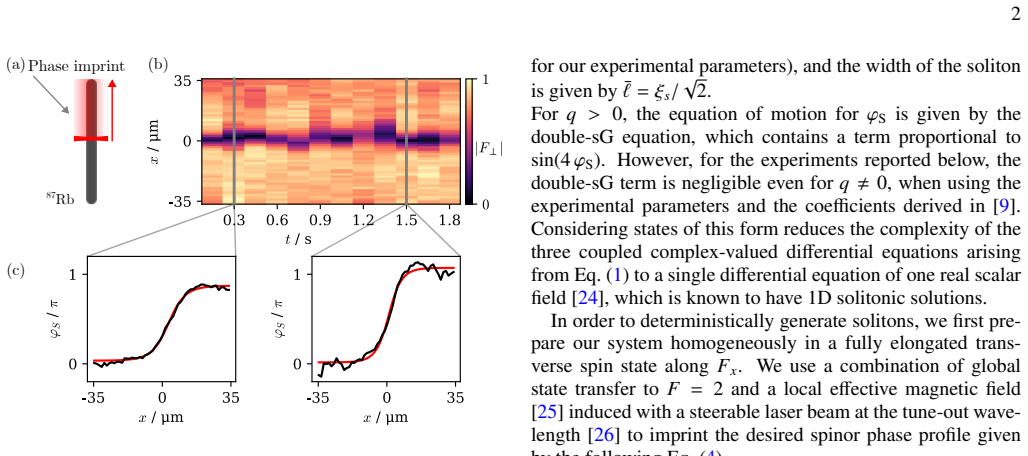
induced with a steerable laser beam at the tune-out wave- length [26] to imprint the desired spinor phase profile given by the following Eq. (4) φS(x,t)=Aarctan h e(x−vt−x 0)/ℓi +C.(4) with minimal disturbance of the total density, cf. Fig. 2 (a). Here,Ais the amplitude,ℓthe width,x 0 the initial position,v the velocity, andCthe offset-phase of the solito...
-
[2]
The resolution of the imprint is∼4µm
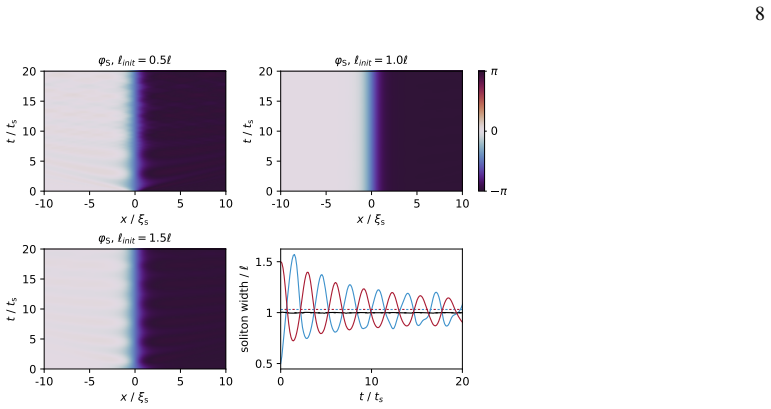
and the static amplitudeA=2 of the soliton. The resolution of the imprint is∼4µm. This dynamical behavior due to imperfect preparation is confirmed in mean-field simulations, see Fig. 9 for more information. In this way, we corroborate, that the velocity of the soliton is independent of its initial width, even as the width undergoes oscillations. The expe...
-
[3]
Experiment-like imprint To simulate a kink close to the experimental imprint the initial state is rotated in spin space with the generator of the rotation given by Q0 = −1 0 0 0 1 0 0 0−1 ,(F6) 10 -6 0 6 x / ξs 0.0 0.5 1.0 1.5 2.0 t / ts -6 0 6 x / ξs 0 1 |F | −π π ϕS FIG. 12. Kink as seen when using the imprint as defined in Eq. (F7) ...
-
[4]
Free propagation As the simulation uses periodic boundary conditions, we choose a kink-anti-kink pair as initial condition. In the following, we also use the analytical kink profile as the initial condition in the spinor phase. In order to observe a single soliton, the initial distance between the two is chosen asd init >20ξ s, such that the solitons do n...
-
[5]
Collision To obtain a numerical value for the phase shiftδxthat can be compared to the value obtained from the experimental results, we choose the density in the simulation such that the width of the soliton in the simulation and the experiment coincide. We perform the same data analysis as in the experiment in each numerical run, which leads to the resul...
-
[6]
Spin-nematic continuity equation We begin by calculating the time derivative of the magnetization density ∂tFi =∂ t ψ† fiψ =(∂ tψ†)f iψ+ψ † fi(∂tψ),(G1) 12 0.0 1.7 3.4 t / s 0 40 80distance between solitons / m δx 0.0 1.7 3.4 t / s -125 0 125x / m 0 1 |F | FIG. 15. Phase shift extraction from the simulation. Here the incoming velocity isv in =16.82µm/s an...
-
[7]
Spinor-phase soliton velocity from spin-continuity equation In the following, we derive the dependence of the spinor-phase kink from the spin nematic continuity equation (G11). The linear Zeeman shift in the spin-1 Hamiltonian can be absorbed into the fields by considering a rotating frame of reference, hence settingp=0. Next, we consider the core of the ...
-
[8]
(5) within the effective sG theory
Spinor-phase soliton velocity from effective sG theory In the following, we give an alternative derivation of Eq. (5) within the effective sG theory. With the Lagrangian given in [9] (where only density fluctuations for small momenta were taken into account in the derivation of the effective theory) the double 15 sine-Gordon equation is found to be: 0=∂ 2...
-
[9]
M. J. Ablowitz,Nonlinear Dispersive Waves: Asymptotic Anal- ysis and Solitons(Cambridge University Press, 2011)
work page 2011
-
[10]
J. Cuevas-Maraver, P. G. Kevrekidis, and F. Williams,The sine- Gordon Model and its Applications(Springer, Cambridge, Eng- land, 2014)
work page 2014
-
[11]
R. K. Dodd, J. C. Eilbeck, J. D. Gibbon, and H. C. Morris,Soli- tons and Nonlinear Wave Equations(Academic Press, London, UK, 1982)
work page 1982
-
[12]
McLachlan, The Mathematical Intelligencer16, 31 (1994)
R. McLachlan, The Mathematical Intelligencer16, 31 (1994)
work page 1994
-
[13]
Y . S. Kivshar and B. A. Malomed, Rev. Mod. Phys.61, 763 (1989)
work page 1989
-
[14]
T. Schweigler, V . Kasper, S. Erne, I. Mazets, B. Rauer, F. Catal- dini, T. Langen, T. Gasenzer, J. Berges, and J. Schmiedmayer, Nature545, 323 (2017)
work page 2017
- [15]
-
[16]
E. Wybo, A. Bastianello, M. Aidelsburger, I. Bloch, and M. Knap, PRX Quantum4, 030308 (2023)
work page 2023
-
[17]
I. Siovitz, A.-M. E. Glück, Y . Deller, A. Schmutz, F. Klein, H. Strobel, M. K. Oberthaler, and T. Gasenzer, Phys. Rev. A 112, 023304 (2025)
work page 2025
-
[18]
T. M. Bersano, V . Gokhroo, M. A. Khamehchi, J. D’Ambroise, D. J. Frantzeskakis, P. Engels, and P. G. Kevrekidis, Phys. Rev. Lett.120, 063202 (2018)
work page 2018
-
[19]
S. Lannig, C.-M. Schmied, M. Prüfer, P. Kunkel, R. Strohmaier, H. Strobel, T. Gasenzer, P. G. Kevrekidis, and M. K. Oberthaler, Phys. Rev. Lett.125, 170401 (2020)
work page 2020
-
[20]
A. Farolfi, D. Trypogeorgos, C. Mordini, G. Lamporesi, and G. Ferrari, Phys. Rev. Lett.125, 030401 (2020)
work page 2020
-
[21]
X. Chai, D. Lao, K. Fujimoto, R. Hamazaki, M. Ueda, and C. Raman, Phys. Rev. Lett.125, 030402 (2020)
work page 2020
- [22]
-
[23]
B. Bakkali-Hassani, C. Maury, Y .-Q. Zou, E. Le Cerf, R. Saint- Jalm, P. C. M. Castilho, S. Nascimbene, J. Dalibard, and J. Beugnon, Phys. Rev. Lett.127, 023603 (2021)
work page 2021
-
[24]
D. M. Stamper-Kurn and M. Ueda, Rev. Mod. Phys.85, 1191 (2013)
work page 2013
- [25]
- [26]
- [27]
- [28]
- [29]
- [30]
-
[31]
One can transform Eq. (3) into a sine-Gordon equation in stan- dard form by using the transformation ¯x=x p 2λ/c2 s, ¯t=t √ 2λ and ¯φs =2φ s
- [32]
-
[33]
Y .-J. Lin, R. L. Compton, K. Jiménez-García, J. V . Porto, and I. B. Spielman, Nature462, 628 (2009)
work page 2009
-
[34]
F. Schmidt, D. Mayer, M. Hohmann, T. Lausch, F. Kindermann, and A. Widera, Phys. Rev. A93, 022507 (2016)
work page 2016
-
[35]
C. D. Hamley, C. S. Gerving, T. M. Hoang, E. M. Bookjans, and M. S. Chapman, Nature Phys.8, 305 (2012)
work page 2012
- [36]
- [37]
-
[38]
M. Nishida, Y . Furukawa, T. Fujii, and N. Hatakenaka, Phys. Rev. E80, 036603 (2009)
work page 2009
-
[39]
D. K. Campbell, M. Peyrard, and P. Sodano, Physica D: Non- linear Phenomena19, 165 (1986)
work page 1986
-
[40]
Ferrodark soliton collisions: breather formation, pair reproduction and spin-mass separa- tion,
Y . Bai, J. Biguo, and X. Yu, “Ferrodark soliton collisions: breather formation, pair reproduction and spin-mass separa- tion,” (2025), arXiv:2509.04769 [cond-mat.quant-gas]
work page internal anchor Pith review arXiv 2025
- [41]
-
[42]
R. Schäfer,Numerical simulations of sine-Gordon soliton dy- namics realised in a spinor Bose-Einstein condensate, Master’s thesis, Heidelberg University (2025)
work page 2025
-
[43]
A. Flamm,Novel readout sequences and local control for spinor Bose-Einstein condensates, Master’s thesis, Heidelberg University (2025)
work page 2025
- [44]
discussion (0)
Sign in with ORCID, Apple, or X to comment. Anyone can read and Pith papers without signing in.