Recognition: 2 theorem links
· Lean TheoremNonuniform relaxation oscillations near SNIPER bifurcations
Pith reviewed 2026-05-13 04:13 UTC · model grok-4.3
The pith
Spatially extended systems develop long-wavelength instabilities in relaxation oscillations near SNIPER bifurcations, yielding modulated patterns that continue on both sides of the point.
A machine-rendered reading of the paper's core claim, the machinery that carries it, and where it could break.
Core claim
A SNIPER bifurcation annihilates a saddle and a node, creating a large-amplitude long-period orbit. In spatially extended media this orbit undergoes a long-wavelength instability that generates spatially modulated relaxation oscillations persisting on both sides of the bifurcation. The resulting states take the form of chimera states in a theta-reaction-diffusion system and chaotic spiking in an activator-inhibitor-substrate system.
What carries the argument
The long-wavelength instability acting on the large-amplitude relaxation orbit created by the SNIPER bifurcation, which permits spatial modulation to survive across the bifurcation value.
If this is right
- Spatially modulated oscillations replace uniform cycling near the SNIPER in extended media.
- Chimera states emerge in theta-reaction-diffusion models on both sides of the bifurcation.
- Chaotic spiking replaces regular relaxation in activator-inhibitor-substrate systems.
- The same modulated behavior is expected in models of the nervous system, chemical reactions, and nonlinear optics.
Where Pith is reading between the lines
- Similar long-wavelength instabilities may appear near other slow-fast bifurcations when spatial coupling is present.
- Targeted experiments in optical or chemical systems could measure the onset of spatial modulation as a control parameter crosses a known SNIPER value.
- Neural models exhibiting SNIPER points may display irregular, spatially varying firing patterns as a direct consequence of this instability.
Load-bearing premise
The long-wavelength instability of the large-amplitude orbit occurs and produces persistent spatially modulated oscillations in the models examined.
What would settle it
Observation of only uniform, spatially homogeneous relaxation oscillations without modulation in a spatially extended system near a SNIPER bifurcation would contradict the reported instability.
Figures


read the original abstract
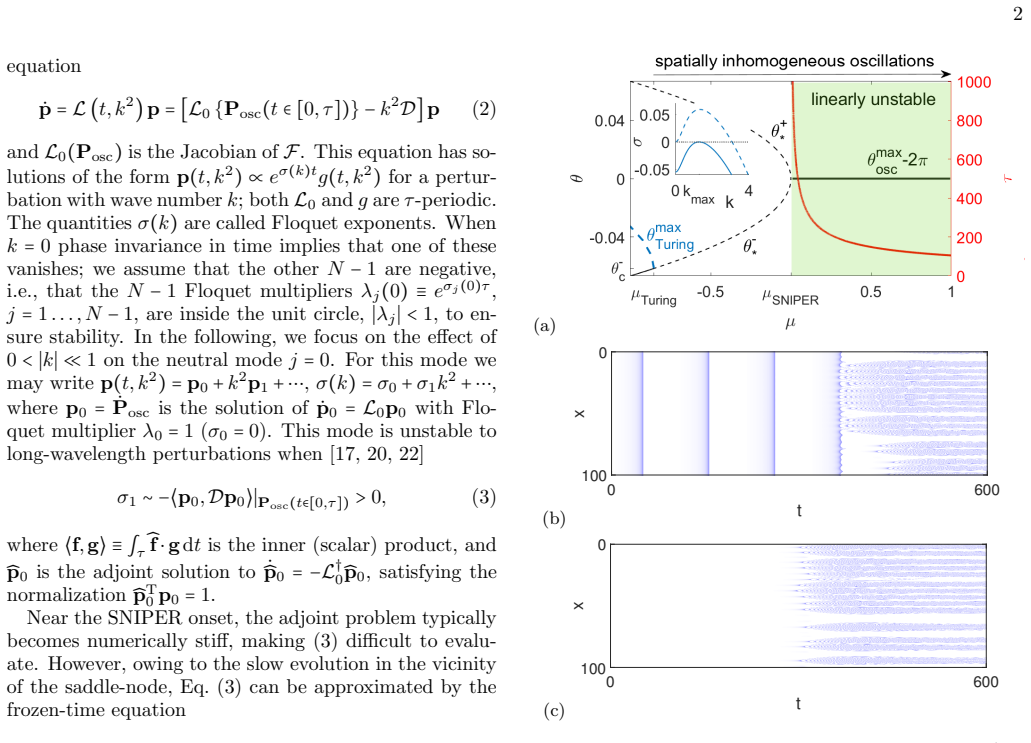
Properties of spatially dependent relaxation oscillations near a SNIPER bifurcation are described. A SNIPER bifurcation creates a large-amplitude long-period periodic orbit via the annihilation of a pair of fixed points in a saddle-node bifurcation. We show that in spatially extended media, this orbit may undergo a long-wavelength instability, leading to spatially modulated oscillations that persist on both sides of the SNIPER. The oscillations take different forms depending on the system: a chimera state in a theta-reaction-diffusion model, and chaotic spiking in an activator-inhibitor-substrate model. The results are expected to have applications in a number of physical systems exhibiting SNIPER bifurcations, ranging from models of the nervous system through chemical reactions to nonlinear optics.
Editorial analysis
A structured set of objections, weighed in public.
Referee Report
Summary. The paper examines the spatiotemporal dynamics of relaxation oscillations near a SNIPER bifurcation in spatially extended systems. It claims that the large-amplitude, long-period uniform orbit created by the SNIPER undergoes a long-wavelength instability, producing persistent spatially modulated oscillations on both sides of the bifurcation. This is demonstrated via linear stability analysis (dispersion relations from the linearized PDE) and direct numerical simulations in a theta-reaction-diffusion model (yielding chimera states) and an activator-inhibitor-substrate model (yielding chaotic spiking), with relevance to neural, chemical, and optical systems.
Significance. If the central claim holds, the work is significant for revealing how a local bifurcation in ODEs manifests as complex, persistent patterns in PDEs. The explicit derivation of dispersion relations around the uniform periodic orbit and confirmation via simulations in two models provide a concrete mechanism for nonuniform relaxation oscillations that persist beyond the SNIPER point. This extends standard bifurcation theory to extended media and offers potential explanations for irregular behaviors in applications ranging from neural models to nonlinear optics. The reproducibility through explicit calculations and simulations is a strength.
minor comments (3)
- The abstract mentions two models but does not specify their equations or parameter regimes; adding a brief reference to the model equations (e.g., in §2) would improve accessibility.
- Figure captions should explicitly state the wave-number range examined in the dispersion relations and the initial conditions for the simulations to allow direct reproduction.
- Notation for the dispersion relation (e.g., the growth rate σ(k)) should be defined consistently in the text and figures to avoid ambiguity for readers unfamiliar with the specific models.
Simulated Author's Rebuttal
We thank the referee for the positive assessment of our manuscript, including the summary of the central claims regarding long-wavelength instabilities of uniform relaxation oscillations near SNIPER bifurcations and the significance for applications in neural, chemical, and optical systems. We appreciate the recommendation for minor revision and will prepare an updated version accordingly.
Circularity Check
No significant circularity detected
full rationale
The central claim rests on explicit linear stability analysis of the uniform large-amplitude periodic orbit (via dispersion relations obtained from the linearized PDE) together with direct numerical simulations in two independent models. These steps are derived from the governing equations without reduction to fitted parameters renamed as predictions, self-definitional loops, or load-bearing self-citations. The argument is model-specific, externally verifiable through the stated calculations and simulations, and does not invoke uniqueness theorems or ansatzes from prior author work as the sole justification.
Axiom & Free-Parameter Ledger
axioms (1)
- standard math Standard bifurcation theory for SNIPER
Lean theorems connected to this paper
-
IndisputableMonolith/Cost/FunctionalEquation.leanwashburn_uniqueness_aczel unclear?
unclearRelation between the paper passage and the cited Recognition theorem.
σ1 ∼−⟨p0,Dp0⟩|Posc(t∈[0,τ])>0
What do these tags mean?
- matches
- The paper's claim is directly supported by a theorem in the formal canon.
- supports
- The theorem supports part of the paper's argument, but the paper may add assumptions or extra steps.
- extends
- The paper goes beyond the formal theorem; the theorem is a base layer rather than the whole result.
- uses
- The paper appears to rely on the theorem as machinery.
- contradicts
- The paper's claim conflicts with a theorem or certificate in the canon.
- unclear
- Pith found a possible connection, but the passage is too broad, indirect, or ambiguous to say the theorem truly supports the claim.
Reference graph
Works this paper leans on
-
[1]
H. von Storch, G. B¨ urger, R. Schnur, and J.-S. von Storch, Journal of Climate8, 377 (1995). S3 6000 11000 t 0 10 x FIG. S2. DNS of the Meinhardt model (S1) with periodic boundary conditions on a domain of lengthL=10, showing a space-time plot ofA(x, t)atρ L W<ρ=0.987<ρ SNIPER. The initial conditions are randomO(10 −5)perturbations of the uniform oscilla...
work page 1995
- [2]
-
[3]
J. J. Tyson, Biochemical Journal479, 185 (2022)
work page 2022
-
[4]
M. C. Cross and P. C. Hohenberg, Reviews of Modern Physics65, 851 (1993)
work page 1993
-
[5]
D. Walgraef,Spatio-temporal Pattern Formation: with Examples from Physics, Chemistry, and Materials Science(Springer Science & Business Media, 2012)
work page 2012
-
[6]
Meron,Nonlinear Physics of Ecosystems(CRC Press, 2015)
E. Meron,Nonlinear Physics of Ecosystems(CRC Press, 2015)
work page 2015
-
[7]
L. Pismen,Patterns and Interfaces in Dissipative Dynamics: Revised and Extended, Now also Covering Patterns of Active Matter(Springer Nature, 2023)
work page 2023
-
[8]
I. S. Aranson and L. Kramer, Reviews of Modern Physics74, 99 (2002)
work page 2002
-
[9]
V. Garc´ ıa-Morales and K. Krischer, Contemporary Physics53, 79 (2012)
work page 2012
-
[10]
Hartman,Ordinary Differential Equations(SIAM, 2002)
P. Hartman,Ordinary Differential Equations(SIAM, 2002)
work page 2002
- [11]
-
[12]
C. A. Klausmeier, Theoretical Ecology1, 153 (2008)
work page 2008
-
[13]
Y. A. Kuznetsov,Elements of Applied Bifurcation Theory, 4th ed. (Springer-Verlag New York Berlin Heidelberg, 2003)
work page 2003
- [14]
-
[15]
Knobloch, inPattern Formation in Complex Dissipative Systems(World Scientific, 1992) pp
E. Knobloch, inPattern Formation in Complex Dissipative Systems(World Scientific, 1992) pp. 263–274
work page 1992
-
[16]
Risler, International Journal of Bifurcation and Chaos11, 2097 (2001)
E. Risler, International Journal of Bifurcation and Chaos11, 2097 (2001)
work page 2097
-
[17]
Kuramoto, inChemical Oscillations, Waves, and Turbulence(Springer, 1984) pp
Y. Kuramoto, inChemical Oscillations, Waves, and Turbulence(Springer, 1984) pp. 111–140
work page 1984
-
[18]
L. S. Tuckerman, inEmerging Frontiers in Nonlinear Science(Springer, 2020) pp. 249–277
work page 2020
-
[19]
T. F. Fairgrieve and A. D. Jepson, SIAM Journal on Numerical Analysis28, 1446 (1991)
work page 1991
-
[20]
B. Pena and M. Bestehorn, The European Physical Journal Special Topics146, 301 (2007)
work page 2007
-
[21]
V. O. Juma, K. Z. Mapfumo, S. Portet, and A. Madzvamuse, PNAS Nexus5, pgag071 (2026)
work page 2026
-
[22]
T. Gallay and A. Scheel, Transactions of the American Mathematical Society363, 2571 (2011)
work page 2011
- [23]
-
[24]
C. Beta, L. Edelstein-Keshet, N. Gov, and A. Yochelis, eLife12, e87181 (2023)
work page 2023
-
[25]
W. M. Bement, A. B. Goryachev, A. L. Miller, and G. Von Dassow, Nature Reviews Molecular Cell Biology25, 290 (2024)
work page 2024
- [26]
- [27]
- [28]
-
[29]
C. Schelte, D. Hessel, J. Javaloyes, and S. V. Gurevich, Physical Review Applied13, 054050 (2020)
work page 2020
-
[30]
S. H. Strogatz,Nonlinear Dynamics and Chaos: with Applications to Physics, Biology, Chemistry, and Engineering(CRC press, 2018)
work page 2018
-
[31]
Z. Noszticzius, P. Stirling, and M. Wittmann, Journal of Physical Chemistry89, 4914 (1985)
work page 1985
-
[32]
K. Bar-Eli and R. M. Noyes, The Journal of Chemical Physics86, 1927 (1987)
work page 1927
-
[33]
M. K. S. Yeung and S. H. Strogatz, Phys. Rev. E58, 4421 (1998)
work page 1998
-
[34]
C. R. Laing, B. Doiron, A. Longtin, L. Noonan, R. W. Turner, and L. Maler, Journal of Computational Neuroscience14, 329 (2003)
work page 2003
-
[35]
L. L. Bonilla, M. Carretero, and E. Momp´ o, Entropy26, 672 (2024)
work page 2024
- [36]
-
[37]
B. Ermentrout, Y. Park, and D. Wilson, Philosophical Transactions A377, 20190092 (2019)
work page 2019
-
[38]
S. A. Prescott, inEncyclopedia of Computational Neuroscience(Springer, 2022) pp. 1368–1374
work page 2022
-
[39]
P. Moreno-Spiegelberg, A. Arinyo-i-Prats, D. Ruiz-Reyn´ es, M. A. Matias, and D. Gomila, Phys. Rev. E106, 034206 (2022)
work page 2022
- [40]
- [41]
- [42]
-
[43]
P. Parra-Rivas, E. Knobloch, D. Gomila, and L. Gelens, Phys. Rev. A93, 063839 (2016)
work page 2016
- [44]
-
[45]
P. Parra-Rivas, A. R. Champneys, F. Al Saadi, D. Gomila, and E. Knobloch, SIAM Journal on Applied Dynamical Systems 22, 2693 (2022)
work page 2022
- [46]
- [47]
-
[48]
E. J. Doedel, A. R. Champneys, T. Fairgrieve, Y. Kuznetsov, B. Oldeman, R. Paffenroth, B. Sandstede, X. Wang, and C. Zhang, AUTO07p: Continuation and bifurcation software for ordinary differential equations, Concordia University, http://indy.cs.concordia.ca/auto (2012)
work page 2012
- [49]
-
[50]
G. B. Ermentrout, SIAM Journal on Applied Mathematics46, 233 (1986)
work page 1986
-
[51]
G. B. Ermentrout and N. Kopell, SIAM Journal on Applied Mathematics46, 233 (1986)
work page 1986
-
[52]
G. B. Ermentrout and D. H. Terman,Mathematical Foundations of Neuroscience(Springer, 2008)
work page 2008
-
[53]
J. Wu, H. Yang, Y. Peng, L. Fang, W. Zheng, and Z. Song, Neural Regeneration Research8, 745 (2013)
work page 2013
-
[54]
C. A. Anastassiou and C. Koch, Current Opinion in Neurobiology31, 95 (2015)
work page 2015
- [55]
- [56]
-
[57]
M. A. Dahlem and S. C. M¨ uller, Biological Cybernetics102, 417 (2010)
work page 2010
-
[58]
A. T. Winfree,The Geometry of Biological Time(Springer, 2001)
work page 2001
-
[59]
Coombes, Biological Cybernetics93, 91 (2005)
S. Coombes, Biological Cybernetics93, 91 (2005)
work page 2005
-
[60]
P. C. Bressloff,Waves in Neural Media(Springer, 2014)
work page 2014
-
[61]
C. R. Laing, SIAM Journal on Applied Dynamical Systems14, 1899 (2015)
work page 2015
-
[62]
Banerjee, Europhysics Letters110, 60003 (2015)
T. Banerjee, Europhysics Letters110, 60003 (2015)
work page 2015
- [63]
- [64]
- [65]
-
[66]
B.-W. Li, J. Xiao, T.-C. Li, A. V. Panfilov, and H. Dierckx, Physical Review Letters133, 207203 (2024)
work page 2024
- [67]
-
[68]
I. Omelchenko, Y. Maistrenko, P. H¨ ovel, and E. Sch¨ oll, Phys. Rev. Lett.106, 234102 (2011)
work page 2011
-
[69]
L. Schmidt, K. Sch¨ onleber, K. Krischer, and V. Garc´ ıa-Morales, Chaos24(2014)
work page 2014
-
[70]
C. R. Laing, Phys. Rev. E92, 050904 (2015)
work page 2015
- [71]
-
[72]
M. G. Clerc, S. Coulibaly, M. A. Ferr´ e, M. A. Garc´ ıa-˜Nustes, and R. G. Rojas, Phys. Rev. E93, 052204 (2016)
work page 2016
-
[73]
L. Smirnov, G. Osipov, and A. Pikovsky, Journal of Physics A: Mathematical and Theoretical50, 08LT01 (2017)
work page 2017
-
[74]
Z. G. Nicolaou, H. Riecke, and A. E. Motter, Phys. Rev. Lett.119, 244101 (2017)
work page 2017
-
[75]
C. R. Laing, Chaos32, 083105 (2022)
work page 2022
-
[76]
V. Garc´ ıa-Morales, J. A. Manzanares, and K. Krischer, Chaos, Solitons & Fractals165, 112808 (2022)
work page 2022
-
[77]
C. R. Laing, Chaos33, 083141 (2023)
work page 2023
-
[78]
Y. Yao, S. Nowak, A. Yochelis, A. Garfinkel, and K. I. Bostr¨ om, Journal of Biological Chemistry282, 30131 (2007)
work page 2007
-
[79]
Y. A. Guo, T.-H. Chen, X. Zeng, D. Warburton, K. I. Bostr¨ om, C.-M. Ho, X. Zhao, and A. Garfinkel, Journal of Physiology 592, 313 (2014)
work page 2014
-
[80]
Y. A. Guo, M. Sun, A. Garfinkel, and X. Zhao, PloS One9, e102718 (2014)
work page 2014
discussion (0)
Sign in with ORCID, Apple, or X to comment. Anyone can read and Pith papers without signing in.