Recognition: 1 theorem link
· Lean TheoremTowards Virtual Qualification in Nuclear Fusion: Demonstrating Probabilistic Model Validation on a High Heat Flux Component
Pith reviewed 2026-05-13 05:01 UTC · model grok-4.3
The pith
A probabilistic validation framework isolates finite element model form error from experimental uncertainties to support virtual qualification of fusion components.
A machine-rendered reading of the paper's core claim, the machinery that carries it, and where it could break.
Core claim
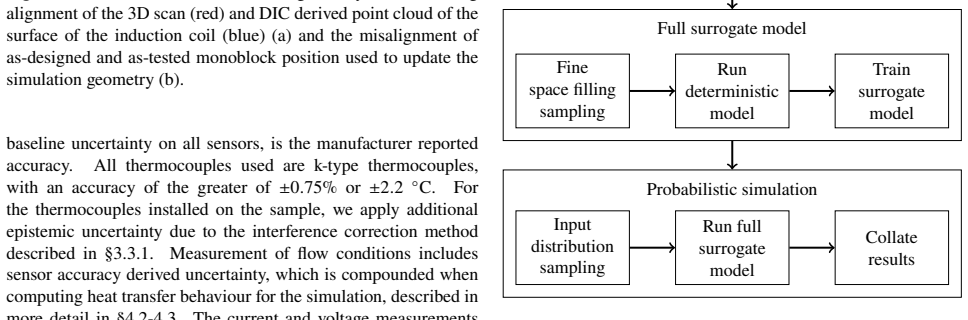
We present a probabilistic model validation framework that forms the basis for implementation of virtual qualification in fusion. We demonstrate our framework on a representative component; a high heat flux heat sink subject to a tightly coupled multi-physics loading. We perform data-rich, optimised experiments, in which we implement high fidelity diagnostics and rigorously quantify aleatoric and epistemic uncertainty on all measurements. Our simulation approach efficiently samples input uncertainty distributions to predict probability boxes describing component response, using a statistical surrogate to replicate behaviour of the finite element model we wish to validate. We then used anovel
What carries the argument
The novel implementation of the modified area validation metric, which quantifies the discrepancy between experimental and simulated probability boxes to isolate model form error from aleatoric and epistemic experimental uncertainty.
Load-bearing premise
The statistical surrogate model accurately replicates the finite element model's behavior when sampling from input uncertainty distributions.
What would settle it
A direct run of the full finite element model on the same set of input samples produces probability boxes that differ substantially from those generated by the surrogate model.
Figures









read the original abstract
Qualification of components operating in future fusion power plants will be heavily reliant on simulations of component behaviour. The lack of representative test environments for many aspects of the expected operating environment will necessitate full or partial virtual qualification of components. The cornerstone of virtual qualification is credible validation of the simulation models on which it relies. In this work, we present a probabilistic model validation framework that forms the basis for implementation of virtual qualification in fusion. We demonstrate our framework on a representative component; a high heat flux heat sink subject to a tightly coupled multi-physics loading. We perform data-rich, optimised experiments, in which we implement high fidelity diagnostics and rigorously quantify aleatoric and epistemic uncertainty on all measurements. Our simulation approach efficiently samples input uncertainty distributions to predict probability boxes describing component response, using a statistical surrogate to replicate behaviour of the finite element model we wish to validate. We then used a novel implementation of the modified area validation metric to quantify the model form error of the finite element model, isolating it from the aleatoric and epistemic experimental uncertainty. We discuss the contribution of our validation approach towards virtual qualification, and the benefits of the risk-based decision-making it facilitates. The experimental, simulation, and validation datasets are published as a benchmark of a probabilistic validation approach for fusion, and for use in development of new model validation methodologies.
Editorial analysis
A structured set of objections, weighed in public.
Referee Report
Summary. The paper presents a probabilistic model validation framework for virtual qualification of fusion components. It demonstrates the approach on a high heat flux heat sink under multi-physics loading by conducting data-rich experiments with rigorous quantification of aleatoric and epistemic uncertainties, employing a statistical surrogate to efficiently sample input uncertainties and generate probability boxes from finite element model predictions, and applying a novel implementation of the modified area validation metric to isolate model form error from experimental uncertainties. The associated datasets are released as a community benchmark.
Significance. If the surrogate fidelity and metric isolation hold, the work provides a concrete, uncertainty-aware validation pathway that supports risk-informed virtual qualification for fusion components where full representative testing is infeasible. The open release of experimental, simulation, and validation datasets is a clear strength, enabling reproducible assessment and development of new validation methods by the community.
major comments (1)
- [Abstract / simulation approach description] The abstract and framework description state that a statistical surrogate replicates the finite element model when sampling input uncertainty distributions to produce probability boxes, after which the modified area validation metric isolates model form error. No surrogate validation metrics (cross-validation error, hold-out comparison to direct FE runs, or hyperparameter sensitivity) are reported. This is load-bearing: any unquantified surrogate approximation error in nonlinear regions would propagate into the probability boxes and could not be separated from true model discrepancy by the metric.
Simulated Author's Rebuttal
We thank the referee for their constructive review and positive evaluation of the work's significance for virtual qualification in fusion. We address the major comment below and will revise the manuscript to strengthen the documentation of the surrogate approach.
read point-by-point responses
-
Referee: [Abstract / simulation approach description] The abstract and framework description state that a statistical surrogate replicates the finite element model when sampling input uncertainty distributions to produce probability boxes, after which the modified area validation metric isolates model form error. No surrogate validation metrics (cross-validation error, hold-out comparison to direct FE runs, or hyperparameter sensitivity) are reported. This is load-bearing: any unquantified surrogate approximation error in nonlinear regions would propagate into the probability boxes and could not be separated from true model discrepancy by the metric.
Authors: We agree that explicit quantification of surrogate approximation error is necessary to ensure it does not confound the isolation of model form error by the modified area validation metric. The original manuscript emphasized the overall probabilistic validation framework and the experimental uncertainty quantification but did not include dedicated surrogate validation results. In the revised version we will add a new subsection describing the surrogate construction (Gaussian process or equivalent), reporting k-fold cross-validation errors, direct hold-out comparisons against additional finite-element runs at selected input points (including nonlinear regions of the response), and hyperparameter sensitivity analysis. These metrics will be used to bound the surrogate error and confirm it remains negligible relative to the aleatoric/epistemic experimental uncertainties and the quantified model discrepancy. revision: yes
Circularity Check
No significant circularity detected in the probabilistic validation framework
full rationale
The paper's derivation proceeds from quantified experimental uncertainties (aleatoric and epistemic) through surrogate-based sampling of input distributions to generate probability boxes, followed by application of a modified area validation metric to isolate model form error. This chain does not reduce any claimed result to its inputs by construction, nor invoke self-citations for load-bearing uniqueness theorems or ansatzes. The surrogate replicates the finite element model for efficiency but is presented as a computational tool rather than a fitted prediction that is then renamed; the metric operates post-simulation to separate quantities rather than equating them definitionally. The framework is self-contained against external benchmarks via published datasets, with no evidence of the central isolation claim collapsing into a tautology or prior self-work.
Axiom & Free-Parameter Ledger
axioms (2)
- domain assumption The statistical surrogate accurately replicates finite element model behavior across sampled input uncertainties
- domain assumption High-fidelity diagnostics and uncertainty quantification in experiments isolate aleatoric and epistemic components completely
Lean theorems connected to this paper
-
IndisputableMonolith/Cost/FunctionalEquation.leanwashburn_uniqueness_aczel unclearOur simulation approach efficiently samples input uncertainty distributions to predict probability boxes describing component response, using a statistical surrogate to replicate behaviour of the finite element model we wish to validate. We then used a novel implementation of the modified area validation metric to quantify the model form error
Reference graph
Works this paper leans on
-
[1]
Stacey, W. M., 2010,Fusion: An introduction to the physics and technology of magnetic confinement fusion, John Wiley & Sons
work page 2010
-
[2]
Ongena, J., Koch, R., Wolf, R., and Zohm, H., 2016, “Magnetic-confinement fusion,” Nature Physics,12(5), pp. 398–410
work page 2016
-
[3]
Inertial-confinement fusion with lasers,
Betti, R. and Hurricane, O., 2016, “Inertial-confinement fusion with lasers,” Nature Physics,12(5), pp. 435–448
work page 2016
-
[4]
Wesson, J. and Campbell, D. J., 2011,Tokamaks, Vol. 149, Oxford university press
work page 2011
-
[5]
The spherical tokamak for energy production: theme issue introduction,
Chapman, I., Cowley, S., and Wilson, H., 2024, “The spherical tokamak for energy production: theme issue introduction,”
work page 2024
-
[6]
Lessons learnt from ITER safety & licensing for DEMO and future nuclear fusion facilities,
Taylor, N. and Cortes, P., 2014, “Lessons learnt from ITER safety & licensing for DEMO and future nuclear fusion facilities,” Fusion Engineering and Design,89(9-10), pp. 1995–2000
work page 2014
-
[7]
Nuclear power in the 21st century: Challenges and possibilities,
Horvath, A. and Rachlew, E., 2016, “Nuclear power in the 21st century: Challenges and possibilities,” Ambio,45(Suppl 1), pp. 38–49
work page 2016
-
[8]
Wenninger, R., Albanese, R., Ambrosino, R., Arbeiter, F., Aubert, J., Bachmann, C., Barbato, L., Barrett, T., Beckers, M., Biel, W., et al., 2017, “The DEMO wall load challenge,” Nuclear Fusion,57(4), p. 046002
work page 2017
-
[9]
Stork, D., Agostini, P., Boutard, J.-L., Buckthorpe, D., Diegele, E., Dudarev, S. L., English, C., Federici, G., Gilbert, M. R., Gonzalez, S., et al., 2014, “Materials R&D for a timely DEMO: Key findings and recommendations of the EU Roadmap Materials Assessment Group,” Fusion Engineering and Design,89(7-8), pp. 1586–1594
work page 2014
-
[10]
Materials engineering and design for fusion—Towards DEMO design criteria,
Gorley, M., Diegele, E., Dudarev, S., and Pintsuk, G., 2018, “Materials engineering and design for fusion—Towards DEMO design criteria,” Fusion Engineering and Design,136, pp. 298–303
work page 2018
-
[11]
Development of design criteria for ITER in-vessel components,
Sannazzaro, G., Barabash, V., Kang, S., Fernandez, E., Kalinin, G., Obushev, A., Mart ´ınez, V., V ´azquez, I., Fern´andez, F., and Guirao, J., 2013, “Development of design criteria for ITER in-vessel components,” Fusion Engineering and Design,88(9-10), pp. 2138–2141
work page 2013
-
[12]
The need for codes and standards in nuclear fusion energy,
Davis, T. P., 2023, “The need for codes and standards in nuclear fusion energy,” Journal of Fusion Energy,42(1), p. 13. 20
work page 2023
-
[13]
Assessment of design limits and criteria requirements for Eurofer structures in TBM components,
Aiello, G., Aktaa, J., Cismondi, F., Rampal, G., Salavy, J.- F., and Tavassoli, F., 2011, “Assessment of design limits and criteria requirements for Eurofer structures in TBM components,” Journal of Nuclear Materials,414(1), pp. 53– 68
work page 2011
-
[14]
Porton, M., Wynne, B., Bamber, R., Hardie, C., and Kalsey, M., 2016, “Structural integrity for DEMO: an opportunity to close the gap from materials science to engineering needs,” Fusion Engineering and Design,109, pp. 1247–1255
work page 2016
-
[15]
Lawless, R., Baxter, M., Bradnam, S., Connors, J., Fletcher, L., Gandy, A., Gilbert, M., Ghani, C., Haley, J., Hardie, C., et al., “An overview of UKAEA’s integrated fusion technology programmes, emphasising a digital first strategy,”
-
[16]
Box, G. E., 1976, “Science and statistics,” Journal of the American Statistical Association,71(356), pp. 791–799
work page 1976
-
[17]
Engineering Simulation Quality Management Standard,
NAFEMS, 2020, “Engineering Simulation Quality Management Standard,” NAFEMS
work page 2020
-
[18]
Standard for Models and Simulations,
Office of the NASA Chief Engineer, 2024, “Standard for Models and Simulations,” NASA
work page 2024
-
[19]
V&V-10 - Standard for Verification and Validation in Computational Solid Mechanics,
The American Society of Mechanical Engineers, 2019, “V&V-10 - Standard for Verification and Validation in Computational Solid Mechanics,” The American Society of Mechanical Engineers
work page 2019
-
[20]
The American Society of Mechanical Engineers, 2019, “V&V-40 - Assessing Credibility of Computational Modeling through Verification and Validation: Application to Medical Devices,” The American Society of Mechanical Engineers
work page 2019
-
[21]
Oberkampf, W. L., Pilch, M., and Trucano, T. G., 2007, Predictive capability maturity model for computational modeling and simulation, 5948, Sandia National Laboratories
work page 2007
-
[22]
McVeigh, C., Harewood, F., King, P., Driscoll, M., Kulkarni, S., Zhao, T., Goodin, M., and Iles, T. L., 2023, “Perspectives on Heart Valve Modelling: Contexts of Use, Risk, Validation, Verification and Uncertainty Quantification and End-to- End Example,”Heart Valves: From Design to Clinical Implantation, Springer, pp. 457–486
work page 2023
-
[23]
Managing the heat: in-vessel components,
Cane, J., Barth, A., Farrington, J., Flynn, E., Kirk, S., Lilburne, J., and Vizvary, Z., 2024, “Managing the heat: in-vessel components,” Philosophical Transactions A, 382(2280), p. 20230408
work page 2024
-
[24]
Barrett, T. R., Ellwood, G., P ´erez, G., Kovari, M., Fursdon, M., Domptail, F., Kirk, S., McIntosh, S., Roberts, S., Zheng, S., et al., 2016, “Progress in the engineering design and assessment of the European DEMO first wall and divertor plasma facing components,” Fusion Engineering and Design, 109, pp. 917–924
work page 2016
-
[25]
Wall protection strategies for DEMO plasma transients,
Maviglia, F., Albanese, R., Ambrosino, R., Arter, W., Bachmann, C., Barrett, T., Federici, G., Firdaous, M., Gerardin, J., Kovari, M., et al., 2018, “Wall protection strategies for DEMO plasma transients,” Fusion Engineering and Design,136, pp. 410–414
work page 2018
-
[26]
Impact of plasma thermal transients on the design of the EU DEMO first wall protection,
Maviglia, F., Bachmann, C., Federici, G., Franke, T., Siccinio, M., Vorpahl, C., Albanese, R., Ambrosino, R., Fable, E., Firdaouss, M., et al., 2020, “Impact of plasma thermal transients on the design of the EU DEMO first wall protection,” Fusion Engineering and Design,158, p. 111713
work page 2020
-
[27]
Reinhart, M., Brezinsek, S., Kirschner, A., Coenen, J., Schwarz-Selinger, T., Schmid, K., Hakola, A., Van Der Meiden, H., Dejarnac, R., Tsitrone, E., et al., 2022, “Latest results of Eurofusion plasma-facing components research in the areas of power loading, material erosion and fuel retention,” Nuclear Fusion,62(4), p. 042013
work page 2022
-
[28]
Divertor of the European DEMO: Engineering and technologies for power exhaust,
You, J., Mazzone, G., Visca, E., Greuner, H., Fursdon, M., Addab, Y., Bachmann, C., Barrett, T., Bonavolont `a, U., B ¨oswirth, B., et al., 2022, “Divertor of the European DEMO: Engineering and technologies for power exhaust,” Fusion Engineering and Design,175, p. 113010
work page 2022
-
[29]
Cyclic medium heat flux testing of a WTa lattice structure on the HIVE facility,
Pearl, J., Paterson, J., Flinders, K., Mantel, N., and You, J.-H., 2023, “Cyclic medium heat flux testing of a WTa lattice structure on the HIVE facility,” https://doi.org/10.1016/j.fusengdes.2023.113699Fusion Engineering and Design,194, p. 113699
-
[30]
CHIMERA fusion technology facility: testing and virtual qualification,
Barrett, T. R., Bamford, M., Bowden, N., Chuilon, B., Deighan, T., Efthymiou, P., Gorley, M., Grant, T., Horsley, D., Kovari, M., et al., 2023, “CHIMERA fusion technology facility: testing and virtual qualification,” Fusion Science and Technology,79(8), pp. 1039–1050
work page 2023
-
[31]
Status of technology R&D for the ITER tungsten divertor monoblock,
Hirai, T., Escourbiac, F., Barabash, V., Durocher, A., Fedosov, A., Ferrand, L., Jokinen, T., Komarov, V., Merola, M., Carpentier-Chouchana, S., et al., 2015, “Status of technology R&D for the ITER tungsten divertor monoblock,” Journal of Nuclear Materials,463, pp. 1248–1251
work page 2015
-
[32]
High heat flux testing of mock-ups for a full tungsten ITER divertor,
Gavila, P., Riccardi, B., Constans, S., Jouvelot, J., Vastra, I. B., Missirlian, M., and Richou, M., 2011, “High heat flux testing of mock-ups for a full tungsten ITER divertor,” Fusion Engineering and Design,86(9-11), pp. 1652–1655
work page 2011
-
[33]
A Good Practices Guide for Digital Image Correlation, Edition 2,
Jones, E. M. C. and Iadicola, M. A., 2025, “A Good Practices Guide for Digital Image Correlation, Edition 2,” International Digital Image Correlation Society
work page 2025
-
[34]
Raukema, J., Bosman, T., Classen, I., Wijkamp, T., Perek, A., Derks, G., Koenders, J., Martinelli, L., Jaspers, R., Team, T., et al., 2024, “Demonstration of a sparse sensor placement technique to the limited diagnostic set in a fusion power plant,” Fusion Engineering and Design,201, p. 114271
work page 2024
-
[35]
Bayesian Optimization: Open source constrained global optimization tool for Python,
Nogueira, F., 2014–, “Bayesian Optimization: Open source constrained global optimization tool for Python,” https://github.com/bayesian-optimization/ BayesianOptimization
work page 2014
-
[36]
2025, “MatchID documentation,” accessed 2025-10-21, https://www.matchid.eu/Wiki/doku.php
work page 2025
-
[37]
Assessment of measuring errors in DIC using deformation fields generated by plastic FEA,
Lava, P., Cooreman, S., Coppieters, S., De Strycker, M., and Debruyne, D., 2009, “Assessment of measuring errors in DIC using deformation fields generated by plastic FEA,” Optics and Lasers in Engineering,47(7-8), pp. 747–753
work page 2009
-
[38]
Image-based deformation measurements of fusion divertor armour under high heat flux loading,
Tayeb, A., Fletcher, L., Gorley, M., Harte, A., and Hamelin, C., 2026, “Image-based deformation measurements of fusion divertor armour under high heat flux loading,” The Journal of Strain Analysis for Engineering Design,61(4), pp. 267–283
work page 2026
-
[39]
Open3D: A Modern Library for 3D Data Processing
Zhou, Q.-Y., Park, J., and Koltun, V., 2018, “Open3D: A Modern Library for 3D Data Processing,” arXiv:1801.09847
work page internal anchor Pith review arXiv 2018
-
[40]
SciPy 1.0: Fundamental Algorithms for Scientific Computing in Python,
Virtanen, P., Gommers, R., Oliphant, T. E., Haberland, M., Reddy, T., Cournapeau, D., Burovski, E., Peterson, P., Weckesser, W., Bright, J., van der Walt, S. J., Brett, M., 21 Wilson, J., Millman, K. J., Mayorov, N., Nelson, A. R. J., Jones, E., Kern, R., Larson, E., Carey, C. J., Polat, ˙I., Feng, Y., Moore, E. W., VanderPlas, J., Laxalde, D., Perktold, ...
work page 2020
-
[41]
A density-based algorithm for discovering clusters in large spatial databases with noise,
Ester, M., Kriegel, H.-P., Sander, J., Xu, X., et al., 1996, “A density-based algorithm for discovering clusters in large spatial databases with noise,”kdd, Vol. 96, Paper No. 34, pp. 226–231
work page 1996
-
[42]
A good practices guide for digital image correlation,
Jones, E. M., Iadicola, M. A., et al., 2018, “A good practices guide for digital image correlation,” International Digital Image Correlation Society,10, pp. 1–110
work page 2018
-
[43]
6.3, Stockholm, Sweden,www.comsol.com
COMSOL AB,COMSOL Multiphysics®v. 6.3, Stockholm, Sweden,www.comsol.com
-
[44]
Heat transfer in automobile radiators of the tubular type,
Dittus, F. and Boelter, L., 1985, “Heat transfer in automobile radiators of the tubular type,” International communications in heat and mass transfer,12(1), pp. 3–22
work page 1985
-
[45]
Hayt, W. H., Buck, J. A., et al., 2006,Engineering electromagnetics, New York
work page 2006
-
[46]
Oberkampf, W. L. and Roy, C. J., 2010,Verification and validation in scientific computing, Cambridge university press
work page 2010
-
[47]
High-dimensional data analysis: The curses and blessings of dimensionality,
Donoho, D. L. et al., 2000, “High-dimensional data analysis: The curses and blessings of dimensionality,” AMS math challenges lecture,1(2000), p. 32
work page 2000
- [48]
-
[49]
Global sensitivity indices for nonlinear mathematical models and their Monte Carlo estimates,
Sobol, I. M., 2001, “Global sensitivity indices for nonlinear mathematical models and their Monte Carlo estimates,” Mathematics and computers in simulation,55(1-3), pp. 271– 280
work page 2001
-
[50]
Distribution of points in a cube and approximate evaluation of integrals,
Sobol, I. M., 1967, “Distribution of points in a cube and approximate evaluation of integrals,” USSR Computational mathematics and mathematical physics,7, pp. 86–112
work page 1967
-
[51]
McKay, M. D., Beckman, R. J., and Conover, W. J., 2000, “A comparison of three methods for selecting values of input variables in the analysis of output from a computer code,” Technometrics,42(1), pp. 55–61
work page 2000
-
[52]
Williams, C. K. and Rasmussen, C. E., 2006,Gaussian processes for machine learning, Vol. 2, MIT press Cambridge, MA
work page 2006
-
[53]
Harris, C. R., Millman, K. J., Van Der Walt, S. J., Gommers, R., Virtanen, P., Cournapeau, D., Wieser, E., Taylor, J., Berg, S., Smith, N. J., et al., 2020, “Array programming with NumPy,” nature,585(7825), pp. 357–362
work page 2020
-
[54]
A generalization of Bayesian inference,
Dempster, A. P., 1968, “A generalization of Bayesian inference,” Journal of the Royal Statistical Society: Series B (Methodological),30(2), pp. 205–232
work page 1968
-
[55]
Shafer, G., 1976,A mathematical theory of evidence, Princeton university press
work page 1976
-
[56]
Guide for verification and validation in computational solid mechanics,
of Mechanical Engineers, A. S., 2006, “Guide for verification and validation in computational solid mechanics,” ASME
work page 2006
-
[57]
Model validation and predictive capability for the thermal challenge problem,
Ferson, S., Oberkampf, W. L., and Ginzburg, L., 2008, “Model validation and predictive capability for the thermal challenge problem,” Computer Methods in Applied Mechanics and Engineering,197(29-32), pp. 2408–2430
work page 2008
-
[58]
Validation of imprecise probability models,
Ferson, S. and Oberkampf, W. L., 2009, “Validation of imprecise probability models,” International Journal of Reliability and Safety,3(1-3), pp. 3–22
work page 2009
-
[59]
Whiting, N. W., Roy, C. J., Duque, E., Lawrence, S., and Oberkampf, W. L., 2023, “Assessment of model validation, calibration, and prediction approaches in the presence of uncertainty,” Journal of Verification, Validation and Uncertainty Quantification,8(1), p. 011001
work page 2023
-
[60]
Evaluation of model validation techniques in the presence of uncertainty,
Voyles, I. T. and Roy, C. J., 2014, “Evaluation of model validation techniques in the presence of uncertainty,”16th AIAA Non-Deterministic Approaches Conference, p. 0120
work page 2014
-
[61]
Voyles, I. T. and Roy, C. J., 2015, “Evaluation of model validation techniques in the presence of aleatory and epistemic input uncertainties,”17th AIAA Non-Deterministic Approaches Conference, p. 1374
work page 2015
-
[62]
Fletcher, L., Hirst, J., Sibson, L., Sampson, M., Atkinson, M., Tayel, A., Marsh, A., Spencer, R., and Charlton, J.,pyvale,https://github.com/ Computer-Aided-Validation-Laboratory/pyvale
-
[63]
Mitchell, M., 1998,An introduction to genetic algorithms, MIT press
work page 1998
-
[64]
Kennedy, J. and Eberhart, R., 1995, “Particle swarm optimization,”Proceedings of ICNN’95-international conference on neural networks, Vol. 4, ieee, pp. 1942–1948
work page 1995
-
[65]
The role of probabilistic design analysis methods in safety and affordability,
Safie, F. M., 2016, “The role of probabilistic design analysis methods in safety and affordability,”2016 Annual Reliability and Maintainability Symposium (RAMS), IEEE, pp. 1–5
work page 2016
-
[66]
Pence, J., Abolhelm, M., Mohaghegh, Z., Reihani, S., Ertem, M., and Kee, E., 2018, “Methodology to evaluate the monetary benefit of Probabilistic Risk Assessment by modeling the net value of Risk-Informed Applications at nuclear power plants,” Reliability Engineering & System Safety,175, pp. 171–182
work page 2018
-
[67]
Safety: a proportionate approach in an uncertain application,
Afify, O., 2024, “Safety: a proportionate approach in an uncertain application,” Philosophical Transactions A, 382(2280), p. 20230405
work page 2024
-
[68]
Recommendations for the future regulation of fusion power plants,
Elbez-Uzan, J., Williams, L., Forbes, S., Dodaro, A., Stieglitz, R., Airila, M. I., Holden, J., and Rosanvallon, S., 2024, “Recommendations for the future regulation of fusion power plants,” Nuclear Fusion,64(3), p. 037001
work page 2024
-
[69]
ITER material properties handbook,
Davis, J. W. and Smith, P., 1996, “ITER material properties handbook,” Journal of Nuclear Materials,233, pp. 1593– 1596
work page 1996
-
[70]
Integrating materials engineering and design for fusion,
Gorley, M., Fursdon, M., and Kalsey, M., 2018, “Integrating materials engineering and design for fusion,” IEEE Transactions on Plasma Science,46(5), pp. 1211–1216
work page 2018
-
[71]
Hancock, D., Homfray, D., Porton, M., Todd, I., and Wynne, B., 2018, “Exploring complex high heat flux geometries for fusion applications enabled by additive manufacturing,” Fusion Engineering and Design,136, pp. 454–460. 22
work page 2018
-
[72]
Lukenskas, A., Barrett, T., Fursdon, M., Domptail, F., Schoofs, F., Greuner, H., Dose, G., Roccella, S., Visca, E., Gallay, F., Richou, M., and You, J.-H., 2019, “High heat flux test results for a thermal break DEMO divertor target and subsequent design and manufacture development,” Fusion Engineering and Design,146, pp. 1657–1660
work page 2019
-
[73]
Meeker, W. Q., Escobar, L. A., and Pascual, F. G., 2021, Statistical methods for reliability data, John Wiley & Sons
work page 2021
-
[74]
The Rogowski coil principles and applications: A review,
Samimi, M. H., Mahari, A., Farahnakian, M. A., and Mohseni, H., 2014, “The Rogowski coil principles and applications: A review,” IEEE Sensors Journal,15(2), pp. 651–658. A DIC calibration, processing parameters and noise floors Parameter Value 𝐹𝑥 Camera 0 [pixels] 19447 𝐹𝑦 Camera 0 [pixels] 19449 𝐹𝑠 Camera 0 [pixels] 4 𝜅1 Camera 0 -0.1983 𝜅2 Camera 0 -1.1...
work page 2014
discussion (0)
Sign in with ORCID, Apple, or X to comment. Anyone can read and Pith papers without signing in.