Recognition: no theorem link
High-energy Neutrino and Gamma Ray Emission from Clusters-like Perseus
Pith reviewed 2026-05-13 04:51 UTC · model grok-4.3
The pith
Galaxy clusters like Perseus confine cosmic rays long enough to generate detectable high-energy neutrinos and gamma rays from their outskirts.
A machine-rendered reading of the paper's core claim, the machinery that carries it, and where it could break.
Core claim
By propagating cosmic rays through three-dimensional cosmological magnetohydrodynamical simulations of the turbulent intracluster medium and applying multi-dimensional Monte Carlo methods that include all photohadronic, photonuclear, and hadronuclear interactions plus cosmological source evolution, the diffuse emission from the outskirts of Perseus-like clusters can be distinguished from the central AGN and reaches levels that IceCube and CTA could detect while also adding to the diffuse backgrounds.
What carries the argument
Monte Carlo propagation of cosmic rays through MHD-simulated turbulent intracluster medium, incorporating full photohadronic, photonuclear, and hadronuclear interaction channels and cosmological evolution.
Load-bearing premise
Cosmic rays with energies up to 10 to the 17 electronvolts remain confined inside galaxy clusters over cosmological timescales because of the magnetic field configuration in the intracluster medium.
What would settle it
A non-detection of diffuse neutrinos or gamma rays from the outskirts of Perseus by IceCube or CTA, after subtracting any central AGN contribution, at the flux levels predicted by the simulations.
Figures
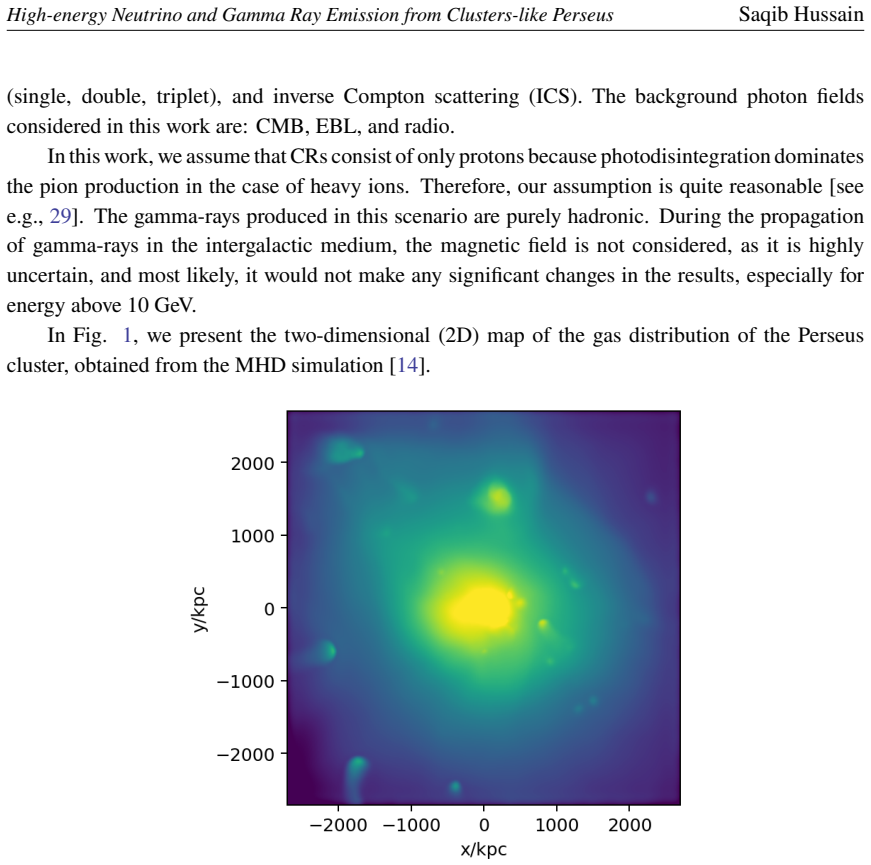


read the original abstract
We calculate the high-energy gamma-ray and neutrino emissions from galaxy clusters like Perseus that host active galactic nuclei (AGNs). Our primary objective is to distinguish the emission from the central source, such as NGC$1275$, from the diffuse emission originating in the outskirts of the Perseus cluster. Due to a unique magnetic-field configuration, CRs with energy $\leq 10^{17}$ eV can be confined within these structures over cosmological time scales, and generate secondary particles, including neutrinos and gamma-rays, through interactions with the background gas and photons. We employ three-dimensional cosmological magnetohydrodynamical simulations of structure formation to model the turbulent intracluster medium (ICM). We propagate CRs in intracluster medium (ICM) and intergalactic medium using multi-dimensional Monte Carlo simulations, considering all relevant photohadronic, photonuclear, and hadronuclear interactions. We also include the cosmological evolution of sources like Perseus. By comparing our results with the existing upper limits from IceCube for galaxy clusters and the sensitivity of CTA, we predict that these observatories could potentially establish a new class of astrophysical sources capable of emitting high-energy multi-messenger signals. We also compute the contribution from clusters like Perseus to the diffuse neutrino and gamma-ray background.
Editorial analysis
A structured set of objections, weighed in public.
Referee Report
Summary. The manuscript calculates high-energy neutrino and gamma-ray emissions from Perseus-like galaxy clusters hosting AGNs. It models the turbulent ICM with 3D cosmological MHD simulations, propagates CRs via multi-dimensional Monte Carlo methods including all photohadronic, photonuclear, and hadronuclear interactions, and incorporates source cosmological evolution. The central claim is that a unique ICM magnetic-field configuration confines CRs with E ≤ 10^17 eV over cosmological timescales, producing detectable diffuse secondaries distinguishable from central sources like NGC 1275; these emissions are compared to IceCube cluster limits and CTA sensitivity, with predictions for a new multi-messenger source class and contributions to the diffuse neutrino and gamma-ray backgrounds.
Significance. If the confinement assumption is validated, the work would be significant for multi-messenger astrophysics by identifying galaxy clusters as potentially detectable high-energy neutrino and gamma-ray sources separate from their central AGNs, while quantifying their role in diffuse backgrounds. The approach benefits from full 3D MHD structure-formation simulations, comprehensive interaction physics in the Monte Carlo propagation, and explicit inclusion of source evolution, which are strengths that could support falsifiable predictions once quantitative escape-time results are provided.
major comments (2)
- [Abstract / CR propagation section] Abstract and CR confinement discussion: the claim that CRs with E ≤ 10^17 eV remain confined over cosmological timescales due to a 'unique magnetic-field configuration' in the ICM is load-bearing for all flux predictions, yet no explicit residence-time distributions, escape fractions, or interaction optical depths from the Monte Carlo runs are reported to demonstrate t_escape ≳ 10^9 yr; standard Bohm-diffusion estimates in μG fields yield t_diff ~ 10^6–10^7 yr, so the simulated fields must be shown to suppress escape sufficiently for appreciable pp and photopion production.
- [Monte Carlo propagation methods] Methods on Monte Carlo propagation: without tabulated escape times or optical-depth results as a function of energy and cluster radius (e.g., analogous to a table of residence times), it is impossible to verify that the predicted neutrino and gamma-ray fluxes are not overestimated by orders of magnitude; this directly affects the comparison to IceCube limits and the diffuse-background contribution claim.
minor comments (2)
- [Abstract] Abstract supplies no quantitative flux values, error bars, or specific IceCube/CTA comparison numbers, making it difficult to assess the strength of the 'potentially establish a new class' prediction without reading the full results section.
- [Introduction / Methods] Notation for the magnetic-field configuration and the precise energy threshold (10^17 eV) should be defined with a reference to the simulation output or an equation showing how the 'unique' topology is quantified.
Simulated Author's Rebuttal
We thank the referee for the careful and constructive review of our manuscript. The concerns about explicitly demonstrating cosmic-ray confinement times are valid and central to the robustness of our predictions. We will revise the paper to include the requested quantitative outputs from the Monte Carlo simulations.
read point-by-point responses
-
Referee: [Abstract / CR propagation section] Abstract and CR confinement discussion: the claim that CRs with E ≤ 10^17 eV remain confined over cosmological timescales due to a 'unique magnetic-field configuration' in the ICM is load-bearing for all flux predictions, yet no explicit residence-time distributions, escape fractions, or interaction optical depths from the Monte Carlo runs are reported to demonstrate t_escape ≳ 10^9 yr; standard Bohm-diffusion estimates in μG fields yield t_diff ~ 10^6–10^7 yr, so the simulated fields must be shown to suppress escape sufficiently for appreciable pp and photopion production.
Authors: We agree that the confinement claim requires explicit support from the simulation outputs. Our 3D MHD structure-formation simulations produce a turbulent ICM magnetic-field geometry that is not captured by uniform-field Bohm-diffusion estimates; particle trajectories in this tangled, volume-filling field yield longer residence times. The Monte Carlo propagation code tracks these trajectories and all interaction channels, but we did not extract or tabulate the residence-time statistics in the submitted version. In the revision we will add a new subsection (with accompanying figure and table) that reports escape-time distributions, escape fractions, and interaction optical depths as functions of energy and cluster-centric radius. These data will directly demonstrate that the average t_escape for E ≤ 10^17 eV exceeds 10^9 yr under the simulated field configuration. revision: yes
-
Referee: [Monte Carlo propagation methods] Methods on Monte Carlo propagation: without tabulated escape times or optical-depth results as a function of energy and cluster radius (e.g., analogous to a table of residence times), it is impossible to verify that the predicted neutrino and gamma-ray fluxes are not overestimated by orders of magnitude; this directly affects the comparison to IceCube limits and the diffuse-background contribution claim.
Authors: We accept that the absence of these tabulated quantities limits independent verification of the flux normalizations. Although the Monte Carlo runs internally accumulate particle histories that include escape times and optical depths, these diagnostics were not reported. We will revise the Methods section to include representative tables and plots of residence times and optical depths versus energy and radius. This addition will allow readers to confirm that the secondary fluxes are not overestimated and will strengthen the comparisons to IceCube cluster limits and the diffuse-background estimates. revision: yes
Circularity Check
No significant circularity in derivation chain
full rationale
The paper performs forward modeling using 3D cosmological MHD simulations of structure formation to generate the turbulent ICM and its magnetic-field configuration. CR propagation is then carried out via multi-dimensional Monte Carlo simulations that incorporate photohadronic, photonuclear, and hadronuclear interactions, cosmological source evolution, and secondary production of neutrinos and gamma rays. The claimed confinement of CRs ≤ 10^17 eV over cosmological timescales is stated as a consequence of the simulated fields rather than an a-priori definition or fitted input. Resulting fluxes are compared to external IceCube upper limits and CTA sensitivity curves; the diffuse-background contribution is likewise computed from the same simulation pipeline. No step reduces a prediction to a fitted parameter, a self-citation chain, or an ansatz smuggled via prior work by the same authors. The derivation is therefore self-contained against external benchmarks.
Axiom & Free-Parameter Ledger
free parameters (2)
- CR confinement energy threshold
- Source evolution parameters for clusters like Perseus
axioms (2)
- domain assumption Cosmic rays below 10^17 eV remain confined in cluster magnetic fields over cosmological timescales
- standard math All relevant photohadronic, photonuclear, and hadronuclear interactions are modeled in the Monte Carlo propagation
Reference graph
Works this paper leans on
- [1]
- [2]
- [3]
- [4]
- [5]
-
[6]
M. A. Roth et al.Nature597, 341 (2021)
work page 2021
- [7]
-
[8]
arXiv preprint arXiv:2208.13792 , year=
F. Lucarelli et al.arXiv:2208.13792(2022)
-
[9]
Pagliaroli, et al.Universe, 9(9),381(2023)
G. Pagliaroli, et al.Universe, 9(9),381(2023)
work page 2023
- [10]
-
[11]
O., Urban, O., et al.Mon. Not. of the R. Astron. Soc.437(2014)
work page 2014
-
[12]
T., Nhut, et al.,A& A686(2024)
work page 2024
- [13]
- [14]
-
[15]
R. B. Tully et al.Astrophys. J.944, 94 (2023)
work page 2023
-
[16]
M. L. Ahnen et al. MAGIC CollaborationA&A589, A33 (2016). 6 High-energy Neutrino and Gamma Ray Emission from Clusters-like PerseusSaqib Hussain
work page 2016
- [17]
-
[18]
R. Alves Batista et al.,J. Cosmol. Astropart. Phys.1605, 038 (2016)
work page 2016
- [19]
- [20]
- [21]
-
[22]
M. G. Aartsen et al.Phys. Rev. L.115, 081102 (2015)
work page 2015
- [23]
- [24]
- [25]
-
[26]
CTAConsortiumetal.,SciencewiththeCherenkovTelescopeArray(WorldScientific,2018)
work page 2018
- [27]
- [28]
- [29]
- [30]
- [31]
- [32]
- [33]
-
[34]
Kim et al.EPJ Web of Conferences283, 03005 (2023) 7
J. Kim et al.EPJ Web of Conferences283, 03005 (2023) 7
work page 2023
discussion (0)
Sign in with ORCID, Apple, or X to comment. Anyone can read and Pith papers without signing in.