Recognition: 2 theorem links
· Lean TheoremUniversal Speed Limit in a Far-from-Equilibrium Bose Gas: Symmetry and Dynamical Decoherence
Pith reviewed 2026-05-13 04:48 UTC · model grok-4.3
The pith
Emergent weak U(1) symmetry and dynamical decoherence together produce a universal momentum distribution that fixes the coherence spreading amplitude at C=3 in far-from-equilibrium Bose gases.
A machine-rendered reading of the paper's core claim, the machinery that carries it, and where it could break.
Core claim
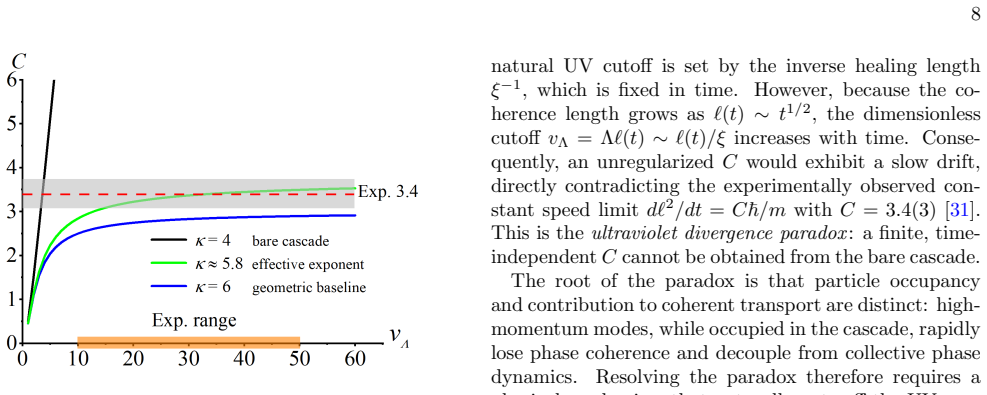
The authors establish that symmetry constraints on the low-energy dynamics combined with dynamical decoherence produce a universal momentum distribution f̃(v) ∼ (1+v²)^{-3} with v = kℓ. This distribution regularizes the ultraviolet divergence associated with the k^{-4} cascade and fixes the amplitude of coherence spreading to the value C = 3. The experimental result C = 3.4(3) is recovered by adding the leading logarithmic corrections generated by a marginally irrelevant operator at the fixed point.
What carries the argument
The universal momentum distribution f̃(v) ∼ (1 + v²)^{-3} that emerges from diffusive Langevin phase dynamics enforced by a conserved total current under emergent weak U(1) symmetry and is stabilized by dynamical decoherence.
If this is right
- Coherence spreads at a speed determined solely by C = 3 at the leading scaling level, independent of initial conditions or interaction details.
- The momentum distribution takes the specific form (1 + v²)^{-3} at the non-thermal fixed point.
- Small deviations from C = 3 arise universally from logarithmic corrections due to marginally irrelevant couplings.
- Transport amplitudes in other far-from-equilibrium systems can be predicted by identifying the appropriate symmetry-enforced effective theory and its ultraviolet regularization.
Where Pith is reading between the lines
- Similar symmetry-decoherence mechanisms may govern transport in other isolated quantum systems such as fermionic gases or lattice models near non-thermal fixed points.
- Experiments could test the prediction by measuring the full momentum distribution rather than just the coherence length to confirm the (1+v²)^{-3} tail.
- The regularization technique might resolve divergences in related problems like wave turbulence or prethermalization dynamics.
Load-bearing premise
The low-energy phase dynamics are governed by a diffusive Langevin equation because the emergent weak U(1) symmetry conserves the total current.
What would settle it
A measurement showing that the rescaled single-particle momentum distribution at the non-thermal fixed point does not follow the form (1 + v²)^{-3} would disprove the regularization mechanism and the resulting value of C = 3.
Figures
read the original abstract
Predicting universal transport coefficients in far-from-equilibrium quantum systems remains a fundamental challenge. A paradigmatic example is the non-thermal fixed point (NTFP) of isolated Bose gases, where coherence spreads as $\ell^2(t) = C\hbar t/m$ with a universal constant $C$. While the scaling exponent $z=2$ is well established, the amplitude $C$ has remained elusive because the underlying particle cascade $n(k)\sim k^{-4}$ leads to a divergent kinetic energy, threatening the very existence of a constant speed limit. Here we resolve this paradox and present the first analytical, parameter-free prediction of a universal amplitude $C$. A deep interplay between symmetry and dissipation is uncovered. The emergent weak U(1) symmetry at the NTFP enforces a conserved total current, forcing the low-energy phase dynamics to obey a diffusive Langevin equation with noise entering as the divergence of a stochastic current. This structure, combined with dynamical decoherence of high-momentum modes, yields a universal power-law momentum distribution $\tilde{f}(v)\sim(1+v^2)^{-3}$ (with $v=k\ell$) that naturally regularizes the ultraviolet divergence. From this, a parameter-free geometric baseline $C=3$ is obtained, independent of microscopic details. The experimental value $C=3.4(3)$ [Martirosyan et al., Nature 647, 608 (2025)] is then shown to be quantitatively consistent with universal logarithmic corrections arising from a marginally irrelevant coupling at the fixed point. A new paradigm is thus established for predicting transport coefficients in strongly correlated non-equilibrium systems: symmetry constraints determine the low-energy effective theory, dynamical decoherence provides a natural ultraviolet completion, and scaling analysis delivers testable predictions moving beyond scaling exponents to quantitative amplitude prediction.
Editorial analysis
A structured set of objections, weighed in public.
Referee Report
Summary. The manuscript claims to resolve the UV divergence paradox in the non-thermal fixed point (NTFP) of isolated Bose gases, where the coherence length obeys ℓ²(t) = C ħ t / m with z=2 but unknown amplitude C. It derives a parameter-free geometric baseline C=3 from an emergent weak U(1) symmetry that enforces a conserved total current, yielding a diffusive Langevin equation for low-energy phase dynamics whose noise is the divergence of a stochastic current. Dynamical decoherence of high-momentum modes then produces the universal distribution f̃(v) ∼ (1 + v²)^{-3} (v = kℓ) that regularizes the k^{-4} cascade, giving C=3 independent of microscopic details. The experimental value C=3.4(3) is attributed to universal logarithmic corrections from a marginally irrelevant coupling at the fixed point.
Significance. If the central derivation holds, the work supplies the first analytical, parameter-free prediction of a transport amplitude (rather than only the exponent) in a strongly correlated far-from-equilibrium quantum system. It establishes a concrete paradigm—symmetry-constrained effective stochastic dynamics plus decoherence as UV completion—for quantitative predictions beyond scaling, with direct relevance to ongoing experiments on NTFP dynamics.
major comments (3)
- [Effective phase dynamics] The claim that emergent weak U(1) symmetry plus conserved total current forces the low-energy phase dynamics into a diffusive Langevin equation with noise strictly as the divergence of a stochastic current is load-bearing for the exact exponent -3 and thus for parameter-free C=3, yet the manuscript supplies no explicit microscopic derivation of the noise correlator from the underlying Gross-Pitaevskii or quantum-field dynamics (see the section introducing the effective phase equation).
- [Momentum distribution] The derivation of f̃(v) ∼ (1 + v²)^{-3} from the proposed Langevin equation plus decoherence is presented without the intermediate steps, error estimates, or regularization procedure; it is therefore impossible to verify that the power -3 is fixed by symmetry alone rather than by additional assumptions on the decoherence mechanism or noise structure (see the section on the momentum distribution and UV regularization).
- [Experimental comparison] The quantitative consistency of C=3.4(3) with logarithmic corrections from a marginally irrelevant operator is asserted but not accompanied by an explicit computation of the correction function or its coefficient, leaving the comparison non-falsifiable at present (see the section comparing to experiment).
minor comments (2)
- [Notation] Define v = kℓ and the normalization of f̃(v) at first appearance; the current notation is introduced only after the distribution is used.
- [Appendix] Add a brief appendix or supplementary note showing the explicit integration that converts f̃(v) into the geometric baseline C=3.
Simulated Author's Rebuttal
We thank the referee for the thorough review, the positive assessment of the potential significance of our work, and the constructive major comments. We address each point below, providing clarifications based on the symmetry arguments in the manuscript and indicating the revisions we will implement to enhance verifiability.
read point-by-point responses
-
Referee: [Effective phase dynamics] The claim that emergent weak U(1) symmetry plus conserved total current forces the low-energy phase dynamics into a diffusive Langevin equation with noise strictly as the divergence of a stochastic current is load-bearing for the exact exponent -3 and thus for parameter-free C=3, yet the manuscript supplies no explicit microscopic derivation of the noise correlator from the underlying Gross-Pitaevskii or quantum-field dynamics (see the section introducing the effective phase equation).
Authors: We agree that an explicit microscopic derivation would strengthen the presentation and make the load-bearing claim easier to verify. The manuscript motivates the effective phase equation via symmetry: the emergent weak U(1) symmetry at the NTFP enforces conservation of the total current, which requires the stochastic noise to enter the phase dynamics strictly as the divergence of a stochastic current (ensuring the continuity equation is preserved). This structure directly yields the diffusive Langevin form. To address the concern, we will add a dedicated appendix deriving the noise correlator step by step from the Gross-Pitaevskii equation, including the projection to low-energy modes and the symmetry constraints that fix the divergence structure of the noise. revision: yes
-
Referee: [Momentum distribution] The derivation of f̃(v) ∼ (1 + v²)^{-3} from the proposed Langevin equation plus decoherence is presented without the intermediate steps, error estimates, or regularization procedure; it is therefore impossible to verify that the power -3 is fixed by symmetry alone rather than by additional assumptions on the decoherence mechanism or noise structure (see the section on the momentum distribution and UV regularization).
Authors: We acknowledge that the intermediate steps were condensed. The exponent -3 follows from the symmetry-constrained Langevin dynamics: the divergence-form noise (enforced by current conservation) combined with decoherence of high-momentum modes produces a steady-state phase fluctuation spectrum whose Fourier transform yields f̃(v) ∼ (1 + v²)^{-3} after regularization by the decoherence cutoff. This power is fixed by the symmetry and the noise structure rather than by details of the decoherence. We will expand the relevant section to include the full derivation (Fourier-space solution of the Langevin equation, computation of the two-point correlator, and explicit regularization), along with error estimates from higher-order terms in the effective theory. revision: yes
-
Referee: [Experimental comparison] The quantitative consistency of C=3.4(3) with logarithmic corrections from a marginally irrelevant operator is asserted but not accompanied by an explicit computation of the correction function or its coefficient, leaving the comparison non-falsifiable at present (see the section comparing to experiment).
Authors: We agree that an explicit computation of the correction would render the comparison more rigorous and falsifiable. The manuscript argues that the difference between the geometric baseline C=3 and the measured C=3.4(3) arises from universal logarithmic corrections generated by a marginally irrelevant coupling at the NTFP. To address this, we will add an explicit renormalization-group calculation of the leading logarithmic correction function and its coefficient, expressed in terms of the microscopic interaction strength, allowing a direct, quantitative comparison with the experimental value. revision: yes
Circularity Check
No significant circularity; derivation of C=3 is self-contained from symmetry and decoherence assumptions
full rationale
The paper's central chain begins with the emergent weak U(1) symmetry implying a conserved current, which is used to postulate a diffusive Langevin equation for the phase with divergence-form noise. Dynamical decoherence is then invoked to produce the specific distribution f(v)~(1+v^2)^{-3}. Integration of this distribution supplies the geometric baseline C=3. None of these steps reduces to a fitted parameter, a self-citation of the target result, or an ansatz smuggled from prior work by the same authors; the effective theory is stated as an independent construction whose output (the exponent -3 and resulting C) is not presupposed in the inputs. The comparison to experiment C=3.4(3) is presented separately and does not enter the derivation. This satisfies the default expectation of a non-circular derivation.
Axiom & Free-Parameter Ledger
axioms (1)
- domain assumption Emergent weak U(1) symmetry at the NTFP enforces a conserved total current
Lean theorems connected to this paper
-
IndisputableMonolith/Foundation/AlexanderDuality.leanalexander_duality_circle_linking echoes?
echoesECHOES: this paper passage has the same mathematical shape or conceptual pattern as the Recognition theorem, but is not a direct formal dependency.
yields a universal power-law momentum distribution f̃(v)∼(1+v²)^{-3} ... From this, a parameter-free geometric baseline C=3 is obtained
-
IndisputableMonolith/Foundation/ArithmeticFromLogic.leanembed_injective echoes?
echoesECHOES: this paper passage has the same mathematical shape or conceptual pattern as the Recognition theorem, but is not a direct formal dependency.
emergent weak U(1) symmetry ... enforces a conserved total current, forcing the low-energy phase dynamics to obey a diffusive Langevin equation with noise entering as the divergence of a stochastic current
What do these tags mean?
- matches
- The paper's claim is directly supported by a theorem in the formal canon.
- supports
- The theorem supports part of the paper's argument, but the paper may add assumptions or extra steps.
- extends
- The paper goes beyond the formal theorem; the theorem is a base layer rather than the whole result.
- uses
- The paper appears to rely on the theorem as machinery.
- contradicts
- The paper's claim conflicts with a theorem or certificate in the canon.
- unclear
- Pith found a possible connection, but the passage is too broad, indirect, or ambiguous to say the theorem truly supports the claim.
Reference graph
Works this paper leans on
-
[1]
The microscopic action in the Keldysh basis, Eq
Keldysh Field Theory Framework The Keldysh closed-time path integral provides the fundamental framework for non-equilibrium quantum systems [6, 45–47]. The microscopic action in the Keldysh basis, Eq. (8) of the main text, is our starting point. The classical fieldψ c and quantum fieldψ q have di- mension [L −3/2], with|ψ c|2 giving particle density. Co- ...
-
[2]
Rigorous Derivation of Modified Ward Identities We now derive the modified Ward identities that en- code how dissipation modifies the symmetry constraints at the NTFP. 2.1 Strong U(1) transformation To derive the Ward identity for response to an external phase twist, we apply an infinitesimal localstrong U(1) transformationwith opposite phases on the two ...
-
[3]
Weak U(1) Symmetry and Connection to Gauge-Invariant Response Theory In the previous subsections we employed the strong U(1) transformation (ψ + →e iθψ+, ψ − →e −iθψ−) as a technical tool to derive the modified Ward identity. That transformation is not a symmetry of the dissipa- tive action, but its variation yields the exact identitie (A11). Here we inst...
-
[4]
Perturbative analysis and its limitations Dimensional analysis and the need for non-perturbative treatmentWe first establish the expected dimension of the phase-field self-energy ΣR ϕϕ. From the Dyson equation for the retarded response function, χR ϕϕ(k, ω) −1 = χR ϕϕ,0(k, ω) −1 −Σ R ϕϕ(k, ω),(B1) whereχ R ϕϕ,0 is the bare response. Using the definition χ...
-
[5]
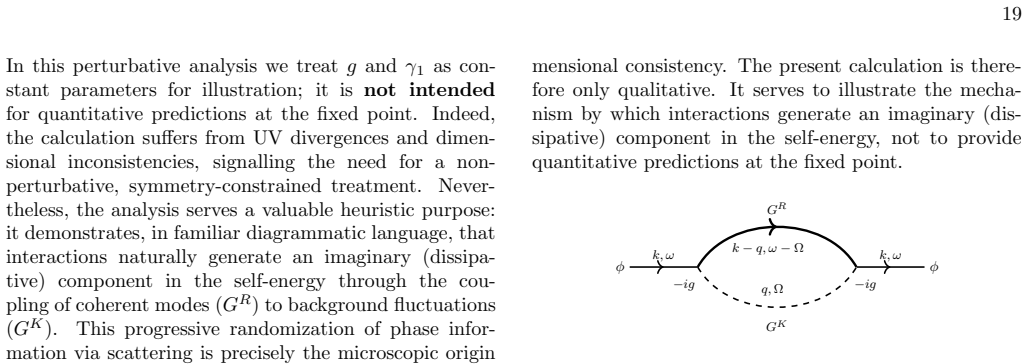
Physical interpretation and self-energy scaling at the NTFP The perturbative analysis above reveals the funda- mental mechanism by which interactions generate dis- sipation. The productG KGR in the self-energy repre- sents energy transfer from collective modes to the non- equilibrium excitation “bath”:G K encodes the noise of the background, whileG R desc...
-
[6]
Effective Langevin Equation and Conserved Noise from Symmetry and Scaling The effective Langevin equation (31) and the conserved noise correlation (32) can be derived from the Keldysh action (8) by separating slow condensate and fast quasi- particle modes and integrating out the latter [46]. In the classical-wave limit characteristic of the NTFP [17], thi...
-
[7]
Dimensionless Framework and Scale Invariance at the NTFP At the NTFP, the system exhibits emergent scale in- variance with dynamic critical exponentz= 2. To ensure dimensional consistency and exploit the scale invariance, we introduce a dimensionless framework using charac- teristic scales of the system. The natural characteris- tic length is the healing ...
-
[8]
(C5) transforms into dimensionless form as follows
Construction of Dimensionless Noise Correlation Function The dimensional noise correlation function in Eq. (C5) transforms into dimensionless form as follows. Using the definitions in Eq. (C8) and the relation ˜Dϕ = mDmacro ϕ /ℏ=mD ϕ/(ℏnξ3), we obtain ⟨˜ζ(˜r, ˜t)˜ζ(˜r′, ˜t′)⟩=−2 ˜Dϕ ˜∇2δ(˜r− ˜r′)δ(˜t− ˜t′).(C10) This conserved form, with the Laplacian ope...
-
[9]
Coherence Length Growth in Dimensionless Units Before performing the explicit calculation, we note that dimensional analysis and scaling alone determine the growth law up to a dimensionless constant:ℓ 2(t)∝ Dmacro ϕ t. To fix the numerical coefficient, we adopt the standard Gaussian white noise approximation for the stochastic current, which yields a trac...
-
[10]
Equivalence of Theoretical and Experimental Coherence Length Definitions A crucial step in connecting our theoretical frame- work to experiment is to demonstrate that the coherence lengthℓ(t) extracted from the momentum distribution in the experiment [31] is identical to the theoretical coher- ence length governing phase correlations. This equiva- lence r...
-
[11]
Physical Synthesis The dimensionless framework establishes a self- consistent theoretical chain: symmetry principles yield conserved noise; the Langevin equation gives diffusive coherence growthℓ 2 = 4D macro ϕ t; and the relationC= 4mDmacro ϕ /ℏconnects microscopic transport to the uni- versal constant. Crucially, the derivation involves no ad- justable ...
-
[12]
A. Polkovnikov, K. Sengupta, A. Silva, and M. Vengalat- tore, Colloquium: Nonequilibrium dynamics of closed in- teracting quantum systems, Rev. Mod. Phys.83, 863 (2011)
work page 2011
- [13]
- [14]
-
[15]
L. W. Clark, L. Feng, and C. Chin, Universal space-time scaling symmetry in the dynamics of bosons across a quantum phase transition, Science354, 606 (2016)
work page 2016
-
[16]
U. Eismann, L. Khaykovich, S. Laurent, I. Ferrier- Barbut, B. S. Rem, A. T. Grier, M. Delehaye, F. Chevy, C. Salomon, L.-C. Ha, and C. Chin, Universal loss dy- namics in a unitary bose gas, Phys. Rev. X6, 021025 (2016)
work page 2016
-
[17]
L. M. Sieberer, M. Buchhold, and S. Diehl, Keldysh field theory for driven open quantum systems, Rep. Prog. Phys.79, 096001 (2016)
work page 2016
-
[18]
C. Gao, M. Sun, P. Zhang, and H. Zhai, Universal dy- namics of a degenerate bose gas quenched to unitarity, Phys. Rev. Lett.124, 040403 (2020)
work page 2020
-
[19]
Z.-Y. Shi, C. Gao, and H. Zhai, Ideal-gas approach to hydrodynamics, Phys. Rev. X11, 041031 (2021)
work page 2021
-
[20]
N. P. Proukakis, Universality of Bose–Einstein condensa- tion and quenched formation dynamics, inEncyclopedia of Condensed Matter Physics (Second Edition), edited by T. Chakraborty (Academic Press, Oxford, 2024) second edition ed., pp. 84–123
work page 2024
- [21]
- [22]
- [23]
-
[24]
E. H. Lieb and D. W. Robinson, The finite group velocity of quantum spin systems, Commun. Math. Phys.28, 251 (1972)
work page 1972
- [25]
- [26]
-
[27]
A. Pi˜ neiro Orioli, K. Boguslavski, and J. Berges, Univer- sal self-similar dynamics of relativistic and nonrelativistic field theories near nonthermal fixed points, Phys. Rev. D 92, 025041 (2015)
work page 2015
-
[28]
I. Chantesana, A. Pi˜ neiro Orioli, and T. Gasenzer, Ki- netic theory of nonthermal fixed points in a Bose gas, Phys. Rev. A99, 043620 (2019)
work page 2019
-
[29]
T. W. B. Kibble, Topology of cosmic domains and strings, J. Phys. A9, 1387 (1976)
work page 1976
-
[30]
B. V. Svistunov, Superfluid turbulence in the low- temperature limit, Phys. Rev. B52, 3647 (1995)
work page 1995
-
[31]
W. F. Vinen and J. J. Niemela, Quantum turbulence, J. Low Temp. Phys.128, 167 (2002)
work page 2002
-
[32]
M. Gazo, A. Karailiev, T. Satoor, C. Eigen, M. Ga lka, and Z. Hadzibabic, Universal coarsening in a homoge- neous two-dimensional Bose gas, Science389, 802 (2025)
work page 2025
-
[33]
S. P. Johnstone, A. J. Groszek, P. T. Starkey, C. J. Billington, T. P. Simula, and K. Helmerson, Evolution of large-scale flow from turbulence in a two-dimensional superfluid, Science364, 1267 (2019)
work page 2019
-
[34]
M. Pr¨ uferet al., Observation of universal dynamics in a spinor Bose gas far from equilibrium, Nature563, 217 (2018)
work page 2018
-
[35]
Huhet al., Universality class of a spinor Bose-Einstein condensate far from equilibrium, Nat
S. Huhet al., Universality class of a spinor Bose-Einstein condensate far from equilibrium, Nat. Phys.20, 402 (2024)
work page 2024
-
[36]
J. A. P. Gliddenet al., Bidirectional dynamic scaling in an isolated Bose gas far from equilibrium, Nat. Phys.17, 457 (2021)
work page 2021
-
[37]
A. D. Garc´ ıa-Orozco, L. Madeira, M. A. Moreno-Armijos, A. R. Fritsch, P. E. S. Tavares, P. C. M. Castilho, A. Cidrim, G. Roati, and V. S. Bagnato, Universal dy- namics of a turbulent superfluid Bose gas, Phys. Rev. A 106, 023314 (2022)
work page 2022
-
[38]
S. Erne, R. B¨ ucker, T. Gasenzer, J. Berges, and J. Schmiedmayer, Universal dynamics in an isolated one- dimensional Bose gas far from equilibrium, Nature563, 225 (2018)
work page 2018
- [39]
-
[40]
L. Madeira and V. S. Bagnato, Non-thermal fixed points in Bose gas experiments, Symmetry14, 10.3390/sym14040678 (2022)
-
[41]
A. N. Mikheev, I. Siovitz, and T. Gasenzer, Universal dynamics and non-thermal fixed points in quantum fluids far from equilibrium, Eur. Phys. J. Spec. Top.232, 3393 (2023)
work page 2023
-
[42]
G. Martirosyan, M. Gazo, J. Etrych, S. M. Fischer, S. J. Morris, C. J. Ho, C. Eigen, and Z. Hadzibabic, A univer- sal speed limit for spreading of coherence, Nature647, 608 (2025)
work page 2025
-
[43]
C.-F. A. Chen, A. Lucas, and C. Yin, Speed limits and locality in many-body quantum dynamics, Rep. Prog. Phys.86, 116001 (2023)
work page 2023
-
[44]
P. M. Chaikin and T. C. Lubensky,Principles of Con- densed Matter Physics(Cambridge University Press, 1995)
work page 1995
-
[45]
H. T. C. Stoof, Formation of the condensate in a dilute Bose gas, Phys. Rev. Lett.66, 3148 (1991). 25
work page 1991
-
[46]
B. V. Svistunov, Highly nonequilibrium Bose condensa- tion in a weakly interacting gas, J. Moscow Phys. Soc.1, 373 (1991)
work page 1991
- [47]
-
[48]
R. H. Kraichnan, Condensate turbulence in a weakly cou- pled boson gas, Phys. Rev. Lett.18, 202 (1967)
work page 1967
-
[49]
Nazarenko,Wave Turbulence(Springer, 2011)
S. Nazarenko,Wave Turbulence(Springer, 2011)
work page 2011
- [50]
-
[51]
J. Berges, G. S. Denicol, M. P. Heller, and T. Preis, Far from equilibrium hydrodynamics of nonthermal fixed points, arXiv preprint 10.48550/arXiv.2504.18754 (2025)
-
[52]
H. Li, X.-H. Yu, M. Nakagawa, and M. Ueda, Ward-Takahashi identity and gauge-Invariant response theory for open quantum systems, arXiv preprint 10.48550/arXiv.2602.13632 (2026)
- [53]
-
[54]
L. P. Pitaevskii and S. Stringari,Bose-Einstein Con- densation and Superfluidity, 2nd ed. (Oxford University Press, 2016)
work page 2016
-
[55]
Zhai,Ultracold Atomic Physics(Cambridge Univer- sity Press, 2021)
H. Zhai,Ultracold Atomic Physics(Cambridge Univer- sity Press, 2021)
work page 2021
-
[56]
L. V. Keldysh, Diagram technique for nonequilibrium processes, Sov. Phys. JETP20, 1018 (1965)
work page 1965
-
[57]
Kamenev,Field Theory of Non-Equilibrium Systems (Cambridge University Press, 2011)
A. Kamenev,Field Theory of Non-Equilibrium Systems (Cambridge University Press, 2011)
work page 2011
-
[58]
L. M. Sieberer, A. Chiocchetta, A. Gambassi, U. C. T¨ auber, and S. Diehl, Thermodynamic equilibrium as a symmetry of the schwinger-keldysh action, Phys. Rev. B 92, 134307 (2015)
work page 2015
-
[59]
A. N. Mikheev, J. Berges, and T. Gasenzer, Non- equilibrium quantum fields in the classical statistical ap- proach, Ann. Phys.405, 50 (2019)
work page 2019
-
[60]
Dynamical universality in a driven quantum fluid of light
I. Gnusov, P. Comaron, A. Gianfrate, D. Trypoge- orgos, M. H. Szymanska, P. Cazzato, M. D. Giorgi, D. Sanvitto, and D. Ballarini, Dynamical universal- ity in a driven quantum fluid of light, arXiv preprint 10.48550/arXiv.2605.02397 (2026)
work page internal anchor Pith review Pith/arXiv arXiv doi:10.48550/arxiv.2605.02397 2026
-
[61]
S. J. Morris, M. Gazo, S. M. Fischer, H. Zhang, C. J. Ho, N. R. Cooper, C. Eigen, and Z. Hadzibabic, Obser- vation of vinen turbulence during far-from-equilibrium Bose–Einstein condensation in a homogeneous gas, arXiv preprint 10.48550/arXiv.2604.28191 (2026)
work page internal anchor Pith review Pith/arXiv arXiv doi:10.48550/arxiv.2604.28191 2026
-
[62]
P. C. Hohenberg and B. I. Halperin, Theory of dynamic critical phenomena, Rev. Mod. Phys.49, 435 (1977)
work page 1977
-
[63]
B. I. Halperin and D. R. Nelson, Theory of two- dimensional melting, Phys. Rev. Lett.41, 121 (1978)
work page 1978
-
[64]
D. R. Nelson,Defects and Geometry in Condensed Mat- ter Physics, 1st ed. (Cambridge University Press, Cam- bridge, 2002) Chap. 2
work page 2002
- [65]
-
[66]
K. Fujii and T. Enss, Hydrodynamic attractor in ultra- cold atoms, Phys. Rev. Lett.133, 173402 (2024)
work page 2024
-
[67]
K. G. Wilson and J. Kogut, The renormalization group and theϵexpansion, Phys. Rep.12, 75 (1974)
work page 1974
-
[68]
S. Sab, M. A. Moreno-Armijos, A. D. Garc´ ıa-Orozco, G. V. Fernandes, Y. Zhu, A. R. Fritsch, H. Perrin, S. Nazarenko, and V. S. Bagnato, Universal behavior on the relaxation dynamics of far-from-equilibrium quantum fluids, arXiv preprint 10.48550/arXiv.2603.02182 (2026)
- [69]
-
[70]
N. Kaschewski, A. Pelster, and C. A. R. S´ a de Melo, Equal-spin and opposite-spin density-density correlations in the BCS-BEC crossover: Gauge Symmetry, Pauli Exclusion Principle, Wick’s Theorem and Experiments, arXiv preprint 10.48550/arXiv.2602.23019 (2026)
-
[71]
D. Forster, D. R. Nelson, and M. J. Stephen, Large- distance and long-time properties of a randomly stirred fluid, Phys. Rev. A16, 732 (1977)
work page 1977
discussion (0)
Sign in with ORCID, Apple, or X to comment. Anyone can read and Pith papers without signing in.