Recognition: unknown
Observation of Vinen turbulence during far-from-equilibrium Bose-Einstein condensation
Pith reviewed 2026-05-07 05:48 UTC · model grok-4.3
The pith
Vortex line density in a 3D Bose gas decays according to Vinen ultraquantum turbulence during condensation.
A machine-rendered reading of the paper's core claim, the machinery that carries it, and where it could break.
Core claim
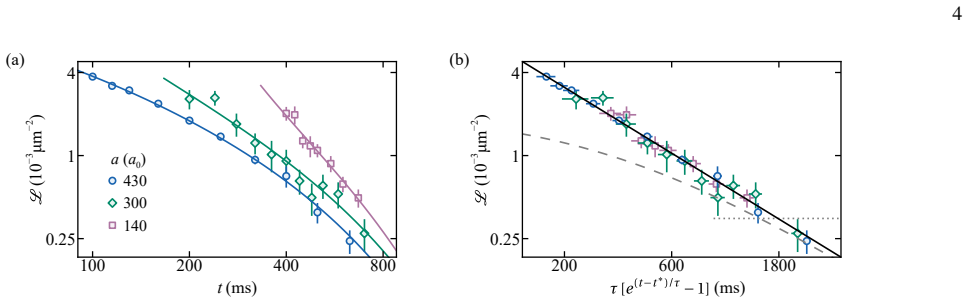
Relaxation of far-from-equilibrium quantum fluids is theoretically associated with the decay of a turbulent isotropic tangle of vortex lines. In a homogeneous 3D atomic Bose gas the authors observe imprints of randomly oriented vortex lines via matter-wave magnification and thin-slice imaging, and measure the vortex line-length density L. The observed decay of L agrees with the prediction for Vinen ultraquantum turbulence. Although the gases are weakly interacting and highly compressible, their large-scale dynamics are consistent with the behavior of an incompressible hydrodynamic fluid, with the decay of L independent of interatomic interaction strength and similar to that in superfluids.
What carries the argument
The vortex line-length density L, obtained from matter-wave magnification and thin-slice imaging of density imprints, which quantifies the isotropic tangle of randomly oriented vortex lines and its decay.
If this is right
- The decay of vortex line-length density L follows the Vinen prediction for ultraquantum turbulence.
- Large-scale dynamics remain consistent with an incompressible hydrodynamic fluid even in a highly compressible gas.
- The decay of L does not depend on the strength of interatomic interactions.
- The observed behavior is similar to that in strongly interacting superfluid helium.
Where Pith is reading between the lines
- This points to a possible universal decay mechanism for quantum turbulence across interaction regimes.
- Atomic Bose gases may provide a controllable testbed for phenomena previously studied mainly in helium.
- The imaging approach could be adapted to probe vortex statistics beyond line density in other far-from-equilibrium quantum fluids.
Load-bearing premise
The matter-wave magnification and thin-slice imaging technique produces faithful imprints of randomly oriented vortex lines without significant distortion, false positives, or selection effects that would alter the measured line-length density L.
What would settle it
An experiment in a homogeneous 3D atomic Bose gas that finds the decay rate of vortex line-length density L depends on interaction strength or deviates from the Vinen ultraquantum turbulence prediction.
Figures


read the original abstract
Relaxation of far-from-equilibrium quantum fluids, intimately related to the emergence of long-range order, is theoretically associated with the decay of a turbulent isotropic tangle of vortex lines. We observe and study such decaying quantum turbulence in a homogeneous 3D atomic Bose gas. Using matter-wave techniques to magnify the gas density distribution, and then imaging a thin slice of the magnified cloud, we observe imprints of randomly oriented vortex lines and measure the vortex line-length density $\mathcal{L}$. The observed decay of $\mathcal{L}$ agrees with the prediction for Vinen `ultraquantum' turbulence. Although our weakly interacting gases are highly compressible, their large-scale dynamics are consistent with the behavior of an incompressible hydrodynamic fluid, with the decay of $\mathcal{L}$ not depending on the strength of the interatomic interactions and being similar to that in the strongly interacting superfluid helium.
Editorial analysis
A structured set of objections, weighed in public.
Referee Report
Summary. The manuscript reports the observation of decaying Vinen ultraquantum turbulence in a homogeneous 3D atomic Bose gas during far-from-equilibrium Bose-Einstein condensation. Using matter-wave magnification followed by thin-slice imaging, the authors extract the vortex line-length density L and claim that its time decay agrees with the theoretical Vinen prediction (L ∝ t^{-1}), is independent of interatomic interaction strength, and matches the behavior seen in strongly interacting superfluid helium despite the high compressibility of the dilute gas.
Significance. If the central measurement is robust, the result would be significant for quantum turbulence studies. It supplies the first direct experimental access to Vinen turbulence in a weakly interacting atomic superfluid, confirming the ultraquantum decay law and showing that large-scale incompressible hydrodynamic behavior can emerge even when the microscopic gas is highly compressible. The work thereby bridges the gap between dilute-gas and helium turbulence and provides a controllable platform for testing far-from-equilibrium relaxation theories. The direct experimental measurement of L(t) constitutes a reproducible data set that strengthens the claim.
major comments (2)
- [Methods (imaging)] Methods section (matter-wave magnification and thin-slice imaging): The central claim that the measured decay of L follows the Vinen law and is independent of interaction strength rests on the assumption that the imaging pipeline faithfully reconstructs the underlying 3D isotropic vortex tangle. No quantitative validation is described—such as synthetic-data reconstruction tests, variation of slice thickness, or checks for orientation-dependent visibility or compressibility-induced artifacts (sound-wave generation during expansion that could distort cores or produce false depletions). Without these controls, the observed t^{-1} decay and interaction independence could be an imaging artifact rather than a property of the turbulence.
- [Results (L decay)] Results section (decay of L and interaction independence): The abstract asserts agreement with the Vinen prediction and independence from interaction strength, yet the manuscript provides no explicit fitting details, error bars, number of realizations, or the precise range of scattering lengths tested. These quantitative elements are required to evaluate whether the exponent is statistically consistent with -1 and whether the claimed interaction independence is robust or limited by the accessible parameter window.
minor comments (2)
- [Abstract] The abstract is concise but would be strengthened by a single sentence stating the observed time window and the fitted exponent with uncertainty.
- [Notation] Notation for line density is consistently denoted L (or script L); ensure the same symbol is used in all figure captions and equations.
Simulated Author's Rebuttal
We thank the referee for their positive evaluation of the significance of our work and for the detailed comments, which have helped us strengthen the manuscript. We address each major comment below and have made revisions to incorporate additional validation and quantitative details.
read point-by-point responses
-
Referee: Methods section (matter-wave magnification and thin-slice imaging): The central claim that the measured decay of L follows the Vinen law and is independent of interaction strength rests on the assumption that the imaging pipeline faithfully reconstructs the underlying 3D isotropic vortex tangle. No quantitative validation is described—such as synthetic-data reconstruction tests, variation of slice thickness, or checks for orientation-dependent visibility or compressibility-induced artifacts (sound-wave generation during expansion that could distort cores or produce false depletions). Without these controls, the observed t^{-1} decay and interaction independence could be an imaging artifact rather than a property of the turbulence.
Authors: We acknowledge that the original manuscript lacked explicit quantitative validation of the imaging pipeline. In the revised manuscript we have added a new subsection in Methods that describes synthetic-data reconstruction tests. Simulated 3D isotropic vortex tangles with known line-length densities were generated, the full matter-wave magnification and thin-slice imaging process was applied, and the reconstructed L was compared to the input value, yielding agreement to within 10% across the relevant parameter range. We also report results from varying the effective slice thickness by ±20% and confirm that extracted L remains consistent. Orientation dependence was checked by rotating the simulated tangle; no systematic bias in visibility was found. For compressibility effects, we performed hydrodynamic simulations of the expansion including sound-wave generation and verified that core distortions do not produce spurious depletions at the vortex densities and expansion times used in the experiment. These controls are now documented with a supplementary figure showing example reconstructions. revision: yes
-
Referee: Results section (decay of L and interaction independence): The abstract asserts agreement with the Vinen prediction and independence from interaction strength, yet the manuscript provides no explicit fitting details, error bars, number of realizations, or the precise range of scattering lengths tested. These quantitative elements are required to evaluate whether the exponent is statistically consistent with -1 and whether the claimed interaction independence is robust or limited by the accessible parameter window.
Authors: We agree that these details were insufficiently explicit. The revised manuscript now includes: (i) the precise fitting procedure, in which L(t) is fit to the Vinen form L(t) = C/(t + t0) and, when the exponent is left free, yields values statistically consistent with −1 (reduced χ² ≈ 1.1); (ii) error bars on each L(t) point obtained from the standard deviation across independent realizations; (iii) the number of realizations (typically 20–30 per time point and condition); and (iv) the tested range of scattering lengths (a = 50 a0 to 250 a0). A new panel in the main figure and an accompanying table show the fitted decay exponents versus a, confirming no systematic dependence within experimental uncertainty. These additions allow direct assessment of statistical consistency and robustness. revision: yes
Circularity Check
No circularity: experimental measurement compared to independent external prediction for Vinen turbulence.
full rationale
The paper reports an experimental observation of decaying vortex line-length density L in a homogeneous 3D Bose gas using matter-wave magnification and thin-slice imaging. The central result is that the measured decay agrees with the known Vinen ultraquantum turbulence prediction (L ∝ t^{-1}), is independent of interaction strength, and matches behavior in superfluid helium. No derivation chain, equations, or first-principles steps are presented that reduce by construction to fitted inputs, self-definitions, or self-citations. The Vinen prediction is an external theoretical result from the literature on quantum turbulence, not derived or fitted within this work. The measurement protocol (magnification + slicing) is a data acquisition method whose validity is an experimental question, not a tautological reduction of a claimed prediction. The paper is self-contained against external benchmarks, with the interaction-independence and similarity to helium serving as cross-checks. Concerns about possible imaging biases (orientation, compressibility effects) relate to measurement fidelity and correctness, not to any circularity in a derivation. No load-bearing self-citations or ansatz smuggling are identified in the text.
Axiom & Free-Parameter Ledger
axioms (1)
- domain assumption Matter-wave magnification followed by thin-slice imaging faithfully captures the density imprints of randomly oriented vortex lines without major artifacts.
Forward citations
Cited by 1 Pith paper
-
Universal Speed Limit in a Far-from-Equilibrium Bose Gas: Symmetry and Dynamical Decoherence
Symmetry-enforced diffusive Langevin dynamics plus decoherence of high-momentum modes produces a universal momentum distribution that yields the parameter-free prediction C=3 for the coherence spreading constant ℓ²(t)...
Reference graph
Works this paper leans on
-
[1]
L. D. Landau, The theory of superfluidity of helium II, J. Phys. (USSR)5, 71 (1941)
1941
-
[2]
Onsager, Statistical hydrodynamics, Nuovo Cimento6, 279 (1949)
L. Onsager, Statistical hydrodynamics, Nuovo Cimento6, 279 (1949)
1949
-
[3]
R. P. Feynman, Application of quantum mechanics to liquid helium, inProgress in Low Temperature Physics, edited by C. J. Gorter (North-Holland Publishing Co., Amsterdam, 1955) pp. 17–53
1955
-
[4]
B. V . Svistunov, E. S. Babaev, and N. V . Prokof’ev,Superfluid states of matter(CRC Press, 2015)
2015
-
[5]
W. F. Vinen, Mutual friction in a heat current in liquid helium II I. Experiments on steady heat currents, Proc. R. Soc. Lond. A240, 114 (1957)
1957
-
[6]
W. F. Vinen, Mutual friction in a heat current in liquid helium II III. Theory of the mutual friction, Proc. R. Soc. Lond. A242, 493 (1957)
1957
-
[7]
P. W. Anderson and N. Itoh, Pulsar glitches and restlessness as a hard superfluidity phenomenon, Nature256, 25 (1975)
1975
-
[8]
T. W. B. Kibble, Topology of cosmic domains and strings, J. Phys. A: Math. Gen.9, 1387 (1976)
1976
-
[9]
W. H. Zurek, Cosmological experiments in superfluid helium?, Nature317, 505 (1985)
1985
-
[10]
Blatter, M
G. Blatter, M. V . Feigel’man, V . B. Geshkenbein, A. I. Larkin, and V . M. Vinokur, V ortices in high-temperature superconduc- tors, Rev. Mod. Phys.66, 1125 (1994)
1994
-
[11]
Bulgac, Y .-L
A. Bulgac, Y .-L. Luo, P. Magierski, K. J. Roche, and Y . Yu, Real-Time Dynamics of Quantized V ortices in a Unitary Fermi Superfluid, Science332, 1288 (2011)
2011
-
[12]
J. T. Tough, Superfluid turbulence, inProgress in Low Temper- ature Physics, V ol. 8, edited by D. F. Brewer (Elsevier, 1982) Chap. 3, pp. 133–219
1982
-
[13]
W. F. Vinen and J. J. Niemela, Quantum Turbulence, J. Low Temp. Phys.128, 167 (2002)
2002
-
[14]
W. F. Vinen, Quantum Turbulence: Achievements and Chal- lenges, J. Low Temp. Phys.161, 419 (2010)
2010
-
[15]
Skrbek, D
L. Skrbek, D. Schmoranzer, Š. Midlik, and K. R. Sreenivasan, Phenomenology of quantum turbulence in superfluid helium, Proc. Natl. Acad. Sci. U.S.A.118, e2018406118 (2021)
2021
-
[16]
C. F. Barenghi, L. Skrbek, and K. R. Sreenivasan,Quantum Turbulence(Cambridge University Press, 2023)
2023
-
[17]
B. V . Svistunov, Highly nonequilibrium Bose condensation in a weakly interacting gas, J. Moscow Phys. Soc.1, 373 (1991)
1991
-
[18]
B. V . Svistunov, Superfluid turbulence in the low-temperature limit, Phys. Rev. B52, 3647 (1995)
1995
-
[19]
N. G. Berloff and B. V . Svistunov, Scenario of strongly nonequilibrated Bose–Einstein condensation, Phys. Rev. A66, 013603 (2002)
2002
-
[20]
Nowak, J
B. Nowak, J. Schole, D. Sexty, and T. Gasenzer, Nonthermal fixed points, vortex statistics, and superfluid turbulence in an ultracold Bose gas, Phys. Rev. A85, 043627 (2012)
2012
-
[21]
G. W. Stagg, N. G. Parker, and C. F. Barenghi, Ultraquantum turbulence in a quenched homogeneous Bose gas, Phys. Rev. A94, 053632 (2016)
2016
-
[22]
Villois, D
A. Villois, D. Proment, and G. Krstulovic, Evolution of a su- perfluid vortex filament tangle driven by the Gross–Pitaevskii equation, Phys. Rev. E93, 061103 (2016)
2016
-
[23]
V . Noel, T. Gasenzer, and K. Boguslavski, Kelvin waves in nonequilibrium universal dynamics of relativistic scalar field theories, Phys. Rev. Res.7, 033220 (2025)
2025
-
[24]
G. P. Bewley, D. P. Lathrop, and K. R. Sreenivasan, Visualiza- tion of quantized vortices, Nature441, 588 (2006)
2006
-
[25]
M. S. Paoletti, M. E. Fisher, K. R. Sreenivasan, and D. P. Lath- rop, Velocity Statistics Distinguish Quantum Turbulence from Classical Turbulence, Phys. Rev. Lett.101, 154501 (2008)
2008
-
[26]
Y . Tang, W. Guo, H. Kobayashi, S. Yui, M. Tsubota, and T. Kanai, Imaging quantized vortex rings in superfluid he- lium to evaluate quantum dissipation, Nat. Commun.14, 2941 (2023)
2023
-
[27]
Peretti, J
C. Peretti, J. Vessaire, É. Durozoy, and M. Gibert, Direct visu- alization of the quantum vortex lattice structure, oscillations, and destabilization in rotating 4He, Sci. Adv.9, eadh2899 (2023)
2023
-
[28]
E. A. L. Henn, J. A. Seman, G. Roati, K. M. F. Magalhães, and V . S. Bagnato, Emergence of Turbulence in an Oscillat- ing Bose–Einstein Condensate, Phys. Rev. Lett.103, 045301 (2009)
2009
-
[29]
K. J. Thompson, G. G. Bagnato, G. D. Telles, M. A. Cara- canhas, F. E. A. dos Santos, and V . S. Bagnato, Evidence of power law behavior in the momentum distribution of a turbu- lent trapped Bose–Einstein condensate, Laser Phys. Lett.11, 015501 (2013). 5
2013
-
[30]
W. J. Kwon, G. Moon, J. Choi, S. W. Seo, and Y . Shin, Relax- ation of superfluid turbulence in highly oblate Bose–Einstein condensates, Phys. Rev. A90, 063627 (2014)
2014
-
[31]
Navon, A
N. Navon, A. L. Gaunt, R. P. Smith, and Z. Hadzibabic, Emer- gence of a turbulent cascade in a quantum gas, Nature539, 72 (2016)
2016
-
[32]
S. W. Seo, B. Ko, J. H. Kim, and Y . Shin, Observation of vortex-antivortex pairing in decaying 2D turbulence of a su- perfluid gas, Sci. Rep.7, 4587 (2017)
2017
-
[33]
Gauthier, M
G. Gauthier, M. T. Reeves, X. Yu, A. S. Bradley, M. A. Baker, T. A. Bell, H. Rubinsztein-Dunlop, M. J. Davis, and T. W. Neely, Giant vortex clusters in a two-dimensional quantum fluid, Science364, 1264 (2019)
2019
-
[34]
S. P. Johnstone, A. J. Groszek, P. T. Starkey, C. J. Billington, T. P. Simula, and K. Helmerson, Evolution of large-scale flow from turbulence in a two-dimensional superfluid, Science364, 1267 (2019)
2019
-
[35]
Navon, C
N. Navon, C. Eigen, J. Zhang, R. Lopes, A. L. Gaunt, K. Fu- jimoto, M. Tsubota, R. P. Smith, and Z. Hadzibabic, Synthetic dissipation and cascade fluxes in a turbulent quantum gas, Sci- ence366, 382 (2019)
2019
-
[36]
Liu, X.-C
X.-P. Liu, X.-C. Yao, Y . Deng, X.-Q. Wang, Y .-X. Wang, C.-J. Huang, X. Li, Y .-A. Chen, and J.-W. Pan, Universal dynami- cal scaling of quasi-two-dimensional vortices in a strongly in- teracting fermionic superfluid, Phys. Rev. Lett.126, 185302 (2021)
2021
-
[37]
Gałka, P
M. Gałka, P. Christodoulou, M. Gazo, A. Karailiev, N. Dogra, J. Schmitt, and Z. Hadzibabic, Emergence of Isotropy and Dy- namic Scaling in 2D Wave Turbulence in a Homogeneous Bose Gas, Phys. Rev. Lett.129, 190402 (2022)
2022
-
[38]
L. H. Dogra, G. Martirosyan, T. A. Hilker, J. A. P. Glidden, J. Etrych, A. Cao, C. Eigen, R. P. Smith, and Z. Hadzibabic, Universal equation of state for wave turbulence in a quantum gas, Nature620, 521 (2023)
2023
-
[39]
J. Kim, J. Jung, J. Lee, D. Hong, and Y . Shin, Chaos-assisted turbulence in spinor Bose–Einstein condensates, Phys. Rev. Res.6, L032030 (2024)
2024
-
[40]
Karailiev, M
A. Karailiev, M. Gazo, M. Gałka, C. Eigen, T. Satoor, and Z. Hadzibabic, Observation of an Inverse Turbulent-Wave Cas- cade in a Driven Quantum Gas, Phys. Rev. Lett.133, 243402 (2024)
2024
-
[41]
M. Zhao, J. Tao, and I. B. Spielman, Kolmogorov Scaling in Turbulent 2D Bose–Einstein Condensates, Phys. Rev. Lett. 134, 083402 (2025)
2025
-
[42]
M. Gazo, A. Karailiev, T. Satoor, C. Eigen, M. Gałka, and Z. Hadzibabic, Universal Coarsening in a Homogeneous Two- Dimensional Bose Gas, Science389, 802 (2025)
2025
-
[43]
Martirosyan, M
G. Martirosyan, M. Gazo, J. Etrych, S. M. Fischer, S. J. Morris, C. J. Ho, C. Eigen, and Z. Hadzibabic, A universal speed limit for spreading of coherence, Nature647, 608 (2025)
2025
- [44]
-
[45]
M. R. Matthews, B. P. Anderson, P. C. Haljan, D. S. Hall, C. E. Wieman, and E. A. Cornell, V ortices in a Bose–Einstein Con- densate, Phys. Rev. Lett.83, 2498 (1999)
1999
-
[46]
K. W. Madison, F. Chevy, W. Wohlleben, and J. Dalibard, V or- tex Formation in a Stirred Bose–Einstein Condensate, Phys. Rev. Lett.84, 806 (2000)
2000
-
[47]
J. R. Abo-Shaeer, C. Raman, J. M. V ogels, and W. Ketterle, Observation of V ortex Lattices in Bose–Einstein Condensates, Science292, 476 (2001)
2001
-
[48]
Bretin, P
V . Bretin, P. Rosenbusch, F. Chevy, G. V . Shlyapnikov, and J. Dalibard, Quadrupole Oscillation of a Single-V ortex Bose– Einstein Condensate: Evidence for Kelvin Modes, Phys. Rev. Lett.90, 100403 (2003)
2003
-
[49]
M. W. Zwierlein, J. R. Abo-Shaeer, A. Schirotzek, C. H. Schunck, and W. Ketterle, V ortices and superfluidity in a strongly interacting Fermi gas, Nature435, 1047 (2005)
2005
-
[50]
C. N. Weiler, T. W. Neely, D. R. Scherer, A. S. Bradley, M. J. Davis, and B. P. Anderson, Spontaneous vortices in the forma- tion of Bose–Einstein condensates, Nature455, 948 (2008)
2008
-
[51]
D. V . Freilich, D. M. Bianchi, A. M. Kaufman, T. K. Langin, and D. S. Hall, Real-Time Dynamics of Single V ortex Lines and V ortex Dipoles in a Bose–Einstein Condensate, Science 329, 1182 (2010)
2010
-
[52]
T. W. Neely, E. C. Samson, A. S. Bradley, M. J. Davis, and B. P. Anderson, Observation of V ortex Dipoles in an Oblate Bose– Einstein Condensate, Phys. Rev. Lett.104, 160401 (2010)
2010
-
[53]
M. J. H. Ku, W. Ji, B. Mukherjee, E. Guardado-Sanchez, L. W. Cheuk, T. Yefsah, and M. W. Zwierlein, Motion of a Soli- tonic V ortex in the BEC–BCS Crossover, Phys. Rev. Lett.113, 065301 (2014)
2014
-
[54]
Donadello, S
S. Donadello, S. Serafini, M. Tylutki, L. P. Pitaevskii, F. Dal- fovo, G. Lamporesi, and G. Ferrari, Observation of Solitonic V ortices in Bose–Einstein Condensates, Phys. Rev. Lett.113, 065302 (2014)
2014
-
[55]
Serafini, M
S. Serafini, M. Barbiero, M. Debortoli, S. Donadello, F. Larcher, F. Dalfovo, G. Lamporesi, and G. Ferrari, Dy- namics and Interaction of V ortex Lines in an Elongated Bose– Einstein Condensate, Phys. Rev. Lett.115, 170402 (2015)
2015
-
[56]
W. J. Kwon, G. Del Pace, K. Xhani, L. Galantucci, A. Muzi Falconi, M. Inguscio, F. Scazza, and G. Roati, Sound emission and annihilations in a programmable quantum vortex collider, Nature600, 64 (2021)
2021
-
[57]
R. J. Fletcher, A. Shaffer, C. C. Wilson, P. B. Patel, Z. Yan, V . Crépel, B. Mukherjee, and M. W. Zwierlein, Geometric squeezing into the lowest Landau level, Science372, 1318 (2021)
2021
-
[58]
A. L. Gaunt, T. F. Schmidutz, I. Gotlibovych, R. P. Smith, and Z. Hadzibabic, Bose–Einstein Condensation of Atoms in a Uniform Potential, Phys. Rev. Lett.110, 200406 (2013)
2013
-
[59]
Eigen, A
C. Eigen, A. L. Gaunt, A. Suleymanzade, N. Navon, Z. Hadz- ibabic, and R. P. Smith, Observation of Weak Collapse in a Bose–Einstein Condensate, Phys. Rev. X6, 041058 (2016)
2016
-
[60]
Murthy, D
P. Murthy, D. Kedar, T. Lompe, M. Neidig, M. Ries, A. Wenz, G. Zürn, and S. Jochim, Matter-wave Fourier optics with a strongly interacting two-dimensional Fermi gas, Phys. Rev. A 90, 043611 (2014)
2014
-
[61]
Asteria, H
L. Asteria, H. P. Zahn, M. N. Kosch, K. Sengstock, and C. Weitenberg, Quantum gas magnifier for sub-lattice-resolved imaging of 3D quantum systems, Nature599, 571 (2021)
2021
-
[62]
Brandstetter, C
S. Brandstetter, C. Heintze, P. Hill, P. M. Preiss, M. Gałka, and S. Jochim, Magnifying the wave function of interacting fermionic atoms, Phys. Rev. Lett.135, 103401 (2025)
2025
-
[63]
M. R. Andrews, C. G. Townsend, H.-J. Miesner, D. S. Dur- fee, D. M. Kurn, and W. Ketterle, Observation of Interference Between Two Bose Condensates, Science275, 637 (1997)
1997
-
[64]
A. L. Fetter and A. A. Svidzinsky, V ortices in a trapped dilute Bose–Einstein condensate, J. Phys. Condens. Matter13, R135 (2001)
2001
-
[65]
P. M. Walmsley and A. I. Golov, Quantum and Quasiclassical Types of Superfluid Turbulence, Phys. Rev. Lett.100, 245301 (2008)
2008
-
[66]
Martirosyan, C
G. Martirosyan, C. J. Ho, J. Etrych, Y . Zhang, A. Cao, Z. Hadz- ibabic, and C. Eigen, Observation of Subdiffusive Dynamic Scaling in a Driven and Disordered Bose Gas, Phys. Rev. Lett. 132, 113401 (2024)
2024
-
[67]
Etrych, G
J. Etrych, G. Martirosyan, A. Cao, J. A. P. Glidden, L. H. Do- gra, J. M. Hutson, Z. Hadzibabic, and C. Eigen, Pinpointing Feshbach resonances and testing Efimov universalities in 39K, Phys. Rev. Res.5, 013174 (2023)
2023
-
[68]
Shvarchuck, C
I. Shvarchuck, C. Buggle, D. S. Petrov, K. Dieckmann, M. Zielonkowski, M. Kemmann, T. G. Tiecke, W. von Klitz- ing, G. V . Shlyapnikov, and J. T. M. Walraven, Bose–Einstein Condensation into Nonequilibrium States Studied by Conden- 6 sate Focusing, Phys. Rev. Lett.89, 270404 (2002)
2002
-
[69]
S. Tung, G. Lamporesi, D. Lobser, L. Xia, and E. A. Cor- nell, Observation of the Presuperfluid Regime in a Two- Dimensional Bose Gas, Phys. Rev. Lett.105, 230408 (2010)
2010
-
[70]
R. J. Fletcher, M. Robert-de-Saint-Vincent, J. Man, N. Navon, R. P. Smith, K. G. H. Viebahn, and Z. Hadzibabic, Connect- ing Berezinskii–Kosterlitz–Thouless and BEC Phase Transi- tions by Tuning Interactions in a Trapped Gas, Phys. Rev. Lett. 114, 255302 (2015)
2015
-
[71]
The slight anisotropy in thex-yplane limits our resolution to a distance that corresponds to≈2µmin-situ
We use a red-detuned laser beam to realize a harmonic trap, with frequenciesω x ≈2π×40Hz,ω y ≈2π×45Hz, andω z ≈0. The slight anisotropy in thex-yplane limits our resolution to a distance that corresponds to≈2µmin-situ
-
[72]
We use a laser beam shaped by a digital micromirror device to optically pump only a slice of the cloud into the highest hyperfine ground state, and then image only the atoms in that state
-
[73]
R. H. Kraichnan, Condensate Turbulence in a Weakly Coupled Boson Gas, Phys. Rev. Lett.18, 202 (1967)
1967
-
[74]
D. J. Tritton,Physical fluid dynamics(Springer Science & Business Media, 2012)
2012
-
[75]
Binzoni, E
T. Binzoni, E. Dumonteil, and A. Mazzolo, Universal property of random trajectories in bounded domains, Phys. Rev. E112, 044105 (2025)
2025
-
[76]
4 and 5, we count imprints in our images within a central circle of radiusrD ≈52µm, which corresponds toin-situS≈2800µm 2
For the data in Figs. 4 and 5, we count imprints in our images within a central circle of radiusrD ≈52µm, which corresponds toin-situS≈2800µm 2. None of our results change (within errorbars) if we reducer D to≈34µm, which corresponds to S≈1500µm 2
-
[77]
We exclude clusters with fewer pixels thanN min =4, which is sufficiently large to avoid counting noise, soN i vanishes for t→ ∞
-
[78]
K. W. Schwarz, Three-dimensional vortex dynamics in super- fluid 4He: Line-line and line-boundary interactions, Phys. Rev. B31, 5782 (1985)
1985
-
[79]
Tsubota, T
M. Tsubota, T. Araki, and S. K. Nemirovskii, Dynamics of vor- tex tangle without mutual friction in superfluid4He, Phys. Rev. B62, 11751 (2000)
2000
-
[80]
A. W. Baggaley, L. K. Sherwin, C. F. Barenghi, and Y . A. Sergeev, Thermally and mechanically driven quantum turbu- lence in helium II, Phys. Rev. B86, 104501 (2012)
2012
discussion (0)
Sign in with ORCID, Apple, or X to comment. Anyone can read and Pith papers without signing in.