Recognition: 2 theorem links
· Lean TheoremEnergy Consumption in Next Generation Radio Access Networks
Pith reviewed 2026-05-13 03:57 UTC · model grok-4.3
The pith
Processing energy dominates total consumption in next-generation radio access networks, and baseband processing location strongly influences energy efficiency.
A machine-rendered reading of the paper's core claim, the machinery that carries it, and where it could break.
Core claim
Transaction-based energy models that separate processing and transmission components reveal that processing energy dominates total consumption in O-RAN setups. The location of baseband processing across network nodes has a strong effect on overall energy efficiency, and this effect changes with different degrees of network densification.
What carries the argument
Transaction-based energy models that capture both processing and transmission components, used to evaluate baseband processing placement across network nodes at varying densification levels.
If this is right
- Processing energy is the primary contributor to total energy use in these networks.
- Choosing where to locate baseband processing can significantly improve energy efficiency.
- These models support design decisions that balance O-RAN flexibility with sustainability goals.
- Densification levels interact with baseband placement to determine the scale of energy savings possible.
Where Pith is reading between the lines
- Applying these models to real multivendor O-RAN deployments could identify practical limits not captured in simulations.
- Integrating the models with intelligent control algorithms might further reduce energy by dynamically adjusting placements.
- Extending the approach to 6G networks with even higher densification would test whether processing remains dominant.
Load-bearing premise
The transaction-based energy models accurately capture both processing and transmission components across different baseband processing placements and densification levels in O-RAN architectures.
What would settle it
Direct measurements of energy consumption in a physical O-RAN testbed with baseband processing placed at different nodes, showing whether processing energy remains dominant or if transmission energy increases substantially with densification.
Figures


read the original abstract
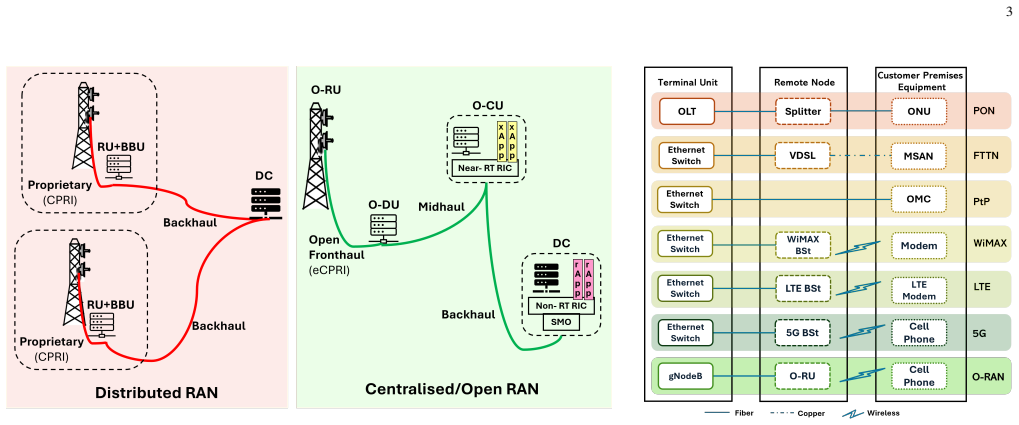
The radio access network (RAN) accounts for the largest share of energy consumption in mobile networks, making it essential to understand how and where this energy is used, particularly as future networks move toward higher levels of densification. Open radio access networks (O-RAN) have emerged as a promising approach to support this evolution through open interfaces that enable a multivendor environment, support for hierarchical intelligent controls, and simplified, cost-effective radio units that facilitate large-scale deployments. This paper examines the energy consumption in next-generation RAN architectures through transaction-based energy models. The model captures both processing and transmission energy components and evaluates how energy use varies with the placement of baseband processing (BBP) across network nodes and with different levels of network densification. Results indicate that processing energy dominates total consumption and that the location of BBP strongly influences overall energy efficiency. These insights can inform the design of future RAN deployments that balance flexibility, cost, and sustainability.
Editorial analysis
A structured set of objections, weighed in public.
Referee Report
Summary. The manuscript develops transaction-based energy models for next-generation O-RAN architectures to quantify total energy consumption. It examines how energy use changes with baseband processing (BBP) placement across network nodes and with varying densification levels, concluding that processing energy dominates overall consumption and that BBP location is a key determinant of energy efficiency.
Significance. If the underlying models prove accurate after validation, the work could usefully inform sustainable RAN design choices by shifting attention from transmission-only metrics to the combined processing-plus-transmission budget and to the architectural placement of BBP functions. The transaction-based framing offers a potentially scalable way to compare centralized, distributed, and virtualized deployments.
major comments (2)
- [Abstract and §3] Abstract and §3 (model description): the claim that the transaction-based model 'captures both processing and transmission energy components' is not supported by any displayed equations, per-transaction energy coefficients, or parameter sources. Without these, it is impossible to assess whether the reported dominance of processing energy is an artifact of the chosen coefficients or a robust outcome across O-RAN-specific overheads.
- [§4 and §5] §4 (results) and §5 (discussion): the headline findings—that processing energy dominates and that BBP placement strongly affects efficiency—are produced solely by the uncalibrated models. No comparison to hardware measurements on real O-RAN platforms, no sensitivity analysis on fronthaul/virtualization/RIC overheads, and no error bars or validation metrics are provided, leaving the central claims dependent on an untested modeling assumption.
minor comments (2)
- [§3] Notation for energy components (e.g., E_proc vs. E_tx) is introduced without a consolidated table of symbols, which would aid readability.
- [Abstract] The abstract could more precisely state the range of densification levels and BBP placement scenarios examined.
Simulated Author's Rebuttal
We thank the referee for their thorough review and valuable feedback on our manuscript. We agree that greater transparency in the model and additional robustness analyses are needed. We have revised the manuscript to address these concerns by including explicit model equations and parameter sources, as well as performing sensitivity analyses. Our point-by-point responses are provided below.
read point-by-point responses
-
Referee: [Abstract and §3] Abstract and §3 (model description): the claim that the transaction-based model 'captures both processing and transmission energy components' is not supported by any displayed equations, per-transaction energy coefficients, or parameter sources. Without these, it is impossible to assess whether the reported dominance of processing energy is an artifact of the chosen coefficients or a robust outcome across O-RAN-specific overheads.
Authors: We thank the referee for highlighting this issue. Upon review, we recognize that while the model description in §3 outlines the transaction-based approach, the specific equations and coefficient values were not sufficiently detailed in the main text. In the revised manuscript, we have added the full set of equations for the energy consumption per transaction, separating processing energy (based on computational complexity and CPU power models) and transmission energy (based on power amplifier efficiency and bit rates). We have also included the sources for all parameters, drawing from O-RAN specifications, 3GPP standards, and relevant literature on baseband processing energy. This allows for better assessment of the results' robustness. revision: yes
-
Referee: [§4 and §5] §4 (results) and §5 (discussion): the headline findings—that processing energy dominates and that BBP placement strongly affects efficiency—are produced solely by the uncalibrated models. No comparison to hardware measurements on real O-RAN platforms, no sensitivity analysis on fronthaul/virtualization/RIC overheads, and no error bars or validation metrics are provided, leaving the central claims dependent on an untested modeling assumption.
Authors: We acknowledge the importance of validating the model assumptions. As this is a modeling study, direct hardware measurements on commercial O-RAN platforms were not performed. However, we have added a comprehensive sensitivity analysis in the revised §4, varying key parameters such as fronthaul overhead, virtualization costs, and RIC processing by ±30% and ±50% to show that the dominance of processing energy and the effect of BBP placement remain consistent. We have also included error bars in the result figures representing the range from sensitivity variations and discussed the model limitations and the need for future empirical validation in §5. We believe this strengthens the reliability of the findings within the modeling framework. revision: partial
Circularity Check
No circularity: transaction-based models applied as independent evaluation tool
full rationale
The paper introduces transaction-based energy models to quantify processing versus transmission components across BBP placements and densification levels in O-RAN. Results on processing dominance and location effects follow directly from applying these models to different configurations. No equations are shown that define a quantity in terms of itself, no parameters are fitted to a data subset and then relabeled as predictions of closely related quantities, and no self-citations or uniqueness theorems are invoked to justify core modeling choices. The derivation chain remains self-contained: the models serve as external inputs whose outputs are the reported energy breakdowns, with no reduction of the central claims to tautological re-statements of the inputs.
Axiom & Free-Parameter Ledger
axioms (1)
- domain assumption Transaction-based energy models capture both processing and transmission components accurately for O-RAN with varying BBP placement and densification.
Lean theorems connected to this paper
-
IndisputableMonolith/Cost/FunctionalEquation.leanwashburn_uniqueness_aczel unclear?
unclearRelation between the paper passage and the cited Recognition theorem.
The energy consumed per bit for BBP at unit u ∈ U is expressed as EB,u = αu σu ρu γu NC PC / CC (Eq. 2); total ET = Era + Epr + Etr.
-
IndisputableMonolith/Foundation/RealityFromDistinction.leanreality_from_one_distinction unclear?
unclearRelation between the paper passage and the cited Recognition theorem.
Results indicate that processing energy dominates total consumption and that the location of BBP strongly influences overall energy efficiency.
What do these tags mean?
- matches
- The paper's claim is directly supported by a theorem in the formal canon.
- supports
- The theorem supports part of the paper's argument, but the paper may add assumptions or extra steps.
- extends
- The paper goes beyond the formal theorem; the theorem is a base layer rather than the whole result.
- uses
- The paper appears to rely on the theorem as machinery.
- contradicts
- The paper's claim conflicts with a theorem or certificate in the canon.
- unclear
- Pith found a possible connection, but the passage is too broad, indirect, or ambiguous to say the theorem truly supports the claim.
Reference graph
Works this paper leans on
-
[1]
Integration of energy, computation and communication in 6G cellular Internet of things,
Q. Qi, X. Chen, C. Zhong, and Z. Zhang, “Integration of energy, computation and communication in 6G cellular Internet of things,”IEEE Communications Letters, vol. 24, no. 6, pp. 1333–1337, 2020
work page 2020
-
[2]
Optimizing the over and underutilization of network resources during peak and off-peak hours,
A. Badshah, A. Daud, H. U. Khan, O. Alghushairy, and A. Bukhari, “Optimizing the over and underutilization of network resources during peak and off-peak hours,”IEEE Access, vol. 12, pp. 82549–82559, 2024
work page 2024
-
[3]
Mobile data traffic prediction by exploiting time-evolving user mobility patterns,
F. Sun, P. Wang, J. Zhao, N. Xu, J. Zeng, J. Tao, K. Song, C. Deng, J. C. Lui, and X. Guan, “Mobile data traffic prediction by exploiting time-evolving user mobility patterns,”IEEE Transactions on Mobile Computing, vol. 21, no. 12, pp. 4456–4470, 2022
work page 2022
-
[4]
Energy challenges in optical access and aggregation networks,
D. C. Kilper and H. Rastegarfar, “Energy challenges in optical access and aggregation networks,”Philosophical Transactions of the Royal Society A: Mathematical, Physical and Engineering Sciences, vol. 374, no. 2062, p. 20140435, 2016
work page 2062
-
[5]
Design and analysis of power consump- tion models for Open-RAN architectures,
U. Tariq, R. Raj, and D. Kilper, “Design and analysis of power consump- tion models for Open-RAN architectures,” in2025 IEEE International Conference on Communications Workshops (ICC Workshops), pp. 1037– 1042, 2025
work page 2025
-
[6]
W. Vereeckenet al., “The environmental footprint of data centers: The influence of server renewal rates on the overall footprint,” inProceedings of the International Conference on Green Communications and Networks (GCN 2011), pp. 823–831, Springer, 2012
work page 2011
-
[7]
Energy consumption in optical IP networks,
J. Baliga, R. Ayre, K. Hinton, W. V . Sorin, and R. S. Tucker, “Energy consumption in optical IP networks,”Journal of Lightwave Technology, vol. 27, no. 13, pp. 2391–2403, 2009
work page 2009
-
[8]
Dissecting the software-based measurement of CPU energy consumption: A comparative analysis,
G. Raffin and D. Trystram, “Dissecting the software-based measurement of CPU energy consumption: A comparative analysis,”IEEE Transac- tions on Parallel and Distributed Systems, vol. 36, no. 1, pp. 96–107, 2025
work page 2025
-
[9]
Power trends in communication networks,
D. Kilperet al., “Power trends in communication networks,”IEEE Journal of selected topics in quantum electronics, vol. 17, no. 2, pp. 275– 284, 2010
work page 2010
-
[10]
Energy consumption in wired and wireless access networks,
J. Baliga, R. Ayre, K. Hinton, and R. S. Tucker, “Energy consumption in wired and wireless access networks,”IEEE Communications Magazine, vol. 49, no. 6, pp. 70–77, 2011
work page 2011
-
[11]
Energy consumption in access networks,
J. Baligaet al., “Energy consumption in access networks,” inOptical Fiber Communication Conference, p. OThT6, Optica Publishing Group, 2008
work page 2008
-
[12]
Energy performance of c-ran with 5g-nx radio networks and optical transport,
M. Fiorani, S. Tombaz, J. M ˚artensson, B. Skubic, L. Wosinska, and P. Monti, “Energy performance of c-ran with 5g-nx radio networks and optical transport,” in2016 IEEE International Conference on Communications (ICC), pp. 1–6, IEEE, 2016
work page 2016
-
[13]
Next generation mobile fronthaul and midhaul architec- tures,
T. Pfeiffer, “Next generation mobile fronthaul and midhaul architec- tures,”Journal of Optical Communications and Networking, vol. 7, no. 11, pp. B38–B45, 2015
work page 2015
-
[14]
Open RAN for 6G networks: Architecture, use cases and open issues,
B. Agarwal, R. Irmer, D. Lister, and G.-M. Muntean, “Open RAN for 6G networks: Architecture, use cases and open issues,”IEEE Communications Surveys & Tutorials, 2025
work page 2025
-
[15]
A survey of the functional splits proposed for 5G mobile crosshaul networks,
L. M. P. Larsen, A. Checko, and H. L. Christiansen, “A survey of the functional splits proposed for 5G mobile crosshaul networks,”IEEE Communications Surveys & Tutorials, vol. 21, no. 1, pp. 146–172, 2019
work page 2019
discussion (0)
Sign in with ORCID, Apple, or X to comment. Anyone can read and Pith papers without signing in.