Recognition: 1 theorem link
· Lean TheoremActive control of phase matching in nonlinear metasurfaces using Pancharatnam--Berry phase
Pith reviewed 2026-05-13 04:45 UTC · model grok-4.3
The pith
Relative rotation between two metasurfaces tunes second-harmonic phase-matching peaks continuously over a 70 nm range.
A machine-rendered reading of the paper's core claim, the machinery that carries it, and where it could break.
Core claim
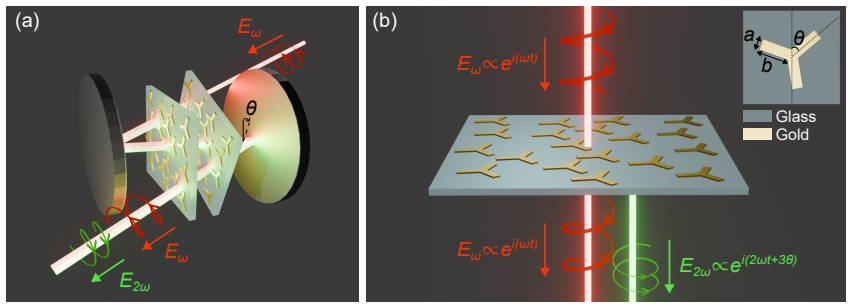
By exploiting the nonlinear Pancharatnam-Berry phase of C_{3v}-symmetric plasmonic metasurfaces and integrating two such surfaces inside a multipass cell, continuous spectral tuning of second-harmonic generation phase-matching peaks is achieved across a 900-970 nm pump range simply by rotating one metasurface relative to the other, with the extracted geometric phase obeying the 3σθ dependence and a full 2π tuning cycle completed with 120° of rotation.
What carries the argument
The nonlinear Pancharatnam-Berry phase generated by the relative rotation angle θ between two C_{3v}-symmetric metasurfaces, which imprints a 3σθ geometric phase on the second-harmonic field and thereby shifts the phase-matching condition.
If this is right
- Mechanical rotation provides post-fabrication, broadband tuning of nonlinear optical responses without altering the metasurface geometry.
- A physical rotation of only 120° completes a full 2π cycle of phase control for the second-harmonic field.
- Geometric-phase metasurfaces become a reconfigurable platform for nonlinear frequency conversion.
- Continuous spectral tuning of SHG phase-matching peaks is possible across at least 70 nm in the near-infrared pump range.
Where Pith is reading between the lines
- The rotation-based approach could be extended to control other nonlinear processes such as third-harmonic generation or four-wave mixing by the same geometric-phase mechanism.
- Integration with fixed nonlinear metasurface designs might enable compact, mechanically tunable sources for spectroscopy or sensing.
- The method opens a route to dynamic, rotation-driven wavefront shaping in nonlinear optics if the two-metasurface stack is replaced by a larger array.
Load-bearing premise
The observed shifts in the SHG phase-matching peaks are caused primarily by the geometric phase from relative rotation rather than by material dispersion, fabrication imperfections, or losses in the multipass cell.
What would settle it
If the measured SHG peak wavelengths fail to shift according to the predicted 3σθ dependence when one metasurface is rotated, or if identical tuning occurs when one metasurface is replaced by a non-geometric-phase structure, the claim that geometric phase dominates the control would be refuted.
Figures


read the original abstract
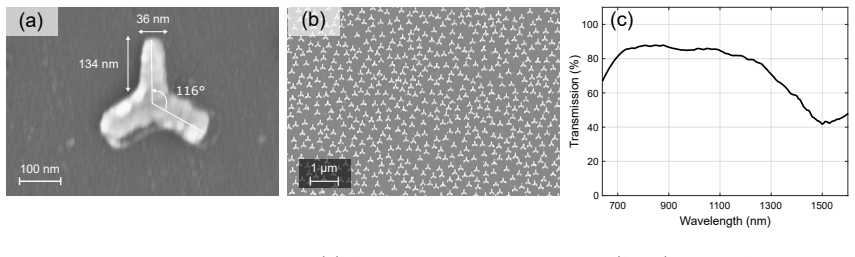
Reconfiguring the spectral output of nonlinear metasurfaces after fabrication remains challenging. We address this by exploiting the nonlinear Pancharatnam--Berry phase of $C_{3v}$-symmetric plasmonic metasurfaces. By integrating two metasurfaces inside a multipass cell, we experimentally demonstrate continuous spectral tuning of second-harmonic generation (SHG) phase-matching peaks across a 900--970 nm pump range by rotating one metasurface relative to the other. The extracted geometric phase follows the $3\sigma\theta$ dependence, and a full $2\pi$ tuning cycle is completed with $120^{\circ}$ of physical rotation. This establishes geometric-phase metasurfaces as a reconfigurable nonlinear platform, where mechanical rotation enables post-fabrication and broadband tuning of nonlinear optical responses.
Editorial analysis
A structured set of objections, weighed in public.
Referee Report
Summary. The paper claims that integrating two C_{3v}-symmetric plasmonic metasurfaces inside a multipass cell enables continuous spectral tuning of SHG phase-matching peaks over 900-970 nm by relative rotation of one metasurface. The tuning is attributed to the nonlinear Pancharatnam-Berry phase, which is reported to follow a 3σθ dependence, with a full 2π cycle achieved via only 120° physical rotation. This is presented as an experimental demonstration of post-fabrication reconfigurability in nonlinear metasurfaces.
Significance. If the attribution to geometric phase holds after excluding classical confounds, the result would establish a mechanically tunable platform for nonlinear frequency conversion with broadband control, which is a notable advance for reconfigurable nanophotonics. The experimental integration into a multipass cell and the reported scaling provide a concrete implementation that could be extended to other nonlinear processes.
major comments (2)
- [Experimental results / multipass cell setup] Experimental results section (around the description of the multipass cell and rotation procedure): The manuscript must provide quantitative bounds or control measurements showing that rotation-induced changes in incidence angle, beam alignment, or total optical path length through the cell mirrors contribute negligibly to the observed 70 nm SHG peak shift. Without such analysis (e.g., via fixed-rotation reference measurements or ray-tracing estimates of wavevector projection changes), the central claim that the tuning is dominated by the nonlinear PB phase remains vulnerable to classical geometric effects.
- [Data analysis / phase extraction] Data analysis paragraph (where the 3σθ dependence is extracted): The extraction of the geometric phase from the measured spectral shifts should include explicit error bars, the number of independent rotations sampled, and a clear statement of how material dispersion, fabrication variations, and multipass losses were subtracted or shown to be secondary. The abstract states the phase 'follows' 3σθ, but the fitting procedure and goodness-of-fit metrics are needed to confirm this is not an assumed functional form.
minor comments (2)
- [Figures and methods] Figure captions and methods: Include the raw spectra (not just peak positions) with error bars for at least three rotation angles to allow readers to assess the signal-to-noise and any broadening effects.
- [Theory / introduction] Notation: Define σ explicitly in the main text (it appears in the 3σθ claim) rather than assuming it is known from prior PB-phase literature.
Simulated Author's Rebuttal
We thank the referee for their insightful comments, which have helped us improve the clarity and robustness of our claims. We address each major comment below and will revise the manuscript to incorporate the requested details and analyses.
read point-by-point responses
-
Referee: [Experimental results / multipass cell setup] Experimental results section (around the description of the multipass cell and rotation procedure): The manuscript must provide quantitative bounds or control measurements showing that rotation-induced changes in incidence angle, beam alignment, or total optical path length through the cell mirrors contribute negligibly to the observed 70 nm SHG peak shift. Without such analysis (e.g., via fixed-rotation reference measurements or ray-tracing estimates of wavevector projection changes), the central claim that the tuning is dominated by the nonlinear PB phase remains vulnerable to classical geometric effects.
Authors: We concur that it is important to rule out classical geometric effects as the source of the observed tuning. Our multipass cell design incorporates a rotation stage where the relative rotation between the two metasurfaces is performed while keeping the overall incidence angle and optical path fixed by aligning the rotation axis with the beam path. To quantify this, we will include ray-tracing estimates showing that changes in wavevector projection due to any small misalignment are minimal and cannot account for the 70 nm shift. Additionally, we will report control measurements with no relative rotation but varying overall orientation, which show negligible spectral changes. These will be added to the Experimental Results section to strengthen the attribution to the nonlinear PB phase. revision: yes
-
Referee: [Data analysis / phase extraction] Data analysis paragraph (where the 3σθ dependence is extracted): The extraction of the geometric phase from the measured spectral shifts should include explicit error bars, the number of independent rotations sampled, and a clear statement of how material dispersion, fabrication variations, and multipass losses were subtracted or shown to be secondary. The abstract states the phase 'follows' 3σθ, but the fitting procedure and goodness-of-fit metrics are needed to confirm this is not an assumed functional form.
Authors: We agree that more details on the data analysis are warranted. In the revised manuscript, we will include error bars on the phase data points, state the number of independent rotations sampled, and explicitly describe how material dispersion was accounted for using linear transmission measurements, how fabrication variations were mitigated through averaging, and how multipass losses were shown to be secondary by monitoring the fundamental beam intensity. The fitting procedure will be detailed, including the use of least-squares minimization to the 3σθ model and the resulting goodness-of-fit metrics, to demonstrate that this is not merely an assumed form but supported by the data. We will also adjust the abstract wording for precision. revision: yes
Circularity Check
No circularity: experimental observation of rotation-induced SHG tuning with extracted phase dependence
full rationale
The paper reports an experimental demonstration using two C3v metasurfaces in a multipass cell, with relative rotation producing observed continuous shifts in SHG phase-matching peaks over 900-970 nm. The 3σθ dependence is stated as extracted from the measured data rather than imposed by any internal equation or fit that would make the result tautological. No load-bearing derivation step reduces the claimed geometric-phase control to a self-referential input, fitted parameter renamed as prediction, or self-citation chain; the central result is a direct experimental mapping of rotation angle to spectral tuning, with the full 2π cycle at 120° presented as measured outcome. External factors such as alignment or path length are not addressed via equations that would circularly presuppose the PB contribution.
Axiom & Free-Parameter Ledger
axioms (1)
- domain assumption The nonlinear Pancharatnam-Berry phase for C3v-symmetric structures exhibits a 3σθ dependence on rotation angle θ.
Lean theorems connected to this paper
-
IndisputableMonolith/Foundation/AlexanderDuality.leanalexander_duality_circle_linking echoesthe nonlinear PB phase ... Φ_PB = (n±1)σθ ... C3v ... n=jm-1=2 ... Φ_PB = 3σθ ... 120° physical rotation spans full 2π
Reference graph
Works this paper leans on
-
[1]
Mixing of Light Beams in Crystals,
J. A. Giordmaine, “Mixing of Light Beams in Crystals,”Physical Review Letters, vol. 8, pp. 19–20, 1962
work page 1962
-
[2]
Effects of Dispersion and Focusing on the Production of Optical Harmonics,
P. D. Maker, R. W. Terhune, M. Nisenoff, and C. M. Savage, “Effects of Dispersion and Focusing on the Production of Optical Harmonics,”Physical Review Letters, vol. 8, pp. 21–22, 1962
work page 1962
-
[3]
M. Kauranen and A. V. Zayats, “Nonlinear plasmonics,”Nature Photonics, vol. 6, pp. 737–748, 2012. v
work page 2012
-
[4]
J. Butet, P.-F. Brevet, and O. J. F. Martin, “Optical second harmonic generation in plasmonic nanostructures: From fundamental principles to advanced applications,”ACS Nano, vol. 9, no. 11, pp. 10 545–10 562, 2015
work page 2015
-
[5]
Giant nonlinear response from plasmonic metasurfaces coupled to intersubband transitions,
J. Lee, M. Tymchenko, C. Argyropoulos, P.-Y. Chen, F. Lu, F. Demmerle, G. Boehm, M.-C. Amann, A. Al` u, and M. A. Belkin, “Giant nonlinear response from plasmonic metasurfaces coupled to intersubband transitions,”Nature, vol. 511, pp. 65–69, 2014
work page 2014
-
[7]
M. Khorasaninejad, W. T. Chen, R. C. Devlin, J. Oh, A. Y. Zhu, and F. Capasso, “Metalenses at visible wavelengths: Diffraction-limited focusing and subwavelength resolution imaging,”Science, vol. 352, no. 6290, pp. 1190–1194, 2016
work page 2016
-
[8]
Dual-polarity plasmonic metalens for visible light,
X. Chen, L. Huang, H. M¨ uhlenbernd, G. Li, B. Bai, Q. Tan, G. Jin, C.-W. Qiu, S. Zhang, and T. Zentgraf, “Dual-polarity plasmonic metalens for visible light,”Nature Communications, vol. 3, p. 1198, 2012
work page 2012
-
[9]
Metalenses: Versatile multifunctional photonic components,
M. Khorasaninejad and F. Capasso, “Metalenses: Versatile multifunctional photonic components,” Science, vol. 358, no. 6367, p. eaam8100, 2017
work page 2017
-
[10]
Three-dimensional optical holography using a plasmonic metasurface,
L. Huang, X. Chen, H. M¨ uhlenbernd, H. Zhang, S. Chen, B. Bai, Q. Tan, G. Jin, K.-W. Cheah, C.-W. Qiu, J. Li, T. Zentgraf, and S. Zhang, “Three-dimensional optical holography using a plasmonic metasurface,”Nature Communications, vol. 4, p. 2808, 2013
work page 2013
-
[11]
Full-color plasmonic metasurface holograms,
W. Wan, J. Gao, and X. Yang, “Full-color plasmonic metasurface holograms,”ACS Nano, vol. 10, no. 11, pp. 10 671–10 680, 2016
work page 2016
-
[12]
Metasurface holograms for visible light,
X. Ni, A. V. Kildishev, and V. M. Shalaev, “Metasurface holograms for visible light,”Nature Communications, vol. 4, p. 2807, 2013
work page 2013
-
[13]
Metasurface holograms reaching 80% efficiency,
G. Zheng, H. M¨ uhlenbernd, M. Kenney, G. Li, T. Zentgraf, and S. Zhang, “Metasurface holograms reaching 80% efficiency,”Nature Nanotechnology, vol. 10, no. 4, pp. 308–312, 2015
work page 2015
-
[14]
Wave front engineering from an array of thin aperture antennas,
M. Kang, T. Feng, H.-T. Wang, and J. Li, “Wave front engineering from an array of thin aperture antennas,”Optics Express, vol. 20, no. 14, pp. 15 882–15 890, 2012
work page 2012
-
[15]
Flat optics with designer metasurfaces,
N. Yu and F. Capasso, “Flat optics with designer metasurfaces,”Nature Materials, vol. 13, pp. 139–150, 2014
work page 2014
-
[16]
Recent advances in planar optics: from plasmonic to dielectric metasurfaces,
P. Genevet, F. Capasso, F. Aieta, M. Khorasaninejad, and R. Devlin, “Recent advances in planar optics: from plasmonic to dielectric metasurfaces,”Optica, vol. 4, no. 1, pp. 139–152, 2017
work page 2017
-
[17]
Spin and wavelength multiplexed nonlinear metasurface holography,
W. Ye, F. Zeuner, X. Li, B. Reineke, S. He, C.-W. Qiu, J. Liu, Y. Wang, S. Zhang, and T. Zentgraf, “Spin and wavelength multiplexed nonlinear metasurface holography,”Nature Communications, vol. 7, p. 11930, 2016
work page 2016
-
[18]
Nonlinear holographic all-dielectric metasurfaces,
Y. Gao, Y. Fan, Y. Wang, W. Yang, Q. Song, and S. Xiao, “Nonlinear holographic all-dielectric metasurfaces,”Nano Letters, vol. 18, no. 12, pp. 8054–8061, 2018
work page 2018
-
[19]
Efficient modeling and tailoring of nonlinear wavefronts in dielectric metasurfaces,
D. H¨ ahnel, J. F¨ orstner, and V. Myroshnychenko, “Efficient modeling and tailoring of nonlinear wavefronts in dielectric metasurfaces,”ACS Photonics, vol. 10, no. 8, pp. 2502–2510, 2023
work page 2023
-
[20]
Hybrid nonlinear metasurface refractive lens,
S. Karepov, C. D. Angelis, and T. Ellenbogen, “Hybrid nonlinear metasurface refractive lens,” Nano Letters, vol. 25, no. 20, pp. 8103–8109, 2025
work page 2025
-
[21]
Quantal phase factors accompanying adiabatic changes,
M. V. Berry, “Quantal phase factors accompanying adiabatic changes,”Proceedings of the Royal Society of London A, vol. 392, no. 1802, pp. 45–57, 1984
work page 1984
-
[22]
Z. Bomzon, G. Biener, V. Kleiner, and E. Hasman, “Space-variant Pancharatnam–Berry phase optical elements with computer-generated subwavelength gratings,”Optics Letters, vol. 27, no. 13, pp. 1141–1143, 2002. vi
work page 2002
-
[23]
Dispersionless phase discontinuities for controlling light propagation,
L. Huang, X. Chen, H. M¨ uhlenbernd, G. Li, B. Bai, Q. Tan, G. Jin, T. Zentgraf, and S. Zhang, “Dispersionless phase discontinuities for controlling light propagation,”Nano Letters, vol. 12, no. 11, pp. 5750–5755, 2012
work page 2012
-
[24]
Opto-thermally controlled beam steering in non- linear all-dielectric metastructures,
D. Rocco, M. Gandolfi, A. Tognazzi, O. Pashina, G. Zograf, K. Frizyuk, C. Gigli, G. Leo, S. Makarov, M. Petrov, and C. D. Angelis, “Opto-thermally controlled beam steering in non- linear all-dielectric metastructures,”Optics Express, vol. 29, no. 23, p. 37128, 2021
work page 2021
-
[25]
Electro-optical switching in a nonlinear metasurface,
M. D. Feinstein, A. Andronikides, and E. Almeida, “Electro-optical switching in a nonlinear metasurface,”npj Nanophotonics, vol. 2, p. 22, 2025
work page 2025
-
[26]
Electro-optically modulated nonlinear metasurfaces,
Z. He, L. Qu, W. Wu, J. Liu, C. Jin, C. Wang, J. You, W. Liu, L. Bai, Z. Gu, W. Cai, M. Ren, and J. Xu, “Electro-optically modulated nonlinear metasurfaces,”Nano Letters, vol. 24, no. 45, pp. 14 215–14 221, 2024
work page 2024
-
[27]
Electrically tunable nonlinear polaritonic metasurface,
J. Yu, S. Park, I. Hwang, D. Kim, F. Demmerle, G. Boehm, M.-C. Amann, M. A. Belkin, and J. Lee, “Electrically tunable nonlinear polaritonic metasurface,”Nature Photonics, vol. 16, pp. 72–78, 2022
work page 2022
-
[28]
Backward phase-matched second-harmonic generation from stacked metasurfaces,
T. Stolt, J. Kim, S. H´ eron, A. Vesala, Y. Yang, J. Mun, M. Kim, M. J. Huttunen, R. Czaplicki, M. Kauranen, J. Rho, and P. Genevet, “Backward phase-matched second-harmonic generation from stacked metasurfaces,”Physical Review Letters, vol. 126, p. 033901, 2021
work page 2021
-
[29]
Phase- matched second-harmonic generation from metasurfaces inside multipass cells,
M. Mekhael, T. Stolt, A. Vesala, H. Rekola, T. K. Hakala, R. Fickler, and M. J. Huttunen, “Phase- matched second-harmonic generation from metasurfaces inside multipass cells,”ACS Photonics, vol. 11, no. 2, pp. 682–687, 2024
work page 2024
-
[31]
Symmetry-selective third-harmonic generation from plasmonic metacrystals,
S. Chen, G. Li, F. Zeuner, W. H. Wong, E. Y. B. Pun, T. Zentgraf, K. W. Cheah, and S. Zhang, “Symmetry-selective third-harmonic generation from plasmonic metacrystals,”Physical Review Letters, vol. 113, p. 033901, 2014
work page 2014
-
[32]
Continuous control of the nonlinearity phase for harmonic generations,
G. Li, S. Chen, N. Pholchai, B. Reineke, P. W. H. Wong, E. Y. B. Pun, K. W. Cheah, T. Zentgraf, and S. Zhang, “Continuous control of the nonlinearity phase for harmonic generations,”Nature Materials, vol. 14, no. 6, pp. 607–612, 2015
work page 2015
-
[33]
Ultra-high-Q resonances in plasmonic metasurfaces,
M. S. Bin-Alam, O. Reshef, Y. Mamchur, M. Z. Alam, G. Carlow, J. Upham, B. T. Sullivan, J.-M. M´ enard, M. J. Huttunen, R. W. Boyd, and K. Dolgaleva, “Ultra-high-Q resonances in plasmonic metasurfaces,”Nature Communications, vol. 12, p. 974, 2021
work page 2021
-
[34]
Nonlinear nonlocal metasur- faces,
R. Kolkowski, T. K. Hakala, A. Shevchenko, and M. J. Huttunen, “Nonlinear nonlocal metasur- faces,”Applied Physics Letters, vol. 122, no. 16, p. 160502, 2023
work page 2023
-
[35]
Subwavelength nonlinear phase control and anomalous phase matching in plasmonic metasurfaces,
E. Almeida, G. Shalem, and Y. Prior, “Subwavelength nonlinear phase control and anomalous phase matching in plasmonic metasurfaces,”Nature Communications, vol. 7, p. 10367, 2016
work page 2016
-
[36]
M. Mekhael, T. Stolt, H. Weigand, K. Arola, R. Grange, P. Genevet, and M. J. Huttunen, “Wavelength-selective nonlinear wavefront control in resonant thin-film lithium niobate metasur- faces,” 2026, arXiv:2601.21382
-
[37]
B. Liu, R. Geromel, Z. Su, K. Guo, Y. Wang, Z. Guo, L. Huang, and T. Zentgraf, “Nonlinear dielectric geometric-phase metasurface with simultaneous structure and lattice symmetry design,” ACS Photonics, vol. 10, no. 12, pp. 4357–4366, 2023
work page 2023
-
[38]
Gradient nonlinear Pancharatnam–Berry metasurfaces,
M. Tymchenko, J. S. Gomez-Diaz, J. Lee, N. Nookala, M. A. Belkin, and A. Al` u, “Gradient nonlinear Pancharatnam–Berry metasurfaces,”Physical Review Letters, vol. 115, p. 207403, 2015
work page 2015
-
[39]
B. Liu, B. Sain, B. Reineke, R. Zhao, C. Meier, L. Huang, Y. Jiang, and T. Zentgraf, “Non- linear wavefront control by geometric-phase dielectric metasurfaces: influence of mode field and rotational symmetry,”Advanced Optical Materials, vol. 8, no. 9, p. 1902050, 2020. vii
work page 2020
-
[40]
Frequency-resolved optical gating with the use of second-harmonic generation,
K. W. DeLong, R. Trebino, J. Hunter, and W. E. White, “Frequency-resolved optical gating with the use of second-harmonic generation,”Journal of the Optical Society of America B, vol. 11, no. 11, pp. 2206–2215, 1994
work page 1994
-
[41]
L. Gallmann, G. Steinmeyer, D. H. Sutter, N. Matuschek, and U. Keller, “Collinear type II second- harmonic-generation frequency-resolved optical gating for the characterization of sub-10-fs optical pulses,”Optics Letters, vol. 25, no. 4, pp. 269–271, 2000
work page 2000
-
[42]
Tunable third harmonic generation in the vacuum ultraviolet region using dielectric nanomembranes,
K. Konishi, D. Akai, Y. Mitaet al., “Tunable third harmonic generation in the vacuum ultraviolet region using dielectric nanomembranes,”APL Photonics, vol. 5, p. 066103, 2020
work page 2020
-
[43]
A. Saari, G. Genty, M. Siltanen, P. Karvinen, P. Vahimaa, M. Kuittinen, and M. Kauranen, “Giant enhancement of second-harmonic generation in multiple diffraction orders from sub-wavelength resonant waveguide grating,”Optics Express, vol. 18, no. 12, pp. 12 298–12 303, 2010
work page 2010
-
[44]
Strong enhancement of second-harmonic generation in all-dielectric resonant waveguide grating,
M. Siltanen, S. Leivo, P. Voima, M. Kauranen, P. Karvinen, P. Vahimaa, and M. Kuittinen, “Strong enhancement of second-harmonic generation in all-dielectric resonant waveguide grating,” Applied Physics Letters, vol. 91, no. 11, p. 111109, 2007
work page 2007
-
[45]
Dark mode-in-the-box for enhanced second-harmonic generation in corrugated waveg- uides,
A.-L. Fehrembach, F. Renaud, E. Popov, H. Tortel, A. Monmayrant, O. Gauthier-Lafaye, and S. Calvez, “Dark mode-in-the-box for enhanced second-harmonic generation in corrugated waveg- uides,”Optics Express, vol. 29, no. 25, pp. 40 981–40 992, 2021
work page 2021
-
[46]
Recent advances in resonant waveguide gratings,
G. Quaranta, G. Basset, O. J. F. Martin, and B. Gallinet, “Recent advances in resonant waveguide gratings,”Laser & Photonics Reviews, vol. 12, no. 9, p. 1800017, 2018. viii Active control of phase matching in nonlinear metasurfaces using Pancharatnam–Berry phase - Supplemental Material Madona Mekhael 1, Roman Calpe 2, Tommi Hakala 2, Robert Fickler 1, and...
work page 2018
discussion (0)
Sign in with ORCID, Apple, or X to comment. Anyone can read and Pith papers without signing in.