Recognition: no theorem link
Joint Realizability Tradeoffs Bounded by Quantum Channel Incompatibility
Pith reviewed 2026-05-13 05:15 UTC · model grok-4.3
The pith
Generalized robustness of channel incompatibility lower-bounds the total error of any approximate joint realization.
A machine-rendered reading of the paper's core claim, the machinery that carries it, and where it could break.
Core claim
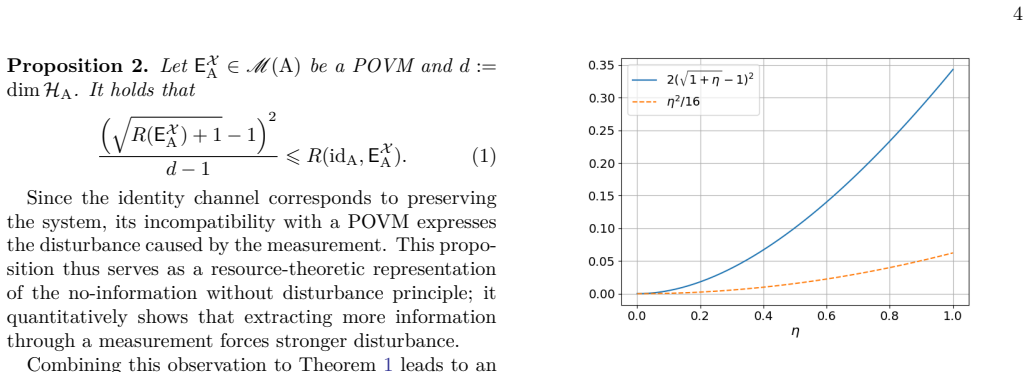
In this Letter, we show that generalized robustness, a typical resource quantifier of channel incompatibility, lower bounds the total error of any approximate joint realization. Applying this result to measurement channels provides a unified, model-independent framework encompassing error-error and information-error-disturbance tradeoffs. Furthermore, our robustness-based evaluation of disturbance outperforms an algebraic bound for all POVMs in dimensions up to six.
What carries the argument
Generalized robustness of channel incompatibility, a resource quantifier that directly lower-bounds the minimal total error achievable in any approximate joint realization of the channels.
If this is right
- Measurement channels inherit a single bound that covers both error-error tradeoffs and information-disturbance tradeoffs without separate derivations.
- The robustness bound on disturbance is strictly tighter than the previous algebraic bound for every POVM in dimensions two through six.
- Incompatibility strength can now be read directly from the minimal error of an approximate joint implementation rather than from abstract algebraic relations.
- The same lower bound extends to unify no-cloning, no-broadcasting, and no-information-without-disturbance as special cases of channel incompatibility.
Where Pith is reading between the lines
- The bound could be used to certify the incompatibility resource by performing only joint-approximation experiments rather than full channel tomography.
- Similar robustness-to-error relations might be derived for other resource theories of quantum channels, such as those for coherence or entanglement.
- Low-dimensional numerical checks already shown to outperform algebraic bounds suggest immediate experimental tests with qubits or qutrits.
Load-bearing premise
The assumption that generalized robustness correctly quantifies the incompatibility resource for arbitrary channels and that the definition of joint-realizability error aligns exactly with the robustness functional.
What would settle it
An explicit pair of incompatible channels together with a concrete joint realization whose total error falls below the generalized robustness value computed for those channels.
Figures


read the original abstract
Incompatible quantum channels cannot be jointly and exactly realized, meaning that any approximate joint realization inevitably entails a tradeoff in implementation accuracy. While this notion of channel incompatibility unifies fundamental limitations such as measurement uncertainty, the no information without disturbance principle, and the no-cloning and no-broadcasting theorems, connecting these traditional relations directly to the resource-theoretic strength of incompatibility has remained elusive. In this Letter, we show that generalized robustness, a typical resource quantifier of channel incompatibility, lower bounds the total error of any approximate joint realization. Applying this result to measurement channels provides a unified, model-independent framework encompassing error-error and information-error-disturbance tradeoffs. Furthermore, our robustness-based evaluation of disturbance outperforms an algebraic bound for all POVMs in dimensions up to six.
Editorial analysis
A structured set of objections, weighed in public.
Referee Report
Summary. The paper claims that generalized robustness of channel incompatibility lower-bounds the total error of any approximate joint realization of incompatible quantum channels. The central result follows from a variational definition of robustness (minimum s such that a convex combination with a compatible channel is jointly realizable) and a direct construction showing that any approximate joint implementation with total error e (infimum of summed diamond-norm distances) yields a feasible witness for the robustness program with value at most e. The bound is applied to measurement channels to recover unified error-error and information-disturbance tradeoffs, with numerical comparisons showing the robustness-based disturbance bound outperforming an algebraic alternative for all POVMs in dimensions up to 6.
Significance. If the result holds, it supplies a resource-theoretic lower bound on joint-realizability error that is derived directly from the definitions without extra assumptions on dimension or channel class. This cleanly connects incompatibility quantifiers to operational tradeoffs, encompassing measurement uncertainty, no-disturbance principles, and no-cloning in a model-independent framework. The explicit witness construction and the numerical evaluation up to dimension 6 are concrete strengths that make the bound falsifiable and practically usable.
minor comments (3)
- [§2] §2, after Eq. (3): the total-error functional is defined as an infimum over summed distances, but the precise choice of distance (diamond norm versus another channel metric) and whether the sum is normalized by the number of channels should be stated explicitly to avoid ambiguity in the subsequent theorem.
- [§4] §4, numerical section: the statement that the robustness bound 'outperforms an algebraic bound for all POVMs' in dimensions up to 6 would be strengthened by reporting the exact number of random POVMs sampled per dimension and the precise algebraic bound being compared (e.g., which reference or formula).
- [Figure 2] Figure 2 caption: the plot labels for disturbance versus incompatibility strength should include error bars or indicate that the curves are deterministic lower bounds rather than sampled averages.
Simulated Author's Rebuttal
We thank the referee for their careful reading and positive assessment of our manuscript. The provided summary accurately reflects the central contribution: that the generalized robustness of channel incompatibility lower-bounds the total error of any approximate joint realization, with direct applications to measurement uncertainty and disturbance tradeoffs. We appreciate the recognition of the variational construction and the numerical comparisons up to dimension 6. No specific major comments were raised in the report.
Circularity Check
No significant circularity identified
full rationale
The central theorem establishes that generalized robustness lower-bounds total joint-realization error by exhibiting an explicit feasible witness for the robustness variational program whose value is at most the error e. Both quantities are defined independently (robustness via convex combination with a compatible channel; error via infimum of summed implementation distances), and the inequality follows directly from these definitions without any self-referential reduction, fitted parameters, or load-bearing self-citations. Applications to POVMs and numerical checks are corollaries that inherit the same non-circular structure. The derivation is therefore self-contained.
Axiom & Free-Parameter Ledger
Reference graph
Works this paper leans on
-
[1]
Joint Realizability Tradeoffs Bounded by Quantum Channel Incompatibility
in two to six-dimensional systems for any non-trivial POVMs. Preliminaries—. Following Refs. [39–41], we only con- sider finite-dimensional Hilbert spacesH A,H B,.... The set of all linear operators fromH A toH B is written as L(HA,H B), endowed with the trace norm∥·∥1, the op- erator norm∥·∥, and the Hilbert-Schmidt inner product ⟨Y,X⟩:= Tr[Y†X]. We writ...
work page internal anchor Pith review Pith/arXiv arXiv 2026
-
[2]
S.M. acknowledges support from the French govern- ment under the France 2030 investment plan, as part of the Initiative d’Excellence d’Aix-Marseille Universit´ e- A*MIDEX, AMX-22-CEI-01. R.T. thanks Takayuki Miyadera for insightful discussions. R.T. acknowl- edges support from JST COI-NEXT program Grant No. JPMJPF2014, and JSPS KAKENHI Grant No. JP25K1731...
work page 2030
- [3]
-
[4]
O. G¨ uhne, E. Haapasalo, T. Kraft, J.-P. Pellonp¨ a¨ a, and R. Uola, Colloquium: Incompatible measurements in quantum information science, Rev. Mod. Phys.95, 011003 (2023)
work page 2023
-
[5]
no information without disturbance
P. Busch, “no information without disturbance”: Quan- tum limitations of measurement in quantum reality. in wayne c. myrvold and joy christian (eds.) relativistic causality, and closing the epistemic circle: Essays in honour of abner shimony, inQuantum Reality , Rela- tivistic Causality , and Closing the Epistemic Cir- cle: Essays in Honour of Abner Shimo...
work page 2009
-
[6]
G. M. D’Ariano, G. Chiribella, and P. Perinotti,Quan- tum Theory from First Principles: An Informa- tional Approach(Cambridge University Press, Cam- bridge, UK, 2017)
work page 2017
-
[7]
W. K. Wootters and W. H. Zurek, A single quantum cannot be cloned, Nature299, 802 (1982)
work page 1982
-
[8]
Dieks, Communication by EPR devices, Phys
D. Dieks, Communication by EPR devices, Phys. Lett. A92, 271 (1982)
work page 1982
-
[9]
Wiesner, Conjugate coding, SIGACT News15, 78–88 (1983)
S. Wiesner, Conjugate coding, SIGACT News15, 78–88 (1983)
work page 1983
- [10]
- [11]
-
[12]
T. Heinosaari and T. Miyadera, Incompatibility of quan- tum channels, J. Phys. A: Math. Theor.50, 135302 (2017)
work page 2017
-
[13]
T. Heinosaari, T. Miyadera, and M. Ziman, An invitation to quantum incompatibility, J. Phys. A: Math. Theor.49, 123001 (2016)
work page 2016
-
[14]
W. K. Heisenberg, ¨Uber den anschaulichen inhalt der quantentheoretischen kinematik und mechanik, Zeitschrift f¨ ur Physik43, 172 (1927)
work page 1927
-
[15]
M. Ozawa, Universally valid reformulation of the Heisen- berg uncertainty principle on noise and disturbance in measurement, Phys. Rev. A67, 042105 (2003)
work page 2003
-
[16]
Ozawa, Uncertainty relations for joint measurements of noncommuting observables, Phys
M. Ozawa, Uncertainty relations for joint measurements of noncommuting observables, Phys. Lett. A320, 367 (2004)
work page 2004
-
[17]
Y. Watanabe, T. Sagawa, and M. Ueda, Uncertainty re- lation revisited from quantum estimation theory, Phys. Rev. A84, 042121 (2011)
work page 2011
- [18]
-
[19]
C. Branciard, Error-tradeoff and error-disturbance re- lations for incompatible quantum measurements, Proc. Natl. Acad. Sci.110, 6742 (2013)
work page 2013
-
[20]
F. Buscemi, M. J. W. Hall, M. Ozawa, and M. M. Wilde, Noise and disturbance in quantum measurements: An information-theoretic approach, Phys. Rev. Lett.112, 050401 (2014)
work page 2014
-
[21]
Maccone, Information-disturbance tradeoff in quan- tum measurements, Phys
L. Maccone, Information-disturbance tradeoff in quan- tum measurements, Phys. Rev. A73, 042307 (2006)
work page 2006
-
[22]
F. Buscemi and M. F. Sacchi, Information-disturbance trade-off in quantum-state discrimination, Phys. Rev. A 74, 052320 (2006)
work page 2006
-
[23]
Maccone, Entropic information-disturbance tradeoff, Europhys
L. Maccone, Entropic information-disturbance tradeoff, Europhys. Lett.77, 40002 (2007)
work page 2007
-
[24]
D. Kretschmann, D. Schlingemann, and R. F. Werner, The information-disturbance tradeoff and the continuity of Stinespring’s representation, IEEE Trans. Inf. Theory 54, 1708 (2008)
work page 2008
-
[25]
T. Heinosaari and T. Miyadera, Qualitative noise- disturbance relation for quantum measurements, Phys. Rev. A88, 042117 (2013)
work page 2013
-
[26]
G. M. D’Ariano, P. Perinotti, and A. Tosini, Informa- tion and disturbance in operational probabilistic theories, Quantum4, 363 (2020). 6
work page 2020
-
[27]
P. Skrzypczyk, I. ˇSupi´ c, and D. Cavalcanti, All sets of incompatible measurements give an advantage in quan- tum state discrimination, Phys. Rev. Lett.122, 130403 (2019)
work page 2019
-
[28]
C. Carmeli, T. Heinosaari, and A. Toigo, Quantum in- compatibility witnesses, Phys. Rev. Lett.122, 130402 (2019)
work page 2019
-
[29]
R. Uola, T. Kraft, J. Shang, X.-D. Yu, and O. G¨ uhne, Quantifying quantum resources with conic programming, Phys. Rev. Lett.122, 130404 (2019)
work page 2019
-
[30]
J. Mori, Operational characterization of incompatibility of quantum channels with quantum state discrimination, Phys. Rev. A101, 032331 (2020)
work page 2020
-
[31]
R. Uola, T. Kraft, and A. A. Abbott, Quantification of quantum dynamics with input-output games, Phys. Rev. A101, 052306 (2020)
work page 2020
-
[32]
A. F. Ducuara, R. Takakura, F. J. Hernandez, and C. E. Susa, Multiobject operational tasks for measurement in- compatibility, Phys. Rev. Res.7, 033050 (2025)
work page 2025
-
[33]
G. Vidal and R. Tarrach, Robustness of entanglement, Phys. Rev. A59, 141 (1999)
work page 1999
-
[34]
Steiner, Generalized robustness of entanglement, Phys
M. Steiner, Generalized robustness of entanglement, Phys. Rev. A67, 054305 (2003)
work page 2003
-
[35]
Datta, Max-Relative Entropy of Entanglement, Alias Log Robustness, Int
N. Datta, Max-Relative Entropy of Entanglement, Alias Log Robustness, Int. J. Quantum Inf.07, 475 (2009)
work page 2009
-
[36]
P. Skrzypczyk and N. Linden, Robustness of measure- ment, discrimination games, and accessible information, Phys. Rev. Lett.122, 140403 (2019)
work page 2019
-
[37]
M. Oszmaniec and T. Biswas, Operational relevance of resource theories of quantum measurements, Quantum3, 133 (2019)
work page 2019
-
[38]
R. Takagi and B. Regula, General resource theories in quantum mechanics and beyond: Operational character- ization via discrimination tasks, Phys. Rev. X9, 031053 (2019)
work page 2019
-
[39]
E. Chitambar and G. Gour, Quantum resource theories, Rev. Mod. Phys.91, 025001 (2019)
work page 2019
-
[40]
Gour,Quantum Resource Theories(Cambridge University Press, Cambridge, UK, 2025)
G. Gour,Quantum Resource Theories(Cambridge University Press, Cambridge, UK, 2025)
work page 2025
-
[41]
M. A. Nielsen and I. L. Chuang,Quantum Compu- tation and Quantum Information: 10th Anniver- sary Edition(Cambridge University Press, Cambridge, UK, 2010)
work page 2010
-
[42]
M. M. Wilde,Quantum Information Theory, 2nd ed. (Cambridge University Press, Cambridge, UK, 2017)
work page 2017
-
[43]
Watrous,The Theory of Quantum Information (Cambridge University Press, Cambridge, UK, 2018)
J. Watrous,The Theory of Quantum Information (Cambridge University Press, Cambridge, UK, 2018)
work page 2018
-
[44]
A. S. Holevo and A. A. Kuznetsova, Information capacity of continuous variable measurement channel, J. Phys. A: Math. Theor.53, 175304 (2020)
work page 2020
-
[45]
Ozawa, Quantum measuring processes of continuous observables, J
M. Ozawa, Quantum measuring processes of continuous observables, J. Math. Phys.25, 79 (1984)
work page 1984
-
[46]
Watrous, Semidefinite programs for completely bounded norms, Theory of Computing5, 217 (2009)
J. Watrous, Semidefinite programs for completely bounded norms, Theory of Computing5, 217 (2009)
work page 2009
-
[47]
A. Ben-Aroya and A. Ta-Shma, On the complexity of approximating the diamond norm, Quantum Information and Computation10, 77 (2010)
work page 2010
-
[48]
Watrous, Simpler semidefinite programs for completely bounded norms, Chicago J
J. Watrous, Simpler semidefinite programs for completely bounded norms, Chicago J. Theor. Comput. Sci.2013, 10.4086/cjtcs.2013.008 (2013)
-
[49]
S. Boyd and L. Vandenberghe,Convex Optimization (Cambridge University Press, Cambridge, UK, 2004)
work page 2004
-
[50]
T. Heinosaari, J. Kiukas, and D. Reitzner, Noise robust- ness of the incompatibility of quantum measurements, Phys. Rev. A92, 022115 (2015)
work page 2015
-
[51]
R. Uola, C. Budroni, O. G¨ uhne, and J.-P. Pellonp¨ a¨ a, One-to-one mapping between steering and joint measur- ability problems, Phys. Rev. Lett.115, 230402 (2015)
work page 2015
-
[52]
Haapasalo, Robustness of incompatibility for quantum devices, J
E. Haapasalo, Robustness of incompatibility for quantum devices, J. Phys. A: Math. Theor.48, 255303 (2015)
work page 2015
-
[53]
S. Designolle, M. Farkas, and J. Kaniewski, Incompat- ibility robustness of quantum measurements: a unified framework, New J. Phys.21, 113053 (2019)
work page 2019
-
[54]
L. Guerini, J. Bavaresco, M. Terra Cunha, and A. Ac ´ ın, Operational framework for quantum measurement simu- lability, J. Math. Phys.58, 092102 (2017)
work page 2017
-
[55]
See Supplemental Material
-
[56]
E. Arthurs and J. L. Kelly Jr., On the simultaneous mea- surement of a pair of conjugate observables, Bell Syst. Tech. J.44, 725 (1965)
work page 1965
-
[57]
E. Arthurs and M. S. Goodman, Quantum correlations: A generalized Heisenberg uncertainty relation, Phys. Rev. Lett.60, 2447 (1988)
work page 1988
-
[58]
P. Busch and P. J. Lahti, On various joint measurements of position and momentum observables in quantum the- ory, Phys. Rev. D29, 1634 (1984)
work page 1984
-
[59]
R. F. Werner, The uncertainty relation for joint measure- ment of position and momentum, Quantum Info. Com- put.4, 546–562 (2004)
work page 2004
-
[60]
P. Busch and D. B. Pearson, Universal joint-measurement uncertainty relation for error bars, J. Math. Phys.48, 082103 (2007)
work page 2007
- [61]
-
[62]
Busch, Unsharp reality and joint measurements for spin observables, Phys
P. Busch, Unsharp reality and joint measurements for spin observables, Phys. Rev. D33, 2253 (1986)
work page 1986
-
[63]
P. Busch and T. Heinosaari, Approximate joint measure- ments of qubit observables, Quantum Inform. Compu.8, 797–818 (2008)
work page 2008
-
[64]
T. Miyadera and H. Imai, Heisenberg’s uncertainty prin- ciple for simultaneous measurement of positive-operator- valued measures, Phys. Rev. A78, 052119 (2008)
work page 2008
-
[65]
R. Takakura and T. Miyadera, Preparation uncertainty implies measurement uncertainty in a class of generalized probabilistic theories, J. Math. Phys.61, 082203 (2020)
work page 2020
-
[66]
Ozawa, Soundness and completeness of quantum root- mean-square errors, npj Quantum Inf.5, 1 (2019)
M. Ozawa, Soundness and completeness of quantum root- mean-square errors, npj Quantum Inf.5, 1 (2019)
work page 2019
- [67]
-
[68]
J. Ghai and A. Mitra, Instrument-based quantum re- sources: quantification, hierarchies and towards con- structing resource theories (2025), arXiv:2508.09134 [quant-ph]
-
[69]
Busch, On the sharpness and bias of quantum effects, Found
P. Busch, On the sharpness and bias of quantum effects, Found. Phys.39, 712 (2009)
work page 2009
-
[70]
J. von Neumann,Mathematical foundations of quantum mechanics(Princeton University Press, Princeton, NJ, 1955)
work page 1955
-
[71]
E. H. Kennard, Zur quantenmechanik einfacher bewe- gungstypen, Zeitschrift f¨ ur Physik44, 326 (1927)
work page 1927
-
[72]
H. P. Robertson, The uncertainty principle, Phys. Rev. 34, 163 (1929)
work page 1929
-
[73]
A. Mitra and M. Farkas, Compatibility of quantum in- struments, Phys. Rev. A105, 052202 (2022)
work page 2022
-
[74]
A. Mitra and M. Farkas, Characterizing and quantifying the incompatibility of quantum instruments, Phys. Rev. A107, 032217 (2023). 7
work page 2023
-
[75]
L. Lepp¨ aj¨ arvi and M. Sedl´ ak, Incompatibility of quantum instruments, Quantum8, 1246 (2024)
work page 2024
-
[76]
F. Buscemi, K. Kobayashi, S. Minagawa, P. Perinotti, and A. Tosini, Unifying different notions of quantum in- compatibility into a strict hierarchy of resource theories of communication, Quantum7, 1035 (2023)
work page 2023
- [77]
-
[78]
R. Uola, T. Bullock, T. Kraft, J.-P. Pellonp¨ a¨ a, and N. Brunner, All quantum resources provide an advantage in exclusion tasks, Phys. Rev. Lett.125, 110402 (2020)
work page 2020
-
[79]
N. Sudarsanan Ragini and S. Sazim, Higher-order incom- patibility improves distinguishability of causal quantum networks, New Journal of Physics26, 123003 (2024)
work page 2024
-
[80]
M.-D. Choi, Completely positive linear maps on com- plex matrices, Linear algebra and its applications10, 285 (1975)
work page 1975
discussion (0)
Sign in with ORCID, Apple, or X to comment. Anyone can read and Pith papers without signing in.