Recognition: 1 theorem link
· Lean TheoremAn ensemble prediction method for forecasting sap flux density and water-use in temperate trees
Pith reviewed 2026-05-13 04:25 UTC · model grok-4.3
The pith
An ensemble of additive models produces reliable daily water-use forecasts for temperate trees from weather data.
A machine-rendered reading of the paper's core claim, the machinery that carries it, and where it could break.
Core claim
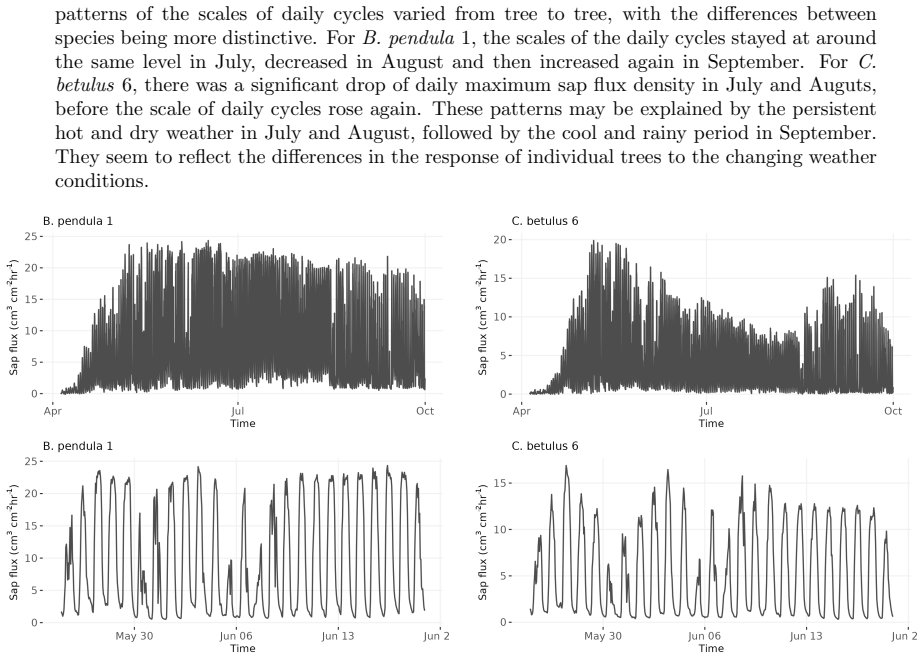
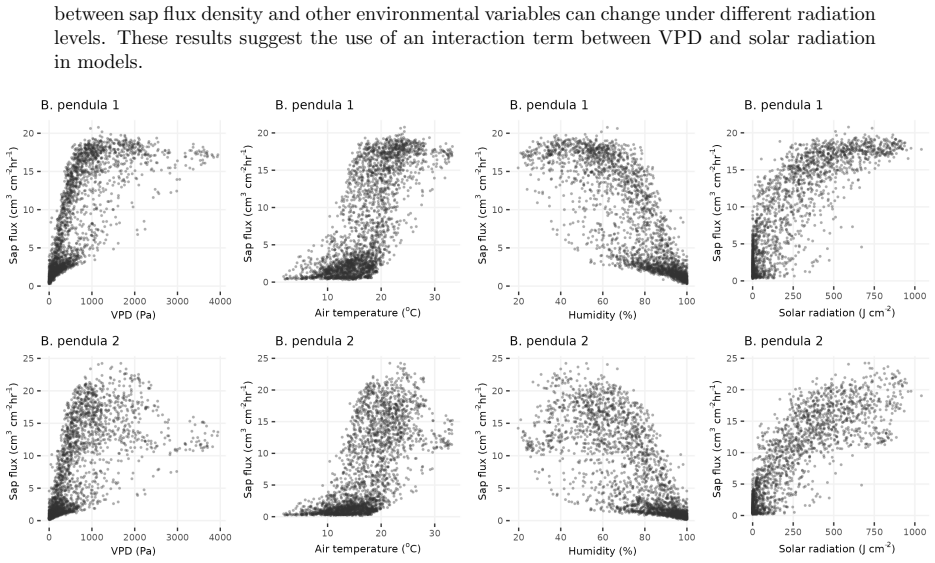
The proposed ensemble prediction approach based on additive models, using weather data as main predictors, can produce reliable daily water-use forecasts for temperate trees. This is shown through application to field data collected on nine species over the 2022, 2023, and 2024 growing seasons, while considering non-linear relationships, interactions, tree variability, and challenges like heatwaves and tree size effects.
What carries the argument
Ensemble prediction method based on additive models that models non-linear relationships and interactions between sap flux density and environmental drivers while accounting for variability among individual trees.
If this is right
- The method enables efficient irrigation management using real-time sensor data.
- It provides a general framework applicable to commercial tree growers and conservation efforts.
- Forecasts remain useful even under climate stress conditions such as heatwaves.
- Integration into online monitoring platforms assists real-time decision making.
Where Pith is reading between the lines
- Similar ensemble approaches could be adapted for predicting water use in other plant species or ecosystems.
- Combining this with climate models might improve long-term projections of forest water needs.
- Further testing on larger datasets could reveal how tree age or health affects prediction accuracy.
Load-bearing premise
That weather variables alone, modeled via additive models, are sufficient to capture non-linear relationships and individual tree variability for reliable forecasts under varying conditions including heatwaves.
What would settle it
Observing large prediction errors or poor performance on data from a new growing season with extreme weather events not represented in the training data would falsify the reliability claim.
Figures


read the original abstract
Efficient irrigation management is crucial to agriculture, forestry and horticulture, especially under climate change. Developments in novel sensors and Internet of Things technology provide an opportunity to carry out real-time monitoring of tree sap flux density, which, when coupled with advanced modelling techniques, enables online prediction of tree water-use suitable for irrigation planning. This manuscript proposes one such pipeline that integrates tree sap flow sensors, weather station sensors, and statistical models to predict tree daily water-use. In particular, an ensemble prediction approach based on additive models has been developed, using weather data as the main predictors of sap flux density. The method simultaneously considers the non-linear relationships and interactions between sap flux density and its environmental drivers, as well as the variability among individual trees over different growing seasons. Using field data collected on nine species of trees over the 2022, 2023 and 2024 growing seasons, this manuscript demonstrates the ability of the proposed ensemble prediction method in producing reliable daily water-use forecasts. The challenge of predicting tree water-use under climate stress, such as heatwaves, and the impact of tree sizes on prediction have also been discussed. Despite the complexity of the problem, the proposed method provides a general framework which can be used in a variety of settings, from commercial tree growers to conversation work. The model can be integrated into an online monitoring platform, assisting real-time decision making on irrigation management.
Editorial analysis
A structured set of objections, weighed in public.
Referee Report
Summary. The manuscript proposes an ensemble prediction method based on additive models to forecast daily sap flux density and water-use in temperate trees. Weather variables are the main predictors, with the models designed to capture non-linear relationships, interactions among drivers, and variability across individual trees and growing seasons. The approach is demonstrated on field data from nine tree species collected over the 2022–2024 growing seasons, with discussion of performance under heatwave conditions and the role of tree size.
Significance. If the ensemble additive models deliver reliable forecasts, particularly under stress, the work would provide a practical statistical framework for coupling sap-flow sensors with weather data to support real-time irrigation decisions in forestry and horticulture. The explicit handling of non-linearities and tree-to-tree heterogeneity is a constructive feature that could improve upon simpler regression approaches. The three-season dataset offers a reasonable temporal span for initial validation, though broader adoption would require stronger evidence of extrapolation.
major comments (2)
- [Heatwave and stress-period analysis] The central claim of reliable daily water-use forecasts under climate stress (heatwaves) rests on the additive models generalizing beyond the observed range of weather variables. The data span only three growing seasons (2022–2024); if high-temperature or high-VPD days are sparse, the fitted smooth functions and interaction terms will be constrained by the training distribution. The manuscript should report the empirical distribution of key predictors during identified heatwave periods and provide separate performance metrics (e.g., RMSE or coverage) on those subsets or on a temporal hold-out containing extremes. Without this, the practical utility for irrigation planning during stress events remains unverified.
- [Model fitting and validation procedure] The ensemble construction and validation strategy are load-bearing for the non-circularity of the reported performance. The abstract states that the method “demonstrates the ability … in producing reliable daily water-use forecasts,” yet no explicit description is given of whether model fitting and evaluation use disjoint temporal blocks, species-level cross-validation, or out-of-sample periods that avoid leakage from the same growing season. If the additive-model parameters and ensemble weights are tuned and assessed on overlapping data, the apparent reliability may be inflated.
minor comments (2)
- [Abstract] The abstract refers to “reliable” forecasts without quoting any quantitative performance metric (e.g., R², MAE, or prediction-interval coverage). Adding one or two summary statistics would strengthen the claim.
- [Methods] Notation for the additive-model components (smooth functions, interaction terms, random effects for trees) should be introduced once in a dedicated methods subsection and used consistently thereafter.
Simulated Author's Rebuttal
We thank the referee for the constructive feedback on our manuscript. We address each major comment below and have revised the manuscript to strengthen the description of our validation approach and to provide additional evidence on performance during heatwave periods.
read point-by-point responses
-
Referee: [Heatwave and stress-period analysis] The central claim of reliable daily water-use forecasts under climate stress (heatwaves) rests on the additive models generalizing beyond the observed range of weather variables. The data span only three growing seasons (2022–2024); if high-temperature or high-VPD days are sparse, the fitted smooth functions and interaction terms will be constrained by the training distribution. The manuscript should report the empirical distribution of key predictors during identified heatwave periods and provide separate performance metrics (e.g., RMSE or coverage) on those subsets or on a temporal hold-out containing extremes. Without this, the practical utility for irrigation planning during stress events remains unverified.
Authors: We agree that explicit reporting of predictor distributions and subset performance is necessary to support claims about heatwave conditions. In the revised manuscript we have added a new subsection that (i) defines heatwave periods using a temperature threshold consistent with regional records, (ii) presents histograms and summary statistics of temperature and VPD on those days versus the full training distribution, and (iii) reports separate RMSE, MAE and interval coverage for the heatwave subset as well as for a temporal hold-out consisting of the warmest contiguous period in 2024. These metrics show only modest degradation relative to non-extreme days, supporting practical utility while acknowledging the limited number of extreme observations. revision: yes
-
Referee: [Model fitting and validation procedure] The ensemble construction and validation strategy are load-bearing for the non-circularity of the reported performance. The abstract states that the method “demonstrates the ability … in producing reliable daily water-use forecasts,” yet no explicit description is given of whether model fitting and evaluation use disjoint temporal blocks, species-level cross-validation, or out-of-sample periods that avoid leakage from the same growing season. If the additive-model parameters and ensemble weights are tuned and assessed on overlapping data, the apparent reliability may be inflated.
Authors: We thank the referee for requiring this clarification. The revised Methods section now explicitly describes a temporal block cross-validation scheme: each growing season is held out in turn as the test set while the additive models are fitted and the ensemble weights are tuned on the remaining seasons only. Inner cross-validation for smoothing parameters and weights is performed exclusively within the training blocks. This procedure is also summarized in a new flowchart and referenced in the abstract and results to confirm that all reported performance metrics are out-of-sample with respect to both season and individual trees. revision: yes
Circularity Check
No circularity; standard ensemble additive modeling on field data with no self-referential derivation
full rationale
The manuscript describes an ensemble of additive models fitted to weather predictors and sap flux observations from nine tree species across three seasons, then demonstrates forecasts. No equations, uniqueness theorems, or self-citations appear in the abstract or description that would reduce any claimed prediction to a fitted input by construction. The approach is a conventional statistical pipeline whose performance claims rest on empirical evaluation rather than algebraic identity with its inputs. No load-bearing step reduces to self-definition or renaming of known results.
Axiom & Free-Parameter Ledger
Lean theorems connected to this paper
-
IndisputableMonolith/Cost/FunctionalEquation.leanwashburn_uniqueness_aczel unclearan ensemble prediction approach based on additive models has been developed, using weather data as the main predictors of sap flux density... GAMs... non-linear relationships and interactions
Reference graph
Works this paper leans on
-
[1]
uhauf, Y., Karvinen, E., Salmon, Y., Lintunen, A., Karvonen, A., J\
Ahongshangbam, J., Kulmala, L., Soininen, J., Fr\"uhauf, Y., Karvinen, E., Salmon, Y., Lintunen, A., Karvonen, A., J\"arvi, L., 2023. Sap flow and leaf gas exchange response to a drought and heatwave in urban green spaces in a Nordic city. Journal of Geophysical Research: Biogeosciences, 20(21), 4455--4475. https://bg.copernicus.org/articles/20/4455/2023/
work page 2023
-
[2]
Asgharinia, S., Leberecht, M., Belelli Marchesini, L., Friess, N., Gianelle, D., Nauss, T., Opgenoorth, L., Yates, J., Valentini, R., 2022. Towards continuous stem water content and sap flux density monitoring: IoT-based solution for detecting changes in stem water dynamics. Forests, 13(7):1040. https://doi.org/10.3390/f13071040
-
[3]
Berdanier, A. B., Miniat, C. F., Clark, J. S., 2016. Predictive models for radial sap flux variation in coniferous, diffuse-porous and ring-porous temperate trees Tree Physiology, 36, 932--941
work page 2016
-
[4]
C., Looker, N., Holwerda, F., Aguilar, L
Berry, Z. C., Looker, N., Holwerda, F., Aguilar, L. R. G., Colin, P. O., Mart\'inez, T. G., Asbjornsen, H., 2018. Why size matters: the interactive influences of tree diameter distribution and sap flow parameters on upscaled transpiration. Tree Physiology, 38 (2), 263--275, https://doi.org/10.1093/treephys/tpx124
-
[5]
British Standard Institute, 1992. BS 3936-1:1992 Nursery stock. Specification for trees and shrubs. London: British Standards Institute. https://doi.org/10.3403/00262241
-
[6]
Burgess, S. S., Adams, M. A., Turner, N. C., Beverly, C. R., Ong, C. K., Khan, A. A. Bleby, T. M., 2001. An improved heat pulse method to measure low and reverse rates of sap flow in woody plants. Tree physiology, 21(9), 589--598
work page 2001
-
[7]
Tree water use patterns as influenced by phenology in a dry forest of southern Ecuador
Butz, P., H\"olscher, D., Cueva, E., Graefe, S., 2018. Tree water use patterns as influenced by phenology in a dry forest of southern Ecuador. Frontiers in Plant Science, 9, 2018. https://doi.org/10.3389/fpls.2018.00945
-
[8]
Capezza, C., Palumbo, Biagio., Goude, Y., Wood, S. N., Fasiolo, M., 2021. Additive stacking for disaggregate electricity demand forecasting. Annals of Applied Statistics, 15 (2), 727--746
work page 2021
-
[9]
Claeskens, G., Magnus, J. R., Vasnev, A. L., Wang, W., 2016. The forecast combination puzzle: A simple theoretical explanation. International Journal of Forecasting, 32 (2016), 754--762
work page 2016
-
[10]
Regression: Models, Methods and Applications
Fahrmeir, L., Kneib, T., Lang, S., Marx, B., 2013. Regression: Models, Methods and Applications. Springer Berlin, Heidelberg
work page 2013
-
[11]
I., Limousin, J-M., Pfautsch, S., 2022
Forrester, D. I., Limousin, J-M., Pfautsch, S., 2022. The relationship between tree size and tree water-use: is competition for water size-symmetric or size-asymmetric? Tree Physiology, 42 (10), 1916--1927. https://doi.org/10.1093/treephys/tpac018
-
[12]
Sap flow of birch and Norway spruce during the European heat and drought in summer 2003
Gartner, K., Nadezhdina, N., Englisch, M., Cermak, J., Leitgeb, E., 2009. Sap flow of birch and Norway spruce during the European heat and drought in summer 2003. Forest Ecology and Management, 258 (5), 590--599. https://doi.org/10.1016/j.foreco.2009.04.028
-
[14]
The Elements of Statistical Learning: Data Mining, Inference, and Prediction, Second Edition
Hastie, T., Tibshirani, R., Friedman, J., 2009. The Elements of Statistical Learning: Data Mining, Inference, and Prediction, Second Edition. Springer New York, NY
work page 2009
-
[15]
Haynes, K., Eckley, I. A., Fearnhead, P., 2017. Computationally efficient changepoint detection for a range of penalties. Journal of Computational and Graphical Statistics, 126(1), 134--143
work page 2017
-
[16]
Horna, V., Schuldt, B., Brix, S., Leuschne, C., 2011. Environment and tree size controlling stem sap flux in a perhumid tropical forest of Central Sulawesi, Indonesia. Annals of Forest Science, 68, 1027--1038
work page 2011
-
[17]
Kabala, J.P., Massari, C., Niccoli, F., Natali, M., Avanzi, F., Battipaglia, G., 2025. Reconstruction of the dynamics of sap-flow timeseries of a beech forest using a machine learning approach. Agricultural and Forest Meteorology, 362, 2025, 110379. https://doi.org/10.1016/j.agrformet.2024.110379
- [18]
-
[19]
Killick, R., Haynes, K., Eckley, I. A., (2022). changepoint: An R package for changepoint analysis. R package version 2.2.4, https://CRAN.R-project.org/package=changepoint
work page 2022
-
[20]
Kim, G., Lee, J., 2024. Micromachined needle-like calorimetric flow sensor for sap flux density measurement in the xylem of plants. Scientific Reports, 14, 14838 (2024). https://doi.org/10.1038/s41598-024-65046-9
-
[21]
Klein, J., 2014. The variability of stomatal sensitivity to leaf water potential across tree species indicates a continuum between isohydric and anisohydric behaviours. Functional ecology, 28 (6), 1313--1320
work page 2014
-
[22]
Prediction of sap flow with historical environmental factors based on deep learning technology
Li, Y., Ye, J., Xu, D., Zhou, G., Feng, H., 2022. Prediction of sap flow with historical environmental factors based on deep learning technology. Computers and Electronics in Agriculture, 202, 2022, 107400. https://doi.org/10.1016/j.compag.2022.107400
-
[23]
Lens, F., Tixier, A., Cochard, H., Sperry, J.S., Jansen, S. and Herbette, S., 2013. Embolism resistance as a key mechanism to understand adaptive plant strategies. Current opinion in plant biology, 16 (3), 287--292
work page 2013
- [24]
-
[25]
Environmental controls on sap flow in black locust forest in Loess Plateau, China
Ma, C., Luo, Y., Shao, M., Li, X., Sun, L., Jia, X., 2017. Environmental controls on sap flow in black locust forest in Loess Plateau, China. Scientific Reports, 7, 13160. https://doi.org/10.1038/s41598-017-13532-8
-
[26]
O'Brien, J. J., Oberbauer, S. F., Clark, D. B., 2004. Whole tree xylem sap flow responses to multiple environmental variables in a wet tropical forest. Plant, Cell & Environment, 27, 551-567 https://doi.org/10.1111/j.1365-3040.2003.01160.x
-
[27]
Oogathoo, S., Houle, D., Duchesne, L., Kneeshaw, D., 2020. Vapour pressure deficit and solar radiation are the major drivers of transpiration of balsam fir and black spruce tree species in humid boreal regions, even during a short-term drought. Agricultural and Forest Meteorology,, 291, 108063, https://doi.org/10.1016/j.agrformet.2020.108063
-
[28]
A probabilistic approach to forecast the uncertainty with ensemble spread
Van Schaeybroeck, B., Vannitsem, S., 2016. A probabilistic approach to forecast the uncertainty with ensemble spread. Monthly Weather Review, 144 (1), 451--468
work page 2016
-
[29]
Shumway, R. H., Stoffer, D. S., 2017. Time Series Analysis and Its Applications: With R Examples, 4th Edition, Springer Texts in Statistics, Springer, Cham
work page 2017
-
[30]
Sperry, J. S., Tyree, M. T., 1988. Mechanism of water stress-induced xylem embolism. Plant Physiology, 88 (3), 581--587
work page 1988
-
[31]
Steppe, K., De Pauw, D. J. W., Lemeur, R., Vanrolleghem, A., 2006. A mathematical model linking tree sap flow dynamics to daily stem diameter fluctuations and radial stem growth Tree Physiology, 26 (3), 257--273. https://doi.org/10.1093/treephys/26.3.257
-
[32]
Stone, C. H., Close, D. C., Corkrey, R., Goodwin, I., 2022. Sap flow of sweet cherry reveals distinct effects of humidity and wind under rain covered and netted protected cropping systems. Scientific Reports, 12, 21031 (2022). https://doi.org/10.1038/s41598-022-25207-0
-
[33]
Quantifying the uncertainties in an ensemble of decadal climate predictions
Strobach, E., Bel, G., 2017. Quantifying the uncertainties in an ensemble of decadal climate predictions. Journal of Geophysical Research: Atmospheres, 122 (24), 13191--13200
work page 2017
-
[34]
Su\'arez, J. C., Casanoves, F., Bieng, M. A. N., Melgarejo, L. M., Di Rienzo, J. A., Armas, C., 2021 Prediction model for sap flow in cacao trees under different radiation intensities in the western Colombian Amazon. Scientific Reports, 10512 (2021). https://doi.org/10.1038/s41598-021-89876-z
-
[35]
Telander, A. C., Slesak, R. A., D’Amato, A. W., Palik, B. J., Brooks, K. N., Lenhart, C. F., 2015. Sap flow of black ash in wetland forests of northern Minnesota, USA: Hydrologic implications of tree mortality due to emerald ash borer. Agricultural and Forest Meteorology, 206, 4--11. https://doi.org/10.1016/j.agrformet.2015.02.019
-
[36]
Tu, J., Wei, X., Huang, B., Fan, H., Jian, M., Li, W., 2019 Improvement of sap flow estimation by including phenological index and time-lag effect in back-propagation neural network models. Agricultural and Forest Meteorology, 276–277, 2019, 107608, https://doi.org/10.1016/j.agrformet.2019.06.007
-
[37]
Sap-flux density measurement methods: working principles and applicability
Vandegehuchte, M., Steppe, K., 2013. Sap-flux density measurement methods: working principles and applicability. Functional Plant Biology, 40(3), 213--223
work page 2013
-
[38]
Van de Wal, B.A.E., Guyot, A., Lovelock, C.E. Lockington, D. A., Steppe, K., 2015. Influence of temporospatial variation in sap flux density on estimates of whole-tree water use in Avicennia marina. Trees, 29, 215–-222. https://doi.org/10.1007/s00468-014-1105-z
-
[39]
Wan, L., Zhang, Q., Cheng, L., Liu, Y., Qin, S., Xu, J., Wang, Y., 2023. What determines the time lags of sap flux with solar radiation and vapor pressure deficit? Agricultural and Forest Meteorology, 333 (109414). https://doi.org/10.1016/j.agrformet.2023.109414
-
[40]
Wan, L., Zhang, Q., Arain, M. A., and Cheng, L., 2024. A novel crossed hysteresis response pattern of sap flux to solar radiation. Journal of Geophysical Research: Biogeosciences, 129, e2024JG007998. https://doi.org/10.1029/2024JG007998
- [41]
- [42]
-
[43]
Hansen, P. R., 2005. A Test for Superior Predictive Ability. Journal of Business & Economic Statistics, 23(4), 365--380. https://doi.org/10.1198/073500105000000063
-
[44]
Politis, D. N., Romano, J. P., 1994. The stationary boostrap. Journal of the American Statistical Association, 89(428), 1303--1313. https://doi.org/10.2307/2290993
- [45]
discussion (0)
Sign in with ORCID, Apple, or X to comment. Anyone can read and Pith papers without signing in.