Recognition: 1 theorem link
· Lean TheoremInferring host environment properties and gravitational-wave decay time from the eccentricity measurement of dynamically captured binaries
Pith reviewed 2026-05-13 04:32 UTC · model grok-4.3
The pith
Assuming an eccentric gravitational-wave event arises from dynamical capture, its eccentricity and mass posteriors can identify the host environment and the time from capture to merger.
A machine-rendered reading of the paper's core claim, the machinery that carries it, and where it could break.
Core claim
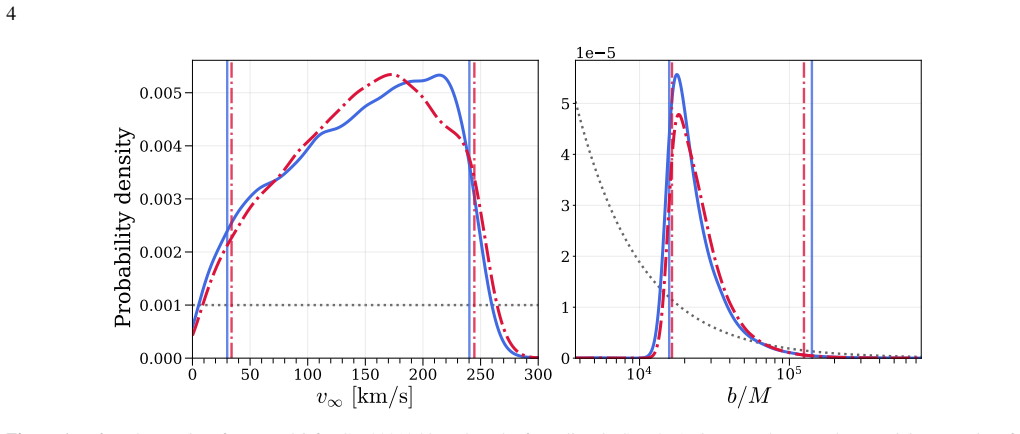
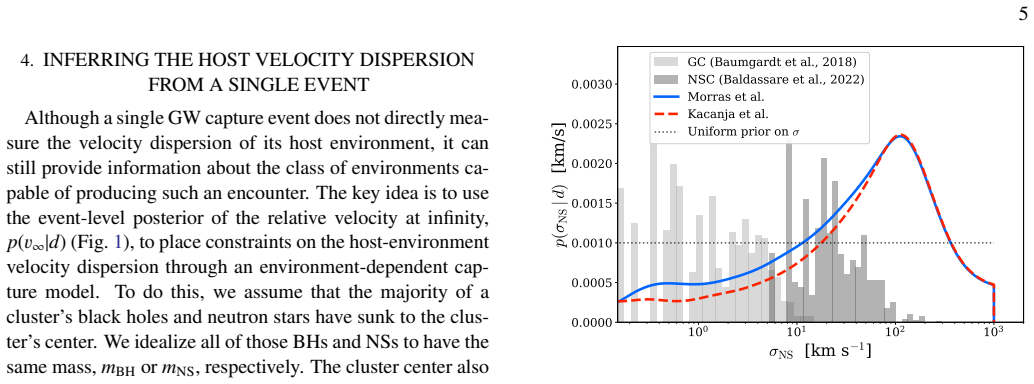
By assuming an observed eccentric event originates from a dynamical gravitational wave capture, the eccentricity posterior can be mapped to posteriors on key capture parameters such as the relative velocity at infinity and the impact parameter. Comparing these with the expected velocity distributions of different astrophysical environments places constraints on the likely host. For the neutron star-black hole merger GW200105, the probability that it merged in a globular cluster is 29 percent and in a nuclear star cluster is 71 percent. The formalism also infers a gravitational-wave decay time from capture to merger of 11-156 days. The same approach applied to GW190521 provides weaker host约束.
What carries the argument
The conversion of measured eccentricity into the relative velocity at infinity and impact parameter for a gravitational-wave capture event, using the relation for the eccentricity after a single close encounter, followed by comparison to environment-specific velocity distributions.
If this is right
- For GW200105, a nuclear star cluster is the more probable host than a globular cluster.
- A decay time between capture and merger of 11-156 days is obtained for GW200105.
- The method can be applied on a single-event basis to future eccentric mergers to diagnose their hosts.
- It can be generalized to study a population of eccentric binaries.
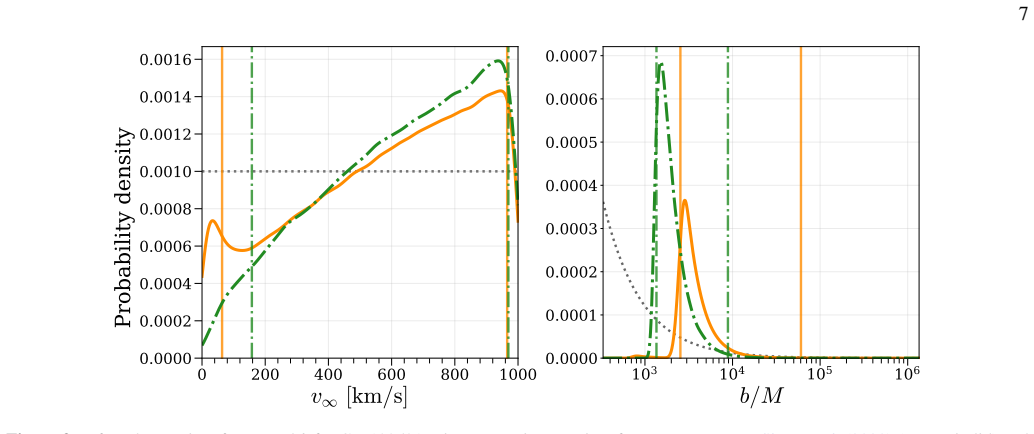
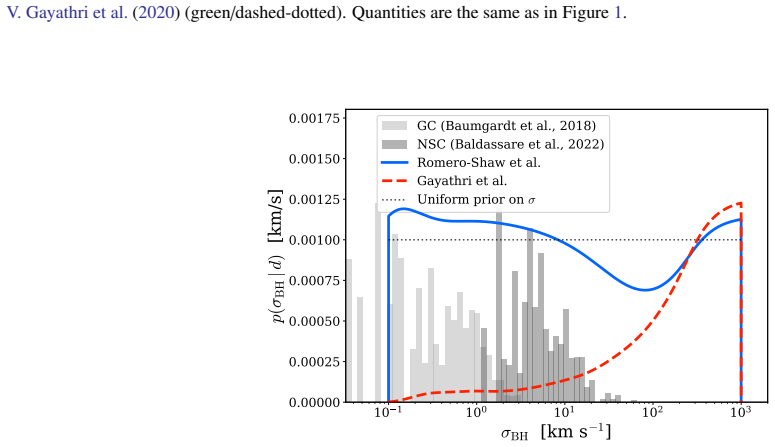
- Application to GW190521 yields less informative constraints on the host environment.
Where Pith is reading between the lines
- If applied to many eccentric events, the distribution of inferred hosts could indicate the relative importance of different dense environments in producing mergers.
- The inferred decay times provide a new observable that could be checked against numerical simulations of capture and inspiral.
- Extending the comparison beyond globular and nuclear star clusters to other environments would broaden the diagnostic power of the method.
- Combining this host inference with independent measurements of merger rates could help calibrate dynamical formation models.
Load-bearing premise
That the eccentric merger was formed by a dynamical gravitational-wave capture in a dense stellar environment.
What would settle it
An eccentric merger whose derived capture velocity lies outside the range spanned by all known dense environments, or a measured decay time that is inconsistent with the age or density of its assigned host.
Figures

read the original abstract
Dynamical capture in dense stellar environments is a promising channel for producing eccentric compact binary mergers. Although there have been no confident detections of eccentric mergers to date, a few candidates show indications of non-negligible in-band eccentricity upon re-analysis of the data. By assuming an observed eccentric event originates from a dynamical gravitational wave (GW) capture, we show that it is possible to identify the host environment using the eccentricity and mass posteriors. In particular, the eccentricity posterior can be mapped to posteriors on key capture parameters, such as the relative velocity at infinity and the impact parameter. By comparing these with the expected velocity distributions of different astrophysical environments, we can place constraints on the likely host. Assuming that it originated from a GW capture, we applied this framework to the neutron star-black hole merger GW200105. By comparing with the velocity dispersion distributions of neutron stars in the cores of globular clusters (GCs) and nuclear star clusters (NSCs), we find the probability that GW200105 merged in a GC (NSC) to be 29% (71%). As we anticipate detecting several eccentric mergers in the future, this method can provide a valuable astrophysical diagnostic of their host environments on a single-event basis; this can be straightforwardly generalized to a population of eccentric binaries. The formalism we develop is also applied to GW190521, but is less constraining for that event. Lastly, we infer a GW decay time from capture to merger of 11-156 days for GW200105.
Editorial analysis
A structured set of objections, weighed in public.
Referee Report
Summary. The manuscript develops a conditional framework to infer host environments (globular clusters vs. nuclear star clusters) and gravitational-wave decay times for eccentric compact binary mergers by assuming dynamical GW capture origin, mapping eccentricity and mass posteriors to capture parameters (relative velocity at infinity and impact parameter), and comparing the resulting distributions against literature velocity dispersion profiles. It applies the method to GW200105 (yielding 29% GC / 71% NSC probabilities and 11-156 day decay time) and GW190521 (less constraining results).
Significance. If the central mapping holds under the stated assumption, the approach supplies a practical, single-event diagnostic for the astrophysical origins of eccentric mergers that can be extended to populations; it reuses standard capture physics and external velocity-dispersion data without introducing new free parameters.
major comments (2)
- [Application to GW200105] The quantitative results for GW200105 (29%/71% probabilities and 11-156 day decay-time interval) depend on the eccentricity-to-capture-parameter mapping and its propagation through the velocity-dispersion comparison; the manuscript provides only an outline of this procedure without explicit formulas, error-propagation steps, or validation against simulated captures, preventing full assessment of the reported numbers (see abstract and the GW200105 application paragraph).
- [Introduction and GW200105 section] The framework is explicitly conditional on the event originating via dynamical capture; while this is stated, the manuscript does not quantify how sensitive the host probabilities and decay-time range are to plausible deviations from the capture assumption or to uncertainties in the input eccentricity posterior (see the opening assumption statement and the final decay-time inference).
minor comments (2)
- Add a brief methods subsection or appendix that reproduces the mapping from eccentricity posterior to v_inf and impact-parameter posteriors, including any numerical integration or sampling steps used.
- Clarify whether the velocity-dispersion distributions for GCs and NSCs are taken directly from the cited literature or re-binned; state the exact reference and any interpolation method.
Simulated Author's Rebuttal
We thank the referee for their thorough and constructive review. The comments identify areas where additional detail and analysis will strengthen the manuscript, and we address each point below with plans for revision.
read point-by-point responses
-
Referee: [Application to GW200105] The quantitative results for GW200105 (29%/71% probabilities and 11-156 day decay-time interval) depend on the eccentricity-to-capture-parameter mapping and its propagation through the velocity-dispersion comparison; the manuscript provides only an outline of this procedure without explicit formulas, error-propagation steps, or validation against simulated captures, preventing full assessment of the reported numbers (see abstract and the GW200105 application paragraph).
Authors: We agree that the current presentation provides only an outline of the mapping and propagation procedure. In the revised manuscript we will add the explicit analytic expressions relating the eccentricity posterior to the capture parameters (relative velocity at infinity and impact parameter), describe the Monte-Carlo error-propagation steps used to obtain the host-environment probabilities and decay-time interval, and include a validation subsection that applies the same pipeline to a set of simulated capture events with known input parameters. These additions will enable full reproducibility and assessment of the quoted numbers for GW200105. revision: yes
-
Referee: [Introduction and GW200105 section] The framework is explicitly conditional on the event originating via dynamical capture; while this is stated, the manuscript does not quantify how sensitive the host probabilities and decay-time range are to plausible deviations from the capture assumption or to uncertainties in the input eccentricity posterior (see the opening assumption statement and the final decay-time inference).
Authors: We acknowledge that a quantitative sensitivity study is currently absent. We will add a dedicated subsection that (i) perturbs the input eccentricity posterior within its reported credible intervals and recomputes the host probabilities and decay-time range, and (ii) explores the effect of small admixtures of non-capture formation channels by varying the fraction of events assumed to follow the capture mapping. The results of these tests will be reported alongside the baseline values for GW200105. revision: yes
Circularity Check
No significant circularity; derivation self-contained under explicit assumption
full rationale
The paper's inference chain begins with an explicit conditional assumption that the event (e.g., GW200105) originated via dynamical GW capture. Under that assumption, the eccentricity posterior is mapped to posteriors on capture parameters (v_inf, impact parameter) using standard capture physics relations, then compared against independent external velocity-dispersion distributions drawn from prior astrophysical literature for GCs and NSCs. The resulting host probabilities (29%/71%) and decay-time range (11-156 days) follow directly from this comparison without any fitted parameter being relabeled as a prediction, without self-definitional loops, and without load-bearing self-citations that substitute for external validation. No enumerated circularity pattern is present; the central claim remains logically independent of its inputs once the stated assumption is granted.
Axiom & Free-Parameter Ledger
free parameters (1)
- velocity dispersion distributions for GCs and NSCs
axioms (1)
- domain assumption The observed eccentric event originates from dynamical gravitational-wave capture
Lean theorems connected to this paper
-
IndisputableMonolith/Foundation/AlexanderDuality.lean (D=3 forcing); IndisputableMonolith/Cost/FunctionalEquation.lean (J uniqueness)reality_from_one_distinction; washburn_uniqueness_aczel unclearBy assuming an observed eccentric event originates from a dynamical gravitational wave (GW) capture, we show that it is possible to identify the host environment using the eccentricity and mass posteriors... e_f = F(b, v_inf, M, eta) ... pcap(sigma_i | d) ... P(env|d)
Reference graph
Works this paper leans on
-
[1]
Aarseth, S. J. 2012, MNRAS, 422, 841, doi: 10.1111/j.1365-2966.2012.20666.x
-
[2]
Aasi, J., et al. 2015, CQGra, 32, 074001, doi: 10.1088/0264-9381/32/7/074001 9
- [3]
-
[4]
Abac, A. G., Abbott, R., Abouelfettouh, I., et al. 2024, ApJL, 970, L34, doi: 10.3847/2041-8213/ad5beb
-
[5]
G., Abouelfettouh, I., Acernese, F., et al
Abac, A. G., Abouelfettouh, I., Acernese, F., et al. 2025, ApJL, 995, L18, doi: 10.3847/2041-8213/ae0c06 Abbott, et al. 2021, ApJL, , doi: 10.3847/2041-8213/ac082e
-
[6]
2017, PhRvL, 119, 161101, doi: 10.1103/PhysRevLett.119.161101
Abbott, B., et al. 2017, PhRvL, 119, 161101, doi: 10.1103/PhysRevLett.119.161101
-
[7]
Abbott, B. P., et al. 2016, PhRvL, 116, 061102, doi: 10.1103/PhysRevLett.116.061102
-
[8]
Abbott, B. P., et al. 2019a, ApJL, 882, L24, doi: 10.3847/2041-8213/ab3800
-
[9]
Abbott, B. P., et al. 2019b, PhRvX, 9, 031040, doi: 10.1103/PhysRevX.9.031040
-
[10]
Abbottet al.[LIGO Scientific and Virgo], Phys
Abbott, R., et al. 2020a, PhRvL, 125, 101102, doi: 10.1103/PhysRevLett.125.101102
-
[11]
2020b, ApJL, 900, L13, doi: 10.3847/2041-8213/aba493
Abbott, R., et al. 2020b, ApJL, 900, L13, doi: 10.3847/2041-8213/aba493
-
[12]
Abbott, R., et al. 2023, PhRvX, 13, 041039, doi: 10.1103/PhysRevX.13.041039
-
[13]
Abbott, R., et al. 2024, PhRvD, 109, 022001, doi: 10.1103/PhysRevD.109.022001
-
[14]
Antonini, F., Chatterjee, S., Rodriguez, C. L., et al. 2016, ApJ, 816, 65, doi: 10.3847/0004-637x/816/2/65
-
[15]
Antonini, F., Toonen, S., & Hamers, A. S. 2017, ApJ, 841, 77, doi: 10.3847/1538-4357/aa6f5e
-
[16]
2025, A&A, 700, A35, doi: 10.1051/0004-6361/202555165
Attia, M., & Sibony, Y . 2025, A&A, 700, A35, doi: 10.1051/0004-6361/202555165
-
[17]
Bae, Y .-B., Lee, H. M., Kang, G., & Hansen, J. 2017, PhRvD, 96, 084009, doi: 10.1103/PhysRevD.96.084009
-
[18]
Baldassare, V . F., Stone, N. C., Foord, A., Gallo, E., & Ostriker, J. P. 2022, ApJ, 929, 84, doi: 10.3847/1538-4357/ac5f51
-
[19]
2017, MNRAS, 467, 524, doi: 10.1093/mnras/stw3392
Banerjee, S. 2017, MNRAS, 467, 524, doi: 10.1093/mnras/stw3392
-
[20]
1967, PhRvL, 18, 379, doi: 10.1103/PhysRevLett.18.379
Barkat, Z., Rakavy, G., & Sack, N. 1967, PhRvL, 18, 379, doi: 10.1103/PhysRevLett.18.379
-
[21]
Monthly Notices of the Royal Astronomical Society , author =
Baumgardt, H., & Hilker, M. 2018, MNRAS, 478, 1520, doi: 10.1093/mnras/sty1057
-
[22]
Benacquista, M. J. 2002, LRR, 5, 2
work page 2002
-
[23]
Bhat, S. A., Tiwari, A., Shaikh, M. A., & Kapadia, S. J. 2025, PhRvD, 112, 124004, doi: 10.1103/rstg-6n6y
-
[24]
Brown, D. A., & Zimmerman, P. J. 2010, PhRvD, 81, 024007, doi: 10.1103/PhysRevD.81.024007
-
[25]
Carlo, U. N. D., Mapelli, M., Giacobbo, N., et al. 2020, MNRAS, 498, 495, doi: 10.1093/mnras/staa2286
-
[26]
Romero-Shaw, I. M. 2023, MNRAS, 526, 4908, doi: 10.1093/mnras/stad3048
-
[27]
Cheng, A. Q., Zevin, M., & Vitale, S. 2023, ApJ, 955, 127, doi: 10.3847/1538-4357/aced98
-
[28]
Cho, G., Gopakumar, A., Haney, M., & Lee, H. M. 2018, PhRvD, 98, 024039, doi: 10.1103/PhysRevD.98.024039
-
[29]
Favata, M., Kim, C., Arun, K. G., Kim, J., & Lee, H. W. 2022, PhRvD, 105, 023003, doi: 10.1103/PhysRevD.105.023003
-
[30]
Publications of the Astronomical Society of the Pacific , author =
Foreman-Mackey, D., Hogg, D. W., Lang, D., & Goodman, J. 2013, PASP, 125, 306, doi: 10.1086/670067
-
[31]
2024, PhRvD, 110, 063012, doi: 10.1103/PhysRevD.110.063012
Fumagalli, G., Romero-Shaw, I., Gerosa, D., et al. 2024, PhRvD, 110, 063012, doi: 10.1103/PhysRevD.110.063012
-
[32]
2023, NatAs, 7, 11, doi: 10.1038/s41550-022-01813-w
Gamba, R., Breschi, M., Carullo, G., & et al. 2023, NatAs, 7, 11, doi: 10.1038/s41550-022-01813-w
-
[33]
2025, PhRvD, 112, 044037, doi: 10.1103/rb1c-nx5f
Gamboa, A., Khalil, M., & Buonanno, A. 2025, PhRvD, 112, 044037, doi: 10.1103/rb1c-nx5f
-
[34]
2020, NatAs, doi: 10.48550/arXiv.2009.05461 Gond´an, L., & Kocsis, B
Gayathri, V ., Healy, J., Lange, J., et al. 2020, NatAs, doi: 10.48550/arXiv.2009.05461 Gond´an, L., & Kocsis, B. 2021, MNRAS, 506, 1665, doi: 10.1093/mnras/stab1722 Gond´an, L., Kocsis, B., Raffai, P., & Frei, Z. 2018, ApJ, 860, 5, doi: 10.3847/1538-4357/aabfee
-
[35]
2010, CAMCS, 5, 65, doi: 10.2140/camcos.2010.5.65
Goodman, J., & Weare, J. 2010, CAMCS, 5, 65, doi: 10.2140/camcos.2010.5.65
-
[36]
2020, PhRvD, 101, 104053, doi: 10.1103/PhysRevD.101.104053
Gupta, P., Suzuki, H., Okawa, H., & Maeda, K.-i. 2020, PhRvD, 101, 104053, doi: 10.1103/PhysRevD.101.104053
-
[38]
2025b, PhRvD, 112, 104045, doi: 10.1103/vpyp-nvfp
Gupte, N., Ramos-Buades, A., Buonanno, A., et al. 2025b, PhRvD, 112, 104045, doi: 10.1103/vpyp-nvfp
- [39]
-
[40]
Hansen, R. O. 1972, PhRvD, 5, 1021, doi: 10.1103/PhysRevD.5.1021
-
[41]
Hansen, R. O. 1974, JMP, 15, 46, doi: 10.1063/1.1666501
-
[42]
Hills, J. G., & Fullerton, L. W. 1980, AJ, 85, 1281, doi: 10.1086/112798
-
[43]
2020, ApJ, 903, 8, doi: 10.3847/1538-4357/abb66a
Hoang, B.-M., Naoz, S., & Kremer, K. 2020, ApJ, 903, 8, doi: 10.3847/1538-4357/abb66a
-
[44]
Hurley, J. R., Sippel, A. C., Tout, C. A., & Aarseth, S. J. 2016, PASA, 33, e036, doi: 10.1017/pasa.2016.30
-
[45]
Kacanja, K., Soni, K., & Nitz, A. H. 2025, PhRvD, , doi: 10.1103/jnsc-783p
-
[46]
O., Spera, M., Mapelli, M., & Ziosi, B
Kimpson, T. O., Spera, M., Mapelli, M., & Ziosi, B. M. 2016, MNRAS, 463, 2443, doi: 10.1093/mnras/stw2085
-
[47]
2024, PhRvD, 110, 043023, doi: 10.1103/PhysRevD.110.043023
Kritos, K., Strokov, V ., Baibhav, V ., & Berti, E. 2024, PhRvD, 110, 043023, doi: 10.1103/PhysRevD.110.043023
-
[48]
Leigh, N. W. C., Geller, A. M., McKernan, B., et al. 2018, MNRAS, 474, 5672, doi: 10.1093/mnras/stx3134
-
[49]
Lower, M. E., Thrane, E., Lasky, P. D., & Smith, R. 2018, PhRvD, 98, 083028, doi: 10.1103/PhysRevD.98.083028 10 L¨utzgendorf, N., Gualandris, A., Kissler-Patig, M., et al. 2012, A&A, 543, A82, doi: 10.1051/0004-6361/201219062
-
[50]
2025, PhRvD, 111, doi: 10.1103/c9l3-gw6w
Mahapatra, P., Chattopadhyay, D., Gupta, A., et al. 2025, PhRvD, 111, doi: 10.1103/c9l3-gw6w
-
[51]
2024, ApJ, 975, 117, doi: 10.3847/1538-4357/ad781b
Mahapatra, P., Chattopadhyay, D., Gupta, A., et al. 2024, ApJ, 975, 117, doi: 10.3847/1538-4357/ad781b
-
[52]
Mandel, I., & Broekgaarden, F. S. 2022, LRR, 25, 1, doi: 10.1007/s41114-021-00034-3
-
[53]
Miller, M. C., & Lauburg, V . M. 2009, Astrophys. J., 692, 917, doi: 10.1088/0004-637X/692/1/917
-
[54]
2025a, PhRvD, 111, 084052, doi: 10.1103/PhysRevD.111.084052
Morras, G., Pratten, G., & Schmidt, P. 2025a, PhRvD, 111, 084052, doi: 10.1103/PhysRevD.111.084052
-
[55]
Morras, G., Pratten, G., & Schmidt, P. 2026, arXiv e-prints. https://arxiv.org/abs/2603.22461
- [56]
-
[57]
Umbreit, S. 2015, ApJ, 800, 9, doi: 10.1088/0004-637x/800/1/9
-
[58]
Naoz, S., Farr, W. M., Lithwick, Y ., Rasio, F. A., & Teyssandier, J. 2013, MNRAS, 431, 2155, doi: 10.1093/mnras/stt302
-
[59]
Naoz, S., Li, G., Zanardi, M., de El´ıa, G. C., & Sisto, R. P. D. 2017, AJ, 154, 18, doi: 10.3847/1538-3881/aa6fb0 O’Leary, R. M., Kocsis, B., & Loeb, A. 2009, MNRAS, 395, 2127, doi: 10.1111/j.1365-2966.2009.14653.x O’Leary, R. M., Meiron, Y ., & Kocsis, B. 2016, ApJL, 824, L12, doi: 10.3847/2041-8205/824/1/L12
-
[60]
Peters, P. C. 1964, PhRvL, 136, B1224, doi: 10.1103/PhysRev.136.B1224
-
[61]
Detection of GW200105 with a targeted eccentric search
Phukon, K. S., Schmidt, P., Morras, G., & Pratten, G. 2026, arXiv e-prints. https://arxiv.org/abs/2512.10803
work page internal anchor Pith review Pith/arXiv arXiv 2026
-
[62]
Planas, M. d. L., Husa, S., Ramos-Buades, A., & Valencia, J. 2025a, ApJ, 995, 47, doi: 10.3847/1538-4357/ae1d7d
-
[63]
Planas, M. d. L., Ramos-Buades, A., Garc´ıa-Quir´os, C., et al. 2025b, PhRvD, 112, 123004, doi: 10.1103/cv75-y8dr
-
[64]
Planas, M. d. L., Ramos-Buades, A., Garc´ıa-Quir´os, C., et al. 2026, PhRvD, 113, doi: 10.1103/wz3v-b151
-
[65]
Quinlan, G. D., & Shapiro, S. L. 1987, ApJ, 321, 199, doi: 10.1086/165624
-
[66]
Quinlan, G. D., & Shapiro, S. L. 1989, ApJ, 343, 725, doi: 10.1086/167745
-
[67]
2023a, PhRvD, 108, 124037, doi: 10.1103/PhysRevD.108.124037
Ramos-Buades, A., Buonanno, A., Estell´es, H., et al. 2023a, PhRvD, 108, 124037, doi: 10.1103/PhysRevD.108.124037
-
[68]
Ramos-Buades, A., Buonanno, A., & Gair, J. 2023b, PhRvD, 108, 124063, doi: 10.1103/PhysRevD.108.124063 Rando Forastier, Bruno, Mar´ın Pina, Daniel, Gieles, Mark, Portegies Zwart, Simon, & Antonini, Fabio. 2025, A&A, 697, A118, doi: 10.1051/0004-6361/202450890
-
[69]
2025, PhRvD, 112, 063052, doi: 10.1103/jj7m-x66y
Romero-Shaw, I., Stegmann, J., Tagawa, H., et al. 2025, PhRvD, 112, 063052, doi: 10.1103/jj7m-x66y
-
[70]
Romero-Shaw, I. M., Lasky, P. D., & Thrane, E. 2019, MNRAS, 490, 5210, doi: 10.1093/mnras/stz2996
-
[71]
2020a, ApJL, 903, L5, doi: 10.3847/2041-8213/abbe26
Romero-Shaw, I. M., Lasky, P. D., Thrane, E., & Calder´on Bustillo, J. 2020, ApJL, 903, L5, doi: 10.3847/2041-8213/abbe26
- [72]
-
[73]
2024, MNRAS, 528, 833, doi: 10.1093/mnras/stae037
Saini, P. 2024, MNRAS, 528, 833, doi: 10.1093/mnras/stae037
-
[75]
2018b, PhRvD, 97, 103014, doi: 10.1103/PhysRevD.97.103014
Samsing, J. 2018b, PhRvD, 97, 103014, doi: 10.1103/PhysRevD.97.103014
-
[76]
2020, PhRvD, 101, 123010, doi: 10.1103/PhysRevD.101.123010
Askar, A. 2020, PhRvD, 101, 123010, doi: 10.1103/PhysRevD.101.123010
-
[77]
2014, ApJ, 784, 71, doi: 10.1088/0004-637X/784/1/71
Samsing, J., MacLeod, M., & Ramirez-Ruiz, E. 2014, ApJ, 784, 71, doi: 10.1088/0004-637X/784/1/71
-
[78]
2017, ApJL, 840, L14, doi: 10.3847/2041-8213/aa6f0b
Samsing, J., & Ramirez-Ruiz, E. 2017, ApJL, 840, L14, doi: 10.3847/2041-8213/aa6f0b
-
[79]
The Astrophysical Journal , author =
Shariat, C., Naoz, S., El-Badry, K., et al. 2024, ApJ, 978, 47, doi: 10.3847/1538-4357/ad944a
-
[80]
2017, ApJ, 836, 39, doi: 10.3847/1538-4357/aa5729
Silsbee, K., & Tremaine, S. 2017, ApJ, 836, 39, doi: 10.3847/1538-4357/aa5729
-
[81]
Spera, M., Trani, A. A., & Mencagli, M. 2022, Galaxies, 10, doi: 10.3390/galaxies10040076
-
[82]
2025, ApJL, 991, L54, doi: 10.3847/2041-8213/ae055b
Stegmann, J., & Klencki, J. 2025, ApJL, 991, L54, doi: 10.3847/2041-8213/ae055b
discussion (0)
Sign in with ORCID, Apple, or X to comment. Anyone can read and Pith papers without signing in.