Recognition: 2 theorem links
· Lean TheoremNematicity in LaFeAsO single crystals studied by elastoresistance, high-resolution thermal expansion and shear-modulus measurements
Pith reviewed 2026-05-13 04:07 UTC · model grok-4.3
The pith
LaFeAsO shows mismatched Weiss temperatures for nematic susceptibilities from elastoresistivity and shear modulus.
A machine-rendered reading of the paper's core claim, the machinery that carries it, and where it could break.
Core claim
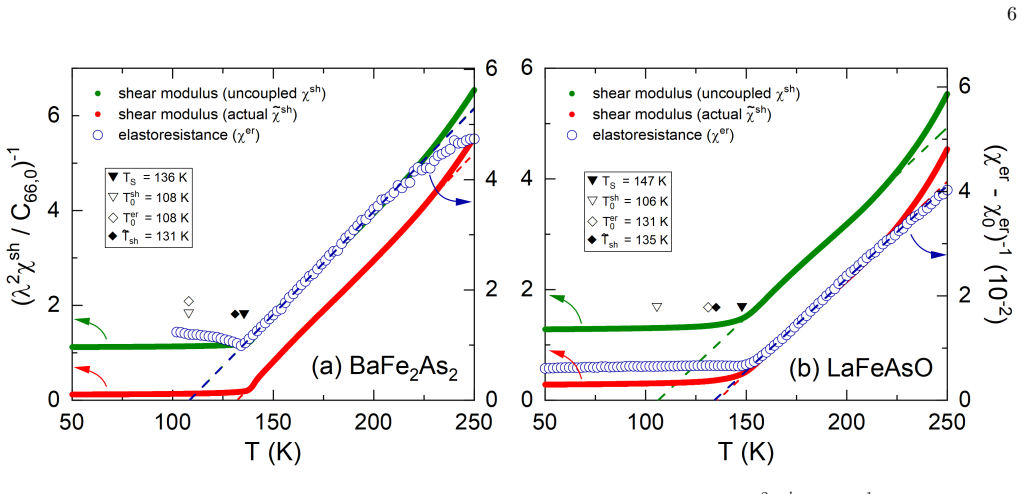
In LaFeAsO the shear modulus C66 softens toward the structural transition at Ts. Both χ^sh and χ^er display similar Curie-Weiss divergence, yet their Weiss temperatures are significantly different. The same measurements on BaFe2As2 yield matching divergences, as required by the underlying Landau theory that links resistivity anisotropy to uncoupled electronic nematicity. The lattice-electronic coupling energy is deduced to be ~30 K.
What carries the argument
The side-by-side comparison of nematic susceptibilities χ^sh (extracted from shear-modulus data) and χ^er (extracted from elastoresistivity data) that tests whether resistivity anisotropy tracks the same electronic nematicity in both compounds.
If this is right
- The structural transition at Ts is driven by electronic nematic degrees of freedom in LaFeAsO.
- The energy scale of coupling between the lattice and the electronic nematic order is ~30 K.
- The direct mapping from resistivity anisotropy to electronic nematic susceptibility assumed in standard theories does not hold for LaFeAsO.
- The shear-modulus temperature dependence remains similar across the 1111 and 122 families even though the resistivity response differs.
Where Pith is reading between the lines
- The mismatch may reflect compound-specific scattering channels that affect resistivity but not the elastic response.
- If the same discrepancy appears in other 1111 compounds, models of nematicity will need separate treatments for the two structural families.
- Doping studies that track both susceptibilities through the superconducting dome could reveal whether the mismatch correlates with Tc.
Load-bearing premise
That elastoresistivity and shear-modulus data both read out the same underlying electronic nematic susceptibility without extra, material-specific contributions from lattice coupling or scattering that are stronger in LaFeAsO than in BaFe2As2.
What would settle it
New measurements that find the Weiss temperature of χ^er to equal that of χ^sh in LaFeAsO would remove the reported mismatch and restore consistency with standard Landau-theory expectations.
Figures


read the original abstract
Nematicity in LaFeAsO single crystals is studied by means of high-resolution thermal expansion, shear modulus, and elastoresistivity measurements. A softening of the shear modulus $C_{\rm 66}$ towards the structural phase transition at $T_{\rm S}$ is observed. In addition, a similar Curie-Weiss-like divergence of the nematic susceptibilities is found in the temperature dependence of both $\chi^{sh}$ and $\chi^{er}$, which are deduced from the shear modulus (sh) and the elastoresistivity (er) studies, respectively. These observations provide evidence for an electronic origin of nematicity in LaFeAsO. The characteristic energy of the coupling between the lattice and the electronic degrees of freedom is deduced to $\sim$30~K. The comparison to corresponding measurements on BaFe$_2$As$_2$ single crystals reveals a very similar temperature dependence of the shear modulus but yields contrasting results for $\chi^{er}$ : In BaFe$_2$As$_2$, $\chi^{er}$ diverges similarly as the uncoupled nematicity deduced from the shear modulus data as it is expected from the underlying Landau theory. In contrast, the Weiss temperatures of $\chi^{er}$ and $\chi^{sh}$ are significantly different in LaFeAsO. This difference is at odds with the commonly anticipated theories of resistivity anisotropy and electronic nematicity in iron pnictides.
Editorial analysis
A structured set of objections, weighed in public.
Referee Report
Summary. The manuscript reports elastoresistivity, high-resolution thermal expansion, and shear-modulus measurements on LaFeAsO single crystals. It observes softening of C66 toward Ts, Curie-Weiss-like divergences in both the shear-modulus-derived nematic susceptibility χ^sh and the elastoresistivity-derived χ^er, and extracts a lattice-electronic coupling energy scale of ~30 K. The central claim is that χ^er and χ^sh exhibit similar temperature dependence in BaFe2As2 (consistent with Landau theory) but show significantly different Weiss temperatures in LaFeAsO, providing evidence for an electronic origin of nematicity while challenging common theories of resistivity anisotropy in iron pnictides.
Significance. If the reported mismatch in Weiss temperatures is shown to be intrinsic rather than arising from unaccounted material-specific terms, the work would demonstrate that nematic susceptibility is not universal across pnictide families and would supply a quantitative coupling benchmark (~30 K) for theory. The direct comparison to prior BaFe2As2 data strengthens the contrast but requires the assumption that both probes access the same bare electronic susceptibility.
major comments (3)
- [Methods and analysis] The headline claim that the Weiss temperatures of χ^er and χ^sh differ significantly (and thereby challenge standard models) rests on the untested assumption that m66 in LaFeAsO receives no additive contributions from anisotropic quasiparticle scattering or orbital-selective effects that are absent or negligible in BaFe2As2. The methods and analysis sections provide no explicit decomposition or control experiment isolating these terms, which directly undermines the interpretation of the mismatch.
- [Results and abstract] No error bars, uncertainties on the fitted Weiss temperatures, or quantitative values for those temperatures are reported in the abstract or main text, nor is sample characterization (e.g., residual resistivity ratio, homogeneity) provided. This prevents assessment of whether the claimed difference exceeds the ~30 K coupling scale or experimental resolution.
- [Shear-modulus analysis] The deduction of the ~30 K coupling energy from C66 softening is presented without the explicit fitting equation or the functional form used to separate lattice and electronic contributions; this step is load-bearing for the quantitative claim and for the subsequent comparison to Landau theory.
minor comments (1)
- [Introduction] The notation χ^sh and χ^er is introduced without an early, self-contained definition of how each is extracted from the raw data (e.g., the precise relation between m66 and χ^er).
Simulated Author's Rebuttal
We thank the referee for the careful reading of our manuscript and the constructive comments. We address each major point below and indicate where revisions will be made to improve clarity and rigor.
read point-by-point responses
-
Referee: [Methods and analysis] The headline claim that the Weiss temperatures of χ^er and χ^sh differ significantly (and thereby challenge standard models) rests on the untested assumption that m66 in LaFeAsO receives no additive contributions from anisotropic quasiparticle scattering or orbital-selective effects that are absent or negligible in BaFe2As2. The methods and analysis sections provide no explicit decomposition or control experiment isolating these terms, which directly undermines the interpretation of the mismatch.
Authors: We agree that the interpretation of the differing Weiss temperatures assumes m66 primarily probes the nematic susceptibility without dominant material-specific additive terms. Our analysis follows the standard procedure established in the BaFe2As2 literature, where χ^er and χ^sh align as expected from Landau theory; the contrast in LaFeAsO is therefore meaningful within that framework. However, we acknowledge the value of an explicit discussion of possible contributions from anisotropic scattering or orbital selectivity. In the revised manuscript we will add a paragraph in the discussion section addressing these effects and arguing, based on the similar C66 softening in both compounds, that they do not account for the observed mismatch. revision: partial
-
Referee: [Results and abstract] No error bars, uncertainties on the fitted Weiss temperatures, or quantitative values for those temperatures are reported in the abstract or main text, nor is sample characterization (e.g., residual resistivity ratio, homogeneity) provided. This prevents assessment of whether the claimed difference exceeds the ~30 K coupling scale or experimental resolution.
Authors: We accept that quantitative Weiss temperatures, their uncertainties, error bars on the fits, and basic sample characterization (RRR, homogeneity) are necessary for readers to judge the significance of the difference. These details are present in the supplementary information and raw data but were not highlighted in the main text or abstract. We will revise the abstract and results section to report the fitted values with uncertainties and add a brief sample-characterization paragraph. revision: yes
-
Referee: [Shear-modulus analysis] The deduction of the ~30 K coupling energy from C66 softening is presented without the explicit fitting equation or the functional form used to separate lattice and electronic contributions; this step is load-bearing for the quantitative claim and for the subsequent comparison to Landau theory.
Authors: We agree that the fitting procedure should be stated explicitly. The ~30 K scale is obtained by subtracting a temperature-independent lattice background from the measured C66(T) and fitting the residual softening to a Curie-Weiss form multiplied by the electron-lattice coupling constant λ. In the revised manuscript we will insert the explicit functional form and fitting equation in the methods or results section so that the separation of lattice and electronic contributions is fully transparent. revision: yes
Circularity Check
No circularity; purely experimental measurements with independent external comparisons
full rationale
This is an experimental study reporting direct measurements of shear modulus softening, thermal expansion, and elastoresistivity on LaFeAsO. The central observations (Curie-Weiss divergences in χ^sh and χ^er, their Weiss temperature mismatch with BaFe2As2 data, and ~30 K coupling scale) are extracted from raw data fits and compared to independent prior measurements on another material plus external Landau theory. No derivation chain exists that reduces any result to a fitted input or self-citation by construction. No self-definitional steps, fitted predictions, or load-bearing self-citations are present. The paper is self-contained against external benchmarks.
Axiom & Free-Parameter Ledger
free parameters (1)
- coupling energy scale =
~30 K
axioms (2)
- domain assumption Nematic susceptibility follows Curie-Weiss divergence near Ts
- domain assumption Landau theory predicts matching Weiss temperatures for coupled probes
Lean theorems connected to this paper
-
IndisputableMonolith/Foundation/Cost/FunctionalEquation.leanwashburn_uniqueness_aczel unclearthe free energy is given by F = χ⁻¹ψ²/2 + C₀ε²/2 − λψϵ − σε ... C₆₆ = C₀ − λ²χ ... χ^er = −dη/dϵ ... Curie-Weiss fitting ... T^er₀ = 133(7) K ... T^sh₀ = 106(9) K
Reference graph
Works this paper leans on
-
[1]
A. Chubukov, Pairing mechanism in Fe-Based superconductors, Annual Review of Condensed Matter Physics3, 57–92 (2012)
work page 2012
-
[2]
P. J. Hirschfeld, M. M. Korshunov, and I. I. Mazin, Gap symmetry and structure of Fe-based superconductors, Reports on Progress in Physics74, 124508 (2011)
work page 2011
-
[3]
E. Fradkin, S. A. Kivelson, M. J. Lawler, J. P. Eisenstein, and A. P. Mackenzie, Nematic Fermi fluids in condensed matter physics, Annual Review of Condensed Matter Physics1, 153–178 (2010)
work page 2010
-
[4]
S. Lederer, Y. Schattner, E. Berg, and S. Kivelson, Enhancement of superconductivity near a nematic quantum critical point, Physical Review Letters114, 10.1103/physrevlett.114.097001 (2015)
-
[5]
R. M. Fernandes and J. Schmalian, Manifestations of nematic degrees of freedom in the magnetic, elastic, and supercon- ducting properties of the iron pnictides, Superconductor Science and Technology25, 084005 (2012)
work page 2012
-
[6]
M. J. Lawler, K. Fujita, J. Lee, A. R. Schmidt, Y. Kohsaka, C. K. Kim, H. Eisaki, S. Uchida, J. C. Davis, J. P. Sethna, and E.-A. Kim, Intra-unit-cell electronic nematicity of the high-T C copper-oxide pseudogap states, Nature466, 347–351 (2010)
work page 2010
- [7]
-
[8]
D. C. Johnston, The puzzle of high temperature superconductivity in layered iron pnictides and chalcogenides, Advances 11 in Physics59, 803–1061 (2010)
work page 2010
-
[9]
G. R. Stewart, Superconductivity in iron compounds, Reviews of Modern Physics83, 1589–1652 (2011)
work page 2011
-
[10]
I. R. Fisher, L. Degiorgi, and Z. X. Shen, In-plane electronic anisotropy of underdoped ‘122’ Fe-arsenide superconductors revealed by measurements of detwinned single crystals, Reports on Progress in Physics74, 124506 (2011)
work page 2011
-
[11]
A. Cano, M. Civelli, I. Eremin, and I. Paul, Interplay of magnetic and structural transitions in iron-based pnictide super- conductors, Physical Review B82, 10.1103/physrevb.82.020408 (2010)
-
[12]
R. M. Fernandes, A. V. Chubukov, and J. Schmalian, What drives nematic order in iron-based superconductors?, Nature Physics10, 97–104 (2014)
work page 2014
- [13]
-
[14]
R. M. Fernandes, L. H. VanBebber, S. Bhattacharya, P. Chandra, V. Keppens, D. Mandrus, M. A. McGuire, B. C. Sales, A. S. Sefat, and J. Schmalian, Effects of nematic fluctuations on the elastic properties of iron arsenide superconductors, Physical Review Letters105, 10.1103/physrevlett.105.157003 (2010)
-
[15]
A. E. B¨ ohmer and C. Meingast, Electronic nematic susceptibility of iron-based superconductors, Comptes Rendus. Physique 17, 90–112 (2015)
work page 2015
-
[16]
A. E. B¨ ohmer, J.-H. Chu, S. Lederer, and M. Yi, Nematicity and nematic fluctuations in iron-based superconductors, Nature Physics18, 1412–1419 (2022)
work page 2022
- [17]
-
[18]
H.-H. Kuo, M. C. Shapiro, S. C. Riggs, and I. R. Fisher, Measurement of the elastoresistivity coefficients of the underdoped iron arsenide Ba(Fe0.975Co0.025)2As2, Physical Review B88, 10.1103/physrevb.88.085113 (2013)
-
[19]
M. Yoshizawa, D. Kimura, T. Chiba, S. Simayi, Y. Nakanishi, K. Kihou, C.-H. Lee, A. Iyo, H. Eisaki, M. Nakajima, and S.-I. Uchida, Structural quantum criticality and superconductivity in iron-based superconductor Ba(Fe 1−xCox)2As2, Journal of the Physical Society of Japan81, 024604 (2012)
work page 2012
-
[20]
A. E. B¨ ohmer, P. Burger, F. Hardy, T. Wolf, P. Schweiss, R. Fromknecht, M. Reinecker, W. Schranz, and C. Mein- gast, Nematic susceptibility of hole-doped and electron-doped BaFe 2As2 iron-based superconductors from shear modulus measurements, Physical Review Letters112, 10.1103/physrevlett.112.047001 (2014)
-
[21]
G. A. Zvyagina, T. N. Gaydamak, K. R. Zhekov, I. V. Bilich, V. D. Fil, D. A. Chareev, and A. N. Vasiliev, Acoustic characteristics of FeSe single crystals, EPL (Europhysics Letters)101, 56005 (2013)
work page 2013
-
[22]
A. B¨ ohmer, T. Arai, F. Hardy, T. Hattori, T. Iye, T. Wolf, H. L¨ ohneysen, K. Ishida, and C. Meingast, Origin of the tetragonal-to-orthorhombic phase transition in FeSe: A combined thermodynamic and NMR study of nematicity, Physical Review Letters114, 10.1103/physrevlett.114.027001 (2015)
- [23]
-
[24]
M. A. Tanatar, A. E. B¨ ohmer, E. Timmons, M. Sch¨ utt, G. Drachuck, V. Taufour, K. Kothapalli, A. Kreyssig, S. Bud’ko, P. Canfield, R. Fernandes, and R. Prozorov, Origin of the resistivity anisotropy in the nematic phase of FeSe, Physical Review Letters117, 10.1103/physrevlett.117.127001 (2016)
-
[25]
M. D. Watson, T. K. Kim, A. A. Haghighirad, N. R. Davies, A. McCollam, A. Narayanan, S. F. Blake, Y. L. Chen, S. Ghannadzadeh, A. J. Schofield, M. Hoesch, C. Meingast, T. Wolf, and A. I. Coldea, Emergence of the nematic electronic state in FeSe, Physical Review B91, 10.1103/physrevb.91.155106 (2015)
-
[26]
S.-H. Baek, D. V. Efremov, J. M. Ok, J. S. Kim, J. van den Brink, and B. B¨ uchner, Orbital-driven nematicity in FeSe, Nat. Mater.14, 210 (2015)
work page 2015
-
[27]
A. Fedorov, A. Yaresko, T. K. Kim, Y. Kushnirenko, E. Haubold, T. Wolf, M. Hoesch, A. Gr¨ uneis, B. B¨ uchner, and S. V. Borisenko, Effect of nematic ordering on electronic structure of FeSe, Sci. Rep.6(2016)
work page 2016
-
[28]
S.-H. Baek, J. M. Ok, J. S. Kim, S. Aswartham, I. Morozov, D. Chareev, T. Urata, K. Tanigaki, Y. Tanabe, B. B¨ uchner, and D. V. Efremov, Separate tuning of nematicity and spin fluctuations to unravel the origin of superconductivity in FeSe, Npj Quantum Mater.5(2020)
work page 2020
-
[29]
C. de la Cruz, Q. Huang, J. W. Lynn, J. Li, W. R. II, J. L. Zarestky, H. A. Mook, G. F. Chen, J. L. Luo, N. L. Wang, and P. Dai, Magnetic order close to superconductivity in the iron-based layered LaO 1−xFxFeAs systems, Nature453, 899–902 (2008)
work page 2008
-
[30]
H. Luetkens, H.-H. Klauss, M. Kraken, F. J. Litterst, T. Dellmann, R. Klingeler, C. Hess, R. Khasanov, A. Amato, C. Baines, M. Kosmala, O. J. Schumann, M. Braden, J. Hamann-Borrero, N. Leps, A. Kondrat, G. Behr, J. Werner, and B. B¨ uchner, The electronic phase diagram of the LaO1−xFxFeAs superconductor, Nature Materials8, 305–309 (2009)
work page 2009
-
[31]
C. Hess, H. Grafe, A. Kondrat, G. Lang, F. Hammerath, L. Wang, R. Klingeler, G. Behr, and B. B¨ uchner, Nematicity in LaFeAsO1−xFx, physica status solidi (b)254, 10.1002/pssb.201600214 (2016)
-
[32]
C. Wang, L. Li, S. Chi, Z. Zhu, Z. Ren, Y. Li, Y. Wang, X. Lin, Y. Luo, S. Jiang, X. Xu, G. Cao, and Z. Xu, Thorium- doping–induced superconductivity up to 56 K in Gd 1−xThxFeAsO, EPL (Europhysics Letters)83, 67006 (2008)
work page 2008
-
[33]
G. Wu, Y. L. Xie, H. Chen, M. Zhong, R. H. Liu, B. C. Shi, Q. J. Li, X. F. Wang, T. Wu, Y. J. Yan, J. J. Ying, and X. H. Chen, Superconductivity at 56 K in samarium-doped SrFeAsF, Journal of Physics: Condensed Matter21, 142203 (2009)
work page 2009
- [34]
-
[35]
L. Wang, U. K¨ ohler, N. Leps, A. Kondrat, M. Nale, A. Gasparini, A. de Visser, G. Behr, C. Hess, R. Klingeler, and B. B¨ uchner, Thermal expansion of LaFeAsOF: Evidence for high-temperature fluctuations, Physical Review B80, 12 10.1103/physrevb.80.094512 (2009)
-
[36]
H.-J. Grafe, G. Lang, F. Hammerath, D. Paar, K. Manthey, K. Koch, H. Rosner, N. J. Curro, G. Behr, J. Werner, N. Leps, R. Klingeler, H.-H. Klauss, F. J. Litterst, and B. B¨ uchner, Electronic properties of LaO 1−xFxFeAs in the normal state probed by NMR/NQR, New Journal of Physics11, 035002 (2009)
work page 2009
-
[37]
H. Maeter, H. Luetkens, Y. G. Pashkevich, A. Kwadrin, R. Khasanov, A. Amato, A. A. Gusev, K. V. Lamonova, D. A. Chervinskii, R. Klingeler, C. Hess, G. Behr, B. B¨ uchner, and H.-H. Klauss, Interplay of rare earth and iron magnetism in RFeAsO (R= La, Ce, Pr, and Sm): Muon-spin relaxation study and symmetry analysis, Phys. Rev. B80, 094524 (2009)
work page 2009
-
[38]
R. Klingeler, N. Leps, I. Hellmann, A. Popa, U. Stockert, C. Hess, V. Kataev, H.-J. Grafe, F. Hammerath, G. Lang, S. Wurmehl, G. Behr, L. Harnagea, S. Singh, and B. B¨ uchner, Local antiferromagnetic correlations in the iron pnictide superconductors LaFeAsO1−xFx and Ca(Fe1−xCox)2As2 as seen via normal-state susceptibility, Phys. Rev. B81, 024506 (2010)
work page 2010
-
[39]
R. Kappenberger, S. Aswartham, F. Scaravaggi, C. G. Blum, M. I. Sturza, A. U. Wolter, S. Wurmehl, and B. B¨ uchner, Solid state single crystal growth of three-dimensional faceted LaFeAsO crystals, Journal of Crystal Growth483, 9 (2018)
work page 2018
-
[40]
J. M. Ok, S.-H. Baek, D. V. Efremov, R. Kappenberger, S. Aswartham, J. S. Kim, J. van den Brink, and B. B¨ uchner, Nematicity and magnetism in LaFeAsO single crystals probed by 75As nuclear magnetic resonance, Phys. Rev. B97, 180405 (2018)
work page 2018
-
[41]
X. Hong, F. Caglieris, R. Kappenberger, S. Wurmehl, S. Aswartham, F. Scaravaggi, P. Lepucki, A. U. B. Wolter, H.-J. Grafe, B. B¨ uchner, and C. Hess, Evolution of the nematic susceptibility in LaFe1−xCoxAsO, Phys. Rev. Lett.125, 067001 (2020)
work page 2020
-
[42]
C. Wuttke, F. Caglieris, S. Sykora, F. Steckel, X. Hong, S. Ran, S. Khim, R. Kappenberger, S. L. Bud’ko, P. C. Canfield, S. Wurmehl, S. Aswartham, B. B¨ uchner, and C. Hess, Ubiquitous enhancement of nematic fluctuations across the phase diagram of iron based superconductors probed by the Nernst effect, Npj Quantum Mater.7(2022)
work page 2022
-
[43]
R. K¨ uchler, T. Bauer, M. Brando, and F. Steglich, A compact and miniaturized high resolution capacitance dilatometer for measuring thermal expansion and magnetostriction, Rev. Sci. Instrum.83, 095102 (2012)
work page 2012
- [44]
-
[45]
S. Spachmann, A. Elghandour, M. Frontzek, W. L¨ oser, and R. Klingeler, Magnetoelastic coupling and phases in the skyrmion lattice magnet Gd 2PdSi3 discovered by high-resolution dilatometry, Phys. Rev. B103, 184424 (2021)
work page 2021
-
[46]
A. E. B¨ ohmer, P. Burger, F. Hardy, T. Wolf, P. Schweiss, R. Fromknecht, H. v. L¨ ohneysen, C. Meingast, H. K. Mak, R. Lortz, S. Kasahara, T. Terashima, T. Shibauchi, and Y. Matsuda, Thermodynamic phase diagram, phase competition, and uniaxial pressure effects in BaFe2As2 studied by thermal expansion, Physical Review B86, 10.1103/physrevb.86.094521 (2012)
-
[47]
A. V. Kityk, V. P. Soprunyuk, A. Fuith, W. Schranz, and H. Warhanek, Low-frequency elastic properties of the incom- mensurate ferroelastic [N(CH 3)4]CuCl4, Physical Review B53, 6337–6344 (1996)
work page 1996
-
[48]
N. Qureshi, Y. Drees, J. Werner, S. Wurmehl, C. Hess, R. Klingeler, B. B¨ uchner, M. T. Fern´ andez-D´ ıaz, and M. Braden, Crystal and magnetic structure of the oxypnictide superconductor LaFeAsO: A neutron-diffraction study, Physical Review B82, 10.1103/physrevb.82.184521 (2010)
-
[49]
L. Wang, S. Sauerland, F. Scaravaggi, R. Kappenberger, S. Aswartham, S. Wurmehl, A. Wolter, B. B¨ uchner, and R. Klin- geler, Nematicity and structure in LaFe 1−xCoxAsO, Journal of Magnetism and Magnetic Materials482, 50–53 (2019)
work page 2019
-
[50]
F. Scaravaggi, S. Sauerland, L. Wang, R. Kappenberger, P. Lepucki, A. P. Dioguardi, X. Hong, F. Caglieris, C. Wuttke, C. Hess, H.-J. Grafe, S. Aswartham, S. Wurmehl, R. Klingeler, A. U. B. Wolter, and B. B¨ uchner, Revisiting the phase diagram of LaFe1−xCoxAsO in single crystals by thermodynamic methods, Phys. Rev. B103, 174506 (2021)
work page 2021
-
[51]
E. C. Blomberg, A. Kreyssig, M. A. Tanatar, R. M. Fernandes, M. G. Kim, A. Thaler, J. Schmalian, S. L. Bud’ko, P. C. Canfield, A. I. Goldman, and R. Prozorov, Effect of tensile stress on the in-plane resistivity anisotropy in BaFe 2As2, Physical Review B85, 10.1103/physrevb.85.144509 (2012)
-
[52]
C. Dhital, Z. Yamani, W. Tian, J. Zeretsky, A. S. Sefat, Z. Wang, R. J. Birgeneau, and S. D. Wilson, Effect of uni- axial strain on the structural and magnetic phase transitions in BaFe 2As2, Physical Review Letters108, 10.1103/phys- revlett.108.087001 (2012)
-
[53]
J. Hu, C. Setty, and S. Kivelson, Pressure effects on magnetically driven electronic nematic states in iron pnictide super- conductors, Physical Review B85, 10.1103/physrevb.85.100507 (2012)
-
[54]
L. Wang, M. He, F. Hardy, P. Adelmann, T. Wolf, M. Merz, P. Schweiss, and C. Meingast, Large nematic susceptibility in the double-4 magnetic phase of Ba 1−xNaxFe2As2, Physical Review B97, 10.1103/physrevb.97.224518 (2018)
-
[55]
W. Schranz, H. Kabelka, A. Sarras, and M. Burock, Giant domain wall response of highly twinned ferroelastic materials, Applied Physics Letters101, 10.1063/1.4757992 (2012)
-
[56]
Y. P. Varshni, Temperature dependence of the elastic constants, Physical Review B2, 3952–3958 (1970)
work page 1970
-
[57]
S. Aswartham, C. Nacke, G. Friemel, N. Leps, S. Wurmehl, N. Wizent, C. Hess, R. Klingeler, G. Behr, S. Singh, and B. B¨ uchner, Single crystal growth and physical properties of superconducting ferro-pnictides Ba(Fe,Co)2As2 grown using self-flux and Bridgman techniques, Journal of Crystal Growth314, 341–348 (2011)
work page 2011
-
[58]
N. Ni, A. Thaler, A. Kracher, J. Q. Yan, S. L. Bud’ko, and P. C. Canfield, Phase diagrams of BaFe 2As2 single crystals, Physical Review B80, 10.1103/physrevb.80.024511 (2009)
-
[59]
R. M. Fernandes, E. Abrahams, and J. Schmalian, Anisotropic in-plane resistivity in the nematic phase of the iron pnictides, Physical Review Letters107, 10.1103/physrevlett.107.217002 (2011)
-
[60]
M. Breitkreiz, P. M. R. Brydon, and C. Timm, Resistive anisotropy due to spin-fluctuation scattering in the nematic phase 13 of iron pnictides, Physical Review B90, 10.1103/physrevb.90.121104 (2014)
-
[61]
M. N. Gastiasoro, P. J. Hirschfeld, and B. M. Andersen, Origin of electronic dimers in the spin-density wave phase of Fe-based superconductors, Physical Review B89, 10.1103/physrevb.89.100502 (2014)
-
[62]
M. N. Gastiasoro, I. Paul, Y. Wang, P. Hirschfeld, and B. M. Andersen, Emergent defect states as a source of resistivity anisotropy in the nematic phase of iron pnictides, Physical Review Letters113, 10.1103/physrevlett.113.127001 (2014)
-
[63]
M. P. Allan, T.-M. Chuang, F. Massee, Y. Xie, N. Ni, S. L. Bud’ko, G. S. Boebinger, Q. Wang, D. S. Dessau, P. C. Canfield, M. S. Golden, and J. C. Davis, Anisotropic impurity states, quasiparticle scattering and nematic transport in underdoped Ca(Fe1−xCox)2As2, Nature Physics9, 220–224 (2013)
work page 2013
-
[64]
S. Ishida, M. Nakajima, T. Liang, K. Kihou, C. H. Lee, A. Iyo, H. Eisaki, T. Kakeshita, Y. Tomioka, T. Ito, and S. Uchida, Anisotropy of the in-plane resistivity of underdoped BaFe 2As2 superconductors induced by impurity scattering in the antiferromagnetic orthorhombic phase, Physical Review Letters110, 10.1103/physrevlett.110.207001 (2013)
-
[65]
H.-H. Kuo and I. R. Fisher, Effect of disorder on the resistivity anisotropy near the electronic nematic phase transition in pure and electron-doped BaFe 2As2, Physical Review Letters112, 10.1103/physrevlett.112.227001 (2014)
-
[66]
M. N. Gastiasoro,Emergent disorder phenomena incorrelated Fe-based superconductors, Ph.D. thesis, University of Copen- hagen (2016)
work page 2016
-
[67]
F. Hammerath, P. Bonf` a, S. Sanna, G. Prando, R. De Renzi, Y. Kobayashi, M. Sato, and P. Carretta, Poisoning effect of Mn in LaFe1−xMnxAsO0.89F0.11: Unveiling a quantum critical point in the phase diagram of iron-based superconductors, Physical Review B89, 10.1103/physrevb.89.134503 (2014)
-
[68]
M. Moroni, S. Sanna, G. Lamura, T. Shiroka, R. De Renzi, R. Kappenberger, M. A. Afrassa, S. Wurmehl, A. U. B. Wolter, B. B¨ uchner, and P. Carretta, Competing effects of Mn and Y doping on the low-energy excitations and phase diagram of La1−yYyFe1−xMnxAsO0.89F0.11 iron-based superconductors, Physical Review B94, 10.1103/physrevb.94.054508 (2016)
-
[69]
M. Moroni, P. Carretta, G. Allodi, R. De Renzi, M. N. Gastiasoro, B. M. Andersen, P. Materne, H.-H. Klauss, Y. Kobayashi, M. Sato, and S. Sanna, Fast recovery of the stripe magnetic order by Mn/Fe substitution in F-doped LaFeAsO supercon- ductors, Physical Review B95, 10.1103/physrevb.95.180501 (2017)
-
[70]
M. N. Gastiasoro, F. Bernardini, and B. M. Andersen, Unconventional disorder effects in correlated superconductors, Physical Review Letters117, 10.1103/physrevlett.117.257002 (2016)
-
[71]
G. Wu, H. Chen, Y. L. Xie, Y. J. Yan, T. Wu, R. H. Liu, X. F. Wang, D. F. Fang, J. J. Ying, and X. H. Chen, Superconductivity induced by oxygen deficiency La0.85Sr0.15FeAsO1−δ, Physical Review B78, 10.1103/physrevb.78.092503 (2008)
discussion (0)
Sign in with ORCID, Apple, or X to comment. Anyone can read and Pith papers without signing in.