Recognition: 1 theorem link
· Lean TheoremKIND: A Kalman-Inspired Adaptive Estimator for SRF Cavity Detuning
Pith reviewed 2026-05-13 05:18 UTC · model grok-4.3
The pith
KIND estimates superconducting cavity detuning by fusing stationary modal models with transient neural predictions and supplies uncertainty for anomaly detection.
A machine-rendered reading of the paper's core claim, the machinery that carries it, and where it could break.
Core claim
KIND is a Kalman-Inspired Neural Decomposition estimator that fuses a Dynamic Mode Decomposition model for stationary modal behavior with a Transformer-based predictor for transient dynamics, while outputting learned uncertainty signals to indicate regime changes and enable anomaly detection using operational cavity data.
What carries the argument
KIND, the hybrid DMD-Transformer estimator with uncertainty outputs, that adapts to both steady-state and changing conditions in cavity detuning.
If this is right
- Provides detuning estimates that generalize better to unseen disturbances than traditional methods.
- Outputs uncertainty signals usable for real-time anomaly detection.
- Supports efficient resonance control and stable beam conditions in accelerators.
- Serves as a foundation for uncertainty-aware, forecast-based control systems.
Where Pith is reading between the lines
- Could integrate with existing accelerator control systems to improve overall performance.
- Might extend to other sensitive resonant systems requiring adaptive estimation under disturbances.
- Potential for reducing downtime by early detection of mechanical issues through uncertainty monitoring.
- Testable by deploying on live accelerator data and measuring improvements in control stability.
Load-bearing premise
A hybrid model trained on operational cavity data will reliably generalize detuning estimates and uncertainty signals to new disturbances.
What would settle it
Operational tests on unseen cavity data where KIND uncertainty signals fail to flag actual regime changes or produce detuning errors larger than those from a classical Kalman filter.
Figures

read the original abstract
Superconducting radio frequency cavities with a high quality factor enable energy-efficient accelerator operation but are very sensitive to mechanical disturbances that detune their resonance. Accurate detuning estimation is therefore essential for efficient resonance control and stable beam conditions. This paper introduces Kalman-Inspired Neural Decomposition (KIND), a data-driven estimator that fuses a Dynamic Mode Decomposition model for stationary modal behavior with a Transformer-based predictor for transient dynamics. KIND further outputs learned uncertainty signals that indicate regime changes, enabling anomaly detection. Using operational cavity data, we compare KIND with a classical Kalman filtering baseline and discuss its potential as a foundation for future uncertainty-aware, forecast-based control.
Editorial analysis
A structured set of objections, weighed in public.
Referee Report
Summary. The paper introduces Kalman-Inspired Neural Decomposition (KIND), a data-driven estimator for detuning in superconducting RF cavities. It fuses a Dynamic Mode Decomposition (DMD) model to capture stationary modal behavior with a Transformer-based predictor for transient dynamics, while also producing learned uncertainty signals to indicate regime changes and support anomaly detection. The method is evaluated against a classical Kalman filter baseline using operational cavity data from an accelerator.
Significance. If the performance and generalization claims are substantiated with quantitative validation, KIND could provide a useful hybrid approach for adaptive detuning estimation and uncertainty-aware monitoring in SRF cavity control systems. The combination of DMD for modal structure and neural components for transients addresses a practical need in high-Q cavity resonance control, where mechanical disturbances affect beam stability.
major comments (3)
- [Abstract] Abstract: The claim of comparison with a classical Kalman filtering baseline on operational data is made, but no quantitative results (e.g., detuning RMSE, uncertainty calibration scores), error metrics, validation splits, or ablation studies are supplied. This prevents assessment of whether the data support the stated performance advantages.
- [Method and results sections] Method and results sections: No train/test splits, details on disturbance diversity in any held-out set, or coverage of mechanical detuning events are reported. Without these, the central claim that the DMD-Transformer fusion and uncertainty outputs generalize to unseen disturbances (required for the anomaly-detection application) cannot be verified.
- [Method description] Method description: The fusion mechanism between the DMD component and Transformer predictor, along with the precise form of the learned uncertainty signals, lacks explicit equations or architectural diagrams. This makes it difficult to determine whether the outputs are independent predictions or reproductions of training patterns.
minor comments (2)
- [Abstract and introduction] The abstract and introduction could more clearly distinguish the contributions of the DMD versus Transformer components in the hybrid estimator.
- [Figures] Figure captions and axis labels in any performance plots should explicitly state the metrics shown and the data partitions used.
Simulated Author's Rebuttal
We thank the referee for the constructive and detailed review of our manuscript. The comments identify important areas for improvement in clarity and substantiation of claims. We address each major comment below and will revise the manuscript accordingly to strengthen the presentation of quantitative results, data handling, and methodological details.
read point-by-point responses
-
Referee: [Abstract] Abstract: The claim of comparison with a classical Kalman filtering baseline on operational data is made, but no quantitative results (e.g., detuning RMSE, uncertainty calibration scores), error metrics, validation splits, or ablation studies are supplied. This prevents assessment of whether the data support the stated performance advantages.
Authors: We agree that the abstract and results lack explicit quantitative metrics. The revised manuscript will update the abstract to report key performance numbers, including detuning RMSE for KIND versus the classical Kalman filter baseline on the operational data, along with any uncertainty calibration scores. The results section will be expanded to include error metrics, validation splits, and ablation studies so that the performance advantages can be directly assessed. revision: yes
-
Referee: [Method and results sections] Method and results sections: No train/test splits, details on disturbance diversity in any held-out set, or coverage of mechanical detuning events are reported. Without these, the central claim that the DMD-Transformer fusion and uncertainty outputs generalize to unseen disturbances (required for the anomaly-detection application) cannot be verified.
Authors: We acknowledge that these details are missing and are necessary to support the generalization claims. In the revision we will add a clear description of the train/test partitioning, the range and diversity of disturbances present in the held-out set, and explicit coverage of mechanical detuning events. This will allow verification that the DMD-Transformer fusion and uncertainty outputs generalize to unseen conditions relevant to anomaly detection. revision: yes
-
Referee: [Method description] Method description: The fusion mechanism between the DMD component and Transformer predictor, along with the precise form of the learned uncertainty signals, lacks explicit equations or architectural diagrams. This makes it difficult to determine whether the outputs are independent predictions or reproductions of training patterns.
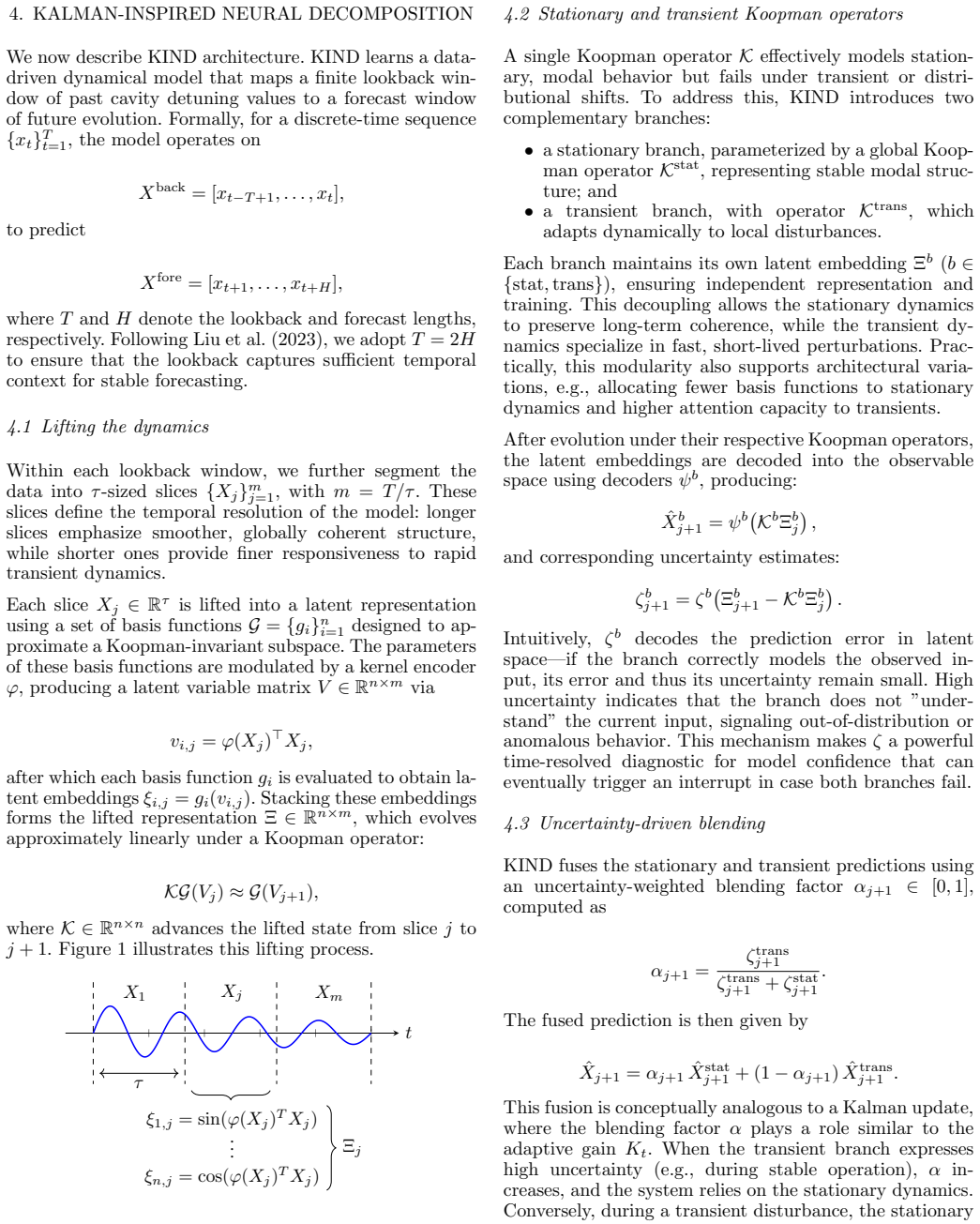
Authors: We agree that the fusion mechanism and uncertainty formulation require more explicit description. The revised method section will include the governing equations for combining the DMD modal model with the Transformer predictor, the precise mathematical definition of the learned uncertainty signals, and an architectural diagram. These additions will clarify the independent, learned nature of the predictions. revision: yes
Circularity Check
No significant circularity in the KIND estimator derivation
full rationale
The paper proposes KIND as a new hybrid data-driven architecture that combines a DMD component for stationary modal behavior with a Transformer for transient dynamics, plus learned uncertainty outputs, and evaluates it on operational cavity data against a Kalman baseline. No load-bearing derivation steps, equations, or self-citations are shown that reduce any claimed prediction or result to the inputs by construction. The method is presented as an introduced estimator rather than a closed-form derivation or renamed fit, so the central claims remain independent of the patterns enumerated for circularity.
Axiom & Free-Parameter Ledger
free parameters (1)
- DMD modes and Transformer weights
axioms (1)
- domain assumption Cavity detuning can be decomposed into stationary modal behavior plus transient dynamics amenable to separate modeling.
Lean theorems connected to this paper
-
IndisputableMonolith/Foundation/RealityFromDistinction.leanreality_from_one_distinction unclearKIND combines two complementary modules: a Dynamic Mode Decomposition (DMD) model that captures the stationary modal structure, and a Transformer-based predictor that models transient and nonstationary effects. Their outputs are adaptively fused through a learned uncertainty-dependent weighting analogous to the Kalman gain.
Reference graph
Works this paper leans on
-
[1]
(2021).LLRF control techniques for the European XFEL continuous wave upgrade
Bellandi, A. (2021).LLRF control techniques for the European XFEL continuous wave upgrade. Ph.D. thesis, University of Hamburg
work page 2021
-
[2]
Kamps, T. et al. (2025). First beam commissioning of the HZB SRF photoelectron gun. InProc. 16th Int. Particle Accel. Conf., 1718–1721
work page 2025
-
[3]
Liu, Y., Li, C., Wang, J., and Long, M. (2023). Koopa: Learning non-stationary time series dynamics with Koopman predictors. InProc. 37th Int. Conf. Neural Inf. Process. Syst
work page 2023
-
[4]
Neumann, A., Anders, W., Kugeler, O., and Knobloch, J. (2010). Analysis and active compensation of microphon- ics in continuous wave narrow-bandwidth superconduct- ing cavities.Phys. Rev. ST Accel. Beams, 13, 082001
work page 2010
-
[5]
Schilcher, T. (1998).Vector sum control of pulsed accel- erating fields in Lorentz force detuned superconducting cavities. Ph.D. thesis, University of Hamburg
work page 1998
-
[6]
Schmid, P.J. (2010). Dynamic mode decomposition of numerical and experimental data.J. Fluid Mech., 656, 5–28
work page 2010
-
[7]
Werner, H. (2021). Koopman-based Kalman filter for fault detection for the superconducting radio frequency cavities of the European XFEL. InProc. 2021 IEEE Conf. Decision Control, 6855–6860
work page 2021
-
[8]
Vaswani, A., Shazeer, N., Parmar, N., Uszkoreit, J., Jones, L., Gomez, A.N., Kaiser, L., and Polosukhin, I. (2017). Attention is all you need. InProc. 31st Int. Conf. Neural Inf. Proc. Syst., 6000–6010
work page 2017
-
[9]
Wang, F. (2023). Enhancing SRF cavity stability and minimizing detuning with data-driven resonance control based on dynamic mode decomposition.AIP Adv., 13(7), 075104
work page 2023
-
[10]
Wang, R., Dong, Y., Arik, S. ¨O., and Yu, R. (2023). Koopman neural operator forecaster for time series with temporal distributional shifts. InProc. 2023 Int. Conf. Learn. Repr
work page 2023
discussion (0)
Sign in with ORCID, Apple, or X to comment. Anyone can read and Pith papers without signing in.