Recognition: 2 theorem links
· Lean TheoremAssessment of cloud and associated radiation fields from a GAN stochastic cloud subcolumn generator
Pith reviewed 2026-05-13 04:36 UTC · model grok-4.3
The pith
A GAN-based stochastic generator for cloud subcolumns reproduces observed overlap patterns and reduces radiation calculation bias by a factor of three.
A machine-rendered reading of the paper's core claim, the machinery that carries it, and where it could break.
Core claim
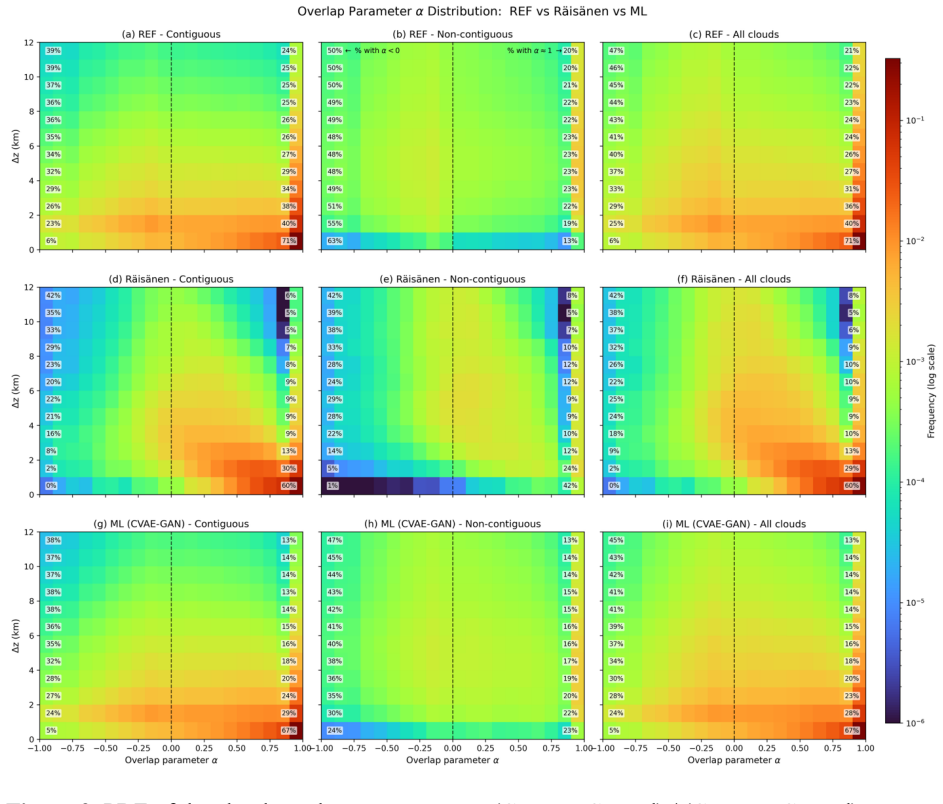
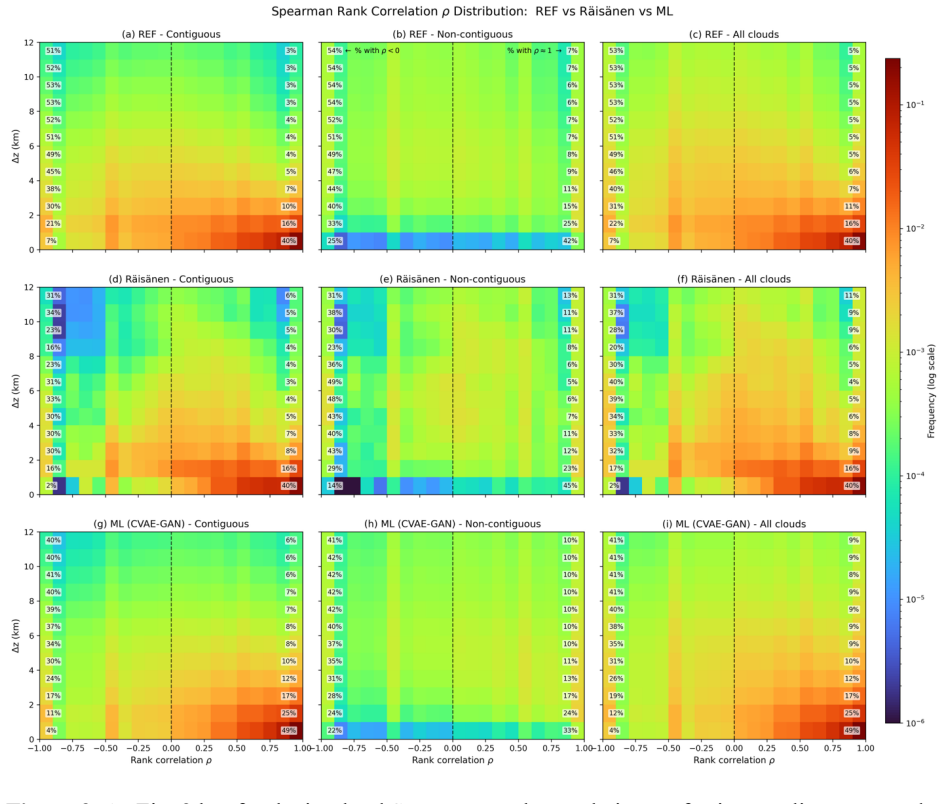
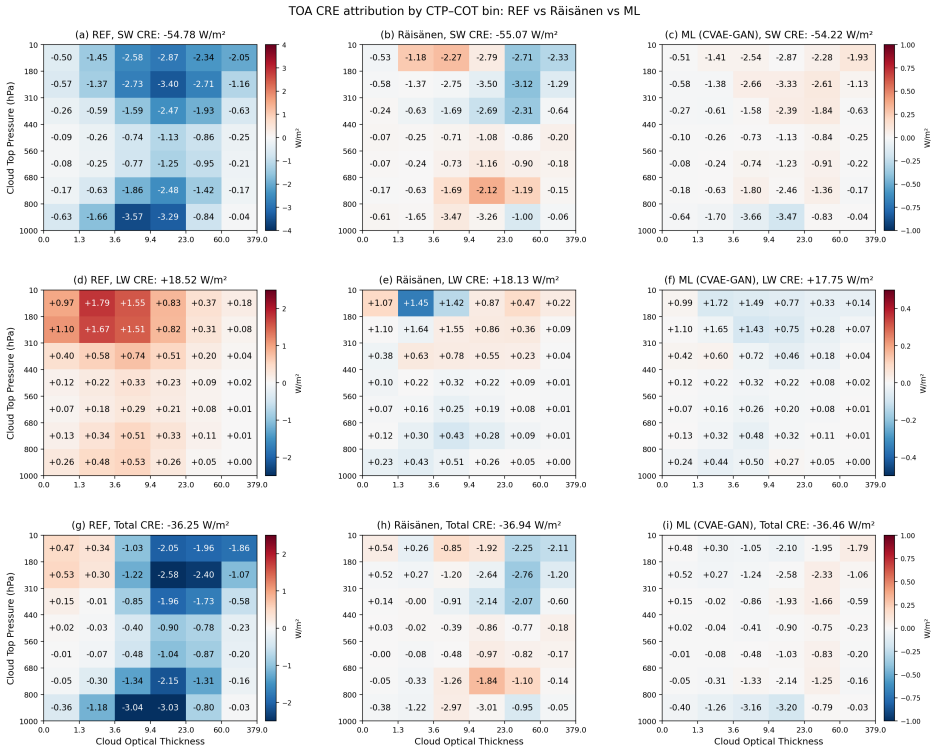
The paper claims that its CVAE-GAN U-Net subcolumn generator, trained on merged CloudSat-CALIPSO height-resolved cloud optical depth data, accurately reproduces bimodal cloud overlap distributions, significantly reduces biases in grid-mean statistics, halves the root-mean-square error in ISCCP-style cloud-top pressure and optical thickness joint histograms, and reduces the global-mean shortwave top-of-atmosphere cloud radiative effect bias by a factor of three relative to the established Raisanen generator in offline radiative transfer calculations.
What carries the argument
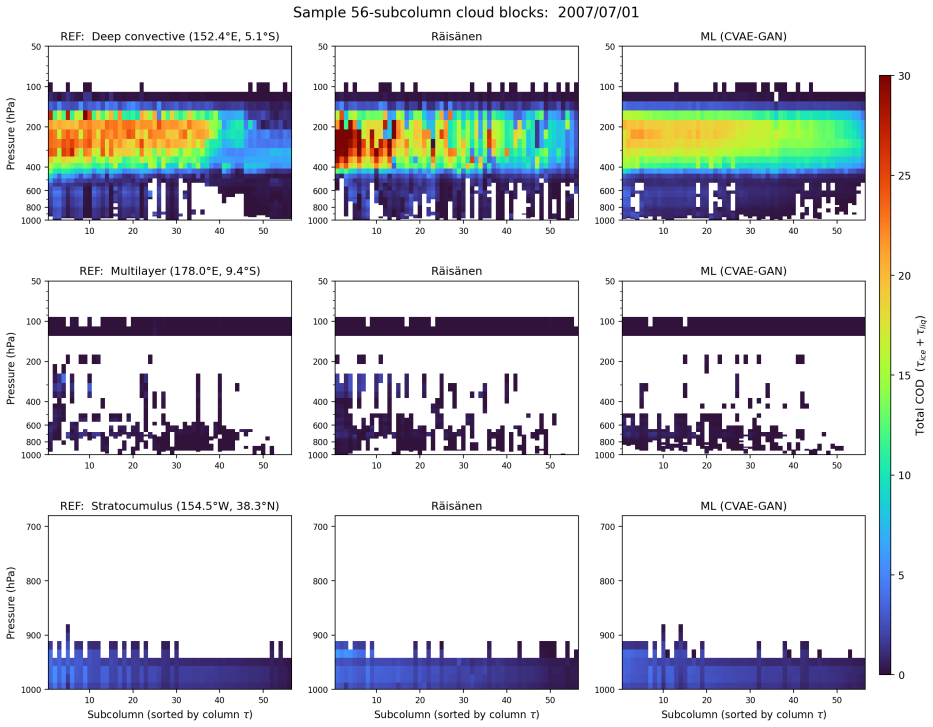
The two-stage CVAE-GAN combined with U-Net that generates 56 stochastic subcolumns representing cloud occurrence and optical depth profiles.
If this is right
- The ML generator reproduces bimodal cloud overlap distributions that traditional methods miss.
- Biases in grid-mean cloud statistics are significantly reduced.
- The root-mean-square error in ISCCP-style joint histograms is halved.
- The global-mean shortwave top-of-atmosphere cloud radiative effect bias is reduced by a factor of three in offline calculations.
Where Pith is reading between the lines
- If integrated online, the generator may reduce structural errors at the cloud-radiation interface in full model runs.
- CPU acceleration of the generator would enable its use in operational climate simulations.
- Similar machine learning approaches could be applied to other atmospheric models with appropriate training data.
Load-bearing premise
The bias reductions observed in offline radiative transfer calculations will persist when the generator is coupled online inside the full GEOS atmospheric model and that the generator can be made sufficiently fast for practical use on CPUs.
What would settle it
Performing radiative transfer calculations or full model simulations with the ML generator and comparing the resulting cloud radiative effects against independent satellite observations of top-of-atmosphere fluxes would determine if the reported bias reduction holds.
Figures




read the original abstract
Modern Earth System Models (ESMs) operate on horizontal scales far larger than typical cloud features, requiring stochastic subcolumn generators to represent subgrid horizontal and vertical cloud variability. Traditional physically-based generators often rely on analytical cloud overlap paradigms, such as exponential-random decorrelation, which can struggle to capture the complex, anti-correlated behavior of non-contiguous cloud layers. In this study, we introduce a novel two-stage machine learning subcolumn generator for the GEOS atmospheric model, utilizing a Conditional Variational Autoencoder combined with a Generative Adversarial Network (CVAE-GAN) and a U-Net architecture. Trained on a merged CloudSat-CALIPSO height-resolved cloud optical depth dataset, the ML generator creates 56 stochastic subcolumns representing cloud occurrence and optical depth profiles. Evaluated against the established R\"{a}is\"{a}nen, the ML approach accurately reproduces bimodal cloud overlap distributions, significantly reduces biases in grid-mean statistics, and halves the root-mean-square error in ISCCP-style cloud-top pressure and optical thickness joint histograms. The improvements brought by our deep generative models translate into more accurate offline radiative transfer calculations, reducing the global-mean shortwave top-of-atmosphere cloud radiative effect bias by a factor of three. Provided that the generator can be accelerated on CPUs, this offers a practical pathway to reduce structural errors at the cloud-radiation interface.
Editorial analysis
A structured set of objections, weighed in public.
Referee Report
Summary. The manuscript introduces a two-stage deep generative model (CVAE-GAN combined with U-Net) to generate 56 stochastic subcolumns of cloud occurrence and optical depth profiles for use in the GEOS atmospheric model. Trained on merged CloudSat-CALIPSO height-resolved cloud optical depth data, the model is assessed against the established Räisänen generator. It demonstrates improved reproduction of bimodal cloud overlap distributions, reduced biases in grid-mean statistics, halved root-mean-square error in ISCCP-style cloud-top pressure and optical thickness joint histograms, and a factor-of-three reduction in global-mean shortwave top-of-atmosphere cloud radiative effect bias in offline radiative transfer calculations. The work concludes that, pending CPU acceleration, this offers a practical pathway to reduce structural errors at the cloud-radiation interface in ESMs.
Significance. If the reported improvements in offline radiative transfer calculations translate to online coupling within the full GEOS model, this approach could meaningfully advance the representation of subgrid-scale cloud variability and associated radiative effects in Earth system models. The quantitative gains against a standard baseline are notable, but the significance depends on demonstrating robustness and computational viability in an operational setting.
major comments (2)
- The abstract and results report concrete quantitative improvements such as halved RMSE and factor-of-three bias reduction, but provide no error bars, details on cross-validation, or sensitivity tests to the training data or hyperparameters. This makes it difficult to gauge the statistical significance and robustness of the claimed gains.
- The central applied claim is that the generator provides a practical pathway inside the full GEOS model. However, all evaluations are performed in offline radiative transfer calculations; no tests of online integration with the model's dynamics, microphysics, or other parameterizations are presented. Additionally, no wall-clock timing or scaling information is provided to assess CPU feasibility for operational runs.
minor comments (2)
- Clarify the exact architecture details of the two-stage CVAE-GAN and U-Net, including how the 56 subcolumns are generated and any post-processing steps.
- Ensure all figures include error bars or uncertainty estimates where quantitative comparisons are shown.
Simulated Author's Rebuttal
We thank the referee for the constructive and insightful comments, which have helped us improve the clarity and robustness of the manuscript. We address each major comment below and have made revisions to incorporate additional statistical details and computational feasibility information where feasible.
read point-by-point responses
-
Referee: The abstract and results report concrete quantitative improvements such as halved RMSE and factor-of-three bias reduction, but provide no error bars, details on cross-validation, or sensitivity tests to the training data or hyperparameters. This makes it difficult to gauge the statistical significance and robustness of the claimed gains.
Authors: We acknowledge the value of providing uncertainty estimates and validation details. In the revised manuscript, we now report error bars on all key metrics (RMSE, bias reductions, and overlap statistics) computed from an ensemble of five models trained with different random seeds. We have added a description of our data splitting procedure (training on 2010-2015 CloudSat-CALIPSO orbits and evaluating on 2016-2018) as a form of temporal cross-validation to assess generalization. Sensitivity tests to the latent space dimension, KL-divergence weight, and adversarial loss coefficient are now included in a new supplementary section, showing that the reported improvements remain stable within reasonable hyperparameter ranges. Full k-fold cross-validation was not performed due to the high computational cost of retraining the CVAE-GAN multiple times on the full dataset, which we now explicitly note as a limitation. revision: partial
-
Referee: The central applied claim is that the generator provides a practical pathway inside the full GEOS model. However, all evaluations are performed in offline radiative transfer calculations; no tests of online integration with the model's dynamics, microphysics, or other parameterizations are presented. Additionally, no wall-clock timing or scaling information is provided to assess CPU feasibility for operational runs.
Authors: We agree that online coupling tests would provide the strongest demonstration of operational viability. Performing such tests requires substantial code integration with the GEOS dynamical core, microphysics, and radiation schemes, which was beyond the scope and resources of the present study. We have added preliminary CPU wall-clock timings for subcolumn generation (batch size of 56 profiles per grid column on standard Xeon hardware) and discuss potential acceleration strategies such as ONNX export and quantization that could bring the overhead to acceptable levels for global simulations. A new paragraph in the conclusions outlines the specific steps required for online implementation and notes that interactions with other parameterizations remain to be quantified. The offline radiative transfer results still provide quantitative evidence that the improved subcolumn statistics reduce structural cloud-radiation errors, but we have revised the abstract and conclusions to frame this as a promising pathway pending further online validation. revision: partial
- Full online integration and testing of the generator within the complete GEOS model, including interactions with dynamics, microphysics, and other parameterizations, due to the extensive model development and computational resources required.
Circularity Check
No significant circularity in the ML subcolumn generator evaluation
full rationale
The paper's core chain consists of training a CVAE-GAN + U-Net model on independent merged CloudSat-CALIPSO height-resolved cloud optical depth observations, then generating 56 stochastic subcolumns per grid column and evaluating them against the external Raisanen generator using separate metrics (bimodal overlap distributions, grid-mean biases, ISCCP CTP-tau histograms, and offline radiative transfer for SW TOA CRE). No equations, fitted parameters, or self-citations reduce the reported improvements to quantities that are equivalent to the inputs by construction. The training data and evaluation benchmarks are external; the performance gains are empirical outcomes of the model rather than definitional or statistically forced. This is a standard ML training-plus-validation workflow with no load-bearing self-referential steps.
Axiom & Free-Parameter Ledger
axioms (1)
- domain assumption Satellite-derived cloud optical depth profiles from CloudSat-CALIPSO are sufficiently accurate and representative to train a generator usable inside the GEOS atmospheric model.
Lean theorems connected to this paper
-
IndisputableMonolith/Cost/FunctionalEquation.leanwashburn_uniqueness_aczel uncleartwo-stage machine learning subcolumn generator ... Conditional Variational Autoencoder combined with a Generative Adversarial Network (CVAE-GAN) and a U-Net architecture ... reproduces bimodal cloud overlap distributions
-
IndisputableMonolith/Foundation/DimensionForcing.leanalexander_duality_circle_linking unclearevaluated against the established Räisänen generator ... halves the root-mean-square error in ISCCP-style cloud-top pressure and optical thickness joint histograms
discussion (0)
Sign in with ORCID, Apple, or X to comment. Anyone can read and Pith papers without signing in.