Recognition: no theorem link
Stochastic Ordering under Weaker Likelihood-Ratio Shape Conditions
Pith reviewed 2026-05-13 04:01 UTC · model grok-4.3
The pith
Weaker shape conditions on the likelihood ratio still yield endpoint criteria for hazard-rate and usual stochastic orders.
A machine-rendered reading of the paper's core claim, the machinery that carries it, and where it could break.
Core claim
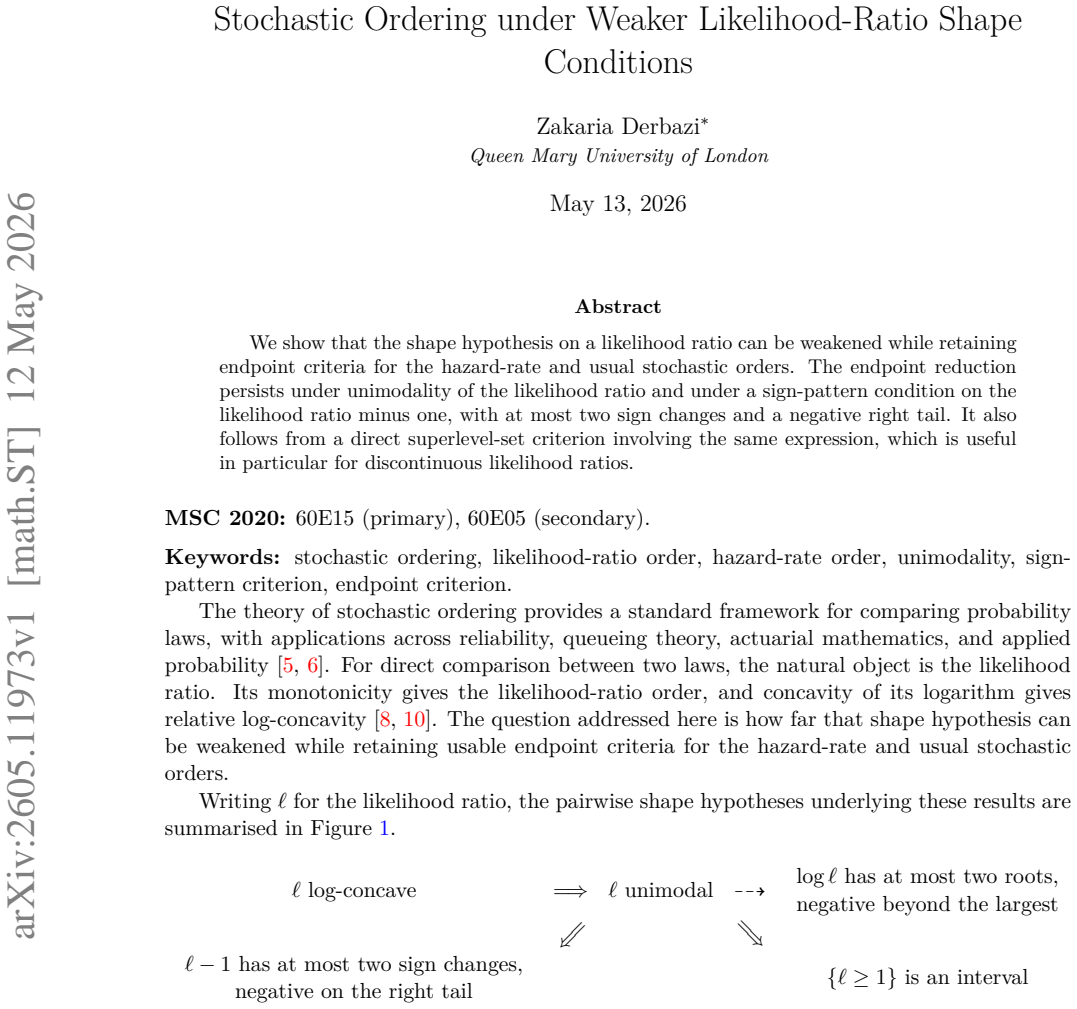
The endpoint reduction for the hazard-rate order and the usual stochastic order persists when the likelihood ratio satisfies unimodality, or a sign-pattern condition on the likelihood ratio minus one with at most two sign changes and negative right tail, or a direct superlevel-set criterion on the same expression. The superlevel-set version is noted to be useful especially when the likelihood ratio is discontinuous.
What carries the argument
The likelihood ratio between two distributions, together with its shape properties (unimodality, sign-pattern of ratio minus one, or superlevel sets) that permit reduction of the stochastic order to endpoint behavior.
If this is right
- Hazard-rate order between two distributions can be verified by endpoint comparison once the likelihood ratio meets one of the three relaxed shape conditions.
- Usual stochastic order follows from the same endpoint reduction under the same weakened hypotheses.
- The criteria remain valid for likelihood ratios that are discontinuous.
- A sign-pattern condition with at most two changes and negative right tail is sufficient for the reduction to hold.
Where Pith is reading between the lines
- Empirical checks of stochastic order could become simpler when the estimated likelihood ratio is inspected only for unimodality or sign changes rather than strict monotonicity.
- The approach may extend to comparing families of distributions in reliability models where hazard rates are the primary object of interest.
- The superlevel-set formulation offers a direct computational test that could be applied to binned or nonparametric density estimates.
Load-bearing premise
The likelihood ratio between the two distributions satisfies unimodality or the stated sign-pattern or superlevel-set condition.
What would settle it
Two distributions whose likelihood ratio is unimodal but whose hazard functions violate the endpoint-predicted hazard-rate order.
Figures

read the original abstract
We show that the shape hypothesis on a likelihood ratio can be weakened while retaining endpoint criteria for the hazard-rate and usual stochastic orders. The endpoint reduction persists under unimodality of the likelihood ratio and under a sign-pattern condition on the likelihood ratio minus one, with at most two sign changes and a negative right tail. It also follows from a direct superlevel-set criterion involving the same expression, which is useful in particular for discontinuous likelihood ratios.
Editorial analysis
A structured set of objections, weighed in public.
Referee Report
Summary. The paper shows that endpoint criteria for hazard-rate and usual stochastic orders hold under weakened likelihood-ratio shape conditions, specifically unimodality of the likelihood ratio, a sign-pattern condition on the likelihood ratio minus one with at most two sign changes and a negative right tail, or a superlevel-set criterion. These are presented as strictly weaker than standard assumptions and are supported by direct proofs, with applicability to discontinuous cases.
Significance. If the results are correct, this contribution is significant for expanding the applicability of stochastic ordering results in mathematical statistics, particularly in areas like survival analysis where likelihood ratios may not be monotone. The manuscript's use of direct proofs for the extensions is a notable strength, offering transparent and parameter-free arguments grounded in the definitions of the orders.
minor comments (1)
- [Abstract] The abstract effectively summarizes the main result but could include a reference to the specific theorem or section containing the proofs for better navigation.
Simulated Author's Rebuttal
We thank the referee for the positive assessment of our manuscript and for recommending minor revision. The referee's summary accurately captures the main results on weakened likelihood-ratio shape conditions (unimodality, sign-pattern with negative tail, and superlevel-set criteria) that suffice for the endpoint criteria in hazard-rate and usual stochastic orders. As no specific major comments were provided in the report, we have no points requiring response or revision.
Circularity Check
No significant circularity detected
full rationale
The manuscript is a pure theoretical derivation in stochastic ordering. It proves that endpoint criteria for hazard-rate and usual stochastic orders continue to hold when the likelihood-ratio shape hypothesis is relaxed to unimodality, a sign-pattern condition on LR-1 (at most two sign changes, negative right tail), or a direct superlevel-set criterion. All steps are direct mathematical arguments from the definitions of the orders and the stated shape conditions; no parameters are fitted to data, no predictions are constructed by renaming fitted quantities, and no load-bearing results are imported via self-citation. The derivation chain is therefore self-contained against the external definitions of stochastic orders and likelihood ratios.
Axiom & Free-Parameter Ledger
axioms (2)
- standard math Standard definitions of hazard-rate order, usual stochastic order, and likelihood ratio ordering hold as background.
- domain assumption The likelihood ratio is a measurable function between two probability densities.
Reference graph
Works this paper leans on
-
[1]
Advances in Applied Probability , volume =
Klenke, Achim and Mattner, Lutz , title =. Advances in Applied Probability , volume =. 2010 , doi =
work page 2010
- [2]
-
[3]
Comparison Methods for Stochastic Models and Risks , publisher =
M. Comparison Methods for Stochastic Models and Risks , publisher =. 2002 , doi =
work page 2002
-
[4]
Johnson, Norman L. and Kemp, Adrienne W. and Kotz, Samuel , title =. 2005 , doi =
work page 2005
-
[5]
Ollero Hinojosa, Jorge and Ramos Romero, H. La distribuci. Trabajos de Estad. 1991 , url =
work page 1991
-
[6]
Belzunce, F. Sufficient conditions for some stochastic orders of discrete random variables with applications in reliability , shortjournal =. Mathematics , volume =. 2022 , doi =
work page 2022
-
[7]
Barlow, Richard E. and Proschan, Frank , title =. 1981 , note =
work page 1981
-
[8]
Kochar, Subhash C. and Rojo, Javier , title =. Journal of Multivariate Analysis , volume =. 1996 , doi =
work page 1996
- [9]
-
[10]
IEEE Transactions on Reliability , volume =
Zhang, Zhengcheng and Li, Xiaohu , title =. IEEE Transactions on Reliability , volume =. 2010 , doi =
work page 2010
-
[11]
Lehmann, E. L. , title =. Annals of Mathematical Statistics , volume =. 1955 , doi =
work page 1955
-
[12]
Liew, K. W. and Ong, S. H. , title =. Malaysian Journal of Science , volume =
- [13]
- [14]
- [15]
- [16]
-
[17]
Journal of Applied Probability , volume =
Yu, Yaming , title =. Journal of Applied Probability , volume =. 2009 , doi =
work page 2009
-
[18]
Annals of Mathematical Statistics , volume =
Noack, Albert , title =. Annals of Mathematical Statistics , volume =
- [19]
- [20]
-
[21]
Discrete Applied Mathematics , volume =
Johnson, Oliver and Kontoyiannis, Ioannis and Madiman, Mokshay , title =. Discrete Applied Mathematics , volume =. 2013 , doi =
work page 2013
-
[22]
Journal of Applied Probability , volume =
Whitt, Ward , title =. Journal of Applied Probability , volume =. 1985 , doi =
work page 1985
-
[23]
The Canadian Journal of Statistics / La Revue Canadienne de Statistique , volume =
Keilson, Julian and Sumita, Ushio , title =. The Canadian Journal of Statistics / La Revue Canadienne de Statistique , volume =. 1982 , doi =
work page 1982
-
[24]
Probability in the Engineering and Informational Sciences , volume =
Xia, Wanwan and Lv, Wenhua , title =. Probability in the Engineering and Informational Sciences , volume =. 2024 , doi =
work page 2024
-
[25]
Annals of Mathematical Statistics , volume =
Karlin, Samuel and Rubin, Herman , title =. Annals of Mathematical Statistics , volume =. 1956 , doi =
work page 1956
-
[26]
Journal of the American Statistical Association , volume =
Karlin, Samuel and Rubin, Herman , title =. Journal of the American Statistical Association , volume =. 1956 , doi =
work page 1956
- [27]
-
[28]
Misra, Neeraj and Singh, Harshinder and Harner, E. James , title =. Statistics & Probability Letters , volume =. 2003 , doi =
work page 2003
-
[29]
Statistics & Probability Letters , volume =
Alamatsaz, Mohammad Hossein and Abbasi, Somayyeh , title =. Statistics & Probability Letters , volume =. 2008 , doi =
work page 2008
-
[30]
Open Journal of Statistics , volume =
Pudprommarat, Chookait and Bodhisuwan, Winai , title =. Open Journal of Statistics , volume =. 2012 , doi =
work page 2012
-
[31]
Statistics & Probability Letters , volume =
Majumder, Priyanka and Mitra, Murari , title =. Statistics & Probability Letters , volume =. 2018 , doi =
work page 2018
-
[32]
Statistics & Probability Letters , volume =
Wang, Jiantian and Cheng, Bin , title =. Statistics & Probability Letters , volume =. 2021 , doi =
work page 2021
-
[33]
Statistics & Probability Letters , volume =
Fried, Sela , title =. Statistics & Probability Letters , volume =. 2021 , doi =
work page 2021
-
[34]
Alenazi, Abdulaziz , title =. Mathematics , volume =. 2025 , doi =
work page 2025
-
[35]
Statistics & Probability Letters , volume =
Yao, Jia and Lou, Bendong and Pan, Xiaoqing , title =. Statistics & Probability Letters , volume =. 2023 , doi =
work page 2023
-
[36]
Journal of Applied Probability , volume =
Hsiau, Shoou-Ren and Yao, Yi-Ching , title =. Journal of Applied Probability , volume =. 2024 , doi =
work page 2024
-
[37]
Corradini, Michela and Strokorb, Kirstin , title =. Extremes , volume =. 2024 , doi =
work page 2024
- [38]
-
[39]
Statistics & Probability Letters , volume =
Wang, Bing and Wang, Min , title =. Statistics & Probability Letters , volume =. 2011 , doi =
work page 2011
discussion (0)
Sign in with ORCID, Apple, or X to comment. Anyone can read and Pith papers without signing in.