Recognition: 2 theorem links
· Lean TheoremOptimizing 4D Wires for Sparse 3D Abstraction
Pith reviewed 2026-05-13 07:30 UTC · model grok-4.3
The pith
A single continuous 4D B-spline wire captures complex volumetric shapes while enforcing global topological coherence.
A machine-rendered reading of the paper's core claim, the machinery that carries it, and where it could break.
Core claim
A single continuous spline parameterized as a B-spline with spatial coordinates and variable width (x, y, z, w) is sufficiently expressive to capture complex volumetric forms while enforcing global topological coherence; the continuity constraint turns 3D sketching into a global routing problem that yields cleaner aesthetics and improved structural coherence, enabled by a differentiable rendering pipeline that rasterizes variable-width curves with bounded projection error.
What carries the argument
The 4D wire, a single B-spline carrying position (x,y,z) and width (w), together with the differentiable rendering pipeline that projects variable-width curves onto images while keeping projection error bounded.
If this is right
- Image-to-3D abstraction yields structures with higher semantic fidelity than collections of independent curves.
- Multi-view wire art generation produces outputs with measurably improved structural coherence.
- Differentiable stylized surface filling becomes possible under one continuous representation.
Where Pith is reading between the lines
- Single-curve outputs may be fabricated directly as physical wire sculptures without additional joining steps.
- The global-routing bias could extend to other sparse path-planning problems such as network layout or stroke-based rendering.
- Variable-width encoding might be generalized to carry additional per-point attributes such as color or material.
Load-bearing premise
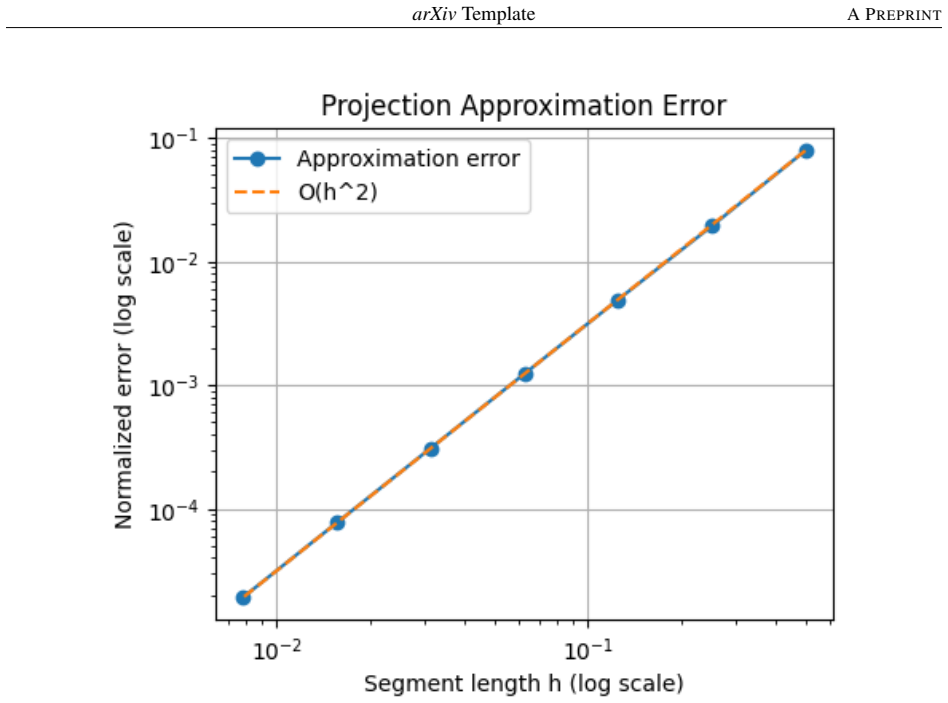
The differentiable rendering pipeline for variable-width curves must keep projection error bounded enough to produce stable gradients across the optimization tasks.
What would settle it
Optimize the 4D spline on a standard image-to-3D task; the claim fails if the resulting structure fragments into multiple disconnected pieces or loses semantic match to the input.
Figures





read the original abstract
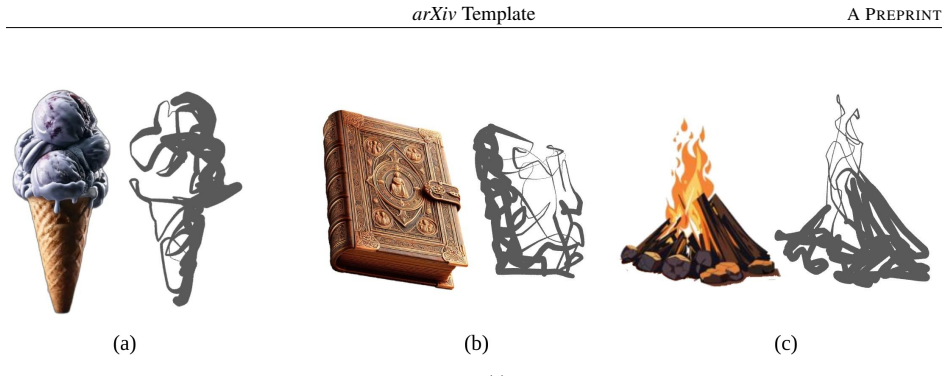
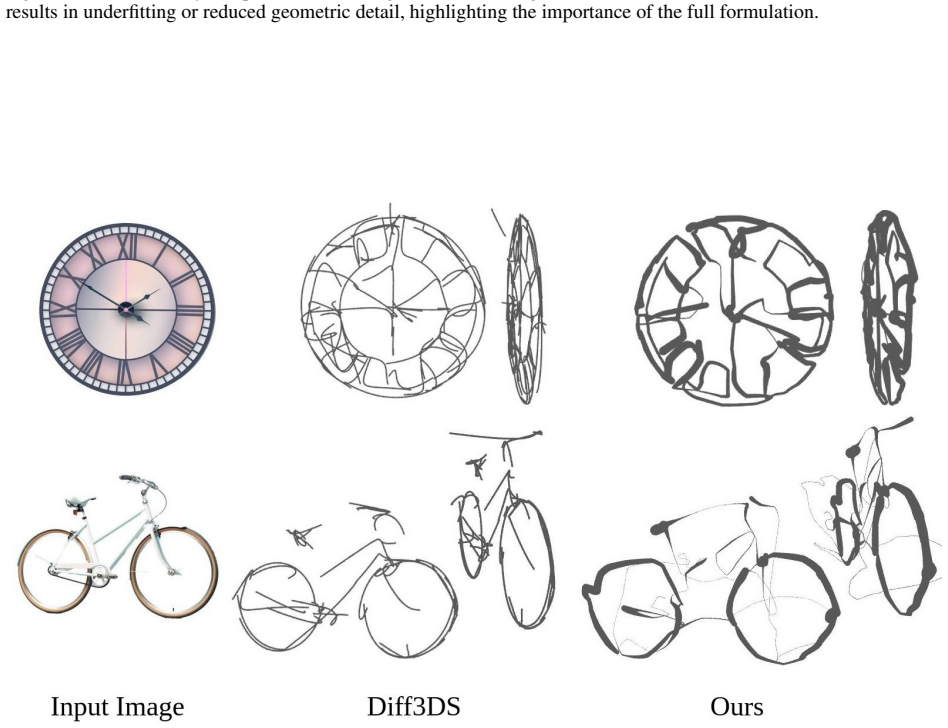
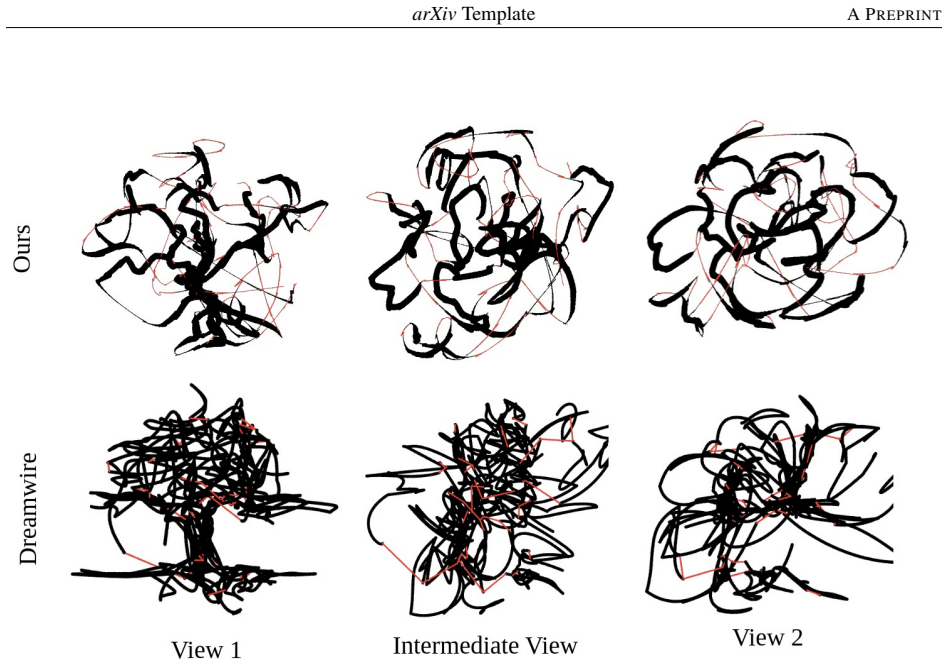
We present a unified framework for 3D geometric abstraction using a single continuous 4D wire, parameterized as a B-spline with spatial coordinates and variable width $(x,y,z,w)$. Existing approaches typically represent shapes as collections of many independent curve segments, which often leads to fragmented structures and limited physical realizability. In contrast, we show that a single continuous spline is sufficiently expressive to capture complex volumetric forms while enforcing global topological coherence. By imposing continuity, our method transforms 3D sketching from a local density-accumulation process into a global routing problem, providing a strong inductive bias toward cleaner aesthetics and improved structural coherence. To enable gradient-based optimization, we introduce a differentiable rendering pipeline that efficiently rasterizes variable-width curves with bounded projection error. This formulation supports robust optimization using modern guidance signals such as Score Distillation Sampling (SDS) or CLIP. We demonstrate applications including image-to-3D abstraction, multi-view wire art generation, and differentiable stylized surface filling. Experiments show that our unified representation produces structures with higher semantic fidelity and improved structural coherence compared to approaches based on collections of discrete curves.
Editorial analysis
A structured set of objections, weighed in public.
Referee Report
Summary. The manuscript proposes representing 3D shapes via a single continuous 4D B-spline wire with coordinates and variable width (x,y,z,w). It claims this unified representation is sufficiently expressive for complex volumetric forms while enforcing global topological coherence, unlike collections of independent curve segments. A differentiable rendering pipeline is introduced to rasterize variable-width curves with bounded projection error, supporting gradient-based optimization with signals such as SDS or CLIP. Demonstrated applications include image-to-3D abstraction, multi-view wire art generation, and differentiable stylized surface filling, with experiments reporting higher semantic fidelity and structural coherence.
Significance. If the bounded-error rendering claim and expressiveness results hold, the work would provide a topologically coherent alternative to fragmented curve collections, with benefits for generative 3D modeling, physical realizability, and stable optimization in graphics pipelines. The reliance on standard B-spline continuity plus external guidance signals is a practical strength that could influence sparse abstraction methods.
major comments (2)
- [Abstract and §3] Abstract and §3 (Differentiable Rendering Pipeline): the central claim that the pipeline produces 'bounded projection error' sufficient for stable gradients is load-bearing for the optimization and expressiveness arguments, yet no derivation, explicit error bound, or analysis is supplied for the regime where local curvature radius approaches or falls below w(t)/2 or when dw/dt is large. This leaves the skeptic concern about discontinuities or aliasing in offset curves unaddressed.
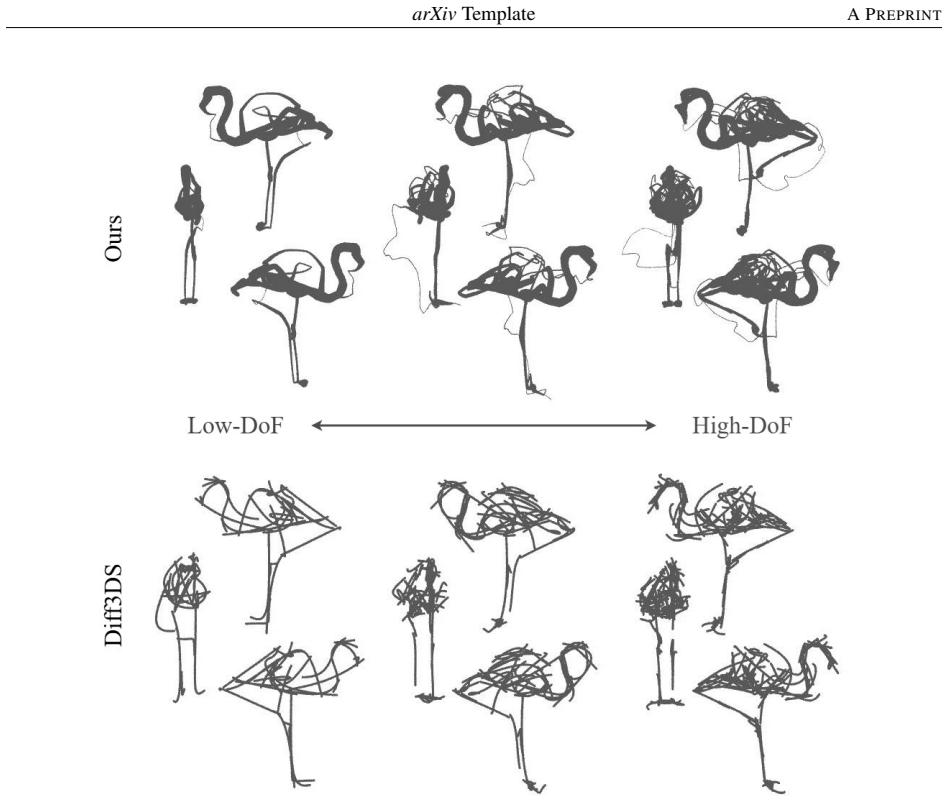
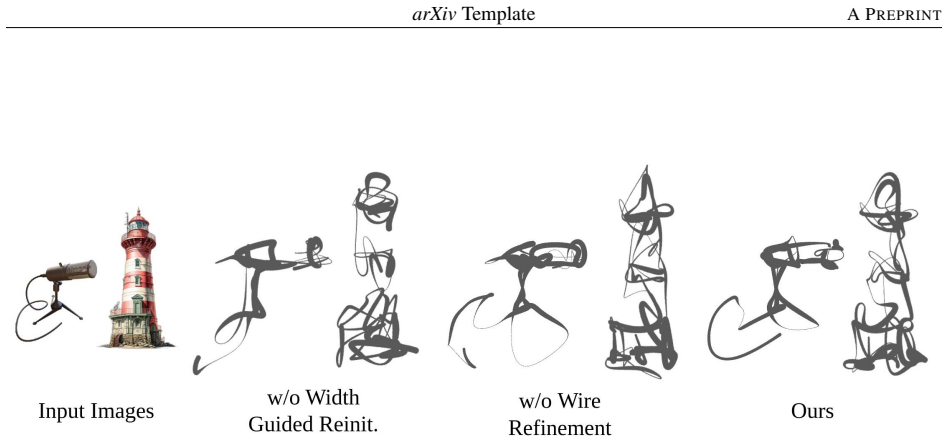
- [§5] §5 (Experiments): the reported improvements in semantic fidelity and structural coherence over discrete-curve baselines do not include ablations that isolate the single-spline constraint from other factors such as total parameter count or guidance-signal strength, weakening the causal link to the 4D-wire representation.
minor comments (2)
- [Introduction] The introduction would benefit from an explicit equation defining the 4D B-spline parameterization (control points, knot vector, degree) to ground the subsequent claims.
- [Figures] Figure captions for the rendering pipeline should include a brief note on the approximation method used for thick-curve rasterization.
Simulated Author's Rebuttal
We thank the referee for the constructive and detailed feedback. The comments highlight important areas for strengthening the theoretical grounding of the rendering pipeline and the experimental isolation of the representation's benefits. We address each point below and will revise the manuscript accordingly.
read point-by-point responses
-
Referee: [Abstract and §3] Abstract and §3 (Differentiable Rendering Pipeline): the central claim that the pipeline produces 'bounded projection error' sufficient for stable gradients is load-bearing for the optimization and expressiveness arguments, yet no derivation, explicit error bound, or analysis is supplied for the regime where local curvature radius approaches or falls below w(t)/2 or when dw/dt is large. This leaves the skeptic concern about discontinuities or aliasing in offset curves unaddressed.
Authors: We acknowledge that the manuscript asserts bounded projection error without supplying a formal derivation or analysis for the critical regimes where curvature radius approaches w(t)/2 or dw/dt becomes large. In the revised version we will add a dedicated error-analysis subsection to §3. This will derive explicit projection-error bounds under these conditions, characterize the continuity of the offset curves, and include both theoretical limits and numerical checks confirming gradient stability. The revision will directly address potential discontinuities and aliasing. revision: yes
-
Referee: [§5] §5 (Experiments): the reported improvements in semantic fidelity and structural coherence over discrete-curve baselines do not include ablations that isolate the single-spline constraint from other factors such as total parameter count or guidance-signal strength, weakening the causal link to the 4D-wire representation.
Authors: We agree that stronger isolation of the single-spline constraint is needed. The current experiments compare against discrete baselines but do not control for parameter count or guidance-signal strength. In the revision we will add two targeted ablations: (1) a parameter-matched comparison in which the discrete-curve baseline is given an equivalent total number of degrees of freedom, and (2) a controlled sweep of guidance-signal strength (SDS and CLIP) while holding the representation fixed. These results will be reported in §5 to clarify the contribution of topological coherence. revision: yes
Circularity Check
No circularity: derivation rests on standard B-spline properties and external guidance
full rationale
The paper's core argument—that a single 4D B-spline is expressive for volumetric forms—follows directly from the continuity and differentiability properties of B-splines, which are standard and externally verifiable. The differentiable rendering pipeline is introduced as a new technical component supporting gradient-based optimization with SDS/CLIP signals; no equations or predictions are shown to reduce by construction to fitted parameters defined on the same data, nor does any load-bearing step rely on self-citation chains or imported uniqueness theorems. The abstract and described formulation remain self-contained against external benchmarks.
Axiom & Free-Parameter Ledger
free parameters (1)
- B-spline control points and widths
axioms (1)
- standard math B-splines provide C2 continuity and local support
invented entities (1)
-
4D wire (x,y,z,w)
no independent evidence
Lean theorems connected to this paper
-
IndisputableMonolith/Foundation/RealityFromDistinction.leanreality_from_one_distinction echoes?
echoesECHOES: this paper passage has the same mathematical shape or conceptual pattern as the Recognition theorem, but is not a direct formal dependency.
a single continuous spline is sufficiently expressive to capture complex volumetric forms while enforcing global topological coherence... transforms 3D sketching from a local density-accumulation process into a global routing problem
-
IndisputableMonolith/Foundation/ArithmeticFromLogic.leanLogicNat inductive structure and embed_add echoes?
echoesECHOES: this paper passage has the same mathematical shape or conceptual pattern as the Recognition theorem, but is not a direct formal dependency.
uniform cubic B-splines... guarantee C² continuity across the entire wire... knot insertion... preserves the global B-spline formulation
What do these tags mean?
- matches
- The paper's claim is directly supported by a theorem in the formal canon.
- supports
- The theorem supports part of the paper's argument, but the paper may add assumptions or extra steps.
- extends
- The paper goes beyond the formal theorem; the theorem is a base layer rather than the whole result.
- uses
- The paper appears to rely on the theorem as machinery.
- contradicts
- The paper's claim conflicts with a theorem or certificate in the canon.
- unclear
- Pith found a possible connection, but the passage is too broad, indirect, or ambiguous to say the theorem truly supports the claim.
Reference graph
Works this paper leans on
-
[1]
Berio, Daniel and Stroh, Michael and Calinon, Sylvain and Fol Leymarie, Frederic and Deussen, Oliver and Shamir, Ariel , title =. 2025 , issue_date =. doi:10.1145/3763345 , journal =
- [2]
-
[3]
arXiv preprint arXiv:2405.15305 , year=
Diff3DS: Generating View-Consistent 3D Sketch via Differentiable Curve Rendering , author =. arXiv preprint arXiv:2405.15305 , year=
-
[4]
Wired Perspectives: Multi-View Wire Art Embraces Generative AI , author=. CVPR , year=
-
[5]
Miguel, Eder and Lepoutre, Mathias and Bickel, Bernd , title =. 2016 , issue_date =. doi:10.1145/2897824.2925978 , journal =
-
[6]
Yeh, Chih-Kuo and Le, Thi-Ngoc-Hanh and Hou, Zhi-Ying and Lee, Tong-Yee , title =. 2022 , issue_date =. doi:10.1145/3475798 , journal =
-
[7]
Liu, Lingjie and Ceylan, Duygu and Lin, Cheng and Wang, Wenping and Mitra, Niloy J. , title =. 2017 , issue_date =. doi:10.1145/3072959.3073682 , journal =
-
[8]
Wang, Peng and Liu, Lingjie and Chen, Nenglun and Chu, Hung-Kuo and Theobalt, Christian and Wang, Wenping , title =. 2020 , issue_date =. doi:10.1145/3386569.3392476 , journal =
-
[9]
Iarussi, Emmanuel and Li, Wilmot and Bousseau, Adrien , title =. 2015 , issue_date =. doi:10.1145/2816795.2818118 , month =
-
[10]
Lira, Wallace and Fu, Chi-Wing and Zhang, Hao , title =. 2018 , issue_date =. doi:10.1145/3272127.3275049 , journal =
-
[11]
Choi, Changwoon and Lee, Jaeah and Park, Jaesik and Kim, Young Min , title =. 2024 , issue_date =. doi:10.1145/3658156 , journal =
-
[12]
The conversion matrix between uniform B-spline and Bézier representations , journal =
L Romani and M.A Sabin , keywords =. The conversion matrix between uniform B-spline and Bézier representations , journal =. 2004 , issn =. doi:https://doi.org/10.1016/j.cagd.2004.04.002 , url =
-
[13]
Inserting new knots into B-spline curves , journal =
Wolfgang Boehm , abstract =. Inserting new knots into B-spline curves , journal =. 1980 , issn =. doi:https://doi.org/10.1016/0010-4485(80)90154-2 , url =
-
[14]
Proceedings of the IEEE/CVF International Conference on Computer Vision (ICCV) , month =
Liu, Ruoshi and Wu, Rundi and Van Hoorick, Basile and Tokmakov, Pavel and Zakharov, Sergey and Vondrick, Carl , title =. Proceedings of the IEEE/CVF International Conference on Computer Vision (ICCV) , month =. 2023 , pages =
work page 2023
-
[15]
Hsiao, Kai-Wen and Huang, Jia-Bin and Chu, Hung-Kuo , title =. 2018 , issue_date =. doi:10.1145/3272127.3275070 , journal =
-
[16]
Stable Zero123: Quality 3D Object Generation from Single Images , author=. 2023 , howpublished=
work page 2023
-
[17]
Mathematische Annalen , year =
Hilbert, David , title =. Mathematische Annalen , year =. doi:10.1007/BF01199431 , url =
-
[18]
Peano, G. , title =. Mathematische Annalen , year =. doi:10.1007/BF01199438 , url =
-
[19]
Pedersen, Hans and Singh, Karan , title =. Proceedings of the 4th International Symposium on Non-Photorealistic Animation and Rendering , pages =. 2006 , isbn =. doi:10.1145/1124728.1124742 , abstract =
-
[20]
Tojo, Kenji and Shamir, Ariel and Bickel, Bernd and Umetani, Nobuyuki , title =. 2024 , isbn =. doi:10.1145/3641519.3657453 , booktitle =
-
[21]
Wang, Zhenyu and Lu, Min , title =. Proceedings of the Special Interest Group on Computer Graphics and Interactive Techniques Conference Conference Papers , articleno =. 2025 , isbn =. doi:10.1145/3721238.3730690 , abstract =
-
[22]
Surface-Filling Curve Flows via Implicit Medial Axes , year =
Noma, Yuta and Sell\'. Surface-Filling Curve Flows via Implicit Medial Axes , year =. ACM Trans. Graph. , month = jul, articleno =. doi:10.1145/3658158 , abstract =
-
[23]
Proceedings of the IEEE/CVF Winter Conference on Applications of Computer Vision , pages=
CLIPAG: Towards Generator-Free Text-to-Image Generation , author=. Proceedings of the IEEE/CVF Winter Conference on Applications of Computer Vision , pages=
-
[24]
Proceedings of the IEEE/CVF Conference on Computer Vision and Pattern Recognition (CVPR) , month =
Kwon, Gihyun and Ye, Jong Chul , title =. Proceedings of the IEEE/CVF Conference on Computer Vision and Pattern Recognition (CVPR) , month =. 2022 , pages =
work page 2022
-
[25]
Advances in Neural Information Processing Systems (NeurIPS) , volume=
CLIPDraw: Exploring Text-to-Drawing Synthesis through Language-Image Encoders , author=. Advances in Neural Information Processing Systems (NeurIPS) , volume=
-
[26]
ACM Transactions on Graphics (TOG) , volume=
CLIPasso: Semantically-Aware Object Sketching , author=. ACM Transactions on Graphics (TOG) , volume=. 2022 , publisher=
work page 2022
-
[27]
International Conference on Machine Learning , pages=
Learning Transferable Visual Models From Natural Language Supervision , author=. International Conference on Machine Learning , pages=. 2021 , organization=
work page 2021
-
[28]
Proceedings of the IEEE/CVF Conference on Computer Vision and Pattern Recognition (CVPR) , pages=
VectorFusion: Text-to-SVG by Abstracting Pixel-Based Diffusion Models , author=. Proceedings of the IEEE/CVF Conference on Computer Vision and Pattern Recognition (CVPR) , pages=
-
[29]
Advances in Neural Information Processing Systems (NeurIPS) , volume=
DiffSketcher: Text Guided Vector Sketch Synthesis through Latent Diffusion Models , author=. Advances in Neural Information Processing Systems (NeurIPS) , volume=
-
[30]
Zhao, Haisen and Zhang, Hao and Xin, Shiqing and Deng, Yuanmin and Tu, Changhe and Wang, Wenping and Cohen-Or, Daniel and Chen, Baoquan , title =. ACM Trans. Graph. , month = jul, articleno =. 2018 , issue_date =. doi:10.1145/3197517.3201338 , abstract =
-
[31]
The Twelfth International Conference on Learning Representations , year=
DreamTime: An Improved Optimization Strategy for Diffusion-Guided 3D Generation , author=. The Twelfth International Conference on Learning Representations , year=
-
[32]
Proceedings of the 38th International Conference on Machine Learning , pages=
Learning Transferable Visual Models From Natural Language Supervision , author=. Proceedings of the 38th International Conference on Machine Learning , pages=. 2021 , organization=
work page 2021
-
[33]
International Conference on Learning Representations , year=
A Neural Representation of Sketch Drawings , author=. International Conference on Learning Representations , year=
-
[34]
and Shechtman, Eli and Wang, Oliver , title =
Zhang, Richard and Isola, Phillip and Efros, Alexei A. and Shechtman, Eli and Wang, Oliver , title =. Proceedings of the IEEE Conference on Computer Vision and Pattern Recognition (CVPR) , month =
-
[35]
Curves and Surfaces for CAGD (Fifth Edition) , publisher =
4 - The de Casteljau Algorithm , editor =. Curves and Surfaces for CAGD (Fifth Edition) , publisher =. 2002 , series =. doi:https://doi.org/10.1016/B978-155860737-8/50004-1 , url =
-
[36]
Iluz, Shir and Vinker, Yael and Hertz, Amir and Berio, Daniel and Cohen-Or, Daniel and Shamir, Ariel , title =. ACM Trans. Graph. , month = jul, articleno =. 2023 , issue_date =. doi:10.1145/3592123 , abstract =
-
[37]
The Eleventh International Conference on Learning Representations , year=
DreamFusion: Text-to-3D using 2D Diffusion , author=. The Eleventh International Conference on Learning Representations , year=
-
[38]
Proceedings of the IEEE/CVF Conference on Computer Vision and Pattern Recognition , pages=
Towards layer-wise image vectorization , author=. Proceedings of the IEEE/CVF Conference on Computer Vision and Pattern Recognition , pages=
-
[39]
Faruqi, Faraz and Paonaskar, Josha and Schuler, Riley and Prevey, Aiden and Taylor, Carson and Tak, Anika and Guinto, Anthony and Shilamkar, Eeshani and Cheenaruenthong, Natarith and Nisser, Martin , title =. 2025 , isbn =. doi:10.1145/3745778.3766662 , booktitle =
-
[40]
Laurentini, A. , title =. 1994 , issue_date =. doi:10.1109/34.273735 , journal =
-
[41]
Stable Diffusion v1.5 Model Card , author=. 2022 , howpublished=
work page 2022
-
[42]
Vision Science: Photons to Phenomenology , author=. 1999 , publisher=
work page 1999
discussion (0)
Sign in with ORCID, Apple, or X to comment. Anyone can read and Pith papers without signing in.