Recognition: 2 theorem links
· Lean TheoremTailoring the material properties, nanostructure and grain alignment of Alnico magnets through micromagnetic simulations
Pith reviewed 2026-05-13 05:14 UTC · model grok-4.3
The pith
Micromagnetic simulations identify trends for tuning rod dimensions, spacing and grain orientations to raise coercivity in Alnico magnets.
A machine-rendered reading of the paper's core claim, the machinery that carries it, and where it could break.
Core claim
Starting from a reference Alnico microstructure, finite-element simulations of exchange-decoupled rods show that coercivity can be raised by increasing rod aspect ratio, widening inter-rod spacing and tightening the distribution of grain orientations; these trends are captured quantitatively by a trained regressor and are analytically traceable to the scaling of the demagnetising field with packing fraction.
What carries the argument
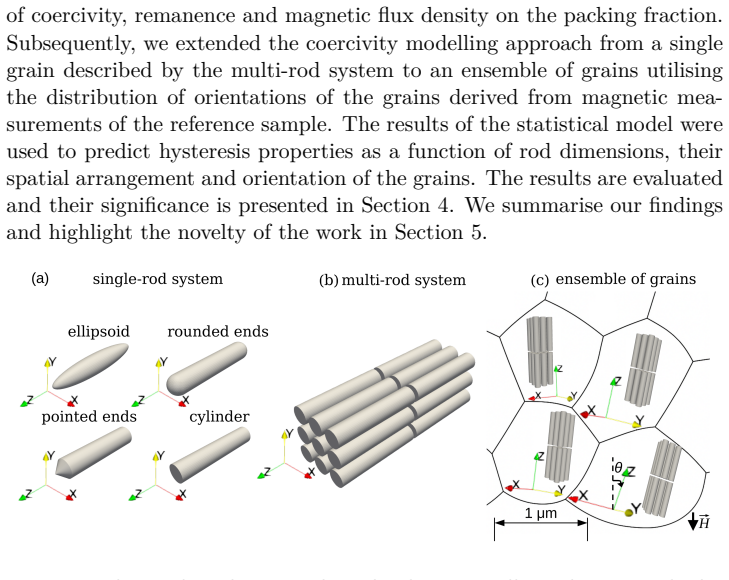
Finite-element micromagnetic simulations of exchange-decoupled rods, first for small interacting clusters and then for statistically large ensembles drawn from the grain-orientation distribution, supplemented by a multi-layer perceptron regressor trained on the resulting data.
If this is right
- Coercivity rises when rods become longer and thinner while inter-rod spacing increases, because the demagnetising field weakens.
- Narrower spread in grain-axis angles directly improves squareness of the hysteresis loop.
- Changing the intrinsic magnetocrystalline anisotropy or saturation polarisation shifts the entire family of loops in a predictable way captured by the regressor.
- The analytic result that coercivity scales with packing fraction p supplies a simple design rule independent of detailed simulation.
- The trained regressor supplies rapid estimates for any un-simulated combination of dimensions and texture.
Where Pith is reading between the lines
- If the predicted optima can be realised in bulk processing, Alnico could extend its use in motors and generators that operate above 200 °C.
- The same rod-based modelling strategy could be applied to other shape-anisotropy magnets such as certain Fe-Ni or Co-based alloys.
- Coupling the regressor to a manufacturing model would allow direct optimisation of sintering or spinodal decomposition parameters.
Load-bearing premise
The real Alnico microstructure can be represented accurately enough by a set of exchange-decoupled rods whose magnetostatic interactions and grain-orientation statistics reproduce the measured hysteresis loop.
What would settle it
If measured coercivity in real Alnico samples whose rod diameters, lengths and packing fractions are independently quantified deviates systematically from the values predicted by the regressor across a range of grain-alignment textures, the tailoring trends would not hold.
Figures


read the original abstract
Alnico magnets have gained renewed interest in the search for rare-earth free permanent magnets due to their high thermal stability and magnetisation. However, the limited coercivity of these shape-anisotropy-based alloys constrains their performance. Starting from a reference Alnico sample, we realised a finite elements micromagnetic study of exchange-decoupled rods by varying their dimensions and interrod spacing across those observed experimentally. We computed the hysteresis properties by progressing from micromagnetic simulations of a small number of rods within the magnetostatic field of their neighbours to large systems treated statistically based on the distribution of orientations of the grains. We compared the coercivity of an isolated rod with that of the exchange-decoupled system to highlight the effect of magnetostatic interactions. We computed analytically the stray field acting on a single rod as a consequence of its surrounding rods in order to confirm the scaling of the coercivity with the packing fraction p. We explored how intrinsic material properties influence magnetic behaviour by examining materials with different magnetocrystalline anisotropy constants and saturation polarisation values. Results from several hundred simulations were used to train a multi-layer perceptron regressor and predict the magnetic properties as function of the dimensions of the rods, interrod spacing and orientation of the grains. With this approach, we highlight the underlying trends by which nanoscale structuring, intrinsic material properties and grain alignment can be tailored to improve the magnetic properties of Alnico alloys.
Editorial analysis
A structured set of objections, weighed in public.
Referee Report
Summary. The manuscript presents a micromagnetic finite-element study of Alnico magnets modeled as exchange-decoupled rods. Starting from a reference sample, rod dimensions, inter-rod spacing, magnetocrystalline anisotropy, saturation polarization, and grain orientations are varied across experimentally observed ranges. Hysteresis properties are computed first for small rod assemblies including magnetostatic interactions, then extended to large systems via statistical averaging over grain-orientation distributions; an analytical stray-field expression is derived to confirm coercivity scaling with packing fraction p. Simulation results train a multi-layer perceptron regressor to predict properties and identify trends for tailoring nanostructure, intrinsic properties, and alignment to improve magnetic performance.
Significance. If the rod model is shown to reproduce experimental reference behavior, the work supplies a computationally efficient framework for exploring the design space of rare-earth-free Alnico magnets. Particular strengths are the analytical confirmation of magnetostatic scaling, the statistical treatment of polycrystallinity, and the use of simulation-trained ML regression for rapid property prediction. These elements could usefully guide experimental optimization of coercivity and energy product.
major comments (4)
- [Abstract] Abstract and introduction: the central claim that the approach can guide tailoring rests on the exchange-decoupled rod model accurately representing the reference Alnico sample. No quantitative comparison of simulated versus measured hysteresis loops (coercivity, remanence ratio, or loop shape) for the reference rod dimensions, spacing, and material parameters is reported, leaving the validity of all subsequent trends unverified.
- [Methods] Methods (micromagnetic model section): the assumption that rods interact solely via magnetostatics while being fully exchange-decoupled omits possible matrix-phase contributions to reversal and interfacial exchange; a sensitivity test or justification for this approximation is required because it directly affects the computed coercivity trends.
- [Results] Results (statistical large-system treatment): the transition from small-rod simulations to statistical averaging over grain orientations lacks reported details on sampling method, number of realizations, or variance in the averaged coercivity and loop parameters, undermining assessment of the robustness of the large-system predictions.
- [ML regressor] ML regressor section: the multi-layer perceptron is trained on several hundred simulations, yet no test-set error metrics, cross-validation results, or uncertainty estimates on the predicted properties are provided, limiting the reliability of using the regressor to identify tailoring trends.
minor comments (2)
- [Figures] Figure captions should explicitly state the fixed parameters (e.g., packing fraction, anisotropy value) and the quantity plotted on each axis for improved readability.
- [Analytical derivation] Notation for packing fraction p and the stray-field expression should be cross-checked for consistency between the analytical derivation and the simulation results.
Simulated Author's Rebuttal
We thank the referee for the constructive and detailed review. We address each major comment below, providing the strongest honest responses and indicating the revisions that will be made to the manuscript.
read point-by-point responses
-
Referee: [Abstract] Abstract and introduction: the central claim that the approach can guide tailoring rests on the exchange-decoupled rod model accurately representing the reference Alnico sample. No quantitative comparison of simulated versus measured hysteresis loops (coercivity, remanence ratio, or loop shape) for the reference rod dimensions, spacing, and material parameters is reported, leaving the validity of all subsequent trends unverified.
Authors: We agree that a direct quantitative validation of the reference model against experiment is necessary to underpin the tailoring trends. The reference parameters were chosen to correspond to a typical experimental Alnico microstructure, but no explicit loop comparison was included in the original text. In the revised manuscript we will add a figure and accompanying text in the results section that directly compares the simulated hysteresis loop (coercivity, remanence ratio, and overall shape) for the reference rod dimensions, spacing, and material parameters with published experimental data for the corresponding Alnico alloy. This addition will confirm that the model reproduces the key experimental features before the parameter sweeps are presented. revision: yes
-
Referee: [Methods] Methods (micromagnetic model section): the assumption that rods interact solely via magnetostatics while being fully exchange-decoupled omits possible matrix-phase contributions to reversal and interfacial exchange; a sensitivity test or justification for this approximation is required because it directly affects the computed coercivity trends.
Authors: The fully exchange-decoupled rod model is motivated by the established Alnico microstructure, in which the ferromagnetic rods are separated by a non-magnetic matrix that suppresses direct exchange. We will strengthen the methods section by adding a concise literature-based justification for this approximation. In addition, we will perform and report a limited sensitivity test in which a small interfacial exchange stiffness is introduced at the rod-matrix boundary; the resulting change in coercivity will be quantified to demonstrate that the reported trends remain robust under modest interfacial coupling. revision: yes
-
Referee: [Results] Results (statistical large-system treatment): the transition from small-rod simulations to statistical averaging over grain orientations lacks reported details on sampling method, number of realizations, or variance in the averaged coercivity and loop parameters, undermining assessment of the robustness of the large-system predictions.
Authors: We will revise the relevant results subsection to supply the missing methodological details. The text will specify that grain orientations are sampled uniformly from the measured distribution, that 500 independent realizations are averaged for each configuration, and that the standard deviation of the resulting coercivity and remanence values is reported (typically < 5 % of the mean). These additions will allow readers to evaluate the statistical reliability of the large-system predictions. revision: yes
-
Referee: [ML regressor] ML regressor section: the multi-layer perceptron is trained on several hundred simulations, yet no test-set error metrics, cross-validation results, or uncertainty estimates on the predicted properties are provided, limiting the reliability of using the regressor to identify tailoring trends.
Authors: We agree that quantitative assessment of the regressor’s performance is required. In the revised manuscript we will add a dedicated paragraph (or supplementary table) reporting test-set mean absolute error and R² values, the results of 5-fold cross-validation, and uncertainty estimates obtained from an ensemble of networks. These metrics will be presented alongside the trend predictions to substantiate the reliability of the identified tailoring guidelines. revision: yes
Circularity Check
No significant circularity; derivation is self-contained
full rationale
The paper starts from standard micromagnetic equations and a reference sample whose parameters are taken from experiment, then varies rod dimensions, spacing, and orientations across observed ranges. Hysteresis is computed via finite-element simulations of magnetostatic interactions among exchange-decoupled rods, followed by statistical averaging over grain orientations. An analytical stray-field calculation is used only to confirm scaling with packing fraction, not to replace simulation. The MLP is trained exclusively on the simulation outputs to map inputs to magnetic properties; no fitted parameter is redefined as a prediction, no self-citation supplies a load-bearing uniqueness theorem, and no quantity is defined in terms of the target result. The chain therefore remains independent of its own outputs.
Axiom & Free-Parameter Ledger
free parameters (2)
- rod dimensions and interrod spacing
- magnetocrystalline anisotropy constant and saturation polarisation
axioms (2)
- domain assumption The nanostructure of the reference Alnico sample can be represented by exchange-decoupled rods interacting only via magnetostatic fields.
- standard math Finite-element micromagnetic equations with the chosen mesh and time-stepping accurately capture reversal dynamics at the nanoscale.
Lean theorems connected to this paper
-
IndisputableMonolith/Cost/FunctionalEquation.leanwashburn_uniqueness_aczel unclear?
unclearRelation between the paper passage and the cited Recognition theorem.
We computed the hysteresis properties by progressing from micromagnetic simulations of a small number of rods within the magnetostatic field of their neighbours to large systems treated statistically based on the distribution of orientations of the grains... scaling the coercive field of the multi-rod system... with the factor 1−p
-
IndisputableMonolith/Foundation/DimensionForcing.leanalexander_duality_circle_linking unclear?
unclearRelation between the paper passage and the cited Recognition theorem.
The coercivity Hc is determined by anisotropies... Hc = 2K1/μ0Ms + Ms/2(1−3N)
What do these tags mean?
- matches
- The paper's claim is directly supported by a theorem in the formal canon.
- supports
- The theorem supports part of the paper's argument, but the paper may add assumptions or extra steps.
- extends
- The paper goes beyond the formal theorem; the theorem is a base layer rather than the whole result.
- uses
- The paper appears to rely on the theorem as machinery.
- contradicts
- The paper's claim conflicts with a theorem or certificate in the canon.
- unclear
- Pith found a possible connection, but the passage is too broad, indirect, or ambiguous to say the theorem truly supports the claim.
Reference graph
Works this paper leans on
-
[1]
Lewis L H and Jim´ enez-Villacorta F 2013 Perspectives on permanent magnetic materials for energy conversion and power generationMetall. Mater. Trans. A442–20
work page 2013
-
[2]
Mohapatra J and Liu J P 2018 Rare-earth-free permanent magnets: the past and futureHandbook of Magnetic Materials271–57
work page 2018
-
[3]
Poudel B, Amiri E, Rastgoufard P and Mirafzal B 2021 Toward less rare-earth permanent magnet in electric machines: a reviewIEEE Trans. Magn.571–19
work page 2021
-
[4]
Eklund P, Sj¨ olund J, Berg M, Leijon M and Eriksson S 2020 Experimen- tal evaluation of a rare earth-free permanent magnet generatorIEEE Trans. Energy Convers.363–10 28
work page 2020
-
[5]
Kovacs A, Fischbacher J, Gusenbauer M, Oezelt H, Herper H C, Vek- ilova O Y, Nieves P, Arapan S and Schrefl T 2020 Computational design of rare-earth reduced permanent magnetsEngineering6148–53
work page 2020
-
[6]
Zhou L, Miller M K, Lu P, Ke L, Skomski R, Dillon H, Xing Q, Palasyuk A, McCartney M R, Smith D J and Constantinides S 2014 Architecture and magnetism of AlnicoActa Mater.74224–33
work page 2014
-
[7]
Zhang C, Li Y, Han X H, Du S L, Sun J B and Zhang Y 2018 Structure and magnetic properties of Alnico ribbonsJ. Magn. Magn. Mater.451 200–7
work page 2018
-
[8]
Skomski R and Coey J M D 1999Permanent Magnetism(Bristol: In- stitute of Physics Publishing)
-
[9]
Fischbacher J, Kovacs A, Gusenbauer M, Oezelt H, Exl L, Bance S and Schrefl T 2018 Micromagnetics of rare-earth efficient permanent magnetsJ. Phys. D: Appl. Phys.51193002
work page 2018
-
[10]
McCurrie R A 1982 The structure and properties of Alnico permanent magnet alloysHandbook of Ferromagnetic Materials3107–88
work page 1982
-
[11]
Zhou L, Guo W, Poplawsky J D, Ke L, Tang W, Anderson I E and Kramer M J 2018 On spinodal decomposition in Alnico—A trans- mission electron microscopy and atom probe tomography studyActa Mater.15315–22
work page 2018
-
[12]
Luborsky F E, Mendelsohn L I and Paine T O 1957 Reproducing the properties of Alnico permanent magnet alloys with elongated single- domain cobalt–iron particlesJ. Appl. Phys.28344–51
work page 1957
-
[13]
Chikazumi S 1964Physics of Magnetism(New York: Wiley)
-
[14]
Coey J M D 2010Magnetism and Magnetic Materials(Cambridge: Cambridge University Press)
-
[15]
Bance S, Fischbacher J, Schrefl T, Zins I, Rieger G and Cassignol C 2014 Micromagnetics of shape anisotropy based permanent magnetsJ. Magn. Magn. Mater.363121–124
work page 2014
-
[16]
Ke L, Skomski R, Hoffmann T D, Zhou L, Tang W, Johnson D D, Kramer M J, Anderson I E and Wang C Z 2017 Simulation of Alnico coercivityAppl. Phys. Lett.111022402 29
work page 2017
-
[17]
Kronm¨ uller H and F¨ ahnle M 2003Micromagnetism and the Microstruc- ture of Ferromagnetic Solids(Cambridge: Cambridge University Press)
-
[18]
Zhao Z, Zhao J, Wang M, Sun Y, Xia W, Chao Z, Li S, Chen R, Yan A and Jiang L 2023 Effect of spinodal decomposition structure of Alnico alloy on magnetic viscosity and magnetisation reversalJ. Magn. Magn. Mater.587171156
work page 2023
-
[19]
Mohapatra J, Fischbacher J, Gusenbauer M, Xing M Y, Elkins J, Schrefl T and Liu J P 2022 Coercivity limits in nanoscale ferromagnetsPhys. Rev. B105214431
work page 2022
-
[20]
Fischbacher J, Kovacs A, Oezelt H, Gusenbauer M, Schrefl T, Exl L, Givord D, Dempsey N M, Zimanyi G, Winklhofer M and Hrkac G 2017 On the limits of coercivity in permanent magnetsAppl. Phys. Lett.111 072404
work page 2017
- [21]
-
[22]
Anderson I E, Kassen A G, White E M, Palasyuk A, Zhou L, Tang W and Kramer M J 2017 Development of controlled solid-state alignment for Alnico permanent magnets in near-final shapeAIP Adv.7056012
work page 2017
-
[23]
Fidler J and Schrefl T 2000 Micromagnetic modelling—the current state of the artJ. Phys. D: Appl. Phys.33R135
work page 2000
-
[24]
Won H, Hong Y K, Choi M, Yan F, Mankey G J, Han X, Lee W, Yeo C D, Lee J and Lee T 2021 Micromagnetic simulation of coercivity of Alnico magnetsIEEE Magn. Lett.121–5
work page 2021
-
[25]
Schabes M E 1991 Micromagnetic theory of non-uniform magnetisation processes in magnetic recording particlesJ. Magn. Magn. Mater.95 249–88
work page 1991
- [26]
-
[27]
Zhou M J, Sun J B, Zhang H Q, Chi X, Ding H W and Wang Y L 2025 Preparation of Alnico alloy with high magnetic properties by the two-phase composite methodJ. Alloys Compd.183272 30
work page 2025
-
[28]
Rehman S U, Liu H, Deng Y, Liu Z, Khan A J, Li J, Yu X and Yang M 2025 Optimization of an isotropic Alnico 8 alloyJ. Alloys Compd. 1010178142
work page 2025
-
[29]
Rahimi A and Almubarak Y 2025 Insights into additively manufactured Alnico alloys using laser metal deposition technologyJ. Mater. Eng. Perform.1–15
work page 2025
-
[30]
Dussa S, Sarkar S K, Verma K K, Joshi S S, Radhakrishnan M, Sharma S, Banerjee R and Dahotre N B 2025 Thermal treatment induced nano- scale spinodal decomposition for enhanced hard-magnetic properties in laser additively fabricated Alnico-8HAppl. Mater. Today44102679
work page 2025
-
[31]
Bonthu S S R, Arafat A K M and Choi S 2017 Comparisons of rare- earth and rare-earth-free external rotor permanent magnet assisted syn- chronous reluctance motorsIEEE Trans. Ind. Electron.649729–38
work page 2017
-
[32]
Cui J, Kramer M, Zhou L, Liu F, Gabay A, Hadjipanayis G, Balasubra- manian B and Sellmyer D 2018 Current progress and future challenges in rare-earth-free permanent magnetsActa Mater.158118–37
work page 2018
-
[33]
Chen Q and Konrad A 1997 A review of finite element open boundary techniques for static and quasi-static electromagnetic field problems IEEE Trans. Magn.33663–676
work page 1997
-
[34]
Demidov D E and Shevchenko D V 2012 Modification of algebraic multi- grid for effective GPGPU-based solution of nonstationary hydrodynam- ics problemsJ. Comput. Sci.3460–462
work page 2012
-
[35]
Salome Platformhttps://www.salome-platform.org/
-
[36]
MeshGems software used within SMESH Module of Salome https://www.spatial.com/products/3d-precise-mesh
-
[37]
Exl L, Fischbacher J, Kovacs A, Oezelt H, Gusenbauer M and Schrefl T 2019 Preconditioned nonlinear conjugate gradient method for micro- magnetic energy minimisationComput. Phys. Commun.235179–86
work page 2019
-
[38]
Serpico C, Bertotti G, Mayergoyz I D and d’Aquino M Nonlinear mag- netisation dynamics in nanomagnetsHandbook of Magnetism and Ad- vanced Magnetic Materials
-
[39]
Exl L, Suess D and Schrefl T Micromagnetism in Coey M and Parkin S (eds)Handbook of Magnetism and Magnetic Materials(Springer In- ternational Publishing, Cham, 2020) pp. 1–44 31
work page 2020
-
[40]
Wohlfarth E P 1959 Hard magnetic materialsAdvances in Physics8:30, 87-224
work page 1959
-
[41]
Wohlfarth E P 1955 The effect of particle interaction on the coercive force of ferromagnetic micropowdersProc. R. Soc. Lond. A232208-227
work page 1955
-
[42]
De Campos M F, Romero S A, Da Silva L M and De Castro J A 2024 Shape anisotropy and magnetic texture determination in anisotropic and isotropic Alnico magnetsJOM764873–4883
work page 2024
-
[43]
Rieger G, Seeger M and Kronm¨ uller H 1999 Microstructural parameters in high-remanent sintered NdFeB magnetsPhys. Status Solidi A171 583–96
work page 1999
-
[44]
Kuncser V, Keune W, Vopsaroiu M, Bissell P R, Sahoo B and Filoti G 2003 Easy axis distribution in modern nanoparticle storage media: a new methodological approachJ. Optoelectron. Adv. Mater.5217-226
work page 2003
-
[45]
Schrefl T, Fidler J, Kirk K J and Chapman J N 1999 Simulation of magnetisation reversal in polycrystalline patterned Co elementsJ. Appl. Phys.856169–71
work page 1999
-
[46]
Goodfellow I, Bengio Y and Courville A 2016Deep Learning(Cam- bridge, MA: MIT Press) ch 6
-
[47]
Givord D, Rossignol M and Taylor D 1992J. Phys. IV2C3–95
-
[48]
Forster H, Bertram N, Wang X and Schrefl T 2003 Energy barrier and effective thermal reversal volume in columnar grainsJ. Magn. Magn. Mater.26769–79
work page 2003
-
[49]
Kuncser V, Palade P, Kuncser A, Greculeasa S and Schinteie G 2014 Size Effects in Nanostructuresin Kuncser V and Miu L (eds)Springer Series in Materials Science(Berlin/Heidelberg: Springer) p. 205
work page 2014
-
[50]
Ener S, Anagnostopoulou E, Dirba I, Lacroix L M, Ott F, Blon T, Piquemal J Y, Skokov K P, Gutfleisch O and Viau G 2018 Consolidation of cobalt nanorods: A new route for rare-earth free nanostructured permanent magnetsActa Mater.145290-297
work page 2018
-
[51]
Elmekawy A H A, Iashina E, Dubitskiy I, Sotnichuk S, Bozhev I, Kozlov D,Napolskii K, Menzel D and Mistonov A 2021 Magnetic properties of ordered arrays of iron nanowires: The impact of the lengthJ. Magn. Magn. Mater.532167951 32
work page 2021
-
[52]
Kuncser A, Antohe S and Kuncser V 2017 A general perspective on the magnetization reversal in cylindrical soft magnetic nanowires with dominant shape anisotropyJ. Magn. Magn. Mater.42334–38
work page 2017
-
[53]
Panagiotopoulos I, Branford WR, Macauley A, et al. 2013 Packing frac- tion dependence of the coercivity and the energy product in nanowire based permanent magnets.Journal of Applied Physics,114(14)
work page 2013
-
[54]
Derby N and Olbert S 2010 Cylindrical magnets and ideal solenoids Am. J. Phys.78229–35
work page 2010
-
[55]
Luborsky FE 1961 Development of elongated particle magnets.Journal of Applied Physics,32(3) S171–S183 33
work page 1961
discussion (0)
Sign in with ORCID, Apple, or X to comment. Anyone can read and Pith papers without signing in.