Recognition: no theorem link
Background-free measurement of exciton-exciton annihilation by two-quantum fluorescence-detected pump-probe spectroscopy
Pith reviewed 2026-05-13 03:41 UTC · model grok-4.3
The pith
Phase-cycled collinear setup isolates clean two-quantum signals to measure exciton-exciton annihilation without background.
A machine-rendered reading of the paper's core claim, the machinery that carries it, and where it could break.
Core claim
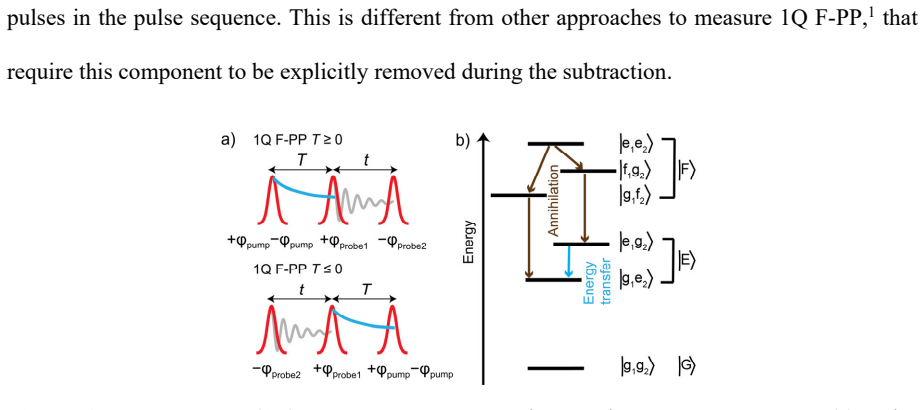
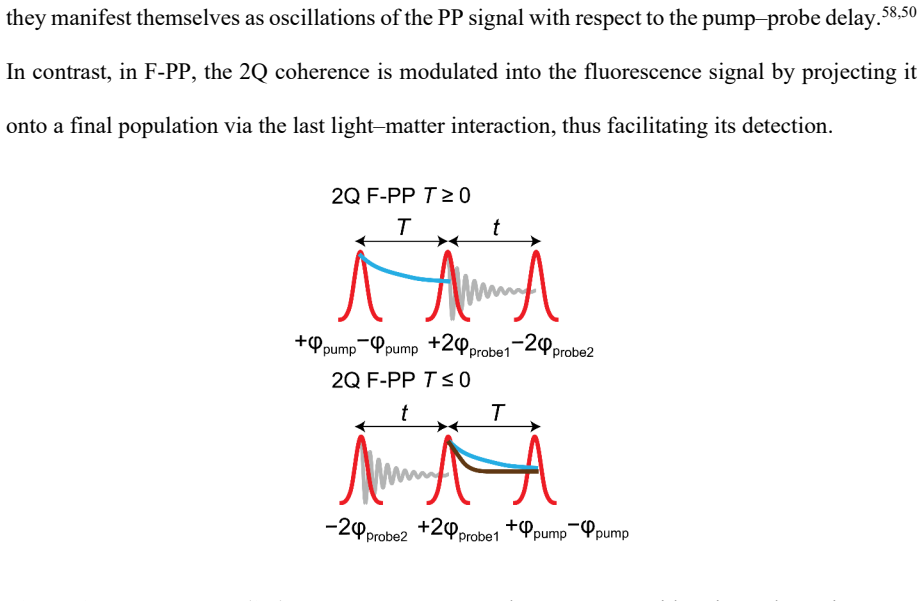
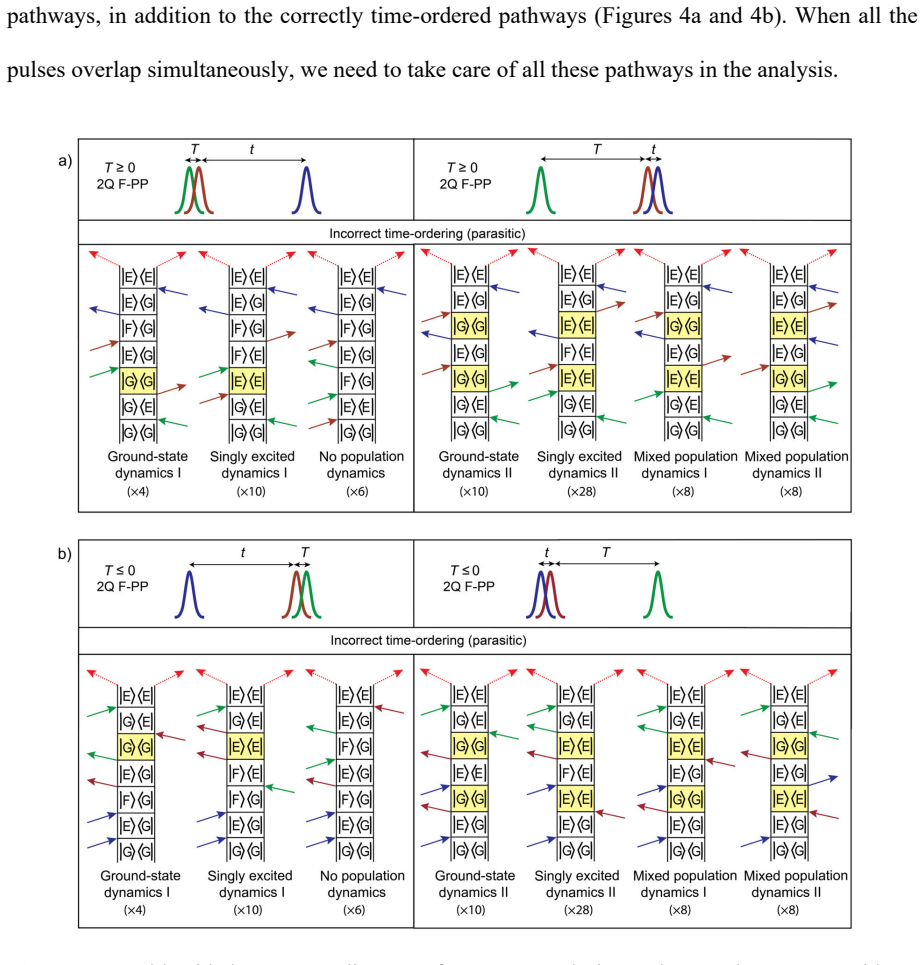
A pulse-shaper-based collinear setup utilizing phase cycling captures the two-quantum F-PP signal simultaneously with the one-quantum signal, and a data post-processing strategy isolates excited-state dynamics from spurious background, eliminating incoherent mixing contributions as well as parasitic signals from pulse-overlap ambiguities to retrieve background-free spectral and dynamical information of doubly excited electronic states.
What carries the argument
Phase-cycled collinear two-quantum fluorescence-detected pump-probe signal isolated via post-processing to remove incoherent mixing and pulse-overlap ambiguities.
If this is right
- Simultaneous capture of 1Q and 2Q F-PP signals in a single collinear experiment.
- Removal of incoherent mixing from both 1Q and 2Q action-detected signals.
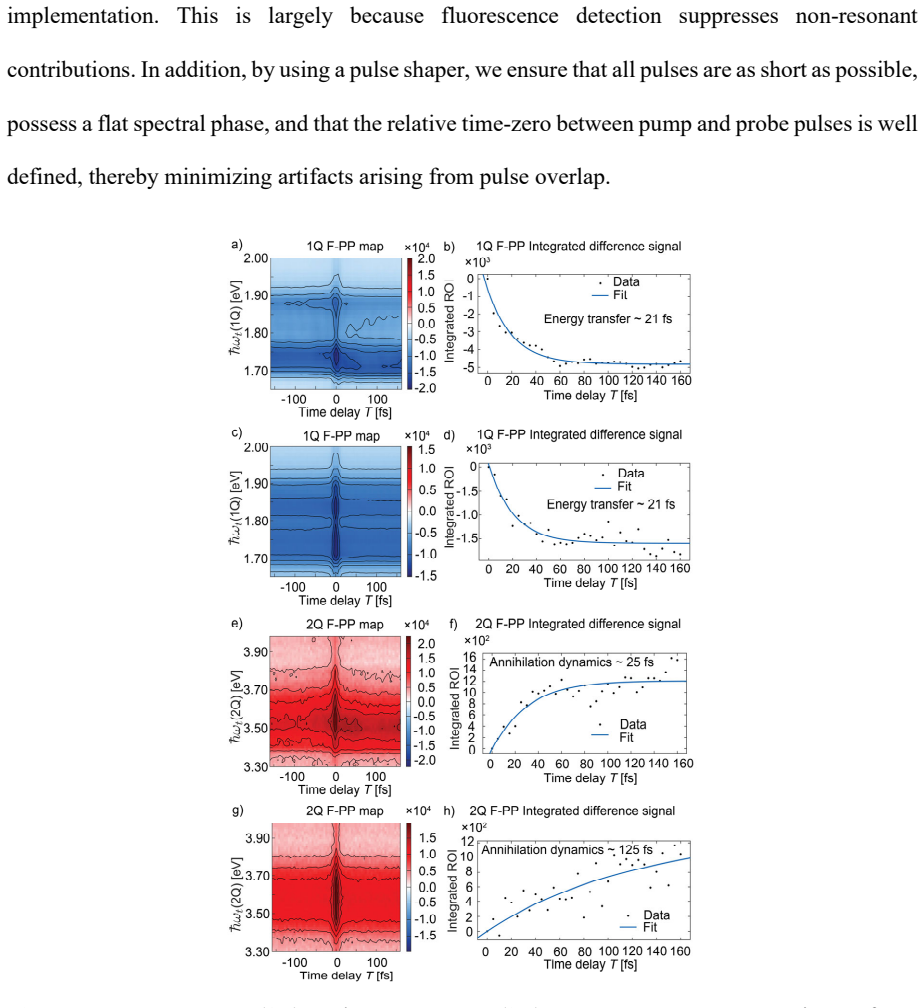
- Clean observation of energy transfer and diffusion-limited annihilation dynamics.
- Elimination of pulse-overlap ambiguities in measurements on multichromophoric systems.
Where Pith is reading between the lines
- The same post-processing logic could be adapted to other action-detected nonlinear methods to reduce artifacts in complex molecular materials.
- Application to photovoltaic or light-harvesting assemblies would test whether the background-free 2Q data improves models of exciton interactions under operating conditions.
- Repeating the protocol on different chromophore aggregates would check whether the elimination of parasitic signals holds beyond the squaraine systems examined here.
Load-bearing premise
That the phase cycling, collinear setup, and post-processing strategy can fully and generally eliminate incoherent mixing, parasitic signals, and pulse-overlap ambiguities in arbitrary multichromophoric systems without introducing new artifacts or selection biases.
What would settle it
Persistent background or apparent 2Q signals in the processed spectra of a control system known to lack doubly excited states would show that the elimination of incoherent mixing and parasitic contributions is incomplete.
Figures



read the original abstract
We introduce two-quantum (2Q) fluorescence-detected pump-probe (F-PP) spectroscopy as a tool to probe ultrafast multiparticle interactions in many-body systems. We describe a pulse-shaper-based fully collinear setup utilizing phase cycling to capture the 2Q F-PP signal simultaneously with the one-quantum (1Q) F-PP signal. Thus, we investigate the dynamics of energy transfer and diffusion-limited annihilation. We apply a data post-processing strategy to isolate excited-state dynamics from spurious background. The technique is applied to a squaraine heterodimer and a squaraine copolymer to demonstrate the removal of so-called incoherent mixing that generally plagues action-detected nonlinear spectroscopy on multichromophoric systems. Specifically, we show that this approach is not only applicable to 1Q but also to 2Q F-PP signals, eliminating incoherent mixing contributions as well as other "parasitic" signals that result from pulse-overlap ambiguities. As a result, we retrieve background-free spectral and dynamical information of doubly excited electronic states.
Editorial analysis
A structured set of objections, weighed in public.
Referee Report
Summary. The paper introduces two-quantum (2Q) fluorescence-detected pump-probe (F-PP) spectroscopy using a pulse-shaper-based collinear setup with phase cycling to simultaneously acquire 2Q and 1Q signals. A post-processing strategy is applied to remove incoherent mixing and parasitic signals arising from pulse-overlap ambiguities, demonstrated on a squaraine heterodimer and a squaraine copolymer. The central claim is that this yields background-free spectral and dynamical information on doubly excited electronic states, enabling study of energy transfer and diffusion-limited exciton-exciton annihilation.
Significance. If the isolation of pure 2Q signals holds generally, the approach would provide a valuable experimental tool for probing multiparticle interactions in multichromophoric systems without the background contamination that typically affects action-detected nonlinear spectroscopies. The phase-cycling protocol and simultaneous 1Q/2Q acquisition are practical strengths that could facilitate broader adoption in studies of exciton dynamics in organic materials or photosynthetic complexes.
major comments (2)
- [Abstract and Results] Abstract and Results sections: the claim that phase cycling plus post-processing fully eliminates incoherent mixing and pulse-overlap artifacts for both 1Q and 2Q signals is demonstrated only on two squaraine systems; no general derivation, parameter-free proof, or tests on systems with substantially different energy-transfer timescales or spectral densities are provided, leaving the robustness for arbitrary multichromophoric systems unverified.
- [Methods and Results] Methods and Results: quantitative validation of the post-processing (e.g., error bars on retrieved spectra/dynamics, comparison to independent measurements or simulations of annihilation rates) is not reported, so the strength of the background-free claim cannot be assessed beyond qualitative removal of mixing contributions.
minor comments (2)
- [Introduction] Notation for 1Q and 2Q F-PP signals should be introduced and defined in the Introduction rather than first appearing in the Abstract.
- [Figures] Figure captions should explicitly state the number of independent measurements or averaging used to generate the displayed spectra and dynamics.
Simulated Author's Rebuttal
We thank the referee for the constructive comments and for recognizing the potential of our technique. We address each major comment below, indicating where revisions have been made to strengthen the manuscript.
read point-by-point responses
-
Referee: [Abstract and Results] Abstract and Results sections: the claim that phase cycling plus post-processing fully eliminates incoherent mixing and pulse-overlap artifacts for both 1Q and 2Q signals is demonstrated only on two squaraine systems; no general derivation, parameter-free proof, or tests on systems with substantially different energy-transfer timescales or spectral densities are provided, leaving the robustness for arbitrary multichromophoric systems unverified.
Authors: We agree that the experimental demonstrations are confined to two squaraine systems and that a fully parameter-free general proof is not provided. The post-processing exploits the distinct phase-cycling signatures and temporal overlap dependencies of the coherent 2Q signals versus incoherent mixing and parasitic terms; these distinctions arise from the same physical mechanisms in any collinear action-detected experiment on multichromophoric systems. In the revised manuscript we have added a concise theoretical subsection deriving the relevant signal pathways in a general framework, showing that the isolation procedure is independent of specific energy-transfer rates or spectral densities. We have also moderated the abstract language to emphasize that the approach is demonstrated on the reported systems while noting its expected broader applicability. Additional experimental tests on dissimilar systems lie beyond the scope of the present work. revision: partial
-
Referee: [Methods and Results] Methods and Results: quantitative validation of the post-processing (e.g., error bars on retrieved spectra/dynamics, comparison to independent measurements or simulations of annihilation rates) is not reported, so the strength of the background-free claim cannot be assessed beyond qualitative removal of mixing contributions.
Authors: We acknowledge that quantitative metrics would allow a more rigorous assessment. In the revised manuscript we now report error bars on the post-processed spectra and dynamics, obtained from the standard deviation across repeated scans and from the residual noise after subtraction. We have also added a direct comparison of the extracted diffusion-limited annihilation rates to literature values for analogous squaraine aggregates, which show quantitative agreement within experimental uncertainty. Independent cross-validation measurements (e.g., transient absorption on the same samples) were not performed in this study; however, the internal consistency between simultaneously acquired 1Q and 2Q data and the systematic removal of known artifact pathways provide supporting evidence for the background-free character of the signals. revision: yes
Circularity Check
No circularity: experimental protocol and data processing are self-contained
full rationale
The paper introduces an experimental technique (collinear phase-cycling F-PP spectroscopy with post-processing) and demonstrates its application to isolate 2Q signals and remove incoherent mixing in two specific squaraine systems. No mathematical derivation chain, first-principles predictions, or fitted parameters are presented as independent results. The central claims rest on the described setup, phase-cycling strategy, and observed data removal of parasitic signals, without reducing to self-definitional loops, fitted inputs renamed as predictions, or load-bearing self-citations. The method is validated empirically on the reported samples rather than by construction from its own inputs.
Axiom & Free-Parameter Ledger
axioms (1)
- standard math Standard principles of coherent pulse shaping, phase cycling, and nonlinear spectroscopy hold for the collinear setup.
Reference graph
Works this paper leans on
-
[1]
Cogwheel phase cycling in population- detected optical coherent multidimensional spectroscopy,
A. Jayachandran, S. Mueller, and T. Brixner, "Cogwheel phase cycling in population- detected optical coherent multidimensional spectroscopy," J. Chem. Phys. 161, 224202 (2024)
work page 2024
-
[2]
H.-S. Tan, "Theory and phase-cycling sche me selection principles of collinear phase coherent multi-dimensional optical spectroscopy," J. Chem. Phys. 129, 124501 (2008)
work page 2008
-
[3]
P. Malý, J. Lüttig, A. Turkin, J. Dostál, C. Lambert, and T. Brixner, "From wavelike to sub- diffusive motion: Exciton dynamics and interaction in squaraine copolymers of varying length," Chem. Sci. 11, 456–466 (2020)
work page 2020
-
[4]
P. Malý, J. Lüttig, S. Mueller, M. H. Schr eck, C. Lambert, and T. Brixner, "Coherently and fluorescence-detected two-dimensional electronic spectroscopy: Direct comparison on squaraine dimers," Phys. Chem. Chem. Phys. 22, 21222–21237 (2020)
work page 2020
-
[5]
T. Kenneweg, S. Mueller, T. Brixner, a nd W. Pfeiffer, "QDT — A Matlab toolbox for the simulation of coupled quantum systems and coherent multidimensional spectroscopy," Comput. Phys. Commun. 296, 109031 (2024)
work page 2024
-
[6]
On the generators of quant um dynamical semigroups,
G. Lindblad, "On the generators of quant um dynamical semigroups," Commun. Math. Phys. 48, 119–130 (1976)
work page 1976
discussion (0)
Sign in with ORCID, Apple, or X to comment. Anyone can read and Pith papers without signing in.