Recognition: no theorem link
A phenomenological model of the magnetic field re-emergence in magnetars and discrepancy between the kinematic and characteristic ages
Pith reviewed 2026-05-13 04:02 UTC · model grok-4.3
The pith
A phenomenological model of magnetic field re-emergence after fallback explains why kinematic ages exceed characteristic ages in magnetars.
A machine-rendered reading of the paper's core claim, the machinery that carries it, and where it could break.
Core claim
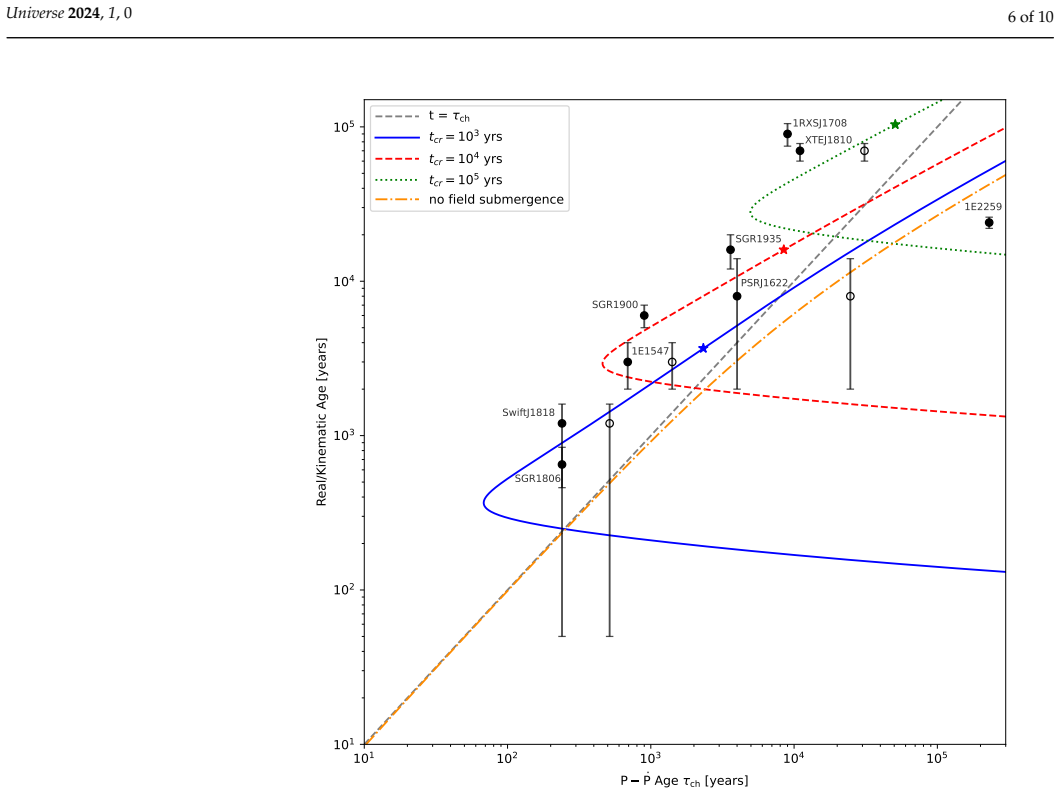
We present a simple model including a realistic approximation for the magnetic field decay in magnetars and a simple phenomenological description of the field re-emergence after an episode of fallback after the birth of a NS. We demonstrate that this simple model can explain the observed relation τ_kin > τ_ch for realistic sets of parameters.
What carries the argument
Phenomenological re-emergence of the magnetic field following fallback accretion shortly after neutron-star formation, combined with standard field decay.
If this is right
- Characteristic age can underestimate true age when an early fallback episode temporarily buries and then re-emerges the field.
- The relation τ_kin > τ_ch arises naturally in sources that experienced fallback without requiring non-standard spin-down physics.
- Magnetar formation frequently involves fallback accretion that affects observable spin evolution for tens of kiloyears.
- Population synthesis models must incorporate fallback episodes to match the age distribution of young neutron stars.
Where Pith is reading between the lines
- If the mechanism holds, fallback may be a generic feature of magnetar birth that also influences their connection to other isolated neutron-star classes.
- Similar re-emergence physics could resolve age discrepancies reported in other young pulsars once kinematic ages become available.
- Detailed supernova simulations could be checked against the fallback masses and timescales required by the model to fit current magnetar data.
Load-bearing premise
The phenomenological description of the field re-emergence after an episode of fallback after the birth of a NS is a realistic approximation.
What would settle it
A new kinematic age measurement for a magnetar that yields τ_kin substantially smaller than τ_ch while the source shows no sign of recent field burial, or a demonstration that no plausible combination of fallback mass and re-emergence timescale reproduces the data.
Figures



read the original abstract
Robust age measurements for isolated neutron stars (NSs) are not easily available. That is why, often the characteristic age $\tau_\mathrm{ch}=P/2\dot P$ is used as a proxy. Here $P$ is the spin period of the NS and $\dot P$ is the time derivative of $P$. Additional assumptions related to the initial properties and spin-down evolution are made to derive $\tau_\mathrm{ch}$. As a result, it is expected that $\tau_\mathrm{ch}$ is an upper limit for the real age $\tau_\mathrm{real}$. Recently, Chrimes et al. presented measurements of kinematic ages $\tau_\mathrm{kin}$ for several magnetars. Surprisingly, for the majority of these sources $\tau_\mathrm{kin}>\tau_\mathrm{ch}$. We present a simple model including a realistic approximation for the magnetic field decay in magnetars and a simple phenomenological description of the field re-emergence after an episode of fallback after the birth of a NS. We demonstrate that this simple model can explain the observed relation $\tau_\mathrm{kin}>\tau_\mathrm{ch}$ for realistic sets of parameters.
Editorial analysis
A structured set of objections, weighed in public.
Referee Report
Summary. The paper presents a simple phenomenological model for the spin-down and magnetic field evolution of magnetars. It combines standard magnetic dipole braking with a realistic approximation for field decay and an ad-hoc re-emergence term triggered by fallback accretion shortly after neutron-star birth. The central claim is that this model reproduces the observed inequality τ_kin > τ_ch for several magnetars using realistic parameter choices, contrary to the usual expectation that the characteristic age τ_ch = P/(2Ṗ) is an upper limit on the true age.
Significance. If the parameter choices prove robust and not post-hoc, the work supplies a minimal, physically motivated explanation for the surprising kinematic-age excess without new physics. It underscores the potential role of early fallback in magnetar evolution and offers a practical tool for interpreting sparse age data in the field.
major comments (2)
- [Model description (likely §2–3)] The re-emergence phase is introduced as a phenomenological term with free parameters (timescale and amplitude). While the abstract asserts that the model works 'for realistic sets of parameters,' the manuscript must show that these values are independently constrained by magnetar field strengths, periods, or fallback simulations rather than selected solely to match the τ_kin > τ_ch data points; otherwise the existence proof risks circularity.
- [Results and discussion] The abstract states that the model reproduces the observed relation, but without explicit differential equations for the combined decay-plus-re-emergence evolution or tabulated fits to the Chrimes et al. sources, it is impossible to judge how sensitive the result is to the precise functional form of the re-emergence term or to variations in initial spin and field.
minor comments (2)
- [Abstract] Define τ_real explicitly in the abstract; it appears to denote the true age but is not distinguished from τ_kin.
- [Model section] List all free parameters and their adopted ranges in a dedicated table or subsection so readers can reproduce the claimed 'realistic' solutions.
Simulated Author's Rebuttal
We thank the referee for the positive assessment and constructive comments on our phenomenological model. We address the major comments point by point below, agreeing that additional justification and explicit details are warranted to strengthen the presentation.
read point-by-point responses
-
Referee: The re-emergence phase is introduced as a phenomenological term with free parameters (timescale and amplitude). While the abstract asserts that the model works 'for realistic sets of parameters,' the manuscript must show that these values are independently constrained by magnetar field strengths, periods, or fallback simulations rather than selected solely to match the τ_kin > τ_ch data points; otherwise the existence proof risks circularity.
Authors: We agree that independent motivation for the parameters is essential to avoid any perception of circularity. The re-emergence timescale and amplitude are drawn from the range of values reported in numerical simulations of fallback accretion following neutron-star formation (e.g., studies of post-supernova fallback disks). In the revised manuscript we will add an expanded discussion, with citations, demonstrating that the adopted values lie within these independently derived ranges and are consistent with typical magnetar field strengths; the same parameter set is applied across the sample rather than tuned individually to the kinematic-age data. revision: yes
-
Referee: The abstract states that the model reproduces the observed relation, but without explicit differential equations for the combined decay-plus-re-emergence evolution or tabulated fits to the Chrimes et al. sources, it is impossible to judge how sensitive the result is to the precise functional form of the re-emergence term or to variations in initial spin and field.
Authors: We concur that explicit equations and tabulated parameters will allow readers to assess sensitivity. The revised manuscript will present the full set of differential equations governing the magnetic-field evolution (decay plus re-emergence term) in Section 2. We will also include a table of initial spin periods, magnetic-field strengths, and re-emergence parameters used for each Chrimes et al. source, together with the resulting ages. A short robustness check will be added showing that the inequality τ_kin > τ_ch persists for variations of the re-emergence timescale by factors of a few. revision: yes
Circularity Check
No significant circularity
full rationale
The paper constructs a phenomenological model that augments standard magnetic dipole braking with an explicit re-emergence term after fallback burial. It then shows numerically that the observed inequality τ_kin > τ_ch can be reproduced for plausible parameter ranges. This constitutes an existence demonstration rather than a closed derivation in which any prediction is forced by construction to equal its own inputs. No equations reduce to tautologies, no fitted parameters are relabeled as predictions, and no load-bearing premise rests solely on self-citation. The functional form of the re-emergence term is openly labeled phenomenological and chosen for compatibility with observed magnetar properties, leaving the central claim independent of the data it illustrates.
Axiom & Free-Parameter Ledger
free parameters (1)
- re-emergence timescale and amplitude
axioms (2)
- domain assumption Magnetic field decay occurs in magnetars on relevant timescales
- domain assumption Fallback accretion episode occurs shortly after NS birth
Reference graph
Works this paper leans on
-
[1]
The Zoo of Isolated Neutron Stars.Universe2023,9, 273, [arXiv:astro-ph.HE/2306.02084]
Popov, S.B. The Zoo of Isolated Neutron Stars.Universe2023,9, 273, [arXiv:astro-ph.HE/2306.02084]. https://doi.org/10.3390/ universe9060273
-
[2]
Borghese, A.; Esposito, P . Isolated Neutron Stars. InHandbook of X-ray and Gamma-ray Astrophysics; 2023; p. 146. https: //doi.org/10.1007/978-981-16-4544-0_102-1
-
[3]
X-ray observations of isolated neutron stars
Rigoselli, M. X-ray observations of isolated neutron stars. In Proceedings of the Multifrequency Behaviour of High Energy Cosmic Sources XIV , 2024, p. 55, [arXiv:astro-ph.HE/2402.14442]. https://doi.org/10.48550/arXiv.2402.14442
-
[4]
Neutron Star Accretion in a Supernova.ApJ1989,346, 847
Chevalier, R.A. Neutron Star Accretion in a Supernova.ApJ1989,346, 847. https://doi.org/10.1086/168066
-
[5]
Evolution of Neutron Star Magnetic Fields.Universe2021,7, 351, [arXiv:astro- ph.HE/2109.05584]
Igoshev, A.P .; Popov, S.B.; Hollerbach, R. Evolution of Neutron Star Magnetic Fields.Universe2021,7, 351, [arXiv:astro- ph.HE/2109.05584]. https://doi.org/10.3390/universe7090351
-
[6]
Magnetars: the physics behind observations
Turolla, R.; Zane, S.; Watts, A.L. Magnetars: the physics behind observations. A review.Reports on Progress in Physics2015, 78, 116901, [arXiv:astro-ph.HE/1507.02924]. https://doi.org/10.1088/0034-4885/78/11/116901
-
[7]
Magnetar counterparts, kinematics and birth sites with HST and JWST.arXiv e-prints2026, p
Chrimes, A.A.; Lyman, J.D.; Levan, A.J.; Borghese, A.; de Bruijne, J.H.J.; Fruchter, A.S.; Guarcello, M.G.; Kouveliotou, C.; Tanvir, N.R.; Wiersema, K. Magnetar counterparts, kinematics and birth sites with HST and JWST.arXiv e-prints2026, p. arXiv:2603.15750, [arXiv:astro-ph.SR/2603.15750]. https://doi.org/10.48550/arXiv.2603.15750
-
[8]
Biryukov, A.; Abolmasov, P .; Levinson, A. Rotational Evolution of Deformed Magnetized Neutron Stars: Implications for Obliquity Distribution and Braking Indices Statistics.ApJ2025,995, 167, [arXiv:astro-ph.HE/2508.01721]. https://doi.org/10.384 7/1538-4357/ae1a44
-
[9]
Powering central compact objects with a tangled crustal magnetic field
Gourgouliatos, K.N.; Hollerbach, R.; Igoshev, A.P . Powering central compact objects with a tangled crustal magnetic field. MNRAS2020,495, 1692–1699, [arXiv:astro-ph.HE/2005.02410]. https://doi.org/10.1093/mnras/staa1295
-
[10]
Dehman, C.; Brandenburg, A. Reality of inverse cascading in neutron star crusts.A&A2025,694, A39, [arXiv:astro- ph.HE/2408.08819]. https://doi.org/10.1051/0004-6361/202451904
-
[11]
Ho, W.C.G. Evolution of a buried magnetic field in the central compact object neutron stars.MNRAS2011,414, 2567–2575, [arXiv:astro-ph.HE/1102.4870]. https://doi.org/10.1111/j.1365-2966.2011.18576.x
-
[12]
Viganò, D.; Pons, J.A. Central compact objects and the hidden magnetic field scenario.MNRAS2012,425, 2487–2492, [arXiv:astro- ph.SR/1206.2014]. https://doi.org/10.1111/j.1365-2966.2012.21679.x
-
[13]
Igoshev, A.P .; Elfritz, J.G.; Popov, S.B. Post-fall-back evolution of multipolar magnetic fields and radio pulsar activation.MNRAS 2016,462, 3689–3702, [arXiv:astro-ph.HE/1608.08806]. https://doi.org/10.1093/mnras/stw1902
-
[14]
2D Cooling of magnetized neutron stars.A&A2008,486, 255–271, [arXiv:astro- ph/0710.0854]
Aguilera, D.N.; Pons, J.A.; Miralles, J.A. 2D Cooling of magnetized neutron stars.A&A2008,486, 255–271, [arXiv:astro- ph/0710.0854]. https://doi.org/10.1051/0004-6361:20078786
-
[15]
Time evolution of pulsar obliquity angle from 3D simulations of magnetospheres
Philippov, A.; Tchekhovskoy, A.; Li, J.G. Time evolution of pulsar obliquity angle from 3D simulations of magnetospheres. MNRAS2014,441, 1879–1887, [arXiv:astro-ph.HE/1311.1513]. https://doi.org/10.1093/mnras/stu591
-
[16]
Hall Attractor in Axially Symmetric Magnetic Fields in Neutron Star Crusts.Phys
Gourgouliatos, K.N.; Cumming, A. Hall Attractor in Axially Symmetric Magnetic Fields in Neutron Star Crusts.Phys. Rev. Lett. 2014,112, 171101, [arXiv:astro-ph.SR/1311.7345]. https://doi.org/10.1103/PhysRevLett.112.171101
-
[17]
Hall effect in neutron star crusts: evolution, endpoint and dependence on initial conditions
Gourgouliatos, K.N.; Cumming, A. Hall effect in neutron star crusts: evolution, endpoint and dependence on initial conditions. MNRAS2014,438, 1618–1629, [arXiv:astro-ph.SR/1311.7004]. https://doi.org/10.1093/mnras/stt2300
-
[18]
Manchester, R.N.; Hobbs, G.B.; Teoh, A.; Hobbs, M. The Australia Telescope National Facility Pulsar Catalogue.AJ2005, 129, 1993–2006, [arXiv:astro-ph/astro-ph/0412641]. https://doi.org/10.1086/428488
-
[19]
Popov, S.B.; Turolla, R. Initial spin periods of neutron stars in supernova remnants.Astroph.Sp.Sci.2012,341, 457–464, [arXiv:astro-ph.HE/1204.0632]. https://doi.org/10.1007/s10509-012-1100-z
-
[20]
Igoshev, A.P .; Frantsuzova, A.; Gourgouliatos, K.N.; Tsichli, S.; Konstantinou, L.; Popov, S.B. Initial periods and magnetic fields of neutron stars.MNRAS2022,514, 4606–4619, [arXiv:astro-ph.HE/2205.06823]. https://doi.org/10.1093/mnras/stac1648
-
[21]
The McGill Magnetar Catalog.ApJ Suppl
Olausen, S.A.; Kaspi, V .M. The McGill Magnetar Catalog.ApJ Suppl. Ser.2014,212, 6, [arXiv:astro-ph.HE/1309.4167]. https://doi.org/10.1088/0067-0049/212/1/6. Universe2024,1, 0 10 of 10
-
[22]
Anderson, G.E.; Gaensler, B.M.; Slane, P .O.; Rea, N.; Kaplan, D.L.; Posselt, B.; Levin, L.; Johnston, S.; Murray, S.S.; Brogan, C.L.; et al. Multi-wavelength Observations of the Radio Magnetar PSR J1622-4950 and Discovery of Its Possibly Associated Supernova Remnant.ApJ2012,751, 53, [arXiv:astro-ph.HE/1203.2719]. https://doi.org/10.1088/0004-637X/751/1/53
-
[23]
Spin-down Evolution and Radio Disappearance of the Magnetar PSR J1622-4950.apj2017,841, 126
Scholz, P .; Camilo, F.; Sarkissian, J.; Reynolds, J.E.; Levin, L.; Bailes, M.; Burgay, M.; Johnston, S.; Kramer, M.; Possenti, A. Spin-down Evolution and Radio Disappearance of the Magnetar PSR J1622-4950.apj2017,841, 126. https://doi.org/10.3847/15 38-4357/aa73de
-
[24]
Braking index of isolated pulsars.Phys
Hamil, O.; Stone, J.R.; Urbanec, M.; Urbancová, G. Braking index of isolated pulsars.Phys. Rev. D2015,91, 063007, [arXiv:astro- ph.HE/1608.01383]. https://doi.org/10.1103/PhysRevD.91.063007
-
[25]
Constraining the Birth Events of Neutron Stars
Kaspi, V .M.; Helfand, D.J. Constraining the Birth Events of Neutron Stars. In Proceedings of the Neutron Stars in Supernova Remnants; Slane, P .O.; Gaensler, B.M., Eds., 2002, Vol. 271,Astronomical Society of the Pacific Conference Series, p. 3, [arXiv:astro- ph/astro-ph/0201183]. https://doi.org/10.48550/arXiv.astro-ph/0201183
work page internal anchor Pith review doi:10.48550/arxiv.astro-ph/0201183 2002
-
[26]
Yue, Y.L.; Xu, R.X.; Zhu, W.W. What can the braking indices tell us about the nature of pulsars?Advances in Space Research2007, 40, 1491–1497, [arXiv:astro-ph/astro-ph/0611022]. https://doi.org/10.1016/j.asr.2007.08.016. Disclaimer/Publisher’s Note:The statements, opinions and data contained in all publications are solely those of the individual author(s)...
discussion (0)
Sign in with ORCID, Apple, or X to comment. Anyone can read and Pith papers without signing in.