Recognition: 2 theorem links
· Lean TheoremSecuring the Flow: Maritime Energy Resilience under Correlated and Decision-Dependent Disruptions
Pith reviewed 2026-05-13 04:59 UTC · model grok-4.3
The pith
A diversified maritime energy network absorbs joint chokepoint failures with the same hedging as isolated ones.
A machine-rendered reading of the paper's core claim, the machinery that carries it, and where it could break.
Core claim
In the calibrated model, the value of modeling correlation between chokepoint disruptions is identically zero across stress tests; the network's diversified portfolio absorbs joint-corridor disruptions using the same hedging mechanisms as single-corridor disruptions.
What carries the argument
Two-stage stochastic multi-commodity flow with affine decision-dependent probability distortion, solved via Benders decomposition that uses corridor-based group-failure cuts to recover the extensive-form optimum for up to 729 scenarios.
If this is right
- Optimal first-stage inventories and activations stay the same whether or not correlations enter the model.
- LPG remains the most exposed commodity while crude oil can be fully hedged through reserves and pipeline bypasses.
- The mean-CVaR frontier exhibits a design phase transition at confidence level approximately 0.75.
- Stochastic planning yields a 14.8 percent value of stochastic solution while endogenous probabilities contribute between 0.93 and 8.18 percent.
Where Pith is reading between the lines
- Highly diversified networks may inherently mask correlation effects, so simpler independent-disruption models suffice for many resilience problems.
- The same structural buffering could be checked in other systems with clustered failure points such as power grids or semiconductor supply chains.
- Testing nonlinear distortion functions or adaptive re-routing after initial disruption could further shrink tail-risk exposure.
Load-bearing premise
First-stage utilization decisions alter chokepoint disruption probabilities through an affine distortion function.
What would settle it
A real joint closure of Hormuz and Bab el-Mandeb that produces shortage levels the correlation-ignorant plan cannot cover as effectively as the correlated plan.
Figures
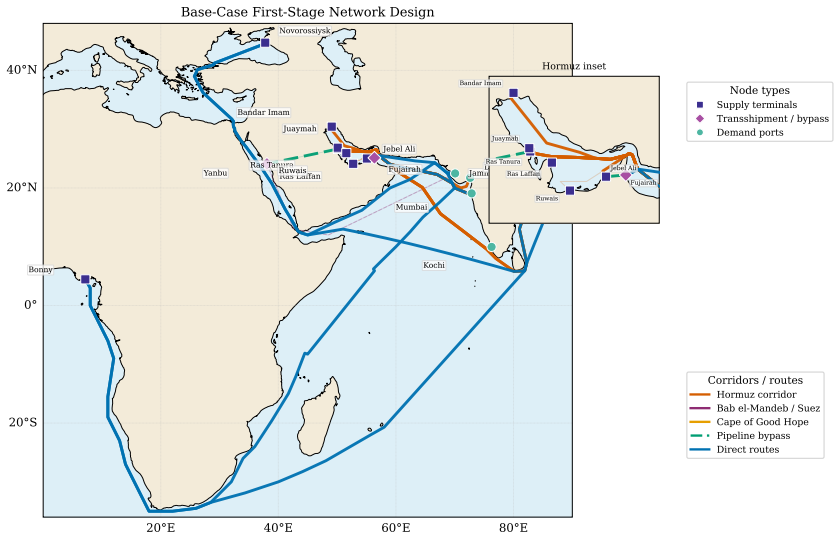
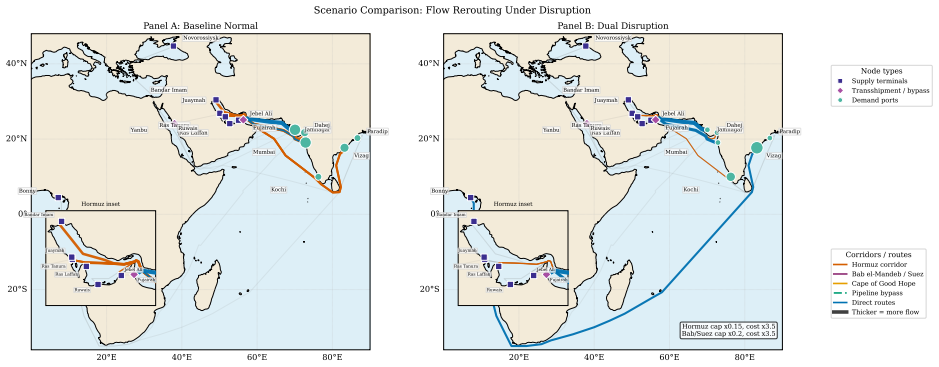
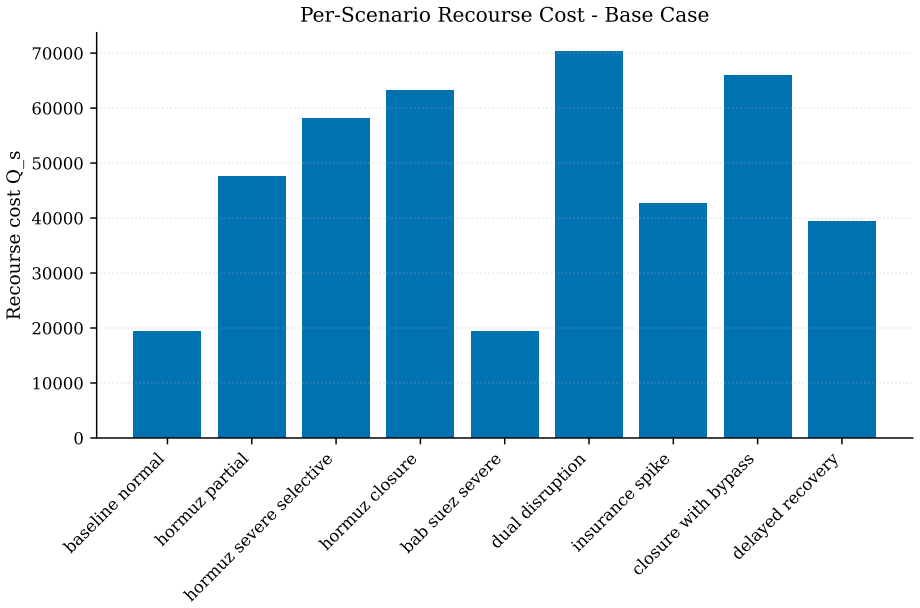


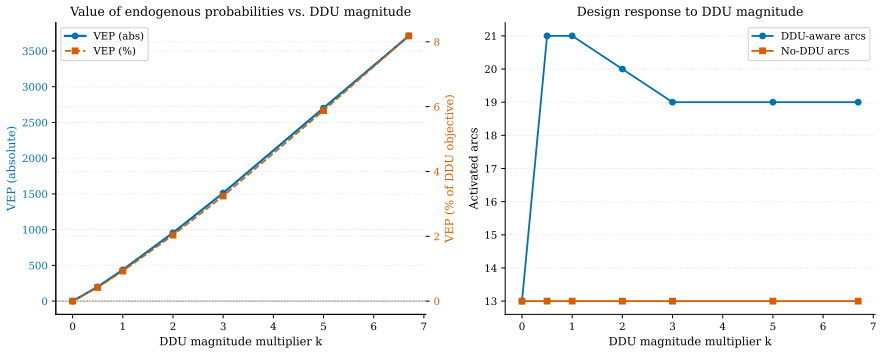


read the original abstract
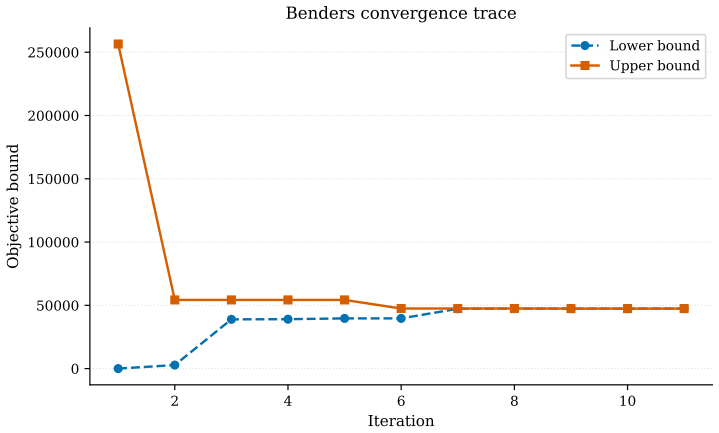
We develop a two-stage stochastic multi-commodity flow model to design a resilient maritime energy supply network under correlated chokepoint disruptions. A planner selects strategic inventories and infrastructure activations prior to uncertainty resolution, then routes crude oil, LNG, LPG, and fertilizer through a capacitated network. Three features distinguish this model: disruption scenarios are \emph{correlated}, reflecting the reality that proximate chokepoints (e.g., Hormuz, Bab el-Mandeb) fail jointly; scenario probabilities depend endogenously on first-stage decisions via affine distortion, formalizing \emph{risk exposure through utilization}; and a mean-CVaR objective mitigates tail-risk shortages. Methodologically, the decision-dependent probability model admits an exact MILP reformulation via McCormick linearization. CVaR preserves scenario-wise decomposability, and our Benders decomposition with corridor-based group-failure cuts converges finitely. The model is calibrated to Indian maritime energy imports (16 nodes, 28 arcs) using EIA, UNCTAD, World Bank, and operational data from the 2026 Hormuz crisis. Benders recovers the extensive-form optimum for scenario sizes up to $|S|=729$ with a constant iteration count (10-11). Empirically, the value of the stochastic solution (VSS) is 14.8%; the value of decision-dependent probabilities (VEP) ranges from 0.93% to 8.18%. The mean-CVaR frontier exhibits a design phase transition at confidence level $\alpha\approx 0.75$. Notably, the value of modeling correlation is identically zero across stress tests: the network's diversified portfolio absorbs joint-corridor disruptions using the same hedging mechanisms as single-corridor disruptions (\emph{structural joint-failure resilience}). Finally, LPG emerges as the most exposed commodity, whereas crude oil is fully hedgeable via reserves and pipeline bypasses.
Editorial analysis
A structured set of objections, weighed in public.
Referee Report
Summary. The paper develops a two-stage stochastic multi-commodity flow model for designing a resilient maritime energy supply network under correlated chokepoint disruptions with decision-dependent probabilities. Strategic first-stage decisions on inventories and infrastructure are made before uncertainty, followed by recourse routing of crude oil, LNG, LPG, and fertilizer. Key features include correlated scenarios, affine-distortion endogenous probabilities, and a mean-CVaR objective. The model admits an exact MILP reformulation via McCormick linearization and a finitely convergent Benders decomposition with corridor-based group-failure cuts. Calibrated to a 16-node Indian import network using EIA, UNCTAD, World Bank, and 2026 Hormuz crisis data, it reports VSS of 14.8%, VEP of 0.93–8.18%, a mean-CVaR phase transition at α≈0.75, zero value of modeling correlation due to structural diversification, and LPG as the most exposed commodity.
Significance. If the results hold, the work advances stochastic network design by providing exact, scalable reformulations for decision-dependent and correlated uncertainties, with demonstrated finite convergence and practical scalability to |S|=729. The empirical findings on structural joint-failure resilience and the CVaR phase transition offer concrete insights for maritime energy security planning, while the VSS and VEP metrics quantify the value of stochastic and endogenous modeling on a realistic instance.
minor comments (3)
- The calibration procedure and data exclusion rules for the 16-node network (using EIA, UNCTAD, World Bank sources) are not fully detailed in the main text or appendix, limiting reproducibility of the VSS, VEP, and phase-transition results.
- Notation for the multi-commodity flows, scenario probabilities, and affine distortion parameters could be consolidated in a single table or section to improve readability, especially when distinguishing first-stage utilization from endogenous probability shifts.
- The Benders decomposition section would benefit from an explicit statement of the master problem and subproblem formulations, including how the group-failure cuts are generated, to allow independent verification of the reported constant iteration count (10-11).
Simulated Author's Rebuttal
We thank the referee for their positive and accurate summary of our manuscript, as well as for recommending minor revision. We are pleased that the contributions regarding the exact MILP reformulation, finite Benders convergence, VSS of 14.8%, VEP range, CVaR phase transition, and the finding of structural joint-failure resilience are recognized as advancing stochastic network design and offering practical insights for maritime energy security. No specific major comments were raised in the report.
Circularity Check
No significant circularity identified
full rationale
The paper presents an explicit two-stage stochastic multi-commodity flow model with correlated scenarios and decision-dependent probabilities via an affine distortion function. This is reformulated exactly as an MILP using McCormick envelopes and solved via Benders decomposition with corridor-based cuts. All reported metrics (VSS of 14.8%, VEP ranging 0.93-8.18%, phase transition at alpha approx 0.75, and zero value of correlation) are obtained by solving the calibrated instance against external data (EIA, UNCTAD, World Bank) on the 16-node Indian network. The central empirical claim—that diversified recourse absorbs joint failures identically to single failures—is a direct comparison of optimized solutions on this network, not a definitional reduction or self-referential fit. No equations equate outputs to inputs by construction, and no load-bearing steps rely on self-citations or imported uniqueness theorems.
Axiom & Free-Parameter Ledger
free parameters (2)
- CVaR confidence level alpha
- affine distortion coefficients
axioms (2)
- standard math Two-stage stochastic programming with recourse admits Benders decomposition under finite scenario sets
- standard math McCormick envelopes provide exact linearization for bilinear terms arising from decision-dependent probabilities
Lean theorems connected to this paper
-
IndisputableMonolith/Cost/FunctionalEquation.leanwashburn_uniqueness_aczel unclearthe decision-dependent probability model admits an exact MILP reformulation via McCormick linearization... Benders decomposition with corridor-based group-failure cuts converges finitely
-
IndisputableMonolith/Foundation/BranchSelection.leanbranch_selection unclearvalue of modeling correlation is identically zero... structural joint-failure resilience
Reference graph
Works this paper leans on
-
[1]
Official Journal of the European Union, L
Regulation (eu) 2022/1032 amending regulations (eu) 2017/1938 and (ec) no 715/2009 with regard to gas storage. Official Journal of the European Union, L
work page 2022
-
[2]
Fattahi, M., Govindan, K., Maihami, R.,
URL: https://eur-lex.europa.eu/eli/reg/2022/1032/2022-06-30/eng. Fattahi, M., Govindan, K., Maihami, R.,
work page 2022
-
[3]
The two oil pipelines helping saudi arabia and uae bypass the strait of hormuz. CNBC URL:https://www.cnbc.com/2026/03/12/strait-of-hormuz-oil-pipelines-iran-war-sau di-arabia-uae.html. Rockafellar, R.T., Uryasev, S., et al.,
work page 2026
-
[4]
Nature Communications 16, 10421
Systemic impacts of disruptions at maritime chokepoints. Nature Communications 16, 10421. URL:https://doi.org/10.1038/s41467-025-65403-w, doi:10.1 038/s41467-025-65403-w. 34 Zhao, S., You, F.,
-
[5]
The mapping is intended for transparency of the calibration; the formulation in Section 4 is not specific to any single institutional setting. Strategic inventory (Wic)..First-stage inventory decisions correspond to the pre-positioning of crude oil in underground rock caverns operated by the Indian Strategic Petroleum Reserves Limited (ISPRL), which maint...
work page 2016
-
[6]
(Petronet LNG Ltd., 2024); (ii) pipeline infrastructure sanctioning, corresponding to the UAE Habshan–Fujairah ADCOP pipeline (1.5 mb/d) and the Saudi East–West Petro- line (7 mb/d, expanded
work page 2024
-
[7]
(International Energy Agency, 2026; Reid and Ellyatt, 2026); and (iii) char- tering and flag-state regulatory authority exercised by the Directorate General of Shipping (India Strategic, 2026), with the corridor-dependence cap¯Φℓ representing the regulatory ceiling on corridor concentration. Risk aversion (λ,α) and DDU coefficients (δsa)..The CVaR weight ...
work page 2026
-
[8]
Allocated 69% Dahej, 31% Kochi (terminal-capacity weighted). National LPG import 23.3 Mt/yr; 97% Middle East (2024) Drewry LPG out- look Mumbai, Vizag in proportion to coastal LPG terminal capacity. Fertilizer import 7Mt urea + 2.2Mt ammonia (2023–
work page 2024
-
[9]
LNG storage anchored to tank volumes (Dahej/Kochi)
Vizag 1.33, Mangalore 1.5, Padur 2.5. LNG storage anchored to tank volumes (Dahej/Kochi). Hormuz capacity 20.7 mb/d (2024) EIAFactsheet(In- ternational Energy Agency,
work page 2024
-
[10]
Bypass-pipeline capacity ADCOP 1.5 mb/d; Petroline 7 mb/d (2025) IEA, CNBC (Reid and Ellyatt,
Allocated to Hormuz-routed arcs by bilateral trade share. Bypass-pipeline capacity ADCOP 1.5 mb/d; Petroline 7 mb/d (2025) IEA, CNBC (Reid and Ellyatt,
work page 2025
-
[11]
Allocated to the two pipeline arcs at nameplate. Suez/Bab capac- ity 4.9 mb/d Suez; 4.1–4.2 mb/d Bab EIARed Sea 2024Allocated to corresponding bab_suez arcs at fleet share. Transport cost cs ac WS70 baseline freight (∼$1.6/bbl) Lloyd’s List, Argus Costs scaled by relative voyage time.cs ac =c ac ·cost_mult ℓs. Holding costh c Storage premia Industry surve...
work page 2026
-
[12]
Scenario probs ¯ps IEA / EIA surveys; UNCTAD 2026 (International En- ergy Agency,
Hormuz 0.7, Bab/Suez 0.5, Cape 0.8, Pipe 1.0. Scenario probs ¯ps IEA / EIA surveys; UNCTAD 2026 (International En- ergy Agency,
work page 2026
-
[13]
Table D.20: DDU-aware and no-DDU first-stage design comparison
at the same total inventory level, isolating route diversification as the mechanism through which the DDU mechanism operates. Table D.20: DDU-aware and no-DDU first-stage design comparison. Pre-positioned Inventory Activated Arcs by Corridor Model DDU Obj. Value Total Arcs Total Inv. Crude LNG LPG Fert. Util.Bab Suez Cape Dir. Hor. Pipe KSA Pipe UAE DDU 4...
discussion (0)
Sign in with ORCID, Apple, or X to comment. Anyone can read and Pith papers without signing in.