Recognition: 2 theorem links
· Lean TheoremEmergent Vortex Ordering in a Multiflavor Pyrochlore-Lattice Compound GeCo₂O₄
Pith reviewed 2026-05-13 04:14 UTC · model grok-4.3
The pith
Kitaev interactions stabilize an emergent vortex lattice in GeCo₂O₄
A machine-rendered reading of the paper's core claim, the machinery that carries it, and where it could break.
Core claim
The authors report the experimental identification of an emergent vortex lattice in the multiflavor pyrochlore-lattice compound GeCo₂O₄. By combining comprehensive neutron scattering experiments with a regularized regression framework, they identify substantial Kitaev interactions among the nearest-neighboring Co²⁺ pseudospins, which cooperate with geometric frustration to stabilize the vortex order. These results reveal an unexpected route to vortex-lattice order in a three-dimensional Kitaev-frustrated magnet and demonstrate a regularized protocol for Hamiltonian determination in frustrated quantum materials.
What carries the argument
Substantial Kitaev interactions among nearest-neighbor Co²⁺ pseudospins that cooperate with geometric frustration on the pyrochlore lattice to stabilize vortex ordering
If this is right
- Vortex-lattice order can emerge in three-dimensional Kitaev-frustrated magnets via the interplay of Kitaev couplings and geometric frustration.
- Multiflavor systems with spin-orbital entanglement host magnetic states inaccessible in conventional spin-only models.
- A regularized regression protocol can determine Hamiltonian parameters from scattering data in other frustrated quantum materials.
- The vortex order in GeCo₂O₄ is specifically stabilized by the identified nearest-neighbor Kitaev terms.
Where Pith is reading between the lines
- The same combination of Kitaev terms and frustration may produce vortex order in other pyrochlore compounds with strong spin-orbit coupling.
- Regression-based analysis of scattering data could reveal hidden Kitaev physics in additional three-dimensional frustrated magnets.
- Multiflavor entanglement may enable further complex magnetic orders beyond the vortex lattice reported here.
Load-bearing premise
The regularized regression framework correctly isolates the Kitaev terms from the neutron scattering data and rules out alternative interactions or higher-order effects that could produce the same vortex pattern.
What would settle it
A neutron scattering measurement or model calculation that reproduces the observed vortex pattern in the absence of substantial Kitaev interactions would disprove the stabilization claim.
Figures


read the original abstract
Entangled spin and orbital degrees of freedom provide a multiflavor route to novel magnetic states inaccessible in conventional spin systems. Here, we report the experimental identification of an emergent vortex lattice in the multiflavor pyrochlore-lattice compound GeCo$_2$O$_4$. By combining comprehensive neutron scattering experiments with a regularized regression framework, we identify substantial Kitaev interactions among the nearest-neighboring Co$^{2+}$ pseudospins, which cooperate with geometric frustration to stabilize the vortex order. These results reveal an unexpected route to vortex-lattice order in a three-dimensional Kitaev-frustrated magnet and demonstrate a regularized protocol for Hamiltonian determination in frustrated quantum materials.
Editorial analysis
A structured set of objections, weighed in public.
Referee Report
Summary. The manuscript reports neutron scattering experiments on the multiflavor pyrochlore compound GeCo₂O₄ that identify an emergent vortex lattice. A regularized regression framework applied to the scattering data extracts substantial nearest-neighbor Kitaev interactions among Co²⁺ pseudospins; these are argued to cooperate with geometric frustration to stabilize the observed vortex order. The work positions this as a new route to vortex-lattice order in three-dimensional Kitaev-frustrated magnets and as a general protocol for Hamiltonian determination in frustrated quantum materials.
Significance. If the regression-based identification of Kitaev terms is robust, the result is significant because it shows how entangled spin-orbital (multiflavor) degrees of freedom can generate novel ordered states on the pyrochlore lattice that are inaccessible in conventional spin-only models. The experimental vortex lattice adds a concrete example to the growing catalog of Kitaev physics beyond two-dimensional honeycomb systems, while the regularized-regression protocol, if validated, offers a practical tool for extracting microscopic interactions from scattering data in other frustrated materials.
major comments (1)
- The central claim that nearest-neighbor Kitaev interactions stabilize the vortex order rests on the regularized regression framework uniquely recovering those terms from the measured structure factor. No cross-validation against synthetic structure factors generated from plausible alternative Hamiltonians (e.g., Heisenberg plus Dzyaloshinskii-Moriya or longer-range exchanges) is described; without such tests it is unclear whether other interaction sets could reproduce the data equally well. This validation step is load-bearing for the assertion that Kitaev terms are required.
minor comments (2)
- The abstract states that the regression identifies 'substantial' Kitaev interactions but does not quote the numerical values, their uncertainties, or the regularization strength used; these should be reported explicitly with error estimates.
- Figure captions and the main text should clarify the temperature and field conditions under which the vortex lattice is observed and whether the order is long-range or short-range.
Simulated Author's Rebuttal
We thank the referee for their careful reading of our manuscript and for the constructive major comment. We address the concern regarding validation of the regression framework below and will incorporate the suggested cross-validation in the revised version.
read point-by-point responses
-
Referee: The central claim that nearest-neighbor Kitaev interactions stabilize the vortex order rests on the regularized regression framework uniquely recovering those terms from the measured structure factor. No cross-validation against synthetic structure factors generated from plausible alternative Hamiltonians (e.g., Heisenberg plus Dzyaloshinskii-Moriya or longer-range exchanges) is described; without such tests it is unclear whether other interaction sets could reproduce the data equally well. This validation step is load-bearing for the assertion that Kitaev terms are required.
Authors: We agree that explicit cross-validation against synthetic data from alternative Hamiltonians is important to establish that the recovered Kitaev terms are not an artifact of the regression procedure. The original manuscript did not include such tests. In the revised manuscript we will add a dedicated subsection and supplementary figure showing the following: (i) synthetic structure factors generated from nearest-neighbor Heisenberg + Dzyaloshinskii-Moriya models and from models with additional longer-range exchanges; (ii) application of the identical regularized regression pipeline to these synthetic data, which recovers only the input interactions and yields negligible Kitaev coefficients; and (iii) direct comparison of fit quality, demonstrating that models lacking Kitaev terms produce systematically worse agreement with the experimental structure factor. These results confirm that the Kitaev terms are required by the data. revision: yes
Circularity Check
No significant circularity; regression extracts parameters from data without reducing to self-definition
full rationale
The paper's chain proceeds from neutron scattering measurements of the vortex order, through a regularized regression procedure that fits interaction parameters to the observed structure factor, to the conclusion that nearest-neighbor Kitaev terms (plus known pyrochlore frustration) stabilize the order. This is a standard data-driven Hamiltonian extraction; the fitted parameters are not renamed as independent predictions, no self-citation chain bears the central claim, and no equation is shown to be equivalent to its input by construction. The derivation remains self-contained against the external neutron data.
Axiom & Free-Parameter Ledger
free parameters (1)
- regularization strength
axioms (1)
- domain assumption Geometric frustration on the pyrochlore lattice prevents conventional magnetic order and favors complex states such as vortex lattices when combined with anisotropic interactions.
Lean theorems connected to this paper
-
IndisputableMonolith/Cost/FunctionalEquation.leanwashburn_uniqueness_aczel unclearBy combining comprehensive neutron scattering experiments with a regularized regression framework, we identify substantial Kitaev interactions among the nearest-neighboring Co^{2+} pseudospins, which cooperate with geometric frustration to stabilize the vortex order.
-
IndisputableMonolith/Foundation/RealityFromDistinction.leanreality_from_one_distinction unclearthe minimal model for GeCo2O4 requires 7 parameters... yielding the Hamiltonian H = ...
Reference graph
Works this paper leans on
-
[1]
As schematically illus- trated in Fig
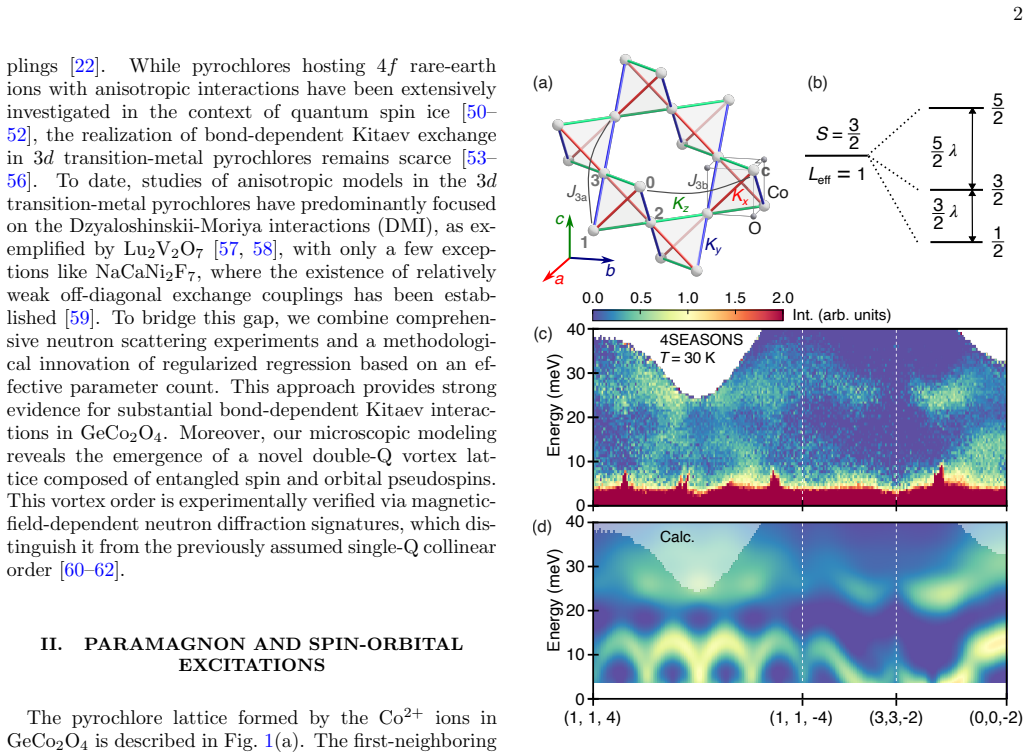
with an unquenched effective orbital angular momentum (|L eff|= 1). As schematically illus- trated in Fig. 1(b), the SOC,H SOC =λL eff ·S, lifts the degeneracy of the spin-orbital manifold, leading to three multiplets characterized by the total effective an- gular momentumJ eff = 1 2, 3 2, and 5 2. Previous inelastic neutron scattering (INS) experi- ments...
-
[2]
[60, 61]. As expected for aJ 1-J3 pyrochlore-lattice model with domi- nant ferromagneticJ 1 interactions [70], short-range spin correlations survive at temperatures up to 100 K, which aligns with the Weiss temperature of Θ∼81 K fitted from the magnetic susceptibility measurements [71, 72]. In Figs. 2(b-e), the left halves present the single-crystal diffus...
-
[3]
For the multiflavor model, the fitted parameters are scaled by a factor of 3 according to the ratio of its spin size compared to that of the effective spin- 1 2 model. Model Type Parameters (meV) spin- 1 2 model JA 1 JK 1 J3a JA 3b JK 3b JC 3b JD 3b −5.60(7) 3.54(17) 0.47(1) 1.81(3)−1.97(7) 0.48(3) 1.98(6) multiflavor model 3JA 1 3JK 1 3J3a 3JA 3b 3JK 3b ...
-
[4]
andQ 4 = (− 1 2 , 1 2 , 1 2) reflections, which belong to theq 1 andq 4 arms, respec- tively. Measurements were performed atT= 2 K by ramping up the field to the designated strengths up to 3 T, all below the meta-magnetic transition reported at 4.2 T [81]. The suppressedq 1 arm and enhancedq 4 arm strongly support the double-Q scenario. Figure 5(c) sum- m...
-
[5]
andq 3 = ( 1 2 ,− 1 2 , 1 2). Or- dered moments within a kagome layer and its two neigh- boring triangular layers are indicated by solid and open arrows, respectively. This double-Q order, described by theC a2/cmagnetic space group [65], emerges as the zero- field magnetic ground state of the fitted Hamiltonian, and is consistent with neutron diffraction ...
-
[6]
andQ 4 = (− 1 2 , 1 2 , 1
-
[7]
reflections, which belong to theq 1 andq 4 arms, respectively. (c) Field dependence of the integrated intensities forQ 1 = (− 5 2 , 3 2 , 3 2), Q2 = ( 1 2 , 1 2 ,− 1 2),Q 3 = ( 1 2 ,− 1 2 , 1 2), andQ 4 = (− 1 2 , 1 2 , 1 2), which belong toq 1,q 2,q 3, andq 4 arms, respectively. (d) The vortex lattice formed by pseudospins viewed along the [111] directio...
-
[8]
implies unequal ordered mo- ments within a single-Q structure, suggesting the natu- ral tendency toward multi-Q orders in pyrochlore systems hosting similar types of propagation vectors [46, 88–90]. While geometric frustration inherent to the pyrochlore lattice drives the double-Q order, the specific vortex lattice demonstrated in GeCo 2O4 is selected by ...
-
[9]
Fazekas,Lecture notes on electron correlation and magnetism, Vol
P. Fazekas,Lecture notes on electron correlation and magnetism, Vol. 5 (World scientific, 1999)
work page 1999
- [10]
- [11]
-
[12]
N. A. Spaldin and R. Ramesh, Advances in magnetoelec- tric multiferroics, Nat. Mater.18, 203 (2019)
work page 2019
-
[13]
K. I. Kugel and D. Khomskii, The Jahn-Teller effect and magnetism: transition metal compounds, Sov. Phys. Us- pekhi25, 231 (1982)
work page 1982
- [14]
-
[15]
G. V. Chen and C. Wu, Multiflavor mott insulators in quantum materials and ultracold atoms, npj Quantum Mater.9, 1 (2024)
work page 2024
- [16]
-
[17]
Y. Matsuda, T. Shibauchi, and H.-Y. Kee, Kitaev quan- tum spin liquids, Rev. Mod. Phys.97, 045003 (2025)
work page 2025
-
[18]
G. Jackeli and G. Khaliullin, Mott Insulators in the Strong Spin-Orbit Coupling Limit: From Heisenberg to a Quantum Compass and Kitaev Models, Phys. Rev. Lett. 102, 017205 (2009)
work page 2009
-
[19]
H. Liu, J. c. v. Chaloupka, and G. Khaliullin, Kitaev spin liquid in 3dtransition metal compounds, Phys. Rev. Lett. 125, 047201 (2020)
work page 2020
-
[20]
Y. Shangguan, S. Bao, Z.-Y. Dong, N. Xi, Y.-P. Gao, Z. Ma, W. Wang, Z. Qi, S. Zhang, Z. Huang, J. Liao, X. Zhao, B. Zhang, S. Cheng, H. Xu, D. Yu, R. A. Mole, N. Murai, S. Ohira-Kawamura, L. He, J. Hao, Q.-B. Yan, F. Song, W. Li, S.-L. Yu, J.-X. Li, and J. Wen, A one- third magnetization plateau phase as evidence for the Ki- taev interaction in a honeycom...
work page 2023
- [21]
-
[22]
Y. Gu, Y. Gu, F. Liu, S. Ohira-Kawamura, N. Murai, and J. Zhao, Signatures of Kitaev interactions in the van der waals ferromagnet VI3, Phys. Rev. Lett.132, 246702 (2024)
work page 2024
-
[23]
I. Lee, F. G. Utermohlen, D. Weber, K. Hwang, C. Zhang, J. van Tol, J. E. Goldberger, N. Trivedi, and P. C. Hammel, Fundamental spin interactions underlying the magnetic anisotropy in the Kitaev ferromagnet CrI 3, Phys. Rev. Lett.124, 017201 (2020)
work page 2020
-
[24]
S. Bandyopadhyay, F. L. Buessen, R. Das, F. G. Uter- mohlen, N. Trivedi, A. Paramekanti, and I. Dasgupta, Exchange interactions and spin dynamics in the layered honeycomb ferromagnet CrI3, Phys. Rev. B105, 184430 (2022)
work page 2022
-
[25]
M. Songvilay, S. Petit, J. Rodriguez-Rivera, W. Rat- cliff, F. Damay, V. Bal´ edent, M. Jim´ enez-Ruiz, P. Lejay, E. Pachoud,et al., Kitaev interactions in the co honey- comb antiferromagnets Na 3Co2SbO6 and Na 2Co2TeO6, Phys. Rev. B102, 224429 (2020)
work page 2020
- [26]
-
[27]
G. Lin, J. Jeong, C. Kim, Y. Wang, Q. Huang, T. Ma- suda, S. Asai, S. Itoh, G. G¨ unther, M. Russina,et al., Field-induced quantum spin disordered state in spin- 1/2 honeycomb magnet Na2Co2TeO6, Nat. Commun.12, 5559 (2021)
work page 2021
-
[28]
W. Yao, K. Iida, K. Kamazawa, and Y. Li, Excitations in the ordered and paramagnetic states of honeycomb mag- net Na2Co2TeO6, Phys. Rev. Lett.129, 147202 (2022)
work page 2022
-
[29]
X. Li, Y. Gu, Y. Chen, V. O. Garlea, K. Iida, K. Ka- mazawa, Y. Li, G. Deng, Q. Xiao, X. Zheng, Z. Ye, Y. Peng, I. A. Zaliznyak, J. M. Tranquada, and Y. Li, Giant magnetic in-plane anisotropy and competing insta- bilities in Na3Co2SbO6, Phys. Rev. X12, 041024 (2022)
work page 2022
- [30]
-
[31]
R. Sano, Y. Kato, and Y. Motome, Kitaev-Heisenberg hamiltonian for high-spind 7 mott insulators, Phys. Rev. B97, 014408 (2018)
work page 2018
-
[32]
S. M. Winter, Magnetic couplings in edge-sharing high- spind 7 compounds, J. Phys. Mater.5, 045003 (2022)
work page 2022
-
[33]
B. S. Mou, X. Zhang, L. Xiang, Y. Xu, R. Zhong, R. J. Cava, H. Zhou, Z. Jiang, D. Smirnov, N. Drichko, and S. M. Winter, Comparative raman scattering study of crystal field excitations in Co-based quantum magnets, Phys. Rev. Mater.8, 084408 (2024)
work page 2024
- [34]
-
[35]
P. A. Maksimov, S. Jiang, L. P. Regnault, and A. L. Chernyshev, Strong Kitaev interaction in BaCo2(AsO4)2, Phys. Rev. Lett.135, 066703 (2025)
work page 2025
- [36]
-
[37]
L. Bischof, J. Arneth, R. Kalaivanan, R. Sankar, K.-Y. Choi, and R. Klingeler, Spin waves in Na2Co2TeO6 stud- ied by high-frequency/high-field ESR: Successes and fail- ures of the triple-q model, Phys. Rev. B112, 104406 (2025)
work page 2025
-
[38]
B. Yuan, I. Khait, G.-J. Shu, F. C. Chou, M. B. Stone, J. P. Clancy, A. Paramekanti, and Y.-J. Kim, Dirac magnons in a honeycomb lattice quantum XY magnet CoTiO3, Phys. Rev. X10, 011062 (2020)
work page 2020
-
[39]
J. Sheng, L. Wang, A. Candini, W. Jiang, L. Huang, B. Xi, J. Zhao, H. Ge, N. Zhao, Y. Fu, J. Ren, J. Yang, P. Miao, X. Tong, D. Yu, S. Wang, Q. Liu, M. Kofu, R. Mole, G. Biasiol, D. Yu, I. A. Zaliznyak, J.-W. Mei, and L. Wu, Two-dimensional quantum universal- ity in the spin-1/2 triangular-lattice quantum antifer- romagnet Na 2BaCo(PO4)2, Proc. Natl. Acad...
work page 2022
- [40]
-
[41]
A. R. Wildes, B. F˚ ak, U. B. Hansen, M. Enderle, J. R. Stewart, L. Testa, H. M. Rønnow, C. Kim, and J.-G. Park, Spin wave spectra of single crystal CoPS 3, Phys. Rev. B107, 054438 (2023)
work page 2023
-
[42]
C. Kim, S. Kim, P. Park, T. Kim, J. Jeong, S. Ohira- Kawamura, N. Murai, K. Nakajima, A. L. Chernyshev, M. Mourigal, S.-J. Kim, and J.-G. Park, Bond-dependent anisotropy and magnon decay in cobalt-based Kitaev tri- angular antiferromagnet, Nat. Phys.19, 1624 (2023)
work page 2023
-
[43]
C. M. Morris, N. Desai, J. Viirok, D. H¨ uvonen, U. Nagel, T. R˜ o˜ om, J. W. Krizan, R. J. Cava, T. M. McQueen, S. M. Koohpayeh, R. K. Kaul, and N. P. Armitage, Du- ality and domain wall dynamics in a twisted Kitaev chain, Nat. Phys.17, 832 (2021)
work page 2021
-
[44]
D. Churchill and H.-Y. Kee, Transforming from kitaev to disguised Ising chain: Application to CoNb 2O6, Phys. Rev. Lett.133, 056703 (2024)
work page 2024
-
[45]
A. A. Konieczna, D. A. S. Kaib, S. M. Winter, and R. Va- lent´ ı, Understanding the microscopic origin of the mag- netic interactions in CoNb2O6, npj Quantum Mater.10, 8 (2025)
work page 2025
-
[46]
Kitaev, Anyons in an exactly solved model and be- yond, Ann
A. Kitaev, Anyons in an exactly solved model and be- yond, Ann. Phys.321, 2 (2006)
work page 2006
-
[47]
W. G. F. Kr¨ uger, W. Chen, X. Jin, Y. Li, and L. Janssen, Triple-qorder in Na 2Co2TeO6 from proximity to hidden- SU(2)-symmetric point, Phys. Rev. Lett.131, 146702 (2023)
work page 2023
-
[48]
X. Jin, M. Geng, F. Orlandi, D. Khalyavin, P. Manuel, Y. Liu, and Y. Li, Robust triple-qmagnetic order with trainable spin vorticity in Na2Co2TeO6, Phys. Rev. Lett. 135, 136701 (2025)
work page 2025
- [49]
-
[50]
J. Jiao, X. Li, G. Lin, M. Shu, W. Xu, O. Zaharko, T. Shi- roka, T. Hong, A. I. Kolesnikov, G. Deng, S. Dunsiger, M. C. Aronson, H. Zhou, X. Wang, T. Shang, and J. Ma, Static magnetic order with strong quantum fluctuations in spin-1/2 honeycomb magnet Na 2Co2TeO6, Commun. Mater.5, 159 (2024)
work page 2024
-
[51]
S. Gao, O. Zaharko, V. Tsurkan, Y. Su, J. S. White, G. S. Tucker, B. Roessli, F. Bourdarot, R. Sibille, D. Chernyshov, T. Fennell, A. Loidl, and C. R¨ uegg, Spi- ral spin-liquid and the emergence of a vortex-like state in MnSc2S4, Nat. Phys.13, 157 (2017)
work page 2017
-
[52]
N. D. Andriushin, J. Muller, N. S. Pavlovskii, J. Grum- bach, S. Granovsky, Y. V. Tymoshenko, O. Zaharko, A. Ivanov, J. Ollivier, M. Doerr, B. Keimer, M. Mostovoy, D. S. Inosov, and D. C. Peets, Reentrant multiple-q magnetic order and a “spin meta-cholesteric” phase in Sr3Fe2O7, npj Quantum Mater.9, 84 (2024)
work page 2024
-
[53]
S. Gao, H. D. Rosales, F. A. G´ omez Albarrac´ ın, V. Tsurkan, G. Kaur, T. Fennell, P. Steffens, M. Boehm, P. ˇCerm´ ak, A. Schneidewind, E. Ressouche, D. C. Cabra, C. R¨ uegg, and O. Zaharko, Fractional antiferromagnetic skyrmion lattice induced by anisotropic couplings, Na- ture586, 37 (2020)
work page 2020
-
[54]
J. A. Paddison, G. Ehlers, A. B. Cairns, J. S. Gard- ner, O. A. Petrenko, N. P. Butch, D. D. Khalyavin, P. Manuel, H. E. Fischer, H. Zhou,et al., Suppressed- moment 2-k order in the canonical frustrated antiferro- magnet Gd2Ti2O7, npj Quantum Mater.6, 99 (2021)
work page 2021
-
[55]
J. A. M. Paddison, H. Zhang, J. Yan, M. J. Cliffe, M. A. McGuire, S.-H. Do, S. Gao, M. B. Stone, D. Dahlbom, K. Barros, C. D. Batista, and A. D. Christianson, Cubic double perovskites host noncoplanar spin textures, npj Quantum Mater.9, 48 (2024)
work page 2024
-
[56]
J. Mo, L. M. Chinellato, F. Williams, A. Kikkawa, J. A. M. Paddison, M. D. Frontzek, G. Sala, C. Pasco, K. Barros, T. Nakajima, T.-h. Arima, Y. Taguchi, Y. Tokura, M. B. Stone, A. D. Christianson, C. D. Batista, and S. Gao, Skyrmion and meron crystals in in- termetallic Gd3Ru4Al12: Microscopic model insights into chiral phases (2025), arXiv:2512.24071 [co...
-
[57]
N. D. Andriushin, J. Grumbach, A. A. Kulbakov, Y. V. Tymoshenko, Y. A. Onykiienko, R. Firouzmandi, E. Cheng, S. Granovsky, Y. Skourski, J. Ollivier, H. C. Walker, V. Kocsis, B. B¨ uchner, B. Keimer, M. Doerr, D. S. Inosov, and D. C. Peets, Anomalous quasielastic scattering contribution in the centrosymmetric multi-q helimagnet srfeo3, Phys. Rev. X15, 0110...
work page 2025
-
[58]
K. A. Ross, L. Savary, B. D. Gaulin, and L. Balents, Quantum excitations in quantum spin ice, Phys. Rev. X 1, 021002 (2011)
work page 2011
-
[59]
M. J. P. Gingras and P. A. McClarty, Quantum spin ice: a search for gapless quantum spin liquids in pyrochlore magnets, Rep. Prog. Phys.77, 056501 (2014)
work page 2014
-
[60]
H. Yan, O. Benton, L. Jaubert, and N. Shannon, The- ory of multiple-phase competition in pyrochlore magnets with anisotropic exchange with application to Yb2Ti2O7, Er2Ti2O7, and Er 2Sn2O7, Phys. Rev. B95, 094422 (2017)
work page 2017
-
[61]
J. W. Krizan and R. J. Cava, NaCaCo 2F7: A single- crystal high-temperature pyrochlore antiferromagnet, Phys. Rev.B89, 214401 (2014)
work page 2014
-
[62]
K. A. Ross, J. W. Krizan, J. A. Rodriguez-Rivera, R. J. Cava, and C. L. Broholm, Static and dynamic XY-like short-range order in a frustrated magnet with exchange disorder, Phys. Rev. B93, 014433 (2016)
work page 2016
-
[63]
K. A. Ross, J. M. Brown, R. J. Cava, J. W. Krizan, S. E. Nagler, J. A. Rodriguez-Rivera, and M. B. Stone, Single-ion properties of theS eff = 1 2 XY antiferromag- netic pyrochlores NaA ′ Co2F7 (A ′ = Ca2+,Sr 2+), Phys. Rev. B95, 144414 (2017)
work page 2017
-
[64]
B. A. Frandsen, K. A. Ross, J. W. Krizan, G. J. Nilsen, A. R. Wildes, R. J. Cava, R. J. Birgeneau, and S. J. Billinge, Real-space investigation of short-range mag- netic correlations in fluoride pyrochlores NaCaCo 2F7 and NaSrCo2F7 with magnetic pair distribution function analysis, Phys. Rev. Mater.1, 074412 (2017)
work page 2017
- [65]
-
[66]
M. Mena, R. S. Perry, T. G. Perring, M. D. Le, S. Guer- rero, M. Storni, D. T. Adroja, C. R¨ uegg, and D. F. Mc- Morrow, Spin-wave spectrum of the quantum ferromag- net on the pyrochlore lattice Lu 2V2O7, Phys. Rev. Lett. 113, 047202 (2014)
work page 2014
-
[67]
K. W. Plumb, H. J. Changlani, A. Scheie, S. Zhang, J. W. Krizan, J. A. Rodriguez-Rivera, Y. Qiu, B. Winn, R. J. Cava, and C. L. Broholm, Continuum of quantum fluctu- ations in a three-dimensionalS= 1 Heisenberg magnet, Nat. Phys.15, 54 (2019)
work page 2019
-
[68]
S. Diaz, S. De Brion, G. Chouteau, B. Canals, V. Si- 11 monet, and P. Strobel, Magnetic frustration in the spinel compounds GeCo 2O4 and GeNi 2O4, Phys. Rev. B74, 092404 (2006)
work page 2006
-
[69]
M. Matsuda, T. Hoshi, H. Aruga Katori, M. Kosaka, and H. Takagi, Magnetic-field-induced transitions in spinel GeCo2O4, J. Phys. Soc. Jpn.80, 034708 (2011)
work page 2011
-
[70]
X. Fabr` eges, E. Ressouche, F. Duc, S. De Brion, M. Amara, C. Detlefs, L. Paolasini, E. Suard, L.-P. Reg- nault, B. Canals, P. Strobel, and V. Simonet, Field- driven magnetostructural transitions in GeCo 2O4, Phys. Rev. B95, 014428 (2017)
work page 2017
-
[71]
K. Tomiyasu, M. K. Crawford, D. T. Adroja, P. Manuel, A. Tominaga, S. Hara, H. Sato, T. Watanabe, S. I. Ikeda, J. W. Lynn, K. Iwasa, and K. Yamada, Molec- ular spin-orbit excitations in thej eff = 1/2 frustrated spinel GeCo2O4, Phys. Rev. B84, 054405 (2011)
work page 2011
-
[72]
R. Kajimoto, M. Nakamura, Y. Inamura, F. Mizuno, K. Nakajima, S. Ohira-Kawamura, T. Yokoo, T. Nakatani, R. Maruyama, K. Soyama, K. Shibata, K. Suzuya, S. Sato, K. Aizawa, M. Arai, S. Wakimoto, M. Ishikado, S.-i. Shamoto, M. Fujita, H. Hiraka, K. Ohoyama, K. Yamada, and C.-H. Lee, The fermi chopper spectrometer 4SEASONS at J-PARC, J. Phys. Soc. Jpn.80, SB0...
work page 2011
-
[73]
See Supplemental Material for details on sample prepa- ration and characterizations, experimental methods, and calculation methods
-
[74]
com/spintoolkit-dev/SpinToolkit_py(2026)
SpinToolkit Developers, SpinToolkit,https://github. com/spintoolkit-dev/SpinToolkit_py(2026)
work page 2026
-
[75]
L. Xu, X. Shi, Y. Jiao, J. Yang, L. Yang, and Z. Wang, In preparation, (2026)
work page 2026
- [76]
-
[77]
S. Gao, M. A. McGuire, Y. Liu, D. L. Abernathy, M. B. Stone, and A. D. Christianson, Spiral spin liquid on a honeycomb lattice, Phys. Rev. Lett.128, 227201 (2022)
work page 2022
-
[78]
S. Gao, G. Pokharel, A. F. May, J. A. M. Paddison, C. Pasco, Y. Liu, K. M. Taddei, S. Calder, D. G. Man- drus, M. B. Stone, and A. D. Christianson, Line-graph approach to spiral spin liquids, Phys. Rev. Lett.129, 237202 (2022)
work page 2022
-
[79]
S. Diaz, S. De Brion, M. Holzapfel, G. Chouteau, and P. Strobel, Study of competitive magnetic interactions in the spinel compounds GeNi 2O4, GeCo 2O4, Physica B: Condensed Matter346–347, 146 (2004)
work page 2004
-
[80]
J. C. Lashley, R. Stevens, M. K. Crawford, J. Boerio- Goates, B. F. Woodfield, Y. Qiu, J. W. Lynn, P. A. God- dard, and R. A. Fisher, Specific heat and magnetic sus- ceptibility of the spinels GeNi 2O4 and GeCo 2O4, Phys. Rev.B78, 104406 (2008)
work page 2008
discussion (0)
Sign in with ORCID, Apple, or X to comment. Anyone can read and Pith papers without signing in.