Recognition: 2 theorem links
· Lean TheoremMagnetism and spin dynamics of Na₅Yb(MoO₄)₄: A weakly interacting rare-earth stretched diamond lattice
Pith reviewed 2026-05-13 03:56 UTC · model grok-4.3
The pith
Na5Yb(MoO4)4 forms a dipolar quantum paramagnet where exchange is negligible and dipolar interactions set the low-energy scale.
A machine-rendered reading of the paper's core claim, the machinery that carries it, and where it could break.
Core claim
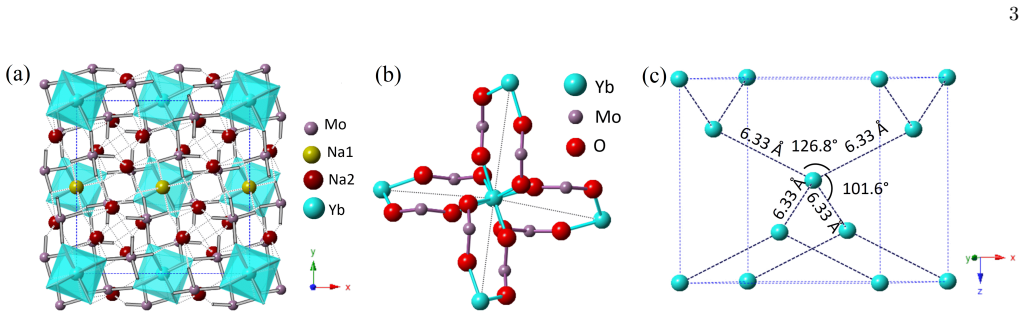
The compound Na5Yb(MoO4)4 exhibits a tetragonal structure with Yb ions on a three-dimensional stretched diamond framework separated by 6.33 Å. Neutron diffraction confirms the lattice, susceptibility and specific heat show no ordering to 60 mK, DFT+U finds negligible exchange due to long super-superexchange paths, specific heat has gapped spin excitations from dipolar correlations, and muSR shows persistent dynamics to 50 mK. Thus it is a dipolar quantum paramagnet dominated by single-ion physics and dipolar interactions with exchange suppressed to the millikelvin scale.
What carries the argument
The stretched diamond lattice of Yb3+ ions, in which large inter-ion distances suppress exchange interactions, allowing long-range dipolar couplings and single-ion anisotropy to govern the quantum paramagnetic behavior.
If this is right
- Exchange interactions are suppressed to millikelvin energies, leaving dipolar terms dominant.
- Gapped excitations arise from long-range dipolar correlations shaped by anisotropy.
- Spin dynamics remain dynamic without static order down to 50 mK.
- The effective J_eff=1/2 Kramers doublet is isolated from higher crystal field levels.
Where Pith is reading between the lines
- Similar stretched lattices in other rare-earth compounds could yield tunable dipolar paramagnets by controlling bond lengths.
- This system offers a platform to study the interplay of dipolar interactions and quantum fluctuations without confounding exchange.
- Measurements at even lower temperatures might reveal the onset of dipolar order if exchange is truly zero.
Load-bearing premise
The assumption that the gapped specific heat originates from dipolar correlations and that DFT+U without parameter tuning accurately reflects the tiny exchange scale.
What would settle it
Detection of long-range magnetic order or gapless magnetic excitations in specific heat or other probes below 50 mK would indicate that dipolar interactions do stabilize order or that exchange is not as suppressed as claimed.
Figures



read the original abstract
We report a comprehensive investigation of the structural and magnetic properties of Na$_5$Yb(MoO$_4$)$_4$, a member of the stretched diamond magnetic lattice family. Neutron powder diffraction at 3.3~K confirms that the compound crystallizes in the tetragonal \textit{I4$_1$/a} space group, with a large interatomic separation of 6.33~\AA{} between magnetic Yb ions forming a three-dimensional stretched diamond framework. Magnetic susceptibility and specific heat measurements reveal no evidence of long-range magnetic order down to 60~mK. The low-temperature magnetic behavior is governed by an effective $J_{\mathrm{eff}} = 1/2$ Kramers doublet ground state, well separated from excited crystal-field levels, arising from the distorted dodecahedral oxygen coordination of Yb$^{3+}$. Density functional theory calculations within the DFT+$U$ framework indicate that exchange interactions between Yb ions are negligibly small, consistent with the long O--Mo--O super-superexchange pathways. The temperature dependence of the specific heat exhibits signatures of gapped spin excitations, most likely originating from long-range dipolar correlations and further shaped by weak exchange interactions together with the strong single-ion anisotropy of the Yb moments. Muon spin relaxation measurements reveal persistent low-energy spin dynamics, indicating that dipolar correlations remain dynamic and are insufficient to stabilize static magnetic order down to 50~mK. These results identify Na$_5$Yb(MoO$_4$)$_4$ as a rare example of a dipolar quantum paramagnet in which single-ion physics and long-range dipolar interactions dominate, while exchange interactions are suppressed to the millikelvin energy scale.
Editorial analysis
A structured set of objections, weighed in public.
Referee Report
Summary. The paper reports neutron diffraction, magnetic susceptibility, specific heat, and muon spin relaxation measurements on Na5Yb(MoO4)4, which crystallizes in a stretched diamond lattice with 6.33 Å Yb-Yb separation. It finds no long-range order down to 60 mK, an effective J=1/2 Kramers doublet ground state, negligibly small exchange from DFT+U, gapped excitations in C(T) attributed to long-range dipolar correlations, and persistent spin dynamics in muSR, concluding that the material is a dipolar quantum paramagnet with exchange suppressed to the mK scale.
Significance. If the central interpretation is confirmed, the work provides a rare experimental realization of a dipolar quantum paramagnet in a rare-earth system where single-ion anisotropy and long-range dipolar interactions dominate over exchange. The multi-technique data set (neutron diffraction confirming structure, consistent absence of order, and DFT support for weak exchange) offers a clean platform for studying dipolar-dominated spin dynamics, with potential value for theory of quantum paramagnets and comparison to other stretched-diamond or dipolar materials.
major comments (1)
- [Specific heat analysis and discussion] The attribution of the gapped excitations observed in specific heat to long-range dipolar correlations (abstract and discussion of C(T)) is not supported by quantitative modeling. The gap magnitude is not compared to the dipolar energy scale computed from the measured g-tensor at the 6.33 Å Yb-Yb separation, and no minimal dipolar Hamiltonian is diagonalized or fitted to the C(T) data to show that dipolar interactions (rather than residual exchange, impurities, or phonons) reproduce the observed gap and temperature dependence. This leaves the dominance of dipolar over other mechanisms as an interpretation rather than a demonstrated result.
Simulated Author's Rebuttal
We thank the referee for their detailed and constructive review of our manuscript. Their comment highlights an important point regarding the interpretation of the specific heat data, and we address it directly below. We believe the clarifications and planned additions will improve the manuscript.
read point-by-point responses
-
Referee: The attribution of the gapped excitations observed in specific heat to long-range dipolar correlations (abstract and discussion of C(T)) is not supported by quantitative modeling. The gap magnitude is not compared to the dipolar energy scale computed from the measured g-tensor at the 6.33 Å Yb-Yb separation, and no minimal dipolar Hamiltonian is diagonalized or fitted to the C(T) data to show that dipolar interactions (rather than residual exchange, impurities, or phonons) reproduce the observed gap and temperature dependence. This leaves the dominance of dipolar over other mechanisms as an interpretation rather than a demonstrated result.
Authors: We agree that a more explicit quantitative link between the observed gap and the dipolar energy scale would strengthen the interpretation. In the manuscript we based the attribution on the combination of (i) DFT+U results showing exchange interactions suppressed well below the mK scale, (ii) the large 6.33 Å Yb–Yb separation, and (iii) the absence of order or static magnetism down to 50 mK in both specific heat and μSR. Using the experimentally determined g-tensor and the known Yb–Yb distance, the characteristic dipolar energy scale evaluates to approximately 0.2–0.4 K (accounting for the angular dependence of the dipolar tensor), which matches the temperature range where the specific-heat anomaly sets in. We will add this estimate, together with a short discussion of why a full lattice diagonalization of the anisotropic dipolar Hamiltonian is computationally demanding for the large unit cell, in the revised manuscript. We maintain that residual exchange, impurities, and phonons are disfavored by the full data set, but we accept that the current presentation leaves the dipolar assignment as a well-supported interpretation rather than a direct numerical demonstration. revision: partial
- A complete numerical diagonalization of the minimal dipolar Hamiltonian on the stretched-diamond lattice followed by a fit to the specific-heat data is beyond the scope and resources of the present experimental study and cannot be provided.
Circularity Check
No significant circularity; claims rest on independent measurements and standard calculations
full rationale
The paper derives its conclusions from direct experimental observables (neutron diffraction confirming structure and Yb-Yb separation, susceptibility and specific heat data showing no order and gapped excitations, muSR showing persistent dynamics) combined with standard DFT+U computations indicating negligible exchange via long super-superexchange paths. No equations reduce a reported quantity (e.g., the specific-heat gap) to a parameter fitted from the same dataset. No self-citation chain is invoked to justify uniqueness or force an ansatz. The interpretive step attributing the gap to dipolar correlations is not a mathematical derivation that loops back to inputs by construction; it remains an inference open to external verification or falsification.
Axiom & Free-Parameter Ledger
free parameters (1)
- Hubbard U in DFT+U
axioms (2)
- domain assumption Yb3+ (4f13) in distorted dodecahedral oxygen coordination produces an isolated J_eff=1/2 Kramers doublet ground state
- domain assumption Long O-Mo-O pathways suppress exchange to the millikelvin scale
Lean theorems connected to this paper
-
IndisputableMonolith/Foundation/AlexanderDuality.leanalexander_duality_circle_linking unclear?
unclearRelation between the paper passage and the cited Recognition theorem.
The temperature dependence of the specific heat exhibits signatures of gapped spin excitations, most likely originating from long-range dipolar correlations... Δ_dip = 0.1314(13) K
-
IndisputableMonolith/Cost/FunctionalEquation.leanwashburn_uniqueness_aczel unclear?
unclearRelation between the paper passage and the cited Recognition theorem.
DFT+U calculations... exchange parameters... sub-μeV range... ordering temperature of approximately 0.3 mK
What do these tags mean?
- matches
- The paper's claim is directly supported by a theorem in the formal canon.
- supports
- The theorem supports part of the paper's argument, but the paper may add assumptions or extra steps.
- extends
- The paper goes beyond the formal theorem; the theorem is a base layer rather than the whole result.
- uses
- The paper appears to rely on the theorem as machinery.
- contradicts
- The paper's claim conflicts with a theorem or certificate in the canon.
- unclear
- Pith found a possible connection, but the passage is too broad, indirect, or ambiguous to say the theorem truly supports the claim.
Reference graph
Works this paper leans on
-
[1]
Spin liquids in frustrated magnets,
Leon Balents, “Spin liquids in frustrated magnets,” Na- ture464, 199–208 (2010)
work page 2010
-
[2]
Quantum spin liquids: a review,
Lucile Savary and Leon Balents, “Quantum spin liquids: a review,” Rep. Prog. Phys.80, 016502 (2016)
work page 2016
-
[3]
Correlated quantum phenomena in the strong spin-orbit regime,
William Witczak-Krempa, Gang Chen, Yong Baek Kim, and Leon Balents, “Correlated quantum phenomena in the strong spin-orbit regime,” Annu. Rev. Condens. Mat- ter Phys.5, 57–82 (2014)
work page 2014
-
[4]
A. Bertin, P. Dalmas de R´ eotier, B. F˚ ak, C. Marin, A. Yaouanc, A. Forget, D. Sheptyakov, B. Frick, C. Rit- ter, A. Amato, C. Baines, and P. J. C. King, “Nd2Sn2O7: An all-in–all-out pyrochlore magnet with no divergence- free field and anomalously slow paramagnetic spin dy- namics,” Phys. Rev. B92, 144423 (2015)
work page 2015
-
[5]
Novel strongly spin-orbit coupled quantum dimer magnet: Yb 2Si2O7,
Gavin Hester, H. S. Nair, T. Reeder, D. R. Yahne, T. N. DeLazzer, L. Berges, D. Ziat, J. R. Neilson, A. A. Aczel, G. Sala, J. A. Quilliam, and K. A. Ross, “Novel strongly spin-orbit coupled quantum dimer magnet: Yb 2Si2O7,” Phys. Rev. Lett.123, 027201 (2019)
work page 2019
-
[6]
Bose-einstein condensation in honeycomb dimer magnets and Yb 2Si2O7,
Chunhan Feng, E. Miles Stoudenmire, and Alexander Wietek, “Bose-einstein condensation in honeycomb dimer magnets and Yb 2Si2O7,” Phys. Rev. B107, 205150 (2023)
work page 2023
-
[7]
Spin ice state in frustrated magnetic pyrochlore materials,
Steven T. Bramwell and Michel J. P. Gingras, “Spin ice state in frustrated magnetic pyrochlore materials,” Sci- ence294, 1495–1501 (2001)
work page 2001
-
[8]
Magnetic monopoles in spin ice,
C. Castelnovo, R. Moessner, and S. L. Sondhi, “Magnetic monopoles in spin ice,” Nature451, 42–45 (2008)
work page 2008
-
[9]
T. Arh, B. Sana, M. Pregelj, P. Khuntia, Z. Jagliˇ ci´ c, M. D. Le, P. K. Biswas, P. Manuel, L. Mangin-Thro, A. Ozarowski, and A. Zorko, “The Ising triangular- lattice antiferromagnet neodymium heptatantalate as a quantum spin liquid candidate,” Nat. Mater.21, 416–422 (2022)
work page 2022
-
[10]
Proximate spin liquid and fractionalization in the triangular antiferromagnet KYbSe2,
A. O. Scheie, E. A. Ghioldi, J. Xing, J. A. M. Paddison, N. E. Sherman, M. Dupont, L. D. Sanjeewa, Sangyun Lee, A. J. Woods, D. Abernathy, D. M. Pajerowski, T. J. Williams, Shang-Shun Zhang, L. O. Manuel, A. E. Trumper, C. D. Pemmaraju, A. S. Sefat, D. S. Parker, T. P. Devereaux, R. Movshovich, J. E. Moore, C. D. Batista, and D. A. Tennant, “Proximate spi...
work page 2024
-
[11]
Realization of quantum dipoles in triangular lattice crystal Ba3Yb(BO3)3,
Rabindranath Bag, Matthew Ennis, Chunxiao Liu, Sa- chith E. Dissanayake, Zhenzhong Shi, Jue Liu, Leon Ba- lents, and Sara Haravifard, “Realization of quantum dipoles in triangular lattice crystal Ba3Yb(BO3)3,” Phys. Rev. B104, L220403 (2021)
work page 2021
-
[12]
Spin dynamics of the quantum dipolar magnet Yb 3Ga5O12 in an external field,
E. Lhotel, L. Mangin-Thro, E. Ressouche, P. Steffens, E. Bichaud, G. Knebel, J.-P. Brison, C. Marin, S. Ray- mond, and M. E. Zhitomirsky, “Spin dynamics of the quantum dipolar magnet Yb 3Ga5O12 in an external field,” Phys. Rev. B104, 024427 (2021)
work page 2021
-
[13]
Changle Liu, Guijing Duan, and Rong Yu, “Theory of rare-earth kramers magnets on a shastry-sutherland lat- tice: dimer phases in the presence of strong spin-orbit coupling,” npj Quantum Materials10, 109 (2025)
work page 2025
-
[14]
Frustrated diamond lattice antiferromagnet,
J Oitmaa, “Frustrated diamond lattice antiferromagnet,” Physical Review B99, 134407 (2019)
work page 2019
-
[15]
Spin order and dynamics in the diamond-lattice heisenberg antiferromagnets CuRh 2O4 and CoRh2O4,
L. Ge, J. Flynn, J. A. M. Paddison, M. B. Stone, S. Calder, M. A. Subramanian, A. P. Ramirez, and M. Mourigal, “Spin order and dynamics in the diamond-lattice heisenberg antiferromagnets CuRh 2O4 and CoRh2O4,” Phys. Rev. B96, 064413 (2017)
work page 2017
-
[16]
Magnetism on the stretched diamond lattice in lan- thanide orthotantalates,
Nicola D. Kelly, Lei Yuan, Rosalyn L. Pearson, Em- manuelle Suard, In´ es Puente Orench, and Siˆ an E. Dut- ton, “Magnetism on the stretched diamond lattice in lan- thanide orthotantalates,” Phys. Rev. Mater.6, 044410 (2022)
work page 2022
-
[17]
Presence of a correlated dy- namical ground state in the stretched diamond lattice system YbNbO4,
Jogendra Kumar, Dheeraj Ranaut, Jumpei G. Naka- mura, and K. Mukherjee, “Presence of a correlated dy- namical ground state in the stretched diamond lattice system YbNbO4,” Phys. Rev. B111, 014411 (2025)
work page 2025
-
[18]
Experimental evidence for the spiral spin liquid in LiYbO 2,
J. N. Graham, N. Qureshi, C. Ritter, P. Manuel, A. R. Wildes, and L. Clark, “Experimental evidence for the spiral spin liquid in LiYbO 2,” Phys. Rev. Lett.130, 166703 (2023)
work page 2023
-
[19]
Antiferromagnetism and crystalline electric field excitations in tetragonal NaCeO 2,
Mitchell M. Bordelon, Joshua D. Bocarsly, Lorenzo Posthuma, Arnab Banerjee, Qiang Zhang, and Stephen D. Wilson, “Antiferromagnetism and crystalline electric field excitations in tetragonal NaCeO 2,” Phys. Rev. B103, 024430 (2021)
work page 2021
-
[20]
Continuous excitations of the triangular-lattice quantum spin liquid YbMgGaO 4,
Joseph A. M. Paddison, Marcus Daum, Zhiling Dun, Georg Ehlers, Yaohua Liu, Matthew B. Stone, Haidong Zhou, and Martin Mourigal, “Continuous excitations of the triangular-lattice quantum spin liquid YbMgGaO 4,” Nature Physics13, 117–122 (2017)
work page 2017
-
[21]
Order-by-disorder and spiral spin-liquid in frustrated diamond-lattice antiferromag- nets,
Doron Bergman, Jason Alicea, Emanuel Gull, Simon Trebst, and Leon Balents, “Order-by-disorder and spiral spin-liquid in frustrated diamond-lattice antiferromag- nets,” Nature Physics3, 487–491 (2007)
work page 2007
-
[22]
Quantum spin liquids on the diamond lattice,
Aishwarya Chauhan, Atanu Maity, Chunxiao Liu, Jonas Sonnenschein, Francesco Ferrari, and Yasir Iqbal, “Quantum spin liquids on the diamond lattice,” Phys. Rev. B108, 134424 (2023)
work page 2023
-
[23]
Johnson Dhanya, Elattuvalappil Kalathil Suresh, Ra- jaram Naveenraj, and Ravendran Ratheesh, “Synthesis and characterization of Na 5M(MoO4)4 (M= Y, Yb) mi- crowave ceramics for ultcc applications,” Ceram. Int.44, 6699–6704 (2018)
work page 2018
-
[24]
Yuan-Bin Chen and Siyi Xiong, “Raman spec- tra and microwave dielectric properties of Na5Tm1–x (Y1/3Yb2/3)x(MoO4)4 ceramics with ultra- low sintering temperature,” Scientific Reports15, 6644 (2025)
work page 2025
-
[25]
Spin ex- citations in the quantum dipolar magnet Yb(BaBO 3)3,
C. Y. Jiang, Y. X. Yang, Y. X. Gao, Z. T. Wan, Z. H. Zhu, T. Shiroka, C. S. Chen, Q. Wu, X. Li, J. C. Jiao, K. W. Chen, Y. Bao, Z. M. Tian, and L. Shu, “Spin ex- citations in the quantum dipolar magnet Yb(BaBO 3)3,” Phys. Rev. B106, 014409 (2022)
work page 2022
-
[26]
J. A. Quilliam, K. A. Ross, A. G. Del Maestro, M. J. P. Gingras, L. R. Corruccini, and J. B. Kycia, “Evidence for gapped spin-wave excitations in the frustrated Gd2Sn2O7 pyrochlore antiferromagnet from low-temperature spe- cific heat measurements,” Phys. Rev. Lett.99, 097201 (2007)
work page 2007
-
[27]
Mag- netic anisotropy and dipolar interactions in the frustrated triangular-lattice magnet NaGdS 2,
J. Grumbach, E. H¨ außler, S. Luther, J. Sichelschmidt, K. M. Ranjith, T. Herrmannsd¨ orfer, M. Rotter, S. Gra- novsky, H. K¨ uhne, M. Uhlarz, J. Wosnitza, H.-H. Klauß, M. Baenitz, T. Doert, and M. Doerr, “Mag- netic anisotropy and dipolar interactions in the frustrated triangular-lattice magnet NaGdS 2,” Phys. Rev. B111, 15 144404 (2025)
work page 2025
-
[28]
A. Scheie, “PyCrystalField: software for calculation, analysis and fitting of crystal electric field Hamiltonians,” J. Appl. Crystallogr.54, 356–362 (2021)
work page 2021
-
[29]
D. J. Newman and B. Ng,Crystal Field Handbook(Cam- bridge University Press, Cambridge, 2000)
work page 2000
-
[30]
Musrfit: A free platform- independent framework forµsr data analysis,
A. Suter and B.M. Wojek, “Musrfit: A free platform- independent framework forµsr data analysis,” Phys. Pro- cedia30, 69–73 (2012)
work page 2012
-
[31]
Ab initio molecular dynamics for liquid metals,
G. Kresse and J. Hafner, “Ab initio molecular dynamics for liquid metals,” Phys. Rev. B47, 558–561 (1993)
work page 1993
-
[32]
G. Kresse and J. Hafner, “Ab initio molecular-dynamics simulation of the liquid-metal–amorphous-semiconductor transition in germanium,” Phys. Rev. B49, 14251–14269 (1994)
work page 1994
-
[33]
Efficient iterative schemes forab initiototal-energy calculations using a plane-wave basis set,
G. Kresse and J. Furthm¨ uller, “Efficient iterative schemes forab initiototal-energy calculations using a plane-wave basis set,” Phys. Rev. B54, 11169–11186 (1996)
work page 1996
-
[34]
G. Kresse and J. Furthm¨ uller, “Efficiency ofab-initioto- tal energy calculations for metals and semiconductors us- ing a plane-wave basis set,” Comput. Mater. Sci.6, 15–50 (1996)
work page 1996
-
[35]
Density func- tional theory of electronic structure,
W. Kohn, A. D. Becke, and R. G. Parr, “Density func- tional theory of electronic structure,” The J. Phys. Chem. 100, 12974–12980 (1996)
work page 1996
-
[36]
Generalized gradient approximation made simple,
John P. Perdew, Kieron Burke, and Matthias Ernzer- hof, “Generalized gradient approximation made simple,” Phys. Rev. Lett.77, 3865–3868 (1996)
work page 1996
-
[37]
Zs. R´ ak and D.W. Brenner, “Interplay of electronic struc- ture and unusual development in crystal structure of YbAuIn and Yb3AuGe2In3,” Philosophical Magazine95, 2167–2174 (2015)
work page 2015
-
[38]
Special points for brillouin-zone integrations,
Hendrik J. Monkhorst and James D. Pack, “Special points for brillouin-zone integrations,” Phys. Rev. B13, 5188–5192 (1976)
work page 1976
-
[39]
Tb2J: A python package for computing mag- netic interaction parameters,
Xu He, Nicole Helbig, Matthieu J. Verstraete, and Eric Bousquet, “Tb2J: A python package for computing mag- netic interaction parameters,” Comput. Phys. Commun. 264, 107938 (2021)
work page 2021
-
[40]
Diamagnetic cor- rections and pascal’s constants,
Gordon A. Bain and John F. Berry, “Diamagnetic cor- rections and pascal’s constants,” J. Chem. Educ.85, 532 (2008)
work page 2008
-
[41]
Single crystal synthe- sis and magnetism of the BaLn 2O4 family (ln = lan- thanide),
Tiglet Besara, Matthew S. Lundberg, Jifeng Sun, Daniel Ramirez, Lianyang Dong, Jeffrey B. Whalen, Rafael Vasquez, Felix Herrera, John R. Allen, Michael W. Davidson, and Theo Siegrist, “Single crystal synthe- sis and magnetism of the BaLn 2O4 family (ln = lan- thanide),” Prog. Solid State Chem.42, 23–36 (2014)
work page 2014
-
[42]
Spin liquid state in a rare-earth hyper- kagome lattice,
J. Khatua, S. Bhattacharya, Q. P. Ding, S. Vrtnik, A. M. Strydom, N. P. Butch, H. Luetkens, E. Kermar- rec, M. S. Ramachandra Rao, A. Zorko, Y. Furukawa, and P. Khuntia, “Spin liquid state in a rare-earth hyper- kagome lattice,” Phys. Rev. B106, 104404 (2022)
work page 2022
-
[43]
Disordered ground state in the spin-orbit coupledJ eff = 1 2 distorted honeycomb mag- net BiYbGeO5,
S. Mohanty, S. S. Islam, N. Winterhalter-Stocker, A. Jesche, G. Simutis, Ch. Wang, Z. Guguchia, J. Sichelschmidt, M. Baenitz, A. A. Tsirlin, P. Gegen- wart, and R. Nath, “Disordered ground state in the spin-orbit coupledJ eff = 1 2 distorted honeycomb mag- net BiYbGeO5,” Phys. Rev. B108, 134408 (2023)
work page 2023
-
[44]
Exploring potential quan- tum spin liquid state in a quasi-one-dimensional magnetic chain,
Rahul Kumar, Kiwan Nam, Seong-Hoon Kim, Kee Hoon Kim, and A Sundaresan, “Exploring potential quan- tum spin liquid state in a quasi-one-dimensional magnetic chain,” Physical Review B109, 224429 (2024)
work page 2024
-
[45]
Magnetic properties of the triangular-lattice antiferromagnets of Ba3RB9O18 (R = Yb, Er),
J. Khatua, M. Pregelj, A. Elghandour, Z. Jagliˇ cic, R. Klingeler, A. Zorko, and P. Khuntia, “Magnetic properties of the triangular-lattice antiferromagnets of Ba3RB9O18 (R = Yb, Er),” Phys. Rev. B106, 104408 (2022)
work page 2022
-
[46]
Role of alkaline metal in the rare-earth triangular antiferromag- net KYbO2,
Franziska Grußler, Mamoun Hemmida, Sebastian Bachus, Yurii Skourski, Hans-Albrecht Krug von Nidda, Philipp Gegenwart, and Alexander A. Tsirlin, “Role of alkaline metal in the rare-earth triangular antiferromag- net KYbO2,” Phys. Rev. B107, 224416 (2023)
work page 2023
-
[47]
J. Khatua, S. Bhattacharya, A. M. Strydom, A. Zorko, J. S. Lord, A. Ozarowski, E. Kermarrec, and P. Khuntia, “Magnetic properties and spin dynamics in the spin- orbit drivenJ eff = 1 2 triangular lattice antiferromagnet Ba6Yb2Ti4O17,” Phys. Rev. B109, 024427 (2024)
work page 2024
-
[48]
David L Clark, “The chemical complexities,” Los Alamos Science , 364 (2000)
work page 2000
-
[49]
Alain Le Yaouanc and Pierre Dalmas De Reotier,Muon spin rotation, relaxation, and resonance: applications to condensed matter(Oxford University Press, Oxford, 2011), Vol. 147., 2011)
work page 2011
-
[50]
Adrian D. Hillier, Stephen J. Blundell, Iain McKenzie, Izumi Umegaki, Lei Shu, Joseph A. Wright, Thomas Prokscha, Fabrice Bert, Koichiro Shimomura, Adam Berlie, Helena Alberto, and Isao Watanabe, “Muon spin spectroscopy,” Nat. Rev. Methods Primers,2, 4 (2022)
work page 2022
-
[51]
Spin dynamics, entanglement, and the nature of the spin liquid state in YbMgGaO 4,
F. L. Pratt, F. Lang, W. Steinhardt, S. Haravifard, and S. J. Blundell, “Spin dynamics, entanglement, and the nature of the spin liquid state in YbMgGaO 4,” Phys. Rev. B106, L060401 (2022)
work page 2022
-
[52]
Dynam- ics in canonical spin glasses observed by muon spin de- polarization,
I. A. Campbell, A. Amato, F. N. Gygax, D. Herlach, A. Schenck, R. Cywinski, and S. H. Kilcoyne, “Dynam- ics in canonical spin glasses observed by muon spin de- polarization,” Phys. Rev. Lett.72, 1291–1294 (1994)
work page 1994
-
[53]
M.T. Hutchings, “Point-charge calculations of energy lev- els of magnetic ions in crystalline electric fields**this work was supported by the U.S. air force, the U.K. de- partment of and industrial research, and the U.S. atomic energy commission,” (Academic Press, 1964) pp. 227– 273
work page 1964
-
[54]
K W H Stevens, “Matrix elements and operator equiv- alents connected with the magnetic properties of rare earth ions,” Proc. Phys. Soc. A65, 209 (1952)
work page 1952
-
[55]
Ybmggao4: A triangular-lattice quan- tum spin liquid candidate,
Yuesheng Li, “Ybmggao4: A triangular-lattice quan- tum spin liquid candidate,” Adv. Quantum Technol.2, 1900089 (2019)
work page 2019
-
[56]
Frustrated magnet for adiabatic demagnetization cooling to milli-kelvin temperatures,
Yoshifumi Tokiwa, Sebastian Bachus, Kavita Kavita, An- ton Jesche, Alexander A. Tsirlin, and Philipp Gegen- wart, “Frustrated magnet for adiabatic demagnetization cooling to milli-kelvin temperatures,” Commun. Mater. 2, 42 (2021)
work page 2021
-
[57]
Marvin Klinger, Tim Treu, Felix Kreisberger, Chris- tian Heil, Anna Klinger, Anton Jesche, and Philipp Gegenwart, “Sub-1 k adiabatic demagnetization re- frigeration with rare-earth borates Ba 3XB9O18 and Ba3XB3O9, X = (Yb, Gd),” Applied Sciences16(2026), 10.3390/app16010290
-
[58]
Magne- tocaloric materials and the optimization of cooling power density,
Patrick Wikus, Edgar Canavan, Sarah Trowbridge Heine, Koichi Matsumoto, and Takenori Numazawa, “Magne- tocaloric materials and the optimization of cooling power density,” Cryogenics62, 150–162 (2014)
work page 2014
-
[59]
Measurements of the specific heats of three magnetic salts at low tempera- tures,
O. E. Vilches and J. C. Wheatley, “Measurements of the specific heats of three magnetic salts at low tempera- tures,” Phys. Rev.148, 509–516 (1966)
work page 1966
-
[60]
R. A. Fisher, E. W. Hornung, G. E. Brodale, 16 and W. F. Giauque, “Magnetothermodynamics of Ce2Mg3(NO3)12·24 H2O. II. the evaluation of absolute temperature and other thermodynamic properties of cmn to 0.6 m◦K,” J. Chem. Phys.58, 5584–5604 (1973)
work page 1973
-
[61]
The thermal and magnetic properties of chromium potassium alum be- low 0·1◦K,
J. M. Daniels and Nicholas Kurti, “The thermal and magnetic properties of chromium potassium alum be- low 0·1◦K,” Proceedings of the Royal Society of Lon- don. A. Mathematical and Physical Sciences221, 243– 256 (1954)
work page 1954
-
[62]
U. Arjun, K. M. Ranjith, A. Jesche, F. Hirschberger, D. D. Sarma, and P. Gegenwart, “Adiabatic demagneti- zation refrigeration to millikelvin temperatures with the distorted square lattice magnet NaYbGeO4,” Phys. Rev. B108, 224415 (2023)
work page 2023
-
[63]
A. Jesche, N. Winterhalter-Stocker, F. Hirschberger, A. Bellon, S. Bachus, Y. Tokiwa, A. A. Tsirlin, and P. Gegenwart, “Adiabatic demagnetization cooling well below the magnetic ordering temperature in the triangu- lar antiferromagnet KBaGd(BO 3)2,” Phys. Rev. B107, 104402 (2023)
work page 2023
-
[64]
Quan- tum spin liquid candidate as superior refrigerant in cas- cade demagnetization cooling,
Xin-Yang Liu, Yuan Gao, Han Li, Wentao Jin, Junsen Xiang, Hai Jin, Ziyu Chen, Wei Li, and Gang Su, “Quan- tum spin liquid candidate as superior refrigerant in cas- cade demagnetization cooling,” Commun. Phys.5, 233 (2022)
work page 2022
discussion (0)
Sign in with ORCID, Apple, or X to comment. Anyone can read and Pith papers without signing in.