Recognition: no theorem link
Is Child-Directed Language Optimized for Word Learning? A Computational Study of Verb Meaning Acquisition
Pith reviewed 2026-05-13 06:25 UTC · model grok-4.3
The pith
Neural models indicate that child-directed language does not provide a unique optimization for learning verb meanings beyond spoken adult language.
A machine-rendered reading of the paper's core claim, the machinery that carries it, and where it could break.
Core claim
The advantage for verb learning previously attributed to child-directed language reflects broader properties of the spoken register rather than a uniquely child-directed optimization. When syntactic information is removed, models on spoken data including child-directed maintain better performance than on written data, and semantic acquisition precedes syntactic proficiency most clearly in the spoken domain.
What carries the argument
Neural language models trained on child-directed versus adult-directed language corpora, with selective removal of syntactic or lexical co-occurrence information to test resilience in verb meaning acquisition.
If this is right
- Disrupting syntax impairs verb meaning learning across child-directed, spoken adult, and written inputs.
- Spoken registers, both child-directed and adult, exhibit higher resilience to information removal than written language.
- Semantic performance emerges prior to syntactic proficiency during training, with greater asynchrony in spoken data.
- The previously observed CDL advantage for verbs is explained by spoken language properties in general.
Where Pith is reading between the lines
- Language acquisition research should prioritize comparing spoken and written registers over focusing solely on child-directed speech.
- These results may inform educational tools that use spoken language simulations for vocabulary building.
- Further experiments could test if similar patterns hold for other word categories beyond verbs.
Load-bearing premise
The performance of neural language models after targeted removal of syntactic or lexical information serves as a valid proxy for how children acquire verb meanings from real linguistic input.
What would settle it
A controlled experiment showing that children learn verb meanings significantly better from child-directed speech than from adult-directed spoken language with matched vocabulary and syntax.
Figures

read the original abstract
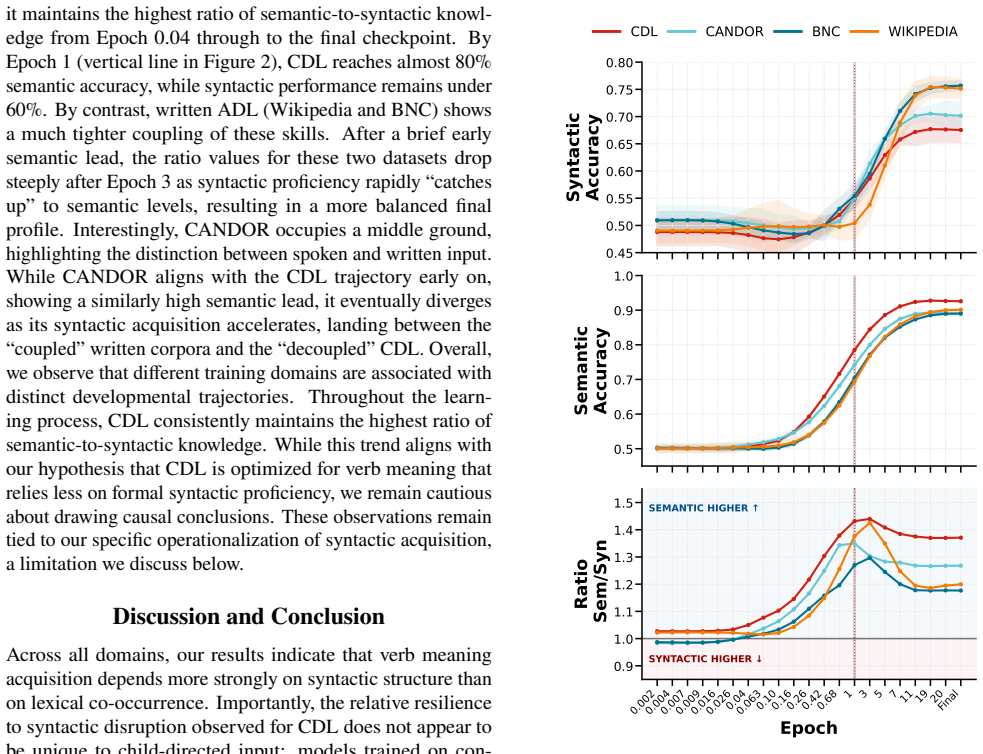
Is child-directed language (CDL) optimized to support language learning, and which aspects of linguistic development does it facilitate? We investigate this question using neural language models trained on CDL versus adult-directed language (ADL). We selectively remove syntactic or lexical co-occurrence information from the model training data, and evaluate the impact of these manipulations on verb meaning acquisition. While disrupting syntax impairs learning across all datasets, models trained on CDL and spoken ADL show significantly higher resilience than those trained on written input. Tracking semantic and syntactic performance over training, we observe a semantic-first trajectory, with verb meanings emerging prior to robust syntactic proficiency, an asynchrony most pronounced in the spoken domain, especially CDL. These results suggest that the advantage for verb learning previously attributed to CDL may instead reflect broader properties of the spoken register, rather than a uniquely CDL-specific optimization.
Editorial analysis
A structured set of objections, weighed in public.
Referee Report
Summary. The manuscript claims that neural language models trained on child-directed language (CDL) and adult-directed spoken language (ADL) exhibit greater resilience to selective removal of syntactic or lexical co-occurrence information during verb meaning acquisition than models trained on written input. It reports a semantic-first learning trajectory (verb meanings emerging prior to robust syntax) that is most pronounced in the spoken domain, particularly CDL. The authors conclude that previously reported CDL advantages for verb learning reflect broader properties of the spoken register rather than unique CDL-specific optimization.
Significance. If the proxy mapping holds, the result would reframe CDL not as specially optimized input but as an instance of spoken-language statistics that facilitate early semantic acquisition. This has implications for usage-based theories of acquisition and for how register differences are modeled computationally. The controlled disruption approach is a strength for isolating information bottlenecks, but the overall significance is limited by the absence of direct validation against child data.
major comments (2)
- [Abstract and Methods] The central claim (that CDL advantages reflect spoken-register properties) depends on the assumption that post-disruption LM accuracy on verb meaning serves as a valid proxy for children's acquisition from real input. The next-token objective and the specific syntactic/lexical removal procedure may capture statistical regularities unavailable to infants; without explicit validation or controls showing correspondence to developmental bottlenecks, the resilience difference cannot be mapped onto the stated developmental conclusion.
- [Abstract] The abstract and reported results provide no details on model architectures, exact training corpora sizes, verb-meaning evaluation metrics, statistical tests, or confound controls. This absence makes it impossible to determine whether the reported resilience differences and semantic-first trajectories are robust or artifactual.
minor comments (1)
- [Abstract] Expand the abstract to include at least one concrete example of the removal manipulation and the verb-meaning probe task so readers can assess the operationalization without consulting the full methods.
Simulated Author's Rebuttal
We thank the referee for their constructive comments. We respond point-by-point to the major comments below, clarifying our use of language models as a computational proxy while acknowledging limitations, and indicating where we will revise the manuscript for greater transparency.
read point-by-point responses
-
Referee: [Abstract and Methods] The central claim (that CDL advantages reflect spoken-register properties) depends on the assumption that post-disruption LM accuracy on verb meaning serves as a valid proxy for children's acquisition from real input. The next-token objective and the specific syntactic/lexical removal procedure may capture statistical regularities unavailable to infants; without explicit validation or controls showing correspondence to developmental bottlenecks, the resilience difference cannot be mapped onto the stated developmental conclusion.
Authors: We agree that language models trained with next-token prediction are not direct models of infant cognition and that our disruption procedure may highlight statistical patterns infants do not access in the same way. Our goal is not to claim equivalence but to use controlled ablations to isolate the relative contribution of syntactic versus lexical co-occurrence information across registers. This yields testable hypotheses about why spoken input (including CDL) supports earlier semantic acquisition than written text. We will add an expanded limitations subsection that explicitly discusses the proxy's boundaries, differences from infant learning mechanisms, and the need for future behavioral validation against child data. revision: partial
-
Referee: [Abstract] The abstract and reported results provide no details on model architectures, exact training corpora sizes, verb-meaning evaluation metrics, statistical tests, or confound controls. This absence makes it impossible to determine whether the reported resilience differences and semantic-first trajectories are robust or artifactual.
Authors: The full manuscript details these elements in the Methods and Results sections: transformer architectures (BERT and GPT variants), corpus sizes (CHILDES-derived CDL ~5M tokens, matched spoken ADL and written corpora), verb-meaning evaluation via semantic similarity probes and classification accuracy against gold-standard embeddings, statistical tests (repeated-measures ANOVA with Bonferroni-corrected post-hoc t-tests), and controls for token count and lexical diversity via subsampling. We will revise the abstract to include concise statements of these parameters and add a summary table in the supplement for quick reference. revision: yes
Circularity Check
No significant circularity in empirical model evaluations
full rationale
The paper conducts direct computational experiments by training neural language models on CDL versus ADL and written corpora, applying selective removal of syntactic or lexical co-occurrence information, and measuring resulting impacts on verb meaning acquisition via accuracy and training trajectories. These results emerge from empirical comparisons and observed patterns such as semantic-first learning, without any mathematical derivation, fitted parameters renamed as predictions, or self-citation chains that reduce the central claims to their own inputs by construction. The suggestion that CDL advantages reflect broader spoken-register properties follows from the comparative resilience data rather than any self-definitional equivalence or ansatz smuggled via prior work.
Axiom & Free-Parameter Ledger
axioms (1)
- domain assumption Neural language models trained on text can serve as proxies for human verb meaning acquisition from linguistic input.
Reference graph
Works this paper leans on
-
[1]
Reece, Andrew and Cooney, Gus and Bull, Peter and Chung, Christine and Dawson, Bryn and Fitzpatrick, Casey and Glazer, Tamara and Knox, Dean and Liebscher, Alex and Marin, Sebastian , journal=. 2023 , publisher=
work page 2023
-
[2]
Dialogue act modeling for automatic tagging and recognition of conversational speech , author=
-
[3]
Distributed by Oxford University Computing Services on behalf of the BNC Consortium
British national corpus version 3 (BNC XML edition) , author=. Distributed by Oxford University Computing Services on behalf of the BNC Consortium. Retrieved February , volume=
-
[4]
MacWhinney, Brian , year=
-
[5]
and Sulem, Elior and Cynthia, Fisher and Roth, Dan
Huebner, Philip A. and Sulem, Elior and Cynthia, Fisher and Roth, Dan. B aby BERT a: Learning More Grammar With Small-Scale Child-Directed Language. 2021. doi:10.18653/v1/2021.conll-1.49
-
[6]
Language models are unsupervised multitask learners , author=. OpenAI blog , volume=
-
[7]
arXiv preprint arXiv:2203.13112 , year=
minicons: Enabling flexible behavioral and representational analyses of transformer language models , author=. arXiv preprint arXiv:2203.13112 , year=
-
[8]
Evaluating Neural Language Models as Cognitive Models of Language Acquisition
V \'a zquez Mart \'i nez, H \'e ctor Javier and Heuser, Annika and Yang, Charles and Kodner, Jordan. Evaluating Neural Language Models as Cognitive Models of Language Acquisition. Proceedings of the 1st GenBench Workshop on (Benchmarking) Generalisation in NLP. 2023. doi:10.18653/v1/2023.genbench-1.4
- [9]
-
[10]
Assessing the Ability of LSTM s to Learn Syntax-Sensitive Dependencies
Linzen, Tal and Dupoux, Emmanuel and Goldberg, Yoav. Assessing the Ability of LSTM s to Learn Syntax-Sensitive Dependencies. Transactions of the Association for Computational Linguistics. 2016. doi:10.1162/tacl_a_00115
-
[11]
Targeted Syntactic Evaluation of Language Models
Marvin, Rebecca and Linzen, Tal. Targeted Syntactic Evaluation of Language Models. 2018. doi:10.18653/v1/D18-1151
-
[12]
Futrell, Richard. 2025
work page 2025
-
[13]
BL i MP : The Benchmark of Linguistic Minimal Pairs for E nglish
Warstadt, Alex and Parrish, Alicia and Liu, Haokun and Mohananey, Anhad and Peng, Wei and Wang, Sheng-Fu and Bowman, Samuel R. BL i MP : The Benchmark of Linguistic Minimal Pairs for E nglish. Transactions of the Association for Computational Linguistics. 2020
work page 2020
-
[14]
Cross-Linguistic Syntactic Evaluation of Word Prediction Models
Mueller, Aaron and Nicolai, Garrett and Petrou-Zeniou, Panayiota and Talmina, Natalia and Linzen, Tal. Cross-Linguistic Syntactic Evaluation of Word Prediction Models. 2020. doi:10.18653/v1/2020.acl-main.490
-
[15]
Child-Directed Language Does Not Consistently Boost Syntax Learning in Language Models
Padovani, Francesca and Jumelet, Jaap and Matusevych, Yevgen and Bisazza, Arianna. Child-Directed Language Does Not Consistently Boost Syntax Learning in Language Models. 2025. doi:10.18653/v1/2025.emnlp-main.999
-
[16]
Language and Linguistics Compass , volume =
Portelance, Eva and Jasbi, Masoud , title =. Language and Linguistics Compass , volume =. doi:https://doi.org/10.1111/lnc3.70001 , eprint =
-
[17]
Nature Reviews Psychology , volume=
Syntactic bootstrapping as a mechanism for language learning , author=. Nature Reviews Psychology , volume=. 2024 , publisher=
work page 2024
-
[18]
Infants rapidly learn word-referent mappings via cross-situational statistics , author=. Cognition , volume=. 2008 , publisher=
work page 2008
-
[19]
arXiv preprint arXiv:2508.12482 , year=
The Structural Sources of Verb Meaning Revisited: Large Language Models Display Syntactic Bootstrapping , author=. arXiv preprint arXiv:2508.12482 , year=
-
[20]
Conference on Language Modeling (COLM) , year =
Readability Learnability: Rethinking the Role of Simplicity in Training Small Language Models , author =. Conference on Language Modeling (COLM) , year =
-
[21]
Society for Computation in Linguistics , volume=
Language Learning as Codebreaking: The Key Roles of Redundancy and Locality , author=. Society for Computation in Linguistics , volume=. 2025 , publisher=
work page 2025
- [22]
-
[23]
Call for Papers -- The BabyLM Challenge: Sample-efficient pretraining on a developmentally plausible corpus , author=. 2023 , eprint=
work page 2023
-
[24]
The 2nd BabyLM Challenge at the 28th Conference on Computational Natural Language Learning. 2024
work page 2024
-
[25]
doi:10.18653/v1/2025.babylm-main.0
2025. doi:10.18653/v1/2025.babylm-main.0
-
[26]
Ethan Gotlieb Wilcox and Michael Y. Hu and Aaron Mueller and Alex Warstadt and Leshem Choshen and Chengxu Zhuang and Adina Williams and Ryan Cotterell and Tal Linzen , keywords =. Bigger is not always better: The importance of human-scale language modeling for psycholinguistics , journal =. 2025 , issn =. doi:https://doi.org/10.1016/j.jml.2025.104650 , url =
-
[27]
Child-directed speech is optimized for syntax-free semantic inference , author=. Scientific Reports , volume=. 2021 , publisher=
work page 2021
-
[28]
Annual Meeting of the Association for Computational Linguistics , year=
How to Plant Trees in Language Models: Data and Architectural Effects on the Emergence of Syntactic Inductive Biases , author=. Annual Meeting of the Association for Computational Linguistics , year=
-
[29]
Language acquisition , volume=
The structural sources of verb meanings , author=. Language acquisition , volume=. 1990 , publisher=
work page 1990
-
[30]
Wiley Interdisciplinary Reviews: Cognitive Science , volume=
Syntactic bootstrapping , author=. Wiley Interdisciplinary Reviews: Cognitive Science , volume=. 2010 , publisher=
work page 2010
-
[31]
Feng, Steven Y. and Goodman, Noah D. and Frank, Michael C. Is Child-Directed Speech Effective Training Data for Language Models?. 2024. doi:10.18653/v1/2024.emnlp-main.1231
-
[32]
Human simulations of vocabulary learning , journal =
Jane Gillette and Henry Gleitman and Lila Gleitman and Anne Lederer , keywords =. Human simulations of vocabulary learning , journal =. 1999 , issn =
work page 1999
-
[33]
American Anthropologist , year=
Baby Talk in Six Languages , author=. American Anthropologist , year=
-
[34]
Kempe, Vera and Ota, Mitsuhiko and Schaeffler, Sonja , journal=. 2024 , publisher=
work page 2024
-
[35]
Sudden Drops in the Loss: Syntax Acquisition, Phase Transitions, and Simplicity Bias in
Angelica Chen and Ravid Shwartz-Ziv and Kyunghyun Cho and Matthew L Leavitt and Naomi Saphra , booktitle=. Sudden Drops in the Loss: Syntax Acquisition, Phase Transitions, and Simplicity Bias in. 2024 , url=
work page 2024
-
[36]
A. Chalnick and D. Billman , title =. Proceedings of the Tenth Annual Conference of the Cognitive Science Society , pages =
-
[37]
E. A. Feigenbaum , title =. Computers and thought , publisher =
-
[38]
J. A. C. Hill , title =. Cognition and Brain Theory , year = 1983, volume = 6, pages =
work page 1983
- [39]
-
[40]
Teenie Matlock , title =
- [41]
-
[42]
Computational models of scientific discovery and theory formation , publisher =
- [43]
-
[44]
The use of multiple frames in verb learning via syntactic bootstrapping , author=. Cognition , volume=. 1996 , publisher=
work page 1996
-
[45]
Newport, Elissa L and Aslin, Richard N , journal=. 2004 , publisher=
work page 2004
-
[46]
What infants know about syntax but couldn't have learned: Experimental evidence for syntactic structure at 18 months , author=. Cognition , volume=. 2003 , publisher=
work page 2003
-
[47]
Chang, Tyler A. and Bergen, Benjamin K. Word Acquisition in Neural Language Models. Transactions of the Association for Computational Linguistics. 2022. doi:10.1162/tacl_a_00444
-
[48]
Predicting age of acquisition for children's early vocabulary in five languages using language model surprisal , author=. Cognitive Science , volume=. 2023 , publisher=
work page 2023
-
[49]
Beyond Surprisal: A Dual Metric Framework for Lexical Skill Acquisition in LLM s
Shafiabadi, Nazanin and Wisniewski, Guillaume. Beyond Surprisal: A Dual Metric Framework for Lexical Skill Acquisition in LLM s. 2025
work page 2025
-
[50]
Comparing Character-level Neural Language Models Using a Lexical Decision Task
Le Godais, Ga. Comparing Character-level Neural Language Models Using a Lexical Decision Task. Proceedings of the 15th Conference of the E uropean Chapter of the Association for Computational Linguistics: Volume 2, Short Papers. 2017
work page 2017
-
[51]
From Babble to Words: Pre-Training Language Models on Continuous Streams of Phonemes
Goriely, Z \'e bulon and Diehl Martinez, Richard and Caines, Andrew and Buttery, Paula and Beinborn, Lisa. From Babble to Words: Pre-Training Language Models on Continuous Streams of Phonemes. 2024
work page 2024
-
[52]
Bunzeck, Bastian and Zarrie , Sina. 2025. doi:10.18653/v1/2025.acl-short.24
-
[53]
The function and evolution of child-directed communication , year =. PLOS Biology , publisher =. doi:10.1371/journal.pbio.3001630 , author =
-
[54]
Current Directions in Psychological Science , volume =
Roberta Michnick Golinkoff and Dilara Deniz Can and Melanie Soderstrom and Kathy Hirsh-Pasek , title =. Current Directions in Psychological Science , volume =. 2015 , doi =. https://doi.org/10.1177/0963721415595345 , abstract =
-
[55]
What artificial neural networks can tell us about human language acquisition , author=. 2022 , publisher=
work page 2022
-
[56]
Transactions of the Association for Computational Linguistics , volume=
Assessing the ability of LSTMs to learn syntax-sensitive dependencies , author=. Transactions of the Association for Computational Linguistics , volume=. 2016 , publisher=
work page 2016
-
[57]
Liu, Yinhan and Ott, Myle and Goyal, Naman and Du, Jingfei and Joshi, Mandar and Chen, Danqi and Levy, Omer and Lewis, Mike and Zettlemoyer, Luke and Stoyanov, Veselin , journal=
-
[58]
Davies, Mark , journal=
discussion (0)
Sign in with ORCID, Apple, or X to comment. Anyone can read and Pith papers without signing in.