Recognition: 2 theorem links
· Lean TheoremH-linear magnetoresistance in NbSe₂ due to impeded cyclotron motion
Pith reviewed 2026-05-13 03:47 UTC · model grok-4.3
The pith
Charge-density-wave hotspots impede cyclotron motion to produce linear magnetoresistance in 2H-NbSe2
A machine-rendered reading of the paper's core claim, the machinery that carries it, and where it could break.
Core claim
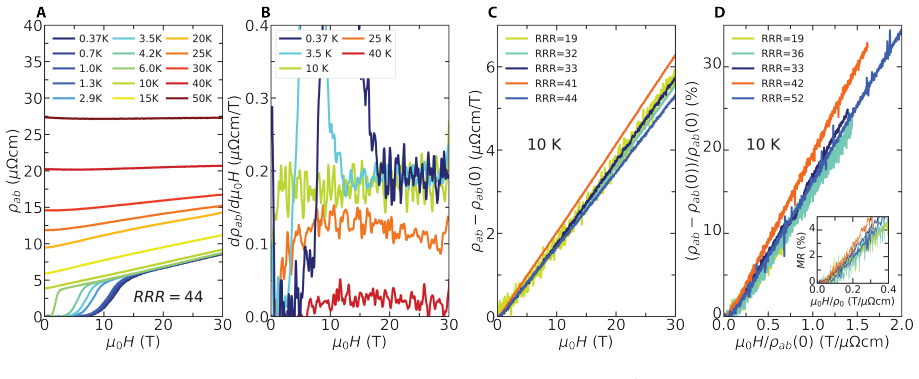
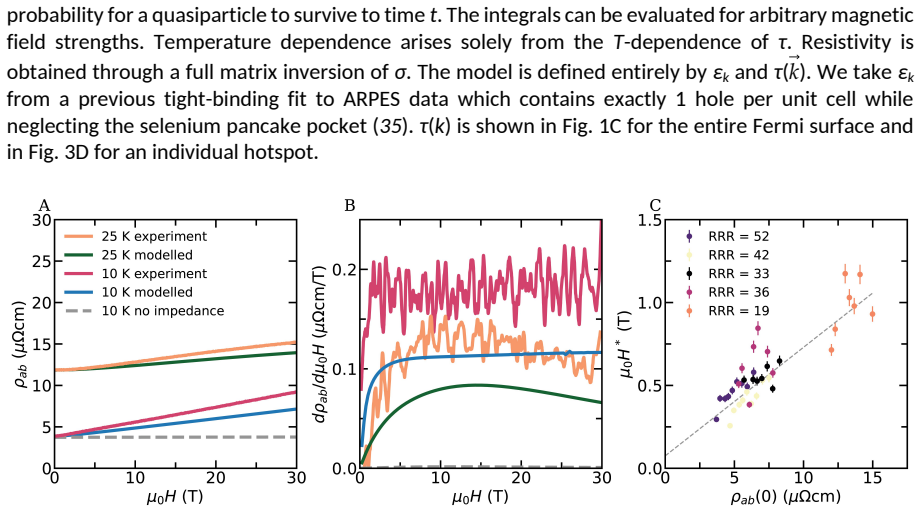
Linear magnetoresistance in 2H-NbSe2 is generated by impeded cyclotron motion at strong scattering sinks induced by the charge density wave order. These sinks occur where the CDW connects the high temperature Fermi cylinders, preventing normal cyclotron orbits. Boltzmann transport analysis with this effect accounts for the measured magnetoresistance, and also accounts for the absence of quantum oscillations inside the CDW state.
What carries the argument
Impeded cyclotron motion from CDW-induced scattering hotspots that connect separate Fermi surface cylinders
Load-bearing premise
The Boltzmann transport analysis with impeded cyclotron motion fully accounts for the observed magnetoresistance without dominant contributions from other mechanisms such as inhomogeneity or quantum effects
What would settle it
Observation of quantum oscillations inside the CDW state or magnetoresistance curves that deviate from the Boltzmann ICM prediction would falsify the claim
Figures

read the original abstract
Linear magnetoresistance (LMR) is a widespread phenomenon observed in a host of quantum materials ranging from semiconductor nanostructures to quantum critical and strange metals. While multiple scenarios to explain LMR have been proposed, a complete understanding of the phenomenon remains elusive. Indeed, it is highly likely that the origin of LMR depends on the specific electronic state. Here, we report a study of the impact of disorder on the form of the magnetoresistance of the prototypical charge-density-wave (CDW) compound 2$H$-NbSe$_2$. The magnetoresistance is shown to exhibit strong qualitative and quantitative agreement with Boltzmann transport analysis incorporating impeded cyclotron motion (ICM). We identify the source of ICM in 2$H$-NbSe$_2$ as strong scattering sinks where the CDW order connects the high temperature Fermi cylinders. Such unusual "hotspots" provide an explanation for the observed LMR as well as for the long-unexplained absence of quantum oscillations inside the charge ordered state in 2$H$-NbSe$_2$. These findings provide strong evidence that ICM generates LMR in certain correlated metals.
Editorial analysis
A structured set of objections, weighed in public.
Referee Report
Summary. The paper claims that the H-linear magnetoresistance in 2H-NbSe2 originates from impeded cyclotron motion due to strong scattering sinks at CDW-induced hotspots on the Fermi surface, where the CDW order connects the high-temperature Fermi cylinders. This is supported by qualitative and quantitative agreement with Boltzmann transport analysis, and it also accounts for the absence of quantum oscillations in the CDW state.
Significance. If the central claim holds, the work provides a specific microscopic mechanism for linear magnetoresistance in a correlated CDW metal, linking it to Fermi surface reconstruction features. This could have broader implications for understanding LMR in other quantum materials with similar scattering hotspots and offers an explanation for missing quantum oscillations in NbSe2.
major comments (2)
- The statement of 'strong qualitative and quantitative agreement' with the Boltzmann ICM model is not accompanied by details on the fitting procedure, the values or number of free parameters (such as hotspot scattering rates), error bars, or statistical measures of fit quality, which are necessary to evaluate the robustness of the agreement.
- The identification of CDW hotspots as the dominant scattering source appears derived from fitting the magnetoresistance data rather than from an independent microscopic calculation (e.g., using CDW gap parameters or ARPES nesting vectors). This introduces potential circularity, as the model parameters are adjusted to the same data it aims to explain, without explicit exclusion of alternative mechanisms like inhomogeneity (Parish-Littlewood) or quantum effects.
minor comments (2)
- The term 'impeded cyclotron motion (ICM)' is introduced without a brief definition or reference to prior work in the abstract, which may hinder immediate understanding for readers unfamiliar with the concept.
- Ensure that all figures include error bars where applicable and that the supplementary information provides the raw data or code for the Boltzmann simulations to enhance reproducibility.
Simulated Author's Rebuttal
We are grateful to the referee for their thorough review and constructive feedback on our manuscript. We have carefully considered each comment and provide point-by-point responses below. Where appropriate, we have revised the manuscript to address the concerns raised.
read point-by-point responses
-
Referee: The statement of 'strong qualitative and quantitative agreement' with the Boltzmann ICM model is not accompanied by details on the fitting procedure, the values or number of free parameters (such as hotspot scattering rates), error bars, or statistical measures of fit quality, which are necessary to evaluate the robustness of the agreement.
Authors: We thank the referee for highlighting this omission. The original manuscript did not provide sufficient details on the fitting. In the revised manuscript, we have added a detailed description of the Boltzmann transport analysis, including the fitting procedure, the number of free parameters (specifically, the scattering rates at the CDW hotspots and the uniform background), error bars on the magnetoresistance data, and quantitative measures of fit quality such as the chi-squared value. This addition allows for a better evaluation of the agreement between the model and the data. revision: yes
-
Referee: The identification of CDW hotspots as the dominant scattering source appears derived from fitting the magnetoresistance data rather than from an independent microscopic calculation (e.g., using CDW gap parameters or ARPES nesting vectors). This introduces potential circularity, as the model parameters are adjusted to the same data it aims to explain, without explicit exclusion of alternative mechanisms like inhomogeneity (Parish-Littlewood) or quantum effects.
Authors: The positions of the CDW-induced hotspots are independently fixed by the known CDW wave vector and nesting conditions from ARPES and prior literature, as discussed in the manuscript. The scattering rates are indeed obtained by fitting to the MR data, but the overall model is validated against multiple independent observations, including the absence of quantum oscillations. We have revised the manuscript to include a more explicit discussion of these independent constraints and to address why alternative mechanisms such as Parish-Littlewood inhomogeneity are not consistent with the observed behavior in our high-quality samples. A full microscopic calculation of the rates is beyond the scope, but we believe the current approach is not circular. We have also added text explaining the regime where semiclassical Boltzmann transport applies, making quantum effects less relevant. revision: partial
Circularity Check
No significant circularity in derivation chain
full rationale
The paper reports qualitative and quantitative agreement between measured magnetoresistance in 2H-NbSe2 and a Boltzmann transport model incorporating impeded cyclotron motion, then attributes the ICM to CDW-induced scattering hotspots at connections between high-temperature Fermi cylinders. This agreement is presented as supporting evidence for the ICM mechanism rather than a closed loop in which a fitted parameter is relabeled as a prediction. No equations are shown reducing the output to the input data by construction, no self-citation is invoked as a uniqueness theorem to forbid alternatives, and the hotspot identification is tied to the known CDW Fermi-surface reconstruction rather than being smuggled in via prior author work. The central claim therefore retains independent content from the transport calculation and the material-specific CDW geometry.
Axiom & Free-Parameter Ledger
free parameters (1)
- hotspot scattering rates
axioms (1)
- domain assumption Semiclassical Boltzmann transport equation remains valid in the presence of CDW order and strong scattering sinks
invented entities (1)
-
CDW-induced scattering sinks (hotspots)
no independent evidence
Lean theorems connected to this paper
-
IndisputableMonolith/Cost/FunctionalEquation.leanwashburn_uniqueness_aczel unclear?
unclearRelation between the paper passage and the cited Recognition theorem.
We follow Ref. (21) and hypothesize that the predominant effect of the CDW order on the electron dynamics is to turn points on the FS connected by a CDW Q-vector incoherent... The only degree of freedom in the model is the isotropic cold scattering time τ across the FS, which we fit to the zero-field resistivity ρab(0).
-
IndisputableMonolith/Foundation/RealityFromDistinction.leanreality_from_one_distinction unclear?
unclearRelation between the paper passage and the cited Recognition theorem.
The LMR slope in ICM is nominally inversely proportional to the cold carrier density... robust against changes in scattering time, temperature, disorder or effective mass
What do these tags mean?
- matches
- The paper's claim is directly supported by a theorem in the formal canon.
- supports
- The theorem supports part of the paper's argument, but the paper may add assumptions or extra steps.
- extends
- The paper goes beyond the formal theorem; the theorem is a base layer rather than the whole result.
- uses
- The paper appears to rely on the theorem as machinery.
- contradicts
- The paper's claim conflicts with a theorem or certificate in the canon.
- unclear
- Pith found a possible connection, but the passage is too broad, indirect, or ambiguous to say the theorem truly supports the claim.
Reference graph
Works this paper leans on
-
[1]
Herring, Effect of random inhomogeneities on electrical and galvanomagnetic measurements
C. Herring, Effect of random inhomogeneities on electrical and galvanomagnetic measurements. J. Appl. Phys. 31, 1939–1953 (1960). 10.1063/1.1735477
-
[2]
T. Khouri, U. Zeitler, C. Reichl, W. Wegscheider, N. E. Hussey, S. Wiedmann, and J. C. Maan, Linear magnetoresistance in a quasifree two-dimensional electron gas in an ultrahigh mobility GaAs quantum well. Phys. Rev. Lett. 117, 256601 (2016). 10.1103/PhysRevLett.117.256601
-
[4]
I. M. Hayes, R. D. McDonald, N. P. Breznay, T. Helm. P. J. W. Moll, M. Wartenbe, A. Shekhter, and J. G. Analytis, Scaling between magnetic field and temperature in the high-temperature superconductor BaFe2(As1−𝑥P𝑥)2. Nat. Phys. 12, 916–919 (2016). 10.1038/nphys3773
-
[5]
N. Maksimovic, I. M. Hayes, V. Nagarajan, J. G. Analytis, A. E. Koshelev, J. Singleton, Y. Lee, and T. Schenkel, Magnetoresistance scaling and the origin of 𝐻-linear resistivity in BaFe2(As1−xPx)2. Phys. Rev. X 10, 041062 (2020). 10.1103/PhysRevX.10.041062
-
[6]
S. Licciardello, N. Maksimovic, J. Ayres, J. Buhot, M. Čulo, B. Bryant, S. Kasahara, Y. Matsuda, T. Shibauchi, V. Nagarajan, J. G. Analytis and N. E. Hussey, Magnetoresistance scaling and thCoexistence of orbital and quantum critical magnetoresistance in FeSe 1−𝑥S𝑥. Phys. Rev. Res. 1, 023011 (2019). 10.1103/PhysRevResearch.1.023011
-
[7]
P. Giraldo-Gallo, J. A. Galvis, Z. Stegen, K. A. Modic, F. F. Balakirev, J. B. Betts, X. Lian, C. Moir, S. C. Riggs, J. Wu, A. T. Bollinger, X. He, I. Božović, B. J. Ramshaw, R. D. McDonald, G. S. Boebinger, and A. Shekhter, Scale-invariant magnetoresistance in a cuprate superconductor. Science 361, 479–481 (2018). 10.1126/science.aan3178
-
[8]
T. Sarkar, P. R. Mandal, N. R. Poniatowski, M. K. Chan, R. L. Greene, Correlation between scale- invariant normal-state resistivity and superconductivity in an electron-doped cuprate. Sci. Adv. 5, eaav6753 (2019). 10.1126/sciadv.aav6753
-
[9]
J. Ayres, M. Berben, M. Čulo, Y.-T. Hsu, E. van Heumen, Y. Huang, J. Zaanen, T. Kondo, T. Takeuchi, J. R. Cooper, C. Putzke, S. Friedemann, A. Carrington, and N. E. Hussey, Incoherent transport across the strange-metal regime of overdoped cuprates. Nature 595, 661–666 (2021). 10.1038/s41586-021-03622-z
-
[10]
M. Parish, P. Littlewood, Non-saturating magnetoresistance in heavily disordered semiconductors. Nature 426, 162–165 (2003). 10.1038/nature02073
-
[11]
Z. H. Wang, L. Yang, X. J. Li, X. T. Zhao, H.L. Wang, Z. D. Zhang, and X. P. A. Gao, Granularity controlled nonsaturating linear magnetoresistance in topological insulator Bi 2Te3 films. Nano Lett. 14, 6510–6514 (2014). 10.1021/nl503083q
-
[12]
A. A. Abrikosov, Quantum magnetoresistance. Phys. Rev. B 58, 2788–2794 (1998). 10.1103/PhysRevB.58.2788
-
[13]
A. B. Pippard, Magnetoresistance in metals , Cambridge Studies in Low Temperature Physics (Cambridge University Press) (1989)
work page 1989
-
[14]
A. E. Koshelev, Linear magnetoconductivity in multiband spin-density-wave metals with nonideal nesting. Phys. Rev. B 88, 060412(R) (2013). 10.1103/PhysRevB.88.060412
-
[15]
Y. Feng, Y. Wang, D. M. Silevitch, J.-Q. Yanc, R. Kobayashi, M. Hedo, T. Nakama, Y. Onuki, A. V. Suslov, B. Mihaila, P. B. Littlewood, and T. F. Rosenbaum, Linear magnetoresistance in the low-field limit in density-wave materials. Proc. Natl. Acad. Sci. (USA) 116, 11201–11206 (2019). 10.1073/pnas.1820092116
-
[16]
J. Ayres, M. Berben, C. Duffy, R. D. H. Hinlopen, Y.-T. Hsu, A. Cuoghi, M. Leroux, I. Gilmutdinov, M. Massoudzadegan, D. Vignolles, Y. Huang, T. Kondo, T. Takeuchi, S. Friedemann, A. Carrington, and N. E. Hussey, Universal correlation between 𝐻-linear magnetoresistance and 𝑇-linear resistivity in high-temperature superconductors. Nat. Commun. 15, 8406 (20...
-
[17]
C. Boyd, and P. W. Phillips, Single-parameter scaling in the magnetoresistance of optimally doped La2−𝑥Sr𝑥CuO4. Phys. Rev. B 100, 155139 (2019). 10.1103/PhysRevB.100.155139 12
-
[18]
A. A. Patel, J. McGreevy, D. P. Arovas, and S. Sachdev, Magnetotransport in a model of a disordered strange metal. Phys. Rev. X 8, 021049 (2018). 10.1103/PhysRevX.8.021049
-
[19]
J. Singleton, Temperature scaling behavior of the linear magnetoresistance observed in high- temperature superconductors. Phys. Rev. Mater. 4, 061801 (2020). 10.1103/PhysRevMaterials.4.061801
-
[20]
A. E. Koshelev, Magnetotransport of multiple-band nearly antiferromagnetic metals due to hot-spot scattering. Phys. Rev. B 94, 125154 (2016). 10.1103/PhysRevB.94.125154
-
[21]
R. D. H. Hinlopen, F. A. Hinlopen, J. Ayres, N. E. Hussey, 𝐵2 to 𝐵-linear magnetoresistance due to impeded orbital motion. Phys. Rev. Res. 4, 033195 (2022). 10.1103/PhysRevResearch.4.033195
-
[22]
J. Kim, E. Altman, S. Chatterjee, Linear magnetoresistance from glassy orders. Proc. Natl. Acad. Sci. (USA) 121, e2405720121 (2024). 10.1073/pnas.2405720121
- [23]
-
[24]
G. Grissonnanche, Y. Fang, A. Legros, S. Verret, F. Laliberté, C. Collignon, J. Zhou, D. Graf, P. A. Goddard, L. Taillefer, and B. J. Ramshaw, Linear-in temperature resistivity from an isotropic Planckian scattering rate. Nature 595, 667–672 (2021). 10.1038/s41586-021-03697-8
-
[25]
M. R. Norman, H. Ding, M. Randeria, J. C. Campuzano, T. Yokoya, T. Takeuchik, T. Takahashi, T. Mochiku, K. Kadowaki, P. Guptasarma, and D. G. Hinks, Destruction of the Fermi surface in underdoped high-Tc superconductors. Nature 392, 157–160 (1998). 10.1038/32366
-
[26]
R. C. Morris, R. V. Coleman, R. Bhandari, Superconductivity and magnetoresistance in NbSe 2. Phys. Rev. B 5, 895–901 (1972). 10.1103/PhysRevB.5.895
-
[27]
M. Naito, S. Tanaka, Galvanomagnetic effects in the charge-density-wave state of 2 𝐻-NbSe2 and 2𝐻-TaSe2. J. Phys. Soc. Japan 51, 228–236 (1982). 10.1143/JPSJ.51.228
-
[28]
L. M. Falicov, P. R. Sievert, Theory of the galvanomagnetic effects in metals with magnetic breakdown: Semiclassical approach. Phys. Rev. 138, A88–A98 (1965). 10.1103/PhysRev.138.A88
-
[29]
A. B. Pippard, Quantization of coupled orbits in metals: II. The two-dimensional network, with special reference to the properties of zinc. Phil. Trans. Roy. Soc. 256, 317–355 (1964). 10.1098/rsta.1964.0008
-
[30]
A. B. Pippard, Magnetic breakdown in a dislocated lattice. Proc. Roy. Soc. A 287, 165–182 (1965). 10.1098/rspa.1965.0174
-
[31]
J. E. Graebner, M. Robbins, Fermi-surface measurements in normal and superconducting 2𝐻- NbSe2. Phys. Rev. Lett. 36, 422–425 (1976). 10.1103/PhysRevLett.36.422
-
[32]
R. Corcoran, P. Meeson, Y. Onuki, P.-A. Probst, M. Springford, K. Takita, H. Harima, G. Y. Guo, and B. L. Gyorffy, Quantum oscillations in the mixed state of the type II superconductor 2𝐻-NbSe2. J. Phys.: Condens. Matt. 6, 4479–4492 (1994). 10.1088/0953-8984/6/24/010
-
[33]
Z.-Y. Cao, K. Zhang, A. F. Goncharov, X.-J. Yang, Z.-A. Xu, and X.-J. Chen, Pressure effect of the charge density wave transition on Raman spectra and transport properties of 2𝐻-NbSe2. Phys. Rev. B 107, 245125 (2023). 10.1103/PhysRevB.107.245125
-
[34]
Kohler, Zur Magnetischen Widerstandsänderung Reiner Metalle, Ann
M. Kohler, Zur Magnetischen Widerstandsänderung Reiner Metalle, Ann. Phys. 424, 211–218 (1938). 10.1002/andp.19384241024
-
[35]
D. J. Rahn, S. Hellmann, M. Kallane, C. Sohrt, T. K. Kim, L. Kipp, and K. Rossnagel, Gaps and kinks in the electronic structure of the superconductor 2 𝐻- NbSe2 from angle-resolved photoemission at 1 K. Phys. Rev. B 85, 224532 (2012). 10.1103/PhysRevB.85.224532
-
[36]
L.-J. Li, Z.-A. Xu, J.-Q. Shen, L.-M. Qiu, Z.-H. Gan, The effect of a charge-density wave transition on the transport properties of 2 𝐻-NbSe2. J. Phys.:Condens. Matt. 17, 493–498 (2005). 10.1088/0953-8984/17/3/008
-
[37]
K. Cho, M. Kończykowski, S. Teknowijoyo, M. A. Tanatar, J. Guss, P. B. Gartin, J. M. Wilde, A. Kreyssig, R. J. McQueeney, A. I. Goldman, V. Mishra, P. J. Hirschfeld, and R. Prozorov, Using controlled disorder to probe the interplay between charge order and superconductivity in NbSe2. Nat. Commun. 9, 2796 (2018). 10.1038/s41467-018-05153-0 13
-
[38]
W. Li, S. Pyon, A. Ichinose, S. Okayasu, T. Tamegai, Suppression of superconductivity in heavy- ion irradiated 2𝐻-NbSe2 caused by negative pressure. J. Phys. Soc. Japan 91, 074709 (2022)
work page 2022
-
[39]
W. Li, S. Pyon, A. Yagi, T. Ren, M. Suyama, J. Wang, T. Matsumae, Y. Kobayashi, A. Takahashi, D. Miyawaki, and T. Tamegai, Effects of 3 MeV proton irradiation on superconductivity and CDW in 2 𝐻- NbSe 2 single crystals. J. Phys. Soc. Japan 92, 064701 (2023). 10.7566/JPSJ.92.064701
-
[40]
F. Flicker, and J. van Wezel, Charge order from orbital-dependent coupling evidenced by NbSe2. Nat. Commun. 6, 7034 (2015). 10.1038/ncomms8034
-
[41]
F. Flicker, and J. van Wezel, Charge order in NbSe 2. Phys. Rev. B 94, 235135 (2016). 10.1103/PhysRevB.94.235135
-
[42]
Z. Wang, C. Chen, J. Mo, J. Zhou, K. P. Loh, and Y. P. Feng, Decisive role of electron-phonon coupling for phonon and electron instabilities in transition metal dichalcogenides. Phys. Rev. Res. 5, 013218 (2022). 10.1103/PhysRevResearch.5.013218
-
[43]
D. J. Huntley, and R. F. Frindt, Transport properties of NbSe 2. Can. J. Phys. 52, 74–117 (1974). 10.1139/p74-117
-
[44]
S. V. Borisenko, A. A. Kordyuk, V. B. Zabolotnyy, D. S. Inosov, D. Evtushinsky, B. Büchner, A. N. Yaresko, A. Varykhalov, R. Follath, W. Eberhardt, L. Patthey, and H. Berger, Two energy gaps and Fermi-surface “arcs” in NbSe 2. Phys. Rev. Lett. 102, 166402 (2009). 10.1103/PhysRevLett.102.166402
-
[45]
Shockley, Effect of magnetic fields on conduction - ‘tube integrals’
W. Shockley, Effect of magnetic fields on conduction - ‘tube integrals’. Phys. Rev. 79, 191–192 (1950). 10.1103/PhysRev.79.191.2
-
[46]
R. G. Chambers, The kinetic formulation of conduction problems. Proc. Phys. Soc. A 65, 458–459 (1952). 10.1088/0370-1298
-
[47]
H. Kontani, K. Kanki, and K. Ueda, Hall effect and resistivity in high- 𝑇𝑐 superconductors: The conserving approximation. Phys. Rev. B 59, 14723–14739 (1999). 10.1103/PhysRevB.59.14723
-
[48]
P. Chudzinski, M. Berben, X. Xu, N. Wakeham, B. Bernáth, C. Duffy, R. D. H. Hinlopen, Y.-T. Hsu, S.Wiedmann, P. Tinnemans, R. Jin, M. Greenblatt, and N. E. Hussey, Emergent symmetry in a low dimensional superconductor on the edge of Mottness. Science 382, 792–796 (2023). 10.1126/science.abp8948
-
[49]
N. Ramakrishnan, Y. T. Lai, S. Lara, M. M. Parish, and S. Adam, Equivalence of effective medium and random resistor network models for disorder-induced unsaturating linear magnetoresistance. Phys. Rev. B 96, 224203 (2017). 10.1103/PhysRevB.96.224203
-
[50]
K. Iwaya, T. Hanaguri, A. Koizumi, K. Takaki, A. Maeda, and K. Kitazawa, Electronic state of NbSe2 investigated by STM/STS. Physica B 329, 1598–1599 (2003). 10.1016/S0921- 4526(02)02309-8
-
[51]
N. V. Kozlova, N. Mori, O. Makarovsky, L. Eaves, Q. D. Zhuang, A. Krier, and A. Patanè, Linear magnetoresistance due to multiple-electron scattering by low-mobility islands in an inhomogeneous conductor. Nat. Commun. 3, 1097 (2012). 10.1038/ncomms2106 (2012)
-
[52]
Peierls, Zur Theorie der elektrischen und thermischen Leitfähigkeit von Metallen
R. Peierls, Zur Theorie der elektrischen und thermischen Leitfähigkeit von Metallen. Ann. Phys. 396, 121–148 (1930). 10.1002/andp.19303960202
-
[53]
Kohn, Image of the Fermi surface in the vibration spectrum of a metal
W. Kohn, Image of the Fermi surface in the vibration spectrum of a metal. Phys. Rev. Lett. 2, 393–394 (1959). 10.1103/PhysRevLett.2.393
-
[54]
M. D. Johannes, and I. I. Mazin, Fermi surface nesting and the origin of charge density waves in metals. Phys. Rev. B 77, 165135 (2008). 10.1103/PhysRevB.77.165135
-
[55]
M. D. Johannes, I. I. Mazin, and C. A. Howells, Fermi-surface nesting and the origin of the charge- density wave in NbSe 2. Phys. Rev. B 73, 205102 (2006). 10.1103/PhysRevB.73.205102
-
[56]
F. Weber, S. Rosenkranz, J.-P. Castellan, R. Osborn, R. Hott, R. Heid, K.-P. Bohnen, T. Egami, A. H. Said, and D. Reznik, Extended phonon collapse and the origin of the charge-density wave in 2𝐻-NbSe2. Phys. Rev. Lett. 107, 107403 (2011). 10.1103/PhysRevLett.107.107403
-
[57]
T. Valla, A.V. Fedorov, P. D. Johnson, P-A. Glans, C. McGuinness, K. E. Smith, E. Y. Andrei, and H. Berger, Quasiparticle spectra, charge density waves, superconductivity, and electron- phonon coupling in 2 𝐻-NbSe2. Phys. Rev. Lett. 92, 086401 (2004). 10.1103/PhysRevLett.92.086401 14
-
[58]
W. L. McMillan, Microscopic model of charge-density waves in 2 𝐻-TaSe2. Phys. Rev. B 16, 643–650 (1977). 10.1103/PhysRevB.16.643
-
[59]
C. M. Varma, and A. L. Simons, Strong-coupling theory of charge-density-wave transitions. Phys. Rev. Lett. 51, 138-141 (1983). 10.1103/PhysRevLett.51.138
-
[60]
W. L. McMillan, Theory of discommensurations and the commensurate-incommensurate charge-density-wave phase transition. Phys. Rev. B 14, 1496–1502 (1976). 10.1103/PhysRevB.14.1496
-
[61]
M.; He, Y.; van Wezel, J.; Rahn, D
A. Soumyanarayanan, M. M. Yee, Y. He, J. van Wezel, D. J. Rahn, K. Rossnagel, E. W. Hudson, M. R. Norman, and J. E. Hoffman, Quantum phase transition from triangular to stripe charge order in NbSe2. Proc. Natl. Acad. Sci. (USA) 110, 1623 (2013). 10.1073/pnas.1211387110
-
[62]
N. Doiron-Leyraud, C. Proust, D. LeBoeuf, J. Levallois, J.-B. Bonnemaison, R. Liang, D. A. Bonn, W. N. Hardy, and L. Taillefer, Quantum oscillations and the Fermi surface in an underdoped high-Tc superconductor. Nature 447, 565–568 (2007). 10.1038/nature05872
-
[63]
W. Tabis, Y. Li, M. Le Tacon, L. Braicovich, A. Kreyssig, M. Minola, G. Dellea, E. Weschke, M. J. Veit, M. Ramazanoglu, A. I. Goldman, T. Schmit, G. Ghiringhelli, N. Barišić, M. K. Chan, C. J. Dorow, G. Yu, X. Zhao, B. Keimer, and M. Greven, Charge order and its connection with Fermi- liquid charge transport in a pristine high- 𝑇𝑐 cuprate. Nat. Commun. 5,...
-
[64]
VESTA3 for three-dimensional visualization of crystal, volumetric and morphology data
K. Momma, and F. Izumi, VESTA3 for three-dimensional visualization of crystal, volumetric and morphology data. J. Appl. Crystal. 44, 1272–1276 (2011). 10.1107/S0021889811038970 65.The data and code supporting this study can be found in the repository at https://doi.org/10.34973/drd0-kj23
-
[65]
N. P. Ong, Geometric interpretation of the weak-field Hall conductivity in two-dimensional metals with arbitrary Fermi surface. Phys. Rev. B 43, 193–201 (1991). 10.1103/PhysRevB.43.193
-
[66]
H. Kontani, Optical conductivity and Hall coefficient in high- Tc superconductors: Significant role of current vertex corrections. J. Phys. Soc. Japan 75, 013703 (2006). 10.1143/JPSJ.75.013703
-
[67]
A. B. Pippard, The influence of small-angle scattering on metallic conduction. Proc. Roy. Soc. A 305, 291–318 (1968). 10.1098/rspa.1968.0119
-
[68]
C. M. Varma, a n d E. Abrahams, Effective Lorentz force due to small-angle impurity scattering: magnetotransport in high- Tc superconductors. Phys. Rev. Lett. 86, 4652 –4655 (2001). 10.1103/PhysRevLett.86.4652
-
[69]
P. Knowles, B. Yang, T. Muramatsu, O. Moulding, J. Buhot, C. J. Sayers, E. Da Como, and S. Friedemann, Fermi surface reconstruction and electron dynamics at the charge-density- wave transition in TiSe 2. Phys. Rev. Lett.124, 167602 (2020).10.1103/PhysRevLett.124.167602
-
[70]
R. D. H. Hinlopen, O. N. Moulding, J. Buhot, F. Bangma, A. McCollam, J. Ayres, C. J. Sayers, E. Da Como, F. Flicker, J. van Wezel, and S. Friedemann, Lifshitz transition enabling superconducting dome around a charge-order critical point. Sci. Adv. 10, eadl3921 (2024). 10.1126/sciadv.adl3921
-
[71]
R. M. Fleming, and R. V. Coleman, Oscillatory magnetotransport in the layer compounds 4 Hb- TaS2 and 2H-TaSe2. Phys. Rev. B 16, 302–315 (1977). 10.1103/PhysRevB.16.302
-
[72]
J. J. Gao, J. G. Si, X. Luo, J. Yan, Z. Z. Jiang, W. Wang, Y. Y. Han, P. Tong, W. H. Song, X. B. Zhu, Q. J. Li, W. J. Lu, and Y. P. Sun, Origin of the large magnetoresistance in the candidate chiral superconductor 4 Hb-TaS2. Phys. Rev. B 102, 075138 (2020). 10.1103/PhysRevB.102.075138
-
[73]
H. Chen, Z. Li, L. Guo, and X. Chen, Anisotropic magneto-transport and magnetic properties of low-temperature phase of TaTe2. EPL 117, 27009 (2017). 10.1209/0295-5075/117/27009
-
[74]
M. Naito, and S. Tanaka, Electrical transport properties in 2 H-NbS2, -NbSe2, -TaS2 and -TaSe2. J. Phys. Soc. Japan 51, 219–227 (1982). 10.1143/JPSJ.51.219 –227 (1982). 15
-
[75]
H. Liu, L. Bao, Z. Zhou, B. Che, R. Zhang, C. Bian, R. Ma, L. Wu, H. Yang, J. Li, C. Gu, C.-M. Shen, S. Du, and H.-J. Gao, Quasi-2D transport and weak antilocalization effect in few-layered VSe 2. Nano Lett. 19, 4551–4559 (2019). 10.1021/acs.nanolett.9b01412
-
[76]
J. Xue, Y. Zhang, H. Wang, S. Lin, Y. Li, J.-Y. Dai, and S. P. Lau, Thickness-dependent magnetotransport properties in 1 T -VSe2 single crystals prepared by chemical vapor deposition. Nanotechnology 31, 145712 (2020). 10.1088/1361-6528/ab6478 78.W. Biberacher, and A. Lerf, Electrical transport properties of 2 H-TaS2 intercalation compounds with variable c...
-
[77]
S. J. Hillenius, and R. V. Coleman, Quantum oscillations and Fermi surface of 2 H-TaS2. Phys. Rev. B 18, 3790–3798 (1978). 10.1103/PhysRevB.18.3790
-
[78]
A. A. Sinchenko, P. D. Grigoriev, P. Lejay, P. Monceau, Linear magnetoresistance in the charge density wave state of quasi-two-dimensional rare-earth tritellurides. Phys. Rev. B 96, 245129 (2017). 10.1103/PhysRevB.96.245129
-
[79]
A. Fang, N. Ru, I. R. Fisher, and A. Kapitulnik, STM studies of TbTe 3: Evidence for a fully incommensurate charge density wave. Phys. Rev. Lett. 99, 046401 (2007). 10.1103/PhysRevLett.99.046401
-
[80]
P. Walmsley, S. Aeschlimann, J. A. W. Straquadine, P. Giraldo-Gallo, S. C. Riggs, M. K. Chan, R. D. McDonald, and I. R. Fisher, Magnetic breakdown and charge density wave formation: A quantum oscillation study of the rare-earth tritellurides. Phys. Rev. B 102, 045150 (2020). 10.1103/PhysRevB.102.045150
- [81]
discussion (0)
Sign in with ORCID, Apple, or X to comment. Anyone can read and Pith papers without signing in.