Recognition: 1 theorem link
· Lean TheoremClosing the Motion Execution Gap: From Semantic Motion Task Constraints to Kinematic Control
Pith reviewed 2026-05-13 05:15 UTC · model grok-4.3
The pith
Motion Statecharts turn semantic task constraints into executable kinematic motions that transfer across robot platforms without retuning.
A machine-rendered reading of the paper's core claim, the machinery that carries it, and where it could break.
Core claim
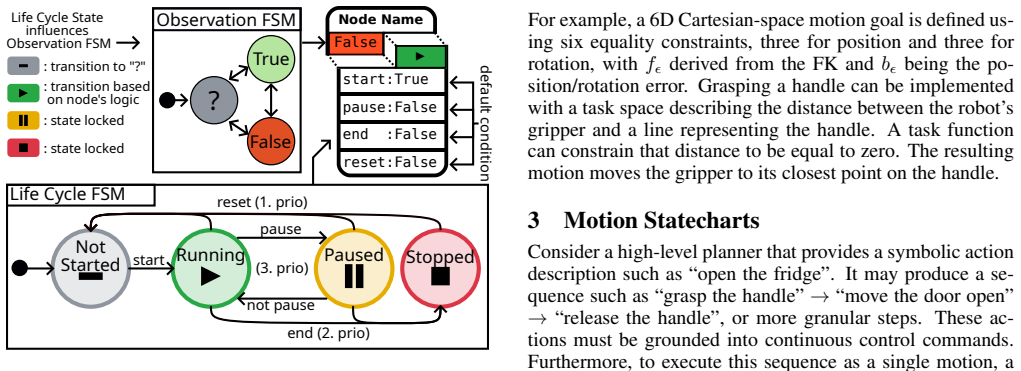
Motion Statecharts provide an executable symbolic representation for complex motions that permits arbitrary parallel and sequential composition of motion constraints, monitors, or nested statecharts. World-centric specification and cross-embodiment generalization are achieved by grounding all constraints in a unified differentiable kinematic model of robots and environments. Execution is realized by a linear model-predictive control implementation of the task-function approach that enforces jerk bounds to produce smooth transitions between tasks.
What carries the argument
Motion Statecharts, an executable symbolic structure that composes motion constraints, monitors and nested charts in parallel or sequence while being grounded in a single differentiable kinematic world model.
If this is right
- Complex tasks become composable from reusable constraint primitives without writing platform-specific code.
- The same semantic description yields executable motions on any robot whose kinematics are captured by the shared model.
- Jerk-bounded linear MPC produces continuous trajectories when the active set of constraints changes.
- Open-source deployment on eight platforms shows that the generated motions remain feasible in real hardware settings.
Where Pith is reading between the lines
- Higher-level symbolic planners could output Motion Statecharts directly, closing the loop between task planning and low-level control.
- The same constraint language might be reused for simulation-based verification before real-robot execution.
- If the kinematic model is extended with dynamics or contact forces, the framework could handle tasks that currently require separate force controllers.
Load-bearing premise
The unified differentiable kinematic model of robots and environments must be accurate enough to let the same constraint description produce correct motions on any new platform without platform-specific adjustments.
What would settle it
A motion task written once in the statechart language fails to produce collision-free, constraint-satisfying trajectories on a ninth robot embodiment or in an environment whose kinematics were not included in the shared model.
Figures




read the original abstract
This paper addresses the Motion Execution Gap, the disconnect between high-level symbolic task descriptions using semantic constraints and executable robot motions. Motion Statecharts are introduced as an executable symbolic representation for complex motions. They allow the arbitrary arrangement of motion constraints, monitors or nested statecharts in parallel and sequence. World-centric motion specification and generalization across embodiments are enabled through the use of a unified differentiable kinematic world model of both, robots and environments. Motion execution is realized through a lMPC-based implementation of the task-function approach, in which smooth transitions during task switches are ensured using jerk bounds. Cross-platform transferability was demonstrated by deploying the method on eight robot platforms, operating in diverse environments. The proposed framework is called Giskard and is available open source: https://github.com/cram2/cognitive_robot_abstract_machine.
Editorial analysis
A structured set of objections, weighed in public.
Referee Report
Summary. The paper claims to close the Motion Execution Gap between high-level semantic task descriptions and executable robot motions by introducing Motion Statecharts as an executable symbolic representation that supports arbitrary parallel and sequential arrangements of motion constraints, monitors, and nested statecharts. It enables world-centric specification and cross-embodiment generalization via a unified differentiable kinematic world model of robots and environments, realized through an lMPC implementation of the task-function approach with jerk bounds for smooth task transitions. Cross-platform transferability is asserted via deployment on eight robot platforms in diverse environments, with the Giskard framework released as open source.
Significance. If the central claims hold, the work offers a practical advance in robotics by providing an executable symbolic layer that bridges semantic constraints to kinematic control while supporting embodiment-agnostic specification. The open-source release and multi-platform demonstration are explicit strengths that support reproducibility and potential adoption, though the absence of quantitative validation limits the assessed impact.
major comments (2)
- Abstract: The claim of demonstrated cross-platform transferability on eight robots is load-bearing for the central contribution but is unsupported by any quantitative results, error metrics, or validation details for the lMPC implementation, preventing assessment of whether the motion execution gap is actually closed.
- The section describing the unified differentiable kinematic world model: The assertion that this model enables generalization across embodiments without platform-specific tuning is central to the cross-embodiment claim, yet no details are provided on model construction, kinematic parameter acquisition, or whether per-robot or per-environment adjustments occurred during the eight-platform deployments.
Simulated Author's Rebuttal
We thank the referee for the constructive feedback. We address each major comment point by point below, indicating where revisions will be made to strengthen the manuscript.
read point-by-point responses
-
Referee: Abstract: The claim of demonstrated cross-platform transferability on eight robots is load-bearing for the central contribution but is unsupported by any quantitative results, error metrics, or validation details for the lMPC implementation, preventing assessment of whether the motion execution gap is actually closed.
Authors: We agree that the abstract's claim would be better supported by quantitative indicators. The manuscript presents the deployments as qualitative demonstrations of successful task execution across platforms, but to enable assessment of the motion execution gap, we will revise the abstract to qualify the claim and add a summary table in the experiments section listing the eight platforms, associated tasks, success rates, and any collected metrics such as execution duration or smoothness indicators. revision: yes
-
Referee: The section describing the unified differentiable kinematic world model: The assertion that this model enables generalization across embodiments without platform-specific tuning is central to the cross-embodiment claim, yet no details are provided on model construction, kinematic parameter acquisition, or whether per-robot or per-environment adjustments occurred during the eight-platform deployments.
Authors: We acknowledge that additional explicit details would clarify the generalization mechanism. The model is constructed from standard kinematic descriptions, but in revision we will expand the relevant section to describe the construction process, confirm that parameters are acquired directly from URDF and environment models with no per-robot or per-environment tuning applied during the deployments, and note that the same unified model was used across all platforms. revision: yes
Circularity Check
No circularity in derivation chain
full rationale
The paper presents an architectural framework (Motion Statecharts plus unified differentiable kinematic world model) for bridging symbolic task constraints to robot control, with claims supported by open-source code and empirical deployment across eight platforms. No equations, parameter-fitting steps, or self-citations are shown that reduce any central result to its own inputs by construction. The derivation is self-contained as a system description and implementation rather than a tautological prediction or renamed prior result.
Axiom & Free-Parameter Ledger
invented entities (2)
-
Motion Statecharts
no independent evidence
-
Giskard framework
no independent evidence
Reference graph
Works this paper leans on
-
[1]
[Aertbeli¨en and De Schutter, 2014] Erwin Aertbeli ¨en and Joris De Schutter. etasl/etc: A constraint-based task spec- ification language and robot controller using expression graphs. In2014 IEEE/RSJ International Conference on Intelligent Robots and Systems, pages 1540–1546. IEEE,
work page 2014
-
[2]
[Anderssonet al., 2019 ] Joel A E Andersson, Joris Gillis, Greg Horn, James B Rawlings, and Moritz Diehl. CasADi – A software framework for nonlinear optimization and optimal control.Mathematical Programming Computa- tion, 11(1):1–36,
work page 2019
-
[3]
CRAM—A Cognitive Robot Ab- stract Machine for everyday manipulation in human envi- ronments
[Beetzet al., 2010 ] Michael Beetz, Lorenz M ¨osenlechner, and Moritz Tenorth. CRAM—A Cognitive Robot Ab- stract Machine for everyday manipulation in human envi- ronments. In2010 IEEE/RSJ International Conference on Intelligent Robots and Systems, pages 1012–1017. IEEE,
work page 2010
-
[4]
[Beetzet al., 2023 ] Michael Beetz, Gayane Kazhoyan, and David Vernon. The cram cognitive architecture for robot manipulation in everyday activities.arXiv preprint arXiv:2304.14119,
-
[5]
[Bolotnikovaet al., 2021 ] Anastasia Bolotnikova, Pierre Gergondet, Arnaud Tanguy, S ´ebastien Courtois, and Abderrahmane Kheddar. Task-space control interface for softbank humanoid robots and its human-robot interaction applications. In2021 IEEE/SICE International Sympo- sium on System Integration (SII), pages 560–565. IEEE,
work page 2021
-
[6]
[Borghesanet al., 2015 ] Gianni Borghesan, Enea Scioni, Abderrahmane Kheddar, and Herman Bruyninckx. Intro- ducing geometric constraint expressions into robot con- strained motion specification and control.IEEE Robotics and Automation Letters, 1(2):1140–1147,
work page 2015
-
[7]
[Bouyarmaneet al., 2018 ] Karim Bouyarmane, Kevin Chap- pellet, Joris Vaillant, and Abderrahmane Kheddar. Quadratic programming for multirobot and task-space force control.IEEE Transactions on Robotics, 35(1):64– 77,
work page 2018
-
[8]
[Bozcuo˘gluet al., 2018 ] Asil Kaan Bozcuo ˘glu, Gayane Kazhoyan, Yuki Furuta, Simon Stelter, Michael Beetz, Kei Okada, and Masayuki Inaba. The exchange of knowledge using cloud robotics.IEEE Robotics and Automation Let- ters, 3(2):1072–1079,
work page 2018
-
[9]
[Dom´ınguezet al., 2022] David C´aceres Dom´ınguez, Marco Iannotta, Johannes A Stork, Erik Schaffernicht, and Todor Stoyanov. A stack-of-tasks approach combined with behavior trees: A new framework for robot con- trol.IEEE Robotics and Automation Letters, 7(4):12110– 12117,
work page 2022
-
[10]
[Escandeet al., 2014 ] Adrien Escande, Nicolas Mansard, and Pierre-Brice Wieber. Hierarchical quadratic program- ming: Fast online humanoid-robot motion generation.The International Journal of Robotics Research, 33(7):1006– 1028,
work page 2014
-
[11]
[Fox and Long, 2003] Maria Fox and Derek Long. Pddl2. 1: An extension to pddl for expressing temporal planning do- mains.Journal of artificial intelligence research, 20:61– 124,
work page 2003
-
[12]
[Guptaet al., 2024 ] Sthithpragya Gupta, Kunpeng Yao, Loic Niederhauser, and Aude Billard. Action contextualization: Adaptive task planning and action tuning using large lan- guage models.IEEE Robotics and Automation Letters,
work page 2024
-
[13]
Statecharts: A visual formalism for complex systems.Science of computer programming, 8(3):231–274,
[Harel, 1987] David Harel. Statecharts: A visual formalism for complex systems.Science of computer programming, 8(3):231–274,
work page 1987
-
[14]
A holistic approach to reactive mo- bile manipulation.IEEE Robotics and Automation Letters,
[Havilandet al., 2022 ] Jesse Haviland, Niko Sunderhauf, and Peter Corke. A holistic approach to reactive mo- bile manipulation.IEEE Robotics and Automation Letters,
work page 2022
-
[15]
[Huanget al., 2025 ] Tzu-Yuan Huang, Armin Lederer, Dai- Jie Wu, Xiaobing Dai, Sihua Zhang, Stefan Sosnowski, Shao-Hua Sun, and Sandra Hirche. Sad-flower: Flow matching for safe, admissible, and dynamically consistent planning.arXiv preprint arXiv:2511.05355,
-
[16]
Fine-Tuning Vision-Language-Action Models: Optimizing Speed and Success
[Kimet al., 2025 ] Moo Jin Kim, Chelsea Finn, and Percy Liang. Fine-tuning vision-language-action mod- els: Optimizing speed and success.arXiv preprint arXiv:2502.19645,
work page internal anchor Pith review Pith/arXiv arXiv 2025
-
[17]
[K¨umpelet al., 2025 ] Michaela K ¨umpel, Manuel Scheibl, Jan-Philipp T ¨oberg, Vanessa Hassouna, Philipp Cimiano, Britta Wrede, and Michael Beetz. Everything robots need to know about cooking actions: Creating actionable knowledge graphs to support robotic meal preparation. Frontiers in Robotics and AI, V olume 12 - 2025,
work page 2025
-
[18]
Skiros2: A skill-based robot control plat- form for ros
[Mayret al., 2023 ] Matthias Mayr, Francesco Rovida, and V olker Krueger. Skiros2: A skill-based robot control plat- form for ros. In2023 IEEE/RSJ International Conference on Intelligent Robots and Systems (IROS), pages 6273–
work page 2023
-
[19]
Task and motion planning for execution in the real.IEEE Transactions on Robotics, 40:3356–3371,
[Panet al., 2024 ] Tianyang Pan, Rahul Shome, and Lydia E Kavraki. Task and motion planning for execution in the real.IEEE Transactions on Robotics, 40:3356–3371,
work page 2024
-
[20]
[Pandalaet al., 2019 ] Abhishek Goud Pandala, Yanran Ding, and Hae-Won Park. qpswift: A real-time sparse quadratic program solver for robotic applications.IEEE Robotics and Automation Letters, 4(4):3355–3362,
work page 2019
-
[21]
[Paneet al., 2021 ] Yudha Pane, Vahid Mokhtari, Erwin Aertbeli¨en, Joris De Schutter, and Wilm Decr ´e. Au- tonomous runtime composition of sensor-based skills us- ing concurrent task planning.IEEE Robotics and Automa- tion Letters, 6(4):6481–6488,
work page 2021
-
[22]
[R¨oferet al., 2022 ] Adrian R ¨ofer, Georg Bartels, Wolfram Burgard, Abhinav Valada, and Michael Beetz. Kinev- erse: A symbolic articulation model framework for model- agnostic mobile manipulation.IEEE Robotics and Au- tomation Letters, 7(2):3372–3379,
work page 2022
- [23]
-
[24]
Accessed: 2023-05-07. [Rovidaet al., 2018 ] Francesco Rovida, David Wuthier, Bjarne Grossmann, Matteo Fumagalli, and V olker Kr¨uger. Motion generators combined with behavior trees: A novel approach to skill modelling. In2018 IEEE/RSJ Inter- national Conference on Intelligent Robots and Systems (IROS), pages 5964–5971. IEEE,
work page 2023
-
[25]
Motion planning for mobile manip- ulators—a systematic review.Machines, 10(2):97,
[Sandakalum and Ang Jr, 2022] Thushara Sandakalum and Marcelo H Ang Jr. Motion planning for mobile manip- ulators—a systematic review.Machines, 10(2):97,
work page 2022
-
[26]
[Stelteret al., 2022 ] Simon Stelter, Georg Bartels, and Michael Beetz. An open-source motion planning frame- work for mobile manipulators using constraint-based task space control with linear mpc. In2022 IEEE/RSJ In- ternational Conference on Intelligent Robots and Systems (IROS), pages 1671–1678. IEEE,
work page 2022
-
[27]
PhD thesis, University of Bremen,
[Stelter, 2025] Simon Stelter.A Robot-Agnostic Kinematic Control Framework: Task Composition via Motion State- charts and Linear Model Predictive Control. PhD thesis, University of Bremen,
work page 2025
-
[28]
[W¨achteret al., 2016 ] Mirko W ¨achter, Simon Ottenhaus, Manfred Kr¨ohnert, Nikolaus Vahrenkamp, and Tamim As- four. The armarx statechart concept: Graphical program- ing of robot behavior.Frontiers in Robotics and AI, 3:33, 2016
work page 2016
discussion (0)
Sign in with ORCID, Apple, or X to comment. Anyone can read and Pith papers without signing in.