Recognition: 2 theorem links
· Lean TheoremTAR: Text Semantic Assisted Cross-modal Image Registration Framework for Optical and SAR Images
Pith reviewed 2026-05-13 06:29 UTC · model grok-4.3
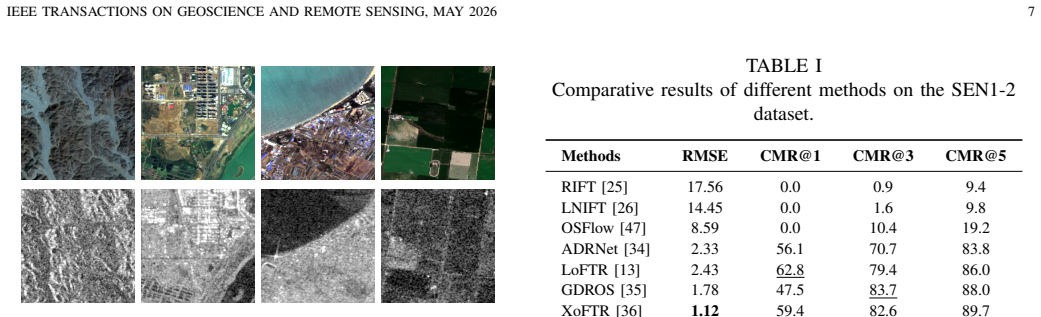
The pith
TAR uses text semantic priors from remote sensing scenes to improve optical-SAR image registration under large geometric deformations.
A machine-rendered reading of the paper's core claim, the machinery that carries it, and where it could break.
Core claim
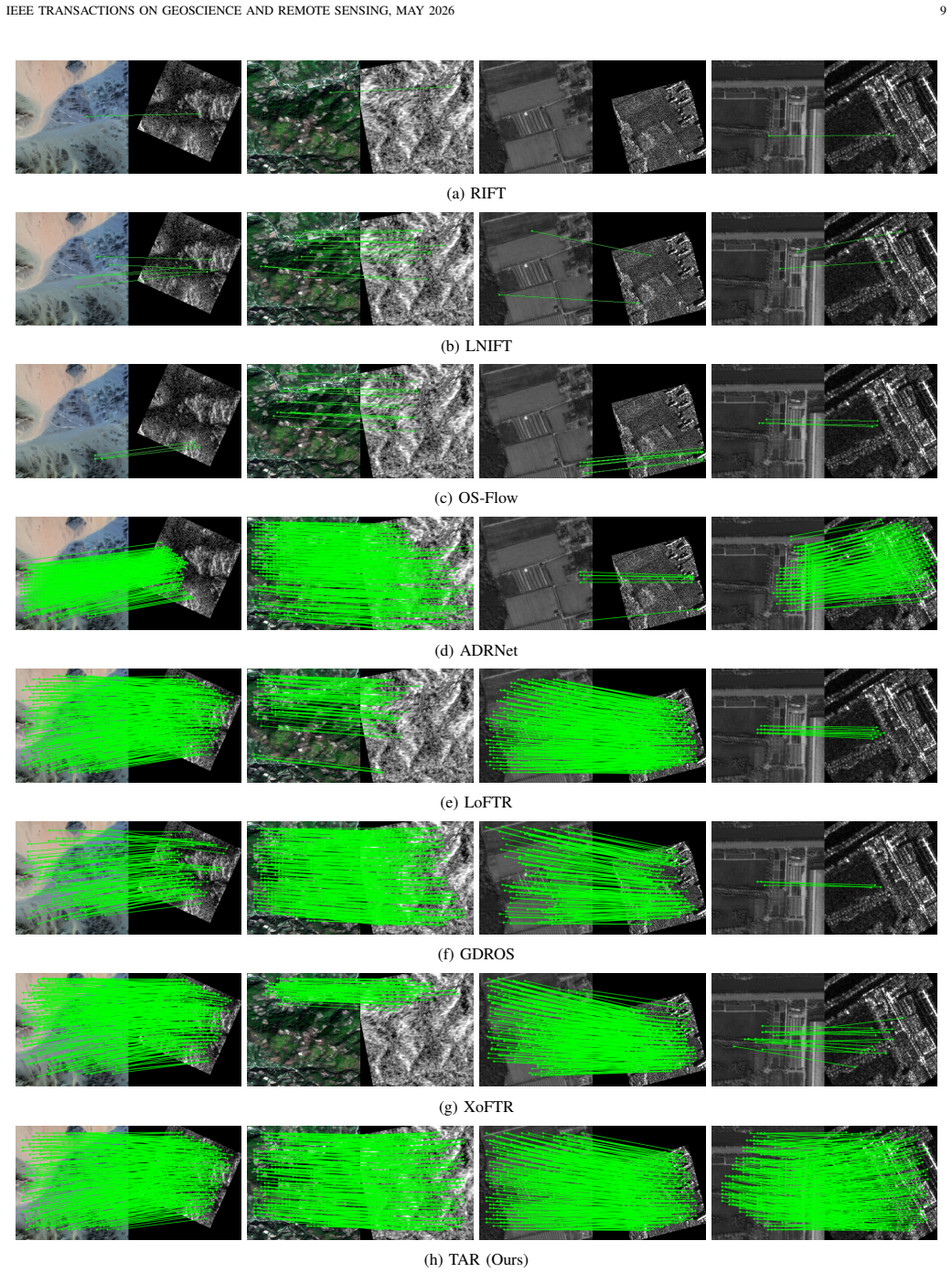
TAR shows that introducing text semantic priors via a frozen RemoteCLIP text encoder into a visual-text interaction module produces more reliable high-level features, which in turn yield stronger coarse matching and overall registration performance than several state-of-the-art methods, with notable gains when large geometric deformations are present.
What carries the argument
The text-assisted feature enhancement (TAFE) module, which builds text descriptors for remote sensing scenes and land-cover objects and fuses them with visual features through visual-text interaction to strengthen high-level representations for coarse matching.
If this is right
- Coarse matching becomes more robust because semantic text features supplement appearance-based cues.
- The coarse-to-fine pipeline in CFDM produces denser and more accurate final correspondences.
- Gains are largest precisely when geometric deformations are severe, the regime where purely visual methods degrade most.
- The frozen text encoder allows the framework to add semantic guidance without additional training cost on the text side.
Where Pith is reading between the lines
- The same text-prior strategy could be tested on other cross-modal pairs such as optical-infrared if suitable scene text descriptors exist.
- Allowing limited fine-tuning of the text branch on remote-sensing data might further close remaining modality gaps.
- Larger language models could supply richer scene descriptions and potentially extend the approach to semantic-level alignment tasks.
Load-bearing premise
That text descriptors from a frozen RemoteCLIP encoder reliably shrink the modality gap and improve feature correspondence without adding domain biases or needing fine-tuning of the text branch.
What would settle it
A test set of optical-SAR image pairs with large deformations where TAR's matching accuracy fails to exceed that of comparable visual-only deep learning baselines.
Figures



read the original abstract
Existing deep learning-based methods can capture shared features from optical and synthetic aperture radar (SAR) images for spatial alignment. However, optical-SAR registration remains challenging under large geometric deformations, because the model needs to simultaneously handle cross-modal appearance discrepancies and complex spatial transformations. To address this issue, this paper proposes a text semantic-assisted cross-modal image registration framework, named TAR, for optical and SAR images. TAR exploits text semantic priors from remote sensing scenes and land-cover categories to alleviate the modality gap and enhance cross-modal feature learning. TAR consists of three components: a multi-scale visual feature learning (MSFL) module, a text-assisted feature enhancement (TAFE) module, and a coarse-to-fine dense matching (CFDM) module. MSFL extracts multi-scale visual features from optical and SAR images. TAFE constructs text descriptors related to remote sensing scenes and land-cover objects, and uses a frozen RemoteCLIP text encoder to extract text features. These text features are introduced through visual-text interaction to enhance high-level visual features for more reliable coarse matching. CFDM then establishes coarse correspondences based on the enhanced high-level features and refines the matched locations using low-level features. Experimental results on cross-modal remote sensing images demonstrate the effectiveness of TAR, which achieves stronger matching performance than several state-of-the-art methods and yields significant gains under large geometric deformations.
Editorial analysis
A structured set of objections, weighed in public.
Referee Report
Summary. The paper claims to introduce TAR, a text semantic-assisted cross-modal registration framework for optical and SAR images. It uses an MSFL module to extract multi-scale visual features, a TAFE module that constructs text descriptors from remote sensing scenes and land-cover categories and extracts features via a frozen RemoteCLIP text encoder to enhance high-level visual features through visual-text interaction, and a CFDM module for coarse-to-fine dense matching. The central claim is that TAR achieves stronger matching performance than several state-of-the-art methods and yields significant gains under large geometric deformations.
Significance. If the results hold, the work could be significant for remote sensing applications by showing how semantic text priors can help bridge the optical-SAR modality gap and improve robustness to large deformations. The use of a frozen pre-trained RemoteCLIP encoder is a strength, as it avoids task-specific fine-tuning overhead while composing existing components (MSFL, coarse-to-fine matching) into a coherent pipeline.
major comments (2)
- [Abstract] Abstract: The claim of stronger matching performance and significant gains under large deformations is stated without any quantitative metrics, error bars, dataset details, or ablation results, which prevents verification of the central experimental claim from the provided text.
- [TAFE module] TAFE module: The framework assumes that text semantic priors extracted by the frozen RemoteCLIP encoder reliably reduce the modality gap and improve feature correspondence for SAR images without introducing domain-specific biases or requiring fine-tuning; no controlled experiments, contribution ablations, or bias analysis are described to support that the reported gains are due to the text assistance rather than MSFL or CFDM.
minor comments (1)
- [TAFE module] The description of visual-text interaction in TAFE lacks explicit equations or pseudocode for how text features are fused with visual features, which would aid reproducibility.
Simulated Author's Rebuttal
We thank the referee for the constructive feedback and positive evaluation of TAR's potential impact. We address each major comment point-by-point below and will revise the manuscript to strengthen the presentation of results and ablations.
read point-by-point responses
-
Referee: [Abstract] Abstract: The claim of stronger matching performance and significant gains under large deformations is stated without any quantitative metrics, error bars, dataset details, or ablation results, which prevents verification of the central experimental claim from the provided text.
Authors: We agree that the abstract would benefit from including key quantitative results. In the revised version, we will add specific metrics (e.g., matching accuracy improvements of X% on average and Y% under large deformations) along with dataset names and brief reference to ablation outcomes, while keeping the abstract concise. revision: yes
-
Referee: [TAFE module] TAFE module: The framework assumes that text semantic priors extracted by the frozen RemoteCLIP encoder reliably reduce the modality gap and improve feature correspondence for SAR images without introducing domain-specific biases or requiring fine-tuning; no controlled experiments, contribution ablations, or bias analysis are described to support that the reported gains are due to the text assistance rather than MSFL or CFDM.
Authors: The manuscript does include ablation studies (Section 4.3) comparing TAR with and without the TAFE module, showing consistent performance drops when text assistance is removed. However, we acknowledge the referee's point that more targeted analysis is needed. We will expand the ablations with controlled experiments on text descriptor variants, add a bias analysis subsection examining domain-specific effects on SAR features, and clarify how the frozen encoder avoids fine-tuning overhead while contributing to the gains beyond MSFL and CFDM. revision: partial
Circularity Check
No significant circularity in compositional framework
full rationale
The paper describes TAR as a composition of three modules (MSFL for multi-scale visual features, TAFE for injecting frozen RemoteCLIP text features, and CFDM for coarse-to-fine matching) whose claimed benefit is demonstrated solely through external experimental comparisons on cross-modal remote-sensing datasets. No equations appear that define a quantity in terms of itself, no fitted parameter is relabeled as a prediction, and no load-bearing uniqueness theorem or ansatz is imported via self-citation. The text-semantic assistance is presented as an additive prior from an independently trained encoder, and performance gains are reported against state-of-the-art baselines rather than derived from the same fitted values, rendering the argument self-contained.
Axiom & Free-Parameter Ledger
axioms (2)
- domain assumption Multi-scale visual features extracted by standard CNN backbones can be meaningfully enhanced by cross-modal text interaction
- domain assumption A frozen RemoteCLIP text encoder produces descriptors that are semantically aligned with remote-sensing visual content
Lean theorems connected to this paper
-
IndisputableMonolith/Cost/FunctionalEquation.leanwashburn_uniqueness_aczel unclear?
unclearRelation between the paper passage and the cited Recognition theorem.
TAFE constructs text descriptors related to remote sensing scenes and land-cover objects, and uses a frozen RemoteCLIP text encoder to extract text features... visual-text interaction to enhance high-level visual features
-
IndisputableMonolith/Foundation/RealityFromDistinction.leanreality_from_one_distinction unclear?
unclearRelation between the paper passage and the cited Recognition theorem.
CFDM establishes coarse correspondences based on the enhanced high-level features and refines the matched locations using low-level features
What do these tags mean?
- matches
- The paper's claim is directly supported by a theorem in the formal canon.
- supports
- The theorem supports part of the paper's argument, but the paper may add assumptions or extra steps.
- extends
- The paper goes beyond the formal theorem; the theorem is a base layer rather than the whole result.
- uses
- The paper appears to rely on the theorem as machinery.
- contradicts
- The paper's claim conflicts with a theorem or certificate in the canon.
- unclear
- Pith found a possible connection, but the passage is too broad, indirect, or ambiguous to say the theorem truly supports the claim.
Reference graph
Works this paper leans on
-
[1]
Deep learning in remote sensing: A comprehensive review and list of resources,
X. X. Zhu, D. Tuia, L. Mou, G.-S. Xia, L. Zhang, F. Xu, and F. Fraun- dorfer, “Deep learning in remote sensing: A comprehensive review and list of resources,”IEEE geoscience and remote sensing magazine, vol. 5, no. 4, pp. 8–36, 2017
work page 2017
-
[2]
A review of remote sensing image fusion methods,
H. Ghassemian, “A review of remote sensing image fusion methods,” Information Fusion, vol. 32, pp. 75–89, 2016
work page 2016
-
[3]
The sen1-2 dataset for deep learning in sar-optical data fusion,
M. Schmitt, L. H. Hughes, and X. X. Zhu, “The sen1-2 dataset for deep learning in sar-optical data fusion,”arXiv preprint arXiv:1807.01569, 2018
-
[4]
Image registration methods: a survey,
B. Zitova and J. Flusser, “Image registration methods: a survey,”Image and vision computing, vol. 21, no. 11, pp. 977–1000, 2003
work page 2003
-
[5]
Multimodal remote sensing image registration: a survey,
B. Zhu and Y . Ye, “Multimodal remote sensing image registration: a survey,”Journal of Image and Graphics, vol. 29, no. 08, pp. 2137–2161, 2024
work page 2024
-
[6]
Object detection in optical remote sensing images: A survey and a new benchmark,
K. Li, G. Wan, G. Cheng, L. Meng, and J. Han, “Object detection in optical remote sensing images: A survey and a new benchmark,”ISPRS journal of photogrammetry and remote sensing, vol. 159, pp. 296–307, 2020
work page 2020
-
[7]
Deep learning- based change detection in remote sensing images: A review,
A. Shafique, G. Cao, Z. Khan, M. Asad, and M. Aslam, “Deep learning- based change detection in remote sensing images: A review,”Remote Sensing, vol. 14, no. 4, p. 871, 2022
work page 2022
-
[8]
Robust registration of multimodal remote sensing images based on structural similarity,
Y . Ye, J. Shan, L. Bruzzone, and L. Shen, “Robust registration of multimodal remote sensing images based on structural similarity,”IEEE Transactions on Geoscience and Remote Sensing, vol. 55, no. 5, pp. 2941–2958, 2017
work page 2017
-
[9]
Deep learning in remote sensing image matching: A survey,
L. Li, L. Han, Y . Ye, Y . Xiang, and T. Zhang, “Deep learning in remote sensing image matching: A survey,”ISPRS Journal of Photogrammetry and Remote Sensing, vol. 225, pp. 88–112, 2025
work page 2025
-
[10]
Deep feature correlation learning for multi-modal remote sensing image registration,
D. Quan, S. Wang, Y . Gu, R. Lei, B. Yang, S. Wei, B. Hou, and L. Jiao, “Deep feature correlation learning for multi-modal remote sensing image registration,”IEEE Transactions on Geoscience and Remote Sensing, vol. 60, pp. 1–16, 2022
work page 2022
-
[11]
D. Quan, H. Wei, S. Wang, Y . Li, J. Chanussot, Y . Guo, B. Hou, and L. Jiao, “Efficient and robust: A cross-modal registration deep wavelet learning method for remote sensing images,”IEEE Journal of Selected Topics in Applied Earth Observations and Remote Sensing, vol. 16, pp. 4739–4754, 2023
work page 2023
-
[12]
Self-distillation feature learning network for optical and sar image registration,
D. Quan, H. Wei, S. Wang, R. Lei, B. Duan, Y . Li, B. Hou, and L. Jiao, “Self-distillation feature learning network for optical and sar image registration,”IEEE Transactions on Geoscience and Remote Sensing, vol. 60, pp. 1–18, 2022
work page 2022
-
[13]
Loftr: Detector- free local feature matching with transformers,
J. Sun, Z. Shen, Y . Wang, H. Bao, and X. Zhou, “Loftr: Detector- free local feature matching with transformers,” inProceedings of the IEEE/CVF conference on computer vision and pattern recognition, 2021, pp. 8922–8931
work page 2021
-
[14]
Match- former: Interleaving attention in transformers for feature matching,
Q. Wang, J. Zhang, K. Yang, K. Peng, and R. Stiefelhagen, “Match- former: Interleaving attention in transformers for feature matching,” in Proceedings of the Asian conference on computer vision, 2022, pp. 2746–2762
work page 2022
-
[15]
Aspanformer: Detector-free image matching with adaptive span transformer,
H. Chen, Z. Luo, L. Zhou, Y . Tian, M. Zhen, T. Fang, D. Mckinnon, Y . Tsin, and L. Quan, “Aspanformer: Detector-free image matching with adaptive span transformer,” inEuropean conference on computer vision. Springer, 2022, pp. 20–36
work page 2022
-
[16]
Dkm: Dense kernelized feature matching for geometry estimation,
J. Edstedt, I. Athanasiadis, M. Wadenb ¨ack, and M. Felsberg, “Dkm: Dense kernelized feature matching for geometry estimation,” inPro- ceedings of the IEEE/CVF conference on computer vision and pattern recognition, 2023, pp. 17 765–17 775
work page 2023
-
[17]
Roma: Robust dense feature matching,
J. Edstedt, Q. Sun, G. B ¨okman, M. Wadenb¨ack, and M. Felsberg, “Roma: Robust dense feature matching,” inProceedings of the IEEE/CVF con- ference on computer vision and pattern recognition, 2024, pp. 19 790– 19 800
work page 2024
-
[18]
Remoteclip: A vision language foundation model for remote sensing,
F. Liu, D. Chen, Z. Guan, X. Zhou, J. Zhu, Q. Ye, L. Fu, and J. Zhou, “Remoteclip: A vision language foundation model for remote sensing,” IEEE Transactions on Geoscience and Remote Sensing, vol. 62, pp. 1– 16, 2024
work page 2024
-
[19]
W. Zhang, R. Zhao, Y . Yao, Y . Wan, P. Wu, J. Li, Y . Li, and Y . Zhang, “Multi-resolution sar and optical remote sensing image registration methods: A review, datasets, and future perspectives,”arXiv preprint arXiv:2502.01002, 2025
-
[20]
Multi-image matching using multi-scale oriented patches,
M. Brown, R. Szeliski, and S. Winder, “Multi-image matching using multi-scale oriented patches,” in2005 IEEE Computer Society Confer- ence on Computer Vision and Pattern Recognition (CVPR’05), vol. 1. IEEE, 2005, pp. 510–517. IEEE TRANSACTIONS ON GEOSCIENCE AND REMOTE SENSING, MAY 2026 11
work page 2005
-
[21]
Image matching using local symmetry features,
D. C. Hauagge and N. Snavely, “Image matching using local symmetry features,” in2012 IEEE conference on computer vision and pattern recognition. IEEE, 2012, pp. 206–213
work page 2012
-
[22]
Distinctive image features from scale-invariant keypoints,
D. G. Lowe, “Distinctive image features from scale-invariant keypoints,” International journal of computer vision, vol. 60, no. 2, pp. 91–110, 2004
work page 2004
-
[23]
Surf: Speeded up robust features,
H. Bay, T. Tuytelaars, and L. Van Gool, “Surf: Speeded up robust features,” inEuropean conference on computer vision. Springer, 2006, pp. 404–417
work page 2006
-
[24]
Fast and robust matching for multimodal remote sensing image registration,
Y . Ye, L. Bruzzone, J. Shan, F. Bovolo, and Q. Zhu, “Fast and robust matching for multimodal remote sensing image registration,”IEEE Transactions on Geoscience and Remote Sensing, vol. 57, no. 11, pp. 9059–9070, 2019
work page 2019
-
[25]
Rift: Multi-modal image matching based on radiation-variation insensitive feature transform,
J. Li, Q. Hu, and M. Ai, “Rift: Multi-modal image matching based on radiation-variation insensitive feature transform,”IEEE Transactions on Image Processing, vol. 29, pp. 3296–3310, 2019
work page 2019
-
[26]
Lnift: Locally normalized image for rotation invariant multimodal feature matching,
J. Li, W. Xu, P. Shi, Y . Zhang, and Q. Hu, “Lnift: Locally normalized image for rotation invariant multimodal feature matching,”IEEE Trans- actions on Geoscience and Remote Sensing, vol. 60, pp. 1–14, 2022
work page 2022
-
[27]
Robust feature matching for remote sensing image registration via locally linear transforming,
J. Ma, H. Zhou, J. Zhao, Y . Gao, J. Jiang, and J. Tian, “Robust feature matching for remote sensing image registration via locally linear transforming,”IEEE Transactions on Geoscience and Remote Sensing, vol. 53, no. 12, pp. 6469–6481, 2015
work page 2015
-
[28]
Disk: Learning local features with policy gradient,
M. Tyszkiewicz, P. Fua, and E. Trulls, “Disk: Learning local features with policy gradient,”Advances in neural information processing sys- tems, vol. 33, pp. 14 254–14 265, 2020
work page 2020
-
[29]
Aslfeat: Learning local features of accurate shape and localization,
Z. Luo, L. Zhou, X. Bai, H. Chen, J. Zhang, Y . Yao, S. Li, T. Fang, and L. Quan, “Aslfeat: Learning local features of accurate shape and localization,” inProceedings of the IEEE/CVF conference on computer vision and pattern recognition, 2020, pp. 6589–6598
work page 2020
-
[30]
Efficient and accurate remote sensing image registration with hierarchical mamba networks,
T. Cao, Z. Zhang, H. Cao, S. Bai, and N. Liu, “Efficient and accurate remote sensing image registration with hierarchical mamba networks,” IEEE Geoscience and Remote Sensing Letters, vol. 23, pp. 1–5, 2025
work page 2025
-
[31]
D. Quan, Z. Wang, S. Wang, Y . Li, B. Ren, M. Kang, J. Chanussot, and L. Jiao, “F3net: Adaptive frequency feature filtering network for multimodal remote sensing image registration,”IEEE Transactions on Geoscience and Remote Sensing, vol. 62, pp. 1–13, 2024
work page 2024
-
[32]
A novel rotation and scale equivariant network for optical-sar image matching,
H. Nie, B. Luo, J. Liu, Z. Fu, W. Liu, C. Wang, and X. Su, “A novel rotation and scale equivariant network for optical-sar image matching,” IEEE Transactions on Geoscience and Remote Sensing, vol. 62, pp. 1– 14, 2024
work page 2024
-
[33]
A multiscale framework with unsupervised learning for remote sensing image regis- tration,
Y . Ye, T. Tang, B. Zhu, C. Yang, B. Li, and S. Hao, “A multiscale framework with unsupervised learning for remote sensing image regis- tration,”IEEE Transactions on Geoscience and Remote Sensing, vol. 60, pp. 1–15, 2022
work page 2022
-
[34]
Adrnet: Affine and deformable registration networks for multimodal remote sensing images,
Y . Xiao, C. Zhang, Y . Chen, B. Jiang, and J. Tang, “Adrnet: Affine and deformable registration networks for multimodal remote sensing images,”IEEE Transactions on Geoscience and Remote Sensing, vol. 62, pp. 1–13, 2024
work page 2024
-
[35]
Z. Sun, S. Zhi, R. Li, J. Xia, Y . Liu, and W. Jiang, “Gdros: A geometry- guided dense registration framework for optical–sar images under large geometric transformations,”IEEE Transactions on Geoscience and Re- mote Sensing, vol. 63, pp. 1–15, 2025
work page 2025
-
[36]
Xoftr: Cross-modal feature matching transformer,
¨O. Tuzcuo ˘glu, A. K ¨oksal, B. Sofu, S. Kalkan, and A. A. Alatan, “Xoftr: Cross-modal feature matching transformer,” inProceedings of the IEEE/CVF conference on computer vision and pattern recognition, 2024, pp. 4275–4286
work page 2024
-
[37]
Learning transferable visual models from natural language supervision,
A. Radford, J. W. Kim, C. Hallacy, A. Ramesh, G. Goh, S. Agarwal, G. Sastry, A. Askell, P. Mishkin, J. Clarket al., “Learning transferable visual models from natural language supervision,” inInternational conference on machine learning. PmLR, 2021, pp. 8748–8763
work page 2021
-
[38]
Scaling up visual and vision-language representation learning with noisy text supervision,
C. Jia, Y . Yang, Y . Xia, Y .-T. Chen, Z. Parekh, H. Pham, Q. Le, Y .-H. Sung, Z. Li, and T. Duerig, “Scaling up visual and vision-language representation learning with noisy text supervision,” inInternational conference on machine learning. PMLR, 2021, pp. 4904–4916
work page 2021
-
[39]
Rs-clip: Zero shot remote sensing scene classification via contrastive vision-language supervision,
X. Li, C. Wen, Y . Hu, and N. Zhou, “Rs-clip: Zero shot remote sensing scene classification via contrastive vision-language supervision,”Inter- national Journal of Applied Earth Observation and Geoinformation, vol. 124, p. 103497, 2023
work page 2023
-
[40]
Z. Zhang, T. Zhao, Y . Guo, and J. Yin, “Rs5m and georsclip: A large- scale vision-language dataset and a large vision-language model for remote sensing,”IEEE Transactions on Geoscience and Remote Sensing, vol. 62, pp. 1–23, 2024
work page 2024
-
[41]
S. Zhang, B. Zhang, Y . Wu, H. Zhou, J. Jiang, and J. Ma, “Segclip: Mul- timodal visual-language and prompt learning for high-resolution remote sensing semantic segmentation,”IEEE Transactions on Geoscience and Remote Sensing, vol. 62, pp. 1–16, 2024
work page 2024
-
[42]
Topicgeo: An efficient unified frame- work for geolocation,
X. Wang, X. Wang, and S. Gou, “Topicgeo: An efficient unified frame- work for geolocation,” inProceedings of the IEEE/CVF International Conference on Computer Vision, 2025, pp. 8241–8251
work page 2025
-
[43]
Text-assisted multimodal adaptive registration and fusion classification network,
Y . He, B. Xi, G. Li, T. Zheng, Y . Li, C. Xue, and M. Shen, “Text-assisted multimodal adaptive registration and fusion classification network,” IEEE Transactions on Geoscience and Remote Sensing, vol. 64, pp. 1–15, 2025
work page 2025
-
[44]
Deep residual learning for image recognition,
K. He, X. Zhang, S. Ren, and J. Sun, “Deep residual learning for image recognition,” inProceedings of the IEEE conference on computer vision and pattern recognition, 2016, pp. 770–778
work page 2016
-
[45]
Focal loss for dense object detection,
T.-Y . Lin, P. Goyal, R. Girshick, K. He, and P. Doll ´ar, “Focal loss for dense object detection,” inProceedings of the IEEE international conference on computer vision, 2017, pp. 2980–2988
work page 2017
-
[46]
Automatic registration of optical and sar images via improved phase congruency model,
Y . Xiang, R. Tao, F. Wang, H. You, and B. Han, “Automatic registration of optical and sar images via improved phase congruency model,”IEEE Journal of Selected Topics in Applied Earth Observations and Remote Sensing, vol. 13, pp. 5847–5861, 2020
work page 2020
-
[47]
Os-flow: A robust algorithm for dense optical and sar image registration,
Y . Xiang, F. Wang, L. Wan, N. Jiao, and H. You, “Os-flow: A robust algorithm for dense optical and sar image registration,”IEEE Transac- tions on Geoscience and Remote Sensing, vol. 57, no. 9, pp. 6335–6354, 2019. Zhuoyu Caireceived the B.S. degree in Artificial Intelligence from Xidian University, Xi’an, China, in 2025. He is currently pursuing the M.S....
work page 2019
discussion (0)
Sign in with ORCID, Apple, or X to comment. Anyone can read and Pith papers without signing in.