Recognition: 2 theorem links
· Lean TheoremConflict-Free Cuts in Planar and 3-Degenerate Graphs with 1-Regular Conflicts
Pith reviewed 2026-05-13 04:45 UTC · model grok-4.3
The pith
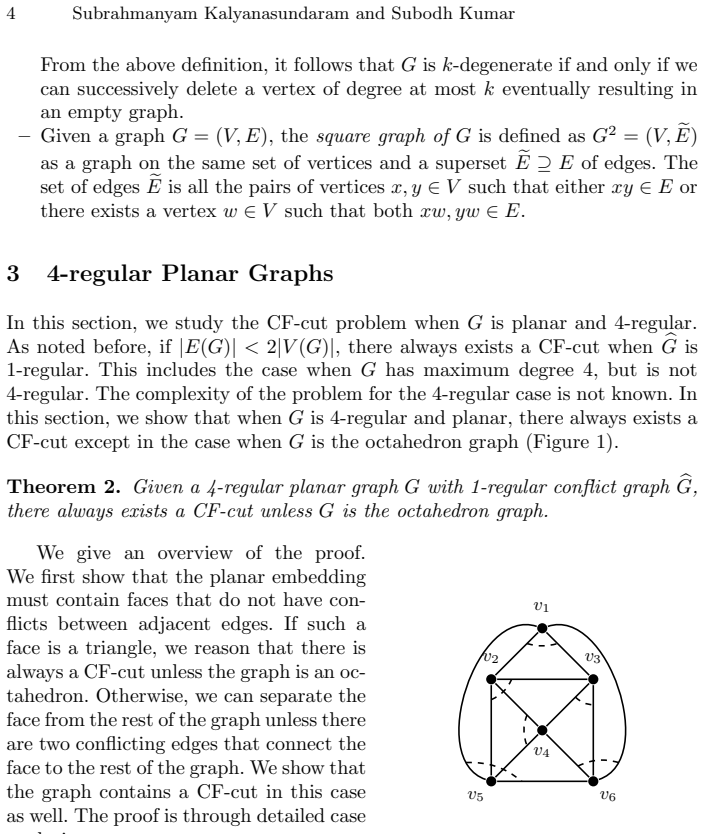
Every planar 4-regular graph except the octahedron admits a conflict-free cut when edge conflicts form disjoint pairs.
A machine-rendered reading of the paper's core claim, the machinery that carries it, and where it could break.
Core claim
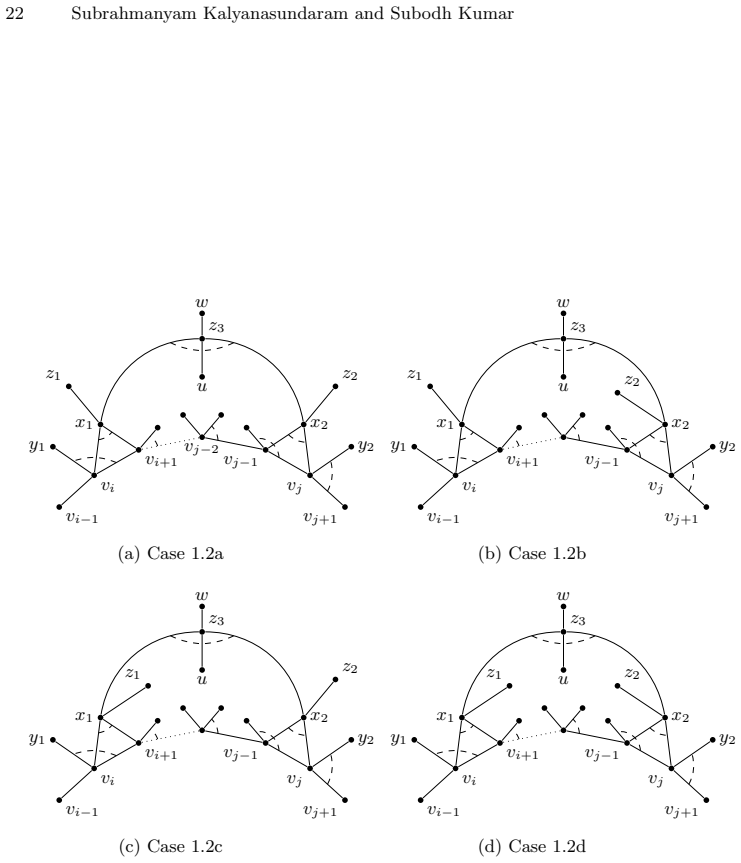
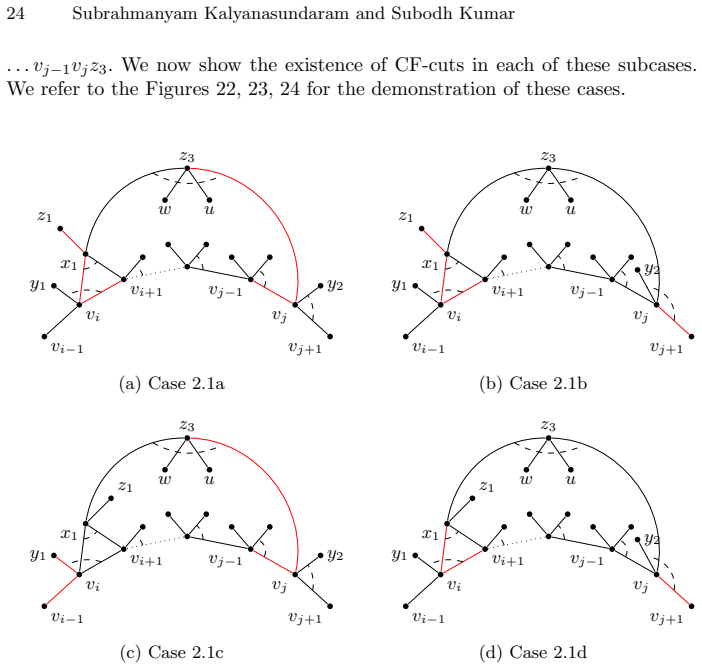
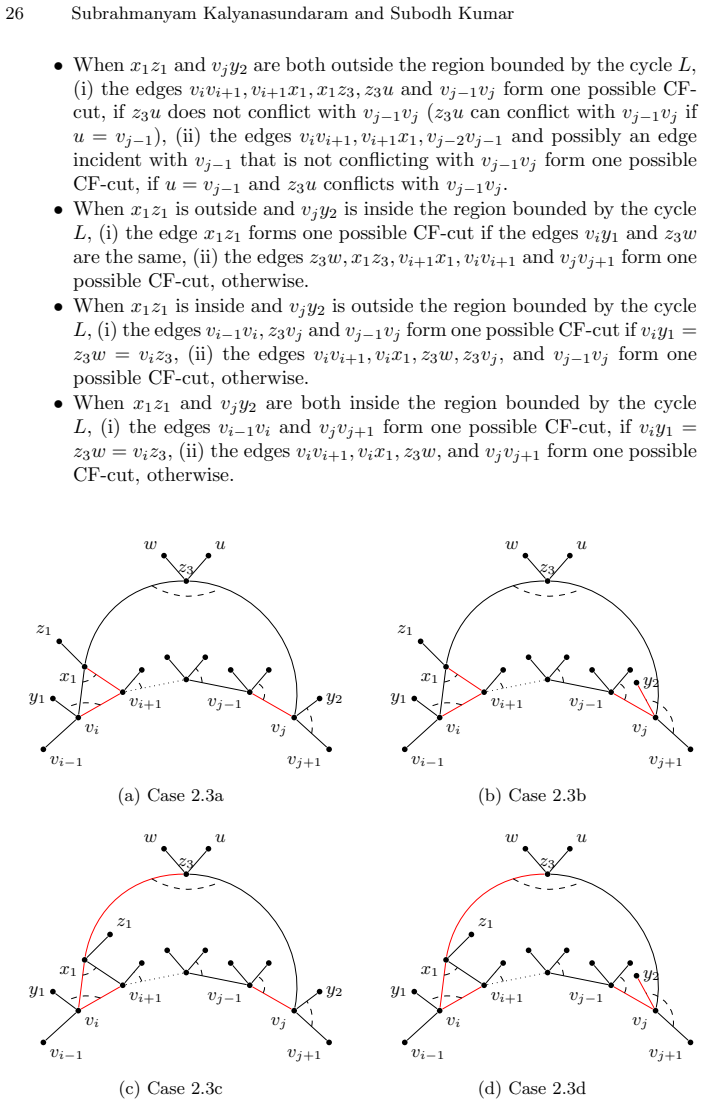
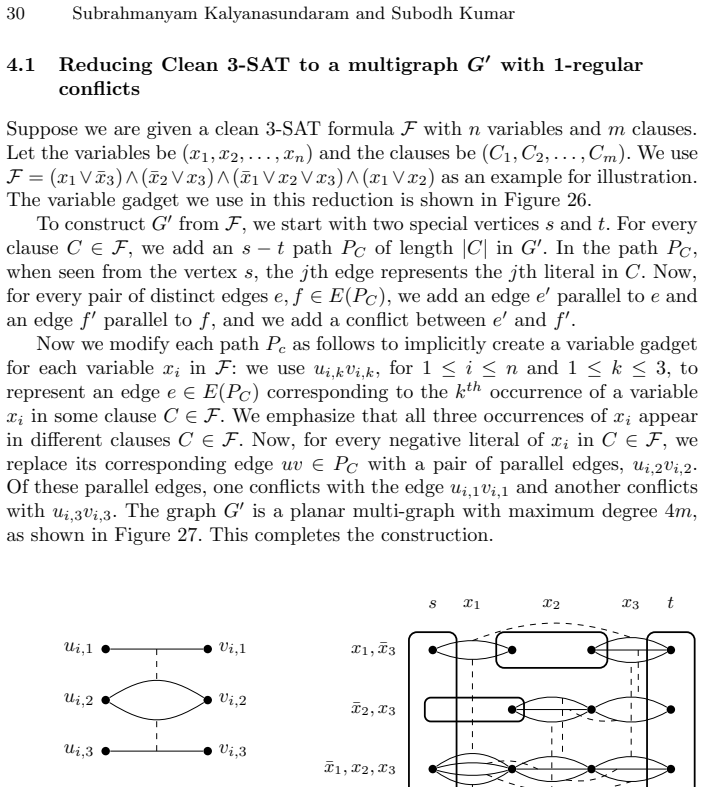
For any 1-regular conflict graph on the edges, every planar 4-regular graph other than the octahedron graph possesses a conflict-free cut. The decision problem of whether a conflict-free cut exists is NP-complete both for planar graphs of maximum degree 5 and for 3-degenerate graphs of maximum degree 5. Infinite families of graphs equipped with 1-regular conflict graphs that admit no conflict-free cut are constructed.
What carries the argument
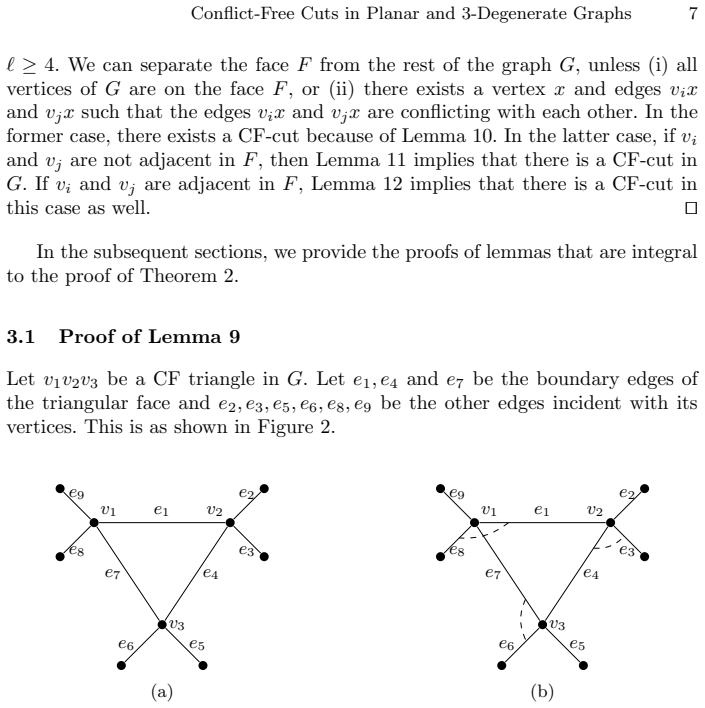
A conflict-free cut: a disconnecting edge subset that contains at most one edge from each conflicting pair in the given 1-regular conflict graph on the edge set.
If this is right
- Conflict-free cuts exist in every planar 4-regular graph except the octahedron.
- Deciding existence of a conflict-free cut is NP-complete for planar graphs of maximum degree 5.
- Deciding existence of a conflict-free cut is NP-complete for 3-degenerate graphs of maximum degree 5.
- There exist infinite families of graphs with 1-regular conflicts that have no conflict-free cut whatsoever.
Where Pith is reading between the lines
- The degree-4 guarantee indicates that planarity plus regularity together force the existence of a constrained disconnecting set.
- The jump to NP-completeness at degree 5 shows that one additional incident edge per vertex supplies enough freedom for hardness reductions while preserving planarity or 3-degeneracy.
- Analogous thresholds may exist for other sparse classes such as bounded-treewidth or series-parallel graphs.
Load-bearing premise
The conflicts between edges form a perfect matching of disjoint pairs.
What would settle it
A planar 4-regular graph distinct from the octahedron together with a 1-regular conflict assignment on its edges that admits no conflict-free cut would refute the existence claim.
Figures


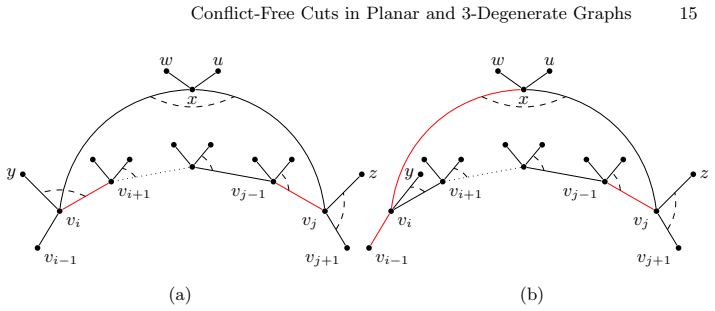
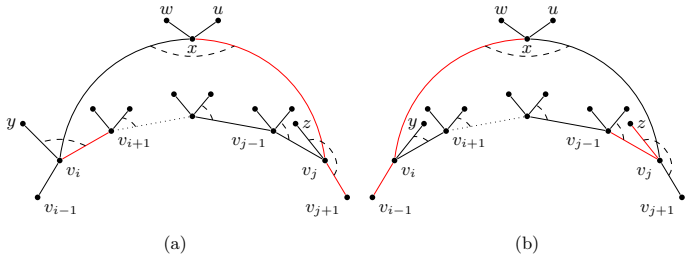


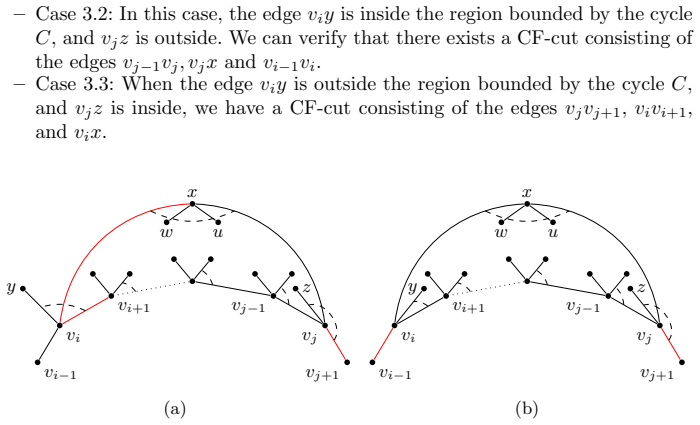

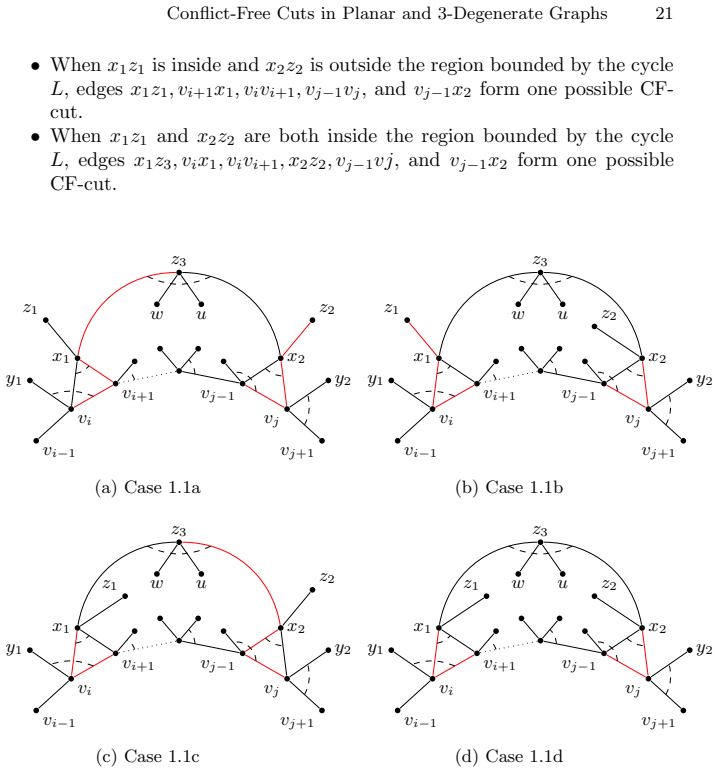



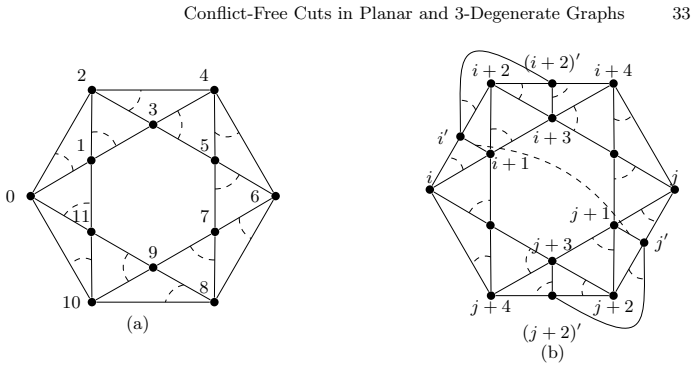


read the original abstract
A conflict-free cut $F$ on a simple connected graph $G = (V, E)$ is defined as a set of edges $F \subseteq E$ such that $G-F$ is disconnected, and no two edges in $F$ are conflicting. The notion of conflicting edges is represented using an associated conflict graph $\widehat{G} = (\widehat{V}, \widehat{E})$ where $\widehat{V} = E$. Deciding if a given planar graph $G$, with an associated conflict graph $\widehat{G}$, has a conflict-free cut is known to be NP-complete, when $G$ has maximum degree four and $\widehat{G}$ is a line graph of $G$ [Bonsma, JGT 2009]. In this paper, we prove the following for the case when $\widehat{G}$ is 1-regular. * We completely resolve the complexity of the decision problem when $G$ is planar. Towards this end, we show that (a) there always exists a conflict-free cut when the graph is planar and 4-regular unless it is the octahedron graph and (b) the decision problem is NP-complete, even in the case when $G$ is planar with maximum degree 5. * We also show that the decision problem is NP-complete when $G$ is a 3-degenerate graph with maximum degree 5. This completely resolves the complexity status of the problem when $G$ is 3-degenerate. * We construct families of graphs with 1-regular conflict graphs that do not have a conflict-free cut. Our results answer the questions posed in [Rauch, Rautenbach and Souza, IPL 2025].
Editorial analysis
A structured set of objections, weighed in public.
Referee Report
Summary. The manuscript studies conflict-free cuts (edge sets whose removal disconnects the graph with no two edges conflicting) under the restriction that the conflict graph is exactly 1-regular. It proves that every planar 4-regular graph admits a conflict-free cut except the octahedron; shows that deciding existence is NP-complete for planar graphs of maximum degree 5; proves NP-completeness for 3-degenerate graphs of maximum degree 5; and constructs infinite families of graphs with 1-regular conflicts that have no conflict-free cut. These results resolve the open questions left by Rauch, Rautenbach and Souza (IPL 2025).
Significance. If the proofs hold, the work completely settles the complexity status of the conflict-free cut problem for all planar graphs and all 3-degenerate graphs when conflicts are 1-regular. The structural existence theorem for 4-regular planar graphs is strong and clean, while the two NP-completeness results close the remaining cases left open by prior hardness proofs that used line graphs or unrestricted conflicts. The explicit constructions of graphs without conflict-free cuts supply concrete negative examples and boundary cases.
minor comments (3)
- Abstract: a one-sentence indication of the main proof techniques (e.g., “by Eulerian orientation and matching arguments” or “by planar gadget reduction from 3-SAT”) would help readers gauge the approach without reading the full text.
- The manuscript should include a small illustrative figure (perhaps in the construction section) showing one member of the infinite family of graphs without conflict-free cuts.
- Ensure that the bibliographic entry for the 2025 IPL paper is complete and that all cross-references to prior work on line-graph conflicts are consistent.
Simulated Author's Rebuttal
We thank the referee for their positive summary, significance assessment, and recommendation of minor revision. The report confirms that our results resolve the open questions from Rauch, Rautenbach and Souza (IPL 2025) for planar and 3-degenerate graphs under 1-regular conflicts. Since no specific major comments or requested changes were listed, we provide no point-by-point responses below.
Circularity Check
No significant circularity detected
full rationale
The paper establishes an existence theorem for conflict-free cuts in planar 4-regular graphs (except the octahedron) via direct case analysis and constructs explicit NP-completeness reductions for planar max-degree-5 and 3-degenerate max-degree-5 graphs using new gadgets that preserve the 1-regular conflict condition. These steps are self-contained mathematical arguments that do not reduce to prior fitted parameters, self-defined quantities, or load-bearing self-citations. The only external reference is to Rauch et al. (IPL 2025), which merely poses the open questions resolved here; no ansatz, uniqueness theorem, or renaming of known results is imported from overlapping authors. The derivation chain therefore stands on independent proofs and reductions.
Axiom & Free-Parameter Ledger
axioms (1)
- standard math Standard definitions and basic properties of planar graphs, 3-degenerate graphs, and 1-regular graphs hold.
Lean theorems connected to this paper
-
IndisputableMonolith/Foundation/AlexanderDuality.leanalexander_duality_circle_linking unclearWe show that (a) there always exists a conflict-free cut when the graph is planar and 4-regular unless it is the octahedron graph and (b) the decision problem is NP-complete, even in the case when G is planar with maximum degree 5.
-
IndisputableMonolith/Foundation/ArithmeticFromLogic.leanLogicNat induction unclearWe also show that the decision problem is NP-complete when G is a 3-degenerate graph with maximum degree 5.
Reference graph
Works this paper leans on
-
[1]
Conflict Free Feedback Vertex Set: A Parameterized Dichotomy
Akanksha Agrawal, Pallavi Jain, Lawqueen Kanesh, Daniel Lokshtanov, and Saket Saurabh. Conflict Free Feedback Vertex Set: A Parameterized Dichotomy. In 43rd International Symposium on Mathematical Foundations of Computer Science (MFCS 2018), pages 53:1–53:15, Dagstuhl, Germany, 2018
work page 2018
-
[2]
Parame- terized complexity of conflict-free matchings and paths.Algorithmica, 82(7):1939– 1965, 2020
Akanksha Agrawal, Pallavi Jain, Lawqueen Kanesh, and Saket Saurabh. Parame- terized complexity of conflict-free matchings and paths.Algorithmica, 82(7):1939– 1965, 2020
work page 1939
-
[3]
Bruno Jos´ e S Barros, Luiz Satoru Ochi, Rian G S Pinheiro, and U´ everton S Souza. On conflict-free spanning tree: Mapping tractable and hard instances through the lenses of graph classes.Theoretical Computer Science, 1031:115081, 2025
work page 2025
-
[4]
A branch-and-bound algorithm for the knapsack problem with conflict graph.INFORMS J
Andrea Bettinelli, Valentina Cacchiani, and Enrico Malaguti. A branch-and-bound algorithm for the knapsack problem with conflict graph.INFORMS J. on Com- puting, 29(3):457–473, August 2017
work page 2017
-
[5]
Paul Bonsma. The complexity of the matching-cut problem for planar graphs and other graph classes.Journal of Graph Theory, 62(2):109–126, 2009
work page 2009
-
[6]
Matching cut in graphs with large minimum degree.Algorithmica, 83(5):1238–1255, May 2021
Chi-Yeh Chen, Sun-Yuan Hsieh, Hoang-Oanh Le, Van Bang Le, and Sheng- Lung Peng. Matching cut in graphs with large minimum degree.Algorithmica, 83(5):1238–1255, May 2021
work page 2021
-
[7]
Recognizing decomposable graphs.Journal of Graph Theory, 8(1):51–53, 1984
Vasek Chv´ atal. Recognizing decomposable graphs.Journal of Graph Theory, 8(1):51–53, 1984
work page 1984
-
[8]
Marek Cygan, D´ aniel Marx, Marcin Pilipczuk, and Micha l Pilipczuk. Hitting for- bidden subgraphs in graphs of bounded treewidth.Information and Computation, 256:62–82, 2017
work page 2017
- [9]
-
[10]
Graph theory 6th ed.Graduate texts in mathematics, 173, 2024
Reinhard Diestel. Graph theory 6th ed.Graduate texts in mathematics, 173, 2024
work page 2024
-
[11]
Online variable-sized bin packing with conflicts.Discrete Optimization, 8(2):333–343, 2011
Leah Epstein, Lene M Favrholdt, and Asaf Levin. Online variable-sized bin packing with conflicts.Discrete Optimization, 8(2):333–343, 2011
work page 2011
-
[12]
Matching cuts in graphs of high girth andH-free graphs.Algorithmica, 87(8):1199–1221, May 2025
Carl Feghali, Felicia Lucke, Dani¨ el Paulusma, and Bernard Ries. Matching cuts in graphs of high girth andH-free graphs.Algorithmica, 87(8):1199–1221, May 2025. 42 Subrahmanyam Kalyanasundaram and Subodh Kumar
work page 2025
-
[13]
Conflict-free hypergraph matchings.Journal of the London Mathematical Soci- ety, 109(5):e12899, 2024
Stefan Glock, Felix Joos, Jaehoon Kim, Marcus K¨ uhn, and Lyuben Lichev. Conflict-free hypergraph matchings.Journal of the London Mathematical Soci- ety, 109(5):e12899, 2024
work page 2024
-
[14]
Petr A Golovach, Christian Komusiewicz, Dieter Kratsch, and Van Bang Le. Re- fined notions of parameterized enumeration kernels with applications to matching cut enumeration.J. Comput. Syst. Sci., 123(C):76–102, February 2022
work page 2022
-
[15]
Bounds on multiprocessing anomalies and related packing algo- rithms
Ronald L Graham. Bounds on multiprocessing anomalies and related packing algo- rithms. InProceedings of the May 16-18, 1972, spring joint computer conference, pages 205–217, 1971
work page 1972
-
[16]
Conflict-free cuts in pla- nar and 3-degenerate1 graphs with 1-regular conflicts
Subrahmanyam Kalyanasundaram and Subodh Kumar. Conflict-free cuts in pla- nar and 3-degenerate1 graphs with 1-regular conflicts. InProceedings of the 37th International Workshop on Combinatorial Algorithms (IWOCA 2026), 2026
work page 2026
-
[17]
Christian Komusiewicz, Dieter Kratsch, and Van Bang Le. Matching cut: kernel- ization, single-exponential time FPT, and exact exponential algorithms.Discrete Applied Mathematics, 283:44–58, 2020
work page 2020
-
[18]
Felicia Lucke, Dani¨ el Paulusma, and Bernard Ries. Dichotomies for maximum matching cut:H-freeness, bounded diameter, bounded radius.Theoretical Com- puter Science, 1017:114795, 2024
work page 2024
-
[19]
Approximation of knapsack problems with conflict and forcing graphs.J
Ulrich Pferschy and Joachim Schauer. Approximation of knapsack problems with conflict and forcing graphs.J. Comb. Optim., 33(4):1300–1323, May 2017
work page 2017
-
[20]
On conflict-free cuts: Algorithms and complexity.Information Processing Letters, 187:106503, 2025
Johannes Rauch, Dieter Rautenbach, and U´ everton S Souza. On conflict-free cuts: Algorithms and complexity.Information Processing Letters, 187:106503, 2025
work page 2025
discussion (0)
Sign in with ORCID, Apple, or X to comment. Anyone can read and Pith papers without signing in.