Recognition: 2 theorem links
· Lean TheoremFinite element and box-method discretizations for fractional elliptic problems with quadrature and mass lumping
Pith reviewed 2026-05-13 04:19 UTC · model grok-4.3
The pith
Mass lumping produces the intrinsic fractional box discretization of elliptic operators within a unified admissible inner product framework.
A machine-rendered reading of the paper's core claim, the machinery that carries it, and where it could break.
Core claim
The discrete fractional operator is defined by taking the beta-power of the discrete solution operator associated with an admissible inner product on the piecewise linear trial space. The standard L2 inner product recovers the usual finite element discretization of the fractional problem, while the quadrature-based mass-lumped inner product recovers the intrinsic fractional box discretization obtained by raising the non-fractional box solution operator to the power beta. Under natural consistency assumptions on the inner products and quadrature rules, both discretizations satisfy error estimates that make the quadrature contribution explicit in the box case.
What carries the argument
admissible inner product on the trial space - any inner product on the piecewise linear finite element space that is equivalent to the L2 inner product and includes both the standard L2 product and the mass-lumped quadrature product as special cases, used to define the discrete solution operator whose beta-power yields the fractional discretization.
If this is right
- The mass-lumped finite element discretization coincides exactly with the intrinsic fractional box discretization.
- Error bounds hold for both finite element and box realizations under the same consistency assumptions on the inner product and quadrature.
- The additional error from load quadrature appears explicitly in the box-method error estimate.
- A continuous family of admissible inner products interpolates between the finite element and mass-lumped extremes.
Where Pith is reading between the lines
- Existing non-fractional box-method codes could be reused for fractional problems simply by computing matrix powers of the discrete solution operator.
- The same admissible-inner-product construction could be tested on finite-volume or discontinuous Galerkin spaces to obtain analogous intrinsic fractional versions.
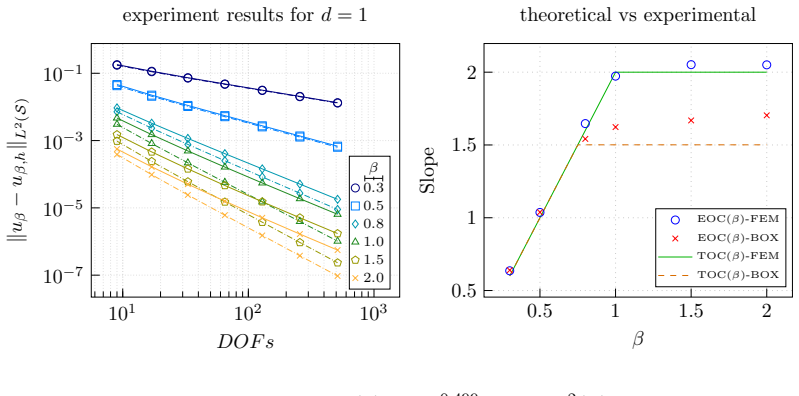
- Numerical checks in three dimensions or on locally refined meshes would test whether the consistency assumptions remain sufficient outside the one- and two-dimensional experiments reported.
Load-bearing premise
The chosen inner products on the discrete space must be admissible and the quadrature rules must satisfy the natural consistency conditions needed for the error estimates.
What would settle it
Direct matrix computation on a uniform one-dimensional mesh showing that the mass-lumped discrete fractional operator differs from the beta-power of the non-fractional box solution operator would falsify the claimed equivalence.
Figures


read the original abstract
We analyze numerical approximation of the fractional elliptic problem $L^{\beta}u=f$, ${\beta>0}$, where $L$ is a second-order self-adjoint elliptic operator with homogeneous Dirichlet or Neumann boundary conditions. The paper develops a unified conforming piecewise linear framework that covers both the standard finite element discretization and the box-method discretization of fractional powers. The key point is that the discrete fractional operator is defined with respect to an admissible inner product on the trial space. This includes, in particular, the standard $L^{2}$ inner product and the quadrature-based mass-lumped inner product, and we also identify a broader family of admissible inner products interpolating between these two realizations. Within this framework, we show that the mass-lumped choice yields the intrinsic fractional box discretization, namely the one obtained by taking fractional powers of the nonfractional box solution operator. For both the finite element and box-method realizations, we establish error estimates under natural consistency assumptions, making explicit the effect of load quadrature in the box case. The analysis applies directly to practical schemes and is supported by numerical experiments in one and two space dimensions.
Editorial analysis
A structured set of objections, weighed in public.
Referee Report
Summary. The paper develops a unified conforming piecewise linear framework for discretizing the fractional elliptic problem L^β u = f (β > 0) by defining the discrete fractional operator via admissible inner products on the trial space. This covers both standard finite-element and box-method realizations, with the mass-lumped inner product shown to recover the intrinsic fractional box discretization (fractional power of the non-fractional box solution operator). Error estimates are derived for both methods under natural consistency assumptions, with the effect of load quadrature isolated in the box case; the analysis is supported by numerical experiments in one and two space dimensions.
Significance. If the error estimates hold under the stated assumptions, the work supplies a coherent mathematical foundation that unifies two standard discretization families for fractional powers of elliptic operators while making the role of quadrature and mass lumping explicit. This is valuable for both theoretical analysis and practical implementation of nonlocal problems, and the provision of numerical validation strengthens its utility.
minor comments (2)
- The precise statement of the 'natural consistency assumptions' (mentioned in the abstract) should be collected in one location with explicit dependence on mesh size and quadrature rules so that the error bounds can be verified without cross-referencing multiple sections.
- Notation for the admissible inner products and the discrete fractional operator should be introduced with a single table or diagram that contrasts the L2, lumped, and interpolating cases to improve readability.
Simulated Author's Rebuttal
We thank the referee for the positive summary, significance assessment, and recommendation for minor revision. No major comments appear in the report, so there are no specific points requiring point-by-point response. We will incorporate any minor editorial or presentational improvements in the revised manuscript.
Circularity Check
No significant circularity; derivation is self-contained
full rationale
The paper constructs the discrete fractional operator directly from admissible inner products on the trial space (including L2 and mass-lumped variants), verifies that the mass-lumped case recovers the intrinsic fractional box discretization by definition within the framework, and derives error estimates under explicit natural consistency assumptions. No self-definitional reductions, fitted inputs renamed as predictions, or load-bearing self-citations appear. The argument relies on standard conforming finite-element and box-method analysis without circular closure.
Axiom & Free-Parameter Ledger
axioms (1)
- domain assumption Natural consistency assumptions on load quadrature and inner-product admissibility
Lean theorems connected to this paper
-
IndisputableMonolith/Foundation/AbsoluteFloorClosure.leanabsolute_floor_iff_bare_distinguishability unclearerror estimates under natural consistency assumptions... making explicit the effect of load quadrature
Reference graph
Works this paper leans on
-
[1]
Numerical methods for nonlocal and fractional models , author=. Acta Numerica , volume=
-
[2]
SIAM Journal on Numerical Analysis , volume=
Error estimates for the optimal control of a parabolic fractional PDE , author=. SIAM Journal on Numerical Analysis , volume=. 2021 , publisher=
work page 2021
-
[3]
Communications in partial differential equations , volume=
An extension problem related to the fractional Laplacian , author=. Communications in partial differential equations , volume=. 2007 , publisher=
work page 2007
-
[4]
SIAM Journal on Mathematical Analysis , volume=
Regularity theory and extension problem for fractional nonlocal parabolic equations and the master equation , author=. SIAM Journal on Mathematical Analysis , volume=
-
[5]
IMA Journal of Numerical Analysis , volume=
Numerical approximation of fractional powers of elliptic operators , author=. IMA Journal of Numerical Analysis , volume=
-
[7]
Numerische Mathematik , volume=
A sharp interface method using enriched finite elements for elliptic interface problems , author=. Numerische Mathematik , volume=. 2021 , publisher=
work page 2021
-
[8]
On first and second order box schemes , author=. Computing , volume=. 1989 , publisher=
work page 1989
- [10]
-
[11]
IMA Journal of Numerical Analysis , volume=
Numerical solution of fractional elliptic stochastic PDEs with spatial white noise , author=. IMA Journal of Numerical Analysis , volume=. 2020 , publisher=. doi:10.1093/imanum/dry091
-
[12]
Journal of Computational and Graphical Statistics , volume=
The rational SPDE approach for Gaussian random fields with general smoothness , author=. Journal of Computational and Graphical Statistics , volume=. 2020 , publisher=
work page 2020
-
[13]
Bolin, David and Simas, Alexandre B and Xiong, Zhen , doi =. Covariance--based rational approximations of fractional SPDEs for computationally efficient Bayesian inference , volume =. Journal of Computational and Graphical Statistics , number =
-
[14]
Communications in Statistics-Theory and Methods , volume=
Convolution-invariant subclasses of generalized hyperbolic distributions , author=. Communications in Statistics-Theory and Methods , volume=. 2016 , publisher=
work page 2016
-
[15]
A class of non-Gaussian second order random fields , author=. Extremes , volume=. 2011 , publisher=
work page 2011
-
[16]
Probability Theory and Related Fields , volume=
Spectral representations of infinitely divisible processes , author=. Probability Theory and Related Fields , volume=. 1989 , publisher=
work page 1989
-
[17]
The domain of definition of the L
Fageot, Julien and Humeau, Thomas , journal=. The domain of definition of the L. 2021 , publisher=. doi:10.1016/j.spa.2021.01.007
-
[18]
Random Measures, Theory and Applications
Kallenberg, Olav. Random Measures, Theory and Applications. 2017. doi:10.1007/978-3-319-41598-7
-
[23]
Interpolation of Hilbert and Sobolev spaces: quantitative estimates and counterexamples , author=. Mathematika , volume=. 2015 , publisher=. doi:10.1112/S0025579314000278
-
[24]
The finite element method for elliptic problems , author=. 2002 , publisher=
work page 2002
-
[25]
Bulletin of the International Statistical Institute , volume=
Stochastic-processes in several dimensions , author=. Bulletin of the International Statistical Institute , volume=. 1963 , publisher=
work page 1963
-
[26]
Spatial variation. Stochastic models and their application to some problems in forest surveys and other sampling investigations. , author=
-
[27]
Journal of Agricultural, Biological, and Environmental Statistics , pages=
Blackbox kriging: spatial prediction without specifying variogram models , author=. Journal of Agricultural, Biological, and Environmental Statistics , pages=. 1996 , publisher=
work page 1996
-
[28]
Proceedings of the 56th Session of the International Statistics Institute , pages=
Some topics in convolution-based spatial modeling , author=. Proceedings of the 56th Session of the International Statistics Institute , pages=. 2007 , publisher=
work page 2007
-
[29]
Journal of Computational and Graphical Statistics , volume=
Covariance tapering for interpolation of large spatial datasets , author=. Journal of Computational and Graphical Statistics , volume=. 2006 , publisher=
work page 2006
-
[30]
Journal of Multivariate Analysis , volume=
Compactly supported correlation functions , author=. Journal of Multivariate Analysis , volume=. 2002 , publisher=
work page 2002
-
[31]
Computational Statistics & Data Analysis , volume=
A comparison between Markov approximations and other methods for large spatial data sets , author=. Computational Statistics & Data Analysis , volume=. 2013 , publisher=
work page 2013
-
[32]
Geostatistical modelling using non-Gaussian Mat
Wallin, Jonas and Bolin, David , journal=. Geostatistical modelling using non-Gaussian Mat. 2015 , publisher=. doi:10.1111/sjos.12141
-
[33]
Bolin, David , journal=. Spatial Mat. 2014 , publisher=. doi:10.1111/sjos.12046
-
[34]
Exploring a new class of non-stationary spatial Gaussian random fields with varying local anisotropy , author=. Statistica Sinica , pages=. 2015 , publisher=. doi:10.5705/ss.2013.106w
-
[35]
Topics in numerical analysis , pages=
The use of numerical integration in finite element methods for solving parabolic equations , author=. Topics in numerical analysis , pages=
-
[36]
Advances in Mathematics , volume=
Orthogonally scattered measures , author=. Advances in Mathematics , volume=. 1968 , publisher=. doi:10.1016/0001-8708(68)90018-2
- [40]
-
[41]
Scandinavian Journal of Statistics , volume=
Normal Inverse Gaussian Distributions and Stochastic Volatility Modelling , author=. Scandinavian Journal of Statistics , volume=. 1997 , publisher=. doi:10.1111/1467-9469.00045
-
[42]
Correlation structure of time-changed L
Leonenko, Nikolai N and Meerschaert, Mark M and Schilling, Ren. Correlation structure of time-changed L. Communications in Applied and Industrial Mathematics , volume=
-
[43]
SIAM Journal on Numerical Analysis , volume=
On the accuracy of the finite volume element method based on piecewise linear polynomials , author=. SIAM Journal on Numerical Analysis , volume=. 2002 , publisher=
work page 2002
-
[45]
Finite Element Methods (Part 1) , publisher=
Evolution problems , author=. Finite Element Methods (Part 1) , publisher=. 1991 , pages=
work page 1991
- [47]
-
[48]
Some Error Estimates for the Finite Volume Element Method for a Parabolic Problem , title =
Panagiotis Chatzipantelidis and Raytcho Lazarov and Vidar Thomée , pages =. Some Error Estimates for the Finite Volume Element Method for a Parabolic Problem , title =. Computational Methods in Applied Mathematics , doi =. 2013 , lastchecked =
work page 2013
- [51]
-
[53]
Almeida-Sousa, Kelvin J. R. and Bolin, David and Simas, Alexandre B. , title =. 2026 , howpublished =
work page 2026
-
[54]
K. J. R. Almeida-Sousa, D. Bolin, and A. B. Simas , fractional\_box\_experiments . https://github.com/KJhonson/fractional_box_experiments, 2026. Accessed: 2026-05-10
work page 2026
-
[55]
R. E. Bank and D. J. Rose , Some error estimates for the box method , SIAM Journal on Numerical Analysis, 24 (1987), pp. 777--787, https://doi.org/10.1137/0724050
-
[56]
D. Bolin and K. Kirchner , The rational spde approach for gaussian random fields with general smoothness , Journal of Computational and Graphical Statistics, 29 (2020), pp. 274--285
work page 2020
-
[57]
D. Bolin, A. B. Simas, and Z. Xiong , Covariance--based rational approximations of fractional spdes for computationally efficient bayesian inference , Journal of Computational and Graphical Statistics, 33 (2024), pp. 64--74, https://doi.org/10.1080/10618600.2023.2231051
-
[58]
A. Bonito and J. Pasciak , Numerical approximation of fractional powers of elliptic operators , Mathematics of Computation, 84 (2015), pp. 2083--2110, https://doi.org/10.1090/S0025-5718-2015-02937-8
-
[59]
S. C. Brenner and L. R. Scott , The Mathematical Theory of Finite Element Methods , Springer New York, New York, NY, 2008, https://doi.org/10.1007/978-0-387-75934-0
-
[60]
L. Caffarelli and L. Silvestre , An extension problem related to the fractional laplacian , Communications in partial differential equations, 32 (2007), pp. 1245--1260
work page 2007
-
[61]
P. Chatzipantelidis , Finite volume methods for elliptic pde's: a new approach , ESAIM: Mathematical Modelling and Numerical Analysis, 36 (2002), pp. 307--324, https://doi.org/10.1051/m2an:2002014
-
[62]
S.-H. Chou and Q. Li , Error estimates in L ^ 2 , H ^ 1 and L ^ in covolume methods for elliptic and parabolic problems: a unified approach , Mathematics of Computation, 69 (2000), pp. 103--120, https://doi.org/10.1090/S0025-5718-99-01192-8
-
[63]
P. G. Ciarlet , The finite element method for elliptic problems , SIAM, 2002
work page 2002
-
[64]
S. G. Cox and K. Kirchner , Regularity and convergence analysis in sobolev and h \"o lder spaces for generalized whittle--mat \'e rn fields , Numerische Mathematik, 146 (2020), pp. 819--873, https://doi.org/10.1007/s00211-020-01151-x
-
[65]
Q. Du, M. Gunzburger, R. B. Lehoucq, and K. Zhou , Numerical methods for nonlocal and fractional models , Acta Numerica, 29 (2020), pp. 1--124
work page 2020
-
[66]
R. E. Ewing, T. Lin, and Y. Lin , On the accuracy of the finite volume element method based on piecewise linear polynomials , SIAM Journal on Numerical Analysis, 39 (2002), pp. 1865--1888, https://doi.org/10.1137/s0036142900368873, http://dx.doi.org/10.1137/s0036142900368873
-
[67]
G. J. Fix , Effects of quadrature errors in finite element approximation of steady state, eigenvalue and parabolic problems , in The Mathematical Foundations of the Finite Element Method with Applications to Partial Differential Equations, A. Aziz, ed., Academic Press, 1972, pp. 525--556, https://doi.org/https://doi.org/10.1016/B978-0-12-068650-6.50024-1,...
-
[68]
H. Fujita and T. Suzuki , Evolution problems , Elsevier, 1991, pp. 789--928, https://doi.org/10.1016/s1570-8659(05)80043-2, http://dx.doi.org/10.1016/s1570-8659(05)80043-2
-
[69]
C. Glusa and E. Ot \'a rola , Error estimates for the optimal control of a parabolic fractional pde , SIAM Journal on Numerical Analysis, 59 (2021), pp. 1140--1165
work page 2021
-
[70]
M. Haase , The Functional Calculus for Sectorial Operators , Birkh \"a user Basel, Basel, 2006, https://doi.org/10.1007/3-7643-7698-8
-
[71]
Hackbusch , On first and second order box schemes , Computing, 41 (1989), pp
W. Hackbusch , On first and second order box schemes , Computing, 41 (1989), pp. 277--296
work page 1989
-
[72]
S. Harizanov, R. Lazarov, P. Marinov, J. Pasciak, and P. Vassilevski , Numerical approximation of fractional powers of elliptic operators , IMA Journal of Numerical Analysis, 40 (2020), pp. 1746--1792
work page 2020
-
[73]
S. H \"o llbacher and G. Wittum , A sharp interface method using enriched finite elements for elliptic interface problems , Numerische Mathematik, 147 (2021), pp. 759--781
work page 2021
-
[74]
H. Jianguo and X. Shitong , On the finite volume element method for general self-adjoint elliptic problems , SIAM journal on numerical analysis, 35 (1998), pp. 1762--1774, https://doi.org/10.1137/S0036142994264699
-
[75]
B. Jin and Z. Zhou , Numerical Treatment and Analysis of Time-Fractional Evolution Equations , Springer International Publishing, 2023, https://doi.org/10.1007/978-3-031-21050-1, http://dx.doi.org/10.1007/978-3-031-21050-1
-
[76]
S. Liang, X. Ma, and A. Zhou , Finite volume methods for eigenvalue problems , BIT Numerical Mathematics, 41 (2001), pp. 345--363, https://doi.org/10.1023/A:1021946607960, https://doi.org/10.1023/A:1021946607960
-
[77]
F. Lindgren, H. Rue, and J. Lindstr \"o m , An explicit link between gaussian fields and gaussian markov random fields: the stochastic partial differential equation approach , Journal of the Royal Statistical Society Series B: Statistical Methodology, 73 (2011), pp. 423--498, https://doi.org/10.1111/j.1467-9868.2011.00777.x
-
[78]
P. R. Stinga and J. L. Torrea , Regularity theory and extension problem for fractional nonlocal parabolic equations and the master equation , SIAM Journal on Mathematical Analysis, 49 (2017), pp. 3893--3924
work page 2017
-
[79]
G. Strang and G. Fix , An Analysis of the Finite Element Methods, New Edition , Wellesley-Cambridge Press, Philadelphia, PA, 2008, https://doi.org/10.1137/1.9780980232707, https://epubs.siam.org/doi/abs/10.1137/1.9780980232707, https://arxiv.org/abs/https://epubs.siam.org/doi/pdf/10.1137/1.9780980232707
-
[80]
V. Thom \'e e , Galerkin Finite Element Methods for Parabolic Problems , Springer Berlin Heidelberg, Berlin, Heidelberg, 2006, https://doi.org/10.1007/3-540-33122-0_15
-
[81]
Y. Voet, E. Sande, and A. Buffa , A mathematical theory for mass lumping and its generalization with applications to isogeometric analysis , Computer Methods in Applied Mechanics and Engineering, 410 (2023), p. 116033, https://doi.org/10.1016/j.cma.2023.116033
discussion (0)
Sign in with ORCID, Apple, or X to comment. Anyone can read and Pith papers without signing in.