Recognition: no theorem link
Laplacian-P-splines for shared Gamma frailty models applied to clustered right-censored time-to-event data
Pith reviewed 2026-05-13 04:53 UTC · model grok-4.3
The pith
Laplacian-P-splines extend to shared Gamma frailty models by supplying closed-form gradient and Hessian for sampling-free inference on clustered survival data.
A machine-rendered reading of the paper's core claim, the machinery that carries it, and where it could break.
Core claim
By extending Laplacian-P-splines to shared Gamma frailty models for right-censored clustered data, the authors derive analytical expressions for the gradient and Hessian of the log-posterior. These formulas support direct Newton-type maximization to obtain maximum a posteriori estimates and curvature-based standard errors for all parameters, including the frailty variance, while preserving the closed-form marginal survival functions that the Gamma frailty supplies.
What carries the argument
Laplacian-P-splines that combine P-splines for the baseline hazard with a Laplace (Gaussian) approximation to the joint posterior, now including a multiplicative shared Gamma frailty term whose variance is estimated jointly.
If this is right
- Model fitting and uncertainty quantification become feasible for data sets too large for routine MCMC.
- The closed-form marginal hazard expressions remain available after estimation, simplifying interpretation of population-level survival.
- Direct comparison with penalized partial likelihood is possible because both approaches avoid specifying the baseline hazard parametrically.
- Uncertainty for the frailty variance is obtained without profile likelihood or additional numerical integration.
Where Pith is reading between the lines
- The same analytic-gradient approach could be tested on other frailty distributions that preserve tractable marginal hazards.
- Extension to left-truncated or interval-censored data would follow the same Laplace-plus-P-spline structure once the appropriate likelihood contributions are written.
- In high-dimensional covariate settings the method might serve as a fast starting point before any MCMC refinement.
Load-bearing premise
The Gaussian approximation to the posterior remains accurate enough for the model parameters and baseline hazard when a shared Gamma frailty is present.
What would settle it
A simulation experiment in which the empirical coverage of the Hessian-derived intervals falls well below the nominal level for moderate cluster sizes or large frailty variance.
Figures
read the original abstract
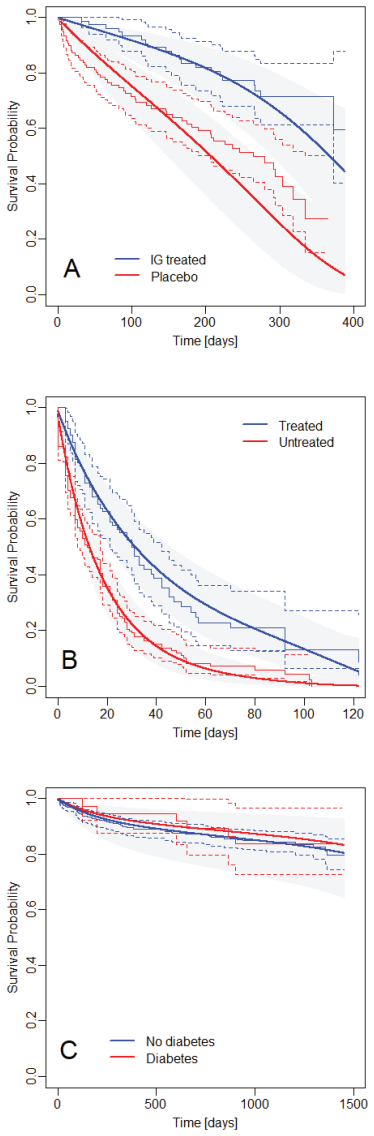
Shared frailty models have been proposed to accommodate unmeasured cluster-specific risk factors through the inclusion of a common latent frailty term. Among possible frailty distributions, the Gamma distribution is appealing due to its non-negativity, flexibility, and algebraic tractability leading to closed-form marginal survival or hazard function expressions. Under the Bayesian paradigm, the posterior distributions of model parameters are usually explored with computationally intensive procedures relying on Markov chain Monte Carlo sampling. As an alternative, Laplacian-P-splines (LPS) provide a flexible and sampling-free alternative by relying on Gaussian approximations of the posterior target distributions. In this model class, analytical formulas are obtained for the gradient and Hessian, yielding a computationally efficient inference scheme for estimation of model parameters with a natural way of quantifying uncertainty. This article extends the LPS toolbox to the inclusion of shared Gamma frailty models for clustered time-to-event data. We assess the finite-sample performance of the LPS estimation procedure through an extensive simulation study and compare estimates with those obtained using penalized partial likelihood estimation, without specification of the baseline hazard, and with the variance of the frailty term being estimated using profile likelihood. Finally, the proposed LPS estimation method is exemplified using three publicly available biomedical datasets on: (i) recurrent infections in children, (ii) cancer prevention, and (iii) kidney transplantation.
Editorial analysis
A structured set of objections, weighed in public.
Referee Report
Summary. The paper extends Laplacian-P-splines (LPS) to shared Gamma frailty models for clustered right-censored survival data. It derives closed-form gradient and Hessian expressions for the joint posterior of spline coefficients, regression parameters, and frailty variance, enabling efficient MAP estimation and Hessian-based uncertainty quantification without MCMC. Finite-sample performance is assessed via simulations against penalized partial likelihood (no baseline hazard) and profile likelihood for the frailty variance, with applications to three biomedical datasets on recurrent infections, cancer prevention, and kidney transplantation.
Significance. If the Laplace approximation remains accurate, the work supplies a sampling-free, computationally efficient Bayesian tool for frailty models that naturally quantifies uncertainty via the Hessian. The analytical derivatives constitute a clear methodological advance over numerical differentiation or full MCMC, with potential for broader adoption in clustered time-to-event analysis where cluster counts are moderate.
major comments (2)
- [Methods (gradient/Hessian derivation) and Simulation study] The central efficiency and uncertainty-quantification claims rest on the accuracy of the Gaussian (Laplace) approximation to the joint posterior that includes the frailty variance parameter. With shared Gamma frailty, the marginal posterior for the variance is frequently asymmetric when the number of clusters is modest or the variance moderate to large; the paper should demonstrate that this does not materially degrade point estimates or interval coverage. Simulation results must report empirical coverage probabilities for the frailty variance credible intervals across the design factors (cluster number, size, censoring rate).
- [Simulation study] The simulation comparisons to penalized partial likelihood and profile likelihood are load-bearing for the performance claims, yet the design details (exact numbers of clusters, cluster sizes, frailty variance values, and censoring mechanisms) are not fully specified in a way that allows readers to judge whether the reported advantages persist precisely where the Laplace approximation is most vulnerable.
minor comments (2)
- [Methods] Notation for the spline basis and penalty matrix should be introduced once with explicit dimension statements to avoid ambiguity when the frailty term is added.
- [Abstract] The abstract would be strengthened by a single sentence summarizing the main numerical findings (e.g., bias or coverage for the frailty variance) rather than only describing the study design.
Simulated Author's Rebuttal
We thank the referee for the constructive comments on our manuscript. We address each major point below, indicating where revisions will be made to strengthen the presentation of the Laplace approximation accuracy and simulation design details.
read point-by-point responses
-
Referee: [Methods (gradient/Hessian derivation) and Simulation study] The central efficiency and uncertainty-quantification claims rest on the accuracy of the Gaussian (Laplace) approximation to the joint posterior that includes the frailty variance parameter. With shared Gamma frailty, the marginal posterior for the variance is frequently asymmetric when the number of clusters is modest or the variance moderate to large; the paper should demonstrate that this does not materially degrade point estimates or interval coverage. Simulation results must report empirical coverage probabilities for the frailty variance credible intervals across the design factors (cluster number, size, censoring rate).
Authors: We agree that validating the Laplace approximation for the frailty variance parameter, particularly given potential posterior asymmetry, is important for supporting the uncertainty quantification claims. In the revised manuscript we will add empirical coverage probabilities for the 95% credible intervals of the frailty variance across all simulation design factors (cluster number, cluster size, and censoring rate). These results will be reported alongside the existing bias, MSE, and interval width metrics to directly assess any material degradation in performance. revision: yes
-
Referee: [Simulation study] The simulation comparisons to penalized partial likelihood and profile likelihood are load-bearing for the performance claims, yet the design details (exact numbers of clusters, cluster sizes, frailty variance values, and censoring mechanisms) are not fully specified in a way that allows readers to judge whether the reported advantages persist precisely where the Laplace approximation is most vulnerable.
Authors: We agree that fully explicit design details are needed for readers to evaluate the simulation results in the most challenging regimes. Although the parameters are described in Section 4, the revised manuscript will include a summary table listing the exact values and ranges used for number of clusters, cluster sizes, frailty variance levels, and censoring mechanisms. This will clarify the scenarios examined and allow direct assessment of performance where the approximation may be most vulnerable. revision: yes
Circularity Check
No circularity: LPS extension derives analytical gradient/Hessian independently and validates via external simulation benchmarks
full rationale
The paper presents an extension of the existing Laplacian-P-splines framework to shared Gamma frailty models for clustered survival data. It derives analytical expressions for the gradient and Hessian of the penalized posterior under the Laplace approximation, then evaluates finite-sample performance through an extensive simulation study that compares LPS estimates against penalized partial likelihood and profile likelihood methods on independent simulated datasets. No step in the derivation chain reduces by construction to a fitted input, self-defined quantity, or load-bearing self-citation; the central results rest on explicit model equations, closed-form marginal survival expressions for the Gamma frailty, and external benchmarking rather than tautological renaming or imported uniqueness theorems. The Gaussian approximation is treated as a modeling choice whose accuracy is assessed empirically, not assumed as a derived result.
Axiom & Free-Parameter Ledger
free parameters (2)
- smoothing parameter
- frailty variance
axioms (2)
- domain assumption The posterior distribution of model parameters can be adequately approximated by a multivariate Gaussian.
- domain assumption The shared frailty term follows a Gamma distribution.
Reference graph
Works this paper leans on
-
[1]
D.R. Cox. Regression Models and Life-Tables. J R Stat Soc Series B Stat Methodol , 34(2):187–202, 1972
work page 1972
-
[2]
T.A. Balan and H. Putter. A tutorial on frailty models. Stat Methods Med Res , 29 (11):3424–3454, 2020
work page 2020
- [3]
-
[4]
R.E. Beard. Appendix: Note on Some Mathematical Mortality Models , pages 302–311. John Wiley and Sons, Ltd, 1959
work page 1959
- [5]
-
[6]
D.G. Clayton. A model for association in bivariate life tables and its a pplication in epidemiological studies of familial tendency in chronic disease incidenc e. Biometrika, 65(1):141–151, 1978
work page 1978
- [7]
-
[8]
A. Wienke. Frailty Models in Survival Analysis . Chapman and Hall, New York, 2010
work page 2010
-
[9]
P.W.W Gamage, C.S. McMahan, L. Wang, and W. Tu. A gamma-frailty p roportional hazards model for bivariate interval-censored data. Comput Stat Data Anal , 128:354– 366, 2018
work page 2018
-
[10]
O. Gressani and P. Lambert. Laplace approximations for fast Bayesian inference in generalized additive models based on P-splines. Comput Stat Data Anal , 154:107088, 2021
work page 2021
-
[11]
O. Gressani, C. Faes, and N. Hens. An approximate Bayesian ap proach for estimation of the instantaneous reproduction number under misreported ep idemic data. Biom J , 65(6):2200024, 2023
work page 2023
-
[12]
O. Gressani, A. Torneri, N. Hens, and C. Faes. Flexible Bayesian estimation of incu- bation times. Am J Epidemiol , 194(2):490–501, 2025. 24
work page 2025
-
[13]
O. Gressani, J. Wallinga, C. L. Althaus, N. Hens, and C. Faes. Ep ilps: A fast and flexible Bayesian tool for estimation of the time-varying reproduct ion number. PLoS Comput Biol , 18(10):e1010618, 2022
work page 2022
-
[14]
B. Sumalinab, O. Gressani, N. Hens, and C. Faes. Bayesian nowc asting with Laplacian- P-splines. J Comput Graph Stat , 34(2):718–728, 2024
work page 2024
-
[15]
P. Lambert and O. Gressani. Penalty parameter selection and a symmetry corrections to Laplace approximations in Bayesian P-splines models. Stat Modelling , 23(5-6):409– 423, 2023
work page 2023
-
[16]
O. Gressani, C. Faes, and N. Hens. Laplacian-P-splines for Bay esian inference in the mixture cure model. Stat Med , 41(14):2602–2626
-
[17]
O. Gressani and P. Lambert. Fast Bayesian inference using La place approximations in a flexible promotion time cure model based on P-splines. Comput Stat Data Anal , 124:151–167, 2018
work page 2018
-
[18]
L. Duchateau, P. Janssen, and S. Abrams. The frailty model. I n International Ency- clopedia of Statistical Science , pages 982–992. Springer, 2025
work page 2025
-
[19]
S. Lang and A. Brezger. Bayesian P-Splines. J Comput Graph Stat , 13(1):183–212, 2004
work page 2004
-
[20]
A. Brezger and W.J. Steiner. Monotonic regression based on Ba yesian P–splines: An application to estimating price response functions from store-leve l scanner data. J Bus Econ Stat , 26(1):90–104, 2008
work page 2008
- [21]
-
[22]
A. Jullion and P. Lambert. Robust specification of the roughnes s penalty prior distri- bution in spatially adaptive Bayesian P-splines models. Comput Stat Data Anal , 51 (5):2542–2558, 2007
work page 2007
-
[23]
Y. Pawitan. In All Likelihood: Statistical Modelling and Inference Usi ng Likelihood . Oxford University Press, Oxford, UK, 2001
work page 2001
- [24]
-
[25]
A controlled trial of interferon gamma to prevent infection in chronic granuloma tous disease
International Chronic Granulomatous Disease Cooperative St udy Group. A controlled trial of interferon gamma to prevent infection in chronic granuloma tous disease. N Engl J Med , 324(8):509–516, 1991
work page 1991
-
[26]
T.A. Balan and H. Putter. frailtyEM: An R package for estimating semiparametric shared frailty models. J Stat Softw , 90(7):1–29, 2019
work page 2019
-
[27]
T.R. Fleming and D.P. Harrington. Counting Processes and Survival Analysis . John Wiley and Sons Inc., New York, 2005
work page 2005
- [28]
-
[29]
D. Collett. Modelling Survival Data in Medical Research (3rd ed.) . Chapman and Hall/CRC, New York, 2015
work page 2015
-
[30]
P. Lewczuk. Laplacian-P-Splines in Gamma Shared Frailty Models. Master’s thesis, Hasselt University, 2024. Accessible at https://lewczuk.info/lps. 26 Appendix Gradient Let us first write the log-likelihood compactly as: ℓ(ξ;D) = I∑ i=1 ( c˜γ + ni∑ j=1 δij ( θ ⊤ b(tij) + β ⊤ zij ) − (ni¯δi + exp(˜γ)) logg1(θ, β, ˜γ) ) , with c˜γ := exp( ˜γ)˜γ + log Γ(ni¯δi ...
work page 2024
discussion (0)
Sign in with ORCID, Apple, or X to comment. Anyone can read and Pith papers without signing in.