Recognition: no theorem link
Bayesian Persuasion with a Risk-Conscious Receiver
Pith reviewed 2026-05-13 03:32 UTC · model grok-4.3
The pith
CVaR preferences break the standard action-based reduction in Bayesian persuasion, yet finite-state models admit an exact polynomial-size linear program via active-facet refinement.
A machine-rendered reading of the paper's core claim, the machinery that carries it, and where it could break.
Core claim
CVaR preferences break the standard action-based direct-recommendation reduction: merging signals that recommend the same action can change the receiver's tail-risk ranking and destroy incentive compatibility. In the explicit finite-state model each CVaR action value is max-affine in the posterior, and refining recommendations by the active affine piece yields an active-facet revelation principle and an exact polynomial-size linear program. Listed polyhedral risks remain tractable by the same LP, whereas succinctly represented facet families make exact persuasion NP-hard. A finite-precision approximation scheme applies to risk preferences determined by finitely many stable posterior st
What carries the argument
The active-facet revelation principle, which partitions the signal space according to the currently active affine piece in the max-affine representation of each CVaR value.
If this is right
- Any listed collection of polyhedral risk measures yields an equivalent polynomial-size linear program for optimal persuasion.
- Exact computation becomes NP-hard once the risk facets are given only succinctly rather than enumerated.
- Risk preferences that depend on finitely many stable posterior statistics admit a finite-precision approximation algorithm.
- The designer must track which affine piece of the CVaR function is active for each recommended action rather than the action label alone.
Where Pith is reading between the lines
- The same max-affine structure may let other coherent risk measures be handled by analogous refinement techniques.
- In continuous-state environments the active-facet idea would likely require a discretization step whose error can be bounded by the same finite-precision argument.
- Representation complexity of the risk functional becomes a first-class design parameter when building computational models of persuasion.
Load-bearing premise
The receiver's CVaR value for every action is exactly the pointwise maximum of a finite collection of affine functions of the posterior belief.
What would settle it
A small finite-state instance in which the linear program returns a signaling scheme that violates CVaR incentive compatibility after any active-facet refinement, or a succinct facet family for which the LP formulation misses the optimal value.
Figures

read the original abstract
We study Bayesian persuasion when the receiver evaluates actions by reward-side Conditional Value-at-Risk (CVaR) rather than expected utility. CVaR preferences break the standard action-based direct-recommendation reduction: merging signals that recommend the same action can change the receiver's tail-risk ranking and destroy incentive compatibility. We show that this failure does not imply intractability in the explicit finite-state model. Each CVaR action value is max-affine in the posterior, and refining recommendations by the active affine piece yields an active-facet revelation principle and an exact polynomial-size linear program. We further identify a representation boundary: listed polyhedral risks remain tractable by the same LP, whereas succinctly represented facet families make exact persuasion NP-hard. Finally, we give a finite-precision approximation scheme for risk preferences determined by finitely many stable posterior statistics.
Editorial analysis
A structured set of objections, weighed in public.
Referee Report
Summary. The paper studies Bayesian persuasion where the receiver has reward-side CVaR preferences instead of expected utility. It shows that CVaR breaks the standard action-based direct-recommendation reduction, as merging signals recommending the same action can alter tail-risk rankings and violate incentive compatibility. In the explicit finite-state model, however, each CVaR action value is max-affine in the posterior belief; refining recommendations by the active affine piece yields an active-facet revelation principle and an exact polynomial-size linear program. The work further delineates a representation boundary (tractable for listed polyhedral risks via the same LP, NP-hard for succinctly represented facet families) and supplies a finite-precision approximation scheme for risk preferences determined by finitely many stable posterior statistics.
Significance. If the central claims hold, the paper makes a substantive contribution by extending Bayesian persuasion to CVaR receivers, a risk measure widely used in finance and operations research. The active-facet revelation principle and the exact polynomial-size LP constitute a clean structural and computational advance; the explicit hardness result for succinct representations and the approximation scheme further clarify the tractability boundary. The exact LP is a reproducible strength that supports practical implementation.
major comments (2)
- [§3] §3 (active-facet revelation principle): the argument that refining by the active affine piece restores incentive compatibility appears to rest on the pointwise max-affine property, but the manuscript must explicitly verify that the resulting LP constraints remain linear and polynomial in the number of states and actions when the number of affine pieces per action is fixed.
- [§4] §4 (representation boundary): the NP-hardness claim for succinctly represented facet families is load-bearing for the tractability conclusion; the reduction must be stated with a concrete succinct encoding (e.g., circuit or formula size) and shown to preserve the finite-state structure used in the positive LP result.
minor comments (3)
- [Introduction] The abstract introduces 'listed polyhedral risks' and 'succinctly represented facet families' without a brief parenthetical definition; a one-sentence clarification in the introduction would improve readability.
- [§2] Notation for the CVaR parameter (e.g., the tail probability level) should be fixed consistently across the LP formulation and the approximation scheme.
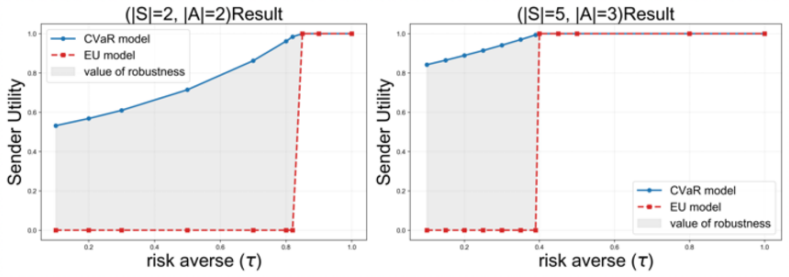
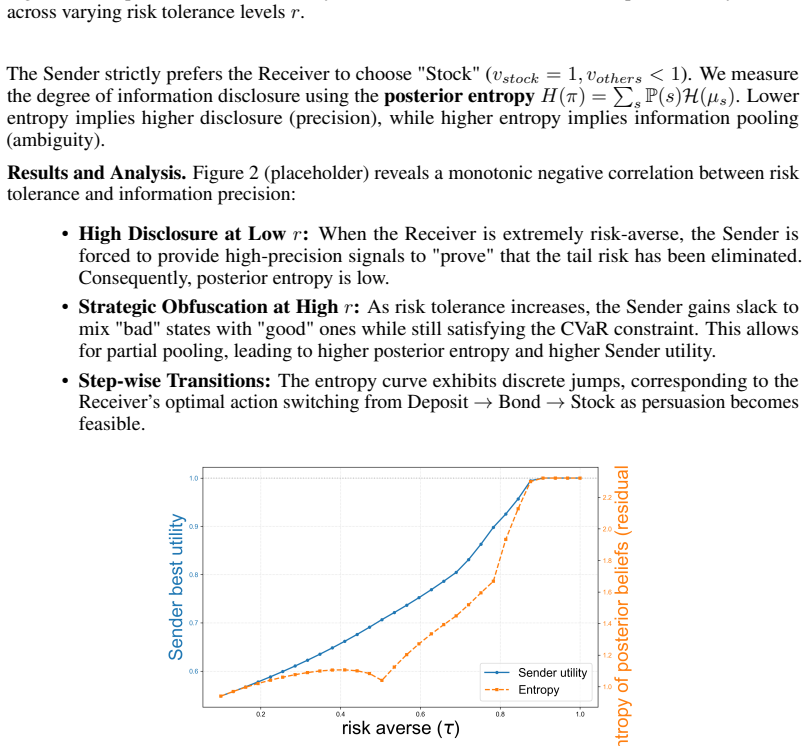
- [Figures] Figure 1 (if present) comparing the standard revelation principle to the active-facet version would benefit from an explicit legend indicating which facets are active for each posterior.
Simulated Author's Rebuttal
We thank the referee for the positive evaluation and the recommendation of minor revision. The comments help strengthen the clarity of the structural and computational results. We respond to each major comment below and will revise the manuscript accordingly.
read point-by-point responses
-
Referee: [§3] §3 (active-facet revelation principle): the argument that refining by the active affine piece restores incentive compatibility appears to rest on the pointwise max-affine property, but the manuscript must explicitly verify that the resulting LP constraints remain linear and polynomial in the number of states and actions when the number of affine pieces per action is fixed.
Authors: We agree that an explicit verification is warranted. In the revised version we will add Lemma 3.3, which derives the LP directly from the max-affine representation. Because CVaR at a fixed level is the pointwise maximum of a fixed finite number of affine functions of the posterior (the number of pieces is independent of |Ω|), each active-facet constraint is a linear inequality in the posterior probabilities. The resulting program therefore has O(|Ω|·|A|·k) variables and constraints for fixed k pieces per action and is manifestly linear. We will include the full algebraic expansion to confirm that no nonlinear terms appear after the active-piece refinement. revision: yes
-
Referee: [§4] §4 (representation boundary): the NP-hardness claim for succinctly represented facet families is load-bearing for the tractability conclusion; the reduction must be stated with a concrete succinct encoding (e.g., circuit or formula size) and shown to preserve the finite-state structure used in the positive LP result.
Authors: We accept the request for a more precise statement of the reduction. The hardness proof in §4 reduces from 3-SAT; each facet family is encoded by a boolean circuit whose size is linear in the number of variables and clauses. The underlying state space Ω remains the same explicitly enumerated finite set used for the polynomial-size LP, so the finite-state model is unchanged. In the revision we will add a formal definition of the circuit encoding together with a short proof that the reduction preserves finiteness of |Ω| and |A|. revision: yes
Circularity Check
No circularity: structural property of finite-state CVaR yields independent LP
full rationale
The derivation begins from the explicit finite-state model in which each CVaR action value is given as the pointwise maximum of finitely many affine functions of the posterior (weakest assumption). From this property the paper derives the active-facet revelation principle and the polynomial-size LP without fitting parameters to data or reducing the claimed tractability result to a self-citation chain. No load-bearing step equates a prediction to its own fitted input or renames a known result; the max-affine representation is a model feature used to obtain the LP, not a circular re-statement of the LP itself. The analysis is therefore self-contained against external benchmarks.
Axiom & Free-Parameter Ledger
axioms (2)
- domain assumption The state space is finite and the set of actions is finite.
- domain assumption CVaR of each action is max-affine in the posterior belief.
Reference graph
Works this paper leans on
-
[1]
Information and Control , volume=
Succinct representations of graphs , author=. Information and Control , volume=. 1983 , doi=
work page 1983
-
[2]
Information and Control , volume=
A note on succinct representations of graphs , author=. Information and Control , volume=. 1986 , doi=
work page 1986
-
[3]
The complexity of combinatorial problems with succinct input representation , author=. Acta Informatica , volume=. 1986 , doi=
work page 1986
-
[4]
Computational Complexity , volume=
On the complexity of succinct zero-sum games , author=. Computational Complexity , volume=. 2008 , doi=
work page 2008
-
[5]
and Xu, Haifeng , month = jul, year =
Wu, Jibang and Zhang, Zixuan and Feng, Zhe and Wang, Zhaoran and Yang, Zhuoran and Jordan, Michael I. and Xu, Haifeng , month = jul, year =. Sequential information design:. Proceedings of the 23rd
-
[6]
American Economic Review , author =
Bayesian persuasion , volume =. American Economic Review , author =. 2011 , keywords =
work page 2011
-
[7]
Proceedings of the AAAI Conference on Artificial Intelligence , volume=
Bayesian Persuasion in Sequential Decision-Making , author=. Proceedings of the AAAI Conference on Artificial Intelligence , volume=
-
[8]
Persuading risk-conscious agents:
Anunrojwong, Jerry and Iyer, Krishnamurthy and Lingenbrink, David , month = jan, year =. Persuading risk-conscious agents:. Operations Research , publisher_ig =
-
[9]
Journal of Computational and Applied Mathematics , author =
Interior-point methods , volume =. Journal of Computational and Applied Mathematics , author =. 2000 , pages =
work page 2000
-
[10]
Optimization of conditional value-at-risk , url_ig =. Journal of Risk , author =
-
[11]
Journal of Banking & Finance , author =
Conditional value-at-risk for general loss distributions , volume =. Journal of Banking & Finance , author =. 2002 , keywords =
work page 2002
-
[12]
Information disclosure as a means to security , isbn =
Rabinovich, Zinovi and Jiang, Albert Xin and Jain, Manish and Xu, Haifeng , month = may, year =. Information disclosure as a means to security , isbn =. Proceedings of the 2015
work page 2015
-
[13]
Exploring information asymmetry in two-stage security games , isbn =
Xu, Haifeng and Rabinovich, Zinovi and Dughmi, Shaddin and Tambe, Milind , month = jan, year =. Exploring information asymmetry in two-stage security games , isbn =. Proceedings of the
-
[14]
Journal of Economic Theory , author =
Stress tests and information disclosure , volume =. Journal of Economic Theory , author =. 2018 , keywords =
work page 2018
-
[15]
Targeting and signaling in ad auctions , url_ig =
Badanidiyuru, Ashwinkumar and Bhawalkar, Kshipra and Xu, Haifeng , month = jan, year =. Targeting and signaling in ad auctions , url_ig =. Proceedings of the 2018
work page 2018
-
[16]
Theoretical Economics , author =
Bayes correlated equilibrium and the comparison of information structures in games , volume =. Theoretical Economics , author =. 2016 , note =
work page 2016
-
[17]
Journal of Economic Literature , author =
Information design:. Journal of Economic Literature , author =. 2019 , keywords =
work page 2019
-
[18]
Dughmi, Shaddin and Xu, Haifeng , month = jan, year =. Algorithmic. SIAM Journal on Computing , publisher_ig =
-
[19]
Bayesian persuasion and information design , volume =
Kamenica, Emir , month = aug, year =. Bayesian persuasion and information design , volume =. Annual Review of Economics , publisher_ig =
- [20]
-
[21]
Uryasev, Stanislav and Rockafellar, R. Tyrrell , year =. Conditional value-at-risk:. Stochastic
-
[22]
International Transactions in Operational Research , author =
Conditional value-at-risk beyond finance:. International Transactions in Operational Research , author =. 2020 , pages =
work page 2020
-
[23]
Journal of Banking & Finance , author =
On the coherence of expected shortfall , volume =. Journal of Banking & Finance , author =. 2002 , keywords =
work page 2002
-
[24]
Near-minimax-optimal risk-sensitive reinforcement learning with
Wang, Kaiwen and Kallus, Nathan and Sun, Wen , month = jul, year =. Near-minimax-optimal risk-sensitive reinforcement learning with. Proceedings of the 40th
-
[25]
Strategizing against no-regret learners in first-price auctions , isbn =
Rubinstein, Aviad and Zhao, Junyao , month = dec, year =. Strategizing against no-regret learners in first-price auctions , isbn =. Proceedings of the 25th
-
[26]
Is learning in games good for the learners? , abstract =
Brown, William and Schneider, Jon and Vodrahalli, Kiran , month = dec, year =. Is learning in games good for the learners? , abstract =. Advances in
-
[27]
Selling to a no-regret buyer , isbn =
Braverman, Mark and Mao, Jieming and Schneider, Jon and Weinberg, Matt , month = jun, year =. Selling to a no-regret buyer , isbn =. Proceedings of the 19th
-
[28]
The Journal of Risk , author =
Optimization of conditional value-at-risk , volume =. The Journal of Risk , author =. 2000 , pages =
work page 2000
-
[29]
A management knowledge graph approach for critical infrastructure protection:
Chen, Jiarui and Lu, Yiqin and Zhang, Yang and Huang, Fang and Qin, Jiancheng , month = dec, year =. A management knowledge graph approach for critical infrastructure protection:. International
-
[30]
Mathematical Finance , author =
Coherent measures of risk , volume =. Mathematical Finance , author =. 1999 , pages =
work page 1999
-
[31]
Preparing for the worst but hoping for the best:. Econometrica , author =. 2022 , note =
work page 2022
-
[32]
Journal of Machine Learning Research , author =
From external to internal regret , volume =. Journal of Machine Learning Research , author =. 2007 , pages =
work page 2007
-
[33]
Frontiers in Psychology , author =
Risk aversion is associated with decision making among community-based older persons , volume =. Frontiers in Psychology , author =. 2012 , pages =
work page 2012
-
[34]
Artificial Intelligence , author =
Improving resource allocation strategies against human adversaries in security games:. Artificial Intelligence , author =. 2013 , keywords =
work page 2013
-
[35]
Games and Economic Behavior , author =
Regret-minimizing. Games and Economic Behavior , author =. 2022 , keywords =
work page 2022
-
[36]
Celli, Andrea and Coniglio, Stefano and Gatti, Nicola , month = apr, year =. Private. Proceedings of the
-
[37]
Sequential information design:
Bernasconi, Martino and Castiglioni, Matteo and Marchesi, Alberto and Gatti, Nicola and Trovo, Francesco , month = nov, year =. Sequential information design:. Advances in
-
[38]
and Xu, Haifeng , month = jul, year =
Hossain, Safwan and Wang, Tonghan and Lin, Tao and Chen, Yiling and Parkes, David C. and Xu, Haifeng , month = jul, year =. Multi-sender persuasion:. Proceedings of the 41th
-
[39]
Wang, Tonghan and Dütting, Paul and Ivanov, Dmitry and Talgam-Cohen, Inbal and Parkes, David C. , month = dec, year =. Deep contract design via discontinuous networks , abstract =. Advances in
-
[40]
Rationality-robust information design:
Feng, Yiding and Ho, Chien-Ju and Tang, Wei , month = jan, year =. Rationality-robust information design:. Proceedings of the 2024
work page 2024
-
[41]
Hardness results for signaling in
Bhaskar, Umang and Cheng, Yu and Ko, Young Kun and Swamy, Chaitanya , month = jul, year =. Hardness results for signaling in. Proceedings of the 17th
-
[42]
Linear Algebra and its Applications , author =
On sparse approximations to randomized strategies and convex combinations , volume =. Linear Algebra and its Applications , author =. 1994 , pages =
work page 1994
-
[43]
Robust persuasion of a privately informed receiver , volume =. Economic Theory , author =. 2021 , keywords =
work page 2021
-
[45]
and Xu, Haifeng , month = jul, year =
Zhou, Chenghan and Nguyen, Thanh H. and Xu, Haifeng , month = jul, year =. Algorithmic information design in multi-player games:. Proceedings of the 23rd
-
[46]
and Markakis, Evangelos and Mehta, Aranyak , month = jun, year =
Lipton, Richard J. and Markakis, Evangelos and Mehta, Aranyak , month = jun, year =. Playing large games using simple strategies , isbn =. Proceedings of the 4th
-
[47]
Gan, Jiarui and Han, Minbiao and Wu, Jibang and Xu, Haifeng , month = jul, year =. Robust. Proceedings of the 24th
-
[48]
arXiv preprint arXiv:2106.06480 , author =
Multi-receiver online. arXiv preprint arXiv:2106.06480 , author =
-
[49]
On the tractability of public persuasion with no externalities , booktitle =
Xu, Haifeng , year =. On the tractability of public persuasion with no externalities , booktitle =
-
[50]
Proceedings of the AAAI Conference on Artificial Intelligence , author =
Bayesian. Proceedings of the AAAI Conference on Artificial Intelligence , author =. 2021 , keywords =
work page 2021
-
[51]
On the hardness of signaling , booktitle =
Dughmi, Shaddin , year =. On the hardness of signaling , booktitle =
-
[52]
Alonso, Ricardo and Câmara, Odilon , year =. Persuading voters , volume =. The American Economic Review , publisher_ig =
-
[53]
Honest signaling in zero-sum games is hard, and liars get paid , booktitle =
Rubinstein, Aviad , year =. Honest signaling in zero-sum games is hard, and liars get paid , booktitle =
-
[54]
Algorithmic information structure design:
Dughmi, Shaddin , year =. Algorithmic information structure design:. ACM SIGecom Exchanges , publisher_ig =
-
[55]
Computational aspects of private
Babichenko, Yakov and Barman, Siddharth , year =. Computational aspects of private. 8th innovations in theoretical computer science conference (
-
[56]
Private bayesian persuasion , volume =
Arieli, Itai and Babichenko, Yakov , year =. Private bayesian persuasion , volume =. Journal of Economic Theory , publisher_ig =
-
[57]
Persuasion with unknown beliefs , volume =
Kosterina, Svetlana , year =. Persuasion with unknown beliefs , volume =. Theoretical Economics , publisher_ig =
-
[58]
Preparing for the worst but hoping for the best:
Dworczak, Piotr and Pavan, Alessandro , year =. Preparing for the worst but hoping for the best:. Econometrica : journal of the Econometric Society , publisher_ig =
-
[59]
Online bayesian persuasion , volume =
Castiglioni, Matteo and Celli, Andrea and Marchesi, Alberto and Gatti, Nicola , year =. Online bayesian persuasion , volume =. Advances in neural information processing systems (
-
[60]
Constrained information design , volume =
Doval, Laura and Skreta, Vasiliki , year =. Constrained information design , volume =. Mathematics of Operations Research , publisher_ig =
-
[61]
On the coherence of expected shortfall
Carlo Acerbi and Dirk Tasche. On the coherence of expected shortfall. Journal of Banking & Finance, 26 0 (7): 0 1487--1503, July 2002
work page 2002
-
[62]
On sparse approximations to randomized strategies and convex combinations
Ingo Althöfer. On sparse approximations to randomized strategies and convex combinations. Linear Algebra and its Applications, 199: 0 339--355, March 1994
work page 1994
-
[63]
Persuading risk-conscious agents: A geometric approach
Jerry Anunrojwong, Krishnamurthy Iyer, and David Lingenbrink. Persuading risk-conscious agents: A geometric approach. Operations Research, 72 0 (1): 0 151--166, January 2024
work page 2024
-
[64]
Itai Arieli and Yakov Babichenko. Private bayesian persuasion. Journal of Economic Theory, 182: 0 185--217, 2019
work page 2019
-
[65]
Philippe Artzner, Freddy Delbaen, Jean‐Marc Eber, and David Heath. Coherent measures of risk. Mathematical Finance, 9 0 (3): 0 203--228, July 1999
work page 1999
-
[66]
Computational aspects of private Bayesian persuasion
Yakov Babichenko and Siddharth Barman. Computational aspects of private Bayesian persuasion. In 8th innovations in theoretical computer science conference ( ITCS ) , 2017
work page 2017
-
[67]
Bayesian Persuasion under Ex Ante and Ex Post Constraints
Yakov Babichenko, Inbal Talgam-Cohen, and Konstantin Zabarnyi. Bayesian Persuasion under Ex Ante and Ex Post Constraints . Proceedings of the AAAI Conference on Artificial Intelligence, 35 0 (6): 0 5127--5134, May 2021
work page 2021
-
[68]
Regret-minimizing Bayesian persuasion
Yakov Babichenko, Inbal Talgam-Cohen, Haifeng Xu, and Konstantin Zabarnyi. Regret-minimizing Bayesian persuasion. Games and Economic Behavior, 136: 0 226--248, November 2022
work page 2022
-
[69]
Targeting and signaling in ad auctions
Ashwinkumar Badanidiyuru, Kshipra Bhawalkar, and Haifeng Xu. Targeting and signaling in ad auctions. In Proceedings of the 2018 Annual ACM - SIAM Symposium on Discrete Algorithms , pages 2545--2563, January 2018
work page 2018
-
[70]
Information design: A unified perspective
Dirk Bergemann and Stephen Morris. Information design: A unified perspective. Journal of Economic Literature, 57 0 (1): 0 44--95, March 2019
work page 2019
-
[71]
Hardness results for signaling in Bayesian zero-sum and network routing games
Umang Bhaskar, Yu Cheng, Young Kun Ko, and Chaitanya Swamy. Hardness results for signaling in Bayesian zero-sum and network routing games. In Proceedings of the 17th ACM Conference on Economics and Computation , EC '16, pages 479--496, July 2016. ISBN 978-1-4503-3936-0
work page 2016
-
[72]
Matteo Castiglioni, Andrea Celli, Alberto Marchesi, and Nicola Gatti. Online bayesian persuasion. In Advances in neural information processing systems ( NeurIPS ) , volume 33, pages 16188--16198, 2020
work page 2020
-
[73]
Constrained information design
Laura Doval and Vasiliki Skreta. Constrained information design. Mathematics of Operations Research, 49 0 (1): 0 78--106, 2024
work page 2024
-
[74]
Shaddin Dughmi. On the hardness of signaling. In IEEE 55th annual symposium on foundations of computer science ( FOCS ) , pages 354--363, 2014
work page 2014
-
[75]
Algorithmic Bayesian persuasion
Shaddin Dughmi and Haifeng Xu. Algorithmic Bayesian persuasion. SIAM Journal on Computing, 50 0 (3): 0 16--68, January 2021. Num Pages: STOC16-97
work page 2021
-
[76]
Preparing for the worst but hoping for the best: Robust ( Bayesian ) persuasion
Piotr Dworczak and Alessandro Pavan. Preparing for the worst but hoping for the best: Robust ( Bayesian ) persuasion. Econometrica, 90 0 (5): 0 2017--2051, 2022. \_eprint: https://onlinelibrary.wiley.com/doi/pdf/10.3982/ECTA19107
-
[77]
Rationality-robust information design: Bayesian persuasion under quantal response
Yiding Feng, Chien-Ju Ho, and Wei Tang. Rationality-robust information design: Bayesian persuasion under quantal response. In Proceedings of the 2024 Annual ACM - SIAM Symposium on Discrete Algorithms , pages 501--546, January 2024
work page 2024
-
[78]
C. Filippi, G. Guastaroba, and M.G. Speranza. Conditional value-at-risk beyond finance: A survey. International Transactions in Operational Research, 27 0 (3): 0 1277--1319, May 2020
work page 2020
-
[79]
On the complexity of succinct zero-sum games
Lance Fortnow, Russell Impagliazzo, Valentine Kabanets, and Christopher Umans. On the complexity of succinct zero-sum games. Computational Complexity, 17: 0 353--376, 2008. doi:10.1007/s00037-008-0252-2
-
[80]
Succinct representations of graphs
Hana Galperin and Avi Wigderson. Succinct representations of graphs. Information and Control, 56 0 (3): 0 183--198, 1983. doi:10.1016/S0019-9958(83)80004-7
-
[81]
J. Gan, R. Majumdar, G. Radanovic, and A. Singla. Bayesian persuasion in sequential decision-making. In Proceedings of the AAAI Conference on Artificial Intelligence, volume 36, pages 4806--4813, 2022
work page 2022
discussion (0)
Sign in with ORCID, Apple, or X to comment. Anyone can read and Pith papers without signing in.