Recognition: 2 theorem links
· Lean TheoremPeriodic Emission Frequency Modulation in a Hyperactive Fast Radio Burst
Pith reviewed 2026-05-13 04:10 UTC · model grok-4.3
The pith
The central emission frequency of FRB 20240114A shows periodic modulation with a period of about 112 days.
A machine-rendered reading of the paper's core claim, the machinery that carries it, and where it could break.
Core claim
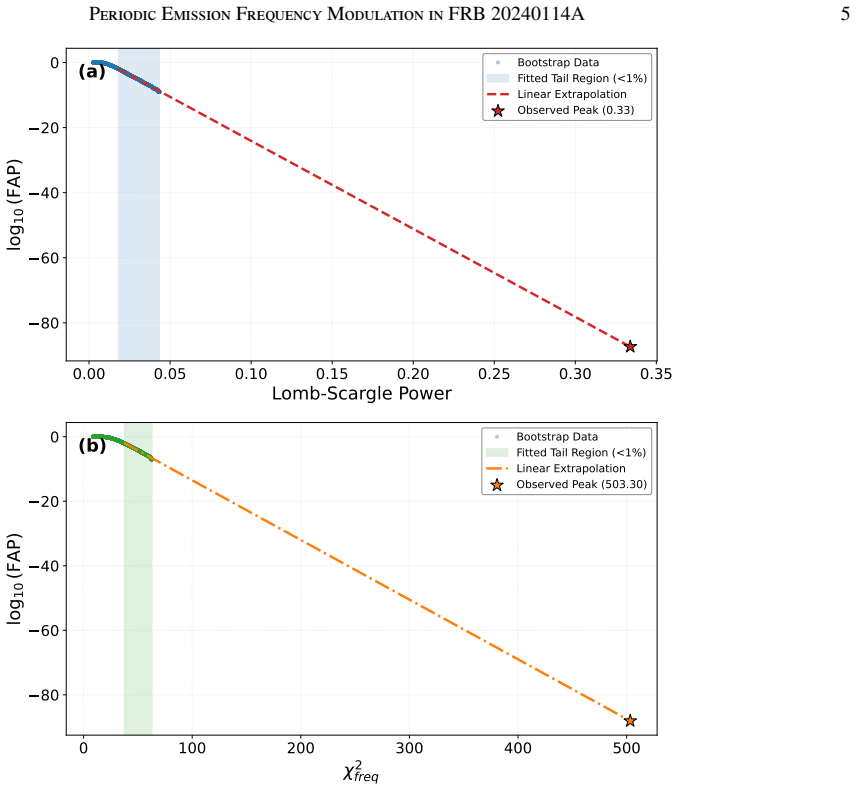
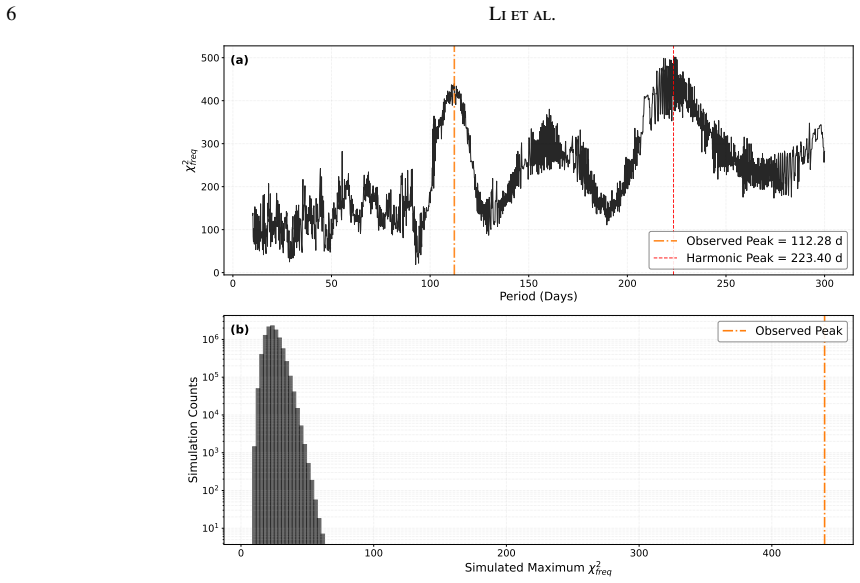
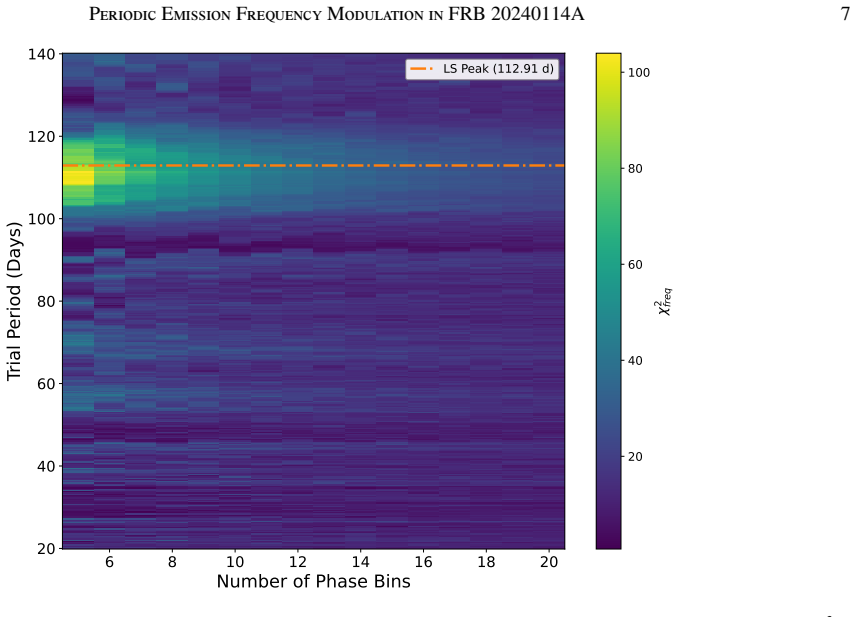
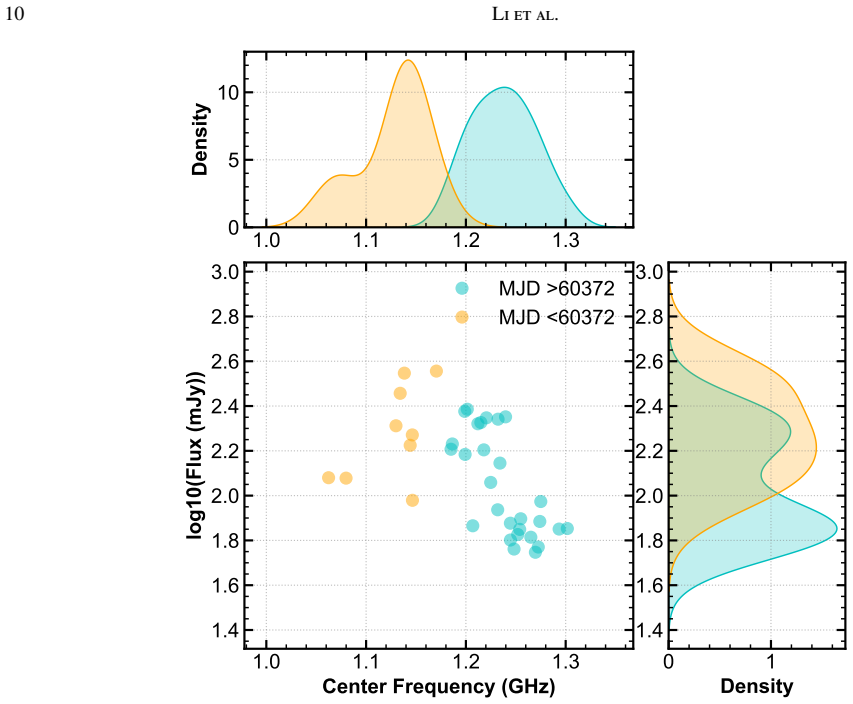
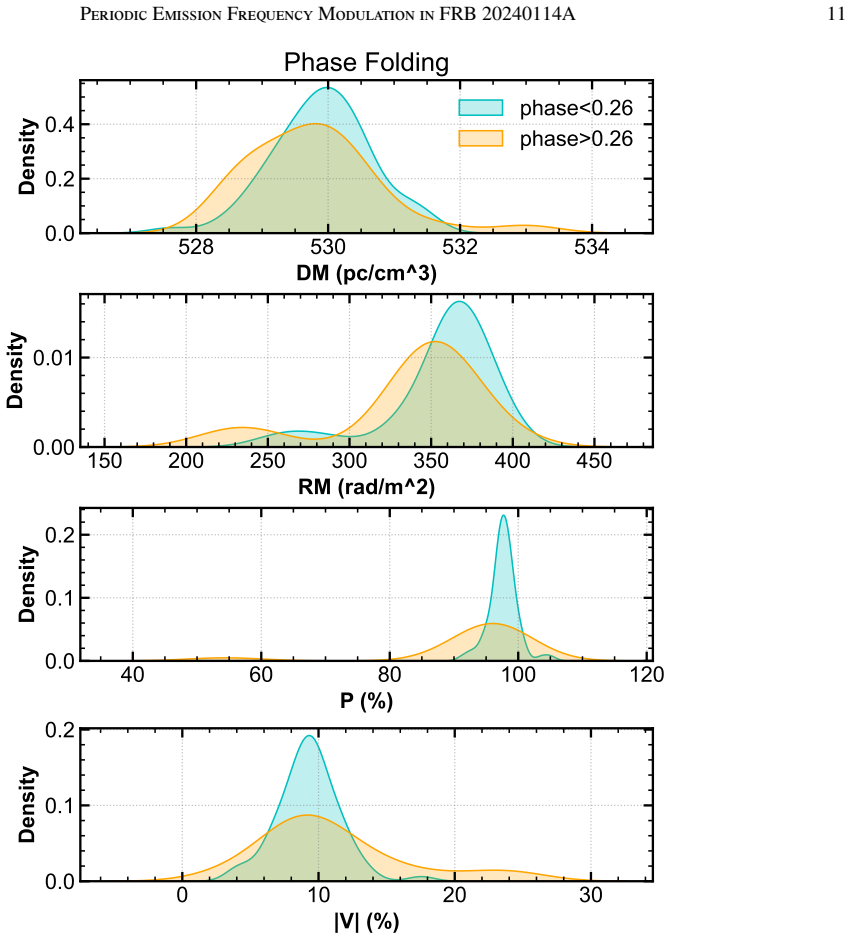
Based on extensive observations, the burst central frequencies exhibit a significant modulation with a period of ∼112 days. The statistical significance exceeds 6σ using both Lomb-Scargle and phase-folding methods. Within each period, the central emission frequency drifts systematically from lower to higher values. Several physical mechanisms, such as free-free absorption with cyclotron resonant absorption in a binary system or free precession, are evaluated as potential explanations for this spectral evolution.
What carries the argument
Periodic modulation in central emission frequency detected through Lomb-Scargle periodogram and phase-folding techniques on burst data.
If this is right
- The periodicity indicates a repeating physical process influencing the emission frequency.
- Binary system models or precession could account for the observed frequency drift.
- This unveils new complexity in FRB radiation mechanisms and propagation effects.
- Similar periodicities may be present in other repeating FRBs and warrant searches.
Where Pith is reading between the lines
- This modulation period might correspond to an orbital period if the FRB source is in a binary system.
- Monitoring other active FRBs could reveal if such frequency modulations are common or unique to highly active sources.
- The systematic drift could be used to probe changing plasma densities or magnetic field strengths in the source environment.
Load-bearing premise
The central frequencies measured from the bursts are not significantly affected by instrumental biases, detection selection effects, or artifacts from the observing schedule and data processing.
What would settle it
Collecting and analyzing bursts over additional periods to check if the 112-day modulation and the frequency drift pattern continue consistently would confirm or refute the discovery.
Figures




read the original abstract
Fast radio bursts (FRBs) are intense, short-duration radio transients of mysterious origin. They have been detected across a wide range of frequencies from 110 MHz to 8 GHz. Their spectral properties, remaining poorly understood, are essential for understanding the intrinsic radiation mechanism and propagation effects. Here, we report the discovery of a periodic modulation in the central emission frequency of FRB 20240114A, based on more than one thousand bursts collected by an ultra-wideband receiving system. The burst central frequencies reveals a significant modulation with a period of $\sim 112$ days. The statistical significance of this detected periodicity exceeds $6\sigma$ for both the Lomb-Scargle and phase-folding methods. Within a single period, the central emission frequency exhibits a systematic drift from lower to higher values. We evaluate several physical mechanisms for this unique spectral evolution. The free-free absorption together with cyclotron resonant absorption in a binary system or free precession models could potentially explain such behavior. The discovery of this periodic frequency modulation unveils a new layer of complexity in the underlying radiation mechanism and propagation effect of FRBs.
Editorial analysis
A structured set of objections, weighed in public.
Referee Report
Summary. The paper reports the discovery of a periodic modulation with a period of ~112 days in the central emission frequencies of more than 1000 bursts from FRB 20240114A, observed with an ultra-wideband system. The periodicity is claimed at >6σ significance via both Lomb-Scargle and phase-folding analyses, accompanied by a systematic drift from lower to higher frequencies within each cycle. Possible explanations include free-free absorption combined with cyclotron resonant absorption in a binary system or free precession models.
Significance. If the periodicity and frequency drift prove intrinsic rather than arising from observational selection effects, the result would represent a notable addition to FRB phenomenology by identifying periodic spectral evolution potentially tied to binary dynamics or precession. The large burst sample lends statistical weight to the periodicity search, though the overall impact remains moderated by the need to confirm measurement robustness.
major comments (2)
- [Abstract] Abstract: The reported >6σ significance for the ~112-day periodicity via Lomb-Scargle and phase-folding is presented without any description of burst selection criteria, the algorithm or precision used to measure central frequencies, associated error bars, or explicit checks for frequency-dependent selection biases in the ultra-wideband pipeline.
- [Results] Results (as described in abstract): The claimed systematic drift from lower to higher central frequencies within a single period is load-bearing for the physical interpretation, yet no tests are described that inject synthetic bursts through the actual detection and fitting pipeline to quantify leakage from frequency-dependent S/N thresholds, spectral fitting, or observing cadence into the periodicity statistic.
minor comments (1)
- [Abstract] Abstract: The sentence 'The burst central frequencies reveals a significant modulation' contains a subject-verb agreement error ('reveals' should be 'reveal').
Simulated Author's Rebuttal
We thank the referee for their constructive comments, which help clarify the presentation and strengthen the robustness of the analysis. We address each major comment below, indicating planned revisions to the manuscript.
read point-by-point responses
-
Referee: [Abstract] Abstract: The reported >6σ significance for the ~112-day periodicity via Lomb-Scargle and phase-folding is presented without any description of burst selection criteria, the algorithm or precision used to measure central frequencies, associated error bars, or explicit checks for frequency-dependent selection biases in the ultra-wideband pipeline.
Authors: The abstract is intentionally concise as a summary. Full details on burst selection criteria (SNR > 7 and frequency coverage within the ultra-wideband band), the central frequency measurement algorithm (Gaussian fitting to the dynamic spectrum with 1σ uncertainties derived from the fit covariance), error bars, and checks for frequency-dependent selection biases (via comparison of detected vs. non-detected bursts across the band) are provided in Sections 2 and 3 of the manuscript. To improve accessibility, we will add a brief clause to the abstract noting the sample of >1000 bursts, spectral fitting for central frequencies, and that selection effects were evaluated in the analysis pipeline. revision: partial
-
Referee: [Results] Results (as described in abstract): The claimed systematic drift from lower to higher central frequencies within a single period is load-bearing for the physical interpretation, yet no tests are described that inject synthetic bursts through the actual detection and fitting pipeline to quantify leakage from frequency-dependent S/N thresholds, spectral fitting, or observing cadence into the periodicity statistic.
Authors: The phase-folded analysis in Section 3 demonstrates the upward drift within each ~112-day cycle at >6σ significance, with the Lomb-Scargle periodogram confirming the periodicity. While the manuscript discusses potential observational effects qualitatively, we acknowledge that quantitative injection tests of synthetic bursts (with controlled frequency distributions, S/N thresholds, and realistic cadence) through the full detection and fitting pipeline are not explicitly described. In the revised version, we will add these tests in a new subsection of the Results, showing that the recovered periodicity and drift remain significant and are not artifacts of the pipeline. revision: yes
Circularity Check
No significant circularity; direct statistical analysis of observational data
full rationale
The paper reports an observational discovery based on more than one thousand bursts from FRB 20240114A. The central claim of a ~112-day periodicity in central emission frequencies is obtained by applying standard Lomb-Scargle periodogram and phase-folding techniques directly to the measured frequencies. No derivation equations, fitted parameters, or self-citations reduce this result to its own inputs by construction. Physical mechanisms are discussed only as possible interpretations after the statistical detection, not as part of the periodicity derivation itself. The analysis chain is self-contained empirical data processing without self-definitional loops or load-bearing self-citations.
Axiom & Free-Parameter Ledger
free parameters (1)
- modulation period =
~112 days
axioms (1)
- domain assumption Central emission frequency of each burst can be reliably determined from the observed spectrum.
Lean theorems connected to this paper
-
IndisputableMonolith/Foundation/RealityFromDistinction.leanreality_from_one_distinction unclear?
unclearRelation between the paper passage and the cited Recognition theorem.
The burst central frequencies reveals a significant modulation with a period of ∼112 days... free-free absorption together with cyclotron resonant absorption in a binary system or free precession models
-
IndisputableMonolith/Foundation/ArithmeticFromLogic.leanLogicNat recovery unclear?
unclearRelation between the paper passage and the cited Recognition theorem.
Lomb-Scargle periodogram... phase-folding... χ²_freq statistic
What do these tags mean?
- matches
- The paper's claim is directly supported by a theorem in the formal canon.
- supports
- The theorem supports part of the paper's argument, but the paper may add assumptions or extra steps.
- extends
- The paper goes beyond the formal theorem; the theorem is a base layer rather than the whole result.
- uses
- The paper appears to rely on the theorem as machinery.
- contradicts
- The paper's claim conflicts with a theorem or certificate in the canon.
- unclear
- Pith found a possible connection, but the passage is too broad, indirect, or ambiguous to say the theorem truly supports the claim.
Reference graph
Works this paper leans on
-
[1]
2021, ApJL, 920, L18, doi: 10.3847/2041-8213/ac2a3a
Aggarwal, K. 2021, ApJL, 920, L18, doi: 10.3847/2041-8213/ac2a3a
-
[2]
2023, Science, 380, 599, doi: 10.1126/science.abo6526
Anna-Thomas, R., Connor, L., Dai, S., et al. 2023, Science, 380, 599, doi: 10.1126/science.abo6526
-
[3]
Backer, D. C., Wong, T., & Valanju, J. 2000, ApJ, 543, 740, doi: 10.1086/317150
-
[4]
Baluev, R. V . 2008, MNRAS, 385, 1279, doi: 10.1111/j.1365-2966.2008.12689.x
-
[5]
Beloborodov, A. M. 2020, ApJ, 896, 142, doi: 10.3847/1538-4357/ab83eb
-
[6]
Beniamini, P., Wadiasingh, Z., & Metzger, B. D. 2020, MNRAS, 496, 3390, doi: 10.1093/mnras/staa1783
-
[7]
Bilous, A. V ., Ransom, S. M., & Demorest, P. 2019, ApJ, 877, 125, doi: 10.3847/1538-4357/ab16dd
-
[8]
Bochenek, C. D., Ravi, V ., Belov, K. V ., et al. 2020, Nature, 587, 59, doi: 10.1038/s41586-020-2872-x
-
[9]
Burnaz, L., Most, E. R., & Bransgrove, A. 2025, ApJL, 995, L57, doi: 10.3847/2041-8213/ae2466 CHIME/FRB Collaboration, Andersen, B. C., Bandura, K. M., et al. 2020, Nature, 587, 54, doi: 10.1038/s41586-020-2863-y Chime/Frb Collaboration, Amiri, M., Andersen, B. C., et al. 2020, Nature, 582, 351, doi: 10.1038/s41586-020-2398-2 Chime/Frb Collaboration, Abbo...
-
[10]
Cordes, J. M., & McLaughlin, M. A. 2003, ApJ, 596, 1142, doi: 10.1086/378231
-
[11]
Cordes, J. M., Rankin, J., & Backer, D. C. 1978, ApJ, 223, 961, doi: 10.1086/156328
-
[12]
Cordes, J. M., Wasserman, I., Hessels, J. W. T., et al. 2017, ApJ, 842, 35, doi: 10.3847/1538-4357/aa74da
-
[13]
2022, Science, 375, 1266, doi: 10.1126/science.abl7759
Feng, Y ., Li, D., Yang, Y .-P., et al. 2022, Science, 375, 1266, doi: 10.1126/science.abl7759
-
[14]
Gajjar, V ., Siemion, A. P. V ., Price, D. C., et al. 2018, ApJ, 863, 2, doi: 10.3847/1538-4357/aad005 Graham Smith, F., Lyne, A. G., & Jordan, C. 2011, MNRAS, 410, 499, doi: 10.1111/j.1365-2966.2010.17459.x
-
[15]
2020, ApJL, 893, L26, doi: 10.3847/2041-8213/ab83fb
Ioka, K., & Zhang, B. 2020, ApJL, 893, L26, doi: 10.3847/2041-8213/ab83fb
-
[16]
Kaspi, V . M., & Beloborodov, A. M. 2017, ARA&A, 55, 261, doi: 10.1146/annurev-astro-081915-023329
-
[17]
Katz, J. I. 2014, PhRvD, 89, 103009, doi: 10.1103/PhysRevD.89.103009 —. 2020, MNRAS, 494, L64, doi: 10.1093 /mnrasl/slaa038
-
[18]
Sendyk, M. 2011, MNRAS, 418, L114, doi: 10.1111/j.1745-3933.2011.01155.x
-
[19]
2007, A&A, 462, 699, doi: 10.1051/0004-6361:20066125 Krtiˇcka, J
Kijak, J., Gupta, Y ., & Krzeszowski, K. 2007, A&A, 462, 699, doi: 10.1051/0004-6361:20066125 Krtiˇcka, J. 2014, A&A, 564, A70, doi: 10.1051/0004-6361/201321980
-
[20]
2017, MNRAS, 468, 2726, doi: 10.1093/mnras/stx665
Kumar, P., Lu, W., & Bhattacharya, M. 2017, MNRAS, 468, 2726, doi: 10.1093/mnras/stx665
-
[21]
Kumar, P., Shannon, R. M., Flynn, C., et al. 2021, MNRAS, 500, 2525, doi: 10.1093/mnras/staa3436
-
[22]
Kumar, P., Luo, R., Price, D. C., et al. 2023, MNRAS, 526, 3652, doi: 10.1093/mnras/stad2969
-
[23]
Levin, Y ., Beloborodov, A. M., & Bransgrove, A. 2020, ApJL, 895, L30, doi: 10.3847/2041-8213/ab8c4c
-
[24]
Li, D., & Zanazzi, J. J. 2021, ApJL, 909, L25, doi: 10.3847/2041-8213/abeaa4
-
[25]
2026a, ApJ, 998, 127, doi: 10.3847/1538-4357/ae3a7e
Li, R.-N., Wang, Y .-B., Yi, S.-X., Zhou, X., & Wang, F.-Y . 2026a, ApJ, 998, 127, doi: 10.3847/1538-4357/ae3a7e
-
[26]
Li, Y ., Zhang, S. B., Yang, Y . P., et al. 2026b, Science, 391, 280, doi: 10.1126/science.adq3225
-
[27]
2025, ApJL, 994, L32, doi: 10.3847/2041-8213/ae1d60
Liang, Y .-F., Li, Y ., Tang, Z.-F., et al. 2025, ApJL, 994, L32, doi: 10.3847/2041-8213/ae1d60
-
[28]
A broadband study of FRB20240114A with the Effelsberg 100-m radio telescope
Limaye, P., Spitler, L. G., Manaswini, N., et al. 2025, arXiv e-prints, arXiv:2510.08367, doi: 10.48550/arXiv.2510.08367
work page internal anchor Pith review Pith/arXiv arXiv doi:10.48550/arxiv.2510.08367 2025
-
[29]
2021, MNRAS, 506, 2824, doi: 10.1093/mnras/stab1811
Shaifullah, G. 2021, MNRAS, 506, 2824, doi: 10.1093/mnras/stab1811
-
[30]
Luo, R., Wang, B. J., Men, Y . P., et al. 2020, Nature, 586, 693, doi: 10.1038/s41586-020-2827-2
-
[31]
2018, Nature, 557, 522, doi: 10.1038/s41586-018-0133-z
Main, R., Yang, I.-S., Chan, V ., et al. 2018, Nature, 557, 522, doi: 10.1038/s41586-018-0133-z
-
[32]
2007, A&A, 464, 59, doi: 10.1051/0004-6361:20064848
Meilland, A., Stee, P., Vannier, M., et al. 2007, A&A, 464, 59, doi: 10.1051/0004-6361:20064848
-
[33]
Metzger, B. D., Margalit, B., & Sironi, L. 2019, MNRAS, 485, 4091, doi: 10.1093/mnras/stz700
-
[34]
2021, Nature, 596, 505, doi: 10.1038/s41586-021-03724-8
Pastor-Marazuela, I., Connor, L., van Leeuwen, J., et al. 2021, Nature, 596, 505, doi: 10.1038/s41586-021-03724-8
-
[35]
Pleunis, Z., Michilli, D., Bassa, C. G., et al. 2021a, ApJL, 911, L3, doi: 10.3847/2041-8213/abec72 14 L i et al
-
[36]
Pleunis, Z., Good, D. C., Kaspi, V . M., et al. 2021b, ApJ, 923, 1, doi: 10.3847/1538-4357/ac33ac
-
[37]
2026, ApJ, 998, 190, doi: 10.3847/1538-4357/ae3a9d
Qu, Y ., & Bransgrove, A. 2026, ApJ, 998, 190, doi: 10.3847/1538-4357/ae3a9d
-
[38]
2024, ApJ, 972, 124, doi: 10.3847/1538-4357/ad5d5b
Qu, Y ., & Zhang, B. 2024, ApJ, 972, 124, doi: 10.3847/1538-4357/ad5d5b
-
[39]
Radhakrishnan, V ., & Cooke, D. J. 1969, Astrophysical Letters, 3, 225
work page 1969
-
[40]
Rajwade, K., Lorimer, D. R., & Anderson, L. D. 2016, MNRAS, 455, 493, doi: 10.1093/mnras/stv2334
-
[41]
Rajwade, K. M., Mickaliger, M. B., Stappers, B. W., et al. 2020, MNRAS, 495, 3551, doi: 10.1093/mnras/staa1237
-
[42]
Rybicki, G. B., & Lightman, A. P. 1979, Radiative processes in astrophysics
work page 1979
-
[43]
2026, ApJ, 997, 334, doi: 10.3847/1538-4357/ae2fc4
Shin, K., Curtin, A., Fine, M., et al. 2026, ApJ, 997, 334, doi: 10.3847/1538-4357/ae2fc4
-
[44]
Snow, Jr., T. P. 1981, ApJ, 251, 139, doi: 10.1086/159448
-
[45]
Sridhar, N., Metzger, B. D., Beniamini, P., et al. 2021, ApJ, 917, 13, doi: 10.3847/1538-4357/ac0140 S¨uveges, M. 2014, MNRAS, 440, 2099, doi: 10.1093/mnras/stu372
-
[46]
2020, Research in Astronomy and Astrophysics, 20, 142, doi: 10.1088/1674-4527/20/9/142
Tong, H., Wang, W., & Wang, H.-G. 2020, Research in Astronomy and Astrophysics, 20, 142, doi: 10.1088/1674-4527/20/9/142
-
[47]
Uttarkar, P. A., Shannon, R. M., Gourdji, K., et al. 2026, arXiv e-prints, arXiv:2602.16409, doi: 10.48550/arXiv.2602.16409
-
[48]
Vaughan, S., Uttley, P., Markowitz, A. G., et al. 2016, MNRAS, 461, 3145, doi: 10.1093/mnras/stw1412
-
[49]
Wang, F. Y ., Lan, H. T., Zhao, Z. Y ., et al. 2025, arXiv e-prints, arXiv:2512.07140. https: //arxiv.org/abs/2512.07140
-
[50]
Wang, F. Y ., Zhang, G. Q., Dai, Z. G., & Cheng, K. S. 2022, Nature Communications, 13, 4382, doi: 10.1038/s41467-022-31923-y
-
[51]
2016, ApJL, 822, L7, doi: 10.3847/2041-8205/822/1/L7
Wang, J.-S., Yang, Y .-P., Wu, X.-F., Dai, Z.-G., & Wang, F.-Y . 2016, ApJL, 822, L7, doi: 10.3847/2041-8205/822/1/L7
-
[52]
FAST Polarization Catalog of FRB 20240114A
Wang, T.-C., Zhang, J.-S., Liu, X.-H., et al. 2026, arXiv e-prints, arXiv:2603.20663, doi: 10.48550/arXiv.2603.20663
work page internal anchor Pith review Pith/arXiv arXiv doi:10.48550/arxiv.2603.20663 2026
-
[53]
Xu, H., Niu, J. R., Chen, P., et al. 2022, Nature, 609, 685, doi: 10.1038/s41586-022-05071-8
-
[54]
2025, arXiv e-prints, arXiv:2505.06006, doi: 10.48550/arXiv.2505.06006
Xu, J., Xu, H., Guo, Y ., et al. 2025, arXiv e-prints, arXiv:2505.06006, doi: 10.48550/arXiv.2505.06006
-
[55]
2018, ApJ, 868, 31, doi: 10.3847/1538-4357/aae685
Yang, Y .-P., & Zhang, B. 2018, ApJ, 868, 31, doi: 10.3847/1538-4357/aae685
-
[56]
2020, ApJL, 901, L13, doi: 10.3847/2041-8213/abb535
Yang, Y .-P., Zhu, J.-P., Zhang, B., & Wu, X.-F. 2020, ApJL, 901, L13, doi: 10.3847/2041-8213/abb535
-
[57]
Zanazzi, J. J., & Lai, D. 2020, ApJL, 892, L15, doi: 10.3847/2041-8213/ab7cdd
-
[58]
2022, ApJ, 925, 53, doi: 10.3847/1538-4357/ac3979 —
Zhang, B. 2022, ApJ, 925, 53, doi: 10.3847/1538-4357/ac3979 —. 2023, Reviews of Modern Physics, 95, 035005, doi: 10.1103/RevModPhys.95.035005
-
[59]
2025, ApJL, 994, L20, doi: 10.3847/2041-8213/ae1023
Zhang, B., & Hu, R.-C. 2025, ApJL, 994, L20, doi: 10.3847/2041-8213/ae1023
-
[60]
2025a, arXiv e-prints, arXiv:2507.14707, doi: 10.48550/arXiv.2507.14707
Zhang, J.-S., Wang, T.-C., Wang, P., et al. 2025a, arXiv e-prints, arXiv:2507.14707, doi: 10.48550/arXiv.2507.14707
-
[61]
2025b, arXiv e-prints, arXiv:2507.14711, doi: 10.48550/arXiv.2507.14711
Zhang, L.-X., Tian, S., Shen, J., et al. 2025b, arXiv e-prints, arXiv:2507.14711, doi: 10.48550/arXiv.2507.14711
-
[62]
Zhao, Z. Y ., Zhang, G. Q., Wang, F. Y ., & Dai, Z. G. 2023, ApJ, 942, 102, doi: 10.3847/1538-4357/aca66b
-
[63]
2026, Science China Physics, Mechanics, and Astronomy, 69, 249512, doi: 10.1007/s11433-025-2866-2
Zhou, D., Wang, P., Fang, J., et al. 2026, Science China Physics, Mechanics, and Astronomy, 69, 249512, doi: 10.1007/s11433-025-2866-2
discussion (0)
Sign in with ORCID, Apple, or X to comment. Anyone can read and Pith papers without signing in.