Recognition: 2 theorem links
· Lean TheoremCell divisions suppress dynamical correlations in solid tissues
Pith reviewed 2026-05-13 03:23 UTC · model grok-4.3
The pith
Cell divisions suppress system-spanning avalanches of cell rearrangements in solid tissues
A machine-rendered reading of the paper's core claim, the machinery that carries it, and where it could break.
Core claim
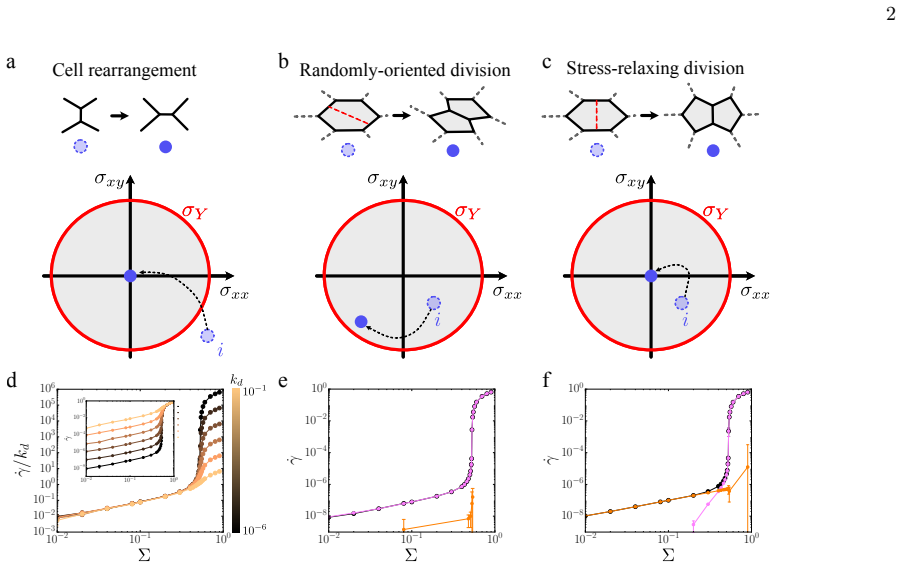
In a two-dimensional elastoplastic model, cell divisions treated as active plastic events allow shear flow below the yield stress while preserving marginal stability in the quasistatic limit, but they suppress system-spanning avalanches of cell rearrangements through the finite energy budget they impose, unlike the avalanche behavior expected in passive amorphous solids.
What carries the argument
Two-dimensional elastoplastic model in which cell divisions are implemented as active plastic events independent of local mechanical stability
If this is right
- Tissues can undergo continuous remodeling and fluidization without large-scale correlated rearrangement events.
- Dynamical correlations in cell rearrangements remain short-ranged despite the tissue retaining structural hallmarks of marginal stability.
- Active driving by divisions decouples fluid-like behavior below yield from the avalanche statistics of passive solids.
Where Pith is reading between the lines
- This energy-budget mechanism may allow tissues to grow rapidly while avoiding mechanically catastrophic correlated failures.
- Analogous suppression could appear in other driven amorphous systems where energy is injected independently of stability thresholds.
- Measuring the spatial extent of rearrangement events in dividing cell monolayers under controlled shear would test the energy-balance origin.
Load-bearing premise
Cell divisions generate stress and remodeling events independently of local mechanical stability.
What would settle it
Observation of system-spanning avalanches of cell rearrangements in proliferating tissues under quasistatic conditions would contradict the predicted suppression.
Figures


read the original abstract
Developing tissues often maintain mechanical coherence while continuously remodeling through cellular processes such as cell divisions and rearrangements. In this way, they are an example of amorphous solids. In passive amorphous solids, local rearrangements can trigger one another through long-ranged elastic interactions, leading to system-spanning avalanches near yielding. Whether similar collective dynamics should be expected in living tissues is unclear, because cell divisions generate stress and remodeling events independently of local mechanical stability. Here, we address this question using a two-dimensional elastoplastic model in which cell divisions are treated as active plastic events. We find that while cell divisions fluidize the tissue below the passive yield stress, but preserve the marginal stability in the quasistatic limit. However, they also strongly suppress the system-spanning avalanches of cell rearrangements, in constrast with the expected behavior in passive amorphous solids. Finally, we show that the avalanche supression originates from the energy balance in the system. Namely, the energy injected by cell divisions allows for shear flow below the yield stress, but also provides a finite budget for rearrangements. These results suggest that proliferating tissues display the structural hallmarks of marginal amorphous solids while exhibiting much shorter-ranged correlations in dynamics, compared to passive amorphous solids.
Editorial analysis
A structured set of objections, weighed in public.
Referee Report
Summary. The manuscript develops a two-dimensional elastoplastic model of solid tissues in which cell divisions are implemented as active plastic events that inject stress independently of the local yield threshold. The central claims are that divisions fluidize the tissue below the passive yield stress while preserving marginal stability in the quasistatic limit, yet strongly suppress system-spanning avalanches of rearrangements (in contrast to passive amorphous solids), with the suppression traced to a finite energy budget that limits cascade propagation.
Significance. If the results hold, the work distinguishes active tissue mechanics from passive amorphous solids by showing how stress injection from divisions enables shear flow below yield while capping avalanche size through energy balance. This offers a mechanistic account for shorter-ranged dynamical correlations in proliferating tissues and preserves the structural signature of marginality, which may inform models of tissue coherence during development.
major comments (2)
- [§4] §4 (energy-balance analysis): the finite-budget argument for avalanche suppression is presented qualitatively; a quantitative relation between injected power, rearrangement energy cost, and maximum avalanche size (e.g., via an explicit inequality or scaling) would strengthen the claim that the budget is load-bearing rather than merely consistent with the observed suppression.
- [Fig. 5] Fig. 5 and associated text: the reported power-law exponent for local event sizes in the active case is stated to match the passive marginal case, but the fitting range and goodness-of-fit metric are not specified; this is central to the claim that marginal stability is preserved.
minor comments (3)
- [Abstract] Abstract: 'in constrast' is a typographical error; 'but preserve the marginal stability' has a subject-verb agreement issue.
- [Model section] Notation: the distinction between the passive yield stress threshold and the active division-induced stress injection is clear in the model description but would benefit from an explicit table or equation summarizing the two independent parameters.
- [Figures] Figure captions: several panels lack error bars or mention of ensemble averaging; this affects readability of the avalanche statistics.
Simulated Author's Rebuttal
We thank the referee for the positive assessment and constructive comments on our manuscript. We address each major point below and will incorporate revisions to strengthen the quantitative aspects of the energy-balance argument and the statistical characterization of the power-law fits.
read point-by-point responses
-
Referee: §4 (energy-balance analysis): the finite-budget argument for avalanche suppression is presented qualitatively; a quantitative relation between injected power, rearrangement energy cost, and maximum avalanche size (e.g., via an explicit inequality or scaling) would strengthen the claim that the budget is load-bearing rather than merely consistent with the observed suppression.
Authors: We agree that making the finite-budget argument more quantitative will strengthen the manuscript. In the revised version we will add a scaling analysis in §4 that relates the power injected by divisions (P_inj), the typical energy cost per local rearrangement (E_rearr), and the maximum avalanche size N_max. Specifically, we will show that the total energy available for a cascade is bounded by the integrated power input over the avalanche duration, yielding the inequality N_max * E_rearr ≲ P_inj * τ, where τ is the characteristic rearrangement timescale. This bound directly limits cascade propagation and explains the absence of system-spanning events while still permitting shear flow below the passive yield stress. revision: yes
-
Referee: Fig. 5 and associated text: the reported power-law exponent for local event sizes in the active case is stated to match the passive marginal case, but the fitting range and goodness-of-fit metric are not specified; this is central to the claim that marginal stability is preserved.
Authors: We thank the referee for noting this omission. In the revised manuscript we will explicitly state the fitting range (e.g., event sizes between 10 and 10^3) used to extract the power-law exponent in Fig. 5 and report the associated goodness-of-fit metric (R² > 0.95). This addition will make the comparison to the passive marginal exponent fully transparent and reinforce the claim that marginal stability is preserved under active driving. revision: yes
Circularity Check
No significant circularity; derivation self-contained in model dynamics
full rationale
The paper defines an elastoplastic model with cell divisions as independent active plastic events (stress injections decoupled from local yield thresholds). Simulations then demonstrate fluidization below passive yield stress, preservation of marginal stability (power-law local events) in the quasistatic limit, and suppression of system-spanning avalanches. The energy-balance explanation—that injected energy enables sub-yield flow but imposes a finite budget limiting cascades—is a direct dynamical consequence of the model rules, not a tautological re-statement of inputs or a fitted parameter renamed as prediction. No self-citations, uniqueness theorems, or ansatzes are invoked as load-bearing justifications for the central claim. The reported contrast with passive amorphous solids follows from the explicit decoupling assumption and is tested across parameter ranges without reduction to self-defined quantities. The chain is therefore self-contained.
Axiom & Free-Parameter Ledger
free parameters (2)
- division rate or frequency
- passive yield stress threshold
axioms (2)
- domain assumption Cell divisions occur independently of local mechanical stability.
- domain assumption The system remains in the quasistatic limit.
Lean theorems connected to this paper
-
IndisputableMonolith/Cost/FunctionalEquation.leanwashburn_uniqueness_aczel unclear?
unclearRelation between the paper passage and the cited Recognition theorem.
the energy injected by cell divisions allows for shear flow below the yield stress, but also provides a finite budget for rearrangements
-
IndisputableMonolith/Foundation/AbsoluteFloorClosure.leanabsolute_floor_iff_bare_distinguishability unclear?
unclearRelation between the paper passage and the cited Recognition theorem.
distribution of local stability P(x) has been shown to characterize the state ... pseudogap P(x)∼x^θ
What do these tags mean?
- matches
- The paper's claim is directly supported by a theorem in the formal canon.
- supports
- The theorem supports part of the paper's argument, but the paper may add assumptions or extra steps.
- extends
- The paper goes beyond the formal theorem; the theorem is a base layer rather than the whole result.
- uses
- The paper appears to rely on the theorem as machinery.
- contradicts
- The paper's claim conflicts with a theorem or certificate in the canon.
- unclear
- Pith found a possible connection, but the passage is too broad, indirect, or ambiguous to say the theorem truly supports the claim.
Reference graph
Works this paper leans on
-
[1]
Forcesin tissue morphogenesis and patterning,
Carl-PhilippHeisenbergandYohannsBellaïche,“Forcesin tissue morphogenesis and patterning,” Cell153, 948–962 (2013)
work page 2013
-
[2]
Mechanical forces and growth in animal tissues,
Loïc LeGoff and Thomas Lecuit, “Mechanical forces and growth in animal tissues,” Cold Spring Harbor Perspec- tives in Biology8, a019232 (2016). 6
work page 2016
-
[3]
Emergence of tissue shape changes from collective cell behaviours,
Frank Jülicher and Suzanne Eaton, “Emergence of tissue shape changes from collective cell behaviours,” Seminars in Cell & Developmental Biology67, 103–112 (2017)
work page 2017
-
[4]
Fluidization of tissues by cell division and apoptosis,
J. Ranft, M. Basan, J. Elgeti, J.-F. Joanny, J. Prost, and F. Jülicher, “Fluidization of tissues by cell division and apoptosis,” Proceedings of the National Academy of Sciences107, 20863–20868 (2010)
work page 2010
-
[5]
Nonlinear rheology in a model biological tissue,
D.A. Matoz-Fernandez, Elisabeth Agoritsas, Jean-Louis Barrat, Eric Bertin, and Kirsten Martens, “Nonlinear rheology in a model biological tissue,” Physical Review Letters118, 158105 (2017)
work page 2017
-
[6]
Guillemette Picard, Armand Ajdari, Francois Lequeux, and Lyderic Bocquet, “Elastic consequences of a single plastic event: a step towards the microscopic modeling of the flow of yield stress fluids,” The European Physical Journal E15, 371–381 (2004)
work page 2004
-
[7]
Deformation and flow of amor- phous solids: Insights from elastoplastic models,
Alexandre Nicolas, Ezequiel E. Ferrero, Kirsten Martens, and Jean-Louis Barrat, “Deformation and flow of amor- phous solids: Insights from elastoplastic models,” Re- views of Modern Physics90(2018), 10.1103/RevMod- Phys.90.045006
-
[8]
On the density of shear transformations in amorphous solids,
Jie Lin, Alaa Saade, Edan Lerner, Alberto Rosso, and Matthieu Wyart, “On the density of shear transformations in amorphous solids,” EPL (Europhysics Letters)105, 26003 (2014)
work page 2014
-
[9]
Marginal stability in structural, spin, and electron glasses,
Markus Müller and Matthieu Wyart, “Marginal stability in structural, spin, and electron glasses,” Annual Review of Condensed Matter Physics6, 177–200 (2015)
work page 2015
-
[10]
Criticality in the approach to failure in amor- phous solids,
Jie Lin, Thomas Gueudré, Alberto Rosso, and Matthieu Wyart, “Criticality in the approach to failure in amor- phous solids,” Physical Review Letters115(2015), 10.1103/PhysRevLett.115.168001
-
[11]
Mean-field description of plastic flow in amorphous solids,
Jie Lin and Matthieu Wyart, “Mean-field description of plastic flow in amorphous solids,” Physical Review X6 (2016), 10.1103/PhysRevX.6.011005
-
[12]
Cell divisions imprint long lasting elastic strain fields in epithelial tissues,
Ali Tahaei, Romina Piscitello-Gómez, S. Suganthan, Greta Cwikla, Jana F. Fuhrmann, Natalie A. Dye, and Marko Popović, “Cell divisions imprint long lasting elastic strain fields in epithelial tissues,” PRX Life3, 043008 (2025)
work page 2025
-
[13]
Extremal model for amorphous media plasticity,
J.-C. Baret, D. Vandembroucq, and S. Roux, “Extremal model for amorphous media plasticity,” Phys. Rev. Lett. 89, 195506 (2002)
work page 2002
-
[14]
Strain localization driven by structural re- laxation in sheared amorphous solids,
E.A. Jagla, “Strain localization driven by structural re- laxation in sheared amorphous solids,” Phys. Rev. E76, 046119 (2007)
work page 2007
-
[15]
Tensorial description of the plasticity of amorphous composites,
E. A. Jagla, “Tensorial description of the plasticity of amorphous composites,” Physical Review E101, 043004 (2020)
work page 2020
-
[16]
Plastic deformation in metallic glasses,
A.S Argon, “Plastic deformation in metallic glasses,” Acta Metallurgica27, 47–58 (1979)
work page 1979
-
[17]
Rate-dependent avalanche size in athermally sheared amorphous solids,
Anaël Lemaitre and Christiane Caroli, “Rate-dependent avalanche size in athermally sheared amorphous solids,” Physical Review Letters103, 065501 (2009)
work page 2009
-
[18]
The influence of cell mechanics, cell-cell interactions, and proliferation on epithelial packing,
Reza Farhadifar, Jens-Christian Röper, Benoit Aigouy, Suzanne Eaton, and Frank Jülicher, “The influence of cell mechanics, cell-cell interactions, and proliferation on epithelial packing,” Current Biology17, 2095–2104 (2007)
work page 2095
-
[19]
Vertex models of epithe- lial morphogenesis,
Alexander G. Fletcher, Miriam Osterfield, Ruth E. Baker, and Stanislav Y. Shvartsman, “Vertex models of epithe- lial morphogenesis,” Biophysical Journal106, 2291–2304 (2014)
work page 2014
-
[20]
The determination of the elastic field of an ellipsoidal inclusion, and related problems,
John Douglas Eshelby, “The determination of the elastic field of an ellipsoidal inclusion, and related problems,” Proceedings of the royal society of London. Series A. Mathematical and physical sciences241, 376–396 (1957)
work page 1957
-
[21]
O. Hertwig,Das Problem der Befruchtung und der Isotropie des Eies: eine Theorie der Vererbung, Jenaische Zeitschrift für Naturwissenschaften (Fischer, 1884)
-
[22]
Epithelial tricellular junctions act as interphase cell shape sensors to orient mitosis,
Floris Bosveld, Olga Markova, Boris Guirao, Charlotte Martin, Zhimin Wang, Anaëlle Pierre, Maria Balakireva, Isabelle Gaugue, Anna Ainslie, Nicolas Christophorou, David K. Lubensky, Nicolas Minc, and Yohanns Bellaïche, “Epithelial tricellular junctions act as interphase cell shape sensors to orient mitosis,” Nature530, 495–498 (2016)
work page 2016
-
[23]
Konsistenzmes- sungen von gummi-benzollösungen,
Winslow H. Herschel and Ronald Bulkley, “Konsistenzmes- sungen von gummi-benzollösungen,” Kolloid-Zeitschrift 39, 291–300 (1926)
work page 1926
-
[24]
Smarajit Karmakar, Edan Lerner, and Itamar Procac- cia, “Statistical physics of the yielding transition in amor- phous solids,” Physical Review E82(2010), 10.1103/Phys- RevE.82.055103
-
[25]
Scaling description of the yielding transition in soft amorphous solids at zero temperature,
Jie Lin, Edan Lerner, Alberto Rosso, and Matthieu Wyart, “Scaling description of the yielding transition in soft amorphous solids at zero temperature,” Proceedings of the National Academy of Sciences111, 14382–14387 (2014)
work page 2014
-
[26]
Mode-coupling theory for the pasty rheology of soft glassy materials,
P. Hébraud and F. Lequeux, “Mode-coupling theory for the pasty rheology of soft glassy materials,” Phys. Rev. Lett.81, 2934–2937 (1998)
work page 1998
-
[27]
On the relevance of disorder in ather- mal amorphous materials under shear,
Elisabeth Agoritsas, Eric Bertin, Kirsten Martens, and Jean-Louis Barrat, “On the relevance of disorder in ather- mal amorphous materials under shear,” The European Physical Journal E38, 71 (2015)
work page 2015
-
[28]
Thermally activated flow in models of amorphous solids,
Marko Popović, Tom W. J. de Geus, and Matthieu Wyart, “Thermally activated flow in models of amorphous solids,” Physical Review E104, 025010 (2021)
work page 2021
-
[29]
Inferring the flow proper- ties of epithelial tissues from their geometry,
Marko Popović, Valentin Druelle, Natalie A Dye, Frank Jülicher, and Matthieu Wyart, “Inferring the flow proper- ties of epithelial tissues from their geometry,” New Journal of Physics23, 033004 (2021)
work page 2021
-
[30]
Characterizing the mechanics of cultured cell monolayers,
A. R. Harris, L. Peter, J. Bellis, B. Baum, A. J. Kabla, and G. T. Charras, “Characterizing the mechanics of cultured cell monolayers,” Proceedings of the National Academy of Sciences109, 16449–16454 (2012)
work page 2012
-
[31]
Glassy dynamics in three-dimensional embryonic tissues,
E.-M. Schotz, M. Lanio, J. A. Talbot, and M. L. Man- ning, “Glassy dynamics in three-dimensional embryonic tissues,” Journal of The Royal Society Interface10, 20130726–20130726 (2013)
work page 2013
-
[32]
Myosin ii controls junction fluctuations to guide epithelial tissue ordering,
Scott Curran, Charlotte Strandkvist, Jasper Bathmann, Marc de Gennes, Alexandre Kabla, Guillaume Salbreux, and Buzz Baum, “Myosin ii controls junction fluctuations to guide epithelial tissue ordering,” Developmental Cell 43, 480–492.e6 (2017), publisher: Elsevier
work page 2017
-
[33]
Motility-driven glass and jamming transitions in biological tissues,
Dapeng Bi, Xingbo Yang, M. Cristina Marchetti, and M. Lisa Manning, “Motility-driven glass and jamming transitions in biological tissues,” Physical Review X6 (2016), 10.1103/PhysRevX.6.021011
-
[34]
Non-monotonic fluidization gen- erated by fluctuating edge tensions in confluent tissues,
Takaki Yamamoto, Daniel M. Sussman, Tatsuo Shibata, and M. Lisa Manning, “Non-monotonic fluidization gen- erated by fluctuating edge tensions in confluent tissues,” Soft Matter18, 2168–2175 (2022)
work page 2022
-
[35]
We only consider the pure shear components of strain and stress, so in the following we omit the ’pure shear’ when denoting strain and stress to keep the notation short. 7 Appendix A: Implementation of cell divisions in the elasto-plastic model Here, we present a more detailed discussion on the implementation of cell divisions in the simulations. We first...
-
[36]
Randomly oriented divisions For randomly oriented divisions, the stationary zero- stress equation inside the stable interval|σ|< 1reduces to diffusion with reinjection atσ = 0. The symmetric stationary solution is P(σ) = 1 2Dm σ+ 1 2Dm ,−1≤σ≤0, − 1 2Dm σ+ 1 2Dm ,0≤σ≤1, (C4) which is the standard mean-field pseudogap Hébraud- Lequeux model. Definin...
-
[37]
Stress-relaxing divisions For stress-relaxing divisions, the stationary equation gains an additional resetting term. At zero imposed stress, the distribution in the stable interval obeys Dm ∂2 σP(σ) + (γ+ 1)δ(σ)−P(σ) = 0,|σ|<1, (C6) with boundary conditionsP (±1) = 0. Away fromσ = 0 thesolutionisexponential, andmatchingthetwobranches at the origin gives P...
-
[38]
Suppression of available plasticity The meaning of this result becomes transparent by estimating the typical lowestx in a system ofN blocks from 1 N ∼ Z xmin 0 P(x)dx.(C10) For a linear pseudogap this givesxmin ∼ (AN)−1/2. Using the prefactors determined above, we obtain xROD min ∼ r 2Dm N , x SRD min ∼ s √ Dsinh(1/ √Dm) (γ+ 1)N . (C11) In the low-noise l...
discussion (0)
Sign in with ORCID, Apple, or X to comment. Anyone can read and Pith papers without signing in.