Recognition: 2 theorem links
· Lean TheoremMPEX AI Digital Twins Milestone Report
Pith reviewed 2026-05-13 03:28 UTC · model grok-4.3
The pith
MPEX project reports two AI digital twin prototypes on track for June 2026 demonstration.
A machine-rendered reading of the paper's core claim, the machinery that carries it, and where it could break.
Core claim
The authors state that the Helicon AI Hot-Spot Controller and the E-beam Damage Assessment Digital Twin prototypes are progressing on schedule, supported by the Galaxy interface that connects simulations to DOE HPC resources and the experiment data system, thereby positioning the project to demonstrate AI advantages for MPEX operations and discovery by June 2026.
What carries the argument
The two phase I prototypes—the Helicon AI Hot-Spot Controller and E-beam Damage Assessment Digital Twin—together with the Galaxy software interface that automates simulation execution, validation, and data analysis.
If this is right
- The Galaxy interface will allow scientists or AI agents to run and validate MPEX simulations on DOE HPC resources.
- Once connected to the American Science Cloud, Galaxy will serve as the MPEX data and simulation gateway.
- Successful hot-spot control will enable predictive adjustment of helicon heating during plasma experiments.
- The damage-assessment twin will provide early estimates of electron-beam effects on target materials.
- These prototypes form the foundation for the full MPEX AI Hot Spot and Damage Assessment Digital Twins.
Where Pith is reading between the lines
- If the milestones succeed, similar AI twin methods could be tested on other plasma devices to reduce trial-and-error operation.
- The current report leaves open whether the AI components deliver faster or more accurate results than existing control methods.
- Integration with cloud resources may allow real-time AI agents to adjust experiment parameters during shots.
- The approach could later extend to additional MPEX diagnostics such as probe arrays or spectroscopy.
Load-bearing premise
That the unreported technical details in the milestone sections actually establish operational readiness and measurable AI advantage without any validation data, performance metrics, or error analysis provided.
What would settle it
Absence of a completed demonstration by June 2026 or release of quantitative metrics showing the AI components outperform non-AI controls on the same MPEX tasks.
Figures








read the original abstract
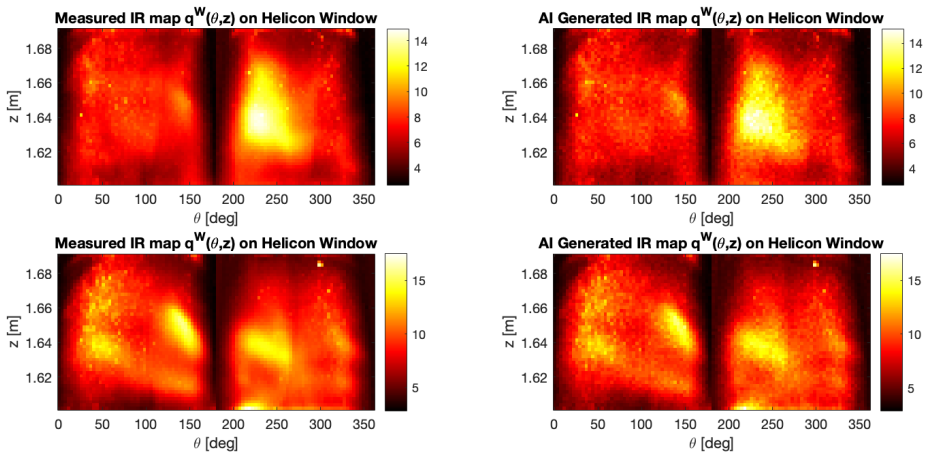
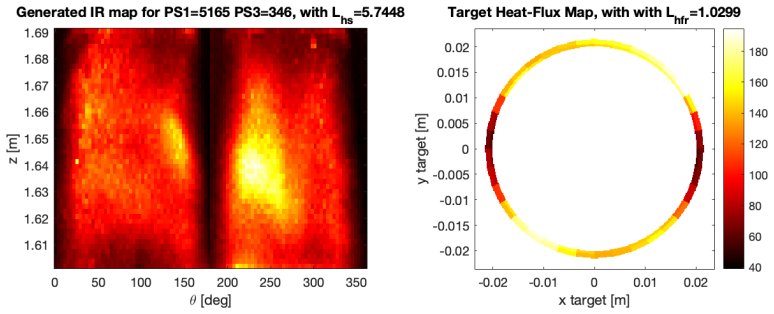
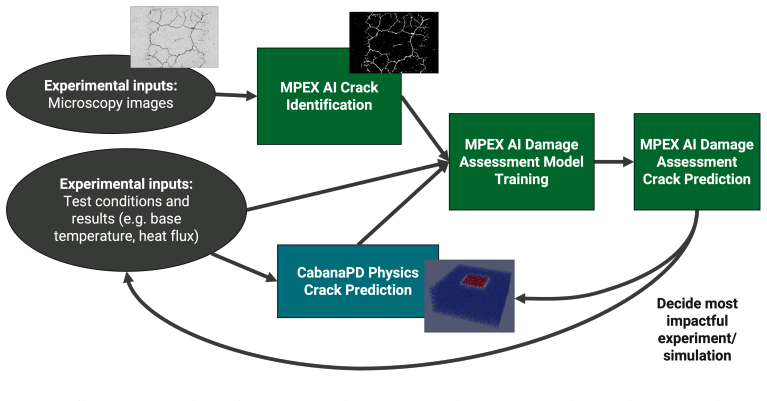
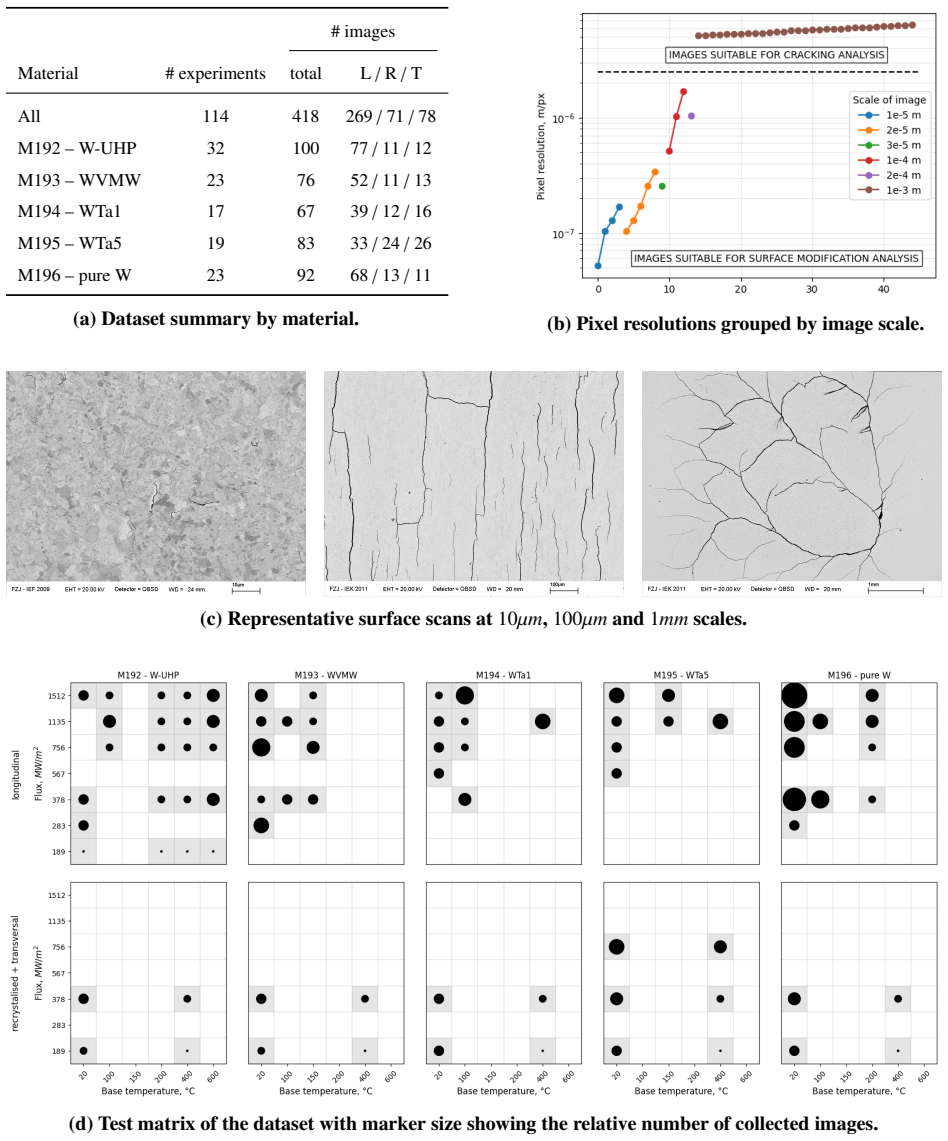
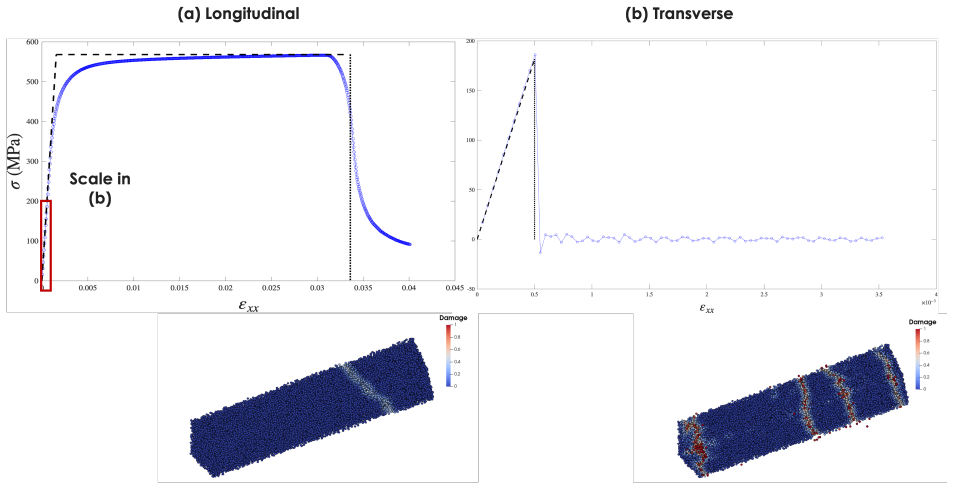
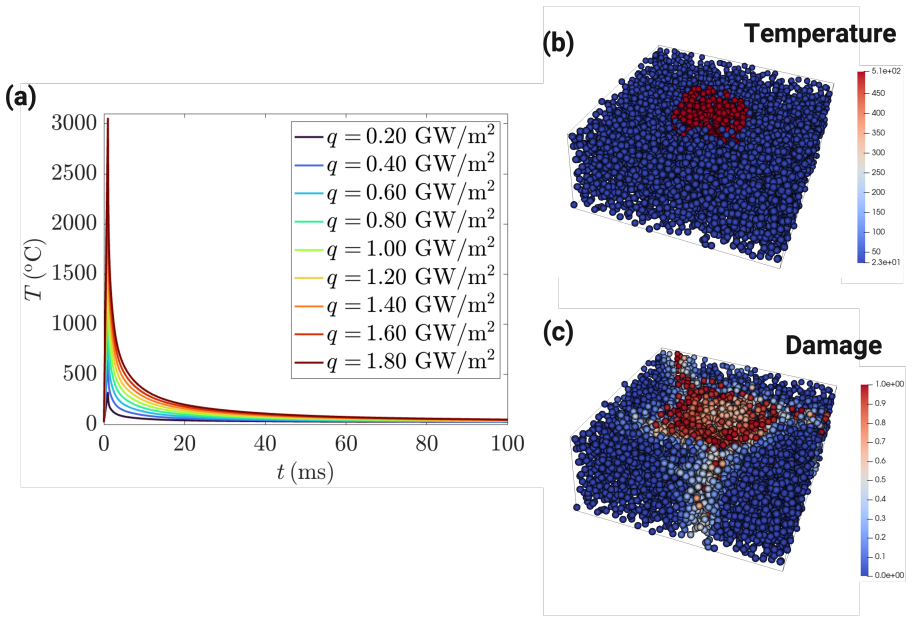
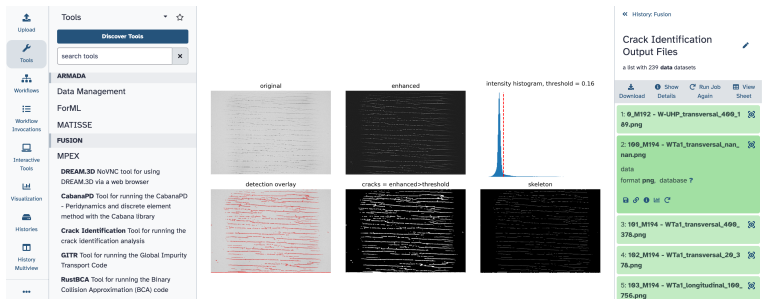
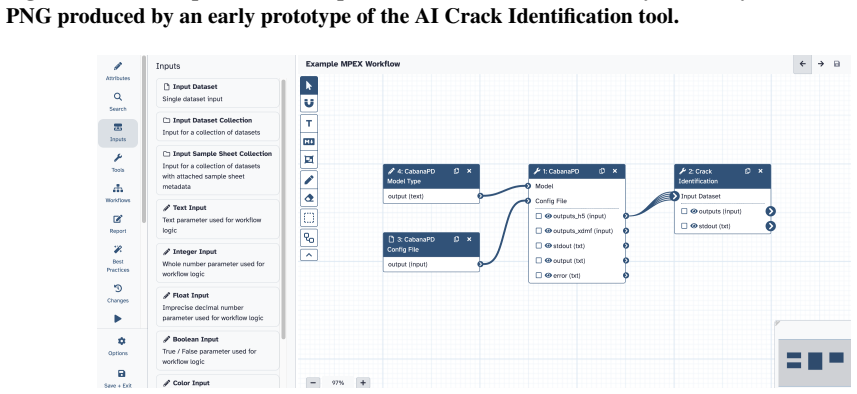
This is the six month progress report to Fusion Energy Science (FES) and the American Science Cloud (AmSC) on the MPEX AI Digtial Twins project that was started in October 2025. There are two milestones to demonstrate the Artificial Intelligence (AI) advantage for MPEX operations and scientific discovery, that will be completed by June 2026. The first is a Helicon AI Hot-Spot Controller (Sec. 3.1), which is the helicon heating component of the more comprehensive planned MPEX AI Hot Spot Digital Twin (Sec. 3). The second is an E-beam Damage Assessment Digital Twin (Sec. 4.1), which is a reduced electron beam damage modality prototype for the MPEX AI Damage Assessment Digital Twin (Sec. 4). These two phase I milestones are on track for the June demonstration. In addition to these two milestones, progress on configuring the Galaxy software interface for automation, validation and data analysis is reported (Sec. 5). This interface now connects a subset of the main physics simulation codes to DOE HPC resources and will connect to the MPEX data acquisition system so that analysis of data, validation and execution of simulations can be performed by the scientist or by AI-Agents. When AmSC is ready to accept connections and data, Galaxy will be the MPEX interface to AmSC
Editorial analysis
A structured set of objections, weighed in public.
Referee Report
Summary. This manuscript is a six-month progress report on the MPEX AI Digital Twins project started in October 2025. It asserts that two Phase I milestones—the Helicon AI Hot-Spot Controller (Sec. 3.1) and the E-beam Damage Assessment Digital Twin (Sec. 4.1)—are on track for demonstration by June 2026, and reports progress on configuring the Galaxy software interface (Sec. 5) to connect physics simulation codes to DOE HPC resources and the MPEX data acquisition system for automated analysis and AI-agent execution.
Significance. If the milestones are successfully demonstrated with the claimed AI advantage, the work would mark incremental progress toward AI-enabled digital twins for controlling helicon heating and assessing electron-beam damage in plasma-material interaction experiments. The Galaxy interface development could enable reproducible workflows linking simulations and data, supporting both operations and discovery in fusion research.
major comments (1)
- [Sec. 3.1, Sec. 4.1] Sec. 3.1 and Sec. 4.1: The central claim that the two milestones are 'on track' for the June demonstration is not supported by any performance metrics, validation results against MPEX data, error analyses, or quantitative comparisons to non-AI baselines. The sections contain only declarative statements of progress and high-level plans, leaving the assertion unevaluable from the reported evidence.
minor comments (2)
- [Abstract] Abstract: 'Digtial' is a typographical error and should read 'Digital'.
- The manuscript lacks any tables, figures, or numerical results that would normally accompany milestone claims in a technical report; adding at least preliminary benchmarks would improve clarity.
Simulated Author's Rebuttal
We thank the referee for their thoughtful review of our six-month progress report on the MPEX AI Digital Twins project. We provide a point-by-point response to the major comment below.
read point-by-point responses
-
Referee: [Sec. 3.1, Sec. 4.1] Sec. 3.1 and Sec. 4.1: The central claim that the two milestones are 'on track' for the June demonstration is not supported by any performance metrics, validation results against MPEX data, error analyses, or quantitative comparisons to non-AI baselines. The sections contain only declarative statements of progress and high-level plans, leaving the assertion unevaluable from the reported evidence.
Authors: We agree that the current version of the manuscript does not include specific performance metrics or validation data, as these are part of the ongoing development toward the June 2026 demonstration. The report focuses on the progress achieved in the first six months, including the configuration of the Galaxy interface and initial setups for the AI controllers. The 'on track' assessment is based on the successful completion of these preparatory steps and alignment with the project timeline. To strengthen the manuscript, we will make a partial revision by adding explicit statements in Sections 3.1 and 4.1 clarifying that this is an interim qualitative evaluation and outlining the next steps for quantitative validation. We believe this addresses the evaluability concern while accurately reflecting the project's status. revision: partial
Circularity Check
No circularity: factual status report with no derivations or predictions
full rationale
This is a six-month progress report asserting that two AI milestones are on track for June demonstration. The text contains no equations, no first-principles derivations, no fitted parameters, no predictions of physical quantities, and no load-bearing self-citations. The central statements are declarative progress summaries (e.g., “These two phase I milestones are on track”) rather than results obtained by reducing one quantity to another via the paper’s own logic. Consequently no step satisfies any of the enumerated circularity patterns, and the circularity score is zero.
Axiom & Free-Parameter Ledger
Lean theorems connected to this paper
-
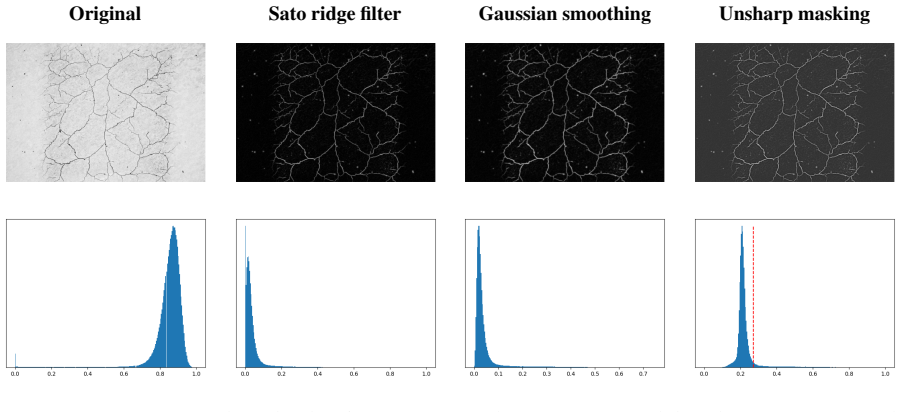
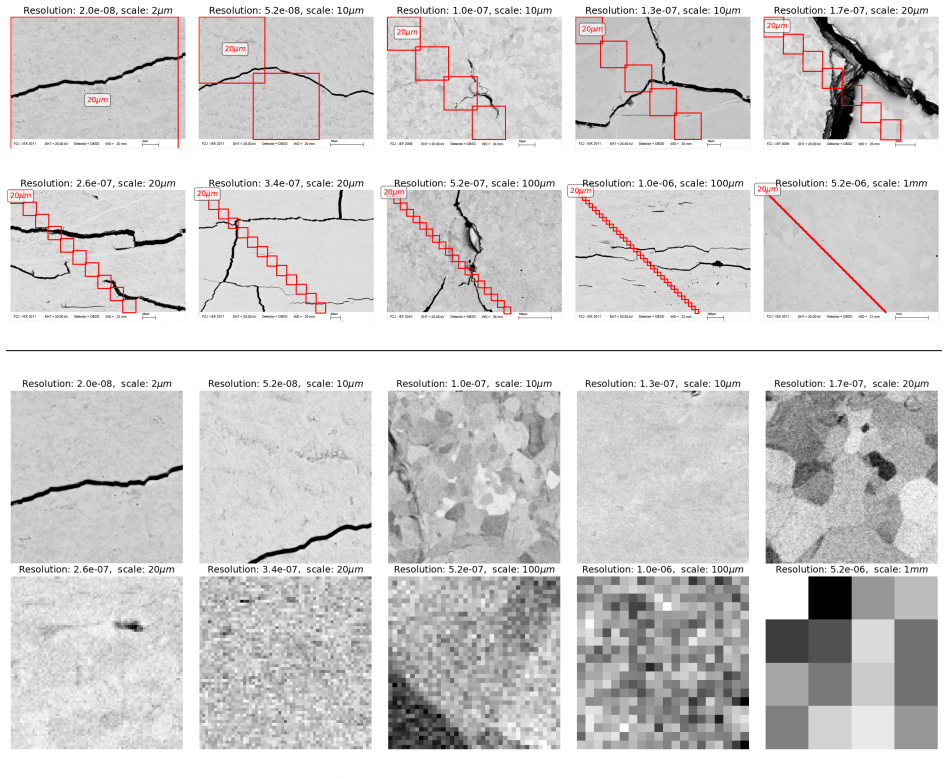
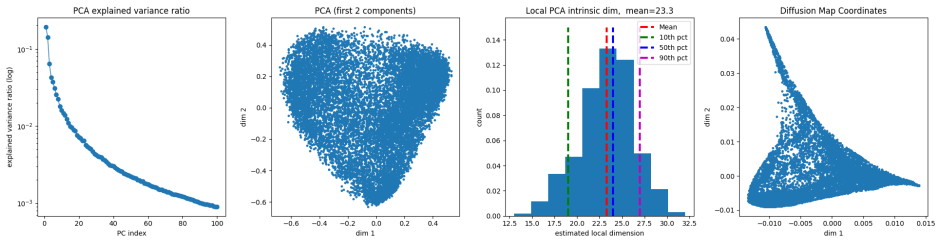
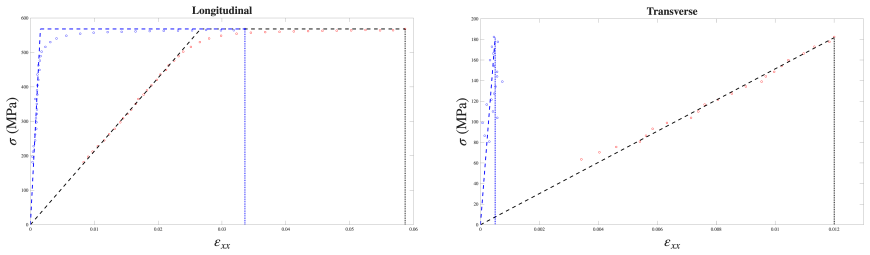
IndisputableMonolith/Cost/FunctionalEquation.leanwashburn_uniqueness_aczel unclearWe use Variational Autoencoders (VAEs) trained on infrared (IR) measurements... kernel ridge regression... DINOv2 vision transformer... diffusion coordinates... CabanaPD peridynamics... flux-tube heat-flux mapping framework
-
IndisputableMonolith/Foundation/RealityFromDistinction.leanreality_from_one_distinction unclearThese two phase I milestones are on track for the June demonstration.
Reference graph
Works this paper leans on
-
[1]
Laplacian eigenmaps for dimensionality reduction and data representation
Mikhail Belkin and Partha Niyogi. “Laplacian eigenmaps for dimensionality reduction and data representation”. In:Neural Computation15.6 (2003), pp. 1373–1396
work page 2003
-
[2]
DINOv2 rocks geological image analysis: Classification, segmentation, and interpretability
Florent Brondolo and Samuel Beaussant. “DINOv2 rocks geological image analysis: Classification, segmentation, and interpretability”. In:Journal of Rock Mechanics and Geotechnical Engineering 17.11 (2025), pp. 6853–6867.doi:10.1016/j.jrmge.2025.01.057
-
[3]
Emerging Properties in Self-Supervised Vision Transformers
Mathilde Caron et al. “Emerging Properties in Self-Supervised Vision Transformers”. In:Proceedings of the IEEE/CVF International Conference on Computer Vision (ICCV). 2021, pp. 9650–9660
work page 2021
-
[4]
Ronald R. Coifman and Stéphane Lafon. “Diffusion maps”. In:Applied and Computational Harmonic Analysis21.1 (2006), pp. 5–30.doi:10.1016/j.acha.2006.04.006
-
[5]
Ronald R. Coifman et al. “Geometric diffusions as a tool for harmonic analysis and structure definition of data: Diffusion maps”. In:Proceedings of the National Academy of Sciences102.21 (2005), pp. 7426– 7431.doi:10.1073/pnas.0500334102
-
[6]
Thermal shock response via weakly coupled peridynamic thermo-mechanics
Pietro D’Antuono and Marco Morandini. “Thermal shock response via weakly coupled peridynamic thermo-mechanics”. In:International Journal of Solids and Structures129 (2017), pp. 74–89.issn: 0020-7683.doi:https://doi.org/10.1016/j.ijsolstr.2017.09.010
-
[7]
AnomalyDINO: Boosting Patch-Based Few-Shot Anomaly Detection with DINOv2
Simon Damm et al. “AnomalyDINO: Boosting Patch-Based Few-Shot Anomaly Detection with DINOv2”. In:Proceedings of the IEEE/CVF Winter Conference on Applications of Computer Vision (WACV). 2025, pp. 1319–1329
work page 2025
-
[8]
Simulation of thermal shock cracking in ceramics using bond-based peridynamics and FEM
Ilias N. Giannakeas, Theodosios K. Papathanasiou, and Hamid Bahai. “Simulation of thermal shock cracking in ceramics using bond-based peridynamics and FEM”. In:Journal of the European Ceramic Society38.8 (2018), pp. 3037–3048.issn: 0955-2219.doi: https : / / doi . org / 10 . 1016 / j . jeurceramsoc.2017.12.039
work page 2018
-
[9]
Jolliffe.Principal Component Analysis
Ian T. Jolliffe.Principal Component Analysis. Springer, 2002
work page 2002
-
[10]
Performance of different tungsten grades under transient thermal loads
J. Linke et al. “Performance of different tungsten grades under transient thermal loads”. en. In:Nuclear Fusion51.7 (June 2011), p. 073017.issn: 0029-5515.doi: https://doi.org/10.1088/0029- 5515/51/7/073017. (Visited on 01/09/2026)
-
[11]
A user’s guide to the encyclopedia of dna elements (encode).PLoS Biology, 9(4):e1001046, 2011
Théo Moutakanni et al. “Cell-DINO: Self-supervised image-based embeddings for cell fluorescent microscopy”. In:PLOS Computational Biology21.12 (2025), e1013828.doi: 10.1371/journal. pcbi.1013828
-
[12]
Continuous Radon Monitoring during Seven Years of V olcanic Unrest at Campi Flegrei Caldera (Italy)
Gustav Müller-Franzes et al. “Medical slice transformer for improved diagnosis and explainability on 3D medical images with DINOv2”. In:Scientific Reports15 (2025), p. 23979.doi: 10.1038/s41598- 025-09041-8
-
[13]
Murphy.Machine Learning: A Probabilistic Perspective
Kevin P. Murphy.Machine Learning: A Probabilistic Perspective. MIT Press, 2012
work page 2012
-
[14]
E. A. Nadaraya. “On Estimating Regression”. In:Theory of Probability&Its Applications9.1 (1964), pp. 141–142
work page 1964
-
[15]
DINOv2: Learning Robust Visual Features without Supervision
Maxime Oquab et al. “DINOv2: Learning Robust Visual Features without Supervision”. In:Transac- tions on Machine Learning Research(2024). Also available as arXiv:2304.07193
work page internal anchor Pith review Pith/arXiv arXiv 2024
-
[16]
A Threshold Selection Method from Gray-Level Histograms
Nobuyuki Otsu. “A Threshold Selection Method from Gray-Level Histograms”. In:IEEE Transactions on Systems, Man, and Cybernetics9.1 (1979), pp. 62–66.doi:10.1109/TSMC.1979.4310076
-
[17]
Sam Reeve et al.CabanaPD. Version 0.4.0. Aug. 2025.url: https://doi.org/10.5281/zenodo. 16997636
-
[18]
Nonlinear dimensionality reduction by locally linear embed- ding
Sam T. Roweis and Lawrence K. Saul. “Nonlinear dimensionality reduction by locally linear embed- ding”. In:Science290.5500 (2000), pp. 2323–2326. 36
work page 2000
-
[19]
Yoshinobu Sato et al. “Three-dimensional multi-scale line filter for segmentation and visualization of curvilinear structures in medical images”. In:Medical Image Analysis2.2 (1998), pp. 143–168.issn: 1361-8415.doi:https://doi.org/10.1016/S1361-8415(98)80009-1
-
[20]
Ridge Regression Learning Algorithm in Dual Variables
Craig Saunders, Alexander Gammerman, and Vladimir V ovk. “Ridge Regression Learning Algorithm in Dual Variables”. In:Proceedings of the 15th International Conference on Machine Learning (ICML) (1998), pp. 515–521
work page 1998
-
[21]
Smola.Learning with Kernels: Support Vector Machines, Regularization, Optimization, and Beyond
Bernhard Schölkopf and Alexander J. Smola.Learning with Kernels: Support Vector Machines, Regularization, Optimization, and Beyond. MIT Press, 2002
work page 2002
-
[22]
Survey over image thresholding techniques and quantitative performance evaluation
Mehmet Sezgin and Bülent Sankur. “Survey over image thresholding techniques and quantitative performance evaluation”. In:Journal of Electronic Imaging13.1 (2004), pp. 146–165.doi: https: //doi.org/10.1117/1.1631315
-
[23]
Peridynamic States and Constitutive Modeling
S. A. Silling et al. “Peridynamic States and Constitutive Modeling”. In:Journal of Elasticity88.2 (Aug. 2007), pp. 151–184.issn: 1573-2681.doi:10.1007/s10659-007-9125-1
-
[24]
Reformulation of elasticity theory for discontinuities and long-range forces
S.A. Silling. “Reformulation of elasticity theory for discontinuities and long-range forces”. In:Journal of the Mechanics and Physics of Solids48.1 (2000), pp. 175–209.issn: 0022-5096.doi: https : //doi.org/10.1016/S0022-5096(99)00029-0
-
[25]
A meshfree method based on the peridynamic model of solid mechanics
S.A. Silling and E. Askari. “A meshfree method based on the peridynamic model of solid mechanics”. In:Computers&Structures83.17 (2005), pp. 1526–1535.issn: 0045-7949.doi: https://doi.org/ 10.1016/j.compstruc.2004.11.026
-
[26]
UMAP: Uniform Manifold Approximation and Projection
Stuart Slattery et al. “Cabana: A Performance Portable Library for Particle-Based Simulations”. In: Journal of Open Source Software7.72 (2022), p. 4115.doi: https://doi.org/10.21105/joss. 04115
-
[27]
Stephens et al.A Brief Introduction to Generative Models
Christopher R. Stephens et al.A Brief Introduction to Generative Models. 2021. arXiv: 2103.00265 [stat.ML].url:https://arxiv.org/abs/2103.00265
-
[28]
Science290(5500), 2319–2323 (2000) https://doi.org/10.1126/ science.290.5500.2319
Joshua B. Tenenbaum, Vin de Silva, and John C. Langford. “A global geometric framework for nonlinear dimensionality reduction”. In:Science290.5500 (2000), pp. 2319–2323.doi: 10.1126/ science.290.5500.2319
-
[29]
Jeremy Trageser and Pablo Seleson. “Anisotropic two-dimensional, plane strain, and plane stress models in classical linear elasticity and bond-based peridynamics”. In:arXiv preprint arXiv:1905.12761 (2019)
-
[30]
Kokkos 3: Programming Model Extensions for the Exascale Era
Christian R. Trott et al. “Kokkos 3: Programming Model Extensions for the Exascale Era”. In: IEEE Transactions on Parallel and Distributed Systems33.4 (2022), pp. 805–817.doi: https : //doi.org/10.1109/TPDS.2021.3097283
-
[31]
Yunteng Wang et al. “A 3-D conjugated bond-pair-based peridynamic formulation for initiation and propagation of cracks in brittle solids”. In:International Journal of Solids and Structures134 (Mar. 2018), pp. 89–115.issn: 0020-7683.doi: https://doi.org/10.1016/j.ijsolstr.2017.10.022. (Visited on 03/25/2026)
-
[32]
G. S. Watson. “Smooth Regression Analysis”. In:Sankhy ¯a: The Indian Journal of Statistics, Series A 26.4 (1964), pp. 359–372
work page 1964
-
[33]
Sheila E. Whitman, Guangyu Hu, and Marat I. Latypov. “Learning Microstructure–Property Relation- ships in Materials with Robust Features from Vision Transformers”. In:Proceedings of the IEEE/CVF Conference on Computer Vision and Pattern Recognition Workshops (CVPRW). 2024, pp. 8125–8130
work page 2024
-
[34]
Sheila E. Whitman and Marat I. Latypov. “Machine learning of microstructure–property relationships in materials leveraging microstructure representation from foundational vision transformers”. In:Acta Materialia296 (2025), p. 121217.doi:10.1016/j.actamat.2025.121217
-
[35]
Thermal shock tests to qualify different tungsten grades as plasma facing material
M Wirtz et al. “Thermal shock tests to qualify different tungsten grades as plasma facing material”. en. In:Physica ScriptaT167 (Feb. 2016), p. 014015.issn: 0031-8949, 1402-4896.doi: https : //doi.org/10.1088/0031-8949/T167/1/014015. (Visited on 01/12/2026). 37
-
[36]
Oliver Marius Wirtz.Thermal shock behaviour of different tungsten grades under varying conditions. V ol. 161. Forschungszentrum Jülich, 2013
work page 2013
-
[37]
Automatic measurement of sister chromatid exchange frequency
G W Zack, W E Rogers, and S A Latt. “Automatic measurement of sister chromatid exchange frequency.” In:Journal of Histochemistry&Cytochemistry25.7 (1977), pp. 741–753.doi: https: //doi.org/10.1177/25.7.70454. eprint:https://doi.org/10.1177/25.7.70454. 38
discussion (0)
Sign in with ORCID, Apple, or X to comment. Anyone can read and Pith papers without signing in.