Recognition: 2 theorem links
· Lean TheoremSynthetic Control Method with Mixed Frequency Data
Pith reviewed 2026-05-13 03:30 UTC · model grok-4.3
The pith
A mixed-frequency synthetic control estimator achieves asymptotic optimality by minimizing squared prediction error among averaging-based treatment effect estimators.
A machine-rendered reading of the paper's core claim, the machinery that carries it, and where it could break.
Core claim
The MF-SCM estimator achieves asymptotic optimality in the sense that it attains the lowest possible squared prediction error among all potential treatment effect estimators obtained by averaging outcomes of control units; its average treatment effect estimator admits an asymptotic distribution derived via projection theory.
What carries the argument
A flexible estimation procedure for constructing synthetic control weights that accommodates observations at heterogeneous temporal resolutions.
If this is right
- Researchers can incorporate high-frequency variables without discarding information through aggregation or filtering.
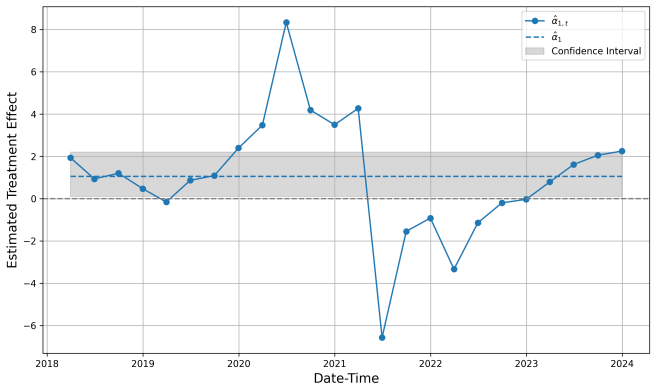
- The method supplies valid confidence intervals for the average treatment effect.
- Applications include policy evaluations in economics and finance where data frequencies naturally differ.
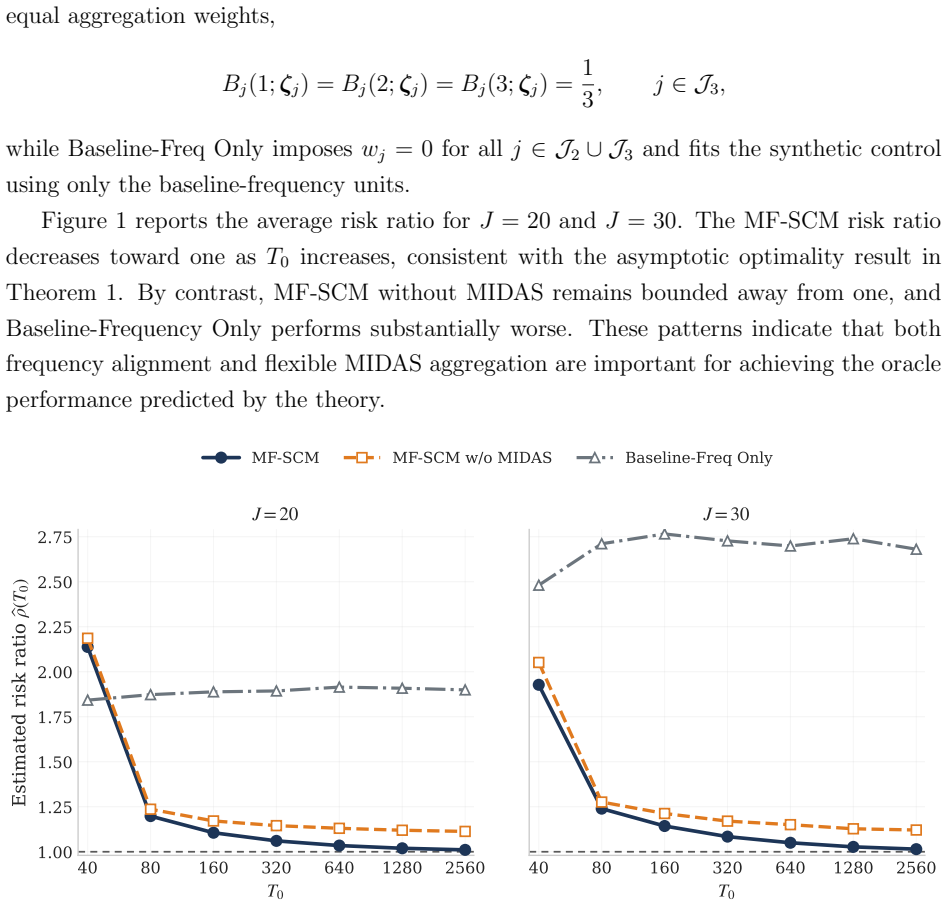
- Simulation studies confirm finite-sample performance matches the asymptotic theory.
Where Pith is reading between the lines
- Similar projection-theory arguments might apply to other panel estimators that combine data at different scales.
- Extensions could handle irregular observation patterns beyond fixed mixed frequencies.
- Testing on datasets with missing high-frequency periods would reveal robustness limits.
Load-bearing premise
The mixed-frequency data-generating process must satisfy regularity conditions that validate both the optimality proof and the projection-theory derivation for the ATE distribution.
What would settle it
An empirical or simulated dataset in which some alternative averaging estimator produces strictly lower out-of-sample squared prediction error than the MF-SCM weights, or where the constructed confidence intervals exhibit coverage rates materially below the nominal level.
Figures
read the original abstract
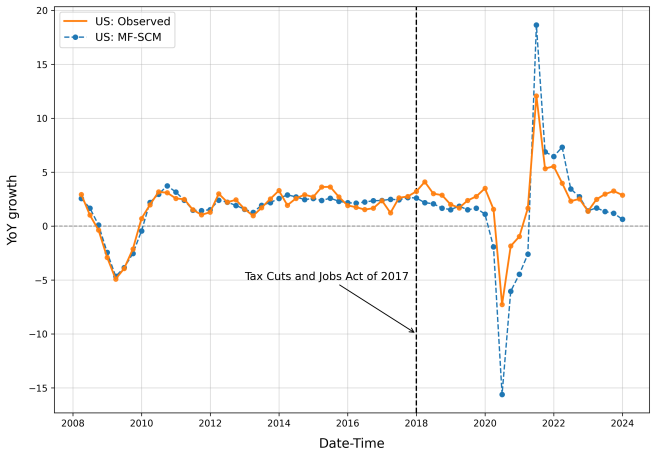
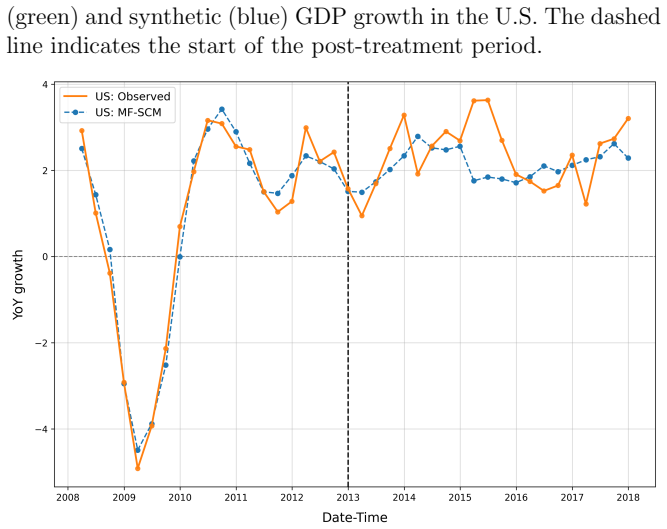
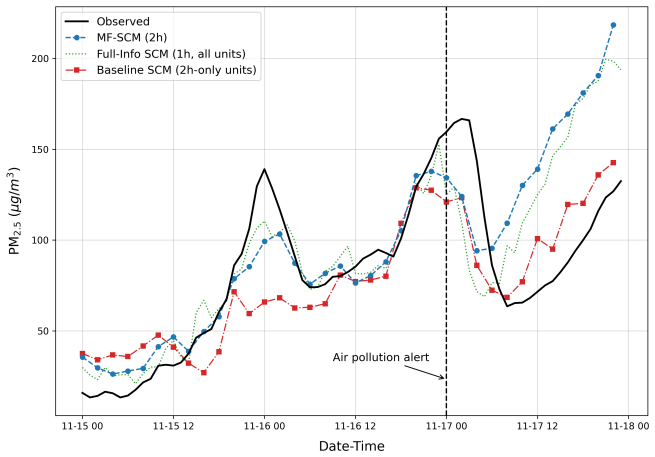
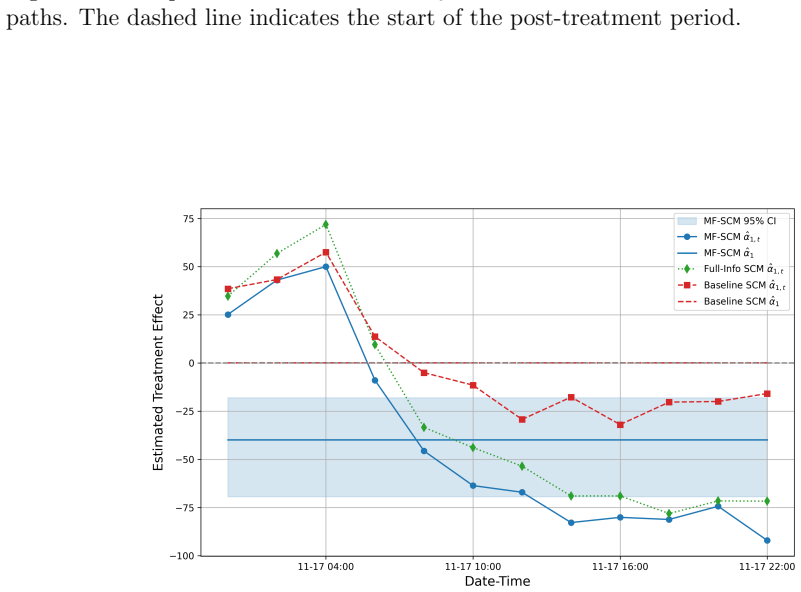
Mixed-frequency data, where variables are observed at different temporal resolutions, commonly occur in economic and financial studies. Classical synthetic control methods (SCM) are ill-suited for such data, often necessitating aggregation or prefiltering that may discard valuable information. This paper proposes a novel Mixed-Frequency Synthetic Control Method (MF-SCM) to integrate mixed-frequency data into the synthetic control framework effectively. We develop a flexible estimation procedure to construct synthetic control weights under mixed-frequency settings and establish the theoretical properties of the MF-SCM estimator. Specifically, we first prove that the estimator achieves asymptotic optimality, in the sense that it achieves the lowest possible squared prediction error among all potential treatment effect estimators from averaging outcomes of control units. We then derive the asymptotic distribution of the average treatment effect (ATE) estimator using projection theory and construct confidence intervals for the ATE estimator. The method's effectiveness is demonstrated through numerical simulations and two empirical applications concerning the 2017 Tax Cuts and jobs Act in US and air pollution alerts.
Editorial analysis
A structured set of objections, weighed in public.
Referee Report
Summary. The paper proposes the Mixed-Frequency Synthetic Control Method (MF-SCM) to extend classical SCM to settings where outcomes and covariates are observed at different temporal frequencies. It introduces a flexible estimation procedure for the synthetic control weights, proves that the resulting estimator achieves asymptotic optimality (lowest possible squared prediction error among all linear averaging estimators over control units), derives the asymptotic distribution of the average treatment effect (ATE) estimator via projection theory, constructs associated confidence intervals, and illustrates the approach with Monte Carlo simulations plus two empirical applications (the 2017 U.S. Tax Cuts and Jobs Act and air-pollution alerts).
Significance. If the optimality and distributional results hold under the stated conditions, the contribution would be a practically useful extension of SCM that avoids information loss from aggregation or pre-filtering. The explicit optimality guarantee and projection-based inference are strengths that could be adopted by empirical researchers working with mixed-frequency economic and financial data.
major comments (2)
- The abstract states that asymptotic optimality and the ATE limiting distribution are proved, yet the regularity conditions required on the mixed-frequency data-generating process (e.g., moment bounds, mixing rates, or eigenvalue restrictions on the high- and low-frequency components) are not listed. These conditions are load-bearing for both the optimality claim and the validity of the projection argument; without them the results cannot be verified or applied.
- The projection-theory derivation of the ATE asymptotic distribution is described only at a high level. It is unclear whether the argument accounts for the estimation error in the mixed-frequency weights or for possible dependence between the treatment and control series at different frequencies; an explicit statement of the relevant projection space and the resulting influence function is needed to confirm that the confidence intervals are correctly centered and scaled.
Simulated Author's Rebuttal
We are grateful to the referee for the positive assessment of our work and the helpful suggestions for improvement. We address the two major comments below and have made revisions to enhance the presentation of the theoretical results.
read point-by-point responses
-
Referee: The abstract states that asymptotic optimality and the ATE limiting distribution are proved, yet the regularity conditions required on the mixed-frequency data-generating process (e.g., moment bounds, mixing rates, or eigenvalue restrictions on the high- and low-frequency components) are not listed. These conditions are load-bearing for both the optimality claim and the validity of the projection argument; without them the results cannot be verified or applied.
Authors: We agree that the regularity conditions should be more prominently featured. They are detailed in Assumptions 1-4 of Section 3, encompassing moment conditions, mixing rates for the mixed-frequency series, and eigenvalue restrictions on the covariance operators. These underpin Theorems 1 and 2. In the revision, we will include a summary of these conditions in the abstract and expand the discussion in the introduction to facilitate verification and application. revision: partial
-
Referee: The projection-theory derivation of the ATE asymptotic distribution is described only at a high level. It is unclear whether the argument accounts for the estimation error in the mixed-frequency weights or for possible dependence between the treatment and control series at different frequencies; an explicit statement of the relevant projection space and the resulting influence function is needed to confirm that the confidence intervals are correctly centered and scaled.
Authors: The derivation in Section 4 does account for weight estimation error and cross-frequency dependence through the joint asymptotic expansion. The projection is onto the space generated by the control units' mixed-frequency observations, yielding an influence function that adjusts for these factors. To clarify, we will provide an explicit statement of the projection space and influence function in a new appendix section, ensuring the confidence intervals' validity is transparent. revision: yes
Circularity Check
No significant circularity in derivation chain
full rationale
The paper proves asymptotic optimality of the MF-SCM estimator (lowest squared prediction error among averaging estimators over control units) and derives the ATE asymptotic distribution via projection theory. No load-bearing step reduces by the paper's own equations to a self-defined fit or tautology; the optimality is presented as a proved property of the constructed weights rather than a renaming or re-use of the fitting criterion itself. No self-citation chains or ansatz smuggling are indicated in the abstract or description. The mixed-frequency extension preserves standard SCM convexity properties without circular reduction, consistent with a low circularity score.
Axiom & Free-Parameter Ledger
Lean theorems connected to this paper
-
IndisputableMonolith/Cost/FunctionalEquation.leanwashburn_uniqueness_aczel unclearwe first prove that the estimator achieves asymptotic optimality, in the sense that it achieves the lowest possible squared prediction error among all potential treatment effect estimators from averaging outcomes of control units
-
IndisputableMonolith/Foundation/AlexanderDuality.leanalexander_duality_circle_linking unclearbw = arg min w∈H (bwOLS − w)′(eZ′eZ/T0)(bwOLS − w) = ΠH,T0 bwOLS
Reference graph
Works this paper leans on
-
[1]
Distributional synthetic controls , author=. Econometrica , volume=. 2023 , publisher=
work page 2023
-
[2]
American Economic Review , volume=
The economic costs of conflict: A case study of the Basque Country , author=. American Economic Review , volume=. 2003 , publisher=
work page 2003
-
[3]
Journal of the American Statistical Association , volume=
Synthetic control methods for comparative case studies: Estimating the effect of California's tobacco control program , author=. Journal of the American Statistical Association , volume=. 2010 , publisher=
work page 2010
-
[4]
Journal of Economic Literature , volume=
Using synthetic controls: Feasibility, data requirements, and methodological aspects , author=. Journal of Economic Literature , volume=. 2021 , publisher=
work page 2021
-
[5]
American Economic Journal: Applied Economics , volume=
Minimum wages and the distribution of family incomes , author=. American Economic Journal: Applied Economics , volume=. 2019 , publisher=
work page 2019
-
[6]
Topics in optimal transportation (Graduate studies in mathematics vol 58) , author=. 2003 , publisher=
work page 2003
-
[7]
SIAM Journal on Mathematical Analysis , volume=
Barycenters in the Wasserstein space , author=. SIAM Journal on Mathematical Analysis , volume=. 2011 , publisher=
work page 2011
-
[8]
Fr. Les. Annales de l'institut Henri Poincar
-
[9]
Handbook of Econometrics , volume=
Large sample estimation and hypothesis testing , author=. Handbook of Econometrics , volume=. 1994 , publisher=
work page 1994
-
[10]
American Economic Review , volume=
Synthetic difference-in-differences , author=. American Economic Review , volume=. 2021 , publisher=
work page 2021
-
[11]
Annals of the Institute of Statistical Mathematics , volume=
Frequentist model averaging for threshold models , author=. Annals of the Institute of Statistical Mathematics , volume=. 2019 , publisher=
work page 2019
-
[12]
Journal of Econometrics , volume=
Jackknife model averaging for quantile regressions , author=. Journal of Econometrics , volume=. 2015 , publisher=
work page 2015
-
[13]
Annals of Statistics , volume=
Nonconcave penalized likelihood with a diverging number of parameters , author=. Annals of Statistics , volume=
- [14]
-
[15]
The Journal of Machine Learning Research , volume=
Robust synthetic control , author=. The Journal of Machine Learning Research , volume=. 2018 , publisher=
work page 2018
-
[16]
Journal of Quantitative Criminology , volume=
A synthetic control approach to evaluating place-based crime interventions , author=. Journal of Quantitative Criminology , volume=. 2015 , publisher=
work page 2015
-
[17]
Examination of the synthetic control method for evaluating health policies with multiple treated units , author=. Health economics , volume=. 2016 , publisher=
work page 2016
-
[18]
Review of Economics and Statistics , volume=
Assessing economic liberalization episodes: A synthetic control approach , author=. Review of Economics and Statistics , volume=. 2013 , publisher=
work page 2013
-
[19]
American Journal of Political Science , volume=
Comparative politics and the synthetic control method , author=. American Journal of Political Science , volume=. 2015 , publisher=
work page 2015
-
[20]
Southern Economic Journal , volume=
Evaluating the economic effects of flat tax reforms using synthetic control methods , author=. Southern Economic Journal , volume=. 2016 , publisher=
work page 2016
-
[21]
JCMS: Journal of Common Market Studies , volume=
Twenty years of the EU-Turkey Customs Union: A synthetic control method analysis , author=. JCMS: Journal of Common Market Studies , volume=. 2017 , publisher=
work page 2017
-
[22]
Journal of Economic Perspectives , volume=
The state of applied econometrics: Causality and policy evaluation , author=. Journal of Economic Perspectives , volume=. 2017 , publisher=
work page 2017
-
[23]
Balancing, regression, difference-in-differences and synthetic control methods: A synthesis , author=. 2016 , institution=
work page 2016
-
[24]
Journal of Policy Analysis and Management , volume=
Cherry picking with synthetic controls , author=. Journal of Policy Analysis and Management , volume=. 2020 , publisher=
work page 2020
-
[25]
Generalized synthetic control method: Causal inference with interactive fixed effects models , author=. Political Analysis , volume=. 2017 , publisher=
work page 2017
-
[26]
Journal of Econometrics , volume=
Jackknife model averaging , author=. Journal of Econometrics , volume=. 2012 , publisher=
work page 2012
-
[27]
American Economic Review , volume=
Minimum Wages and Employment: A Case Study of the Fast-Food Industry in New Jersey and Pennsylvania , author =. American Economic Review , volume=
-
[28]
American Economic Review , Volume =
Neumark, David and Wascher, William , Title =. American Economic Review , Volume =
-
[29]
American Economic Journal: Applied Economics , Volume =
Dube, Arindrajit , Title =. American Economic Journal: Applied Economics , Volume =. 2019 , Pages =
work page 2019
-
[30]
The Econometrics Journal , volume=
On the role of covariates in the synthetic control method , author=. The Econometrics Journal , volume=. 2019 , publisher=
work page 2019
-
[31]
Journal of the American Statistical Association , volume=
The augmented synthetic control method , author=. Journal of the American Statistical Association , volume=. 2021 , publisher=
work page 2021
-
[32]
Quantitative Economics , volume=
Synthetic controls with imperfect pretreatment fit , author=. Quantitative Economics , volume=. 2021 , publisher=
work page 2021
-
[33]
Journal of the American Statistical Association , volume=
On the properties of the synthetic control estimator with many periods and many controls , author=. Journal of the American Statistical Association , volume=. 2021 , publisher=
work page 2021
-
[34]
A new study on asymptotic optimality of least squares model averaging , author=. Econometric Theory , volume=. 2021 , publisher=
work page 2021
-
[35]
Least squares model averaging , author=. Econometrica , volume=. 2007 , publisher=
work page 2007
-
[36]
Journal of Econometrics , volume=
Least squares model averaging by Mallows criterion , author=. Journal of Econometrics , volume=. 2010 , publisher=
work page 2010
-
[37]
arXiv preprint arXiv:2211.12095 , year=
Asymptotic Properties of the Synthetic Control Method , author=. arXiv preprint arXiv:2211.12095 , year=
-
[38]
Applied Mathematics-A Journal of Chinese Universities , volume=
Some recent developments in modeling quantile treatment effects , author=. Applied Mathematics-A Journal of Chinese Universities , volume=. 2020 , publisher=
work page 2020
-
[39]
Quantile factor models , author=. Econometrica , volume=. 2021 , publisher=
work page 2021
-
[40]
Synthetic control as online linear regression , author=. Econometrica , volume=. 2023 , publisher=
work page 2023
-
[41]
Journal of Econometrics , volume=
On time-varying factor models: Estimation and testing , author=. Journal of Econometrics , volume=. 2017 , publisher=
work page 2017
-
[42]
Working Papers, UNC and UCLA , year=
The MIDAS touch: Mixed data sampling regression models , author=. Working Papers, UNC and UCLA , year=
-
[43]
Journal of Business & Economic Statistics , volume=
Macroeconomic forecasting with mixed-frequency data: Forecasting output growth in the United States , author=. Journal of Business & Economic Statistics , volume=. 2008 , publisher=
work page 2008
-
[44]
Journal of Financial Economics , volume=
There is a risk-return trade-off after all , author=. Journal of Financial Economics , volume=. 2005 , publisher=
work page 2005
-
[45]
The Theory and Practice of Econometrics , author=. 1985 , publisher=
work page 1985
-
[46]
Journal of the American Statistical Association , volume=
Optimal model averaging estimation for generalized linear models and generalized linear mixed-effects models , author=. Journal of the American Statistical Association , volume=. 2016 , publisher=
work page 2016
-
[47]
Journal of the Royal Statistical Society Series B: Statistical Methodology , volume=
Dynamic synthetic control method for evaluating treatment effects in auto-regressive processes , author=. Journal of the Royal Statistical Society Series B: Statistical Methodology , volume=. 2024 , publisher=
work page 2024
-
[48]
Journal of Econometrics , volume=
Predicting volatility: getting the most out of return data sampled at different frequencies , author=. Journal of Econometrics , volume=. 2006 , publisher=
work page 2006
-
[49]
Journal of Applied Econometrics , volume=
A panel data approach for program evaluation: measuring the benefits of political and economic integration of Hong Kong with mainland China , author=. Journal of Applied Econometrics , volume=. 2012 , publisher=
work page 2012
- [50]
-
[51]
Journal of Econometrics , volume=
Estimation of average treatment effects with panel data: Asymptotic theory and implementation , author=. Journal of Econometrics , volume=. 2017 , publisher=
work page 2017
-
[52]
Projections on Convex Sets: Part II
Projections on Convex Sets in Hilbert Space and Spectral Theory: Part I. Projections on Convex Sets: Part II. Spectral Theory, in Contributions to Nonlinear Functional Analysis , author=. 1971 , publisher=
work page 1971
-
[53]
The Review of Economic Studies , volume=
Inference on directionally differentiable functions , author=. The Review of Economic Studies , volume=. 2019 , publisher=
work page 2019
-
[54]
Journal of the American Statistical Association , volume=
Statistical inference for average treatment effects estimated by synthetic control methods , author=. Journal of the American Statistical Association , volume=. 2020 , publisher=
work page 2020
-
[55]
Inconsistency of the bootstrap when a parameter is on the boundary of the parameter space , author=. Econometrica , volume=. 2000 , publisher=
work page 2000
-
[56]
A comparative study of alternative estimators in a distributed lag model , author=. Econometrica , volume=. 1967 , publisher=
work page 1967
-
[57]
The distributed lag between capital appropriations and expenditures , author=. Econometrica , volume=. 1965 , publisher=
work page 1965
-
[58]
Maximum likelihood estimation of misspecified models , author=. Econometrica , volume=. 1982 , publisher=
work page 1982
-
[59]
AEA Papers and Proceedings , volume=
Temporal aggregation for the synthetic control method , author=. AEA Papers and Proceedings , volume=. 2024 , organization=
work page 2024
-
[60]
arXiv preprint arXiv:2203.06279 , year=
Synthetic controls in action , author=. arXiv preprint arXiv:2203.06279 , year=
-
[61]
Asymptotic Properties of the Distributional Synthetic Controls
Asymptotic Properties of the Distributional Synthetic Controls , author=. arXiv preprint arXiv:2405.00953 , year=
work page internal anchor Pith review Pith/arXiv arXiv
-
[62]
arXiv preprint arXiv:2306.02584 , year=
Synthetic Regressing Control Method , author=. arXiv preprint arXiv:2306.02584 , year=
-
[63]
Journal of Business & Economic Statistics , volume=
Machine learning time series regressions with an application to nowcasting , author=. Journal of Business & Economic Statistics , volume=. 2022 , publisher=
work page 2022
-
[64]
Variable selection in predictive MIDAS models , author=. 2014 , publisher=
work page 2014
-
[65]
Available at SSRN 2268912 , year=
A survey of econometric methods for mixed-frequency data , author=. Available at SSRN 2268912 , year=
-
[66]
Estimation when a parameter is on a boundary , author=. Econometrica , volume=. 1999 , publisher=
work page 1999
-
[67]
The Annals of statistics , pages=
On the asymptotics of constrained M-estimation , author=. The Annals of statistics , pages=. 1994 , publisher=
work page 1994
discussion (0)
Sign in with ORCID, Apple, or X to comment. Anyone can read and Pith papers without signing in.