Recognition: 1 theorem link
· Lean TheoremEchoTracker2: Enhancing Myocardial Point Tracking by Modeling Local Motion
Pith reviewed 2026-05-13 07:26 UTC · model grok-4.3
The pith
EchoTracker2 tracks myocardial points more accurately by skipping coarse initialization and modeling local continuous motion instead.
A machine-rendered reading of the paper's core claim, the machinery that carries it, and where it could break.
Core claim
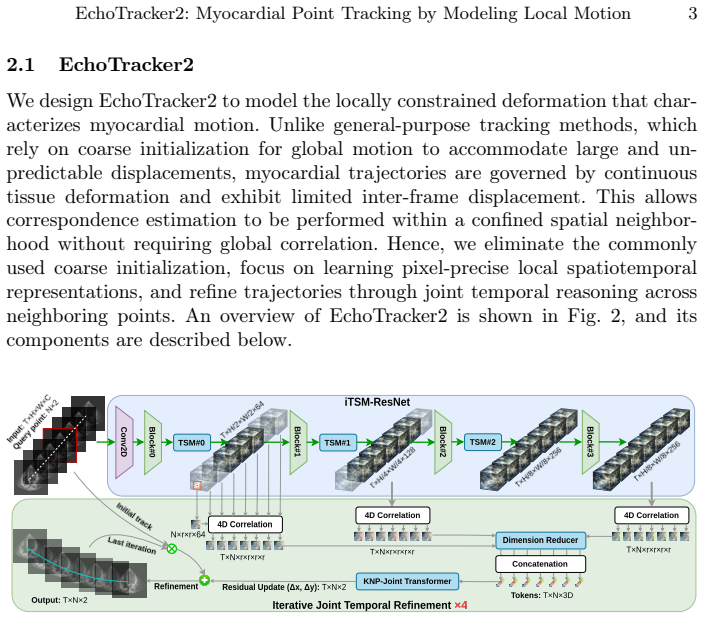
Myocardial motion arises from physiologically constrained deformation that is spatially and temporally continuous, so coarse initialization in two-stage trackers is unnecessary. EchoTracker2 therefore employs a fine-stage-only architecture that enriches pixel-precise features with local spatiotemporal context and integrates them with long-range joint temporal reasoning, delivering 6.5 percent better position accuracy and 12.2 percent lower median trajectory error than the domain-specific state-of-the-art model.
What carries the argument
A fine-stage-only tracking architecture that enriches pixel-precise features with local spatiotemporal context and integrates long-range joint temporal reasoning.
If this is right
- Higher agreement with expert-derived global longitudinal strain values.
- Improved test-retest reproducibility for repeated echocardiographic exams.
- Stronger generalization on out-of-distribution and synthetic cardiac datasets.
- Simpler inference pipelines without multi-stage processing overhead.
Where Pith is reading between the lines
- The same local-motion prior could apply to other constrained deformation tasks such as vessel wall tracking in ultrasound.
- Removing the coarse stage may lower memory and compute requirements at inference time.
- The approach might extend naturally to handling variable heart rates or mild pathologies if the local context window is adjusted.
Load-bearing premise
Myocardial motion stays sufficiently locally confined and continuous that coarse initialization adds no value and can be skipped.
What would settle it
A test set containing large discontinuous jumps in myocardial point positions between frames; if the fine-only model then produces higher errors than two-stage baselines, the central claim fails.
Figures

read the original abstract
Myocardial point tracking (MPT) has recently emerged as a promising direction for motion estimation in echocardiography, driven by advances in general-purpose point tracking methods. However, myocardial motion fundamentally differs from motion encountered in natural videos, as it arises from physiologically constrained deformation that is spatially and temporally continuous throughout the cardiac cycle. Consequently, motion trajectories typically remain locally confined despite substantial tissue deformation. Motivated by these properties, we revisit the architectural design for MPT and find that coarse initialization in commonly used two-stage coarse-to-fine architectures may be unnecessary in this domain. In this work, we propose a fine-stage-only architecture, \textbf{EchoTracker2}, which enriches pixel-precise features with local spatiotemporal context and integrates them with long-range joint temporal reasoning for robust tracking. Experimental results across in-distribution, out-of-distribution (OOD), and public synthetic datasets show that our model improves position accuracy by $6.5\%$ and reduces median trajectory error by $12.2\%$ relative to a domain-specific state-of-the-art (SOTA) model. Compared to the best general-purpose point tracking method, the improvements are $2.0\%$ and $5.3\%$, respectively. Moreover, EchoTracker2 shows better agreement with expert-derived global longitudinal strain (GLS) and enhances test-rest reproducibility. Source code will be available at: https://github.com/riponazad/ptecho.
Editorial analysis
A structured set of objections, weighed in public.
Referee Report
Summary. The manuscript proposes EchoTracker2, a fine-stage-only architecture for myocardial point tracking in echocardiography. Motivated by the claim that myocardial motion is physiologically constrained and locally confined, the authors argue that coarse initialization in standard two-stage coarse-to-fine trackers is unnecessary. EchoTracker2 enriches pixel-precise features with local spatiotemporal context and combines them with long-range joint temporal reasoning. Experiments on in-distribution, out-of-distribution, and public synthetic datasets report 6.5% higher position accuracy and 12.2% lower median trajectory error versus a domain-specific SOTA, plus 2.0% and 5.3% gains over the best general-purpose tracker, with improved agreement to expert GLS and better test-retest reproducibility. Code release is promised.
Significance. If the performance gains can be shown to arise specifically from the fine-stage-only design rather than from other modeling choices, the work would offer a useful simplification for echocardiography tracking by exploiting domain-specific motion properties. The planned code release would aid reproducibility. At present the central claims rest on aggregate percentage improvements whose attribution remains unverified.
major comments (2)
- [Abstract / §4] Abstract and §4 (Experimental Results): the reported 6.5% position-accuracy and 12.2% median-trajectory-error gains are presented without naming the exact domain-specific SOTA baseline, without statistical significance tests, without data-split details, and without per-sequence error distributions, rendering the central performance claim only partially verifiable.
- [Introduction / Method] Introduction and Method sections: the architectural claim that coarse initialization is unnecessary rests on the local-confinement property of myocardial motion, yet no controlled ablation is reported that adds a coarse stage to the identical EchoTracker2 feature extractor and temporal-reasoning module. Without this comparison it is impossible to isolate whether the observed gains derive from the absence of coarse initialization or from the spatiotemporal enrichment and joint temporal reasoning.
minor comments (1)
- [Abstract] Abstract: the phrase 'a domain-specific state-of-the-art (SOTA) model' is used without citation or explicit model name, which should be supplied for clarity.
Simulated Author's Rebuttal
We thank the referee for the constructive feedback. We address each major comment below and describe the revisions we will incorporate to improve verifiability and strengthen the central claims.
read point-by-point responses
-
Referee: [Abstract / §4] Abstract and §4 (Experimental Results): the reported 6.5% position-accuracy and 12.2% median-trajectory-error gains are presented without naming the exact domain-specific SOTA baseline, without statistical significance tests, without data-split details, and without per-sequence error distributions, rendering the central performance claim only partially verifiable.
Authors: We agree that the current presentation leaves the performance claims only partially verifiable. In the revised manuscript we will (i) explicitly name the domain-specific SOTA baseline (EchoTracker) in both the abstract and §4, (ii) report statistical significance tests (paired Wilcoxon signed-rank tests with p-values) for the reported improvements, (iii) detail the data splits (patient-wise 70/15/15 partitioning), and (iv) add per-sequence error distributions via box plots and cumulative error curves. revision: yes
-
Referee: [Introduction / Method] Introduction and Method sections: the architectural claim that coarse initialization is unnecessary rests on the local-confinement property of myocardial motion, yet no controlled ablation is reported that adds a coarse stage to the identical EchoTracker2 feature extractor and temporal-reasoning module. Without this comparison it is impossible to isolate whether the observed gains derive from the absence of coarse initialization or from the spatiotemporal enrichment and joint temporal reasoning.
Authors: We acknowledge that a controlled ablation isolating the contribution of the fine-stage-only design is currently absent. In the revision we will add this experiment: we will attach a coarse initialization stage (identical to the one used in standard two-stage trackers) to the same EchoTracker2 feature extractor and joint temporal reasoning module, train it under the same protocol, and directly compare tracking accuracy and trajectory error against the fine-stage-only version to attribute the gains. revision: yes
Circularity Check
No circularity; claims rest on experimental comparisons to external baselines
full rationale
The manuscript proposes a fine-stage-only architecture motivated by the domain property that myocardial trajectories remain locally confined. This motivation is stated as an assumption and is not derived from any equation or prior result within the paper. All performance claims (6.5% position accuracy, 12.2% trajectory error) are obtained by direct comparison against independently published SOTA models on held-out datasets; no parameter is fitted to a subset and then renamed as a prediction, no self-citation supplies a uniqueness theorem, and no ansatz is smuggled in. The derivation chain therefore terminates in external benchmarks rather than reducing to quantities defined by the authors' own fitted values or prior work.
Axiom & Free-Parameter Ledger
axioms (1)
- domain assumption Myocardial motion arises from physiologically constrained deformation that is spatially and temporally continuous throughout the cardiac cycle.
Reference graph
Works this paper leans on
-
[1]
In: International Conference on Medical Image Computing and Computer-Assisted Intervention
Azad, M.A., Chernyshov, A., Nyberg, J., Tveten, I., Lovstakken, L., Dalen, H., Grenne, B., Østvik, A.: Echotracker: Advancing myocardial point tracking in echocardiography. In: International Conference on Medical Image Computing and Computer-Assisted Intervention. pp. 645–655. Springer (2024)
work page 2024
-
[2]
In: 2025 IEEE/CVF International Conference on Computer Vision Workshops (IC- CVW)
Azad, M.A., Nyberg, J., Dalen, H., Grenne, B., Lovstakken, L., Østvik, A.: Taming modern point tracking for speckle tracking echocardiography via impartial motion. In: 2025 IEEE/CVF International Conference on Computer Vision Workshops (IC- CVW). pp. 1115–1124 (2025)
work page 2025
-
[3]
The Journal of thoracic and cardiovascular surgery136(3), 578–589 (2008)
Buckberg, G., Mahajan, A., Saleh, S., Hoffman, J.I., Coghlan, C.: Structure and function relationships of the helical ventricular myocardial band. The Journal of thoracic and cardiovascular surgery136(3), 578–589 (2008)
work page 2008
-
[4]
IEEE Access13, 186992–187004 (2025)
Chernyshov, A., Nyberg, J., Holmstrøm, V., Azad, M.A., Grenne, B., Dalen, H., Aase, S.A., Lovstakken, L., Østvik, A.: Low complexity point tracking of the my- ocardium in 2d echocardiography. IEEE Access13, 186992–187004 (2025)
work page 2025
-
[5]
In: European conference on computer vision
Cho, S., Huang, J., Nam, J., An, H., Kim, S., Lee, J.Y.: Local all-pair correspon- dence for point tracking. In: European conference on computer vision. pp. 306–325. Springer (2024)
work page 2024
-
[6]
JACC: Cardiovascular Imaging8(12), 1444–1460 (2015)
Claus, P., Omar, A.M.S., Pedrizzetti, G., Sengupta, P.P., Nagel, E.: Tissue tracking technology for assessing cardiac mechanics: principles, normal values, and clinical applications. JACC: Cardiovascular Imaging8(12), 1444–1460 (2015)
work page 2015
-
[7]
Myocardial imaging: tissue Doppler and speckle tracking pp
D’hooge, J.: Principles and different techniques for speckle tracking. Myocardial imaging: tissue Doppler and speckle tracking pp. 17–25 (2007)
work page 2007
-
[8]
Advances in Neural Information Processing Systems (NeurIPS)35, 13610–13626 (2022)
Doersch,C.,Gupta,A.,Markeeva,L.,Recasens,A.,Smaira,L.,Aytar,Y.,Carreira, J.,Zisserman,A.,Yang,Y.:Tap-vid:Abenchmarkfortrackinganypointinavideo. Advances in Neural Information Processing Systems (NeurIPS)35, 13610–13626 (2022)
work page 2022
-
[9]
In: Proceedings of the IEEE/CVF International Conference on Computer Vision (ICCV)
Doersch, C., Yang, Y., Vecerik, M., Gokay, D., Gupta, A., Aytar, Y., Carreira, J., Zisserman, A.: Tapir: Tracking any point with per-frame initialization and tem- poral refinement. In: Proceedings of the IEEE/CVF International Conference on Computer Vision (ICCV). pp. 10061–10072 (2023)
work page 2023
-
[10]
IEEE transactions on medical imaging41(8), 1911–1924 (2022) 10 M
Evain, E., Sun, Y., Faraz, K., Garcia, D., Saloux, E., Gerber, B.L., De Craene, M., Bernard, O.: Motion estimation by deep learning in 2d echocardiography: synthetic dataset and validation. IEEE transactions on medical imaging41(8), 1911–1924 (2022) 10 M. A. Azad et al
work page 1911
-
[11]
In: Pro- ceedings of the IEEE/CVF International Conference on Computer Vision (ICCV)
Karaev, N., Makarov, Y., Wang, J., Neverova, N., Vedaldi, A., Rupprecht, C.: Co- tracker3: Simpler and better point tracking by pseudo-labelling real videos. In: Pro- ceedings of the IEEE/CVF International Conference on Computer Vision (ICCV). pp. 6013–6022 (2025)
work page 2025
-
[12]
In: Proceedings of the IEEE/CVF international conference on computer vision
Lin, J., Gan, C., Han, S.: Tsm: Temporal shift module for efficient video under- standing. In: Proceedings of the IEEE/CVF international conference on computer vision. pp. 7083–7093 (2019)
work page 2019
-
[13]
Advances in neural information pro- cessing systems30(2017)
Vaswani,A.,Shazeer,N.,Parmar,N.,Uszkoreit,J.,Jones,L.,Gomez,A.N.,Kaiser, Ł., Polosukhin, I.: Attention is all you need. Advances in neural information pro- cessing systems30(2017)
work page 2017
-
[14]
In: Proceedings of the IEEE/CVF International Conference on Computer Vision (ICCV)
Zheng, Y., Harley, A.W., Shen, B., Wetzstein, G., Guibas, L.J.: Pointodyssey: A large-scale synthetic dataset for long-term point tracking. In: Proceedings of the IEEE/CVF International Conference on Computer Vision (ICCV). pp. 19855– 19865 (2023)
work page 2023
-
[15]
Medical image analysis14(3), 429–448 (2010)
Zhu, Y., Papademetris, X., Sinusas, A.J., Duncan, J.S.: A coupled deformable model for tracking myocardial borders from real-time echocardiography using an incompressibility constraint. Medical image analysis14(3), 429–448 (2010)
work page 2010
discussion (0)
Sign in with ORCID, Apple, or X to comment. Anyone can read and Pith papers without signing in.