Recognition: no theorem link
Zeno-Enhanced Probabilistic Error Cancellation with Quantum Error Detection Codes
Pith reviewed 2026-05-13 04:02 UTC · model grok-4.3
The pith
Post-selection from quantum error detection weakens physical noise into a logical channel that probabilistic error cancellation can invert with far lower overhead.
A machine-rendered reading of the paper's core claim, the machinery that carries it, and where it could break.
Core claim
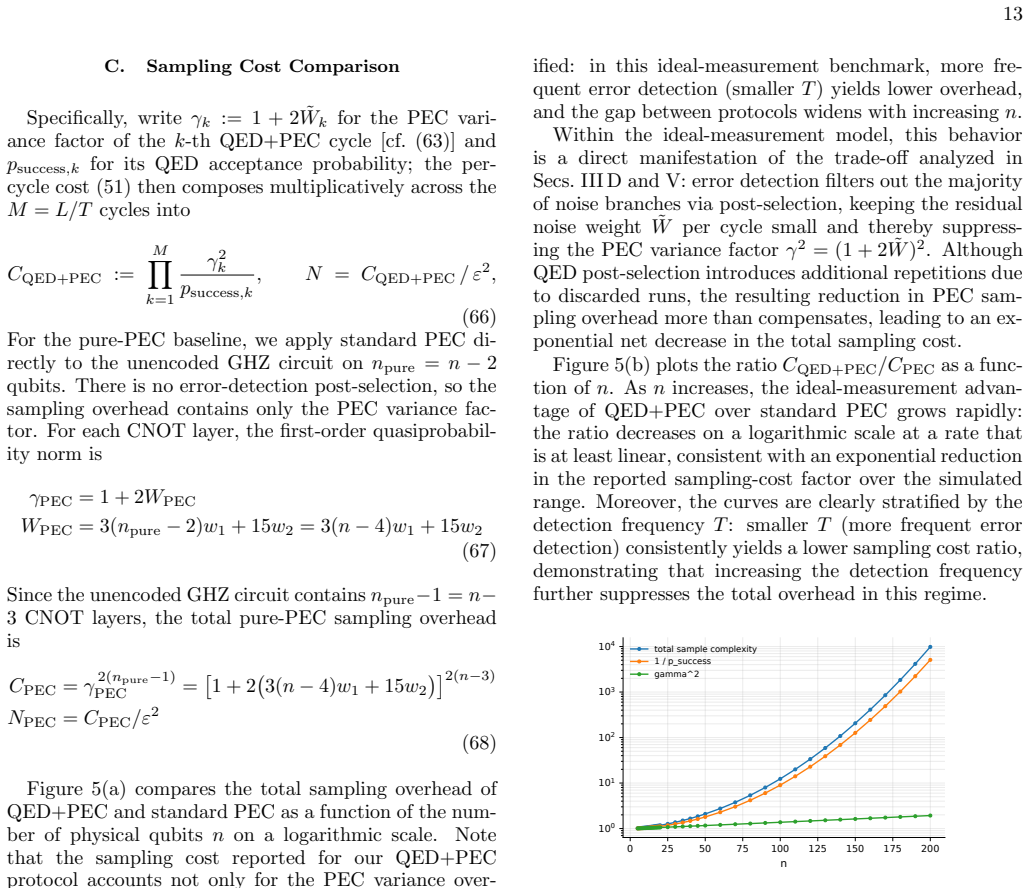
By mapping physical faults to a weaker accepted logical channel via post-selection and then constructing a degree-K perturbative inverse of the normalized post-selected channel, the QED+PEC protocol cancels errors up to O(W^{K+1}) per block with linear accumulation across the circuit; for first-order application to logical GHZ preparation under the Iceberg code this yields n=200 physical qubits at F approximately 0.956 while cutting sampling cost by three to four orders relative to standard PEC.
What carries the argument
The order-K perturbative inverse of the normalized post-selected logical channel, which retains only accepted fault branches up to weight K and thereby replaces the exponential 2^m preprocessing of bare PEC with O(m^K) cost per block.
If this is right
- First-order QED+PEC reaches 200 physical qubits for logical GHZ preparation at fidelity approximately 0.956.
- Sampling overhead drops by three to four orders of magnitude compared with standard PEC.
- Readout-only measurement flips mainly raise the post-selection discard rate, whereas noise in global stabilizer extraction can erase the overhead reduction.
- Error after cancellation accumulates linearly with circuit blocks rather than exponentially.
- The scheme works without active recovery or real-time decoding.
Where Pith is reading between the lines
- The same post-selection reshaping could be applied to other distance-2 detecting codes to test whether the overhead reduction generalizes beyond the Iceberg construction.
- Frequent cheap detections may allow mitigation of deeper circuits by repeatedly resetting the effective noise spectrum before cancellation.
- Hardware experiments with noisy stabilizers would directly test whether the ideal-measurement advantage survives or whether global extraction noise dominates the cost.
- The linear accumulation bound suggests the method could be stacked with other mitigation layers without immediate exponential blow-up.
Load-bearing premise
Stabilizer measurements are perfect and introduce no additional noise, while the chosen perturbative order fully captures the post-selected channel so that higher-order contributions remain negligible.
What would settle it
Simulate or execute the first-order protocol for n=100 qubits on a device with realistic noisy stabilizer extraction and measure whether the observed fidelity remains near 0.956 and whether the sampling overhead stays three orders below bare PEC.
Figures



read the original abstract
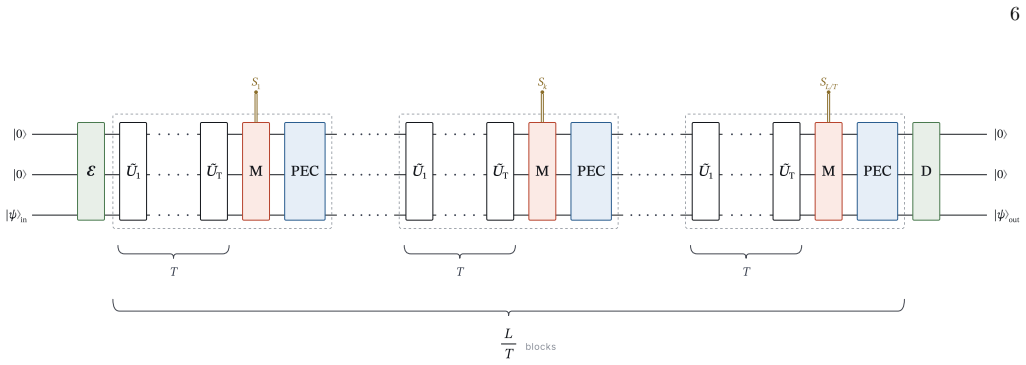
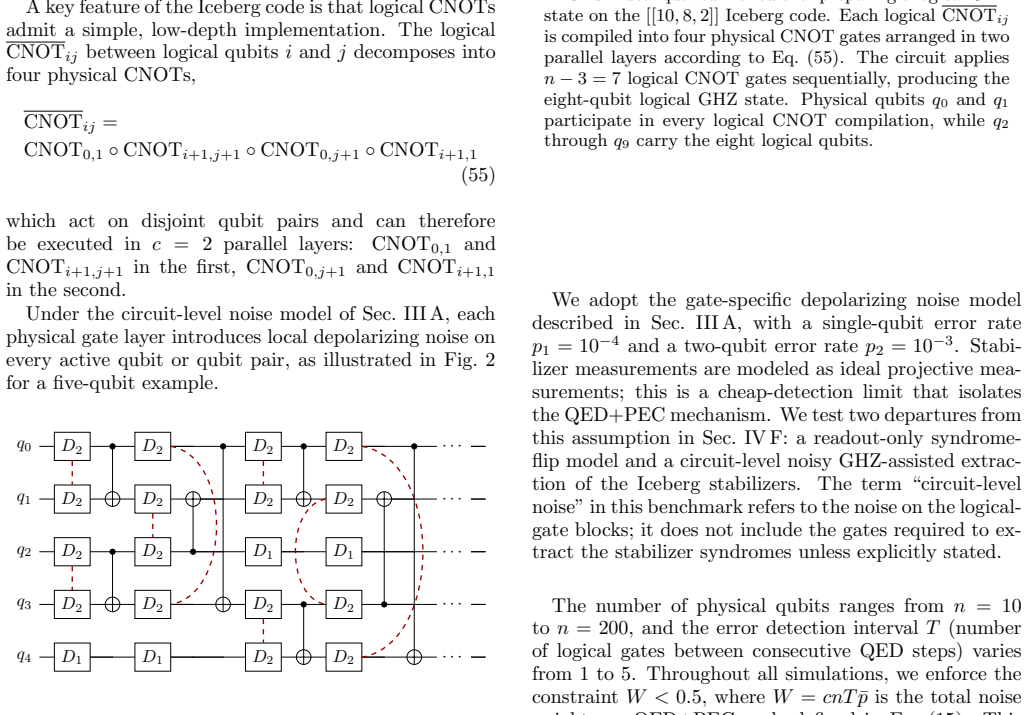
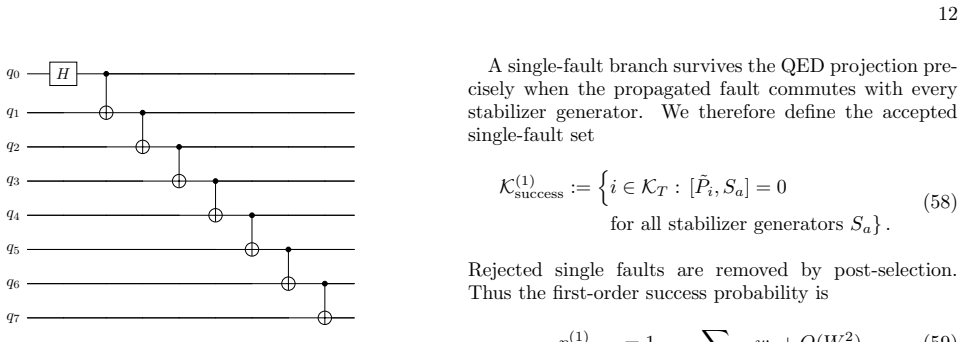
Probabilistic error cancellation (PEC) is unbiased but suffers exponential sampling overhead set by noise-weighted circuit volume, whereas quantum error-detecting codes (QEDCs) remove many physical faults by stabilizer post-selection but leave an undetectable logical residue. We exploit this complementarity by using post-selection to map physical noise to a weaker accepted logical channel, and then applying PEC only to the residual channel. The resulting feedback-free QED+PEC scheme interleaves Clifford logical blocks, stabilizer measurements, post-selection, and probabilistic cancellation on accepted trajectories, without real-time decoding or active recovery. A key complication is that post-selection correlates accepted fault branches through stabilizer-commutation constraints, so the sparse Pauli-Lindblad factorization underlying bare PEC no longer applies directly. We therefore construct the inverse channel perturbatively: for fixed order $K$, only accepted fault branches up to order $K$ are retained, reducing preprocessing from $2^m$ branches to $O(m^K)$ per block. The order-$K$ protocol cancels the normalized post-selected channel through degree $K$, leaving a per-block error $O(W^{K+1})$ that accumulates at most linearly. For logical GHZ-state preparation with the $[[n,n-2,2]]$ Iceberg code under circuit-level depolarizing noise and ideal stabilizer measurements, first-order QED+PEC reaches $n=200$ physical qubits and lowers sampling overhead by three to four orders of magnitude relative to standard PEC while maintaining $F\simeq0.956$. Syndrome-noise tests show that readout-only flips mainly increase post-selection cost, whereas noisy GHZ-assisted global stabilizer extraction can remove the advantage. This identifies a discrete-Zeno trade-off: cheap detection reshapes the effective channel PEC must invert, rather than simply adding overhead.
Editorial analysis
A structured set of objections, weighed in public.
Referee Report
Summary. The manuscript proposes a hybrid Zeno-enhanced probabilistic error cancellation (QED+PEC) protocol that combines quantum error-detecting codes with PEC. Post-selection on stabilizer measurements maps physical noise to a weaker accepted logical channel; a perturbative order-K inverse is then constructed for the residual normalized post-selected channel by retaining only accepted fault branches up to weight K. This yields a per-block residual error O(W^{K+1}) claimed to accumulate linearly. For logical GHZ-state preparation with the [[n,n-2,2]] Iceberg code under circuit-level depolarizing noise and ideal stabilizer measurements, first-order (K=1) QED+PEC is reported to reach n=200 physical qubits with fidelity F≃0.956 while reducing sampling overhead by three to four orders of magnitude relative to standard PEC.
Significance. If the perturbative construction and linear accumulation bound hold, the work offers a concrete route to lower the exponential sampling cost of PEC by leveraging error detection to reshape the effective channel. The explicit simulation numbers for n=200, the identification of a discrete-Zeno trade-off between detection cost and residual channel strength, and the reproducible numerical protocol constitute clear strengths. The approach is complementary to existing mitigation techniques and could inform hybrid strategies for near-term logical operations.
major comments (2)
- [Abstract and §4] Abstract and §4 (numerical results): The headline claim that first-order QED+PEC reaches n=200 with F≃0.956 and 3–4 orders overhead reduction rests on the order-K=1 perturbative inverse exactly canceling the normalized post-selected channel through degree 1. The full derivation of this inverse, the normalization step, and the explicit error accumulation bound under stabilizer-commutation correlations are not visible; without them the O(W^2) per-block residual and linear accumulation across blocks cannot be verified for the reported parameters.
- [§3] §3 (theoretical construction): Post-selection correlates accepted fault branches via stabilizer-commutation constraints, breaking the sparse Pauli-Lindblad factorization used in bare PEC. The manuscript replaces it with a truncated expansion retaining only weight ≤K branches, reducing preprocessing to O(m^K). No explicit bound or numerical check on the truncation error is provided to confirm that higher-order terms remain negligible enough not to invalidate the linear accumulation bound when many logical blocks are composed at n=200 under circuit-level depolarizing noise.
minor comments (2)
- [§2] The Iceberg code stabilizer definitions and the precise form of the accepted logical channel after post-selection would benefit from an expanded notation table or small example for n=4.
- [Figure 3] Figure captions for the overhead-vs-n plots should explicitly state the number of Monte Carlo samples used to obtain the reported F values.
Simulated Author's Rebuttal
We thank the referee for the careful reading, positive assessment of the approach's potential, and constructive feedback. We address each major comment below with clarifications and commit to revisions that will make the derivations, normalization, and bounds fully explicit and verifiable while preserving the reported numerical results.
read point-by-point responses
-
Referee: [Abstract and §4] Abstract and §4 (numerical results): The headline claim that first-order QED+PEC reaches n=200 with F≃0.956 and 3–4 orders overhead reduction rests on the order-K=1 perturbative inverse exactly canceling the normalized post-selected channel through degree 1. The full derivation of this inverse, the normalization step, and the explicit error accumulation bound under stabilizer-commutation correlations are not visible; without them the O(W^2) per-block residual and linear accumulation across blocks cannot be verified for the reported parameters.
Authors: We agree that the explicit form of the order-1 inverse, the normalization (post-selection probability factor), and the accumulation bound should be derived in full detail to allow independent verification. Section 3 outlines the perturbative truncation to accepted branches of weight ≤K and states that the normalized post-selected channel is canceled through degree K, but the algebraic steps are condensed. In the revision we will add an appendix containing: (i) the explicit construction of the order-K inverse operator for the normalized channel, (ii) the normalization step, and (iii) a proof sketch showing that, under the stabilizer-commutation constraints, the residual per-block error is O(W^{K+1}) and accumulates at most linearly across independent blocks. This will directly substantiate the K=1, n=200 claims. The existing simulations already implement this protocol; we will also include a small-system numerical check confirming the bound. revision: yes
-
Referee: [§3] §3 (theoretical construction): Post-selection correlates accepted fault branches via stabilizer-commutation constraints, breaking the sparse Pauli-Lindblad factorization used in bare PEC. The manuscript replaces it with a truncated expansion retaining only weight ≤K branches, reducing preprocessing to O(m^K). No explicit bound or numerical check on the truncation error is provided to confirm that higher-order terms remain negligible enough not to invalidate the linear accumulation bound when many logical blocks are composed at n=200 under circuit-level depolarizing noise.
Authors: The referee correctly identifies that post-selection introduces correlations that invalidate the standard sparse Pauli-Lindblad factorization. Section 3 replaces it with the weight-≤K truncation, which cancels the normalized channel through degree K and leaves an O(W^{K+1}) residual. While the manuscript argues this residual is negligible for the weak-noise regime used in the simulations, we acknowledge that an explicit general bound on the truncation error and additional numerical checks for the n=200 regime are not supplied. In the revision we will add: (i) a perturbative estimate of the truncation error under circuit-level depolarizing noise, and (ii) numerical results for intermediate block counts (n=20–50) that verify linear accumulation of the residual and confirm higher-order contributions remain below the reported fidelity threshold at n=200. These additions will substantiate that the truncation does not invalidate the linear bound for the simulated parameters. revision: yes
Circularity Check
Order-K cancellation and linear accumulation hold by construction of the truncated perturbative inverse
specific steps
-
self definitional
[Abstract]
"We therefore construct the inverse channel perturbatively: for fixed order K, only accepted fault branches up to order K are retained... The order-K protocol cancels the normalized post-selected channel through degree K, leaving a per-block error O(W^{K+1}) that accumulates at most linearly."
The inverse is explicitly defined to retain and invert only branches up to order K. The cancellation through degree K is therefore true by the definition of the retained terms in the perturbative expansion, not by a separate mathematical derivation or numerical confirmation independent of that truncation choice.
full rationale
The paper's central technical step defines the inverse channel by retaining only fault branches up to order K in the post-selected noise model. The claim that this cancels the normalized channel through degree K (leaving O(W^{K+1}) per block that accumulates linearly) therefore follows directly from the definition rather than from an independent derivation or external verification. The reported performance numbers (n=200, overhead reduction, F≈0.956) are presented as consequences of applying this constructed inverse under the stated noise model and ideal measurements. No self-citations, fitted parameters, or ansatzes imported from prior work are required for the reduction; the construction itself supplies the cancellation property.
Axiom & Free-Parameter Ledger
free parameters (1)
- truncation order K
axioms (2)
- domain assumption Stabilizer measurements are ideal and noiseless
- domain assumption Circuit-level depolarizing noise model
Reference graph
Works this paper leans on
-
[1]
Readout-only syndrome flips We first isolate the effect of classical syndrome-record errors. After each otherwise ideal stabilizer measure- ment, each reported outcome is flipped independently with probabilityp m. The first-order PEC table is un- changed. This model is a diagnostic that separates false rejection from false acceptance; it is not a full ext...
-
[2]
Circuit-level noisy GHZ-assisted extraction The readout-only model above does not capture the main physical cost of measuring the Iceberg stabilizers, becauseX ⊗n andZ ⊗n are global checks. We therefore 17 10 5 10 4 10 3 pm 0.75 0.80 0.85 0.90 0.95 1.00 Fidelity, T = 1 10 5 10 4 10 3 pm T = 2 10 5 10 4 10 3 pm T = 3 10 5 10 4 10 3 pm T = 4 10 5 10 4 10 3 ...
-
[3]
Quantum Computing in the NISQ era and beyond,
J. Preskill, “Quantum Computing in the NISQ era and beyond,” Quantum2, 79 (2018)
work page 2018
-
[4]
Early fault-tolerant quantum computing,
A. Katabarwa, K. Gratsea, A. Caesura, and P. D. John- son, “Early fault-tolerant quantum computing,” PRX quantum5, 020101 (2024)
work page 2024
-
[5]
Evidence for the utility of quan- tum computing before fault tolerance,
Y. Kim, A. Eddins, S. Anand, K. X. Wei, E. Van Den Berg, S. Rosenblatt, H. Nayfeh, Y. Wu, M. Zale- tel, K. Temme,et al., “Evidence for the utility of quan- tum computing before fault tolerance,” Nature618, 500 (2023)
work page 2023
-
[6]
Suppressing quantum errors by scaling a surface code logical qubit,
Google Quantum AI, “Suppressing quantum errors by scaling a surface code logical qubit,” Nature614, 676 (2023)
work page 2023
-
[7]
Quantum er- ror correction below the surface code threshold,
Google Quantum AI and Collaborators, “Quantum er- ror correction below the surface code threshold,” Nature 638, 920 (2025)
work page 2025
-
[8]
Non-abelian topo- logical order and anyons on a trapped-ion processor,
M. Iqbal, N. Tantivasadakarn, R. Verresen, S. L. Camp- bell, J. M. Dreiling, C. Figgatt, J. P. Gaebler, J. Jo- hansen, M. Mills, S. A. Moses,et al., “Non-abelian topo- logical order and anyons on a trapped-ion processor,” Nature626, 505 (2024)
work page 2024
-
[9]
Logical quantum processor based on reconfigurable atom arrays,
D. Bluvstein, S. J. Evered, A. A. Geim, S. H. Li, H. Zhou, T. Manovitz, S. Ebadi, M. Cain, M. Kalinowski, D. Hangleiter,et al., “Logical quantum processor based on reconfigurable atom arrays,” Nature626, 58 (2024)
work page 2024
-
[10]
A fault-tolerant neutral-atom ar- chitecture for universal quantum computation,
D. Bluvstein, A. A. Geim, S. H. Li, S. J. Evered, J. P. Bonilla Ataides, G. Baranes, A. Gu, T. Manovitz, M. Xu, M. Kalinowski,et al., “A fault-tolerant neutral-atom ar- chitecture for universal quantum computation,” Nature 649, 39 (2026)
work page 2026
-
[11]
Theory of quantum error- correcting codes,
E. Knill and R. Laflamme, “Theory of quantum error- correcting codes,” Physical Review A55, 900 (1997)
work page 1997
-
[12]
Fault-tolerant quantum computation with constant error,
D. Aharonov and M. Ben-Or, “Fault-tolerant quantum computation with constant error,” inProceedings of the twenty-ninth annual ACM symposium on Theory of com- puting(1997) pp. 176–188
work page 1997
-
[13]
Resilient quantum computation: error models and thresholds,
E. Knill, R. Laflamme, and W. H. Zurek, “Resilient quantum computation: error models and thresholds,” Proceedings of the Royal Society of London. Series A: Mathematical, Physical and Engineering Sciences454, 365 (1998)
work page 1998
-
[14]
Fault-tolerant quantum computation,
P. W. Shor, “Fault-tolerant quantum computation,” in Proceedings of 37th conference on foundations of com- puter science(IEEE, 1996) pp. 56–65
work page 1996
-
[15]
Fault-tolerant quantum computation,
J. Preskill, “Fault-tolerant quantum computation,” In- troduction to quantum computation and information 213(1998)
work page 1998
-
[16]
Surface Codes: Towards Practical Large-Scale Quantum Computation,
A. G. Fowler, M. Mariantoni, J. M. Martinis, and A. N. Cleland, “Surface Codes: Towards Practical Large-Scale Quantum Computation,” Physical Review A86, 032324 (2012)
work page 2012
-
[17]
How to Factor 2048 Bit RSA Integers in 8 Hours Using 20 Million Noisy Qubits,
C. Gidney and M. Eker˚ a, “How to Factor 2048 Bit RSA Integers in 8 Hours Using 20 Million Noisy Qubits,” Quantum5, 433 (2021), arXiv:1905.09749 [quant-ph]
-
[18]
Z. Cai, R. Babbush, S. C. Benjamin, S. Endo, W. J. Hug- gins, Y. Li, J. R. McClean, and T. E. O’Brien, “Quantum error mitigation,” Reviews of Modern Physics95, 045005 (2023)
work page 2023
-
[19]
D. Aharonov, O. Alberton, I. Arad, Y. Atia, E. Bairey, Z. Brakerski, I. Cohen, O. Golan, I. Gurwich, O. Ken- neth,et al., “On the importance of error mitigation for quantum computation,” arXiv preprint arXiv:2503.17243 (2025)
-
[20]
Virtual distillation for quantum error mitiga- tion,
W. J. Huggins, S. McArdle, T. E. O’Brien, J. Lee, N. C. Rubin, S. Boixo, K. B. Whaley, R. Babbush, and J. R. McClean, “Virtual distillation for quantum error mitiga- tion,” Physical Review X11, 041036 (2021)
work page 2021
-
[21]
Error mitigation with clifford quantum-circuit data,
P. Czarnik, A. Arrasmith, P. J. Coles, and L. Cincio, “Error mitigation with clifford quantum-circuit data,” Quantum5, 592 (2021)
work page 2021
-
[22]
Scalable error mitigation for noisy quantum circuits produces competi- tive expectation values,
Y. Kim, C. J. Wood, T. J. Yoder, S. T. Merkel, J. M. Gambetta, K. Temme, and A. Kandala, “Scalable error mitigation for noisy quantum circuits produces competi- tive expectation values,” Nature Physics19, 752 (2023)
work page 2023
-
[23]
Low-Cost Error Mitigation by Symmetry Ver- ification,
X. Bonet-Monroig, R. Sagastizabal, M. Singh, and T. E. O’Brien, “Low-Cost Error Mitigation by Symmetry Ver- ification,” Physical Review A98, 062339 (2018)
work page 2018
-
[24]
Decoding Quantum Errors with Subspace Ex- pansions,
J. R. McClean, Z. Jiang, N. C. Rubin, R. Babbush, and H. Neven, “Decoding Quantum Errors with Subspace Ex- pansions,” Nature Communications11, 636 (2020)
work page 2020
-
[25]
Generalized Quantum Sub- space Expansion,
N. Yoshioka, H. Hakoshima, Y. Matsuzaki, Y. Tokunaga, Y. Suzuki, and S. Endo, “Generalized Quantum Sub- space Expansion,” Physical Review Letters129, 020502 (2022)
work page 2022
-
[26]
Error Miti- gation for Short-Depth Quantum Circuits,
K. Temme, S. Bravyi, and J. M. Gambetta, “Error Miti- gation for Short-Depth Quantum Circuits,” Physical Re- view Letters119, 180509 (2017)
work page 2017
-
[27]
Practical Quantum Error Mitigation for Near-Future Applications,
S. Endo, S. C. Benjamin, and Y. Li, “Practical Quantum Error Mitigation for Near-Future Applications,” Physical Review X8, 031027 (2018)
work page 2018
-
[28]
Funda- mental Limits of Quantum Error Mitigation,
R. Takagi, S. Endo, S. Minagawa, and M. Gu, “Funda- mental Limits of Quantum Error Mitigation,” npj Quan- tum Information8, 114 (2022)
work page 2022
-
[29]
Universal Sampling Lower Bounds for Quantum Error Mitigation,
R. Takagi, H. Tajima, and M. Gu, “Universal Sampling Lower Bounds for Quantum Error Mitigation,” Physical Review Letters131, 210602 (2023)
work page 2023
-
[30]
Exponentially Tighter Bounds on Limitations of Quantum Error Mitigation,
Y. Quek, D. Stilck Fran¸ ca, S. Khatri, J. J. Meyer, and J. Eisert, “Exponentially Tighter Bounds on Limitations of Quantum Error Mitigation,” Nature Physics20, 1648 (2024)
work page 2024
-
[31]
Stabilizer Codes and Quantum Error Correction
D. Gottesman,Stabilizer Codes and Quantum Error Cor- rection, Ph.D. thesis, California Institute of Technology (1997), arXiv:quant-ph/9705052 [quant-ph]
work page internal anchor Pith review Pith/arXiv arXiv 1997
-
[32]
Protecting Ex- pressive Circuits with a Quantum Error Detection Code,
C. N. Self, M. Benedetti, and D. Amaro, “Protecting Ex- pressive Circuits with a Quantum Error Detection Code,” Nature Physics20, 219 (2024)
work page 2024
-
[33]
Prescription for Exper- imental Determination of the Dynamics of a Quantum Black Box,
I. L. Chuang and M. A. Nielsen, “Prescription for Exper- imental Determination of the Dynamics of a Quantum Black Box,” Journal of Modern Optics44, 2455 (1997)
work page 1997
-
[34]
Quantum-Process Tomography: Resource Analysis of Different Strategies,
M. Mohseni, A. T. Rezakhani, and D. A. Lidar, “Quantum-Process Tomography: Resource Analysis of Different Strategies,” Physical Review A77, 032322 (2008)
work page 2008
-
[35]
Probabilistic Error Cancellation with Sparse Pauli–Lindblad Models on Noisy Quantum Processors,
E. van den Berg, Z. K. Minev, A. Kandala, and K. Temme, “Probabilistic Error Cancellation with Sparse Pauli–Lindblad Models on Noisy Quantum Processors,” Nature Physics19, 1116 (2023)
work page 2023
-
[36]
J. R. McClean, M. E. Kimchi-Schwartz, J. Carter, and W. A. de Jong, “Hybrid Quantum-Classical Hierarchy for Mitigation of Decoherence and Determination of Excited States,” Physical Review A95, 042308 (2017). 24
work page 2017
-
[37]
Improved Simulation of Stabilizer Circuits,
S. Aaronson and D. Gottesman, “Improved Simulation of Stabilizer Circuits,” Physical Review A70, 052328 (2004)
work page 2004
-
[38]
The Zeno’s Paradox in Quantum Theory,
B. Misra and E. C. G. Sudarshan, “The Zeno’s Paradox in Quantum Theory,” Journal of Mathematical Physics 18, 756 (1977)
work page 1977
-
[39]
W. M. Itano, D. J. Heinzen, J. J. Bollinger, and D. J. Wineland, “Quantum Zeno Effect,” Physical Review A 41, 2295 (1990)
work page 1990
-
[40]
Quantum zeno dynamics: mathematical and physical aspects,
P. Facchi and S. Pascazio, “Quantum zeno dynamics: mathematical and physical aspects,” Journal of Physics A: Mathematical and Theoretical41, 493001 (2008)
work page 2008
-
[41]
Error Mitigation for Universal Gates on Encoded Qubits,
C. Piveteau, D. Sutter, S. Bravyi, J. M. Gambetta, and K. Temme, “Error Mitigation for Universal Gates on Encoded Qubits,” Physical Review Letters127, 200505 (2021)
work page 2021
-
[42]
Y. Suzuki, S. Endo, K. Fujii, and Y. Tokunaga, “Quan- tum Error Mitigation as a Universal Error Reduction Technique: Applications from the NISQ to the Fault- Tolerant Quantum Computing Eras,” PRX Quantum3, 010345 (2022)
work page 2022
-
[43]
Combining Error Detection and Mitigation: A Hybrid Protocol for Near-Term Quantum Simulation,
D. Zhong, W. Munizzi, H. Chen, and W. A. de Jong, “Combining Error Detection and Mitigation: A Hybrid Protocol for Near-Term Quantum Simulation,” (2025), arXiv:2510.01181 [quant-ph]
-
[44]
Reduced Sampling Overhead for Probabilistic Error Cancellation by Pauli Error Propagation,
T. Scheiber, P. Haubenwallner, and M. Heller, “Reduced Sampling Overhead for Probabilistic Error Cancellation by Pauli Error Propagation,” Quantum9, 1840 (2025), arXiv:2412.01311 [quant-ph]
-
[45]
Scheme for Reducing Decoherence in Quan- tum Computer Memory,
P. W. Shor, “Scheme for Reducing Decoherence in Quan- tum Computer Memory,” Physical Review A52, R2493 (1995)
work page 1995
-
[46]
Good Quantum Error-Correcting Codes Exist,
A. R. Calderbank and P. W. Shor, “Good Quantum Error-Correcting Codes Exist,” Physical Review A54, 1098 (1996)
work page 1996
-
[47]
Error Correcting Codes in Quantum The- ory,
A. M. Steane, “Error Correcting Codes in Quantum The- ory,” Physical Review Letters77, 793 (1996)
work page 1996
-
[48]
Detecting bit-flip errors in a logical qubit using stabilizer measurements,
D. Riste, S. Poletto, M.-Z. Huang, A. Bruno, V. Vester- inen, O.-P. Saira, and L. DiCarlo, “Detecting bit-flip errors in a logical qubit using stabilizer measurements,” Nature communications6, 6983 (2015)
work page 2015
-
[49]
Noise tailoring for scal- able quantum computation via randomized compiling,
J. J. Wallman and J. Emerson, “Noise tailoring for scal- able quantum computation via randomized compiling,” Physical Review A94, 052325 (2016)
work page 2016
-
[50]
Co-Designing Error Mitigation and Error Detection for Logical Qubits
R. S. Kumar, T. Tsunoda, S. H. Xue, D. Li, R. J. Schoelkopf, and Y. Ding, “Co-Designing Error Mitiga- tion and Error Detection for Logical Qubits,” (2026), arXiv:2604.19871 [quant-ph]
work page internal anchor Pith review Pith/arXiv arXiv 2026
-
[51]
Statistical distance and the geometry of quantum states,
S. L. Braunstein and C. M. Caves, “Statistical distance and the geometry of quantum states,” Physical Review Letters72, 3439 (1994)
work page 1994
-
[52]
Optimal mea- surement on noisy quantum systems,
Y. Watanabe, T. Sagawa, and M. Ueda, “Optimal mea- surement on noisy quantum systems,” Physical review letters104, 020401 (2010). 25 APPENDIX CONTENTS A. Additional details for the algorithmic order-KQED+PEC construction 26
work page 2010
-
[53]
One-block notation 26
-
[54]
The algorithmic reduced channel is the Taylor truncation of the exact reduced channel 27
-
[55]
The implemented inverse is a formal inverse through orderK27
-
[56]
Perturbative scaling 27
- [57]
-
[58]
Depolarizing dynamics and single-round survival probability 29 b
Model A: QED+PEC 29 a. Depolarizing dynamics and single-round survival probability 29 b. Normalized post-selected state and the effective Pauli channel 30 c. Single-round PEC quasiprobability overhead 30 d. Total sample complexity afterT /τrounds 30 e. Combined result 31
-
[59]
Model B: Pure subspace PEC 31 a. Setup 31 b. Single-round PEC overhead 31 c. Total PEC complexity with periodic cancellation 32 d. Optimal single-shot PEC (τ=T) 32 C. Quantum Fisher Information Analysis 32 26 Appendix A: Additional details for the algorithmic order-KQED+PEC construction
-
[60]
LetKbe the set of independent physical Pauli fault locations
One-block notation We first work within one block and suppress the block labelm. LetKbe the set of independent physical Pauli fault locations. Each locationi∈ Koccurs with probabilityw i, and a subsetI⊆ Khas exact Bernoulli probability πI =w I Y j∈K\I (1−w j), w I := Y i∈I wi.(A1) After propagation through the Clifford block, the fault branch acts as a Pa...
-
[61]
(A5) is precisely Trunc ≤K[πI]
The algorithmic reduced channel is the Taylor truncation of the exact reduced channel Lemma 1(Identification of ˆNreduce).As a formal power series in the fault probabilities{w i}, ˆNreduce = Trunc≤K N exact reduce .(A10) Proof.For|I| ≤K, Eq. (A5) is precisely Trunc ≤K[πI]. If|I|> K, the exact branch probabilityπ I has total degree at least|I|> K, so Trunc...
-
[62]
The implemented inverse is a formal inverse through orderK Lemma 2(Formal inverse property).Let ˆNreduce = id +RK be defined by Eq.(A7). Then Trunc≤K h bN −1 K ◦ ˆNreduce i = id.(A14) Consequently, bN −1 K ◦ ˆNreduce −idhas no monomial of total degree0,1, . . . , K. Proof.The channelR K has no degree-zero term, because ˆNreduce is a trace-preserving Taylo...
-
[63]
LetW:= P i∈K wi and assume that the success probabilityp success stays bounded away from zero asW→0
Perturbative scaling This subsection proves Corollary 1. LetW:= P i∈K wi and assume that the success probabilityp success stays bounded away from zero asW→0. We estimate the three certificates separately. 28 a. Estimate forη K.Scale all fault probabilities by a single parametert, definingN exact reduce(t) :=N exact reduce({twi}). By Lemma 1, ˆNreduce = KX...
-
[64]
Implementation remarks The fixed-order construction is implemented using sparse branch tables rather than a full Pauli-channel table over the 4n Pauli group. 1.Sparse branch representation.Each retained branch is stored by its fault-label subsetI⊆ Kwith|I| ≤K, its polynomial coefficienta (K) I , and its propagated symplectic Pauli string ˜PI. The algorith...
-
[65]
Model A: QED+PEC a. Depolarizing dynamics and single-round survival probability Consider an initial pure stateρ 0 supported entirely on the code subspace, with projectorPsatisfying Tr(P) = 2 andP ρ 0P=ρ 0. The system evolves under a global depolarizing Lindbladian dρ dt =L(ρ) =γ Tr(ρ) N I−ρ ,(B1) whose exact solution over a time intervalτis ρ(τ) =e −γτ ρ0...
-
[66]
Inverting Eq. (B9): λ−1 = 1−p+ 2p N 1−p = 1 + 2 N p 1−p .(B10) Define the auxiliary variable x:= p 1−p =e γτ −1,(B11) where the last equality follows fromp= 1−e −γτ . Substituting into the PEC overhead: γPEC = 3 2 1 + 2 N x − 1 2 = 1 + 3 N eγτ −1 .(B12) d. Total sample complexity afterT /τrounds AfterT /τconsecutive rounds of noise-then-project, the total...
-
[67]
Model B: Pure subspace PEC a. Setup To provide a baseline for comparison, we now analyze a system that is restricted to the 2-dimensional physical qubit space, with no ancilla degrees of freedom and hence no possibility of error detection. The only error-mitigation tool available is PEC, applied periodically at intervalsτ. The depolarizing noise within th...
discussion (0)
Sign in with ORCID, Apple, or X to comment. Anyone can read and Pith papers without signing in.